Using event correlation and AI for Threat Detection and Incident Response
Unified Security Stack is a forward-looking Security Information and Event Management (SIEM) product that uses real-time correlation and artificial intelligence (AI) to detect advanced threats. The following is a detailed examination of how Unified Security Stack applies these technologies:
Real-Time Event Correlation
Within Unified Security Stack’s SIEM framework, the event correlation tool collects and examines log data from many network applications, systems, and devices. This examination is essential for revealing security threats and malicious behavior patterns in corporate networks that could otherwise go unnoticed. The process involves three main steps:
- DetectionDetecting and classifying events across the network.
- AnalysisExamining events for possible patterns that could point to a threat.
- ResponseActing appropriately in response to the patterns observed.
By combining machine intelligence with human expertise, Unified Security Stack improves the precision of this event correlation, acknowledging that neither method is fully adequate by itself.
Artificial Intelligence and Machine Learning
Unified Security Stack’s threat detection does not rely only on hardcoded correlation rules and signatures. Rather, it adjusts to its environment, creating tailored rules when necessary. This is where AI becomes relevant. The threat detection engine consists of rule-based correlation systems, scanners, and AI-powered machine learning algorithms that let the system learn from its surroundings. This ability to learn is vital for spotting unusual and potentially threatening activity.
The AI element is particularly skilled at addressing the constantly changing nature of cybersecurity threats, which are usually hard to foresee. Through machine learning algorithms, Unified Security Stack can identify most threats in real time, greatly improving an organization’s security posture.
Unified Security Stack’s Approach to Threat Detection
Unified Security Stack uses a variety of technologies for its threat detection engine, including rule-based modules, scanners, and AI-powered machine learning algorithms. Depending on the situation, these modules can work separately or together to deliver accurate, real-time threat detection.
The Role of Logstash
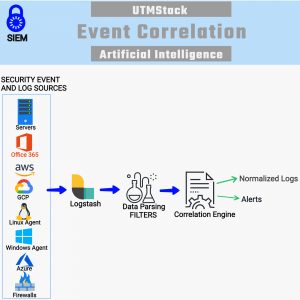
A key element of Unified Security Stack’s functionality is its reliance on Logstash, an open-source data collection engine that consolidates and normalizes data from different sources. Unified Security Stack uses Logstash to parse logs from sources such as firewalls, AWS, Office 365, and others. These logs are then handled through input, filter, and output plugins and forwarded to the Unified Security Stack correlation engine, where multiple rule-based correlations are used to produce alerts and normalized logs.
Significance of AI-Powered SIEM
In an environment where cyber threats are persistent and the landscape keeps changing, solutions such as Unified Security Stack’s AI-powered SIEM are extremely valuable. They automate threat detection and also support proactive incident response, strengthening an organization’s infrastructure and assets against possible cyber attacks.
In conclusion, Unified Security Stack demonstrates how AI and real-time event correlation can be combined to provide a strong and adaptable threat detection system. Its broad approach helps businesses, particularly small to midsize organizations, strengthen their cyber defenses against advanced and constantly evolving cyber threats.