
Detection Engineering: Build Robust Programs & Best
Your SOC likely possesses existing detections. However, many fail to function as managed security capabilities. Instead, they resemble a chaotic collection of alerts.
Analysts silence noisy rules to safeguard their workload. Engineers continue adding logic to address genuine coverage gaps. Leadership questions whether the program is advancing, yet receives weak responses. Alert volumes rise. Tuning requests accumulate. A rule that appeared robust last quarter ceases to trigger following a parser update, and this gap remains undisclosed until an incident review reveals it.
This is where detection engineering extends beyond simple query creation. It involves the discipline of constructing detections that are relevant, testable, maintainable, and operationally reliable. Successful teams do not merely generate alerts. They build a system that maintains detection health, resists drift, and mitigates the two issues that compromise most programs: silent failures and the precision trap.
Table of Contents
- What Is Detection Engineering and Why Does It Matter Now
- Understanding the Detection Engineering Lifecycle
- Building Effective Detections with Proven Patterns
- Avoiding Silent Failures with Rigorous Validation
- Key Metrics and KPIs for Your Detection Program
- Implementing Detection as Code with SIEM and SOAR
- Practical Best Practices and Next Steps
What Is Detection Engineering and Why Does It Matter Now
At 2:00 a.m., an analyst receives an alert regarding suspicious PowerShell activity on a finance workstation. The rule triggered because the command line matched a known pattern. By the time the case opens, the process has terminated, the parent-child relationship is absent from the event stream, and no one can determine if the alert indicates malicious execution or a software deployment script. The alert is technically accurate yet operationally insufficient.
Detection engineering exists to address that gap.
Detection engineering is the disciplined approach of converting threat behavior, business risk, and available telemetry into detection logic capable of withstanding real-world operations. It encompasses rule design, testing, deployment, tuning, ownership, and continuous review. A SIEM query is merely one component. The true task is creating detections that remain valuable as the environment evolves.
MITRE ATT&CK is widely utilized for this purpose because it provides teams with a common framework for mapping attacker behavior to observable events, rather than depending on ad hoc alert concepts. The benefit lies not in the framework itself, but in the shared language it establishes among detection authors, threat hunters, incident responders, and leadership.
In many SOCs, alert fatigue stems not solely from telemetry volume. It arises from weak logic replicated across numerous systems, combined with detections that continue running long after their underlying assumptions have become invalid.
A weak program usually looks familiar:
- Too many vendor defaults: Generic rules trigger in environments for which they were never intended.
- No clear owner: Analysts triage alerts, but no one bears responsibility for ensuring the detection remains functional.
- Tuning without a detection hypothesis: Exclusions accumulate until the queue quiets down and the rule fails to observe the behavior it was designed to detect.
- Little feedback from investigations: Detection authors lack visibility into which alerts were helpful, which confused analysts, and which should never have triggered.
Practical rule: If an analyst cannot determine what to validate next, the detection is incomplete.
Detection engineering is increasingly critical because failures are often silent. Noisy rules attract attention. A broken parser, renamed field, missing log source, or over-tuned correlation can eliminate coverage without generating a visible problem ticket. Teams then report lower alert counts and assume quality has improved, when they have actually reduced visibility.
This is the precision trap. Teams pursue cleaner queues and higher precision, then tune away weak but useful signals that aid investigations. High-quality programs manage this trade-off directly. They tolerate some noise where threats are high value, and they verify whether a detection maintains coverage before deeming it mature.
The objective is not alert volume. The objective is reliable signal.
This alters the inquiries security teams make. Rather than counting rules, they assess if detections align with real attacker activity, if required telemetry is present and remains consistent, if alerts provide sufficient context for investigations, and if content remains useful following platform or schema modifications. Teams that build or improve threat detection and response solutions require that comprehensive operational view, not merely additional correlation logic.
Understanding the Detection Engineering Lifecycle
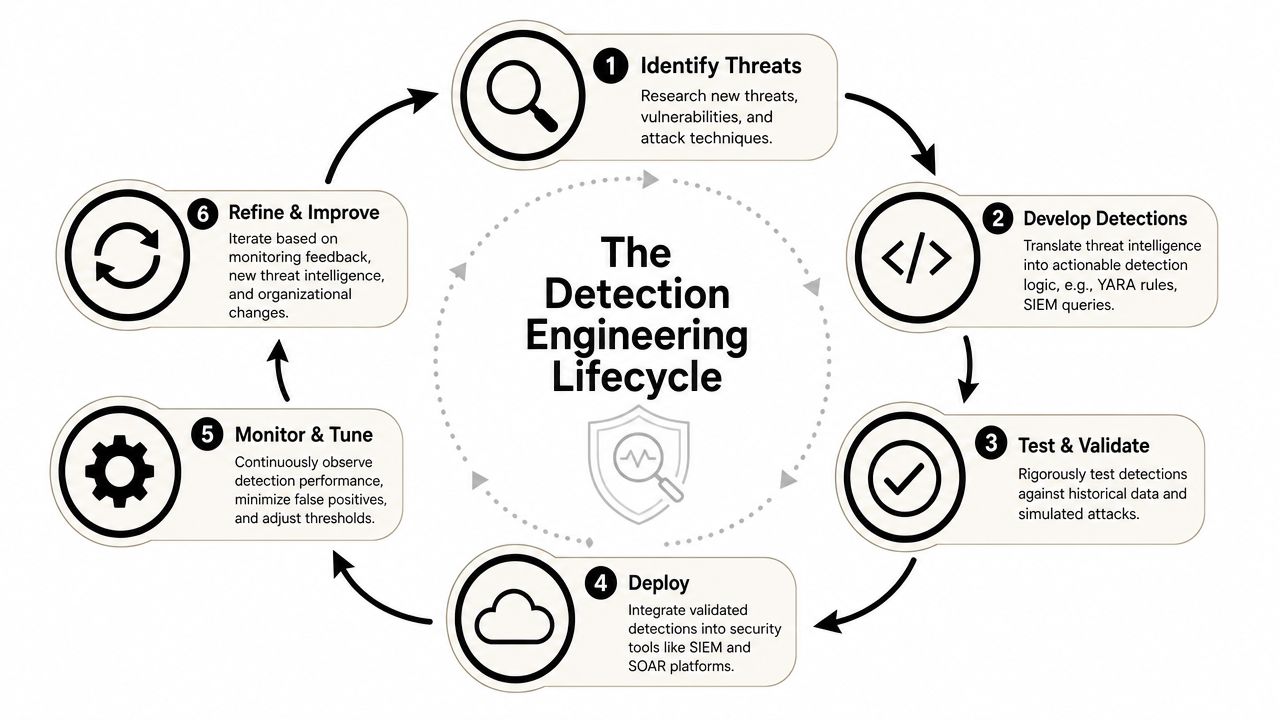
Detection engineering functions best when teams manage it as a software lifecycle, rather than a backlog of one-off requests. Splunk describes it as a cyclical, systems-thinking process that applies software engineering best practices, specifically CI/CD pipelines and Detection-as-Code, to write, test, and maintain threat detection logic (Splunk on detection engineering).
Why the lifecycle matters
The software analogy is valuable because detections fail for the same reasons software fails. Requirements are ambiguous. Inputs change. Testing is limited. Deployment is hurried. Maintenance is neglected.
Teams that manage detections as lifecycle assets typically achieve cleaner results than teams that treat rules as isolated content.
If you're evaluating platforms that operationalize this model, threat detection and response solutions must support the entire path from ingestion to correlation to validation feedback, not just alert generation.
The six stages in practice
Identify threats
Begin with threat modeling. This involves selecting adversary behaviors relevant to your environment, not just those that are easy to query.
In a healthcare setting, identity abuse and privileged access misuse may warrant greater focus than broad malware signatures. For a cloud-native team, suspicious API activity and anomalous workload behavior may take precedence. High-quality programs ground detection work in risk and attacker tradecraft.
Develop detections
Next, convert that threat model into logic. This may involve a SIEM correlation, endpoint analytic, identity rule, enrichment workflow, or scheduled hunt.
At this stage, engineers should define:
- What behavior is being detected
- Which log sources are required
- What the alert will contain
- What the likely false positive patterns are
- How an analyst should investigate it
Test and validate
Compiling successfully does not mean a rule works.
Teams require syntax checks, replay testing with known data, and controlled simulations when feasible. Validation must address two distinct questions. First, does the rule trigger when the behavior occurs? Second, does it generate enough context to support triage?
Alerts that fire without actionable context still generate analyst workload. They simply shift the burden to investigations rather than rule tuning.
Deploy
Deployments in production must be controlled, versioned, and reversible. Mature teams stage new detections, monitor them closely, and roll them out broadly only after verifying expected behavior.
Controlled deployment also involves tracking dependencies. If a rule relies on a parser, enrichment field, or normalization pipeline, those dependencies must be visible before production breaks them.
Monitor and tune
Many programs perform too little work or the wrong kind. Tuning is not merely suppressing false positives. It involves adjusting thresholds, improving entity mapping, enriching outputs, and verifying that the detection aligns with real workflows.
Refine and improve
Every investigation should inform the detection program. Analysts identify what was missing, what was ambiguous, and which clues were significant. Engineers should incorporate this feedback into the rule library so detections become more durable over time.
Building Effective Detections with Proven Patterns
At 2:00 a.m., an analyst opens a high-priority alert. A single suspicious process caused the rule to fire. Ten minutes into the investigation, that process turns out to be routine admin work hidden behind an odd command line. The alert was technically correct but operationally ineffective. Strong detection patterns close the distance between fired and useful.
Start with attacker behavior
Behavior provides detections with a stable foundation. Tools change, infrastructure rotates, and malware families are renamed, but attackers still need to execute, persist, move, and access valuable assets. As noted earlier, many teams leverage MITRE ATT&CK to anchor logic to these actions rather than isolated artifacts.
This is essential for resilience. Rules anchored in credential dumping behavior outlast those tied to a single hash or filename. They also offer analysts clearer rationale for alerts. Investigating “possible credential access from a non-admin host” is simpler than reviewing a “matched suspicious binary” alert.
Teams still writing logic directly in the SIEM console should shift toward reusable SIEM correlation rules That links related events into a single narrative. The aim is not more rules. The aim is rules that clarify why the activity matters.
Use multiple patterns for different jobs
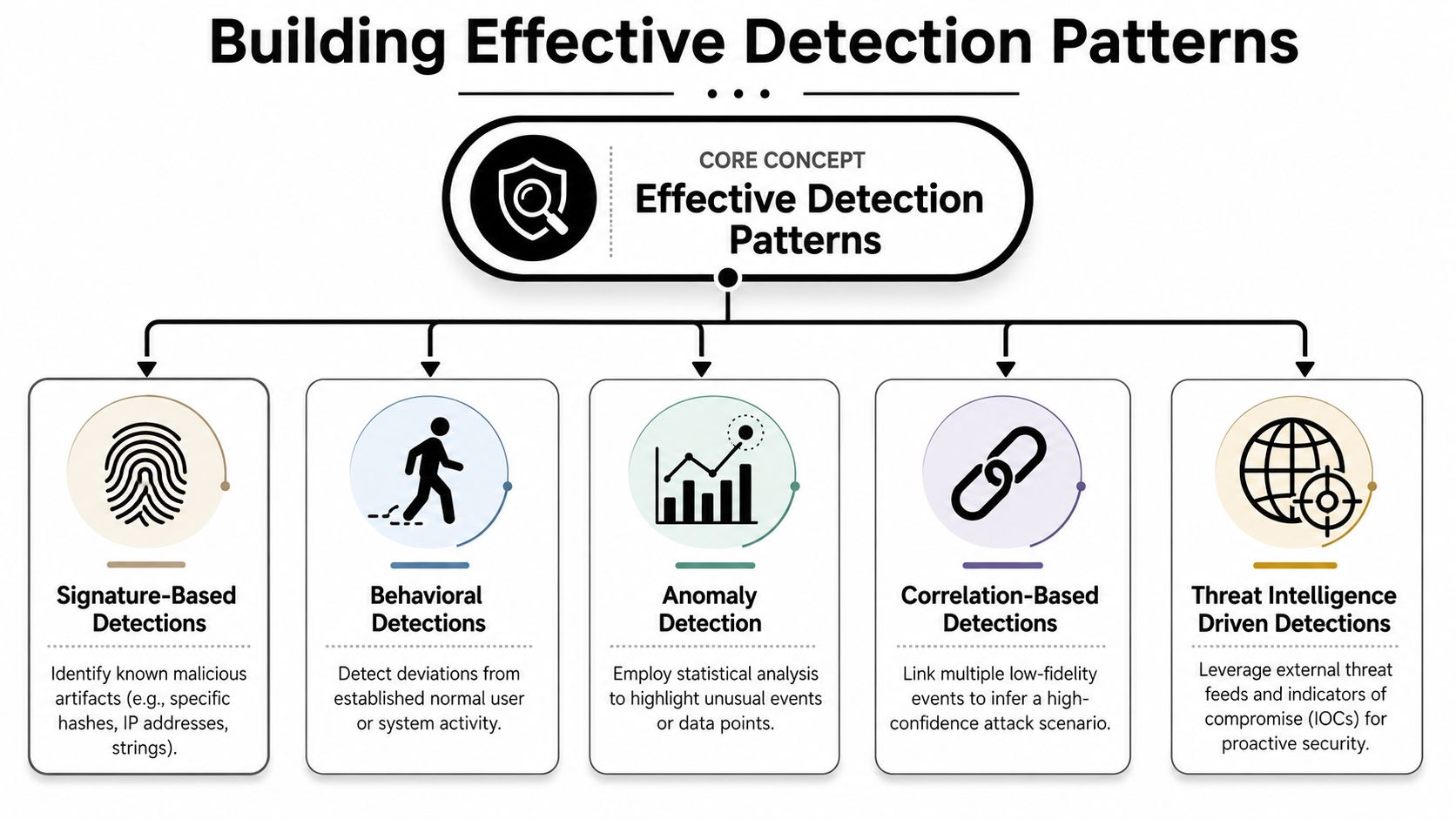
No single pattern supports a modern detection program. Signature logic is fast and inexpensive to execute. Behavioral logic handles attacker variation better. Correlation boosts confidence by combining weak signals. Anomaly logic can reveal unexpected activity, but only if baselines are reliable.
In plain terms, here is the trade-off.
| Pattern | Best use | Strength | Weakness |
|---|---|---|---|
| Signature-based | Known bad artifacts | Fast and simple | Brittle and easy to evade |
| Behavioral | Actions that reflect attacker tradecraft | More durable than indicators | Requires strong telemetry and context |
| Anomaly-based | Outlier activity | Useful for surfacing unknowns | Can generate noise without baselines |
| Correlation-based | Multi-step attack chains | Higher fidelity from combined signals | More engineering effort |
| Threat intelligence driven | External indicators and context | Helps prioritize known risk | Short-lived value if used alone |
The error lies in pursuing a perfect rule with zero false positives. This often results in narrow logic that appears precise in testing but fails to catch messy production variants. Robust programs employ multiple detection patterns together to ensure one brittle assumption does not create a blind spot.
Behavioral rules
Behavioral detections typically provide the most lasting value in a mature SOC. They focus on the attacker’s objectives, such as privilege escalation, defense evasion, or suspicious use of remote administration tools.
Engineering effort is the trade-off. Behavioral logic depends on normalized data, clean entity mapping, and enough alert context for triage. Without this, the rule may still fire, but the analyst has to manually piece the story together.
Statistical and anomaly logic
Anomaly logic performs best as a lead generator. It can highlight unusual login times, first-time administrative actions, or service relationships that deviate from known patterns.
Alone, it can overwhelm a queue with odd but harmless behavior. Combine it with stronger context, such as asset criticality, identity risk, or subsequent events. This transforms "unusual" into "worth investigating."
Correlation rules
Correlation is where detection engineering resembles system design rather than keyword matching. A single event rarely proves malicious activity. A sequence often does. A user disables logging, authenticates from a new host, and then accesses a sensitive system. Each step may be explainable individually. Together, they warrant attention.
Effective correlation also shields the program from the precision trap. If one event source becomes noisy or changes format, the broader pattern can remain intact if the rule is built around multiple signals and entities.
A practical approach to selecting patterns involves asking one initial question. Is this detection intended to confirm known bad activity, surface suspicious behavior for triage, or connect weak signals into a credible attack path? The answer should guide the design.
Programs in regulated environments already understand this discipline from adjacent work, including validating Microsoft 365 migrations, in which success hinges on demonstrating controls function under actual operating conditions, not just in tidy test scenarios. This perspective aids detection engineering. Design for production reality.
Avoiding Silent Failures with Rigorous Validation
A SOC reviews a week of low alert volume and assumes tuning is finally effective. Then an incident review reveals the attacker used a technique the team believed was covered. The rule did not fail due to a novel adversary. It failed because a parser changed, a field became null, or an exclusion outlasted the exception it was designed for.

Silent failure is one of the most difficult challenges in detection engineering since, from the queue, functioning and malfunctioning systems may appear identical. Neither generates much noise. Only one is safeguarding you.
Where silent failures come from
The common issue is over-tuning. Teams continuously narrow a rule to reduce analyst burden, and eventually the detection only works under the exact lab conditions it was built for. This is the precision trap. A rule can be highly selective yet operationally weak.
In practice, silent failures usually come from a small set of causes:
- Exclusion sprawl: Exceptions build up more quickly than they are reviewed.
- Schema drift: Field names, parsers, or enrichments change, and the rule still compiles but no longer evaluates the correct data.
- Data pipeline gaps: A connector fails, sampling changes, or a log source degrades without clear alerting.
- Single-path logic: The detection anticipates one event pattern and overlooks equivalent behavior expressed through a different process, host, or identity path.
- Bad success criteria: A low number of alerts is often interpreted as evidence of rule accuracy.
The practical takeaway is straightforward. A silent rule does not necessarily indicate a healthy one.
Validation has to test production reality
Effective validation addresses two core questions. Does the rule identify the specific behavior it targets? How will the team identify when this capability deteriorates following content updates, parser modifications, or platform migrations?
This is why advanced programs evaluate detections similarly to how engineering teams validate services. They go beyond query creation or backtesting with historical data. They also check dependencies, anticipated inputs, and failure scenarios.
Useful validation methods include:
- Atomic testing: Initiate a minor activity that should trigger the rule and verify that the resulting alert includes the correct entities and context.
- Purple team exercises: Execute the attack path from start to finish, ensuring that detection occurs not only but also at the appropriate stage with the relevant evidence.
- Breach and attack simulation: Regularly test coverage against known techniques to identify broken content before an incident reveals the flaw.
- Schema and parser checks: Track the fields, mappings, and transformations relied upon by each rule, particularly following connector or SIEM updates.
- Negative testing: Ensure the rule remains silent during authorized administrative tasks, scheduled maintenance, and expected automated processes.
This same rigor extends beyond the SOC. Teams managing regulated environments require repeatable proof that controls remain effective after changes. The philosophy behind validating Microsoft 365 migrations is directly applicable here. Detection content should be viewed as a control requiring verification, not blind trust.
What rigorous validation looks like in practice
A practical standard involves requiring every production detection to include three elements: a clear hypothesis, a defined set of data dependencies, and at least one repeatable validation method.
For instance, if a rule targets suspicious PowerShell execution, the documentation should specify required event sources, fields that identify the process chain, expected benign scenarios, and a test command to confirm functionality. If underlying telemetry shifts, the team can immediately identify at-risk detections rather than discovering the failure weeks later during incident response.
Many programs face operational stagnation. They treat detections as static content, yet detections function more like production software. They require version control, change reviews, regression testing, and health checks linked to their dependencies.
The harder question is not “Can this rule fire?” It is “What evidence tells us it still works today?”
Teams managing this effectively view silent failure as a primary risk. They monitor coverage drift, test rules following platform changes, and decommission detections that lack validation. This approach creates a detection program that remains resilient amid change, rather than one that merely appears precise on paper.
Key Metrics and KPIs for Your Detection Program
Many detection programs continue to measure the easiest metrics: alert volume, false positives, and mean time to detect. While not worthless, these metrics do not indicate whether a detection aids people and systems in making correct decisions.
Why old metrics fall short
In an AI-assisted SOC, a rule may seem accurate in isolation but remain operationally inadequate. If alerts lack context, generate ambiguous entities, or frequently trigger poor escalations, they create downstream inefficiency.
Prophet Security argues that traditional metrics such as MTTD and false positive rate are no longer sufficient on their own, and highlights a shift toward Investigation Accuracy by Detection, Escalation Precision, and Context Completeness as better measures of operational impact (Prophet Security on detection engineering in an AI-driven SOC).
A helpful mental model derives from machine learning evaluation. The tradeoff detailed in this article on balancing precision and recall metrics is relevant to detections as well. A rule can be precise yet fail its mission by missing significant attack paths or providing insufficient context for action.
Traditional vs. Modern Detection KPIs
| Metric | Focus | Limitation | Modern Alternative |
|---|---|---|---|
| MTTD | Speed of initial detection | Doesn't show whether the alert was useful | Investigation Accuracy by Detection |
| False positive rate | Noise reduction | Can reward over-tuning and reduced coverage | Escalation Precision |
| Alert volume | Throughput | Encourages quantity over value | Context Completeness |
| ATT&CK coverage alone | Mapping breadth | Doesn't show real investigation outcomes | Operational impact by detection |
What should leaders request instead?
- Investigation Accuracy by Detection: Does the alert guide analysts or AI systems toward the correct conclusion?
- Escalation Precision: When this rule escalates, does it typically lead to a confirmed incident?
- Context Completeness: Does the alert include sufficient metadata and business context to enable action without additional lookup processes?
Optimal KPIs enforce accountability at the rule level. They indicate which detections warrant expansion, which require redesign, and which should be retired.
Implementing Detection as Code with SIEM and SOAR
At 2 a.m., a SOC analyst receives an alert for suspicious lateral movement. The rule triggered, but the alert lacks clear asset context, ownership, or a defined response path. The team spends the next thirty minutes reconstructing information the detection should have provided initially. This illustrates the gap between writing a rule and engineering a detection capability.
Detection as Code addresses this by managing detections as production assets. Rules are stored in version control, changes undergo review, tests execute before deployment, and releases follow a predictable path into SIEM and SOAR platforms. The advantage extends beyond cleaner administration to operational reliability.
A mature DaC workflow usually includes a few core controls:
- Version control: Rules are managed in Git, featuring commit histories, peer reviews, and rollback capabilities.
- Validation gates: Before release, pipelines validate syntax, schemas, field mappings, and expected behaviors.
- Required metadata: Every rule includes severity levels, ATT&CK mappings, log source dependencies, ownership details, and triage instructions.
- Deployment automation: Approved detections are consistently published to SIEM, XDR, or SOAR platforms using a standardized process.
That final point carries more weight than many teams anticipate.
Silent failures rarely stem solely from flawed logic. They frequently result from parser modifications, renamed fields, missing data sources, or enrichment steps that cease functioning after platform updates. Treating detections as code provides teams a mechanism to identify these issues before analysts encounter them during incidents. This also helps avoid the precision trap. Teams can verify if a rule continues to detect the intended attack path, rather than merely tuning until alert volumes appear manageable.
A practical deployment pattern is straightforward:
- In a repository, an engineer writes or revises a rule.
- Pull requests initiate linting, schema validation, and unit tests against anticipated event patterns.
- A staging pipeline deploys the detection into a test environment.
- Validation processes replay known-good and known-bad telemetry or execute controlled attack simulations.
- Reviewers ensure the alert output contains the necessary context for triage and response.
- The pipeline moves the rule into production.
- When rules satisfy defined criteria, SOAR executes enrichment, case creation, or containment actions.
SIEM manages collection, normalization, correlation, and search. SOAR manages response coordination. Detection engineering bridges both domains. The interaction between them must be intentionally designed, not assumed. Teams evaluating security orchestration tools should verify if alerts can transition directly into repeatable playbooks while preserving correct context, rather than requiring analysts to manually reconstruct the workflow.
A frequent error is halting at deployment. Pushing a rule to the SIEM is only part of the effort. The true measure is whether the alert arrives with sufficient structure for responders to act quickly and consistently. If a high-confidence credential abuse detection fails to trigger enrichment, owner lookup, ticketing, or isolation logic, the program retains a significant gap.
This walkthrough shows the integration mindset clearly:
Teams adopting DaC typically observe three immediate benefits: stricter change control, consistent deployment, and clearer feedback loops between detection logic and response outcomes. More critically, they minimize the number of failures that remain undetected until the worst possible time.
Practical Best Practices and Next Steps
Detection engineering programs do not improve because teams purchase additional content. They improve because teams establish discipline regarding scope, validation, feedback, and maintenance.
Best practices that hold up under pressure
- Start with business-relevant threats: Target the attack paths relevant to your environment, rather than just the simplest ATT&CK techniques to label.
- Prioritize data quality early: An advanced rule operating on unreliable telemetry remains unreliable.
- Design alerts for investigation: Include identities, hosts, timestamps, asset context, and sufficient metadata for triage.
- Treat exclusions as debt: Each suppression should carry an owner and a rationale.
- Validate continuously: Test not only if a rule triggers, but if it remains capable of triggering after pipeline, parser, or schema updates.
- Create a tight analyst feedback loop: Analysts identify which alerts waste time and which ones advance investigations.
- Retire weak detections: Some rules never achieve reliability. Retaining them in production merely generates false confidence.
Mature detection engineering focuses less on writing additional logic and more on maintaining trusted logic.
FAQ
How is detection engineering different from threat hunting
Threat hunting takes an investigative approach, while detection engineering is methodical. Hunters seek out suspicious activity that current rules do not catch. Detection engineers turn insights from hunts, incidents, and threat intelligence into repeatable logic.
What skills does a detection engineer need
The role typically combines threat knowledge, log analysis, query languages, scripting, systems thinking, and sufficient software engineering discipline to manage code, testing, and deployment effectively.
Can a small team do this without a dedicated detection engineer
Yes. Small teams should begin with a limited scope. Select a few high-value use cases, document dependencies, version the rules, and establish a basic validation habit. A large content library is not required for a credible program. A small set of trusted detections is sufficient.
What should be fixed first in a struggling program
Prioritize telemetry accuracy and rule accountability before introducing additional content. Without clear ownership of rule health, new detections rapidly evolve into legacy issues.
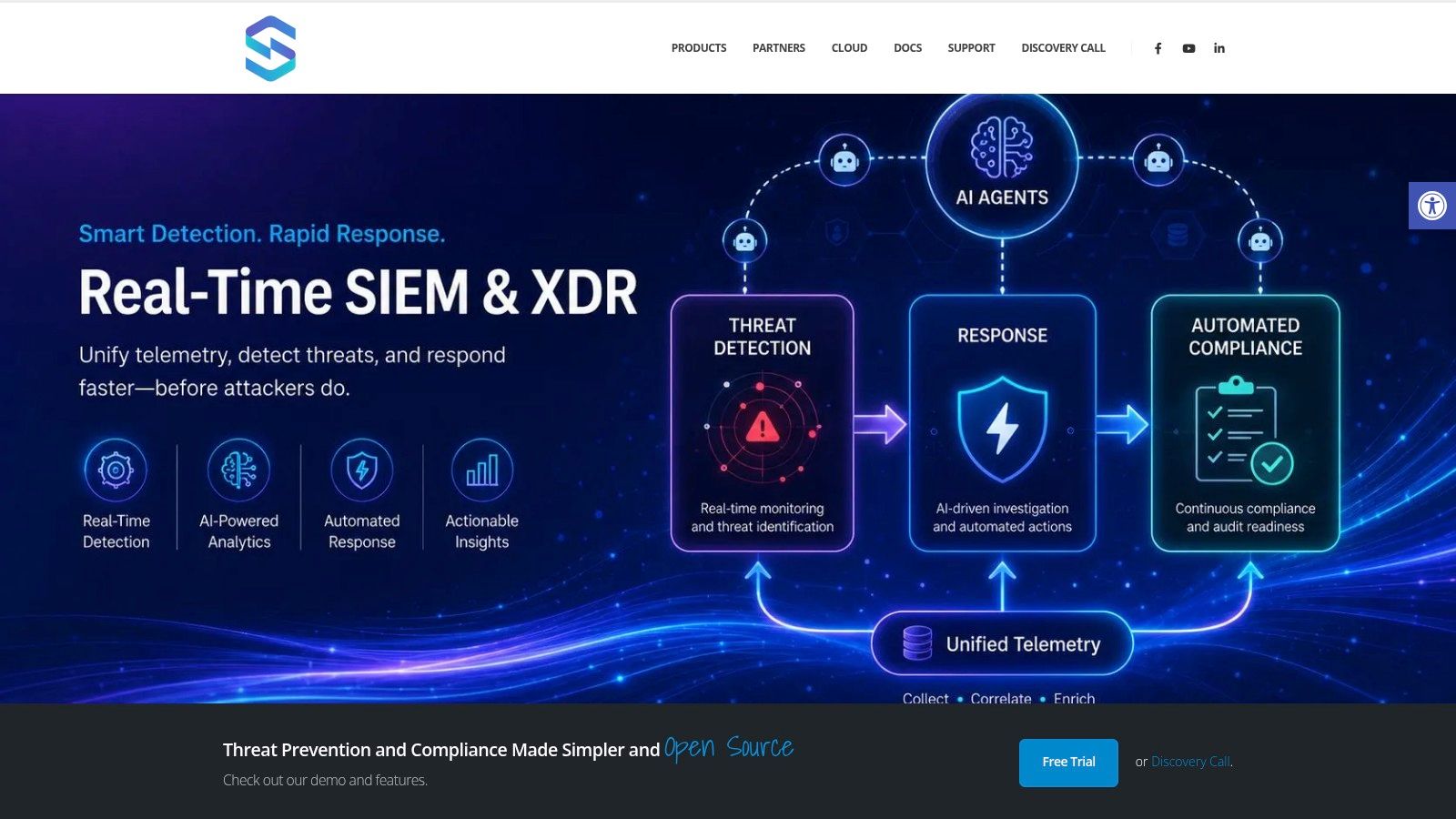
If you're building or maturing a detection engineering program, Unified Security Stack SYNOTI represents a viable option for consolidating SIEM, SOAR, and XDR workflows into one operational stack. It provides teams with a centralized platform to correlate telemetry, refine detections, and link alerts to response actions, avoiding the fragmentation caused by disjointed tools.