Critical Infrastructure Protection Programs Explained
A ransomware alert arrives before the daily standup, silencing the room. Firewall logs for the water utility sit in one console, endpoint alerts in another, and OT sensor data elsewhere entirely. Each team sees a fragment of the incident, but no one sees the complete picture.
This is the immediate pain point for teams. It is not theoretical or about policy wording, but the stark understanding that point tools don't become a program on their own. A critical infrastructure protection program must integrate these disparate signals, or it remains an unused document.
By the conclusion, you should be able to outline the components of a CIP program, distinguish governance from detection, and understand how SIEM, XDR, OT visibility, and compliance evidence combine into a single operating model. This is vital whether you protect a regional utility, a manufacturer, or a public-sector entity required to both prove and enforce control.
Table of Contents
- The Wake-Up Call That Starts the Journey
- What a Critical Infrastructure Protection Program Actually Is
- Governance and Risk Assessment That Actually Drives Decisions
- Technical Controls for Network, OT/ICS, and Endpoints
- Monitoring, Detection, and Supply-Chain Telemetry
- Incident Response and Compliance Mapping in One Motion
- A Practical Roadmap for Rolling Out the Program
- Why a Unified SIEM and XDR Makes the Loop Work
The Wake-Up Call That Starts the Journey
A regional water utility receives a ransomware advisory, and the CISO poses a straightforward question: “Are we exposed?” The firewall team reviews perimeter logs, the endpoint team checks EDR, and the OT engineer extracts sensor data from a separate stack. Each response is incomplete, and none clarify if the attack path crossed from IT into operations.
By now, many security executives encounter the limitations of siloed tools. This is not due to a lack of effort from the team; it is because the environment was never run as one unified system. Within a critical environment, visibility without correlation still has blind spots with charts.
Practical rule: if your teams cannot determine exposure, containment, and recovery using the same evidence set, you do not have a CIP program, only isolated tools and shared anxiety.
A genuine program offers more than just alerts. It provides a framework to prioritize issues, assign controls, validate telemetry, and define responses when threats impact the wrong segment at the wrong time. This is why the article treats governance, OT/ICS controls, SIEM/XDR detection, and compliance mapping as a unified chain rather than distinct topics.
The benefit is straightforward. You gain a mental model for leadership, a technical map for engineers, and a rollout sequence that does not require ideal conditions. In a utility, hospital, manufacturer, or public agency, this distinguishes reacting to noise from executing a real protection program.
What a Critical Infrastructure Protection Program Actually Is
A CIP program is the safety system of the organization, not just the sprinklers. A building establishes access rules, emergency drills, alarms for anomalies, and recovery procedures to safely re-enter. Sprinklers, cameras, and badge readers are essential, but they only function effectively because the building has a plan guiding everyone’s actions.
That's the easiest way to think about critical infrastructure protection programs. The program serves as the coordination layer, comprising decisions, priorities, and operating rules that link governance, risk, controls, detection, response, and recovery. Without this connective tissue, you possess only isolated security investments.
The national blueprint behind the idea
In the U.S., the policy architecture behind this model is the National Infrastructure Protection Plan and its 17 Sector-Specific Plans. DHS described them as a risk management framework with national priorities, goals, and requirements, and said the sector plans act as a roadmap for how stakeholders communicate, mitigate risk, and enhance security iteratively. This is significant because it demonstrates that CIP is structured as a multi-sector system, not a universal checklist National Infrastructure Protection Program and Sector-Specific Plans fact sheet.
For internal security teams, the practical definition is even more direct. A CIP program is the structure that determines what must stay available, what can't be exposed, which assets are most important, which controls apply to each class of system, and how the team proves those controls are working. This final aspect is where SIEM, XDR, and compliance reporting cease to be separate functions and integrate into the same operating model.
What belongs in the program
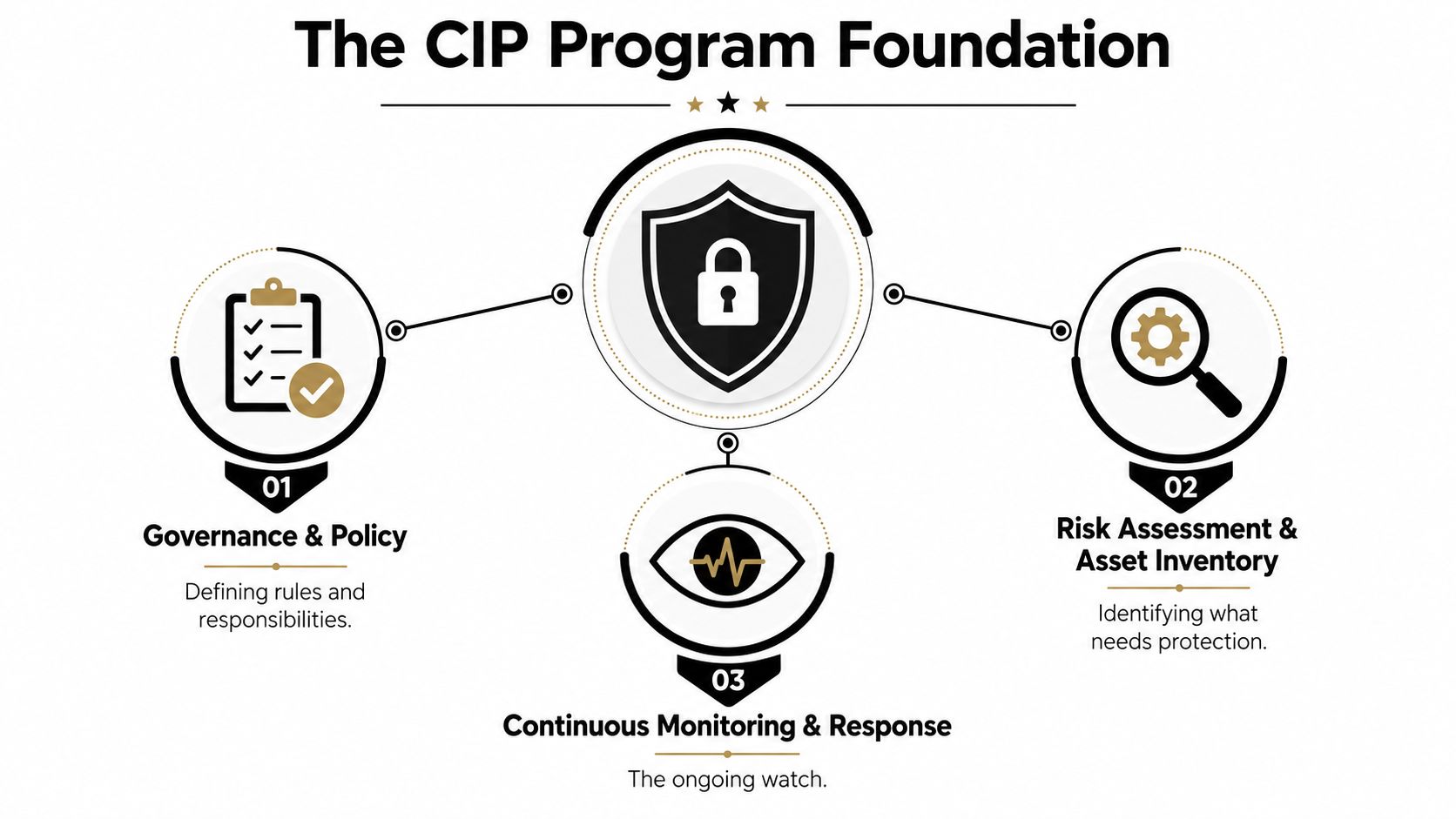
An effective CIP program always addresses three underlying questions. What are we protecting. What fails if it breaks. How do we detect when it is stressed.
These questions translate into four operational layers. Governance establishes rules, risk assessment identifies critical assets and dependencies, controls reduce exposure, and monitoring verifies expected behavior. If you can assign each layer to a person, process, and signal, you have the program’s core.
The most robust programs are those where policy and telemetry align. If policy designates an asset as critical but logs never capture it, the policy is fictional.
This forms the scaffold. The next step is determining who prioritizes, who owns exceptions, and how the organization manages the sensitive data required for these decisions.
Governance and Risk Assessment That Actually Drives Decisions
Governance is where difficult discussions occur. Someone must own the program, define asset tiers, determine criticality, and maintain stability in judgments despite staff turnover. In real environments, this is rarely a neat org chart exercise, but a mix of politics, engineering realities, and risk tolerance.
The difficulty is also evident in federal programs. GAO reported that stakeholders viewed the National Critical Infrastructure Prioritization Program as “not reflective” of prevalent threats like cyberattacks, requesting more regionally specific threat information. GAO also recommended better stakeholder involvement, clearer goals, and improved threat-sharing measures GAO report on critical infrastructure prioritization.
Prioritization has to survive disagreement
This critique is important because prioritization is not merely a ranking exercise. It involves deciding whose outage is most damaging, which dependencies are critical, and what the organization protects first when budgets, time, and staff are scarce. Technical and political answers often differ, and the CIP program must manage this tension without failing.
A robust governance model begins with named owners for each critical asset class, a documented exception process, and a repeatable method to weigh interdependencies. If one system failure cascades into power, communications, transport, or water operations, that dependency must appear in the prioritization model, not just a slide deck. The DoD life-cycle model is useful here as it reminds teams that analysis, remediation, warning, mitigation, response, and reconstitution belong together, not in silos DoD Critical Infrastructure Protection Plan.
Sharing sensitive data without breaking trust
Another obstacle is information sharing. Operators will not provide agencies with useful asset and vulnerability data if they fear exposure, misuse, or incorrect processing. That is why the Protected Critical Infrastructure Information framework matters, since it limits access to validated data to trained and certified government personnel with a need to know, and shields that data from FOIA, state and local disclosure laws, regulatory proceedings, and civil actions PCII program.
This protection alters behavior. It enables owners and operators to submit actual asset inventories, vulnerability context, and interdependency data rather than sanitized versions that are safe but nearly useless. If you are building governance from scratch, a practical resource like the IT Cloud Global risk assessment guide This approach helps organize the initial inventory and scoring dialogue without making the process feel overly academic.
A simple internal guideline works best here. Define asset tiers, clearly account for interdependencies, and draft prioritization criteria in terms that remain relevant even when leadership transitions occur.
Effective governance is intentionally unexciting. If these criteria are drafted effectively, you should be able to apply them again next quarter without needing to renegotiate the entire program.
For teams mapping the governance layer to existing control frameworks, the NIST 800-53 controls reference While useful as a control crosswalk, the real work lies in determining what your organization considers essential before the first incident occurs.
Technical Controls for Network, OT/ICS, and Endpoints
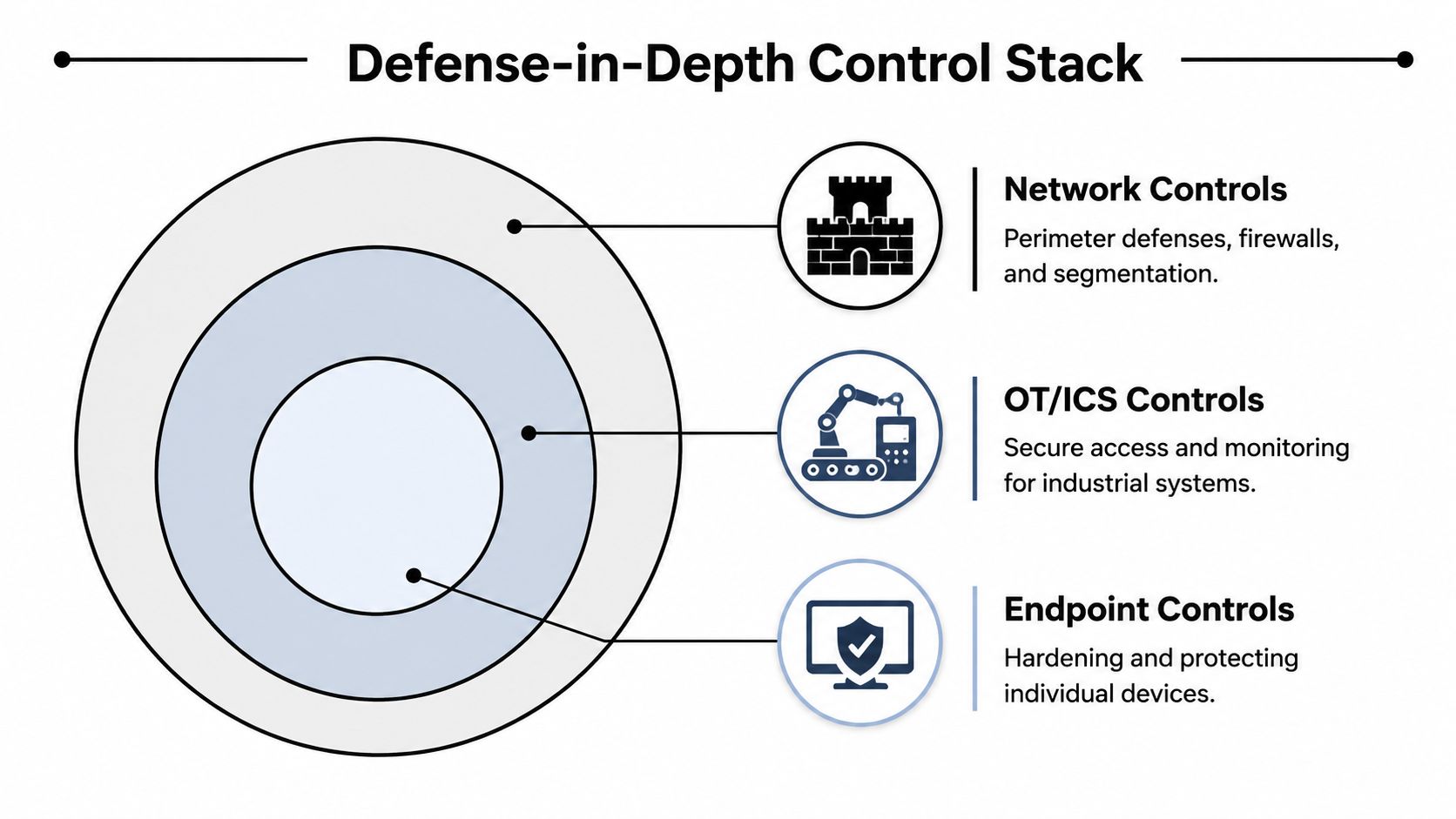
Technical controls define the physical structure of the program. Governance identifies what matters, while controls make it difficult for attackers, misconfigurations, or failures to reach sensitive areas. Think of them as three concentric layers: the perimeter, the machinery room, and the device layer.
Network controls set the boundaries
Network controls act as fences and locked doors. Firewalls, segmentation, access rules, and routing constraints restrict where traffic goes and which systems communicate. In critical environments, this is most important at the IT and OT intersection, where administrative convenience often clashes with operational risk.
Segmentation between IT and OT is not merely cosmetic. It prevents a compromise in one domain from becoming a lateral movement issue in the other. When these boundaries are weak, detection becomes harder because telemetry reveals more traffic than actual intent.
OT and ICS controls need different assumptions
OT and ICS environments are not simply smaller IT networks with industrial labels. They feature specialized protocols, legacy devices, long maintenance cycles, and scenarios where patching is risky or impossible. This is why passive monitoring and agentless methods are crucial, particularly when installing software would alter the very system you are trying to protect.
CISA’s 2025 report provides a concrete reason to prioritize exposure analysis in these environments. It stated government entities accounted for 63% of OT/ICS protocols exposed to the public internet CISA report summary. This does not imply that every exposed protocol is actively exploited, but it confirms that exposure is a tangible risk, especially for public-sector and utility-facing organizations.
Endpoint controls close the gap inside the estate
Endpoint controls serve as locks on devices within the building. EDR, hardening, local privilege restrictions, and file and process monitoring are vital because many attacks initially target servers, laptops, or engineering workstations before reaching higher-value assets. In a CIP context, the endpoint layer often provides the first strong indication that an attacker has moved from reconnaissance to execution.
Each control should generate a signal that your SIEM can ingest. Network segmentation provides flow records and denied connections. Passive OT monitoring generates protocol metadata and unauthorized command patterns. EDR contributes process creation, file modifications, script execution, and suspicious parent-child relationships. If the team cannot define what each control should log, the control design is incomplete.
The trade-off is clear. Additional controls increase operational overhead, and OT environments experience this burden more acutely than cloud-native IT stacks. Therefore, the control stack must be selected with the monitoring layer in mind, rather than added as an afterthought.
Monitoring, Detection, and Supply-Chain Telemetry
A CIP program is only as effective as the visibility it provides. If logs remain fragmented, incidents remain ambiguous, and ambiguity allows attackers to hide. Consequently, monitoring, detection, and supply-chain telemetry must be treated as a single pipeline rather than three separate checklist items.
Telemetry only helps when it's unified
Raw data feeds typically originate from disparate sources. Syslog captures system and device events, NetFlow reveals traffic patterns, APIs ingest cloud and SaaS activity, and agents provide host-level details. Individually, these sources are merely volume. Once centralized and correlated, they reveal sequences, outliers, and behaviors that no single feed could expose.
This is where a unified SIEM/XDR design becomes practical. Unified Security Stack, for instance, consolidates log ingestion, real-time correlation, and large-scale IOC matching, utilizing integrated large language models to assist with alert triage and rule tuning. It also supports a modular stack including log management, vulnerability scanning, access rights auditing, endpoint protection, dark web monitoring, and file tracking, aligning with the telemetry pipeline described here.
Supply-chain signals belong in the same view
Supply-chain telemetry is no longer a peripheral concern. Vendor access, third-party software inventory, and SBOM-driven alerts determine whether a critical service can trust the software and identities interacting with it. If a vendor account is active during an unexpected window, or a software component changes without context, this constitutes detection data, not procurement trivia.
Fleet telematics provides a useful comparison. The UK fleet manager's telematics guide demonstrates how vehicle data becomes valuable only when location, movement, and maintenance signals are interpreted collectively. Security telemetry functions similarly; raw readings are just noise until correlation transforms them into a route, a stop, or a deviation.
Detection becomes usable when it cuts noise
Correlation also reduces false positives in this context. A single failed login might be inconsequential. However, a failed login followed by privileged process creation, an unusual OT protocol, and a new outbound connection from an engineering workstation tells a different story. Detection engineering’s role is to shape these sequences into rules that are sensitive enough to be meaningful and specific enough to avoid overwhelming the team.
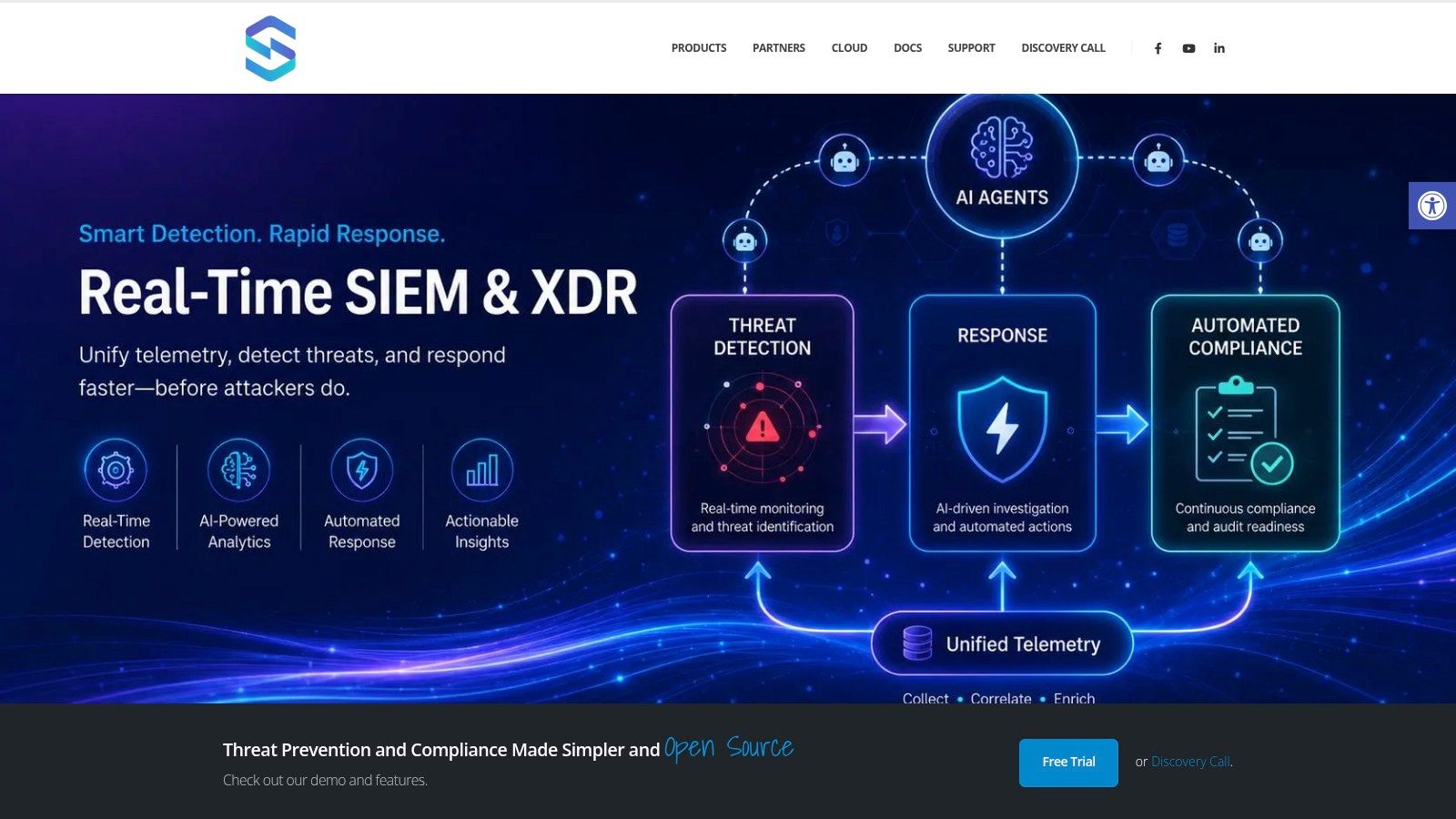
If you want a reference point for how that looks in practice, the real-time threat detection overview illustrates the operating model behind correlated alerting and response. The objective is not for every team to purchase the same tool, but for every team to have a single detection surface capable of viewing network, endpoint, and supply-chain context.
Incident Response and Compliance Mapping in One Motion
Response and compliance are frequently viewed as distinct areas. Within a mature CIP program, both draw on the same evidence. An alert triggers, enrichment proceeds, containment executes, and the event trail that results serves as audit material.
One playbook, two outcomes
A robust SOAR workflow begins with triage. The alert arrives, enrichment verifies identity, asset criticality, vulnerability context, and recent activity, and then the playbook determines whether to isolate a host, revoke a token, block an IOC, or escalate to a human. The critical element is not the action itself, but that the decision path is captured as evidence.
That same evidence can map to frameworks like CMMC, HIPAA, ISO 27001, PCI, SOC 2, and GLBA This is effective when the platform records who acted, what was affected, and which control objective the action supported. Unified Security Stack’s compliance workflows are built on this principle, allowing detections and response actions to feed audit-ready reporting rather than requiring manual reconstruction after the fact.
Control evidence belongs in the incident record
The value is operational, not superficial. If investigation artifacts already align with control language, audits become faster, and incident lessons are codified into controls rather than lost in postmortems. This means the analyst who handled the incident does not have to rewrite the event later for the auditor.
| Framework | Sample Control | Telemetry Signal |
|---|---|---|
| HIPAA | Access to sensitive systems reviewed | Authentication logs and privileged access events |
| CMMC | Incident response actions documented | SOAR playbook execution records |
| ISO 27001 | Logging and monitoring evidence retained | Centralized event logs and correlation results |
| PCI | Suspicious access and containment tracked | Alert history, host isolation, and block actions |
If your environment also has product lifecycle obligations, the EU compliance for product passports illustrates how traceability requirements can attach to data flows and evidence trails in a similar manner. The underlying lesson remains the same: compliance becomes easier when telemetry is structured from the outset.
Response discipline needs rehearsal
A playbook lacks credibility unless operators can execute it under stress. Teams must rehearse containment procedures, escalation routes, and evidence collection prior to an actual incident, since discovering that a response rule requires three manual approvals during the first breach is unacceptable.
Effective incident response maintains an audit trail that you would confidently present to an auditor. If the sequence of actions is difficult to articulate, it is likely difficult to reproduce.
A Practical Roadmap for Rolling Out the Program
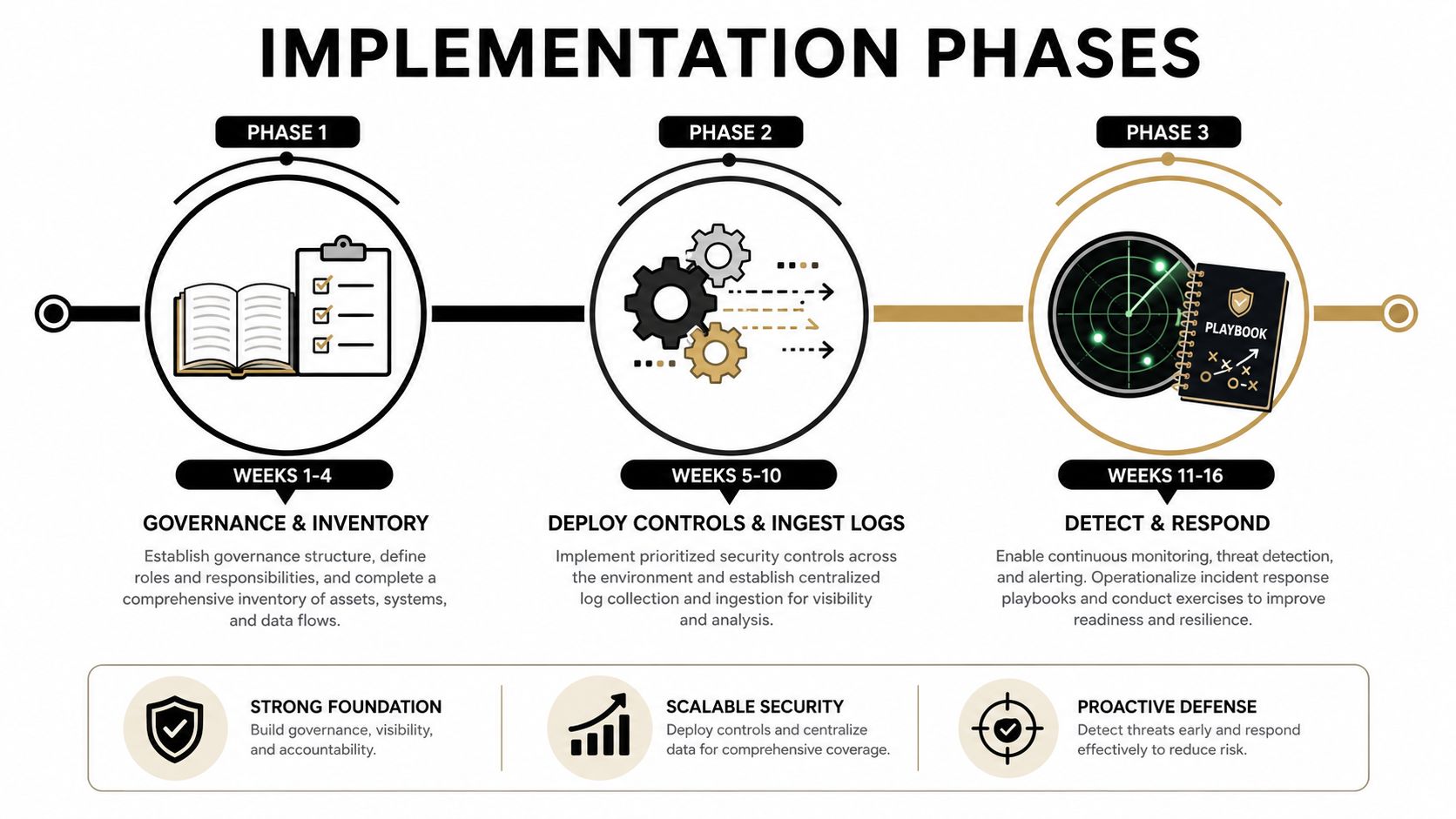
Phased implementation of CIP is more effective than attempting a single massive transformation. The objective is moving from “risk is dispersed” to “we can visualize, decide, and react” without demanding a complete rebuild from the team. This is particularly vital for smaller or under-resourced sectors, which DHS identified as overlooked and frequently lacking updated regulations, partnerships, and information-sharing channels DHS report on overlooked critical infrastructure.
Weeks 1 to 4, governance and inventory
Begin with ownership rather than tools. Designate a program owner, categorize asset tiers, record critical dependencies, and establish a baseline inventory covering IT, OT, and shared services. If leadership cannot agree on the inventory, they will not agree on response priorities later.
The KPIs worth using here are straightforward. Monitor the percentage of assets with a current inventory, the count of documented critical dependencies, and whether each tier has a designated owner. Incomplete metrics indicate a program deficiency, not a reporting issue.
Weeks 5 to 10, controls and log ingestion
After establishing a credible inventory, implement controls aligned with the highest-risk tiers and begin collecting logs that validate their effectiveness. Integrate network, OT, and endpoint telemetry into a unified analysis layer, ensuring the team can view blocked traffic, protocol anomalies, and host activity simultaneously.
At this stage, a practical KPI is control coverage by framework. Avoid pursuing perfect coverage across all systems. Prioritize controls linked to the most critical services and the compliance requirements most significant to the business.
Weeks 11 to 16, detection and playbooks
Next, develop detections based on behavior rather than just indicators. Adjust correlation rules, validate enrichment, and create playbooks instructing analysts on actions when evidence confirms a genuine threat. The aim is to reduce triage time and uncertainty, not to increase alert volume.
Track mean time to detect and mean time to respond from the beginning. These metrics become valuable only after the team trusts the underlying telemetry, so anticipate initial noise.
After week 16, continuous improvement
At this stage, the program becomes iterative. Assess missed detections, playbook bottlenecks, undocumented assets, and controls that add overhead without mitigating risk. The goal is not a perfect maturity score, but a system that improves in clarity each month.
View the roadmap as an initial sequence rather than a maturity model. If the next step is correcting inventory, address inventory first.
Why a Unified SIEM and XDR Makes the Loop Work
Fragmentation is the common failure mode in critical infrastructure protection programs. Governance resides in one area, controls in another, detections in a third, and compliance evidence is manually compiled upon request. This is why a unified SIEM and XDR is essential, functioning as the nervous system allowing the entire program to sense, decide, and respond cohesively.
A platform such as Unified Security Stack is one method to operationalize this model, integrating real-time correlation, log management, response playbooks, and compliance mapping with the same telemetry. In the original water utility case, this allows the team to see not just a ransomware advisory, but the correlated path, containment steps, and evidence proving the organization fulfilled its commitments. For readers seeking architectural context, the XDR overview is a useful companion.
When building or revising a CIP program, Unified Security Stack provides a centralized location for correlating logs, automating responses, and mapping evidence to compliance requirements without manually integrating disparate systems. It addresses the governance, OT, endpoint, and audit needs discussed here, and you can explore its functionality at Unified Security Stack.