Understanding PCI DSS Compliance: The Essential Guide
You are looking over payment flows, the bank wants evidence, and the audit date now feels very close. Usually the issue is not that the team has done nothing, but that no one has converted routine security activities into proof a card brand, acquirer, or assessor can accept. PCI DSS compliance is where that shortfall becomes clear, and it explains why security teams already using SIEM, XDR, or EDR still end up in a distinct compliance rush.
Table of Contents
- What PCI DSS Compliance Actually Means
- Who Must Comply and What Counts as the CDE
- The 12 PCI DSS Requirements Explained Through Real Payment Flows
- Validation Levels, SAQ vs ROC, and Assessment Timelines
- Common Non-Compliance Issues and How to Remediate Them
- Using SIEM and XDR to Streamline PCI DSS Evidence
- A Practical 90-Day PCI DSS Readiness Roadmap
What PCI DSS Compliance Actually Means
A mid-sized merchant often discovers PCI DSS in the same manner your team discovers renewals and insurance. A finance colleague receives an email from the acquiring bank requesting evidence, and all at once the technical controls, logs, scans, and policies must align.
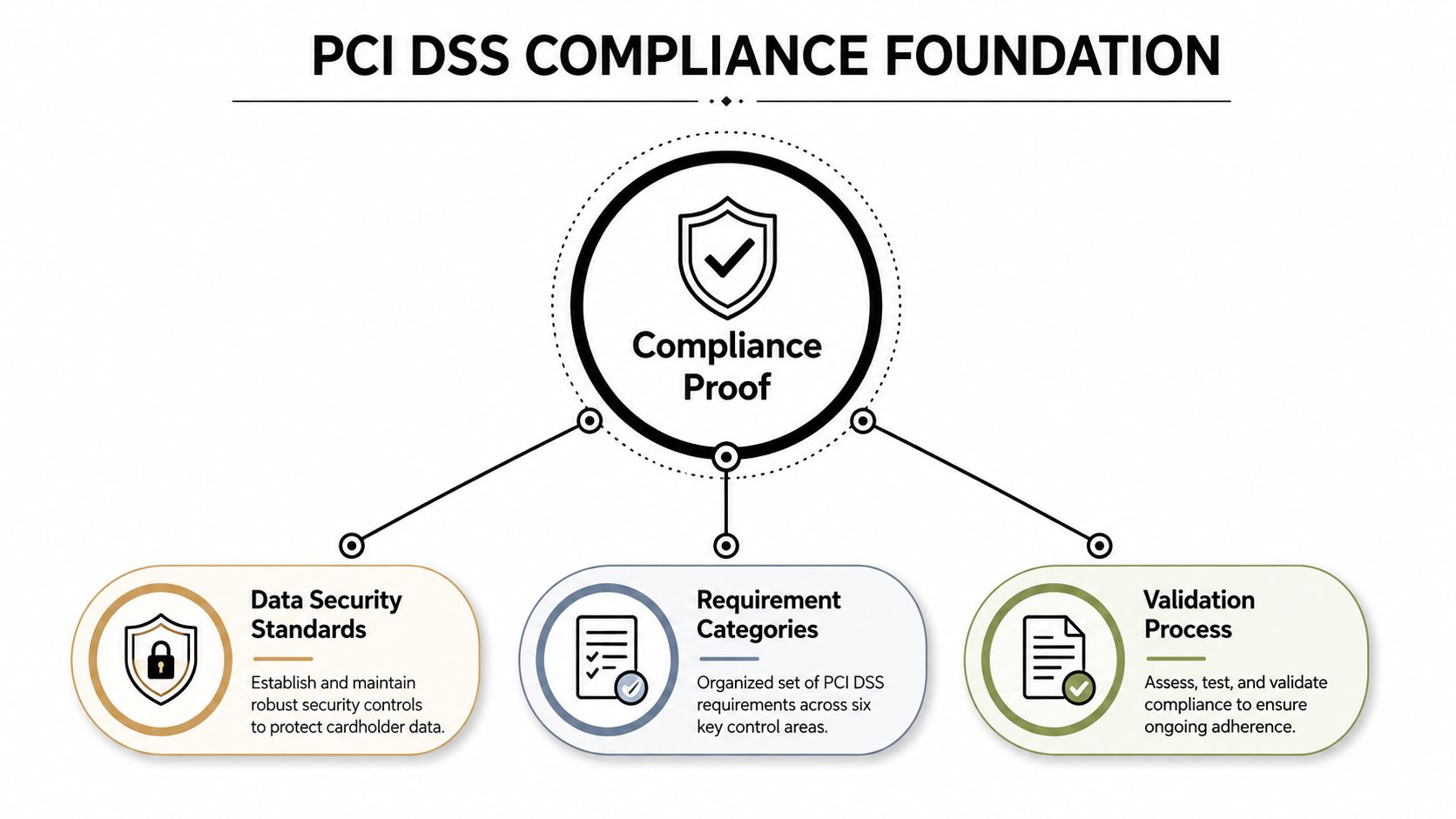
PCI DSS stands for Payment Card Industry Data Security Standard. It is an international payment-card security standard established by the major card brands and managed by the PCI Security Standards Council. This distinction matters because it is not a law in the way HIPAA or GDPR are, but a contractual security standard linked to how card payment ecosystems may function.
Compliance requires your organization to have implemented the necessary controls, to be able to prove them, and to keep proving them. The Council issued PCI DSS v4.0 in March 2022, and the retirement date for v3.2.1 was set for 31 March 2024 (PCI Security Standards Council standards page). The purpose of that shift is straightforward: standards change, yet the duty to continually demonstrate security remains.
Compliance is proof, not a badge
New compliance owners often err by believing PCI DSS is a certificate obtained once and stored. It is not. The framework centers on continuous validation, continuous monitoring, and periodic assessments, which is why the quality of evidence counts as much as the controls do.
That is also why security teams often perform better when compliance links to operational tools. If your SIEM already records authentication events, firewall changes, and admin activity, you are not beginning at zero. You are simply converting that telemetry into evidence.
For a practical example of how payment handling work gets organized in travel, the payment processing checklist for tours is a helpful method for viewing how various operational steps correspond to payment risk.
Practical rule: if a control cannot be demonstrated through logs, scan results, or written procedures, it will be regarded as though it does not exist.
PCI DSS is narrow, but deep
PCI DSS is less broad than general privacy laws since it concentrates on cardholder data and the systems that interact with it. Yet it goes deeper than many teams anticipate because it extends into logging, authentication, segmentation, vulnerability management, and policy rigor.
That is why confusion arises when people compare it with HIPAA or GDPR. Those frameworks cover more ground, but PCI DSS is far more prescriptive within its focus. You are not merely stating that you care about data security. You are demonstrating exactly how card data is protected, who can access it, how that access is watched, and how frequently the controls are reviewed.
Who Must Comply and What Counts as the CDE
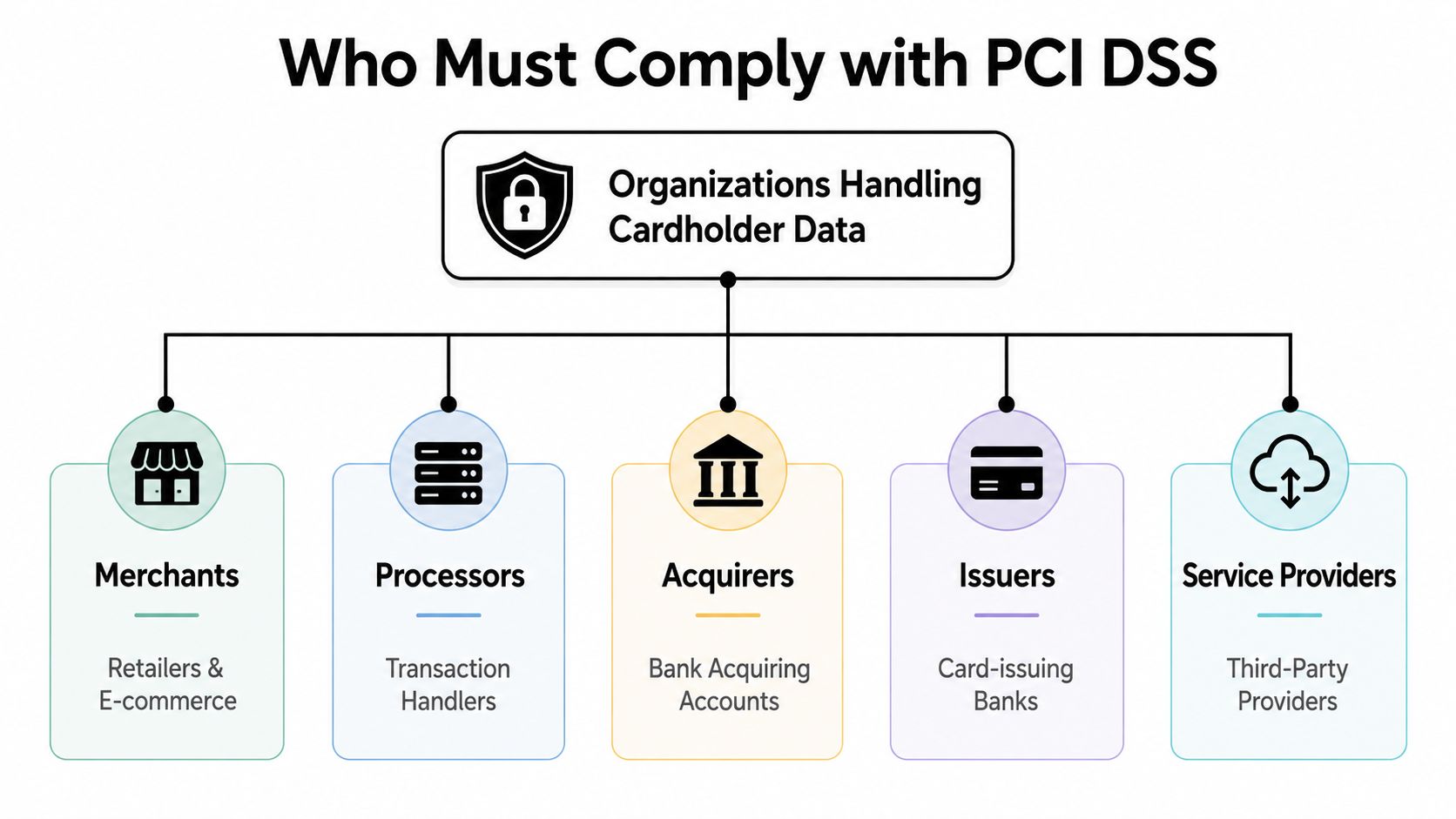
If your organization stores, processes, or transmits cardholder data, PCI DSS applies to you. That covers merchants, processors, acquirers, issuers, and service providers. Simply put, if your business handles card data within the payment chain, the standard applies to you.
Merchant level changes the amount of validation
Merchant level determines how much validation effort is required, not whether PCI DSS is relevant. The specific level depends on transaction volume under the card-brand rules applied by acquirers and brands, and that level decides if you finish a simpler self-assessment or a complete formal report.
That difference matters because teams frequently underestimate the work. A small online seller may validate through an SAQ and scans, whereas a larger operation could require a QSA-led review and a Report on Compliance. The compliance load increases quickly as more systems, people, and payment paths enter the picture.
The CDE is bigger than the payment app
The cardholder data environment, or CDE, is not only the register or checkout page. It covers the people, processes, and technology that store, process, or transmit card data, along with connected systems that could impact security.
In a coffee-shop environment, the POS register is plainly visible. The back-office computer that reconciles sales, the shared network segment, the third-party support vendor for the POS, and the jump host used by administrators can each bring systems into scope. If a single overlooked system can reach the payment path, it can pull the rest of the environment along with it.
Reducing scope is the single greatest compliance lever. Every system taken out of the CDE lowers future evidence demands, review workload, and audit friction.
Scope mistakes cost more than controls
When the CDE is scoped poorly, a review that should be manageable can grow much larger, because every connected asset becomes part of the evidence narrative. The standard itself is seldom the difficult part. The challenge is the inventory discipline required to show which hosts, users, and network paths fall within scope.
This is why security architects begin with segmentation and data flow mapping before adjusting tools or drafting policies. When scope is incorrect, every control added afterward is more difficult to justify.
The 12 PCI DSS Requirements Explained Through Real Payment Flows
The clearest approach to the 12 requirements is to organize them into six control families. That reflects how security teams reason and is nearer to how an auditor interprets evidence than a simple 12-item checklist.
Network security and cardholder data protection
Network security forms the first family. Requirement 1 addresses installing and maintaining network security controls, and Requirement 2 addresses secure configuration of system components. In an actual payment flow, this means the firewall rule that keeps rogue devices off the POS network, the hardening baseline for payment servers, and the segmentation that separates guest Wi-Fi from card systems.
Cardholder data protection is the next family. Requirement 3 safeguards stored cardholder data, while Requirement 4 safeguards it in transit across open or public networks. Tokenization at the POS is a clear example, since it limits the amount of actual card data retained, and TLS secures that data as it travels from checkout to processor.
Vulnerability management and access control
Requirement 5 and Requirement 6 form the vulnerability management family. The first addresses malicious software defenses, and the second addresses secure systems and software. A quarterly ASV scan that finds an overlooked subdomain is a classic illustration of why external scanning is important. It surfaces the edge cases people overlook.
Access control is the following family, and many environments fall short here in mundane ways. Requirement 7 restricts access according to business need to know, Requirement 8 identifies users and authenticates access, and Requirement 9 limits physical access to cardholder data. Role-based administrator access on the payment database, MFA on administrator paths, and locked server rooms all belong to the same narrative.
Monitoring, testing, and policy
Requirement 10 covers the monitoring family. It requires logging and monitoring of all access to system components and cardholder data. A daily log review that catches a skimming probe is exactly the type of event auditors expect to see tied to an operational control.
Requirement 11 addresses regular testing of systems and networks. Consider penetration tests, vulnerability scans, and change validation after configuration updates. Requirement 12 is the policy family, and it matters because an incident response plan that is written down and tested yearly turns security intent into a repeatable process.
| Control family | Requirement numbers | Real payment-flow example |
|---|---|---|
| Network security | 1, 2 | Firewall rules, secure configs, segmentation |
| Cardholder data protection | 3, 4 | Tokenization, encryption in transit |
| Vulnerability management | 5, 6 | Malware defense, patching, ASV scans |
| Access control | 7, 8, 9 | Least privilege, MFA, physical controls |
| Monitoring and testing | 10, 11 | Log review, alerting, testing |
| Policy | 12 | Incident response and security governance |
One helpful way to view these is as blockers of threats. Every family eliminates a distinct path an attacker might use to go from a payment touchpoint to card data compromise.
Validation Levels, SAQ vs ROC, and Assessment Timelines
Validation is the PCI DSS component that often confuses people, since it appears to be paperwork, yet it actually serves as a proof mechanism. Smaller merchants typically complete a Self-Assessment Questionnaire, or SAQ, while larger merchants and service providers need a Report on Compliance, or ROC, attested by a Qualified Security Assessor, or QSA.
SAQ, ROC, and who signs what
An SAQ is a structured self-assessment. Its type varies according to how you take payments, and frequent formats include A, A-EP, B, B-IP, C, C-VT, D, and P2PE-HWThe goal is not to gather forms for their own sake. It is to align the validation method with your real payment model.
A ROC is more detailed and formal. It applies when an organization's size, role, or acquirer requirements make self-attestation inadequate. The QSA validates the environment, and the organization provides supporting evidence alongside the attestation.
Scan cadence matters as much as the questionnaire
The recurring technical checks are mandatory. Under the earlier v3.2.1 thresholds, internal scans must be free of high-risk vulnerabilities, and external scans must have no vulnerabilities with a CVSS base score of 4.0 or higher (PCI DSS Quick Reference Guide v3.2.1). Certain merchants are required to complete passing scans every 90 dayswhich is why scan scheduling and exception handling must sit within the compliance process, not alongside it.
This is also why the correct answer to what should I submit, to whom, and how often depends on scope and merchant level. If you have the wrong merchant classification, or you do not know which systems belong to the CDE, you will assemble the wrong evidence package.
A weak validation process typically breaks down in two areas: absent scans and absent proof. The control may be present, yet the auditor cannot trace it.
For a checklist-oriented view of the moving parts, this PCI DSS compliance checklist serves as a useful internal benchmark.
Timing is operational, not ceremonial
This rhythm exists to show controls continue to function after updates, patches, personnel changes, and added integrations. That is the real test. PCI DSS asks whether your environment remains secure as normal business runs, not whether it appeared tidy on the day of the audit.
Common Non-Compliance Issues and How to Remediate Them
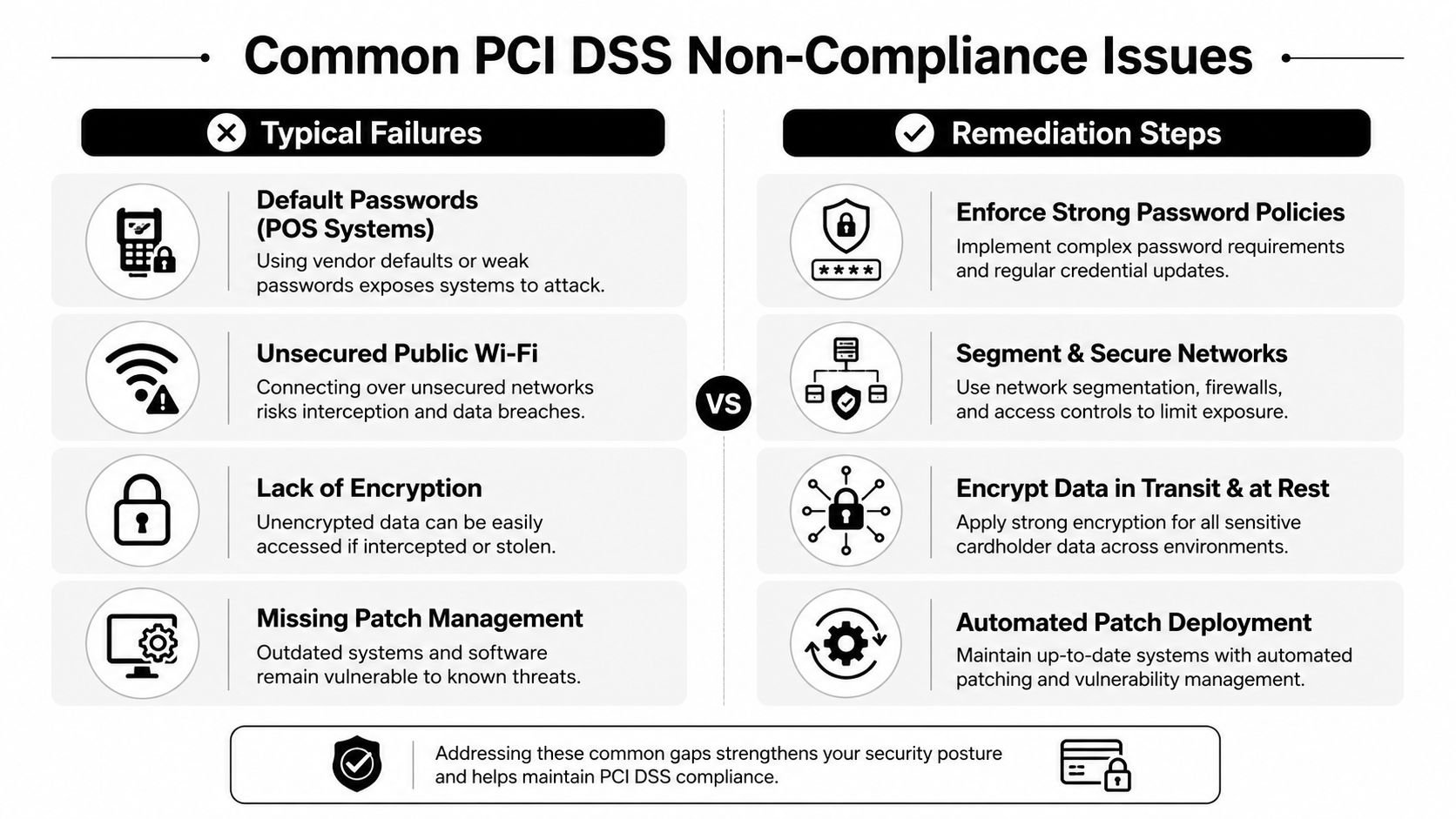
A regional retailer is compromised when a POS vendor account is reused with a default password. The forensic evidence is messy, yet the failure pattern is common. No one planned a breach; they inherited a series of minor errors that were simple to overlook until they could not be.
The failures auditors keep seeing
The first problem is unsegmented networks. When POS systems can reach everything else, the CDE expands without visibility. The correction is simple: isolate the payment path and validate the boundary using logs and scan findings, not merely network diagrams.
The second problem is missing MFA on admin paths. If an administrator password is stolen, the attacker gains unrestricted entry. The fix is to require MFA on every route into the CDE, including remote support and privileged console access.
A third concern involves expired TLS certificates and poor encryption practices. Payment data should not remain exposed because a renewal date was missed. Maintain a certificate inventory, automate renewals, and verify encryption in transit and at rest wherever the environment requires it.
Shadow systems and retained data
Hidden systems are frequently the source of the most expensive surprises. A neglected SaaS test tenant, a legacy point-of-sale pilot, or a laptop a vendor uses can all become shadow IT inside the scope. That's where the e skimming attacks explained resource is valuable, since internet-facing payment flows are frequently where concealed exposures first come into view.
Another poor habit is keeping track data out of caution. That way of thinking creates needless exposure. If a defined business purpose does not require the data, do not retain it.
Assess first, remediate second. If you cannot identify the control that failed, you will purchase tools rather than close the gap.
For a deeper comparison of security platforms that can help separate logging from detection work, the internal discussion on SIEM versus XDR merits use as a planning resource.
Where monitoring and testing usually break
Requirement 10 and Requirement 11 are areas where many SOCs already possess data but lack proof. Logs are present, alerts trigger, and scans execute, yet no one can demonstrate an unbroken chain from event to review to remediation. That is the recurring audit failure pattern.
The fix is to standardize review steps, keep scan evidence orderly, and assign every exception to an owner and a deadline. When that occurs, the same security efforts begin to support both operations and compliance.
Using SIEM and XDR to Streamline PCI DSS Evidence
PCI DSS Requirement 10 requires you to log and monitor access to system components and cardholder data. Requirement 11 requires regular testing of systems and networks. That is precisely where SIEM and XDR cease to be only security tools and begin to serve as compliance infrastructure.
Evidence starts with log onboarding
A SIEM workflow built for compliance collects logs from endpoints, payment switches, databases, IAM systems, and cloud services via agents, Syslog, NetFlow, and APIs. That combination matters because card environments seldom reside in a single place now. If the system cannot ingest the event, it cannot prove the event occurred.
After those logs are centralized, correlation filters out noise. Administrator logins, configuration changes, new service accounts, and data exfiltration patterns are easier to detect because the platform views them together rather than as separate records. For PCI, that separates raw telemetry from actionable evidence.
Why retention and mapping matter
A current compliance platform should also maintain the evidence trail in a format auditors can use. This requires mapping detections, retained logs, and scan outputs into the rows of an SAQ or ROC, with 12 months of retention and at least 90 days quickly accessible for investigation, as stated in the PCI guidance above. If the evidence resides in six separate tools, the assessment turns into a scavenger hunt.
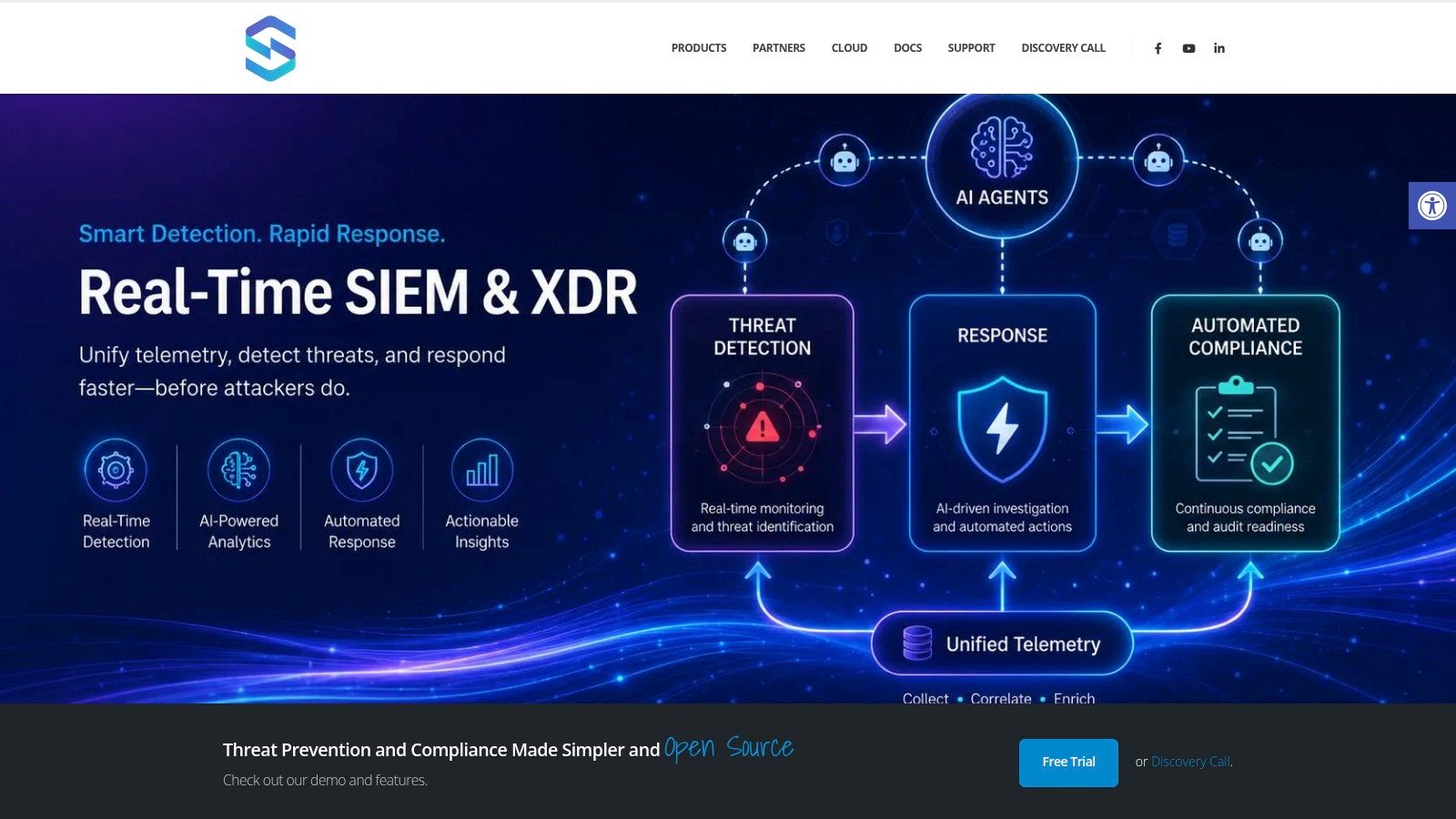
Unified Security Stack is one example of an open-source SIEM, SOAR, and XDR platform that brings together log management, correlation, vulnerability scanning, file integrity monitoring, and compliance evidence for frameworks including PCI DSS. The benefit here is not magic; it is consolidation. A single system is easier to defend than a collection of disconnected exports.
Monitoring becomes a control, not a chore
If the platform can demonstrate who accessed the CDE, what changed, what failed a scan, and what was reviewed, compliance ceases to be a quarterly scramble. The operations team still performs the work, but the evidence is already available when the assessor requests it.
For teams building that architecture, the internal overview of centralized log management is a pragmatic approach to consider the data layer first and the compliance layer second.
A Practical 90-Day PCI DSS Readiness Roadmap
The quickest way to gain momentum is to treat PCI DSS as an operational program rather than a document project. During the first 30 days, inventory the CDE, verify segmentation, and map existing controls to the 12 requirements. From days 31 to 60, close the clear gaps, enable MFA for admin access, centralize logs, set up vulnerability scanning, and draft the missing policies.
Between days 61 and 90, your testing should mirror how an assessor will evaluate the environment. Carry out internal and ASV scans, do a dry run of the SAQ or ROC, and gather ongoing evidence via the SIEM so the next review does not turn into a fire drill.
| Phase | Timeframe | Key Activities | Owner |
|---|---|---|---|
| Scoping and gap analysis | Days 1 to 30 | Inventory the CDE, verify segmentation, map controls to requirements | Security architect, compliance officer |
| Remediation | Days 31 to 60 | Deploy MFA, centralize logs, configure scanning, write policies | Security engineering, IT operations |
| Validation | Days 61 to 90 | Run scans, dry-run SAQ or ROC, collect evidence continuously | SOC, compliance owner, QSA if needed |
Organizations that remain compliant do not count on luck in their paperwork. They carry out disciplined operations, keep evidence tied closely to the control, and use platforms that transform logs, detections, and scan results into audit-ready proof.
If you need PCI DSS evidence to live inside the same workflow as detection and response, Unified Security Stack provides a means to centralize logs, correlate activity, and map security evidence to compliance controls. Apply it to narrow the space between what your team is already doing and what an assessor must see.