Unlock Compliance Management Solutions for 2026
You can generally recognize when a compliance program still operates on audit-season logic. With an assessment three weeks out, Slack threads fill with evidence requests. Security exports screenshots from cloud dashboards. IT extracts user lists from IAM. HR rushes to demonstrate termination workflows. Then someone opens the spreadsheet untouched since the last audit and begins guessing which controls still correspond to which systems.
That approach falls apart when audits are no longer periodic. Teams are not getting ready for a single event. They must keep evidence up to date across several frameworks, business units, and platforms even as production systems continue to shift beneath them. When you manage UK GDPR, ISO 27001, HIPAA, SOC 2, or industry-specific obligations simultaneously, the reporting load grows quickly. For executives trying to make sense of overlapping requirements, this practical guide to UK GDPR and ISO 27001 guidance is valuable because it demonstrates how reporting obligations begin to intersect well before the underlying tooling does.
The defining change in compliance management solutions is not more attractive dashboards. It is operational. Effective platforms now reside within security workflows, gather evidence from live systems, connect that evidence to controls, and maintain audit readiness near real time. That is what distinguishes a reporting tool from a system you can actually operate.
Table of Contents
- The End of the Annual Audit Scramble
- Beyond Spreadsheets The New Compliance Hub
- How Modern Solutions Automate Compliance Workflows
- Key Features and Integrations to Evaluate
- A Practical Roadmap for Selecting and Implementing Your Solution
- How to Measure the ROI of Your Compliance Platform
- Common Pitfalls in Compliance Management and How to Avoid Them
The End of the Annual Audit Scramble
The previous pattern is well known. An auditor requests evidence that endpoint protection is turned on, access reviews are up to date, privileged accounts are governed, and log retention aligns with policy. The answers are available, yet they sit in separate places: Jira tickets, SIEM queries, IAM exports, policy PDFs, and screenshots stored in a colleague's desktop folder. Compliance turns into a company-wide retrieval effort.
That approach does not withstand present pressure. 92% of organizations conducted at least two audits or assessments in 2025, and 35% of enterprises conducted more than six on average, while 69% of organizations said regulations are too complex or too numerous, or that supplier compliance is hard to verify, according to Secureframe's 2025 compliance statistics. That is why this work has moved from periodic preparation to continuous operations.
What the scramble actually costs
The obvious expense is employee hours. The more difficult expense is context switching. Security engineers halt detection tuning to collect evidence. Identity teams set aside access cleanup to reconstruct reviewer lists. Risk managers use their time aligning inconsistent names across controls, systems, and business owners rather than verifying whether controls remain effective.
A manual approach also introduces a trust issue. When evidence is gathered late, teams come to depend on point-in-time exports that may already be outdated. It is possible to pass an audit packet that no longer represents the actual environment.
The strongest compliance programs don't ask, "Can we produce evidence next month?" They ask, "Is the evidence already being produced by the systems we run every day?"
Why leaders are changing the model
Compliance management solutions address this gap by cutting the effort required to pursue proof retrospectively. They consolidate evidence, make control ownership clear, and enable quicker responses when a framework shifts or another assessment emerges. This is especially important in hybrid environments, where controls rely simultaneously on cloud configurations, identity platforms, endpoint telemetry, ticketing systems, and vendor attestations.
For a CISO or IT risk leader, the operational takeaway is straightforward. If compliance still relies on screenshots and quarterly archaeology, the problem is not audit discipline. It is architecture.
Beyond Spreadsheets The New Compliance Hub
The week begins with an audit message in Slack requesting evidence of privileged access reviews, log retention, and endpoint coverage. If answering still relies on shared drives, screenshots, and a control spreadsheet that just one analyst truly understands, documentation is no longer the issue. The issue is that compliance sits apart from the systems that generate operational truth.
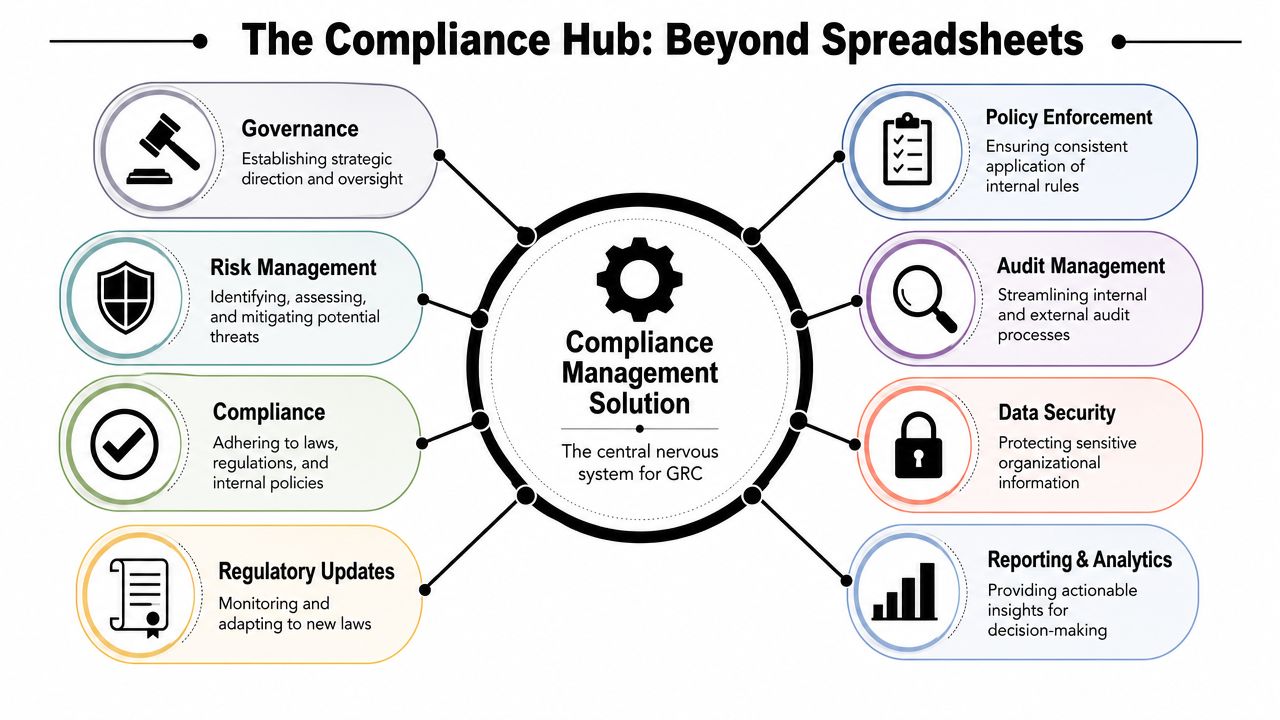
Modern compliance management solutions serve as the control hub for governance, risk, and compliance. They connect requirements, policies, controls, evidence, issues, and audits within a single operating model, attaching live system data to each control wherever feasible. This change matters because a control has value only when the platform can display its present state, its owner, and the evidence trail supporting it.
What changes when the hub is real
In legacy environments, policy lives in one repository, asset data in another, tickets in yet another system, and evidence in folders named after the most recent audit. Teams spend audit season recreating relationships they already know ought to exist. A true hub preserves those relationships throughout the year and links them back to the source systems that security and IT already rely on.
That usually means the platform maintains persistent links between:
- Requirements and controls, so one control can satisfy multiple frameworks without duplicate testing
- Controls and owners, so accountability survives org changes and staff turnover
- Evidence and source systems, so proof comes from identity, cloud, SIEM, XDR, ticketing, and endpoint platforms instead of manual uploads
- Findings and remediation work, so exceptions become tracked tasks with status, deadlines, and audit history
This is the trade-off that buyers must assess with care. Certain tools are strong in policy management and audit workflows but remain limited in operational integrations. Others integrate effectively with security tooling yet require greater maturity in control mapping and exception handling. A market overview such as this GRC tools comparison for security and compliance teams can help outline the options, but the real test is whether the product can reside at the center of everyday security operations without adding manual effort.
Why document repositories stall out
A document repository may store evidence. It cannot demonstrate that a control remains effective.
That difference becomes clear quickly in live environments. A screenshot of MFA settings may satisfy an auditor a single time. It does not show a CISO whether the policy remained enforced after an administrator change, whether service accounts were left out, or whether enforcement reaches the correct user groups. A hub linked to identity systems, security telemetry, and ticketing data can address those questions with current evidence and historical context.
Guidance from audit and advisory firms has repeated this point for years. Continuous controls monitoring and automated evidence collection cut the time teams spend compiling documentation because evidence is captured during operations rather than rebuilt afterward. KPMG describes this change in its overview of continuous controls monitoring and automation in compliance programs.
Practical rule: If a platform cannot demonstrate where evidence originated, when it was gathered, whether it remains current, and which control it backs, then it is a repository, not a compliance hub.
The business case behind the architecture
The rationale here is operational. Security teams already gather useful data across SIEM, XDR, cloud security, IAM, EDR, and ITSM platforms. A compliance hub puts that data to work in two ways. First, for defense and operations; second, for evidence and control validation. This cuts down on repeated work, speeds up audit readiness, and provides risk leaders with clearer insight into control health between formal assessments.
A trade-off exists. Greater integration demands more upfront design discipline. Teams must have clear ownership, dependable control mappings, and consensus on which systems are authoritative. Once that base is established, however, audit readiness emerges from routine operations instead of becoming a standalone initiative that pulls engineers away from security work.
How Modern Solutions Automate Compliance Workflows
On Monday morning, an auditor requests evidence that MFA, log retention, and privileged access reviews were functioning last month, not merely configured today. Teams that depend on screenshots, exported CSVs, and ticket comments turn that request into a scramble. Teams using a unified compliance platform respond with live system evidence that is collected and mapped continuously.
Automation is what alters that distinction. The objective is not quicker report creation. The objective is for audit evidence to result from security operations.
Evidence collection from live systems
Today's platforms begin with systems that already contain operational truth. SIEM, XDR, IAM, cloud security tools, EDR, HR systems, and ITSM platforms each generate evidence that may support one or more controls. The platform ingests that data via APIs, agents, and event streams, keeps source context intact, and associates it with a specific control, owner, and timeframe.
A screenshot captures a single moment. A direct pull from a live system reveals state across time.
That difference has practical consequences. If an analyst must still export a report from a cloud console, rename the file, upload it, and explain which control it supports, the costly portion of compliance work remains manual. A platform connected to centralized log management for compliance evidence can retrieve retention settings, alert coverage, and activity records from the logging layer without that additional handling.
Control testing inside the workflow
Collection by itself does not resolve the issue. Evidence must be assessed against control logic while it remains current.
If MFA is required, the platform should validate identity-provider data and identify gaps by group, role, or application. If endpoint protection is required, it should verify EDR status and policy coverage for the assets in scope. If incident response controls rely on ticket closure and escalation paths, it should correlate alerts, case records, and workflow timestamps instead of treating a file upload as proof.
In mature implementations, the workflow looks like this:
- Pull evidence from systems of record on a schedule or continuously
- Evaluate control conditions against current data
- Map one result to all relevant frameworks and policies
- Open remediation tasks when evidence is missing, stale, or failed
- Refresh audit views automatically as control status changes
Operational trade-offs surface. More integrations yield higher evidence quality, yet they also require decisions about data ownership, normalization, and exception handling. When the IAM system reports that MFA is enabled and the application team says the service account is exempt, the platform needs a clear exception model, or the control will create noise and lose credibility.
One evidence stream, multiple control outcomes
Efficiency comes from reuse. A single validated event stream from IAM or SIEM can support multiple controls across SOC 2, ISO 27001, PCI DSS, or an internal policy set. Security teams should not gather separate proof for every framework when the underlying control is identical.
Analysts at Sprinto explain this advantage in their discussion of automated compliance evidence collection. They observe that automation can remove a large portion of the documentation and follow-up work that typically consumes audit preparation. That aligns with what I see in practice. The time savings result from eliminating repeated evidence requests, not from making spreadsheets more attractive.
The same principle holds for transaction-level evidence in regulated workflows. Where teams must trace specific events across systems, a transaction identification API can help connect technical records back to control testing and audit narratives.
A workflow is mature when a failed control automatically creates remediation work, assigns it to the correct owner, and records the fix without another email chain.
Reporting becomes a byproduct of control operations
Once evidence collection and testing operate within normal security workflows, reporting is no longer the main task. Dashboards, assessor views, and framework summaries show current control health because the underlying systems continue feeding the platform. Auditors still request explanations, exceptions, and ownership history, but the team no longer begins each quarter from a blank page.
That is the operational shift CISOs should focus on. Compliance no longer competes with security work and instead uses the same data, the same systems, and the same workflow discipline.
Key Features and Integrations to Evaluate
Most compliance platforms appear alike in a demo. They all display control libraries, status indicators, task workflows, and reports. The critical difference emerges when you ask how the system obtains evidence, how it correlates that evidence, and how much manual effort remains after go-live.
The integrations that change the outcome
Compliance software creates the most value when it's fully integrated with security systems such as SIEM, IAM, and cloud infrastructure because those connections let the platform correlate events, ownership, and evidence automatically instead of relying on manual exports, as outlined in Cynomi's overview of compliance management software solutions.
That means your evaluation should begin with data paths, not dashboard design.
| Feature / Integration | Why It's Critical | Example Use Case |
|---|---|---|
| SIEM or XDR integration | Connects detections, alerts, and log evidence to control validation | Show that security monitoring and incident evidence support logging and response controls |
| IAM integration | Validates MFA, access reviews, role changes, and privileged account controls | Prove joiner-mover-leaver controls and privileged access restrictions |
| Cloud platform integration | Pulls configuration states and resource metadata from the environment itself | Validate encryption, logging, and public exposure settings in cloud workloads |
| HR system integration | Confirms onboarding, offboarding, training assignment, and ownership changes | Tie terminated users to account deprovisioning evidence |
| Ticketing integration | Links exceptions and remediation to accountable work items | Show an audit trail from finding to resolution |
| Asset and endpoint data | Connects policy requirements to actual device posture | Demonstrate that managed devices meet endpoint protection controls |
| Immutable audit trail | Preserves who changed what, when, and why | Answer auditor questions without rebuilding history |
| Multi-framework mapping | Reuses one validated control across several frameworks | Map one access control to ISO 27001, HIPAA, and SOC 2 requirements |
Nice to have versus must have
A polished UI is good to have. Prebuilt templates and export-friendly reports are also good to have. The essential requirements go deeper:
- Source-system evidence collection so proof isn't manually curated
- Bidirectional workflow links with ticketing or case systems
- Identity-aware ownership so controls don't lose accountability
- Security stack integration so control testing reflects live events
- Framework mapping logic that avoids duplicating effort
When your team works with payment platforms or transaction logs, focused enrichment may also be relevant. In such situations, a resource of this kind transaction identification API can assist teams in evaluating how attribution at the event level enables clearer evidence trails for regulated processes.
Questions that expose weak products
Ask vendors to show these things live:
- How is evidence introduced into the platform? Is the route API, log ingestion, agent, or file upload?
- What fails when a connector goes down? You need evidence staleness to be visible, not silent gaps.
- Is it possible to link control failures with security telemetry? When the answer is yes, the platform is operational. When it is no, it is primarily administrative.
- Where does the underlying log context reside? A control view that omits event detail generates blind spots.
For teams already centralizing telemetry, a platform connected to centralized log management is much more valuable than a separate compliance portal, since it keeps evidence connected to the operational record.
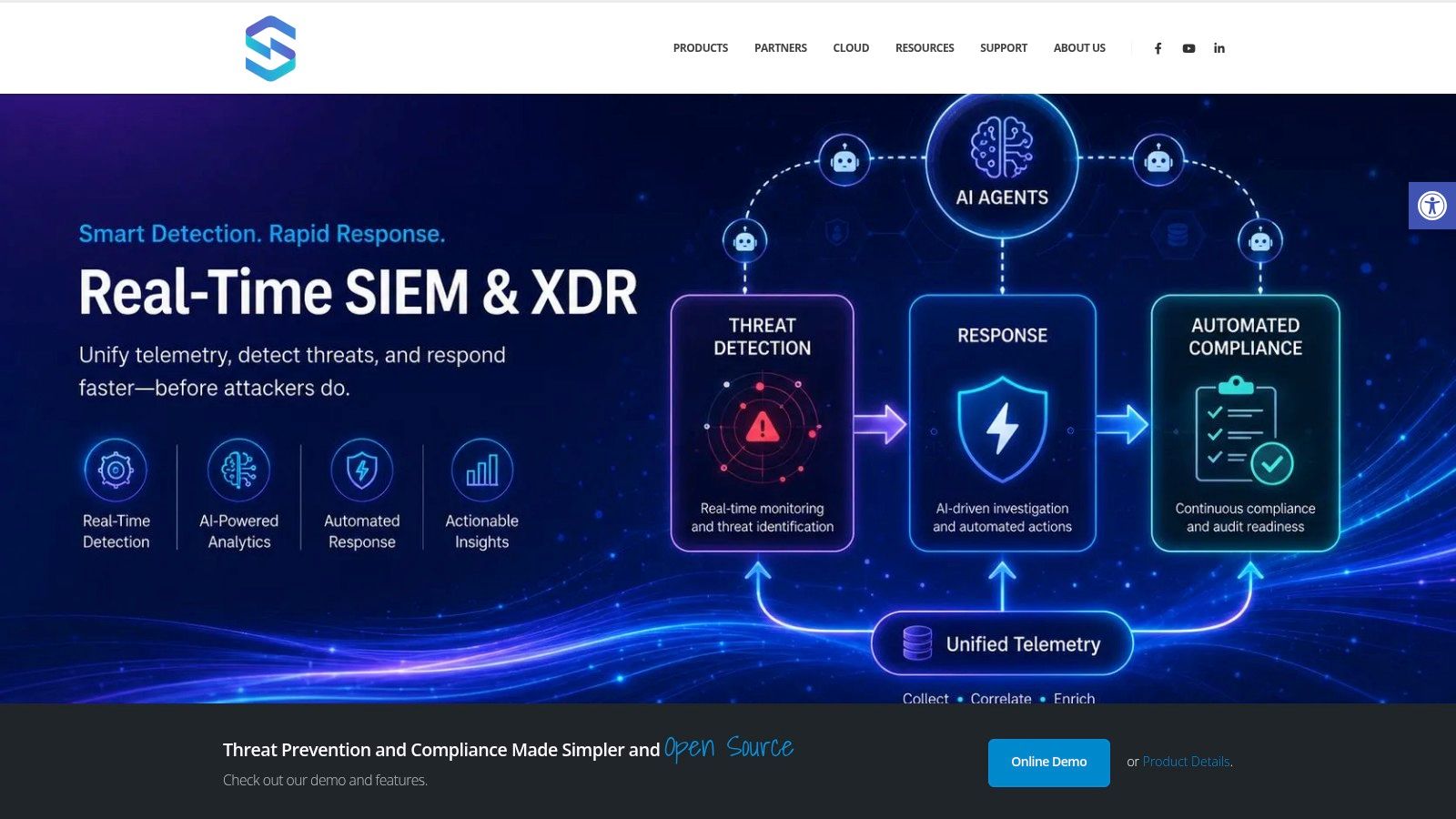
Unified Security Stack is one example here; it brings together SIEM/XDR and compliance workflows, allowing detections, logs, and mapped control evidence to reside in one environment. For hybrid teams that do not want another silo, that is a significant design decision.
A Practical Roadmap for Selecting and Implementing Your Solution
The most common selection error I observe is purchasing for appearances and deploying just to get by. Demos focus on reports. The real work starts when you try to link cloud logs, IAM events, HR ownership data, endpoint status, and legacy records within a single control model.
Begin with the implementation path rather than the license tier.
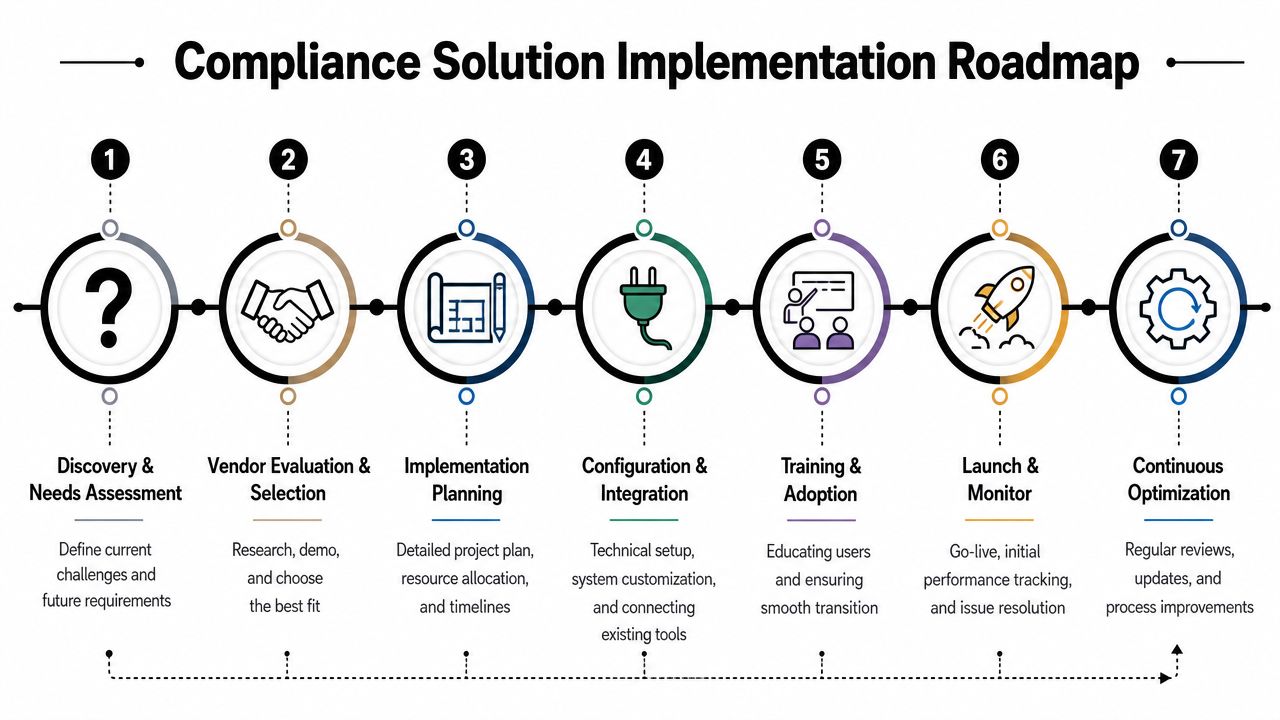
Phase one and two define whether the project survives
Discovery and scoping make up the first phase. Take stock of the frameworks you report against, the internal controls already in place, and the systems capable of generating evidence. This may sound elementary, yet many teams overlook it and learn late that a supposedly straightforward HIPAA or ISO rollout relies on HR data, ticket states, identity groups, and third-party attestations.
If you're in healthcare or adjacent regulated operations, a concise 10-point HIPAA checklist is useful in discovery because it pushes the discussion back toward tangible safeguards and operational evidence.
Integration prioritization is the second phase. Start by connecting the systems that resolve the greatest number of audit questions. Typically those are identity, cloud, logging, endpoint, and ticketing. Defer lower-value edge cases unless they underpin a critical control.
Build workflows before you build dashboards
After purchase, many buyers struggle because report generation is not the difficult part. The challenge is cutting administrative overhead in a mixed environment and connecting varied evidence sources for ongoing validation. ANSI's announcement about its cloud compliance platform calls attention to this operational issue when it discusses reducing administrative overhead and staying current with obligations.
Before rollout, this brief walkthrough merits a look because it encourages teams to consider workflow fit, not only platform fit.
After core integrations, define playbooks for recurring work:
- Evidence freshness rules for how often each control needs live validation
- Exception workflows for temporary noncompliance and documented risk acceptance
- Remediation routing so findings become tickets with owners and due states
- Escalation paths when a control repeatedly fails or evidence stops flowing
Choose the product for its evidence model. Deploy it according to the operating model.
Adoption is part of implementation
Give auditors, compliance leads, identity administrators, cloud teams, and SOC analysts training in a shared control language. When teams use different names for one control, the platform will reflect that confusion. For organizations centered on regulated healthcare settings, HIPAA compliance automation workflows serve as a helpful reference because they demonstrate how evidence collection and security operations can be linked rather than run in isolation.
Continuous optimization arrives last, yet it is never finished. Connectors shift. Control owners depart. Frameworks change. Strong implementations expect drift and prepare for it.
How to Measure the ROI of Your Compliance Platform
When seeking budget for compliance management solutions, improved visibility alone will not make the case. Leaders require evidence that the platform cuts labor, shortens audit cycles, and strengthens control reliability.
The market signal is already present. A forecast projects the global quality and compliance management solution market at USD 31.9 billion in 2025, rising to USD 77.6 billion by 2035, with a 9.3% CAGR, according to Future Market Insights' market forecast. That level of investment means buyers must demonstrate operational return, not merely policy coverage.
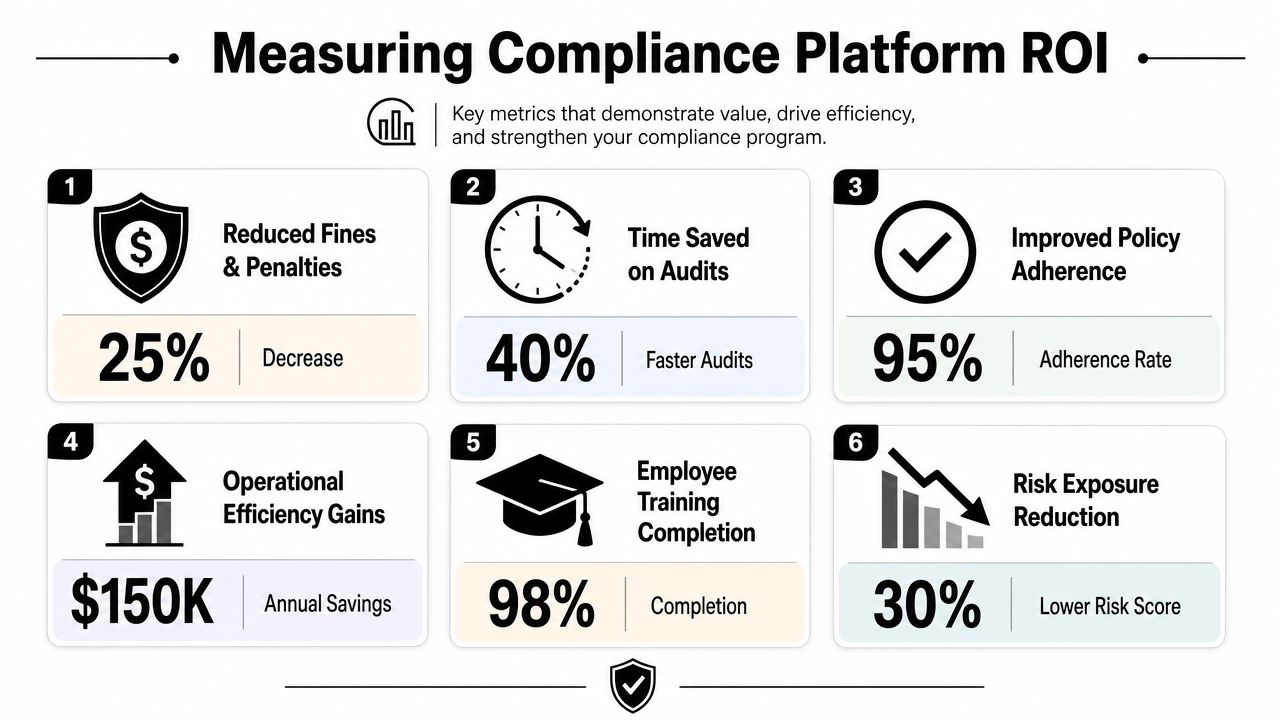
The metrics that matter
Use a before-and-after view tied to actual process work:
- Audit preparation effort measured in staff hours spent collecting, formatting, and validating evidence
- Time to produce an audit-ready package from request to delivery
- Control automation coverage measured as the share of controls backed by direct system evidence instead of manual uploads
- Exception resolution speed based on how quickly findings move from detection to documented closure
- Evidence freshness based on how much of your control set is current without human intervention
- Cross-framework evidence reuse based on whether one validated control supports multiple obligations
What not to overvalue
Do not place too much weight on dashboard usage, report export counts, or controls imported on the first day. Those metrics indicate activity, not business results.
A platform delivers ROI when it takes recurring work off senior staff and substitutes repeatable evidence collection for static proof.
The most compelling business cases connect platform value to three outcomes: less time consumed by audit preparation, reduced tension between security and compliance teams, and greater confidence that controls are functioning.
Common Pitfalls in Compliance Management and How to Avoid Them
The first pitfall is the reporting-only trap. Organizations purchase a platform for status dashboards and exports suited to the board, but keep evidence gathering outside the system. The dashboard appears tidy, yet employees continue to track down proof by hand. Prevent this by mandating integrations with source systems for your most critical controls before declaring the project finished.
The second is integration ignorance. Purchasers undervalue the effort needed to standardize data from legacy systems, cloud services, ticketing platforms, and bespoke workflows. That does not mean every connector must be present from day one. It means integration work should be estimated during product selection, not discovered unexpectedly after signing.
Three habits that keep the platform useful
- Manage evidence pipelines as production dependencies. Watch for failed connectors, outdated data, and faulty mappings just as you would for any other critical service.
- Examine control logic on a regular basis. A control that worked last year might no longer align with the system, the framework, or the business process.
- Maintain security and compliance within a single workflow. If the SOC detects a problem but compliance cannot use that signal, you will recreate silos within a modern tool.
The last pitfall is the set-it-and-forget-it mindset. Compliance management solutions are not fixed libraries. They require maintenance as teams, systems, and obligations evolve. Organizations that gain value from them do not view implementation as the end. They see it as the moment compliance becomes part of daily operations.
If your team wants one place to connect security telemetry, automate evidence collection, and support compliance workflows across hybrid environments, Unified Security Stack deserves consideration. It brings together SIEM, XDR, log management, and compliance capabilities in one platform, which often suits better than adding another standalone reporting tool to an already fragmented stack.