Continuous Compliance Monitoring: A Practical Guide
83% of organizations reported moderate or major delays from manual compliance work in 2026, while 53% said one full-time employee's worth of effort is spent on evidence collectionAccording to the 2026 State of Continuous Compliance Monitoring report, those figures capture the operational problem more accurately than one more promise of an audit-ready dashboard.
Continuous compliance monitoring should keep controls visible, testable, and tied to remediation as systems evolve. In reality, many teams roll out the tools, then find that people still must adjust integrations, investigate alerts, verify evidence, pursue control owners, and justify exceptions to auditors. The technology may be continuous, but the operating model stays painfully manual.
Table of Contents
- Why Continuous Compliance Monitoring Matters Now
- Understanding Continuous Compliance Monitoring
- Architecture and Core Components
- Framework-Specific Monitoring Requirements
- Implementation Steps for Security Teams
- Avoiding Compliance Theatre and Common Pitfalls
- Operationalizing Continuous Compliance with Unified Security Stack
Why Continuous Compliance Monitoring Matters Now
Periodic compliance produces a risky gap between how fast environments change and how frequently teams check controls. A cloud permission may shift, an endpoint may drift from its baseline, or a logging pipeline may stop forwarding events well before the next scheduled review. An audit report can accurately reflect the environment when testing occurred, yet offer limited assurance about what took place afterward.
The resourcing issue makes this worse. That same 2026 report found that 85% of organizations had delayed or eliminated legacy GRC activities, and 44% had postponed control testing and monitoringThese issues do not reflect a lack of compliance knowledge. Instead, they show that constraints in evidence collection and staffing can prevent skilled security teams from sustaining the programs they established.
The hidden cost of manual evidence
Manual evidence gathering takes attention away from detection and response in security operations. Analysts pull logs, engineers take configuration screenshots, system owners verify access reviews, and compliance staff match artifacts across cloud platforms, endpoints, identity systems, and ticket queues. Each handoff can bring stale evidence, missing context, or an unresolved exception treated as a finished task.
The result is often compliance theatrea process that creates artifacts without proving that controls work under real operating conditions. A dashboard can show a control was checked. It can't, on its own, prove that the correct event was detected, assigned to an owner, remediated, and validated afterward.
Practical rule: Automate the evidence trail surrounding a control, rather than just the act of marking a box.
Continuous monitoring as an operating model
Continuous compliance monitoring closes the gap by linking telemetry, control logic, risk decisions, and response. A SIEM can centralize logs, an XDR platform can provide endpoint and identity context, and SOAR playbooks can build a consistent route from a finding to containment or remediation. The value lies in the connection among those functions.
Organizations that have achieved some level of continuous compliance are not using it solely as an audit exercise. Three in four organizations in the same industry dataset reported that continuous compliance drives business value, as summarized by Drata's compliance statisticsThat value becomes visible when teams cut evidence handling, identify control drift earlier, and provide risk leaders with up-to-date information rather than historical snapshots.
For teams with limited resources, the goal isn't to monitor everything with the same intensity. It's to focus on high-risk assets and controls, gather the evidence machines already produce, and save human judgment for exceptions, ambiguous findings, and risk acceptance.
A practical starting point is a unified compliance management solution that ties control status to the underlying security events. Without that connection, automation can reduce paperwork while leaving the operational bottleneck intact.
Understanding Continuous Compliance Monitoring
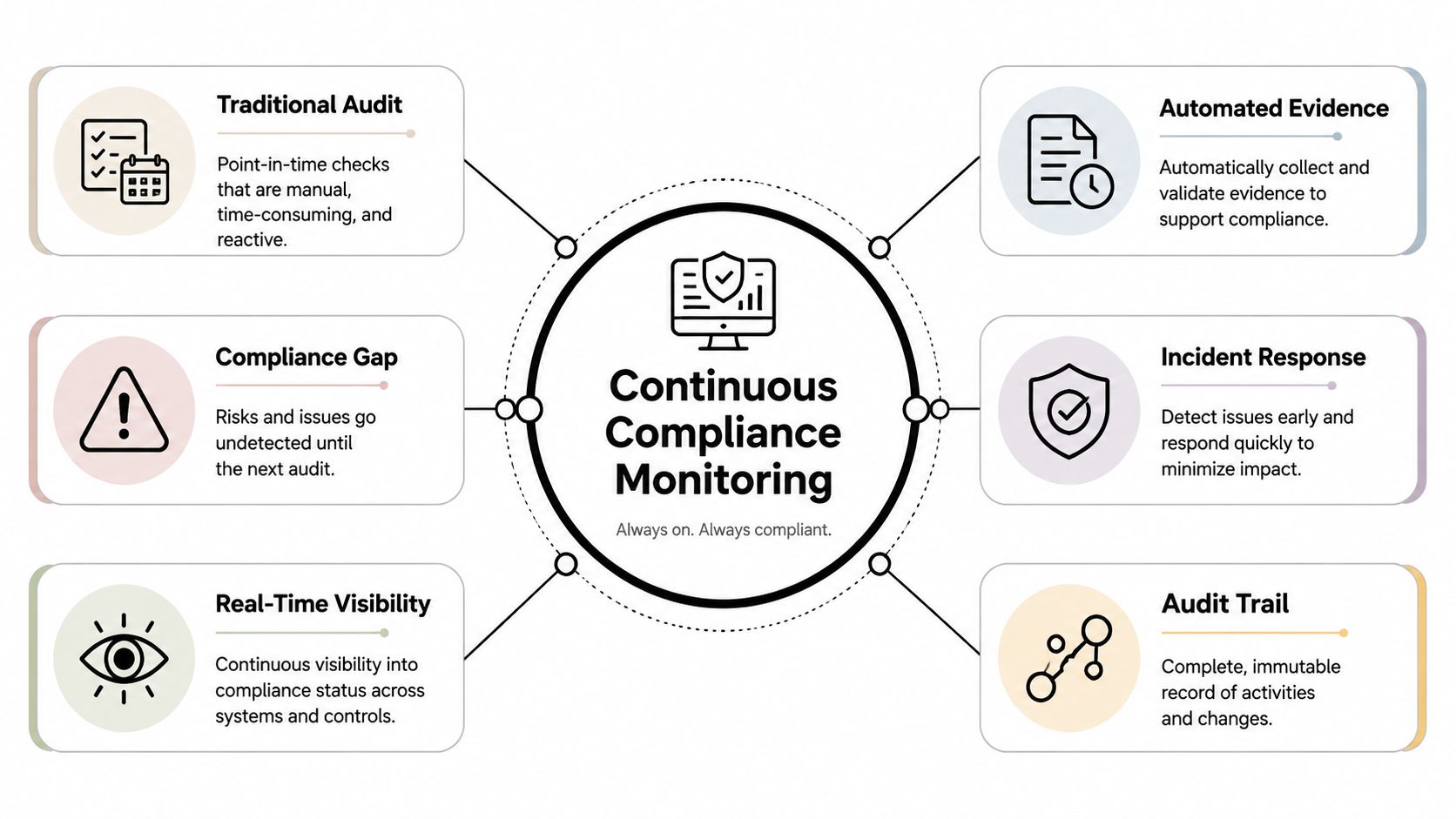
Traditional compliance depends on point-in-time validation. Teams ready themselves for an audit, collect evidence for a set period, test chosen controls, and document the results. That method can satisfy a review window, but it doesn't continuously prove that controls remain effective after configuration changes, new deployments, personnel changes, or threat activity.
Continuous compliance monitoring substitutes an ongoing feedback loop for the snapshot. The system gathers relevant telemetry, assesses controls against current conditions, retains evidence, and routes material deviations for investigation or remediation. The goal isn't continuous human observation. It's recurring automated validation that enables timely, data-driven risk decisions.
The NIST foundation
The practice became formally established in modern federal security practice with NIST SP 800-137, published on September 30, 2011The publication described Information Security Continuous Monitoring, or ISCM, as keeping ongoing awareness of information security, vulnerabilities, and threats to guide risk management decisions, as outlined in the NIST SP 800-137 publication.
NIST's framework is important because it presents monitoring as security management work, not an audit administration duty. Monitoring has to happen often enough to inform real-time decisions, and controls that are deployed or inherited stay within its scope. A related NIST FAQ from June 1, 2010 had already recognized continuous monitoring as one of the six steps in the Risk Management Framework, indicating that the concept was in practice before the formal publication.
Monitoring versus compliance
Continuous monitoring and continuous compliance intersect, but they are not the same. Monitoring watches systems, events, configurations, vulnerabilities, and access activity. Continuous compliance adds the policy and control layer that decides whether those observations satisfy a framework requirement or internal obligation.
A useful operational model has four questions:
- What changed? An endpoint state, an identity privilege, a configuration, or an access event.
- Which control is impacted? Any change needs to align with a defined requirement or risk goal.
- What decision follows? The team can examine, resolve, accept, or escalate that risk.
- What proof establishes closure? The system is required to keep the event, action, owner, and validation outcome.
That final step distinguishes an actual program from a flood of alerts. Ongoing compliance monitoring ought to yield a clear record of how well controls work over time, rather than merely a stack of notifications.
Architecture and Core Components
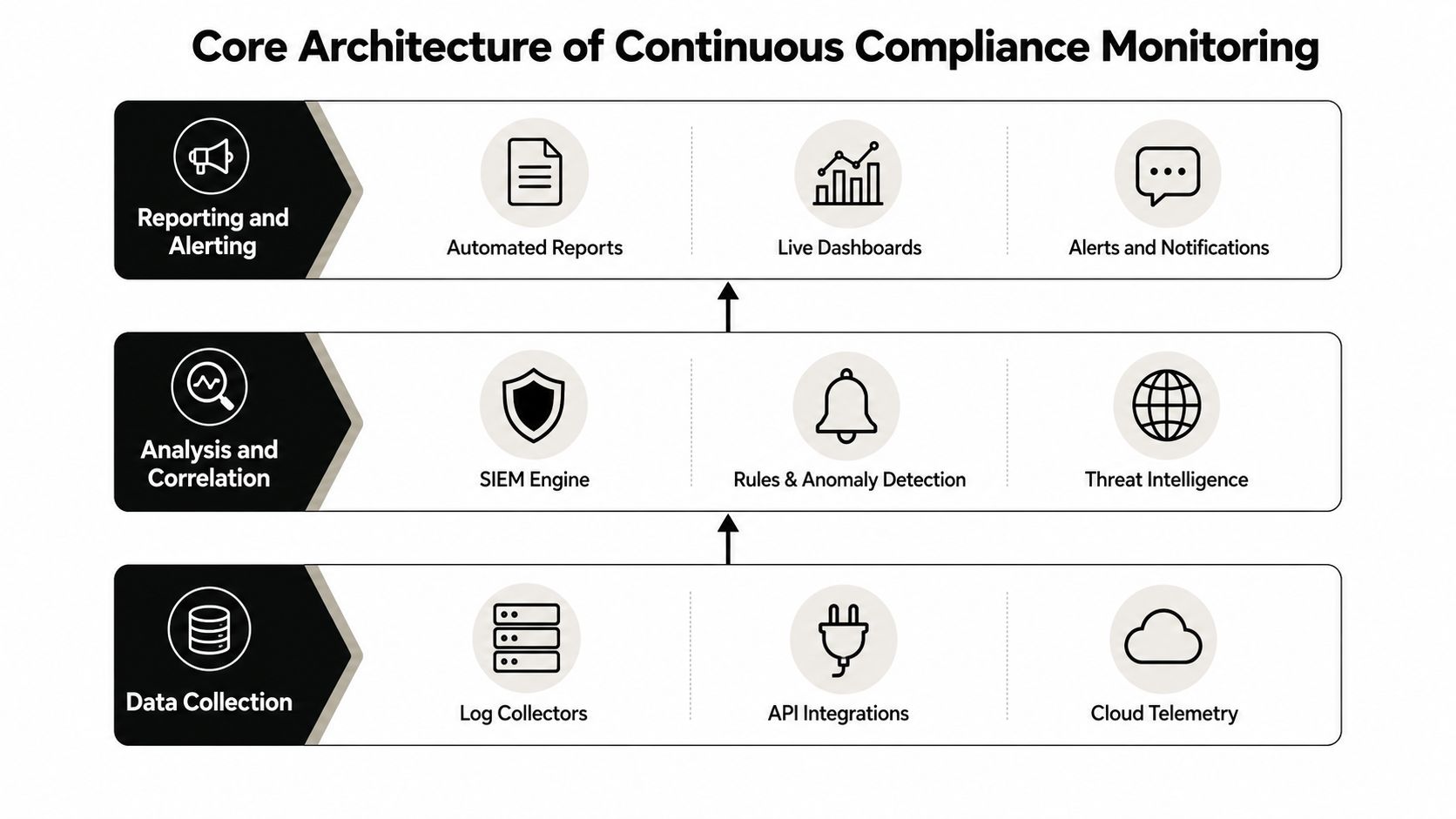
A sustainable architecture has three connected layers: collection, correlation, and evidence mapping. Teams frequently acquire these functions independently and then invest considerable effort getting them to share context. A unified SIEM/XDR architecture lowers that integration load, yet it still calls for intentional data selection and control engineering.
Collection creates the evidence foundation
The collection tier pulls telemetry from the systems that establish the compliance boundary. In a hybrid setting, this typically covers cloud audit services, identity providers, firewalls, network devices, applications, virtual machines, containers, and endpoints. APIs offer structured access to cloud and SaaS events, Syslog transports device and application messages, NetFlow contributes network behavior, and agents deliver endpoint detail that network logs cannot supply.
Centralization is essential because auditors or investigators require more than separate records. They must link an identity action to the endpoint involved, the resource reached, the alert generated, and the remediation carried out. NIST SP 800-171 control 3.3.1 obliges organizations to generate and keep system audit logs and records as necessary for monitoring, analysis, investigation, and reporting of unauthorized activity, as outlined in this NIST SP 800-171 control reference.
A practical centralized log management design also establishes accountability for every source. Someone needs to know which system produces the event, what a missing event signifies, how long it should be kept, and how its integrity is safeguarded.
Correlation turns telemetry into decisions
Raw data is not proof of control effectiveness until the platform makes sense of it. Correlation rules link related events, for example a failed authentication sequence followed by a successful privileged login and access to a sensitive resource. Detection logic can merge identity, endpoint, network, vulnerability, and asset context before an alert reaches an analyst.
At this layer, security teams balance sensitivity against fatigue. A rule that triggers on every small deviation might technically increase visibility while rendering the program unworkable. A rule that suppresses too heavily could conceal the very activity an auditor or incident responder must understand.
Large language models can help with alert triage, rule tuning, and summarization, but they should not substitute for deterministic control logic or analyst accountability. The platform must retain the underlying events and clarify why a finding maps to a control.
Evidence mapping closes the loop
The last layer connects detections, configuration checks, access reviews, vulnerability results, and remediation records to framework controls. It should keep timestamps, source context, ownership, exception status, and validation results. Automated reports are valuable only if they reveal the path from observation to decision.
Response playbooks finish the architecture. A failed control may open a ticket, alert the owner, isolate an endpoint, disable an exposed credential, or seek human approval before acting. The correct response depends on the control and the risk, so playbooks need to be explicit, tested, and reversible when feasible.
Framework-Specific Monitoring Requirements
Frameworks do not all require the same evidence. An effective monitoring program begins with the actual obligation, then chooses the telemetry and review process that can demonstrate it. Treating every framework as a generic checklist causes unnecessary collection and leaves critical requirements under-specified.
Where the requirements differ
HIPAA monitoring centers on continuous awareness across systems that handle ePHI. The operational scope brings together continuous log collection, access reviews, vulnerability scanning, and configuration checks to support the Administrative, Physical, and Technical Safeguards in 45 CFR § 164.308, § 164.310, and § 164.312, according to this HIPAA continuous monitoring overview. A healthcare organization thus must link user activity and system posture to the systems that process ePHI, instead of depending on a standalone audit log.
PCI DSS Requirement 10 is more specific about the events that logs must record. Those events cover individual user access to cardholder data, actions by root or administrative users, access to audit trails, invalid logical access attempts, and changes to identification or authentication mechanisms, as detailed in this PCI DSS logging and monitoring guide. Every record requires user identification, event type, date and time, success or failure, origin, and the affected resource.
PCI DSS also links monitoring to availability and response. Centralized logging demands limited access and sufficient capacity to keep at least 90 days of log data readily available, while the rest of the 12-month retention period can be restored when necessary. Required events must be reviewed at any hour, day or night, and monitoring must happen at least daily, according to this PCI DSS Requirement 10 monitoring guidance.
For SOC 2, teams usually require structured evidence showing that controls operate in line with the relevant Trust Services Criteria. The focus is not on a single common event list; it is on demonstrating consistent operation of policies, access controls, change management, monitoring, and incident processes.
ISO 27001 draws value from a monitoring approach linked to the information security management system and ongoing improvement. Evidence should underpin risk treatment, control operation, incidents, corrective actions, and management review. CMMC obliges defense contractors to show practices suited to the relevant maturity level, which makes defensible logging, access control, configuration management, and incident evidence particularly critical. GDPR focuses on accountability and safeguarding personal data, so monitoring should underpin access governance, security events, response, and documented decisions related to data protection.
Comparison at a glance
| Framework | Log Retention | Review Frequency | Key Evidence Types |
|---|---|---|---|
| HIPAA | Retain logs according to organizational policy and applicable safeguards | Ongoing monitoring with recurring reviews | ePHI access logs, access reviews, vulnerability results, configuration checks |
| PCI DSS | 90 days readily available, with the remainder of a 12-month retention period restorable | At least daily, with required alerts reviewed at any time of day or night | Cardholder data access, administrative actions, invalid attempts, audit trail access, authentication changes |
| SOC 2 | Defined by the control design and audit scope | Based on control operation and monitoring requirements | Control evidence, access records, change records, incident records, review results |
| ISO 27001 | Defined by risk, policy, and evidence needs | Ongoing improvement and management review | Risk treatment, control operation, corrective actions, monitoring records |
| CMMC | Defined by applicable practice and assessment requirements | Based on practice implementation and organizational process | Audit records, access control evidence, configuration and incident records |
| GDPR | Defined by policy, risk, and data protection obligations | Ongoing accountability and security review | Access activity, incident records, data protection decisions, remediation evidence |
The table serves as a planning aid; it does not replace the relevant framework text or assessor guidance. The key distinction is that retention, event detail, and review cadence must be designed per obligation, rather than taken from a boilerplate SIEM template.
Implementation Steps for Security Teams
A team with limited resources should not start by trying to monitor every control in every system. Begin with the assets, data flows, and controls where failure would cause the greatest security or audit risk, then broaden coverage once the evidence pipeline proves dependable.
1. Assess the current state
Take inventory of in-scope cloud accounts, identity systems, network devices, endpoints, applications, data stores, and third-party services. Document which systems generate logs, where those logs are sent, who owns them, and whether existing records support investigation and reporting.
Check for silent failures first. A collector no longer forwarding data, an endpoint missing an active agent, or a cloud integration that records administrative events but not data access can give a misleading impression of coverage.
2. Establish boundaries and rank what matters most.
Link each priority control to the telemetry required to test it. For instance, a privileged access control might need identity events, endpoint context, administrative activity, and ticket evidence. A vulnerability control might require scanner output, asset ownership, remediation status, and a validation event.
Select a limited starting scope that the team can manage. Prioritization should account for sensitive data, privileged systems, critical services, known exposure, and the requirements most likely to influence an active audit or customer commitment.
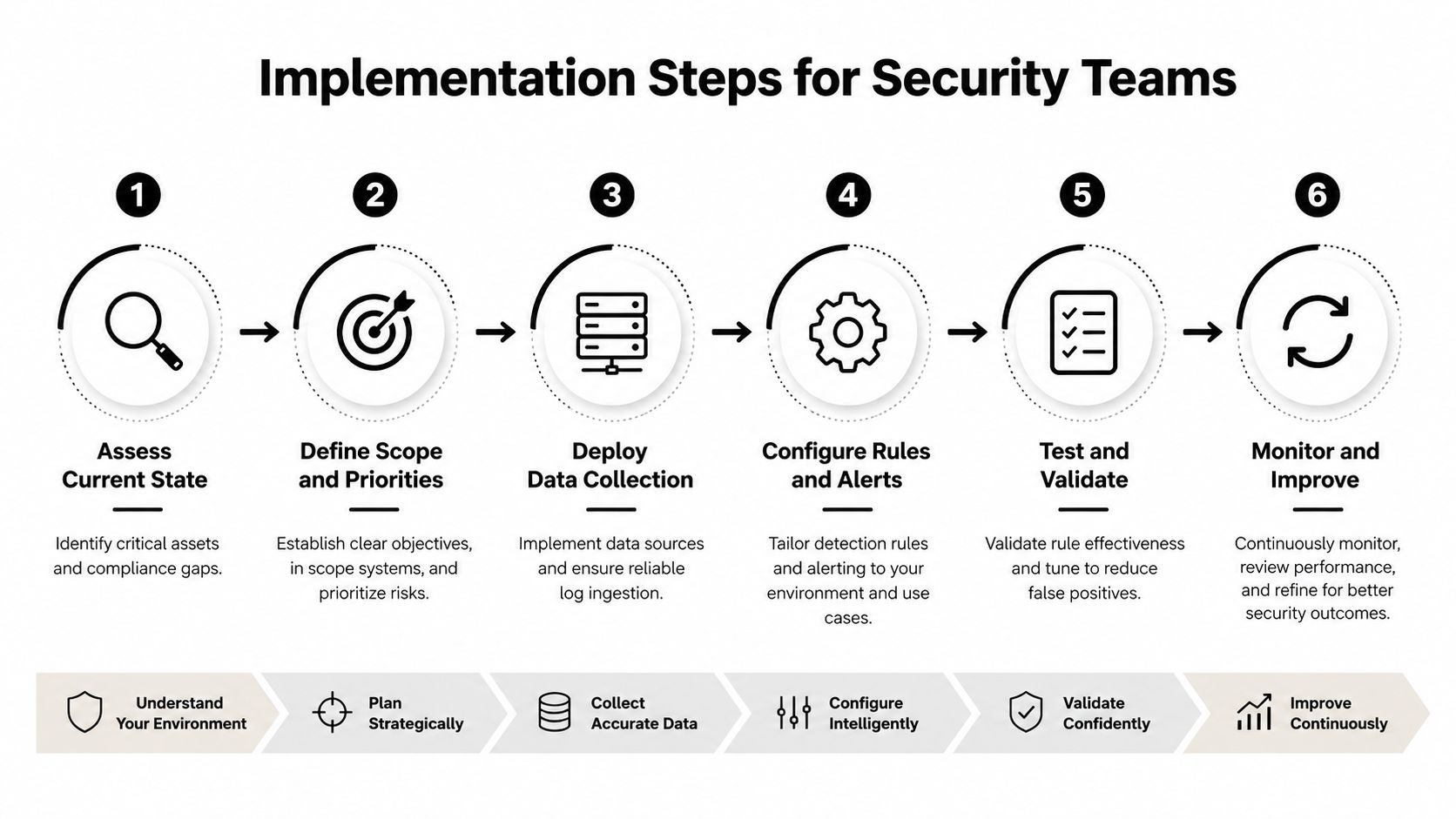
3. Deploy collection with assigned ownership
Integrate cloud APIs, Syslog sources, NetFlow, endpoint agents, and application feeds. Standardize timestamps, identities, hostnames, and resource identifiers so correlation rules can combine records across systems. Give every integration an owner and a health check.
4. Put rules and alerts in place.
Build rules for control failures and significant attack behavior, not for every event available. Adjust thresholds based on normal activity, document exceptions, and send findings to the team able to act. A rule with no owner is an observation, not an operational control.
5. Test and validate
Create safe test activity, confirm that the platform detects it, ensure that evidence ties back to the intended control, and verify that the response workflow reaches the right owner. Then validate the remediation and retain that closure record.
A control is not operationally effective when it can alert but cannot produce a reliable closure trail.
6. Monitor and improve
Examine false positives, missed events, outdated integrations, unresolved exceptions, and evidence quality. Use that feedback to refine rules and collection. Compliance automation software can cut down on repetitive work, but it will not eliminate the need to maintain control definitions and response ownership.
The implementation sequence should stay linked to incident response. A compliance finding that points to active compromise requires the same urgency and escalation path as a security alert, not a separate queue that waits for audit preparation.
Avoiding Compliance Theatre and Common Pitfalls
A monitoring program can appear mature while demonstrating very little. The warning signs are well known: dashboards show green status without revealing the underlying evidence, the platform gathers data that is not mapped to controls, and alerts vanish into queues with no accountable owner. Documentation may describe an approved configuration while the production environment follows another process.
Current practitioner reporting directly identifies this shortfall. Only 4% of organizations have full end-to-end automation, and only 28% monitor controls continuously in real time, according to this coverage of continuous monitoring practices in regulated industries. Those numbers do not mean automation is ineffective. They show that deploying a tool is easier than linking monitoring to decisions, remediation, and proof of effectiveness.
What weak programs get wrong
- They collect without mapping: Teams take in large volumes of logs but cannot explain which control each source supports.
- They alert without prioritizing: Findings reach analysts technically sound but stripped of context about assets, identities, business relevance, or data sensitivity.
- They document without validating: A policy continues to show as effective despite drift in the underlying configuration.
- They remediate without closure: A ticket gets closed as complete, yet no later event demonstrates the control was restored to its required state.
- They automate without governance: Playbooks act without defined approval limits, exception paths, or rollback steps.
A stronger test is to choose a single critical control and follow it from start to finish. Can the team pinpoint the originating event, spot a failure, assess risk, name an owner, document the decision, fix the problem, and confirm the outcome? If any step relies on an undocumented manual workaround, the program is not yet continuous.
A dashboard showing green does not prove a control works unless the team can explain how that status was derived and what occurred when the control failed.
Limited resources make prioritization inevitable. Do not judge success by how much data is collected or how many rules are configured. Judge whether the platform helps the staff you have make quicker, more defensible decisions and keeps evidence aligned with how systems actually behave.
Operationalizing Continuous Compliance with Unified Security Stack
A unified SIEM and XDR platform can bridge the distance between continuous compliance tooling and the personnel needed to run it. Unified Security Stack gathers logs from cloud services, network devices, and endpoints via APIs, Syslog, NetFlow, and agents, then correlates events in real time before indexing to cut noise. Its built-in large language models help with alert triage and rule tuning, while response playbooks link findings to containment and remediation.
The platform further merges compliance workflows with security capabilities like vulnerability scanning, access rights auditing, endpoint protection, dark web monitoring, and file tracking. Evidence can be aligned to frameworks such as CMMC, HIPAA, SOC 2, ISO 27001, PCI, GDPR, and GLBA, providing risk teams one shared view rather than distinct dashboards for each obligation.

The real benefit is consolidation. A leaner security team can rely on shared telemetry, correlation rules, evidence workflows, and automated playbooks without creating a separate operating process for each framework. Automation still requires ownership and tuning, but a unified architecture cuts down on the disconnected handoffs that stall compliance work.
Unified Security Stack provides open-source SIEM, SOAR, XDR, centralized logging, automated compliance evidence, vulnerability monitoring, and response playbooks for hybrid environments. Visit Unified Security Stack to assess how a unified platform can help your team maintain continuous compliance monitoring without increasing headcount.