Compliance Automation Software: A Practical Guide for 2026
You have a spreadsheet packed with screenshots, CSV exports, and partially assigned owners, while the auditor expects a single clear response to a basic question: can you show the control operated at the critical moment? That is the gap compliance automation software is designed to bridge in security teams that cannot rely on assumptions, particularly when logs, cloud configurations, identity activity, and policy proof reside in separate locations.
The strain is genuine since compliance no longer means chasing documents once per year. It now depends on ongoing cloud shifts, identity drift, endpoint behavior, and audits across frameworks, which explains why today's security teams view compliance as an operational control plane rather than a paperwork task.
Table of Contents
- What Is Compliance Automation Software
- The Problem with Manual Compliance Management
- How Compliance Automation Software Actually Works
- Core Capabilities and Essential Integrations
- Implementing a Compliance Automation Strategy
- Unifying Security and Compliance with an XDR Platform
- Measuring ROI and Avoiding Common Pitfalls
What Is Compliance Automation Software
The fastest way to understand compliance automation software is to examine the moment it replaces. Rather than gathering evidence during the week before an audit, the platform keeps controls, logs, and proof updated continuously, so the team does not recreate the same narrative from zero every quarter. This matters in cybersecurity because controls remain credible only when supported by live operational data rather than static checklists.
The category turns compliance from a periodic manual event into a continuous automated process. Current platforms collect data from internal systems and regulatory feeds, then apply rules, workflow logic, and automated validation to keep evidence and control status up to date. That change is one reason the wider compliance software market is projected to rise from USD 40.82 billion in 2026 to USD 74.12 billion by 2031, at a 12.67% CAGR (Mordor Intelligence).
Why the market keeps expanding
The market is growing because regulated teams require a single location to coordinate audit evidence, policy mapping, and repeated control checks. The business rationale is not mainly novelty but replacing fragile manual tracking with centralized automation that withstands cloud changes, staffing shortages, and pressure across frameworks. For smaller teams creating an organized checklist, a sensible starting point is Blowfish Technology's checklist for UK SMEs, which offers helpful context if your compliance program still depends on worksheets and email threads.
From a software perspective, compliance automation intersects with security operations. If your stack already consolidates telemetry, compliance can reuse that operational reality rather than asking staff to rebuild it afterward. A helpful internal reference point is the wider concept of compliance management solutions, since the most effective implementations link policy, evidence, and remediation within a single workflow.
Practical rule: if the system cannot tell you what changed, when it changed, and which control it impacted, it is not automation. It is merely a better checklist.
The Problem with Manual Compliance Management
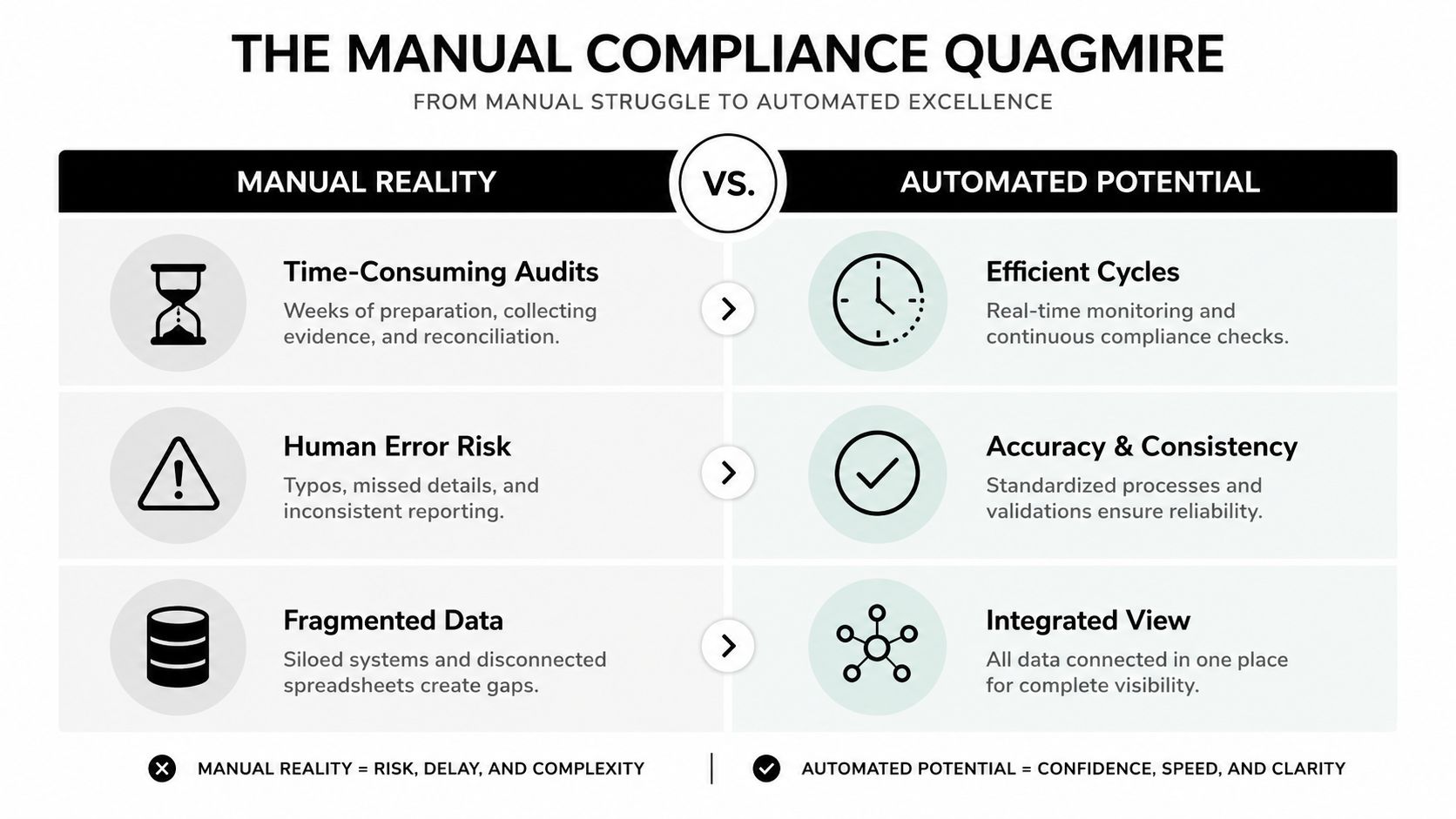
Manual compliance appears manageable until the environment begins to change. The expense appears in screenshots, spreadsheet reconciliations, and email threads that keep expanding because each control owner must be pursued manually. In cybersecurity, that lag is a genuine risk, since a control may fail well before a quarterly review reveals it.
Why spreadsheets break under security pressure
Regulated organizations frequently must monitor hundreds of requirements across cloud platforms, identity systems, vendors, and several frameworks. That burden is precisely why spreadsheet-based compliance fails in practice. A small number of obligations can be handled diligently. As scope expands, the process becomes disjointed, handoffs go missing, and evidence ends up stored in too many locations simultaneously.
The security guard analogy
Manual compliance operates like a guard who inspects every door once per quarter and assumes the building remained secure in between. That might satisfy a schedule, but it does not reflect a live environment where cloud permissions, logs, vendor access, and endpoint states shift daily. Automation replaces that periodic check with continuous monitoring, and that is where the operational distinction begins to count.
Market reporting points to a large reduction in manual compliance workload, better audit coverage, and fewer manual tasks in evidence collection when automation is in place MarketIntelo. The practical benefit is not merely speed. It is the capacity to keep controls connected to actual system state rather than depending on someone to reconstruct proof afterward.
Those benefits matter because manual processes conceal issues. A missing screenshot, an obsolete control owner, or an outdated policy attestation can all appear acceptable until the audit begins. By that point, the team is describing gaps rather than fixing them.
A spreadsheet can document that a control once existed. It cannot demonstrate that the control remained operational when the system changed.
Manual compliance also produces a misleading sense of certainty. Teams devote more time to collecting proof than to verifying that proof, and that is an exposed position in finance, healthcare, government contracting, and SaaS. The issue is visibility, since security leaders require live evidence, not retrospective narration.
How Compliance Automation Software Actually Works
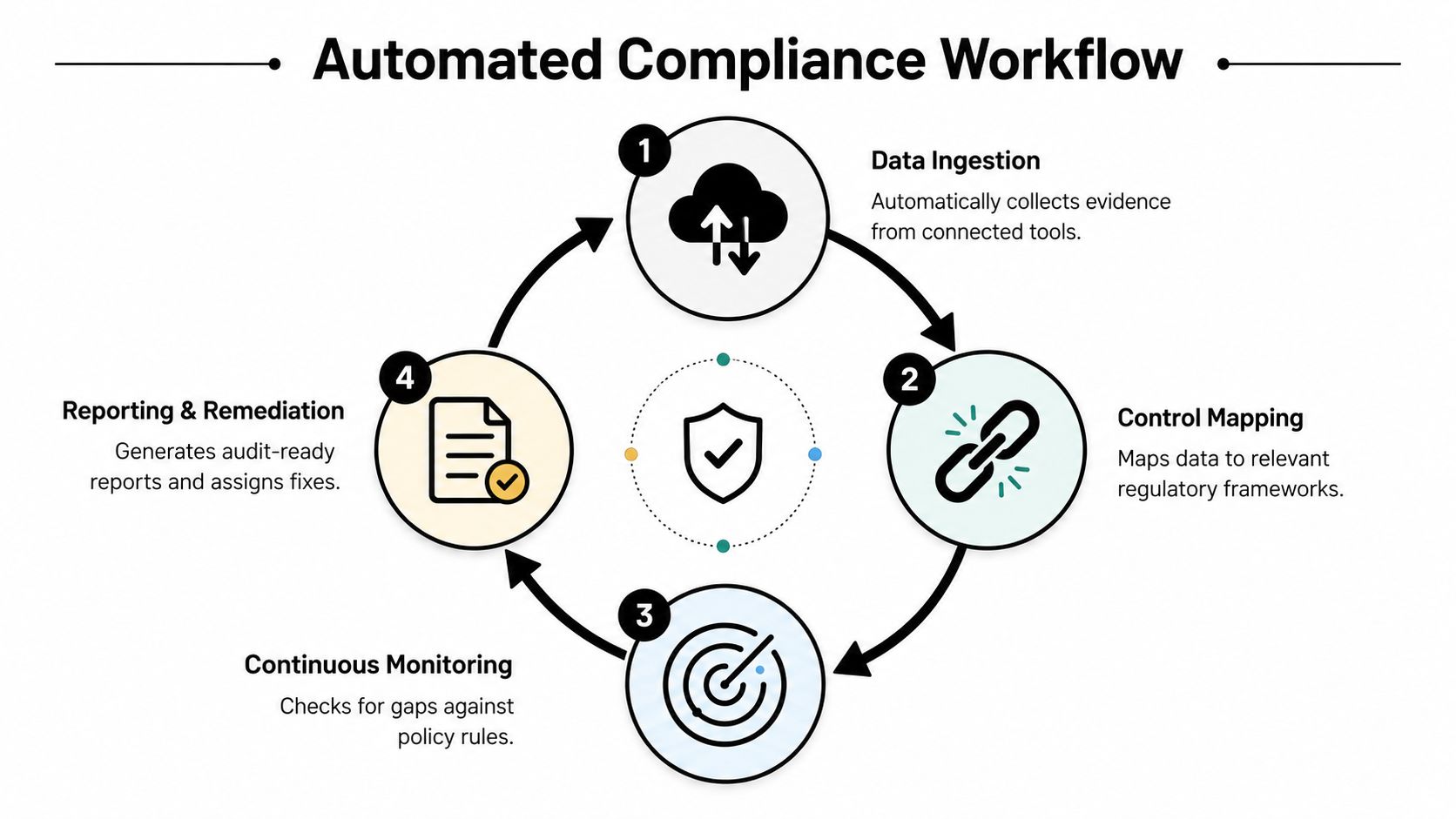
The simplest way to grasp the workflow is to view it as an assembly line. Data enters at one end, control logic enriches it, monitoring tests it against policy, and reporting converts it into audit-ready output. The value is not in any single step, it is in the sequence remaining linked without people reentering the same facts into separate systems.
Data ingestion and control mapping
First, the platform retrieves evidence from connected systems, cloud services, and operational tools. This covers source systems that already hold useful information about access, configuration, or activity, so compliance does not depend on files uploaded by hand. The following step is control mapping, where a single operational control connects to several frameworks so the team does not repeat the same evidence request for each audit. SecurityCompass describes this reusable control model across frameworks including ISO 27001, PCI DSS, NIST, and FDA (SecurityCompass).
Continuous monitoring and automated reporting
The key transition is away from checks set by the calendar and toward verification driven by events. Today’s platforms take in internal system data along with external regulatory feeds, then apply AI and ML to evaluate the impact of regulatory changes almost instantly and start workflows before violations happen (Diligent). This means configuration drift, missing evidence, or policy exceptions can be surfaced the moment they emerge, rather than waiting until the next review cycle.
What the workflow changes operationally
With the data in motion, the platform can produce audit-ready reporting without manually recreating evidence packs. That shortens the gap between a control failing and its remediation, a point where many security programs stall. The technical distinction is straightforward yet significant: the system no longer behaves like a filing cabinet and begins to function as a control loop.
Core Capabilities and Essential Integrations
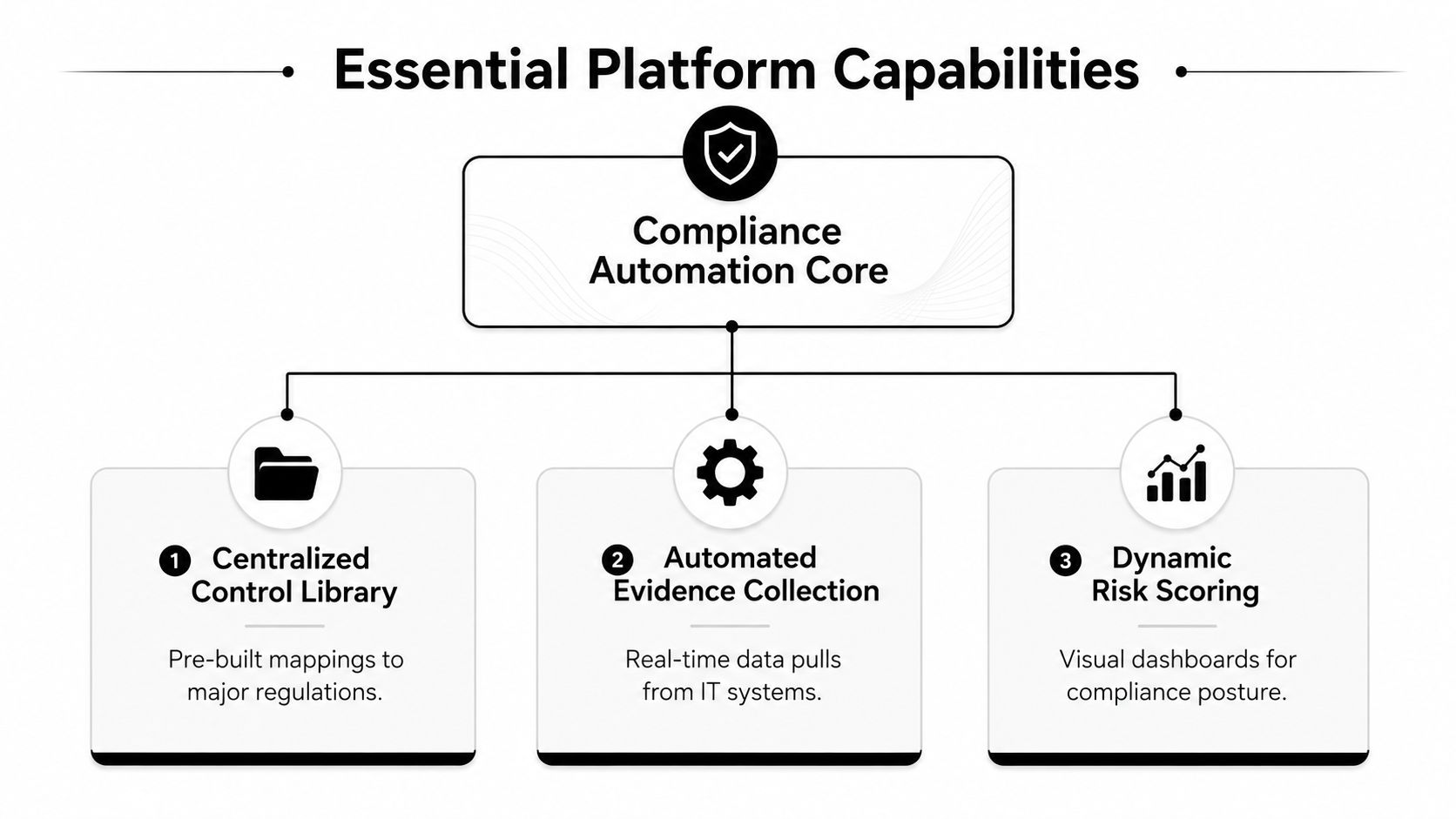
A credible platform must go beyond housing policies and producing reports. It requires a reusable control library, evidence gathering linked to actual systems, and sufficient integration breadth so compliance does not become yet another silo. In cybersecurity operations, that generally means the platform must align with the same stack that generates logs, identity events, and change records.
Essential capabilities
Automated evidence collection is necessary. Platforms that draw directly from AWS, Azure, identity providers, and HR tools can map one control to multiple frameworks such as SOC 2, ISO 27001, and HIPAA, which cuts duplicate work and gives auditors a single place to verify proof (TryComp). This matters because requesting evidence separately for every framework tends to produce inconsistent timestamps, outdated exports, and needless back-and-forth.
A robust platform also requires a centralized control library. Without one, each new framework turns into another manual project, and the team winds up maintaining the same control in three separate locations. Control normalization is what allows continuous compliance to function in daily operations.
Integration breadth decides whether automation works
The largest deployment error is failing to give the integration layer enough weight. Compliance tools become useful only when they link to the systems that contain evidence, so cloud, identity, HR, asset, and audit platforms all must be included. The internal difficulty resembles what security teams already manage with centralized log management solution, so established log pipelines frequently serve as the evidence backbone for compliance workflows.
For regulated organizations, that integration effort becomes more difficult when controls cover finance, identity, endpoint, and operational data. Teams in tokenized asset environments also must align compliance evidence with systems that support RWA tokenization solutions, since the audit trail must mirror how the business actually operates.
Buyer check: if a vendor demonstration fails to show live integrations, control mapping, and remediation tracking, then what you are viewing is reporting software, not compliance automation.
What to look for in practice
- Reusable controls: A single control ought to serve multiple standards without requiring duplicate upkeep.
- Live evidence pulls: Screenshots ought to be the exception rather than the normal way of operating.
- Workflow linkage: Exceptions ought to automatically generate tasks, owners, and due dates.
- Audit trails: Each change must carry timestamps and be traceable.
Implementing a Compliance Automation Strategy
The most difficult aspect of automation is not purchasing the tool. It is determining what falls within scope, who owns each control, and how evidence will move across systems that were never built to work together. That concealed effort matters because the license fee is merely one line item in the true cost of the program.
Start with scope, not software
Before choosing a platform, establish which frameworks and environments matter most. If your program covers cloud workloads, identity, HR, and audit evidence, then the implementation plan must mirror that reality from day one. Scrut's guidance is direct on this point, organizations still need to define scope, ownership, and evidence workflows before automation produces measurable results (Scrut).
That means ownership mapping must come first. Security controls require named owners, evidence sources require validation, and exceptions require a standard route to remediation. Otherwise automation simply accelerates disorganization.
Build the workflow before you buy the promise
The following step is integration planning. The concealed burden lies in linking systems that hold critical data, since HR, cloud, asset, and audit platforms seldom use the same structure or terminology. That is why a practical implementation often involves process redesign, not merely configuration.
For teams operating in regulated finance or tokenized asset environments, the same discipline applies to operational and compliance controls. A useful resource from another related field is Blocsys Technologies' RWA tokenization solutions, and that matters because modern digital processes still require explicit control ownership and evidence that can be traced.
A practical rollout pattern
- Identify the initial framework. Choose a single compliance scope that can validate the model.
- Map the control owners. Each control requires a person answerable for the outcome.
- Link the sources of evidence. Concentrate on systems that already contain authoritative data.
- Test the workflow. Verify exceptions, alerts, and remediation workflows before expanding.
- Expand carefully. Introduce frameworks only once the initial flow is stable.
Groups that succeed at this view automation as a governance effort rather than a purchasing exercise. That distinction often determines if the initiative cuts effort or merely adds another dashboard while leaving the same gaps in visibility.
Unifying Security and Compliance with an XDR Platform
In most cases, compliance controls and security controls reflect the same operational realities seen from separate perspectives. When your SOC already identifies which endpoint drifted, which identity changed, or which log source stopped reporting, that information can back compliance verification rather than sitting in another system. This makes unified security platforms a very natural foundation for compliance automation.
Why the SIEM and XDR layer matters
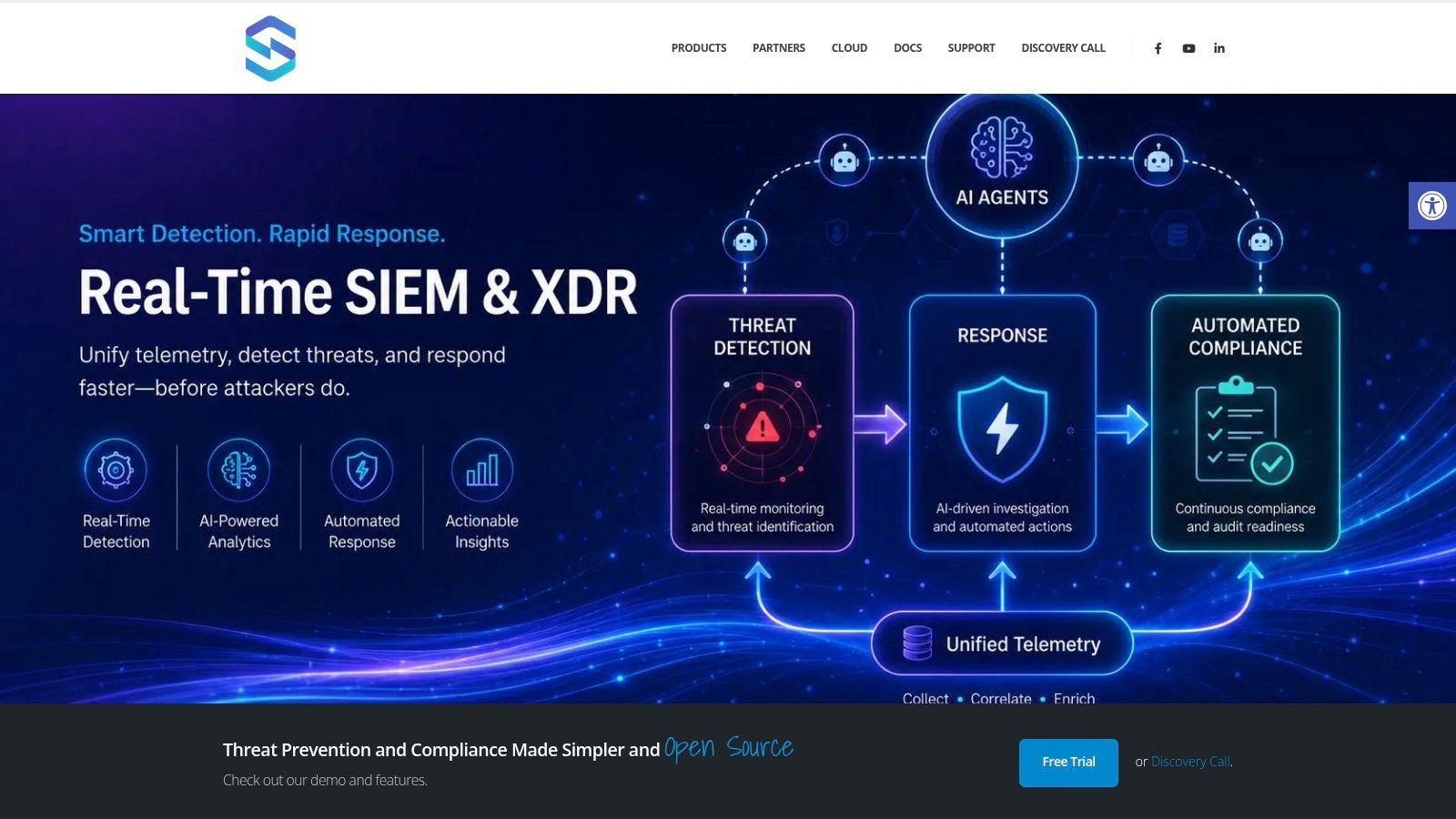
An open-source SIEM and XDR platform already gathers telemetry from cloud services, endpoints, and network tools in one place. This provides compliance workflows with something manual efforts often miss: a current operational record of what the environment actually did. If you are assessing the XDR portion of that stack, the idea is explained well in what is an XDR, since the detection layer and the compliance layer start to intersect once events, alerts, and evidence sit in the same system.
What changes when evidence comes from operations
If compliance evidence emerges naturally from logging, detection, and response, the team no longer hunts for disconnected proof files. Control testing can link to actual events, remediation can be followed in the same process, and exceptions are simpler to examine because the foundational telemetry is already present. That is the real benefit of bringing security and compliance together: the audit trail comes from the same system that protects the environment.
Unified Security Stack illustrates this model in action, since it brings SIEM, SOAR, XDR, and compliance workflows together in a single platform. For regulated environments, this type of architecture cuts tool sprawl and helps keep evidence matched to real security activity.
When security events and compliance evidence sit in different tools, a person must manually reconcile them. That is where precision begins to erode.
Operational consistency is a major benefit. One platform can log, detect, correlate, and map evidence simultaneously, which suits modern cloud and hybrid environments far better than a collection of disconnected point tools.
Measuring ROI and Avoiding Common Pitfalls
It is easy to reduce ROI in compliance automation to a simple number. Teams frequently tally reduced audit hours and go no further, yet the true value also covers better evidence quality, less duplicated effort, and reduced risk of control drift. For security programs, that wider perspective is more important than a limited labor metric.
What to measure
Begin with clear metrics: audit preparation time, effort spent retrieving evidence, and how quickly remediation cycles move. Then include quality measures, such as whether control owners close exceptions sooner, whether evidence remains current when reviewed, and whether one control can serve several frameworks without repeated effort. These outcomes reveal whether the system is strengthening compliance execution, not merely generating tidier reports.
Market pressure helps clarify why this is important. As the wider compliance software market continues to grow, the teams gaining the most value are those that use automation to improve control execution, not merely to accelerate documentation (Mordor Intelligence). Quicker reporting has value, but only when it mirrors genuine control health.
The false confidence trap
The greatest risk is believing automation guarantees compliance quality. It does not. When scope is incorrect, control ownership is unclear, or integrations are partial, the software will still generate polished dashboards while overlooking genuine risk.
This is why effective programs test controls on an ongoing basis and retain human accountability. Automation should bring exceptions to light sooner, not substitute for judgment about whether an exception is acceptable. If a tool reduces evidence collection time without enhancing control design, it has merely automated the documentation.
What good governance looks like
- Own every control: no evidence left unowned and no ambiguity held jointly.
- Review scope regularly: Systems and frameworks evolve more rapidly than yearly programs.
- Verify evidence sources: A connected system has value only when it is authoritative.
- Keep remediation visible: Exceptions with no deadlines turn into lasting gaps.
Organizations that do this correctly apply automation to strengthen the connection among detection, evidence, and action. That distinction separates a quicker audit from a more secure environment.
If you need compliance automation that matches how security teams operate, consider a platform that links logs, detection, evidence, and remediation rather than pushing those functions into different tools. Unified Security Stack unites SIEM, XDR, and compliance workflows for regulated environments that require evidence, not only reports.