Threat Detection and Response Solutions: A Complete Guide
For anyone assessing threat detection and response options, the core problems tend to remain the same: The firewall reports one thing, the endpoint product reports something else, cloud alerts accumulate in yet another console, and compliance still requests proof that nobody can pull together fast. Analysts burn time switching among tools instead of determining if an incident is genuine and what to contain first.
That problem intensifies in regulated settings. Security does not end with spotting malicious activity. Teams must also maintain a clear record of what occurred, which controls triggered, who authorized containment, and how the response aligns with HIPAA, PCI, SOC 2, ISO 27001, GDPR, or CMMC. A rapid response that cannot be justified afterward is operationally incomplete.
The practical fix is not another console. It is creating an integrated detection and response program that centralizes correlation, automates routine tasks, and retains evidence so auditors can examine it. That is where modern TDR architecture proves valuable, particularly when delivered as a unified stack rather than yet another source of sprawl.
Table of Contents
- Why Modern Security Needs Threat Detection and Response
- The Core Components SIEM XDR and SOAR Explained
- How Modern Detection Techniques Find Hidden Threats
- Automating Security Response with Orchestration Playbooks
- How to Evaluate and Implement a TDR Solution
- Mapping TDR to Compliance and Measuring Success with KPIs
- Unifying TDR and Compliance with the Unified Security Stack Platform
Why Modern Security Needs Threat Detection and Response
A normal SOC shift begins with good intentions and turns into queue management. One analyst examines endpoint detections. Another looks at identity alerts. A third attempts to determine if odd cloud activity is connected or merely another noisy event. By the time anyone links the dots, the problem has already spread across users, hosts, or workloads.
This is the reason legacy monitoring falls short. It presumes analysts can hand-review enough alerts to uncover what counts. They cannot. Microsoft reports detecting approximately 600 million cyberattacks every day, averaging more than 6,900 attacks per second, a scale highlighted in IBM's overview of threat detection and response. At that scale, manual review ceases to be a process issue and becomes a design flaw.
TDR is an operating capability, not a product label
Threat detection and response succeeds when three elements occur in tandem. You gather signals widely, correlate them quickly, and initiate the correct action with sufficient context to contain the issue safely.
In practice, this requires continuous monitoring of endpoints, identities, network activity, applications, and cloud services. Periodic scanning remains useful, but it will not detect a user signing in from an unexpected location, accessing unusual systems, and generating suspicious process behavior within the same attack path.
Security teams do not require more raw alerts. They require fewer, stronger decisions made faster.
This is also where regional risk becomes concrete. For organizations assessing local exposure, guidance on mitigating Atlanta cyber risks is a helpful reminder that threat pressure is not abstract. It affects particular business ecosystems, supply chains, and local operating constraints.
Why disconnected tools slow down real response
The previous approach was straightforward. Purchase a log tool, add endpoint protection, attach network monitoring, then hire staff to stitch the workflow together. That worked when environments were smaller and attack paths were less distributed.
Now the common failure modes are easy to spot:
- Context lives in silos. Endpoint, network, identity, and cloud teams each view only a fragment.
- Priority is inconsistent. One tool labels an event critical while another hardly flags it.
- Response stalls. Teams argue over ownership instead of isolating, blocking, or escalating.
- Evidence gets lost. Compliance teams request timelines and approvals after the fact.
Modern threat detection and response solutions are designed to address precisely that. They establish a shared operational layer where data is normalized, suspicious behavior is correlated, and response can be automated or at least directed with enough confidence to act quickly.
The Core Components SIEM XDR and SOAR Explained
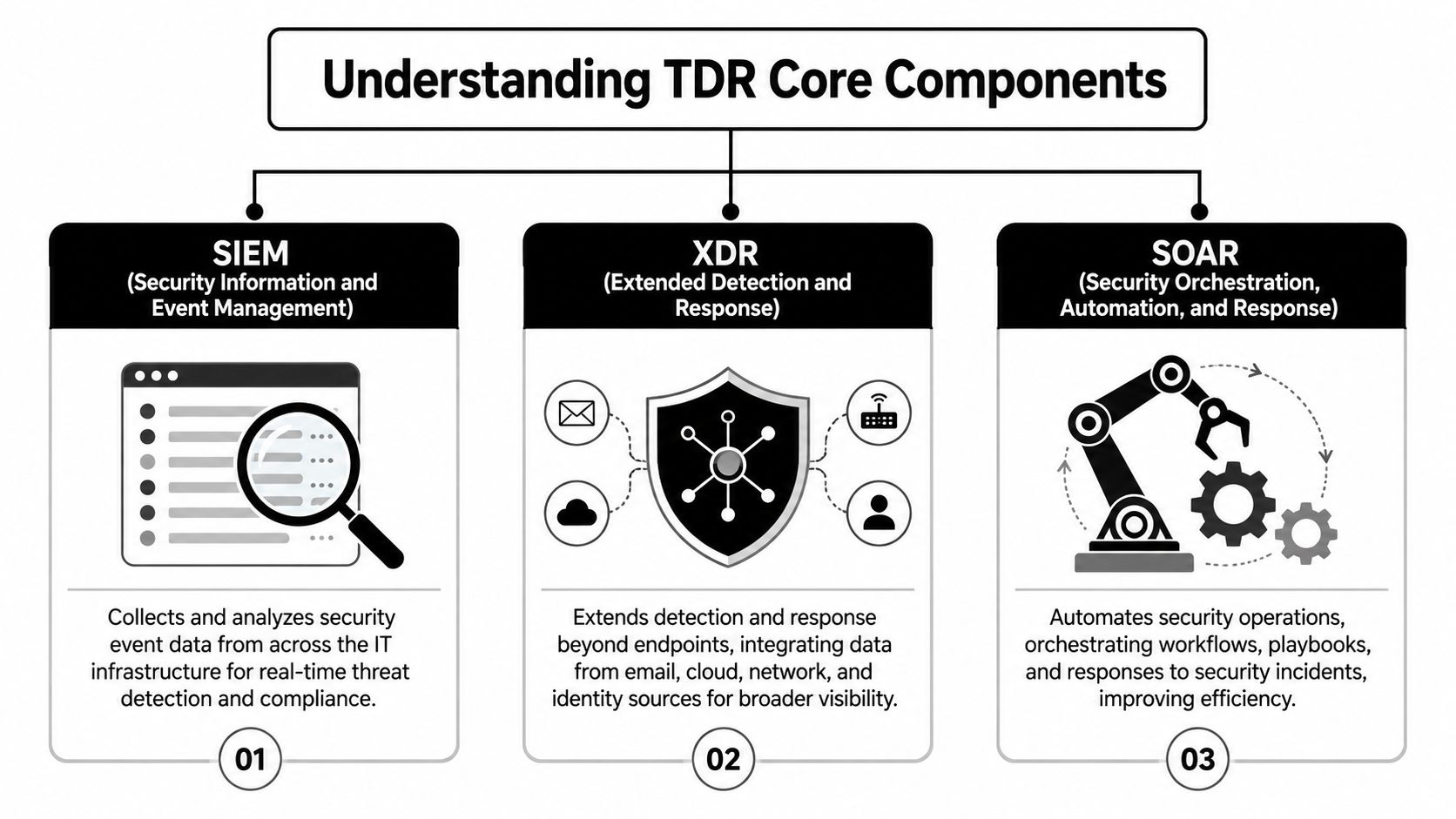
The easiest way to understand modern TDR architecture is to picture it as a central nervous system. One component gathers signals from the body, another helps make sense of what those signals mean across systems, and a third triggers coordinated action. In security terms, those components are SIEM, XDR, and SOAR.
Microsoft describes threat detection and response as a layered architecture built around SIEM, XDR, and SOAR, with each capability addressing a different operational need in hybrid environments through its TDR overview.
A basic diagram can help make clear how those responsibilities differ.
How each component behaves in practice
SIEM serves as the central correlator. It ingests logs and events from across the environment, normalizes them, and lets analysts search, correlate, and investigate. If you need one location to link VPN authentication, Windows process activity, firewall traffic, SaaS admin changes, and cloud audit logs, that falls under SIEM.
XDR broadens visibility across control points and aims to follow attacker behavior across domains. It is useful when a problem does not stay in one lane. A suspicious mailbox rule, a token misuse event, an endpoint process chain, and unusual east-west traffic might all belong to the same story. XDR is designed to keep that story intact.
SOAR converts choices into repeatable execution. It manages playbooks, approvals, enrichment, ticket creation, case updates, and automated containment steps. The focus is less on seeing more and more on responding faster with fewer handoffs.
Here's the short version:
| Component | Primary Function | Typical Data Sources | Key Outcome |
|---|---|---|---|
| SIEM | Centralized collection, search, and correlation | Logs from endpoints, identities, cloud services, applications, network devices | Unified visibility and investigation |
| XDR | Cross-domain detection and threat context | Endpoint, email, identity, cloud, and network telemetry | Higher-fidelity incident detection |
| SOAR | Workflow orchestration and automated response | Alerts, cases, threat intelligence, ITSM and security tool integrations | Faster and more consistent response |
For teams comparing architecture choices, this breakdown of SIEM vs XDR matters because confusion typically begins when buyers expect a single tool category to cover all three functions.
Once you have reviewed the high-level model, the mechanics are simpler to follow in motion.
Why integration matters more than feature lists
Many security programs that failed purchased capable tools. They simply did not connect them operationally. A SIEM without response workflows turns into an alert-filled data lake. A SOAR platform without solid detections automates noise. An XDR deployment without long-term investigation and evidence handling may accelerate triage yet still leave compliance teams lacking documentation.
Practical rule: Choose based on workflow continuity, not the longest feature checklist.
The strongest designs usually share a few traits:
- Shared case context so analysts do not have to reconstruct the same incident in multiple consoles.
- Common identity and asset references so alerts identify actual users, devices, and owners.
- Tunable correlation logic that captures business risk, rather than only vendor defaults.
- Response integration alongside identity systems, network controls, endpoint actions, and ticketing.
Once those components work in concert, threat detection and response solutions no longer feel like distinct products and begin to act as one operating system for the SOC.
How Modern Detection Techniques Find Hidden Threats
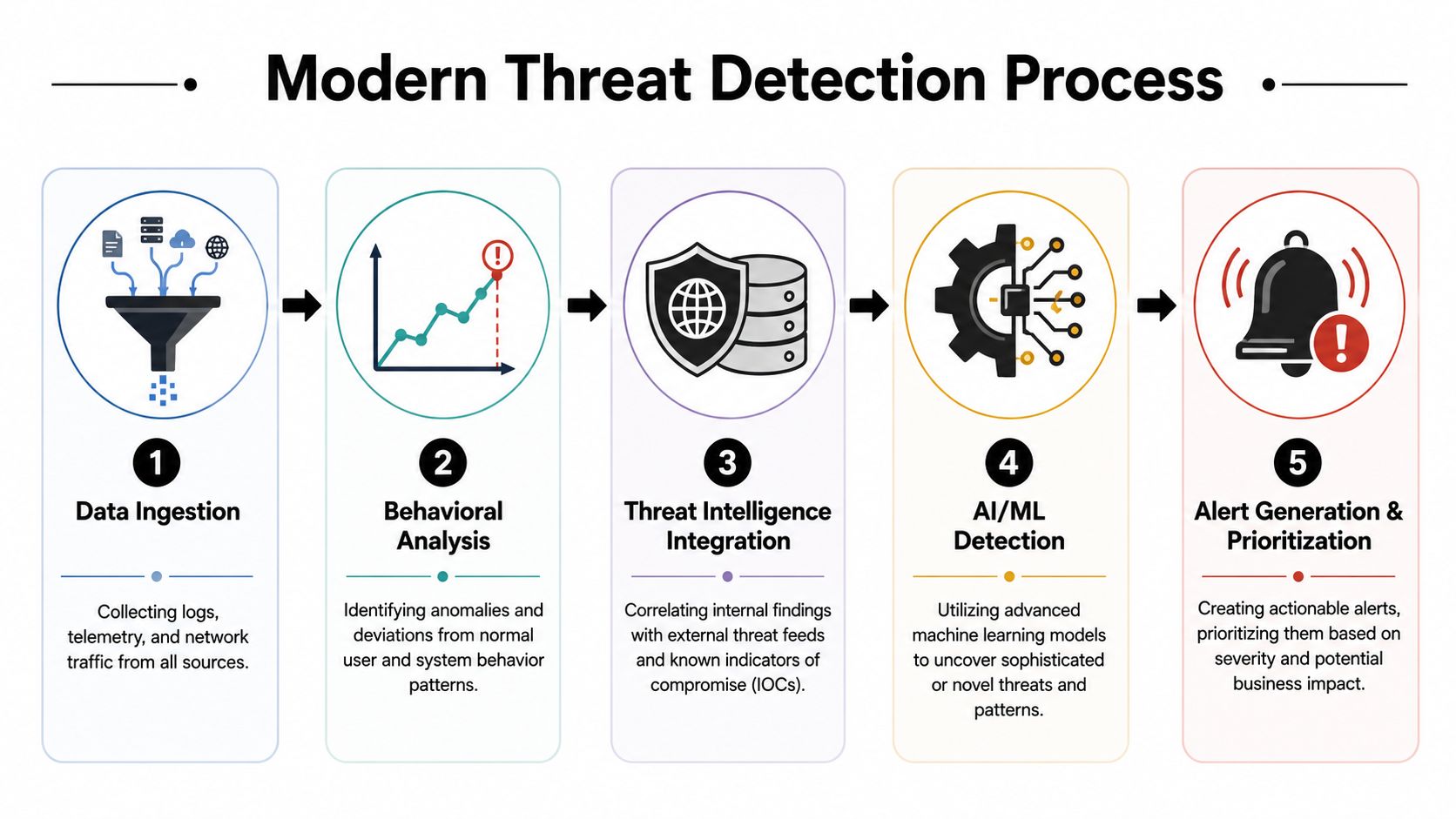
Most hidden threats are not invisible. They are simply scattered across telemetry sources that no one correlates effectively enough. An attacker uses a valid account, launches a process that appears administrative, reaches a cloud workload, and moves laterally through normal channels. Individually, each action may look routine. Combined, they describe compromise.
That is why detection quality begins with data quality, not the detection rule itself.
Telemetry quality decides detection quality
Detailed endpoint telemetry shows which process launched, which child processes followed, which files changed, and which persistence mechanisms appeared. Network telemetry indicates who communicated with whom, how frequently, and whether the pattern shifted. Identity and cloud logs expose administrative changes, risky authentications, role modifications, and access path anomalies.
Absent that depth, detection logic reverts to signatures and disconnected alerts. IBM points out in its SIEM material that without full-packet capture and granular endpoint telemetry, organizations see a 40 to 60 percent increase in Mean Time to Detect, and signature-based detection alone misses up to 70 percent of evasive attacks in its discussion of SIEM and detection efficacy.
This is the operational takeaway many teams miss. Better telemetry does not merely generate more data. It alters what your platform can demonstrate.
Behavior analytics and AI only work with context
Behavior analytics matters because today's attacks frequently use legitimate tools. PowerShell, admin consoles, service accounts, remote management utilities, and cloud APIs are all ordinary until their sequence, timing, source, or target turns abnormal.
Useful detection pipelines usually combine several methods:
- Signature matching for identified malware, suspicious patterns, and threat intel hits.
- Behavioral baselining for anomalous user, host, and service activity.
- Threat intelligence enrichment to add context to indicators and associated infrastructure.
- AI-assisted triage to rank what analysts should address first.
Order is important. When telemetry is weak, behavior analytics becomes guesswork. When correlation is poor, AI merely summarizes disconnected pieces.
A mature team asks different questions than “Did the tool detect something?” It asks:
- What proof backs this alert across domains?
- Can we rebuild the path from initial activity to current impact?
- Which detections can be trusted enough for automation?
- Which data source was missing when we failed to see this earlier?
Hidden threats usually emerge when endpoint, identity, and network evidence is examined as one chain rather than three separate alerts.
Teams that sharpen detection most rapidly usually tune for attack behavior rather than vendor category. They seek impossible travel combined with privilege use, mailbox changes combined with token abuse, or host isolation triggers combined with east-west traffic. This is how threat detection and response solutions shift from noisy surveillance to actionable detection engineering.
Automating Security Response with Orchestration Playbooks
An alert has value only when a person can respond to it quickly. In high-volume SOCs, that is the point of failure. The detection may be sound, yet response procedures sit in a wiki, approvals take place in chat, and analysts perform the same enrichment work by hand each shift. SOAR is there to eliminate that drag.
Effective orchestration playbooks are not meant to replace human judgment. Instead, they wrap up the repeatable elements of response, freeing analysts to focus on scoping, exceptions, and business impact.
What a useful playbook actually contains
A usable playbook begins with a condition, gathers evidence next, and then determines whether to act directly, seek approval, or escalate. Its logic needs to be clear enough for an analyst to review quickly and trust its behavior.
A ransomware containment playbook often looks like this:
- Trigger on a high-confidence detection from endpoint telemetry, suspicious file activity, or behavior already known to be malicious.
- Enrich the case automatically with host information, user identity, recent process chain, and associated alerts.
- Check asset criticality so the system can determine if auto-isolation is permitted or if approval must be obtained.
- Contain immediately if policy allows by isolating the host, blocking associated indicators, and suspending credentials that pose risk.
- Open and update a case in the ticketing or incident platform, with each action documented.
- Notify the right teams including IT, legal, and compliance whenever business rules call for it.
A phishing response playbook works differently. It typically looks for message spread, identifies affected recipients, deletes matching emails where possible, checks if users clicked or entered credentials, and generates follow-up tasks for account review.
For teams designing these workflows, examples of incident response playbooks are useful because the challenge is not identifying the steps. It is ordering them so the process remains safe under pressure.
Where automation fails
Three mistakes account for most automation failures.
- Bad trigger quality. When the underlying detection is noisy, the playbook scales that noise more quickly.
- No approval boundaries. Certain actions should occur automatically. Others require human confirmation because their business impact is too high.
- Weak documentation. When automated actions fail to update the case, the team loses auditability.
That third point is more important than many security teams acknowledge. In regulated environments, response must be defensible. Legal and compliance leaders frequently value a documented decision flow as much as the speed of the initial containment step. For a legal view on operational readiness, this checklist for expert data breach planning for businesses serves as a helpful complement to technical playbook design.
Automation ought to eliminate repetitive delay. It should not eliminate traceability.
The strongest playbooks begin narrowly. Start with high-confidence use cases, mandate clear ownership, and document every action. Then broaden. Teams that automate wide, ambiguous detections too soon often spend the following quarter repairing lost trust.
How to Evaluate and Implement a TDR Solution
Purchasing a TDR platform is simple. Using one to replace fragmented security operations is not. Most procurement errors occur when teams assess product features separately and overlook the operating model those features need to support.
A practical evaluation begins with your real environment. Hybrid identity, cloud workloads, remote endpoints, regulated data, and third-party integrations all determine what the platform must handle from day one. If a tool demonstrates well but cannot cleanly ingest your actual telemetry, correlate it reliably, and retain evidence for audits, it is not the right fit.
What to ask before you buy
A vendor checklist ought to concentrate less on slogans and more on the friction points that commonly derail deployments.
- Ask about ingestion pathsCan the platform ingest data from APIs, agents, Syslog, NetFlow, and current infrastructure without requiring brittle workarounds?
- Test correlation logicCan analysts build and adjust rules to match your environment, or must they rely on fixed content packs?
- Review response integrationsDoes it integrate with identity providers, endpoint tools, firewalls, cloud controls, ITSM, and case management in a practical manner?
- Inspect evidence handlingWill the platform retain alert context, enrichment, analyst notes, approvals, and response records for audit purposes?
- Clarify licensing behaviorAs data volume or the number of sources grows, do costs rise in ways that make teams halt collection of valuable telemetry?
Many teams also overlook regional operational realities. For organizations that balance in-house staffing with outside support, this view of protecting Essex businesses from cyber threats serves as a practical reminder that successful implementation hinges on service model decisions as much as on choosing software.
A practical rollout sequence
The most effective deployments are phased. Not because phased delivery appears disciplined, but because TDR platforms grow noisy and fragile when teams ingest all data before they understand their baseline.
Phase 1 starts with discovery and establishing baselines. Determine critical assets, map identities and business systems, set log retention requirements, and select initial detection use cases. In this phase, you define what high confidence means for your environment.
Phase 2 centers on onboarding telemetry and initial tuning. Onboard endpoint, identity, network, cloud, and application data in a deliberate sequence. Verify parsing, normalize fields, and refine noisy detections early. Do not proceed until analysts trust the priority model.
Phase 3 builds playbooks and workflows that span teams. Introduce orchestrated response actions, approval workflows, ticketing, legal notification routes, and compliance evidence mapping. The platform then becomes an operating system instead of a monitoring tool.
A few implementation habits consistently help:
- Pick a small set of critical use cases first including suspicious privilege activity, ransomware signs, or risky authentication patterns.
- Assign one owner for tuning decisions so detections do not stall in committee.
- Run tabletop exercises against live workflows to verify whether alerts, cases, approvals, and containment truly link together.
- Measure analyst friction as much as technical coverage, since a platform that generates busywork will not be used effectively.
A flawed TDR deployment does not fail because the tool lacks capabilities. It fails because the team never converts those capabilities into a repeatable operating model.
Mapping TDR to Compliance and Measuring Success with KPIs
Within regulated organizations, the security discussion shifts after the first alert. Detecting malicious behavior is important, but auditors, legal teams, and executives will also ask what occurred, when you learned of it, who authorized the response, and which controls the event affected. If that chain is not documented, the organization faces both a security event and an evidence problem.
Corelight points to this gap directly in its discussion of network detection and response. The problem is not just whether teams can detect threats. It is whether they can prove what happened and how they responded for compliance purposes.
Turning detections into audit evidence
A robust TDR program naturally produces the artifacts compliance teams require, but only when the workflow is built for that purpose. An alert should link to the underlying logs. The investigation should retain analyst notes, enrichment, and timeline data. The response should capture what action took place, when it occurred, and whether approval was needed.
That makes a practical compliance chain look like this:
| TDR activity | Audit value |
|---|---|
| Alert creation from correlated telemetry | Shows detection capability and event origin |
| Analyst investigation and case notes | Documents review, validation, and scoping |
| Containment or remediation action | Proves operational response occurred |
| Approval and workflow history | Shows governance and decision accountability |
| Final case closure with evidence | Supports reporting, review, and control mapping |
For organizations trying to simplify this recordkeeping, centralized log management matters because fragmented logs make each audit request slower, less complete, and more difficult to defend.
What to measure besides alert volume
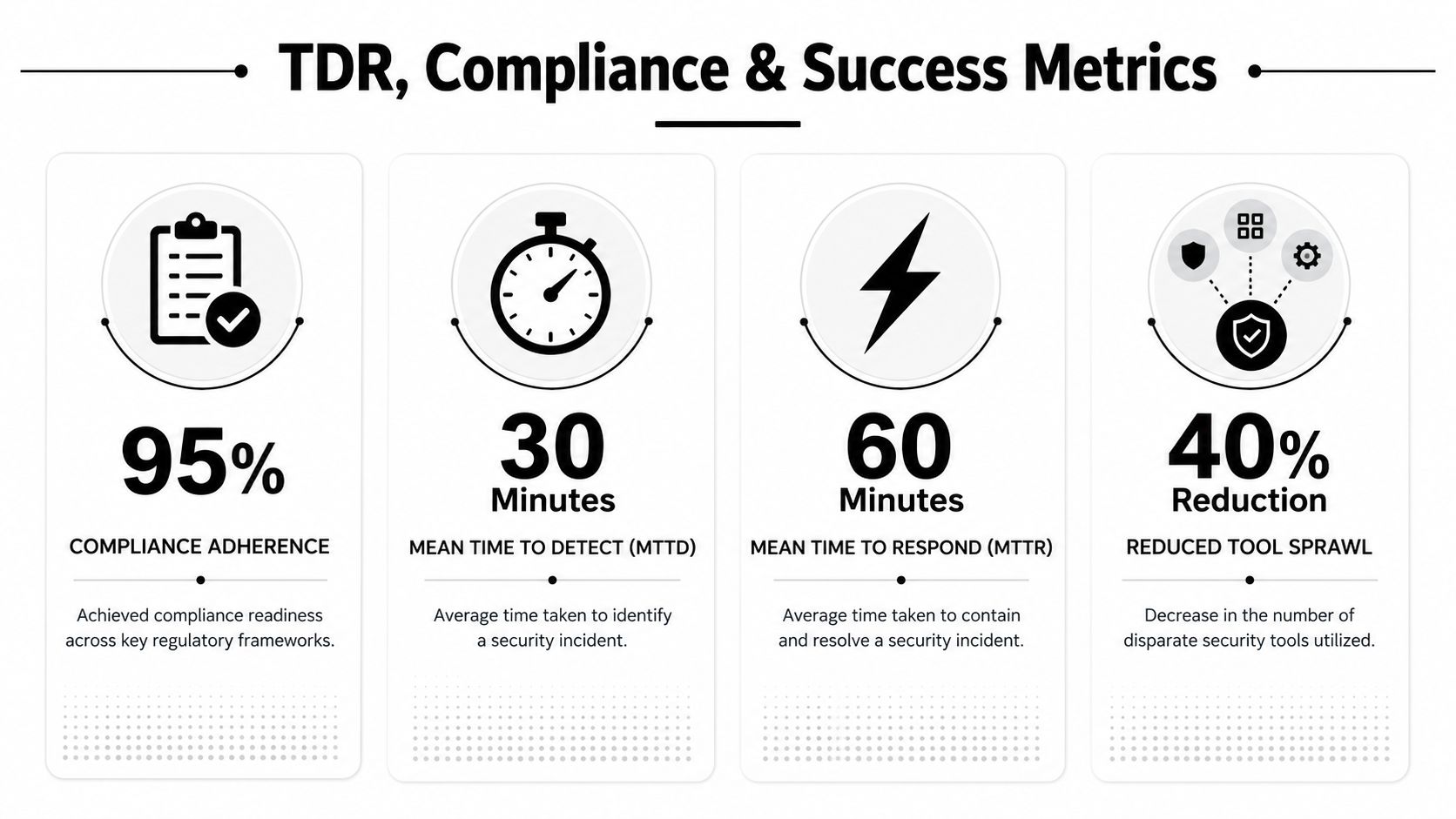
Many teams still report volume metrics that reveal little about genuine risk reduction. More alerts do not mean better coverage. Closed tickets do not mean stronger response. Effective KPIs measure speed, quality, and evidence.
The metrics that matter most usually include:
- MTTD to demonstrate how rapidly the team detects credible threats.
- MTTR to illustrate how rapidly the team contains and closes them.
- False positive burden to reveal whether analysts’ time is going to waste.
- Dwell time to illustrate how long attackers operate before being contained.
- Evidence completeness to demonstrate whether cases meet audit and reporting requirements.
In regulated settings, the difference lies in how those metrics are read. A brief MTTR has value, yet not when the response history is incomplete. A small false positive load is useful, but not if the team buries alerts auditors expect to see addressed. Security and compliance are not at odds in this context. Both rest on the same operational rigor.
Quick response lowers exposure. Recorded response lowers governance risk. Mature programs pursue both simultaneously.
That is why current threat detection and response solutions must be assessed as business systems, not merely as security tools. They need to reduce investigation and containment time while also creating a defensible record for internal review, customer assurance, and external audits.
Unifying TDR and Compliance with the Unified Security Stack Platform
For many organizations, the primary hurdle is not a shortage of security tools. Instead, it stems from each tool addressing a narrow issue while increasing the workload for surrounding systems. One platform manages logs, another processes endpoint alerts, a third offers automation, and a fourth captures compliance evidence. Consequently, the SOC focuses on maintaining integrations rather than lowering risk.
A unified approach alters that operational load. Based on the Linux Foundation material referenced for Unified Security Stack, effective TDR depends on correlating over 30 billion IOCs in real time, and platforms using AI for alert triage can reduce analyst time spent on false positives by 70 percent, enabling an MTTR of under 15 minutes for critical threats as part of its Unified Security Stack announcement.
Why a unified open source stack changes the economics
An open-source approach is important for two reasons. First, it may ease the cost pressure that frequently leads teams to remove telemetry sources or postpone onboarding. Second, it gives security teams greater control over the evolution of detection logic, integrations, and workflows.
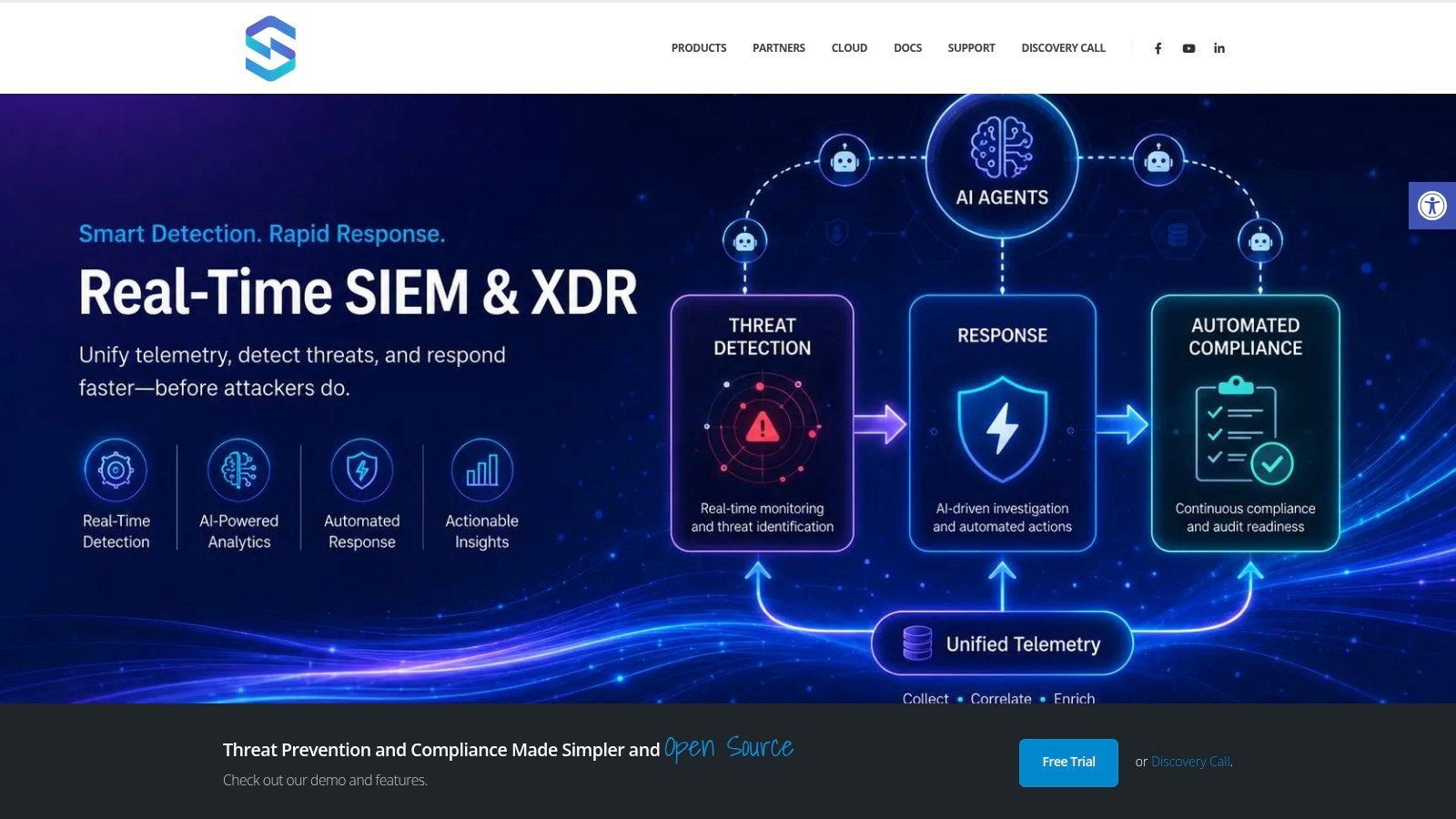
Unified Security Stack illustrates this unified model. It brings SIEM, XDR, and SOAR capabilities together in a single platform, takes in logs from cloud services, endpoints, and network devices, correlates events in real time prior to indexing, and offers compliance workflows that map detections and evidence to common frameworks. This is important for teams seeking one operating layer for detection, response, and audit support instead of distinct products for each.
What this looks like operationally
In daily operations, a unified stack alters the way incidents progress.
- Analysts triage in one place rather than reconstructing context in every console.
- Response actions are tied to detections directly so enrichment, containment, and case updates occur within one workflow.
- Compliance evidence is produced as part of the response rather than pieced together after the incident.
- Teams tune one correlation layer instead of attempting to coordinate multiple vendor-specific logic engines.
This does not remove trade-offs. Unified platforms still require deliberate onboarding, tuning, access control, and governance. Open source also places more architectural responsibility on the team or service partner that uses it. Yet for many regulated organizations, that exchange is preferable to funding fragmented tooling that never becomes operationally coherent.
Threat detection and response solutions perform best when they operate as a single system. That is the central lesson. Unified telemetry, analyst workflow, orchestration, and evidence handling are not distinct maturity objectives. They are a single design decision.
If you're trying to reduce tool sprawl while building a more auditable detection and response program, Unified Security Stack merits consideration as a unified open-source choice for SIEM, XDR, SOAR, and compliance management in hybrid environments.