Open Source Security Tools: A 2026 Guide
In a mid-sized SOC, endpoint telemetry may sit on one platform, cloud logs on another, vulnerability findings on a third, and identity alerts elsewhere altogether. Analysts jump between consoles, repeatedly normalize the same event, and still overlook the incident that needed context from multiple systems. Typically, the issue is not insufficient detection technology. It is the lack of a common data model, consistent correlation, and evidence that security and compliance teams can share.
Open source security tools merit genuine consideration in that assessment. They can offer control over detection logic, data movement, retention, and integrations, yet they also introduce operational duties that commercial buyers may undervalue. In 2026, the relevant question is not which tool has the most extensive feature list. It is which combination cuts tool sprawl, focuses on exploitable risk, and generates defensible evidence across a hybrid environment.
Table of Contents
- Why Security Teams Are Rethinking Their Tool Stack in 2026
- The Core Categories of Open Source Security Tools
- Criteria for Choosing the Right Tools for Your Environment
- Deployment and Integration in Hybrid and Cloud Environments
- Correlation Rules and Playbooks That Actually Reduce Noise
- Mapping Detections to Compliance Frameworks
- Why a Unified Platform Beats Tool Sprawl
- A Practical Evaluation and Migration Roadmap
Why Security Teams Are Rethinking Their Tool Stack in 2026
A SOC may work all day across eight overlapping tools and still have no dependable view of incidents. One product gathers authentication events, another keeps endpoint data, a third scans dependencies, and several take in similar network or cloud telemetry. The organization pays to move and store related data multiple times, while analysts reconstruct context by hand for each investigation.
This setup imposes a hidden cost. Licensing changes can make formerly predictable platforms difficult to forecast, telemetry pricing can make each extra data source a budget choice, and alert fatigue drains analyst attention even when the tools are technically strong. Vendor sprawl also requires security architects to manage more connectors, identity mappings, upgrade processes, and response integrations.
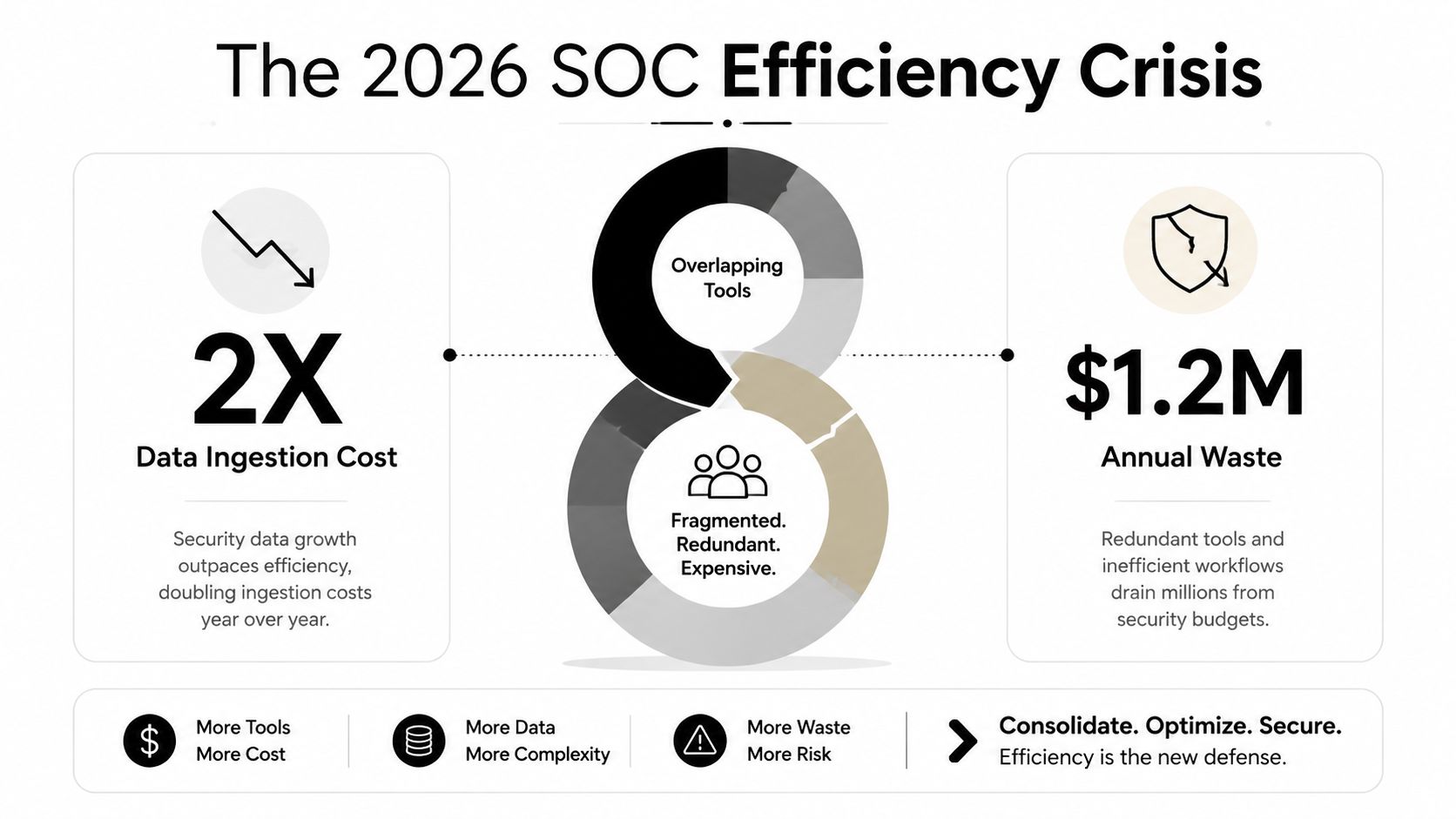
Consolidation is now a security decision
Open source alters the purchasing discussion because teams can examine detection logic, modify parsers, and decide where data resides. Such flexibility does not make every project ready for the enterprise, nor does it eliminate the need for support, patching, capacity planning, or governance. It does offer a structured option instead of accepting an expanding set of opaque point products.
Software composition itself is where the risk becomes visible. Black Duck's open source security risk analysis reports that 87% of scanned codebases contained at least one open source vulnerability, versus 86% in the previous year. The average count of vulnerabilities increased from 280 to 581, a 107% increase, and one codebase contained 38,998 vulnerabilities. These numbers show why ongoing dependency discovery and prioritization should sit within routine security operations, not within an occasional developer task.
Leadership test: Before you approve an additional security product, make the team specify which existing data, alert, workflow, or evidence gap it closes.
A CISO weighing consolidation should also link tool decisions to business outcomes, not merely technical coverage. A pragmatic primer on measuring cybersecurity ROI for leaders can help explain analyst capacity, risk reduction, and audit readiness in language leadership understands. The next step is to review each category by the function it serves, then determine whether it should stay standalone or become a capability within a unified platform.
The Core Categories of Open Source Security Tools
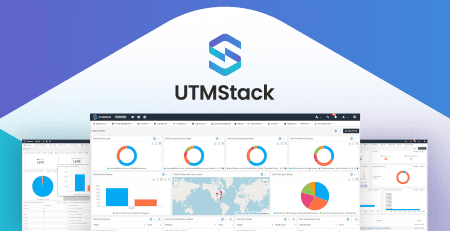
View the categories as layers rather than a shopping list. A SIEM is the central logbook, gathering and correlating events across identity, infrastructure, applications, and security controls. Wazuh, Security Onion, and Unified Security Stack are practical starting points, though commercial SIEMs often offer wider managed content, support, and scale assurance.
EDR provides endpoint reflexes, monitoring processes, files, persistence, and host activity. osquery, Velociraptor, and OSSEC provide open source methods for endpoint visibility and investigation. XDR extends those senses across endpoint, identity, network, and cloud data, yet the integration and response experience tends to be stronger in mature commercial suites.
A vulnerability scanner is a periodic health check across hosts, applications, and dependencies. OpenVAS, Nmap, and Trivy address separate surfaces. Scanner choice must match the target, since detection quality and runtime are not interchangeable. A comparison of four application security scanners found no significant performance differences, yet their reports diverged considerably, highlighting the need to benchmark coverage and false negatives rather than reward speed alone. The OWASP Benchmark and OpenSSF CVE Benchmark offer helpful models for that testing.
SOAR is the dispatcher, converting a detection into enrichment, containment, ticketing, and recovery steps. Shuffle, StackStorm, and TheHive can assist with this work. Log management is the long-term archive, with OpenSearch, Fluent Bit, and Graylog supplying collection, transport, search, and retention capabilities.
Identity and access auditing acts as the ledger kept by the bouncer. Keycloak, OpenLDAP, and FreeIPA can surface authentication and authorization activity, while the SIEM correlates it with endpoint and application events. Network detection is the perimeter's hearing, with Suricata, Snort, and Zeek handling inspection, signatures, metadata, and protocol analysis. Teams examining packet-level behavior should also understand PCAP analysis for security teams, particularly when alerts need validation against raw traffic.
Cloud posture management is the configuration inspector, auditing accounts, permissions, storage, and infrastructure state. Prowler, ScoutSuite, and Cloud Custodian are helpful examples. Dark-web monitoring is an early-warning radar, uncovering exposed credentials, domains, or organization references via projects like SpiderFoot, theHarvester, and Recon-ng, provided collection is lawful and validation is careful.
| Category | SOC Function | Representative OSS Projects |
|---|---|---|
| SIEM | Centralize and correlate security events | Wazuh, Security Onion, Unified Security Stack |
| EDR and XDR | Monitor endpoints and join cross-domain signals | osquery, Velociraptor, OSSEC |
| Vulnerability scanning | Discover weaknesses and dependencies | OpenVAS, Nmap, Trivy |
| SOAR | Automate investigation and response | Shuffle, StackStorm, TheHive |
| Log management | Collect, search, and retain telemetry | OpenSearch, Fluent Bit, Graylog |
| Identity auditing | Review authentication and access activity | Keycloak, OpenLDAP, FreeIPA |
| Network detection | Inspect traffic and network behavior | Suricata, Snort, Zeek |
| Cloud posture | Detect insecure cloud configuration | Prowler, ScoutSuite, Cloud Custodian |
| Dark-web monitoring | Find exposed organizational indicators | SpiderFoot, theHarvester, Recon-ng |
By design, these layers intersect. A vulnerability finding gains value when linked with asset criticality, endpoint activity, identity context, and network evidence. A unified SIEM should thus unite these functions without requiring analysts to examine the same incident in separate consoles. The open-source SIEM tools overview is a valuable baseline for assessing that architecture.
Criteria for Choosing the Right Tools for Your Environment
Run a pilot against actual work rather than a vendor feature matrix. A tool that appears impressive in a demo can break when given your cloud audit format, endpoint volume, or your organization's retention requirements.
Ask questions the pilot can answer
- Detection coverage: During a purple-team exercise, does the logic catch known-bad activity, and can analysts explain why the alert fired?
- Telemetry breadth: Is the platform able to take in critical cloud, identity, endpoint, network, and application logs without custom forks or fragile transformations?
- Operational cost: At the required retention window, what burden emerges for storage, compute, administration, upgrades, and support?
- Community health: Do maintainers address issues, review changes, document breaking behavior, and release security fixes?
- Upgrade discipline: Is the team able to test upgrades safely, reverse changes, and maintain rules and parsers through releases?
- Compliance evidence: Can the system output access reviews, privileged activity, remediation history, and retention proof in a format auditors can review?
- Exit portability: Through open formats and APIs, can detections, normalized events, and case data shift to a different backend?
Consolidation impact is the final criterion. Another queue may result from a scanner that exports findings but cannot share asset identity with the SIEM. An EDR that produces alerts outside the response workflow adds another console. Assess every capability by whether it eliminates manual joins and duplicated storage.
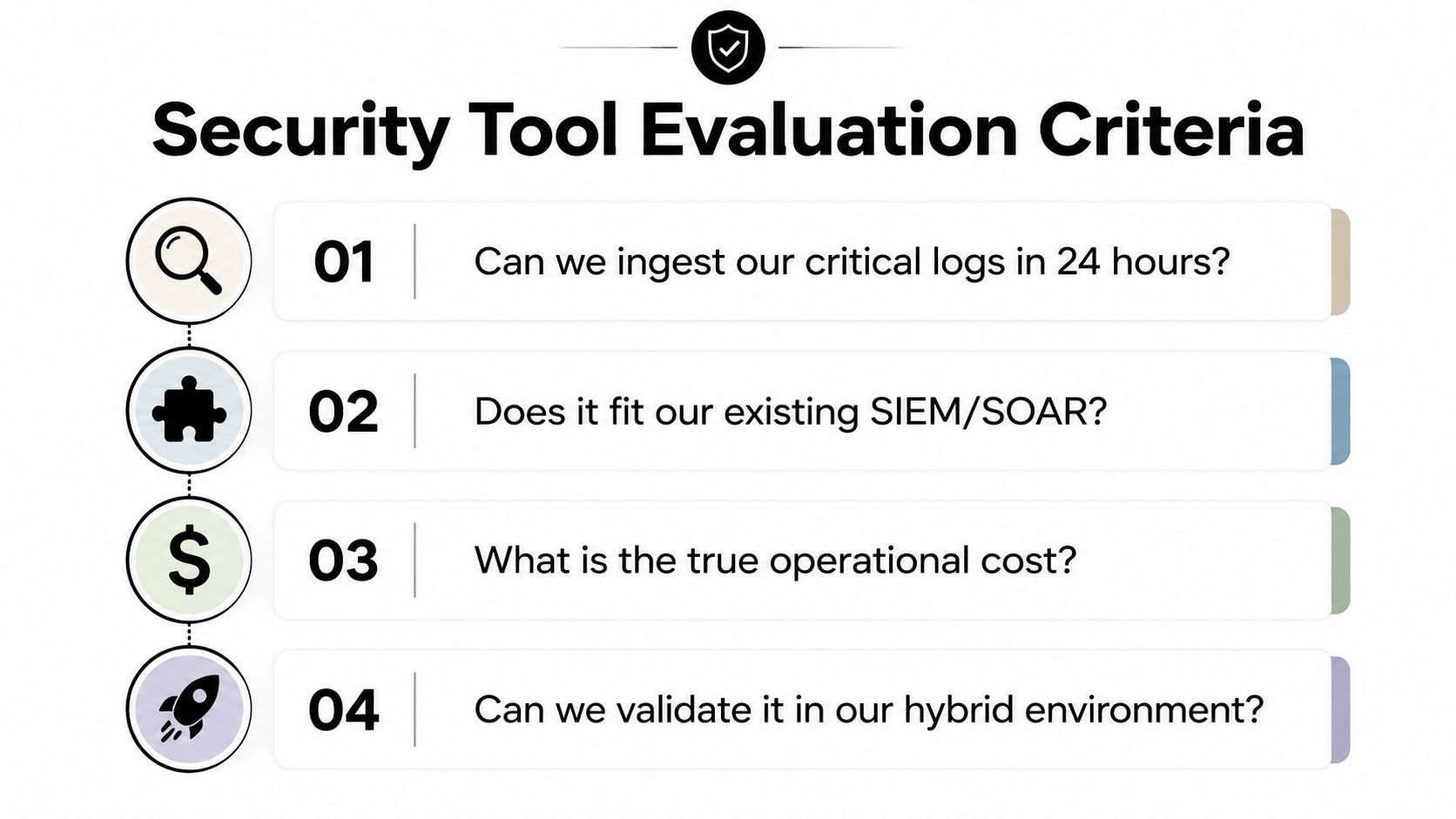
Weight the checklist to the estate
An organization that is cloud-first ought to prioritize API coverage, visibility into ephemeral workloads, and identity context. A hybrid enterprise requires dependable agents, syslog, Windows Event Forwarding, and network transport. A regulated organization should rank evidence exports, immutability, access control, and retention validation highest on its scorecard.
Open source also belongs in a wider engineering assessment. Teams weighing security platforms against developer workflows may gain from examining how to find top AI developer tools, as long as they separate developer productivity from security acceptance criteria. The buyer's decision should depend on validated data flows, useful detections, manageable operations, and audit-ready output.
Deployment and Integration in Hybrid and Cloud Environments
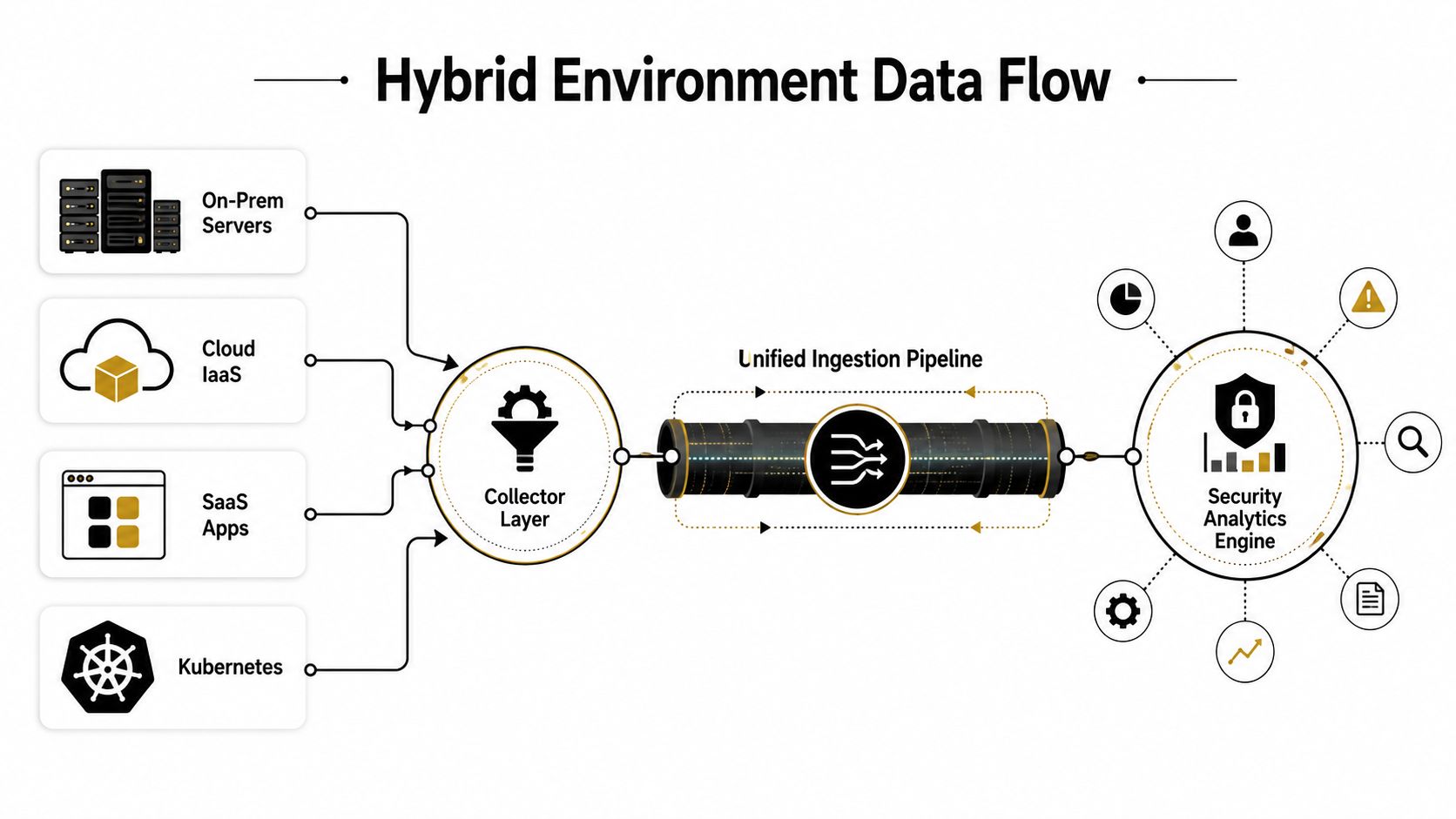
Deployment begins by mapping data flows. Before choosing collectors, inventory on-premises servers, network devices, endpoints, IaaS accounts, SaaS applications, databases, Kubernetes clusters, identity providers, and existing security products. The goal is to understand where events come from, how they move, how normalization occurs, and where retention applies.
Use the ingestion method that matches the source:
- Endpoints and EDR telemetry: Install agents wherever host state, process activity, and file events need local collection.
- Legacy infrastructure: For systems unable to run modern agents, rely on syslog and Windows Event Forwarding.
- Containers: Position Beats or Fluent Bit sidecars near workloads, and normalize events prior to central indexing.
- Cloud services: Rely on native exporters for AWS CloudTrail, Azure Activity, and GCP Cloud Logging instead of scraping interfaces that may change without warning.
Keep transport local and policy central
In a hybrid environment, deploy a lightweight collector in every VPC or region and send events over mutually authenticated TLS to a central indexer. Avoid direct WAN pulls when a local collector can buffer, filter, and forward dependably. Use jump hosts or VPC peering for controlled cross-cloud transport, and favor pull-based collection for ephemeral workloads if push delivery would rely on short-lived addresses or unstable agents.
Maintain consistent identity, secrets, and retention policies. Service accounts should have tightly limited permissions, credentials should reside in a managed secret system, and every collector needs a defined failure mode. A queue or local buffer keeps a temporary network issue from becoming a visibility gap.
Detection ought to sit above the ingestion pipeline. This allows the team to replace parsers, indexers, or collectors without rewriting every correlation rule. A platform like Unified Security Stack can bring log management, vulnerability scanning, access auditing, endpoint protection, and compliance workflows together in one open source SIEM and XDR architecture. Teams evaluating cloud-specific patterns can also examine cloud security monitoring for an illustration of how cloud telemetry fits into a wider monitoring design.
Use the following video as an additional visual reference for hybrid security data flow:
Correlation Rules and Playbooks That Actually Reduce Noise
Much SOC noise results from correlation failure. A failed login, a suspicious WAF request, and an identity-provider anomaly may each appear modest alone, but together they can indicate a credential-stuffing campaign. Treating them as separate alerts compels analysts to correlate manually and inflates the apparent workload.
Sigma enables security engineers to describe relevant log events in an open, generic format that translates across SIEM backends. The SigmaHQ repository is the canonical community source for that rule format. Write portable detection logic, then adapt field mappings to the local data model instead of rewriting the detection for every product.
Patterns that deserve immediate tuning
| Pattern | Data Sources | Noise Reduction |
|---|---|---|
| Identity context | Authentication, MFA, identity provider | Join failed MFA, impossible travel, and unusual access into one case |
| Asset criticality | Vulnerability, CMDB, cloud inventory | Prioritize public-facing production assets over development endpoints |
| Time-window suppression | Authentication, firewall, WAF | Group repeated events into one incident during a defined investigation window |
| Process plus network behavior | EDR, DNS, proxy, network detection | Link execution and outbound communication before escalation |
| Change plus privilege | IAM, audit logs, deployment systems | Distinguish approved change activity from unauthorized privilege use |
A credential-stuffing rule should merge authentication failures by account and source, WAF evidence of repeated login automation, and identity-provider signals such as unfamiliar device or location context. The output should be a single actionable case with affected accounts, targeted applications, source indicators, and recommended containment, not a page of independent alerts.
Correlation rule: One incident should stand for one investigation, even when multiple sensors supply evidence.
Structure the response around four stages. Triage verifies the identity, asset, timing, and confidence. Containment disables or challenges impacted accounts, blocks malicious indicators, and applies rate controls. Eradication eliminates persistence, rotates exposed credentials, and closes the abused path. Recovery returns access to normal, verifies monitoring, and documents the evidence and lessons learned.
The practical tuning order is clear: normalize fields, enrich with identity and asset context, group related events, suppress duplicates, and measure whether analysts can reach a decision faster. Guidance on reducing false positives in SIEM systems is helpful when converting that sequence into an operational tuning program.
Mapping Detections to Compliance Frameworks
Compliance evidence should not exist in a separate realm from security operations. A detection that captures privileged access, configuration change, authentication context, and response action can serve multiple control families if the team tags it correctly and retains the underlying event.
HIPAA logging commonly involves six years of audit-log retention, while PCI DSS v4.0 calls for comprehensive event logging and integrity protection. ISO 27001 logging controls focus on logging, monitoring, clock synchronization, and privileged-utility controls. Such requirements mean collection alone is not enough. The platform must demonstrate who acted, what changed, when it occurred, how the event was protected, and whether the organization reviewed it.
Build evidence around log classes
For HIPAA, map access to systems holding regulated health information, administrative actions, authentication events, and review records. PCI DSS 4.0 requires payment-environment access, administrative activity, authentication, system changes, and proof that logs stay complete and protected. CMMC 2.0 demands security-relevant event handling, access control evidence, configuration records, and incident-response support for covered environments.
ISO 27001 Annex A and SOC 2 Trust Services Criteria gain from the same evidence model. Label detections with control IDs, system owners, data classification, and retention policy. One privileged-change rule can support access control, change management, monitoring, and incident-response evidence across multiple frameworks.
| Detection Category | HIPAA | PCI DSS 4.0 | ISO 27001 | SOC 2 |
|---|---|---|---|---|
| Authentication and access | Access to regulated systems | Cardholder-environment access | Access control and monitoring | Logical access |
| Privileged activity | Administrative actions | Administrative accounts and utilities | Privileged-utility control | Change and access governance |
| Configuration change | System and application changes | Secure configuration and change records | Configuration management | Change management |
| Vulnerability management | Risk analysis support | Scan records and remediation tracking | Technical vulnerability management | Risk mitigation |
| Log integrity and retention | Audit-log preservation | Event protection and review | Logging, monitoring, clock synchronization | System monitoring and evidence retention |
A useful audit packet should include the control mapping, source inventory, parser status, detection logic, sample events, access history, remediation timestamps, and immutable retention proof. Provide the auditor a matrix linking each detection to its source and control ID, then walk through one full event from collection to report generation.
For logging-specific requirements across HIPAA, PCI DSS, and ISO 27001, this security logging framework comparison offers useful context. The operational principle is straightforward: compliance costs less when the SIEM, SOAR, and evidence workflow share the same event and identity model.
Why a Unified Platform Beats Tool Sprawl
The appeal of best-of-breed tools is clear. A product may deliver deep capability in a single domain, but the SOC inherits distinct data models, alert queues, retention policies, APIs, and response mechanisms. Build-your-own systems give maximum control, yet they also make every integration and upgrade an internal engineering obligation.
A unified open source platform exchanges some specialized depth for shared context and easier operations. That exchange is normally favorable when the organization requires a single investigation view across endpoint, identity, cloud, vulnerability, and compliance data.
| Dimension | Build-Your-Own | Best-of-Breed | Unified Open Source |
|---|---|---|---|
| Customization | Very high | Depends on vendor | High through rules and integrations |
| Data model | Internally maintained | Fragmented across products | Shared across core capabilities |
| Detection depth | Strong where engineering focuses | Strong in individual domains | Broad, with selected specialized integrations |
| Operations | Heavy internal ownership | Many consoles and contracts | Fewer operational surfaces |
| Response | Custom development | Product-specific workflows | Shared playbooks and case context |
| Compliance evidence | Must be designed | Often split across products | Can be mapped in one workflow |
| Exit strategy | Fully controlled but costly | Vendor-dependent | More portable when formats and APIs stay open |
Evaluate the hidden cost
Account for integration engineering effort, duplicate log storage, redundant alerting licenses, and the time needed to onboard a new log source. Also account for analyst context switching, incident handoffs, and the cost of preserving evidence in separate systems. A platform with lower license costs can still cost more to operate if each new source requires custom code and manual reconciliation.
Do not accept unsupported savings claims. Model total cost with your own ingestion volume, retention window, staffing, support requirements, and migration effort. The correct consolidation target is the point where shared storage and correlation eliminate enough duplicated work to justify any lost specialized depth.
Architectural rule: Start by unifying the control plane and data model. Keep specialized sensors where they provide unique visibility, then send their evidence into the shared investigation workflow.
Specialized tools still prevail when a team requires deep malware reverse engineering, highly tuned network inspection, or a vendor-backed managed response service. Unification is the right choice when the main problem is fragmented context, duplicated telemetry, inconsistent retention, or evidence that analysts must assemble manually.
A Practical Evaluation and Migration Roadmap
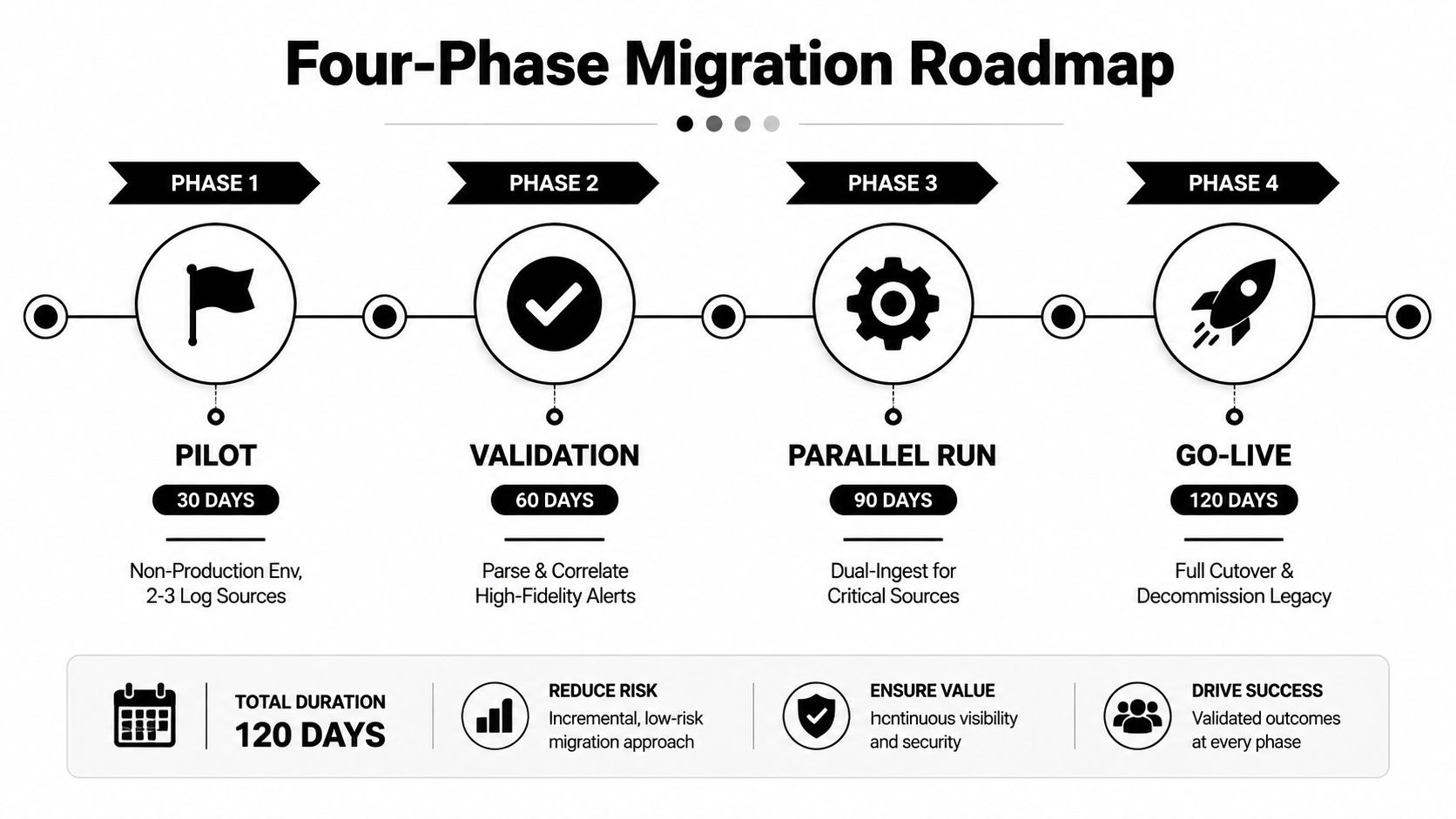
A migration should reduce risk in stages. Leave the existing control in place until the replacement demonstrates that it can parse representative data, reproduce known detections, preserve evidence, and support the analysts who will run it.
Phase one is the pilot
Use a non-production environment for 30 days. Ingest 2 to 3 representative log sourcesIncluding identity events, endpoint telemetry, and a cloud audit feed. Validate parsing with real samples and replay known-bad events or approved test activity.
Do not exit until the team can explain field mappings, identify missing events, reproduce detection results, and export investigation evidence. A dashboard that seems complete does not qualify as an exit criterion.
Phase two validates operational reality
Run a 60-day validation phase using production-like data. Track detection latency, false-positive rate, analyst dwell time, parser failures, storage behavior, and response execution. The planned acceptance thresholds are set at a false-positive rate under 5% and an analyst dwell-time reduction of at least 25%. These targets are internal decision criteria, not universal industry benchmarks, so adjust them if the baseline or risk tolerance requires it.
Phase three cuts over one family
At 90 days, move one high-fidelity detection family, for example authentication anomalies. Run dual ingestion for critical sources, preserve legacy evidence, and document retention parity before retiring the old tool. The first cutover should be narrow enough to reverse without jeopardizing an audit or an active investigation.
Phase four expands continuously
Grow into further domains, decommission duplicate tooling each quarter, and report sprawl reduction to leadership. Track whether the new architecture cuts consoles, duplicate storage, manual enrichment, and unresolved ownership gaps.
Use this acceptance checklist:
- Open data model: Verify that normalized events and exports are not confined to proprietary formats.
- Portable detections: Confirm support for Sigma and YARA where those formats suit the use case.
- API-first design: Directly test the ingestion, search, case management, and response APIs.
- Community activity: Review whether commit velocity is above 50 per quarter as an internal health indicator, together with issue response and release quality.
- Evidence parity: Validate retention, access controls, timestamps, and export integrity before migrating.
- Operational ownership: Designate staff for upgrades, rule review, capacity, and incident response.
The common failure is to skip validation. Another is to move compliance evidence before retention parity is confirmed. View the migration as a security-control change, not a dashboard replacement.
Unified Security Stack provides an open source SIEM, SOAR, and XDR platform, uniting log ingestion, correlation, automated response, vulnerability management, endpoint visibility, access auditing, and compliance workflows for hybrid environments. Visit Unified Security Stack to assess whether a unified data model and shared response layer can supplant overlapping tools in your SOC.