Real Time Threat Detection
Weekly cyberattacks now average 1,968 per week, up 18% year over year and 70% since 2023, while security teams still take an average of 277 days to identify and contain a breach, according to SentinelOne's cybersecurity statistics roundupThat combination alters what real time means in security. It is no longer a dashboard that refreshes quickly. It is about designing detection and response so attackers do not get months of freedom between initial access and containment.
Security teams already gather plenty of logs. That is not where the difficulty lies. The difficulty lies in converting scattered endpoint, identity, network, and cloud signals into a limited set of high-confidence incidents that analysts can act on at once, even when an attacker remains quiet, blends in, or intentionally creates noise.
Real time threat detection works only when engineering, telemetry design, correlation logic, and response automation are aligned. If any one of those components is weak, the system either overlooks subtle attacks or floods the SOC with alerts of little value.
Table of Contents
- Why Real Time Detection Is No Longer Optional
- Comparing Core Threat Detection Methods
- Building Your Telemetry and Ingestion Pipeline
- Architecting for Low-Latency Correlation
- Activating Response with SOC Workflows and SOAR
- Tuning Detections and Mapping to Compliance
Why Real Time Detection Is No Longer Optional
During many intrusions, the attacker does not begin with ransomware or a noisy exploit. They begin with a valid account, a quiet login pattern, a mailbox rule, a suspicious PowerShell command, or a cloud permission change that appears harmless by itself. If the SOC examines those signals hours later, the attacker has already used that time to broaden access and eliminate the simplest containment options.
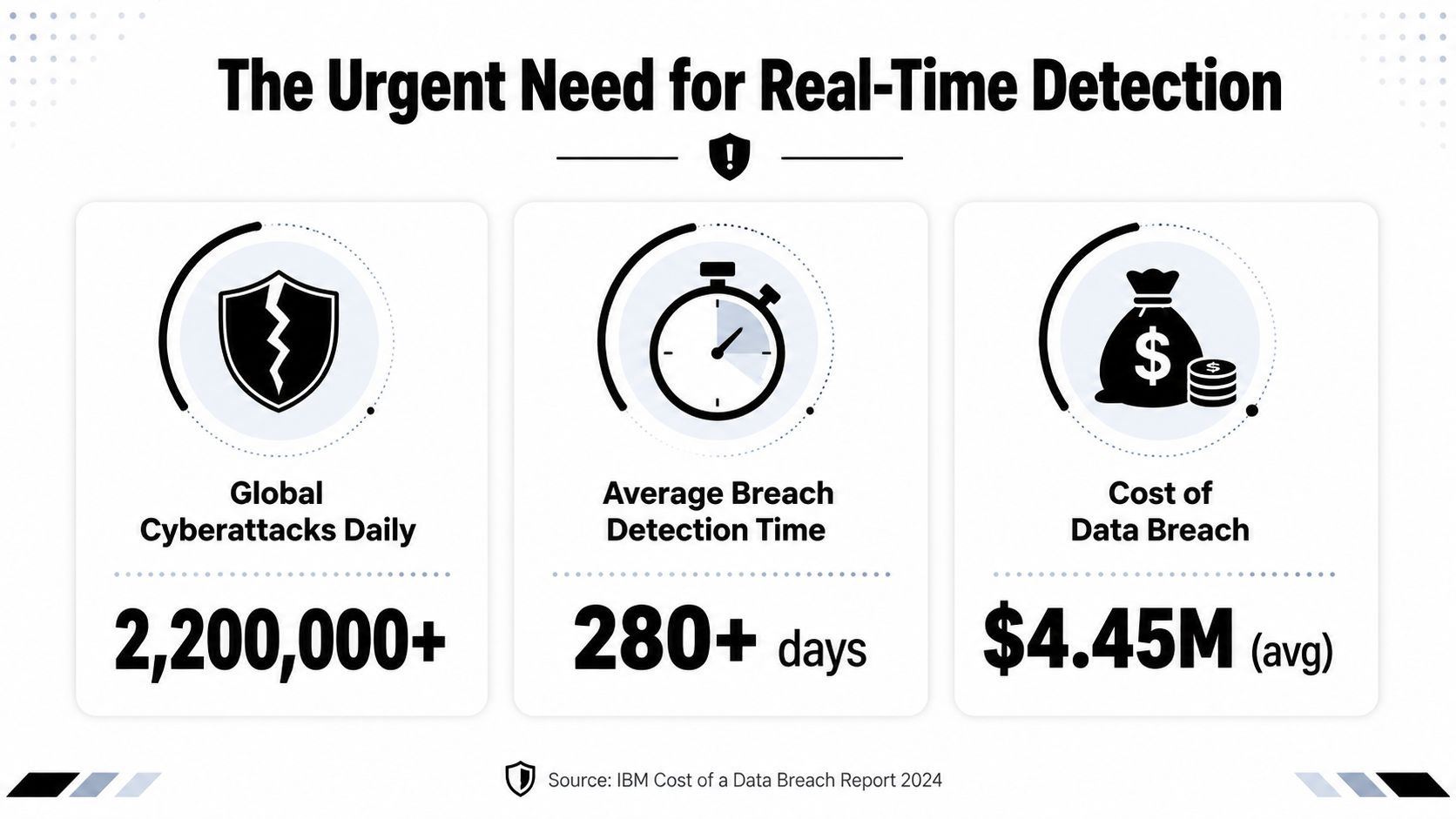
For this reason, real time detection has become a design requirement for security operations rather than a reporting capability. The goal is not to generate alerts more quickly. The goal is to shorten the path from a weak signal to a confident decision to containment while the attack is still underway.
This becomes even more important with low-and-slow activity. Automated commodity attacks usually create enough noise for basic controls to detect. Adaptive attackers take the opposite approach. They spread actions across identities, endpoints, SaaS apps, and cloud infrastructure, making each event appear routine unless your pipeline can quickly correlate the evidence.
In practice, real time detection means detection that changes the outcome. If an analyst receives an alert within seconds but still spends 20 minutes moving between endpoint, identity, email, and cloud consoles to verify it, the organization has speed only at the start of the process and delay everywhere else.
What real time actually means in operations
A working real time program does three things consistently:
- Collects context with the event: It takes in identity, endpoint, cloud, and network telemetry so suspicious activity can be understood in the moment rather than after a manual hunt.
- Correlates related signals before triage: It consolidates low-signal events into one incident that clarifies scope, sequence, and probable intent.
- Starts the response path immediately: It performs enrichment, case creation, and selected containment actions as soon as the evidence reaches a defined confidence threshold.
Practical rule: If your SOC receives alerts quickly yet still needs manual pivoting across five tools before it can judge whether an incident is genuine, your detection is fast, but it is not real time.
The architectural decision behind that principle often matters more than the alert itself. Teams that divide telemetry among disconnected tools tend to notice this first in identity-driven attacks, where a single suspicious sign-in is insufficient, a single endpoint event is insufficient, and a single cloud alert is insufficient. The solution is not always one platform, but the operating model does require shared context and low-latency correlation. A clear SIEM vs XDR comparison helps determine where correlation, investigation, and automated response should take place.
For a CISO, this concerns shrinking exposure windows and keeping response options open. For an analyst, it concerns receiving incidents that already contain enough context to act with confidence. These two aims are the same requirement seen from different roles in the SOC.
Comparing Core Threat Detection Methods
No serious SOC depends on a single detection method. Signature logic, behavioral analytics, streaming anomaly detection, and machine learning each address different failure modes. Consider them as distinct kinds of guards. One reviews a watchlist, one observes unusual behavior, one identifies outliers in a crowd, and one learns from patterns over time.
Microsoft's overview of modern threat detection and response notes that SIEM and XDR tools work by correlating logs and alerts across endpoints, identities, networks, apps, and clouds, while combining behavior-based and anomaly-based detection to catch attacks that signature-only tools miss, in Microsoft's explanation of threat detection and response.
Why single-method detection fails
Signature-only detection is accurate for known threats. It is also simple to evade when attackers alter tooling, misuse legitimate admin utilities, or distribute activity across several systems. That is why low-and-slow activity often persists in environments that still rely on static indicators.
Behavioral and anomaly approaches cover more territory, but they bring another problem. They can yield unstable results if the baseline is weak, the environment changes quickly, or the model sees only one telemetry class. That is why detection engineering still matters. Better tools do not remove the need for rule design, exclusions, and analyst feedback.
A practical way to compare architectures is to ask a single question: which methods build confidence when another method only creates suspicion? Teams assessing SIEM vs XDR approaches typically discover that the answer depends less on product labels and more on how effectively the platform correlates across telemetry types.
Threat detection methods at a glance
| Method | How It Works | Best For | Weakness |
|---|---|---|---|
| Signature-based | Matches known indicators, patterns, or rules against incoming events | Known malware, known exploit behavior, policy violations with stable patterns | Misses novel techniques and adapted variants |
| Behavioral analytics | Compares user, host, or service activity against expected patterns | Account misuse, insider activity, living-off-the-land behavior | Needs a stable baseline and ongoing tuning |
| Streaming anomaly detection | Flags statistical outliers in event streams as they occur | Burst activity, unusual access patterns, sudden changes in traffic or process behavior | Can generate noise without contextual enrichment |
| Machine learning and AI | Uses trained models or inference layers to classify, prioritize, or interpret suspicious activity | Complex multi-signal incidents, triage support, pattern generalization | Quality depends on data, model scope, and guardrails |
Signature rules should answer, “Have we seen this exact thing before?” Behavioral logic should answer, “Does this actor normally behave this way?” Anomaly detection should answer, “Is this event stream deviating from expected range right now?”
Top-performing detection programs apply these approaches in tandem rather than letting them vie with one another. Signature-based logic provides high confidence for familiar patterns. Behavioral and anomaly-based logic address new activity. Machine learning assists in ranking and clarifying unclear cases. The correlation layer merges those distinct findings into a single incident that merits escalation.
Building Your Telemetry and Ingestion Pipeline
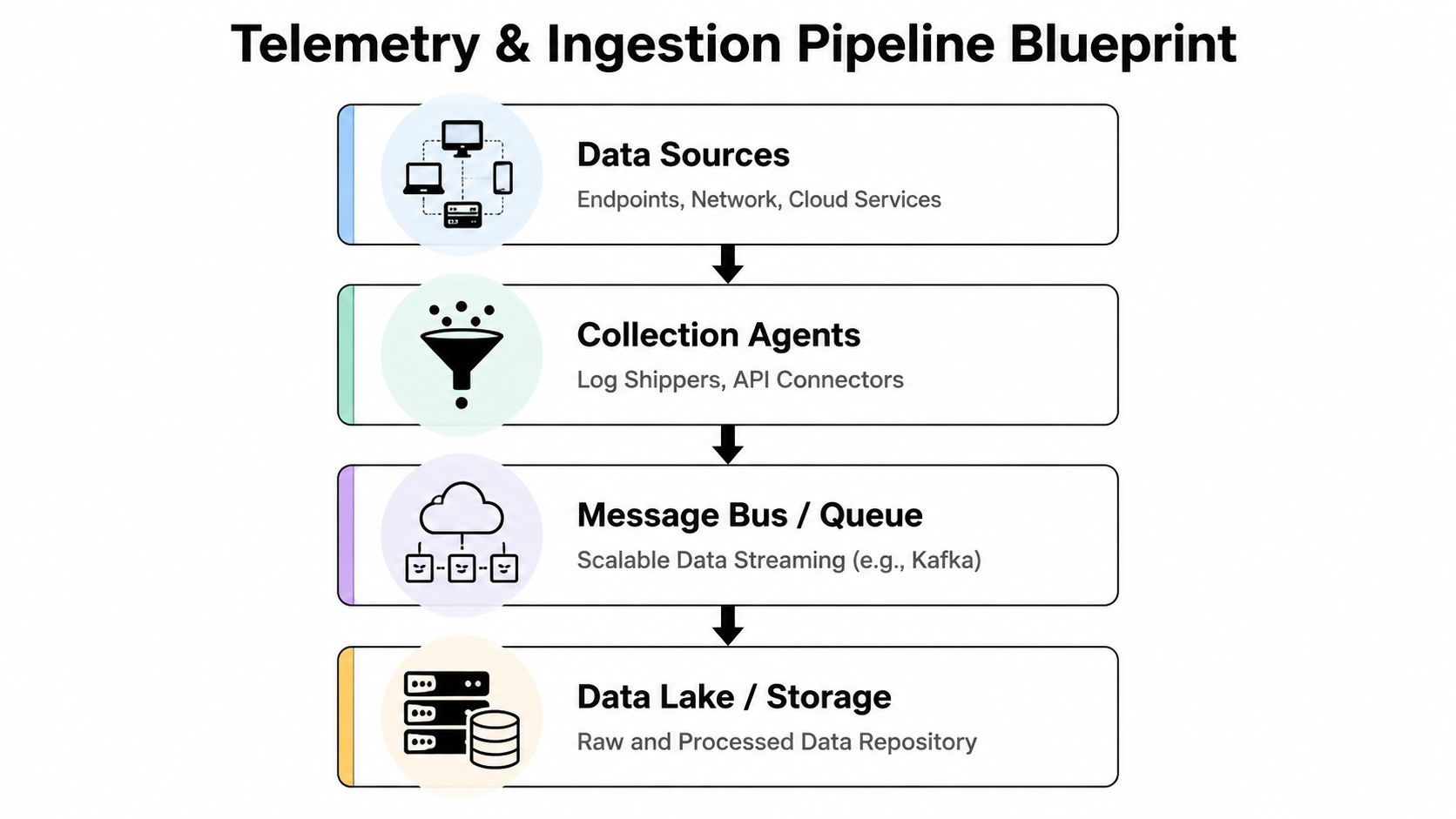
Most detection programs that fail do not fail at analytics. They fail earlier in the pipeline. The telemetry is incomplete, inconsistent, or too delayed to support dependable correlation. If the system cannot see identity activity, endpoint execution, cloud control-plane changes, and network movement together, it cannot explain what an attacker is doing.
A 2024 arXiv study using a curated dataset of 2,000 records found that basic header metrics alone lacked the precision needed for accurate classification, while combining features such as attack type and geolocation patterns improved detection quality, as described in the arXiv study on predictive analytics for real-time cyber-attack detectionThis finding aligns with what SOC teams observe in live environments. Real time threat detection is a correlation challenge.
Collect telemetry that explains behavior
Start with sources that answer different questions about the same incident:
- Endpoint telemetry: Execution of processes, parent-child process chains, script behavior, persistence modifications, and actions on local accounts.
- Identity telemetry: Login events, MFA prompts, conditional access choices, privilege modifications, and usage patterns that should not be possible.
- Cloud telemetry: Activity in the control plane, role assumptions, API actions, storage access, workload events, and changes to configuration.
- Network telemetry: Flow records, DNS activity, proxy logs, east-west traffic, and packet-level inspection applied selectively when warranted.
The goal is not to gather everything. It is to gather enough to rebuild attacker behavior without making the analyst guess. Endpoint data may reveal a suspicious script. Identity data can indicate whether that same user had unusual login behavior. Cloud logs can show whether the identity accessed sensitive services minutes later.
Design ingestion for context before storage
Centralizing logs alone is not sufficient. Effective ingestion pipelines perform at least four tasks before events reach long-term storage:
- Normalize fields: A shared schema is required for user, host, process, and event names.
- Enrich records: Incorporate asset criticality, identity metadata, geolocation when applicable, and threat intel tags if you rely on them.
- Deduplicate noise: Consolidate duplicate alerts and low-value events that repeat.
- Pre-correlate obvious relationships: Connect related events while ingestion occurs so the SOC does not need to rediscover them by hand.
That's why teams invest in centralized log management architectures that go beyond storing records. The pipeline must maintain context while lowering friction downstream.
Field lesson: When two logs point to the same user under different naming formats, or to the same host under different identifiers, your correlation engine will silently lose incidents well before analysts see any alert.
Storage design also counts. Retain raw data for forensics. Retain normalized and enriched data for search and detection. Do not force your costly analytics layer to handle cleanup that should have occurred as soon as the event arrived.
Architecting for Low-Latency Correlation
High-volume pipelines break when each event receives the same costly treatment. That design appears thorough on paper, yet it collapses under load, increases latency, and pushes analysts into a backlog model. Real time threat detection requires a correlation architecture that processes common events at low cost and rare events in depth.
A reference architecture for WebSocket-based monitoring showed how a tiered pipeline using Isolation Forest for initial scoring and escalating only high-risk or complex logs to an LLM handled more than 10,000 events per second and achieved a 93% F1-score on synthetic DDoS and data-exfiltration datasets, according to the SCIRP paper on a real-time cyber monitoring architecture. The architecture counts more than the particular tools. Separating ingestion from deep reasoning is what prevents throughput and analytical depth from working against each other.
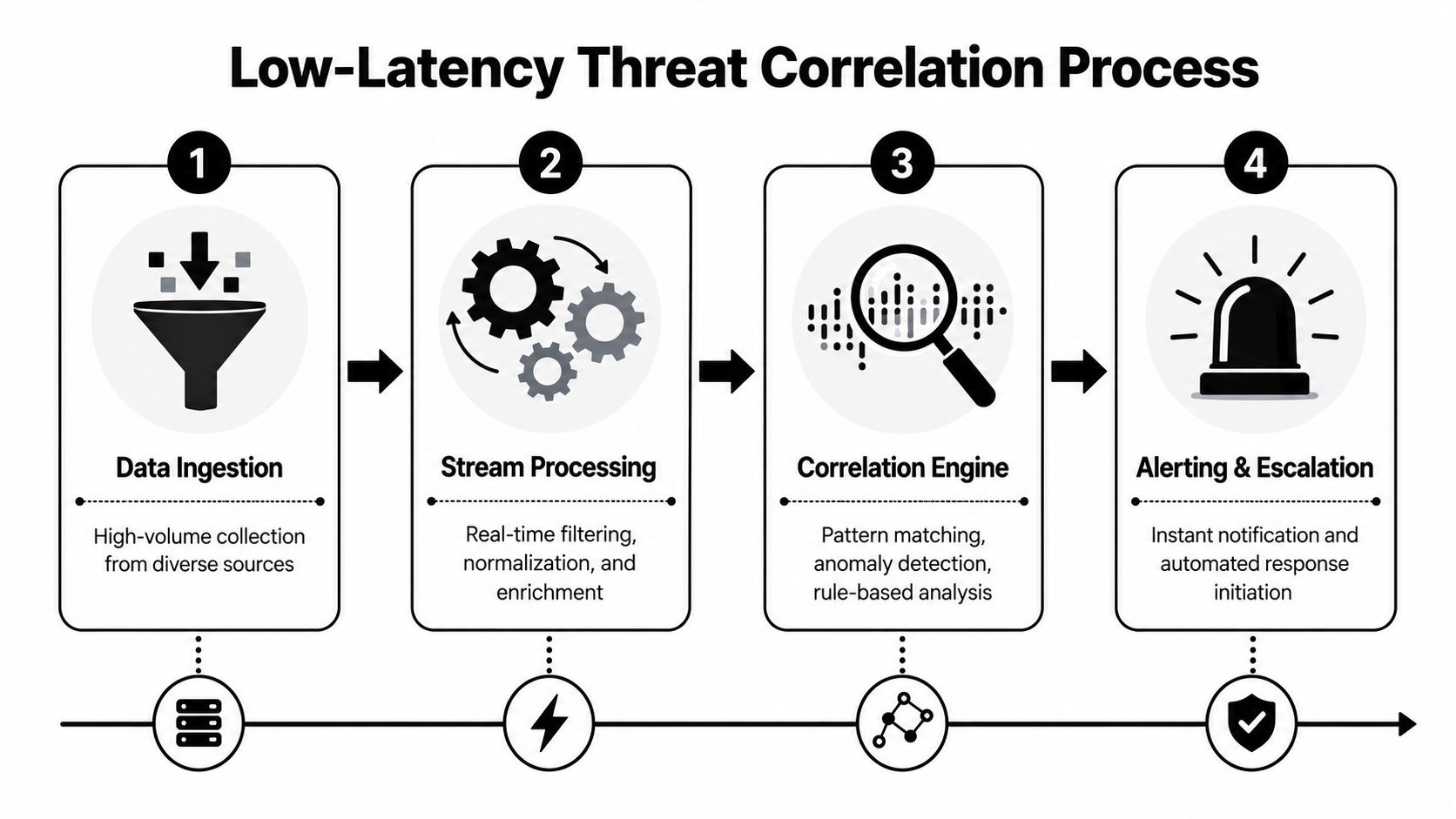
Normalize first or correlation breaks
Correlation engines do not reason. They compare fields, order events, and check conditions. If your input data is inconsistent, the engine cannot link actions across tools.
This is why mature SOC architectures standardize on a stable event model. At the least, you need trustworthy representations of:
| Correlation object | Why it matters |
|---|---|
| User identity | Ties login activity, privilege changes, SaaS access, and endpoint use together |
| Host or workload | Connects process activity, network communication, and asset context |
| Event time | Supports sequencing and window-based rules |
| Action type | Lets the engine distinguish authentication, execution, data access, and configuration changes |
When those objects become stable, stateful correlation can happen. The engine can recall that a user failed MFA, then signed in from a new location, then created a mailbox rule, then triggered unusual file access. Without state, those are four distinct alerts. With state, they become one incident narrative.
Use a tiered analysis path
The most workable architecture relies on several processing layers with distinct costs and functions.
- Fast filters first: Rules, allowlists, parsers, and lightweight anomaly scoring eliminate clear noise and surface suspicious events rapidly.
- Stateful correlation next: Events are correlated by the system within a set time range, actor, or asset.
- Deep analysis last: Advanced analytics, human review, or LLM-assisted triage provide deeper interpretation for high-risk cases.
Teams frequently overbuild. Because they distrust the front of the pipeline, they send every event to the deepest analysis layer. The outcome is easy to foresee. Increased cost, added latency, and reduced consistency.
Regard deep reasoning as a limited resource. Apply it when context is unclear or impact is significant, not when a deterministic rule already provides the answer.
A low-latency design also needs operational safeguards:
- Back-pressure control: Queues need to handle spikes while ensuring critical events are not silently lost.
- Priority paths: Signals tied to identity abuse, privilege escalation, and containment should be processed more quickly than ordinary informational logs.
- Replay capability: After a missed detection or threat hunting lead, analysts must be able to run new logic again over retained data.
When the architecture cannot support those functions, real time turns into a best-effort label instead of an operational property.
Activating Response with SOC Workflows and SOAR
A strong detection stuck in a queue is merely delayed response with nicer branding. The SOC gains value when a high-confidence incident arrives automatically with sufficient context for a decision, and when routine containment actions occur without a person copying steps from a runbook.
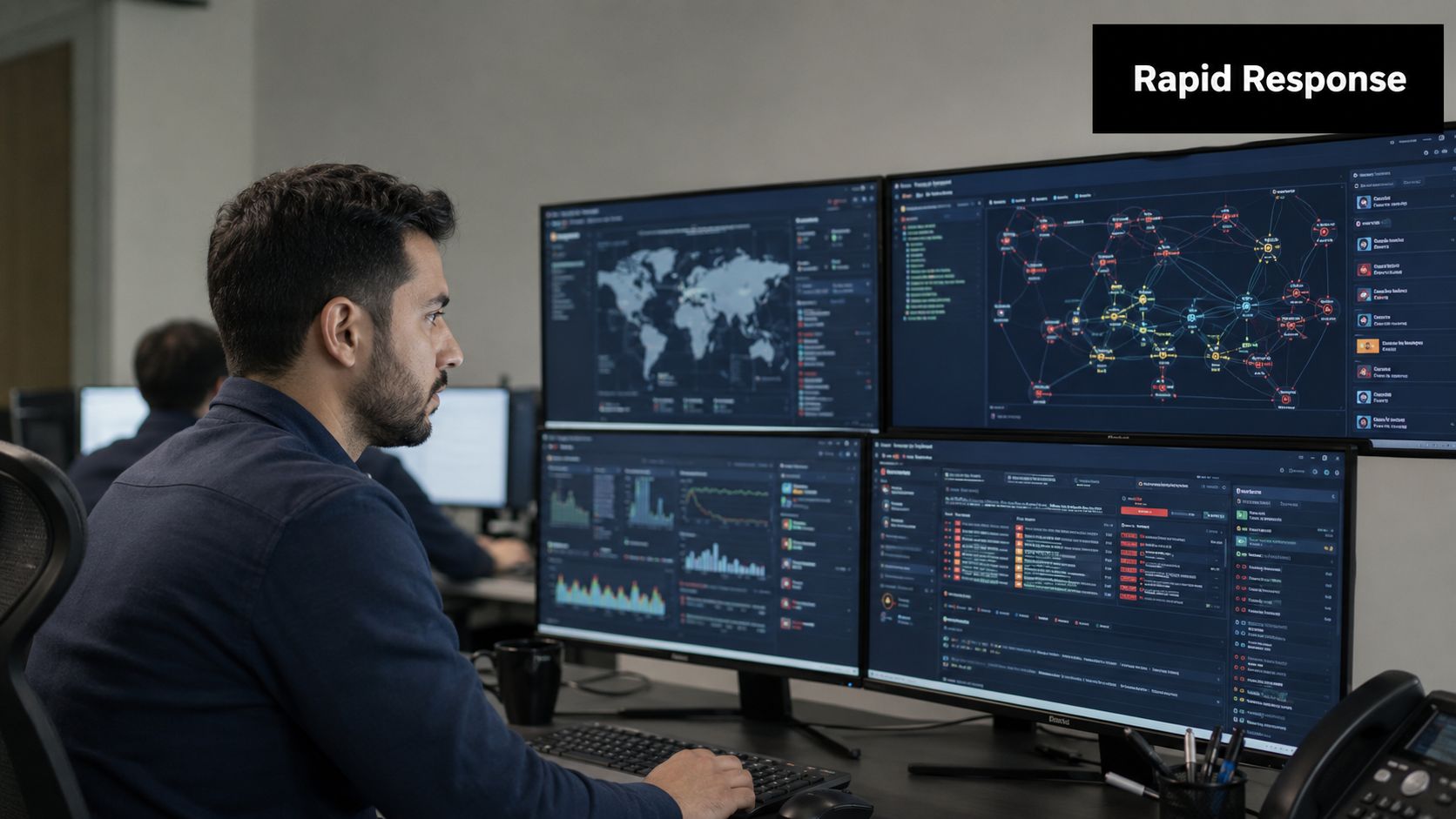
What a useful alert looks like
An analyst should not get a raw event labeled suspicious login. A useful alert ought to contain identity context, asset criticality, related activity, and suggested next actions from the start. That is the practical handoff from detection engineering to incident response.
Take, for instance, an identity alert in the impossible-travel style. By itself, it may still be a false positive from VPN routing or mobile network shifts. It turns actionable once the system enriches it with context like recent MFA behavior, failed login volume, admin role status, sensitive application access, and endpoint activity tied to that user session.
At that point, the alert can feed a structured security incident response workflow rather than forcing an analyst to hunt across multiple consoles.
A practical response flow
A workable SOAR playbook for a high-confidence identity compromise usually follows this sequence:
Validate the trigger
- Verify that the alert originated from correlated identity and endpoint signals, rather than one raw event.
- Review suppression rules and established exceptions for travel, VPN, or service accounts.
Enrich the incident
- Gather user role, manager, group membership, privileged access status, and asset ownership.
- Collect adjacent activity, including mailbox rules, unusual file access, or token use.
Contain if confidence is high
- Either disable the account or challenge it.
- Revoke active sessions.
- Contain the impacted endpoint when endpoint telemetry indicates compromise.
Create an investigation trail
- Open a ticket.
- Include every piece of related evidence.
- Set severity according to affected systems and user privileges.
Control is one reason to keep these steps separate. You want automation to act quickly, while also ensuring analysts understand precisely why a playbook took action.
The best SOC workflows do not automate every action. They automate what repeats, keep evidence intact, and retain judgment points where business impact is significant.
A short demonstration of incident workflow automation helps make that concrete:
Implementations vary from platform to platform, but the core design principle remains constant. One possibility is Unified Security Stacka solution that combines SIEM, SOAR, and XDR capabilities, ingests logs from endpoints, networks, and cloud services, and correlates events in real time before indexing, enabling response playbooks to act on higher-context incidents instead of isolated alerts.
Tuning Detections and Mapping to Compliance
Detection effectiveness degrades more quickly than most teams anticipate. New SaaS applications emerge, administrators take on different tools, users change how they work, and attackers modify their techniques to hide within that evolution. When tuning is irregular, the program gravitates toward two costly results. Either analysts are overwhelmed by alerts, or the rules are so tightly constrained that persistent attackers remain under the threshold of concern.
Vectra AI makes a useful point in its discussion of the cybersecurity detection gapAdaptive attackers do not rely solely on loud malware or high-volume automation. They leverage legitimate accounts, sanctioned tools, and incremental changes made over time. A robust detection program must factor in that behavior, not merely signature matches and single-event anomalies.
Tune against drift and attacker adaptation
Effective tuning begins with feedback from operations. Each closed alert ought to result in a determination by detection engineering or the SOC lead:
- Keep as-is: The alert was accurate and timely, and it justified the analyst's time.
- Refine: The rule logic detected the correct pattern, yet the scope, threshold, suppression logic, or enrichment requires modification.
- Retire or replace: The alert no longer corresponds to meaningful attacker behavior, or a different rule now handles it more effectively.
That process appears straightforward. The difficult part is determining what to optimize for.
When a rule triggers on every admin script, analysts will overlook the single execution that matters. If the rule is constrained too tightly, an attacker who uses the same tooling with a slightly different parent process or host profile will evade detection. The trade-off is not abstract false positives versus false negatives. It is analyst time versus detection coverage, weighed against the attacker behaviors your environment is most likely to encounter.
Low-and-slow activity sets a higher standard. One login from a new ASN may be harmless. A login from a new ASN followed by MFA reset activity, OAuth consent changes, and access to a finance mailbox within 45 minutes is a different scenario entirely. Effective tuning often means shifting from single-event rules to sequence-based detections that score related behavior across identity, endpoint, and cloud telemetry.
I have observed mature teams achieve better outcomes by examining detections on a set schedule using real cases, not theory. Select 20 to 30 recent alerts from a detection family. Review time-to-triage, closure reason, enrichment quality, and whether the rule revealed attacker behavior early enough to matter. That review typically uncovers real issues: missing context, outdated allowlists, poor entity normalization, or threshold logic borrowed from a different environment.
Map detections to control evidence
Compliance mapping is most effective when integrated into the detection catalog, rather than appended during audit preparation. For every production detection, record four elements: the rule ID, the control objective it supports, the evidence artifacts it generates, and the review owner. This transforms detections from operational output into audit-ready control evidence.
A specific example helps put this into practice.
Detection rule DET-055: Impossible travel followed by remote access activity
- Detection logic: Flag a user who logs in from two geographically distant locations within an implausible timeframe, then starts remote access or opens a sensitive cloud application.
- Required telemetry: Sign-in logs from the identity provider, VPN or ZTNA logs, device posture or endpoint identity, and geolocation enrichment.
- SOC action: Confirm session legitimacy, inspect token usage, look for MFA fatigue or session hijacking, and contain the account when confidence is high.
- Evidence produced: Alert record, raw authentication events, analyst disposition, session revocation log, ticket history, and notes from manager or user verification.
That rule can map directly to CMMC AC.2.016This obligates organizations to control and monitor remote access sessions. It can also assist with SOC 2 CC6 objectives concerning logical access monitoring, depending on the auditor's expected format for evidence. Specificity is the key point. Claiming that we monitor suspicious logins is weak evidence. Stating that DET-055 produced 14 alerts this quarter, three required containment, Tier 2 analysts reviewed all of them, and ticket records show session termination and user verification provides evidence an auditor can test.
The same method applies to other control families:
- Privileged access detections: Correspond to access control and privileged account monitoring requirements.
- Configuration change detections: Correspond to change management, unauthorized modification, and baseline integrity controls.
- Data access and exfiltration detections: Align with monitoring, incident response, and data protection requirements.
The strength of your evidence counts as much as the logic behind your detection. Auditors typically expect proof that a control ran from start to finish. That covers the alert, triage notes, escalation path, exception handling, containment action where relevant, and final closure. Should any of those records sit outside the case system, demonstrating the control becomes more difficult.
Organizations that do this well assign an owner and a review period to each detection family. They can answer standard audit questions promptly: Which controls does this rule uphold? What evidence does it produce? Who authorized the tuning adjustment? What occurred when the rule triggered? The same rigor benefits the SOC. Rules with no clear control value and no measurable detection value are easier to retire.
If you're evaluating how to operationalize real time threat detection across SIEM, XDR, SOAR, and compliance workflows, Unified Security Stack is a platform worth evaluating. It is built to deliver centralized telemetry, real-time correlation, automated response, and control mapping across hybrid environments, which makes it a fit for SOC teams needing detection engineering and audit evidence within one operating model.