What Is the Cyber Kill Chain: A 2026 Guide
You open an inbox and spot the kind of message every SOC team knows all too well, one that looks routine, arrives with a harmless subject line, and asks someone to click, open, or approve something they should not. That is where what is the cyber kill chain ceases to be an abstract phrase and becomes a practical lens for thinking about intrusion, since an attack is usually not a single event but a series of decisions an adversary makes before harm becomes visible.
The Cyber Kill Chain offers a structure for making those choices. Lockheed Martin gave it formal shape in 2011 as a defense framework that breaks an intrusion into seven phases, reconnaissance, weaponization, delivery, exploitation, installation, command and control, and actions on objectives (Lockheed Martin). For an analyst who is new, this matters because it converts a chaotic stream of alerts into a path you can follow across SIEM, XDR, and SOAR controls.
It is also the reason the model still appears in modern security operations. In traditional perimeter intrusions, ransomware staging, and supply-chain compromise, the staged perspective helps you ask a better question than whether we blocked it. You ask, Where is the adversary at this moment, what telemetry ought to be present already, and what can we still disrupt? For groups focused on governance, risk, and controls, that staged approach also complements broader security programs, particularly when you align detection and response with policy and audit expectations. A helpful companion in that area is why GRC is so critical.
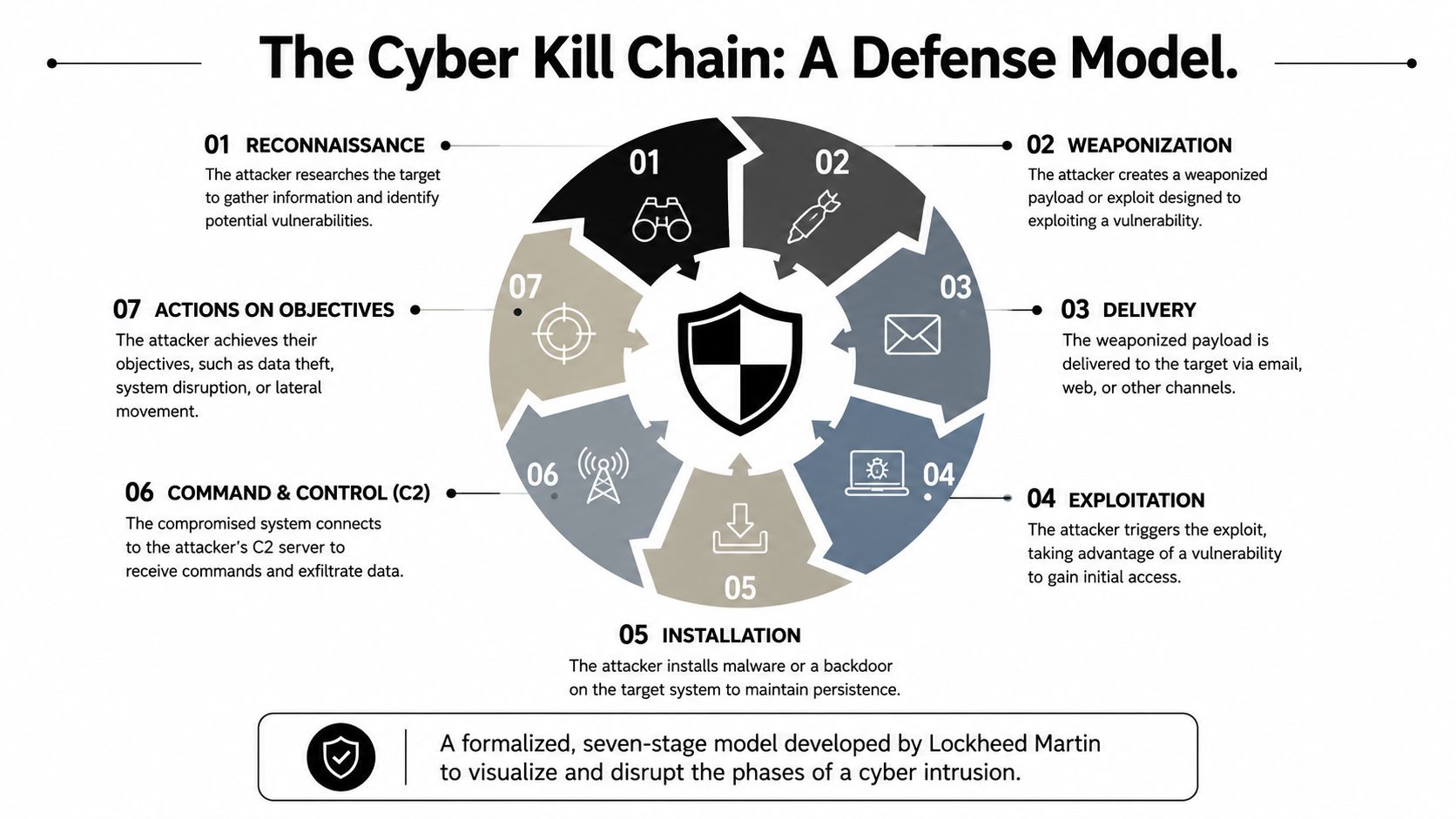
Table of Contents
- What the Cyber Kill Chain Is
- The Seven Stages Explained from Recon to Action
- A Real-World Walkthrough of the Target Breach
- Mapping SIEM, XDR, and SOAR Controls to Each Stage
- How MITRE ATT&CK Complements the Kill Chain
- Where the Kill Chain Falls Short
- A Practical SOC Playbook and Observability Checklist
What the Cyber Kill Chain Is
A phishing message arrives in a finance inbox, one employee opens the attachment, and the response queue fills with a suspicious process tree, an unusual outbound connection, and an identity event that does not match the rest of the narrative. The Cyber Kill Chain gives analysts a method to label that sequence and follow how the intrusion progressed, rather than handling each alert as a separate problem.
The model is a staged intrusion framework. It breaks an attack into seven phases, with interruption as the goal. Halt the adversary at a single stage, and the intrusion path can collapse before it reaches the final objective. That is why SOC teams rely on it as a common language for discussing how an attack starts, advances, and ends across endpoints, identity systems, and cloud workloads.
Its value lies in clarity. A junior analyst can state that the incident is in delivery or command and control, while the rest of the team knows what evidence to gather next. The same sequence also assists threat hunters in choosing among email telemetry, endpoint behavior, DNS analytics, NetFlow, or identity logs. A technical review characterizes the framework as capturing the path an intruder takes to penetrate information systems over time, which is a useful way to frame it in a SIEM or XDR program (technical review).
Practical rule: regard the kill chain as a narrative backbone, rather than a full chart of every adversary action.
The model performs best when an intrusion still has a clear start and finish, which is why it stays useful for phishing, malware staging, and supply-chain compromise. It begins to strain when adversaries are already within trust zones, misusing identities, or moving laterally in cloud and SaaS environments. That trade-off matters to defenders. A staged model provides a clean narrative for the response team, yet it does not account for every modern attack path, which is why control design often must sit beside broader governance and risk work, including why GRC is so critical.
The Seven Stages Explained from Recon to Action
Reconnaissance
Adversaries begin by discovering what you expose. They examine public profiles, job postings, certificates, subdomains, and open services before they touch a host, since the less expensive the target is to map, the simpler the later steps become. In a SOC, the earliest signals often appear in DNS logs, firewall events, cloud discovery alerts, and unusual scan patterns.
Weaponization
At this point the adversary constructs the payload based on what they discovered. That may involve a malicious document, a macro chain, or a loader that conceals a second-stage tool. For defenders, the first clue is often email gateway telemetry, attachment detonation results, or EDR behavior around script execution and child processes.
Delivery
Delivery is the transfer. A phishing message, a malicious link, a drive-by download, or a supply-chain insertion brings the payload within reach of a user or system. Correlate mail flow, URL reputation, proxy logs, and endpoint downloads at this point, because delivery is where many attacks still leave a visible trace.
Exploitation
This is when the payload takes effect, whether by exploiting a software flaw or a user trust decision. Look for process injection, abnormal script hosts, browser-to-shell transitions, and suspicious child processes. The first defensive instinct should be to connect endpoint behavior back to the original email, web request, or vulnerable application.
Installation
After gaining a foothold, an intruder seeks persistence. Common markers include services, scheduled tasks, registry modifications, web shells, and added startup entries. Your telemetry should focus on EDR persistence detections, host configuration changes, and privileged account creation.
Command and Control
At this point, the system contacts the adversary. Beaconing, tunneling, recurring DNS queries, and outbound connections to strange destinations are all relevant here. The correct visibility is on NetFlow, DNS analytics, proxy logs, and endpoint network telemetry, since C2 is frequently quieter than the earlier phases yet more telling than the final action.
Actions on Objectives
This is where the adversary cashes out. Data theft, encryption, disruption, or extortion appear at this point, and your alerting should already be driving containment. Consider file access anomalies, archive creation, mass rename activity, backup tampering, and exfiltration patterns.
| Stage | Attacker Behavior | Primary Telemetry |
|---|---|---|
| Reconnaissance | Gathers target information and scans exposure | DNS, firewall, cloud discovery, scan logs |
| Weaponization | Builds or customizes the payload | Email gateway, attachment sandbox, EDR script alerts |
| Delivery | Gets the payload to the target | Mail flow, proxy, URL filtering, download events |
| Exploitation | Triggers execution or trust abuse | Endpoint process behavior, browser activity, exploit alerts |
| Installation | Establishes persistence | EDR persistence events, service creation, registry changes |
| Command and control | Reaches back to the attacker | NetFlow, DNS analytics, proxy, endpoint network data |
| Actions on objectives | Steals, encrypts, disrupts, or extorts | File activity, archive creation, data movement, backup tampering |
Netskope notes that many attacks spend most of their lifecycle in the middle of the chain, often spanning Step 2 to Step 6 (Netskope). That is why detection engineering must not wait for exfiltration. It should activate earlier, where the signals are weaker but the opportunity to stop the intrusion remains real.
A Real-World Walkthrough of the Target Breach
The 2013 Target breach makes the model tangible because it did not start with a dramatic exploit. It started with a trusted third party. A U.S. Senate analysis applied the kill chain to show that defenders need only stop an attacker at one stage to disrupt the full intrusion path, which is the lesson that still matters when you're reviewing a breach timeline today (PMC analysis).
The adversary path matches the staged model neatly at first. A spear-phishing email reached a third-party HVAC vendor, credentials were stolen, and the attacker used that foothold to enter the Target environment through trusted access. Once inside, the campaign moved into scanning, lateral movement, and eventual deployment against point-of-sale systems. The meaningful point is not merely that malware existed. It is that the attacker kept crossing phase boundaries without being stopped.
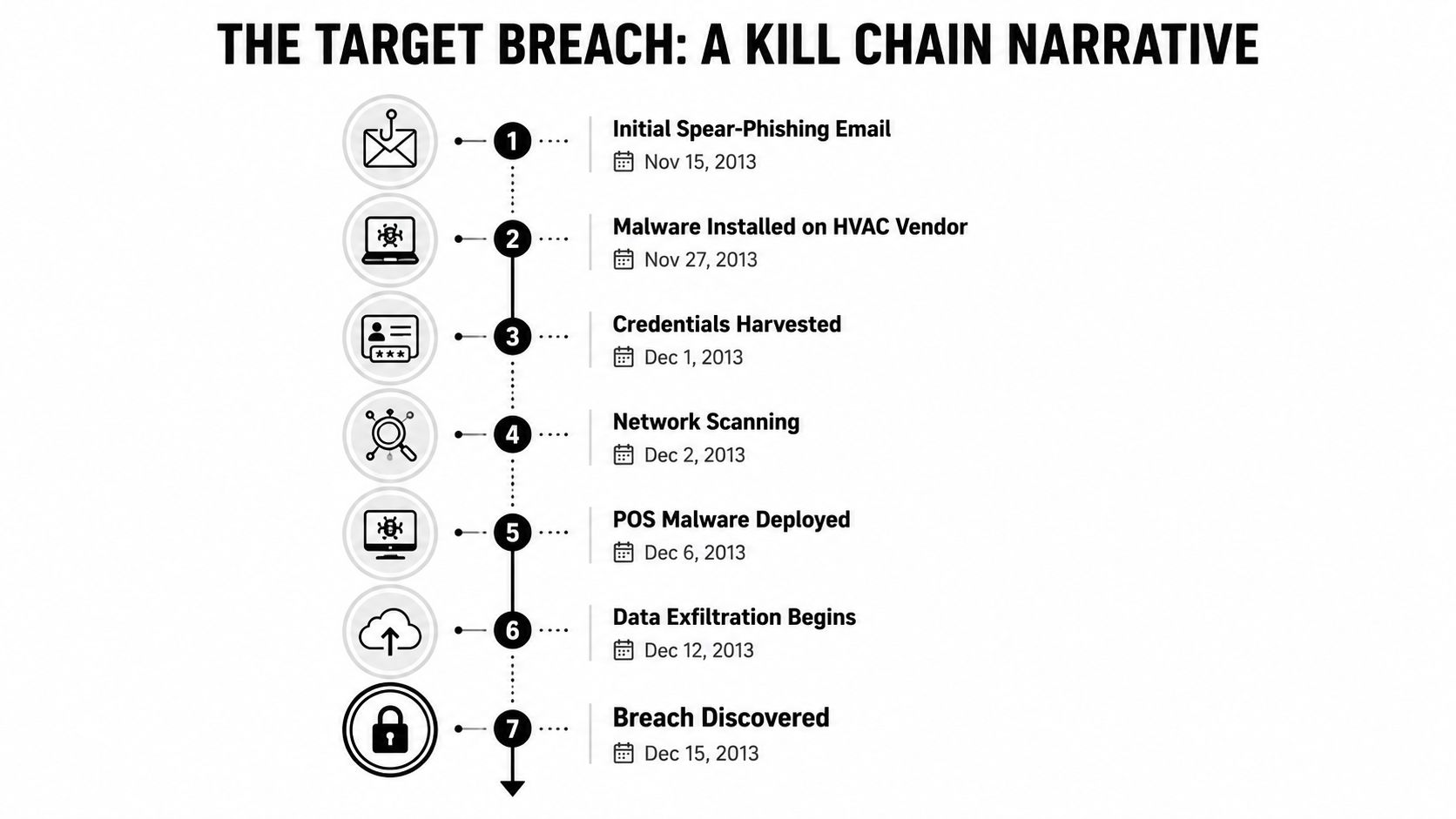
Many breach retrospectives emphasize only the final payload. The kill chain enforces a different practice: identify which control failed first and what telemetry should have connected the dots sooner. In the Target case, the story also illustrates why siloed visibility is harmful. Network, endpoint, and identity teams can each observe part of the attack, but if no one correlates the sequence, the intrusion appears smaller than it is.
The breach is still relevant because it's a reminder that trusted relationships are part of the attack surface. A vendor account, a service path, or a poorly monitored credential can move an adversary from delivery into exploitation without triggering the kind of perimeter alert teams expect. That is precisely why staged analysis remains valuable in a modern SOC.
Mapping SIEM, XDR, and SOAR Controls to Each Stage
A strong kill chain program does not stop at naming stages. It maps every stage to a correlation rule, a sensor source, and a response action. This way, the SOC knows what to detect, where to validate it, and how to contain it without improvising under pressure.
For reconnaissance, the SIEM should correlate scanning behavior across DNS, firewall, and cloud discovery logs. XDR evidence comes from unusual asset enumeration, suspicious web probing, or host discovery bursts, and the SOAR action should enrich the alert, then decide whether to rate-limit, block, or isolate the source according to confidence.
For weaponization and delivery, email and endpoint data are most important. A macro-enabled document, a malicious link, or a suspicious attachment should prompt correlation across the mail gateway, sandbox results, and endpoint execution telemetry. If the chain is strong, SOAR can quarantine the message, disable the sender relationship, and open a case to hunt related hosts.
For exploitation, bind the alert to behavior, not signatures alone. A SIEM rule that seeks user-driven execution followed by script host activity and unusual child processes gives analysts a stronger pivot than one process name. In practice, an XDR view pays off because it links endpoint, identity, and network evidence in a single investigation flow. If you want a closer look at that layer, the concept is summarized well in Unified Security Stack's XDR overview.
Operational habit: write the detection so the analyst can quickly answer three questions: what happened, where it happened, and what was touched next.
Installation, C2, and actions on objectives require more aggressive containment. The SIEM should correlate persistence creation, suspicious outbound beacons, and data movement anomalies, while SOAR should be prepared to contain the host, disable the account, or block traffic. Unified Security Stack is one platform that collects logs from cloud services, network devices, and endpoints through APIs, Syslog, NetFlow, and agents, then correlates them in real time and can trigger response playbooks across the estate.
For better correlation, threat intelligence also counts. The platform note in the brief emphasizes more than 30 billion IOC elements as enrichment to reduce false positives, which is especially useful when a beacon looks odd but is not yet conclusive. That is the difference between alert fatigue and a workable kill chain program.
If you are formalizing these response steps, the playbook structure itself warrants the same attention as the detections. A strong starting point is incident response playbooks, because containment, triage, and evidence preservation must be defined before an incident forces the issue.
How MITRE ATT&CK Complements the Kill Chain
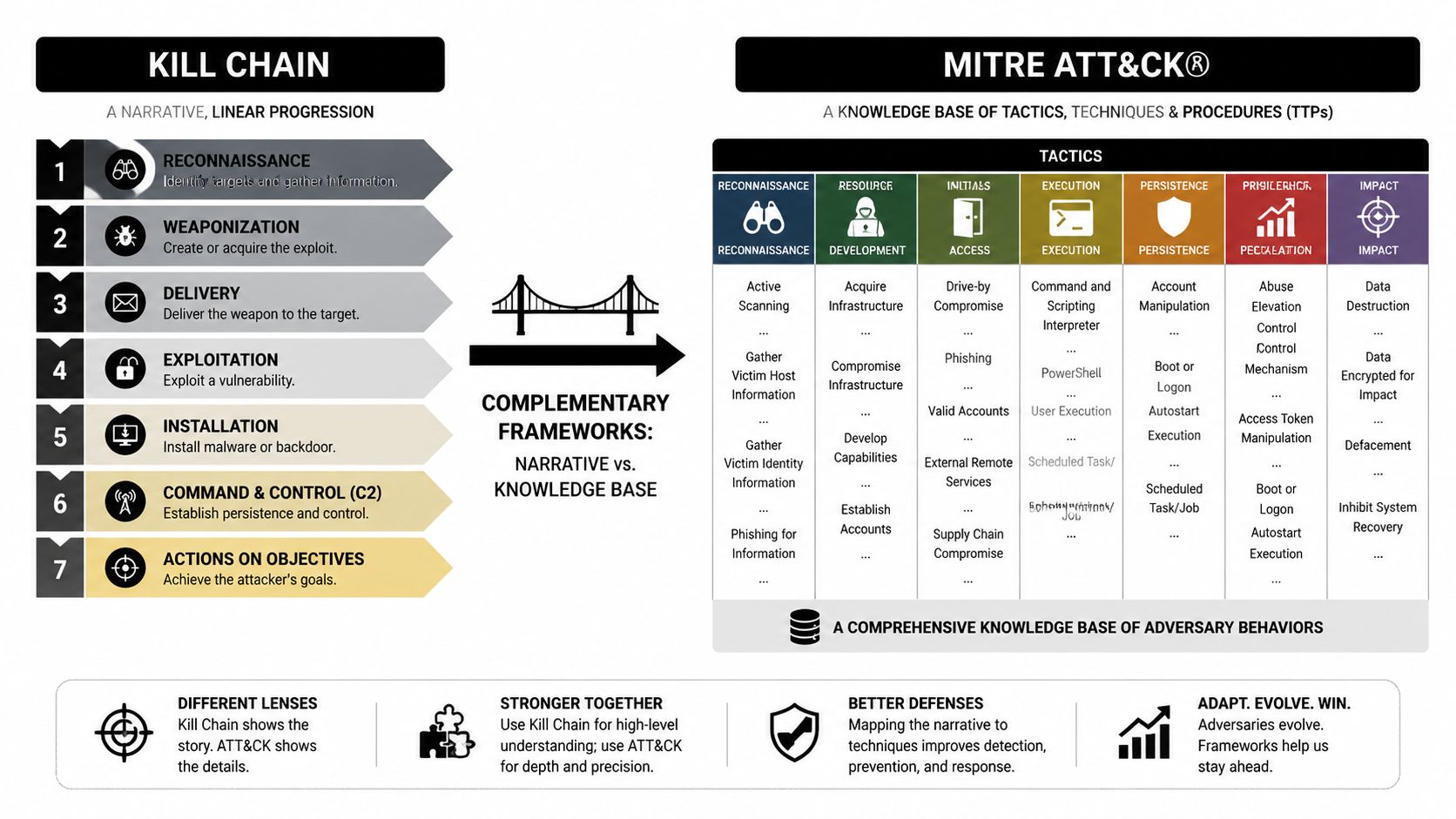
The Cyber Kill Chain indicates where an attack falls in time. MITRE ATT&CK shows what the adversary is doing. This difference is important because the kill chain is a linear story, whereas ATT&CK is a behavior matrix that allows you to categorize techniques within a stage rather than reducing everything to one label.
Command and control illustrates this well. Within the kill chain, it is a single phase. In ATT&CK, that phase may correspond to techniques such as application layer protocol, encrypted channel, or ingress tool transfer. If a SIEM rule labels both the kill chain stage and the ATT&CK technique ID, triage becomes simpler since analysts can view the narrative and the behavior together.
Combining the two also supports control coverage. A view based only on the kill chain may indicate that the attacker is active midway through the intrusion. ATT&CK shows whether the evidence suggests script execution, remote services, scheduled task abuse, or a specific channel used for C2. This is why mature SOCs rely on both rather than making a single framework perform both roles.
The compliance benefit also appears in reporting. When detections correspond to a stage and a technique, explaining control coverage to auditors and stakeholders becomes easier in programs such as CMMC, HIPAA, PCI, ISO 27001, and SOC 2. The framework does not take the place of those controls, but it provides clearer language to demonstrate how your monitoring matches risk.
If your team needs a practical method to connect both perspectives, detection engineering is the appropriate bridge. Unified Security Stack's detection engineering guidance aligns with that operating model since it views stage-based detection and technique-level classification as complementary rather than competing.
Where the Kill Chain Falls Short
The traditional model presumes an external attacker advancing from the perimeter. That is helpful, yet it does not completely capture what occurs when the attacker is already within the trust boundary, using a valid identity, or traversing SaaS and cloud systems. In such situations, the neat seven-step sequence may appear incomplete.
Identity-driven attacks represent the most obvious gap. Lateral movement, delegated trust abuse, and OAuth consent abuse do not always resemble a textbook intrusion path, particularly after a privileged account is involved. Independent guidance on the model's limitations observes that teams depending only on the kill chain may overlook these behaviors and advises combining it with MITRE ATT&CK for broader coverage (independent guidance).
The definition itself is also more contested than many assume. Microsoft describes an eight-phase version that adds monetization after actions on objectives, while the original Lockheed Martin framework remains the canonical seven-step model (Microsoft). That is not merely a naming dispute. It reflects that modern ransomware and extortion campaigns often conclude in criminal business outcomes, not only compromise.
Thus the model is best used as a storyline, not a limit. It provides SOC teams with a sequence to anchor to, yet cloud telemetry, identity logs, and ATT&CK mappings are what close the gaps. Without those layers, the attacker can blend into trusted activity while the kill chain still appears orderly on paper.
A Practical SOC Playbook and Observability Checklist
Begin by connecting telemetry to the phases that typically provide the earliest signal. DNS and NetFlow analytics help with reconnaissance and C2, email and endpoint controls help with delivery and exploitation, and EDR tamper protection assists with installation. If identity provider logs are not in the SIEM, you are blind to delegated trust abuse and a large portion of modern exploitation paths.
Next, define containment actions before they are needed. Your SOAR engine should know when to isolate a host, disable an account, block traffic, and create a high-priority incident. If you want a practical reference for dividing response roles, incident response roles defined serves as a helpful companion for aligning responsibilities before the pager sounds.
A quarterly checklist keeps this manageable:
- Reconnaissance coverage: verify that scan detection, cloud discovery alerts, and DNS anomaly rules are active.
- Delivery and exploitation coverage: check mail quarantine, attachment sandboxing, browser and script telemetry, and endpoint behavioral rules.
- Installation coverage: exercise persistence detections for services, scheduled tasks, and registry changes.
- C2 coverage: examine beaconing, tunneling, and unusual outbound protocol analytics.
- Actions on objectives coverage: Practice ransomware response, backup safeguards, and alerts on data movement.
Unified Security Stack fits that workflow because it combines log management, vulnerability scanning, access rights auditing, endpoint protection, and built-in compliance mapping for HIPAA, GLBA, CMMC, PCI, ISO 27001, and SOC 2Applied in that manner, the cyber kill chain is no longer just a diagram; it serves as the framework for your detections, your response, and your reporting.
If you want to turn the cyber kill chain into daily operational practice, visit Unified Security Stack and discover how a unified SIEM, SOAR, and XDR stack can bring stage-based detections, identity signals, and automated response together in a single location. It's a simple path from theory to an operational SOC process that your team can operate, refine, and audit.