Cyber Security for Lawyers: A Practical Compliance Guide
You're midway through an ordinary week, and a partner calls because a client cannot open a shared matter folder. Then the help desk discovers encrypted files, an unusual overnight login, and an inbox rule that sent privileged emails beyond the firm. That is the starting point for cyber security for lawyers, not a policy memo, and that is why your firm requires controls that safeguard confidentiality, retain evidence, and demonstrate due care when pressure is high.
A law firm does more than simply store documents. It keeps merger drafts, litigation strategy, privileged communications, financial records, and personal data that attackers can quickly monetize. The newest survey of 500 U.S. law firms found that 20% reported being targeted by cyberattacks in the past year, 8% said the attack led to lost or exposed sensitive data, and among firms that suffered a breach, 56% lost sensitive client information, with the average cost of a law-firm data breach reaching $5.08 million in 2024, up more than 10% from the prior year law-firm cyberattack statistics. That is not just an IT nuisance. It is a client-trust event, a business-continuity problem, and a malpractice risk all rolled into one.
Table of Contents
- Why Law Firms Are High-Value Targets in 2026
- Ethical and Regulatory Duties Every Lawyer Must Meet
- How Attackers Actually Target Law Firms
- Core Technical Controls That Protect Client Data
- Monitoring, Logging, and Preserving Evidence Without Waiving Privilege
- Incident Response That Honors Confidentiality and Notification Duties
- A Practical Checklist for Small, Mid-Size, and Large Firms
- Common Questions Lawyers Ask About Cyber Security
Why Law Firms Are High-Value Targets in 2026
A partner opens an email, a receptionist approves a seemingly routine document request, and an attacker succeeds because the sender appears familiar. That one click can lead to credential theft, mailbox access, and a direct path to ransomware.
Law firms remain in the crosshairs because they possess the material criminals can freeze, sell, or leak quickly. Matter files, merger drafts, litigation strategy, privileged communications, financial records, and personal data all reside in one environment, often with wide access throughout the firm. The outcome is clear. When a breach occurs, the cost is not only downtime. It is client trust, confidentiality exposure, and a genuine risk of professional and business harm.
The risk has also remained persistent throughout the market. A 2026 law-firm technology report states that breach incidence more than doubled from 6% to 13% year over year, and a separate regulatory view from the UK legal sector found that 75% of the firms visited had experienced a cyber incident in the past law-firms technology challenges, law-firm cyberattacks. That matters because it demonstrates the problem is spreading while many firms continue to rely on controls designed for convenience, not confidentiality.

The practical answer is to regard every mailbox, matter folder, and vendor portal as a breach route until it is protected, logged, and recoverable. Secure access, tested backups, and incident readiness must fit around billable work, not halt it, which is why a guide to law firm IT support is valuable for firms that need operational discipline, not merely vendor pledges.
The lesson is straightforward. Cybersecurity in a law firm is part of supervision, retention, client communication, and the capacity to keep the practice open after an incident.
Ethical and Regulatory Duties Every Lawyer Must Meet
Lawyers don't get to define security as “whatever the vendor installed.” The standard is reasonable safeguards, and the duties stem from professional responsibility rules, sector regulations, and notification laws that take effect as soon as a matter involves regulated or sensitive data. If your controls cannot be explained to a client, insurer, or bar counsel, they are not defensible enough.
The professional rules set the floor
ABA Model Rule 1.1 requires competence, and that includes comprehending the technology you use to manage client information. Rule 1.6 requires confidentiality, and Rule 1.15 adds duties linked to protecting client property and records. Rule 5.1 matters as well, because supervision is not only about associates and paralegals; it also extends to how the firm manages systems, vendors, and access to client data.
State bar opinions typically point in the same direction, reasonable security must be documented, not assumed. That means MFA, access review, encrypted communications, backup discipline, logging, and incident response are not optional extras. They are the operational proof that your confidentiality program is real.
The regulatory layer depends on the work. Health-related matters may bring HIPAA and HITECH, financial-client work can trigger GLBA, cross-border matters can invoke GDPR and UK GDPR, defense work can require CMMC discipline, payment workflows can implicate PCI DSS, and state breach-notification statutes can compel swift action when personal data is exposed. A solid GDPR checklist can help organize the administrative side, and the GDPR compliance checklist is a helpful anchor for mapping legal obligations to controls.
What regulators and insurers will ask for
A lawyer ought to demonstrate, rather than merely assert, how the firm safeguarded client data. Ensure that proof remains connected to the obligation.
| Obligation | Required Control | Evidence to Retain |
|---|---|---|
| Confidentiality under Rule 1.6 | MFA, encryption, role-based access, secure client portals | Access logs, MFA enforcement records, encryption settings |
| Competence under Rule 1.1 | Documented security program and user training | Policies, training completion records, change approvals |
| Supervision under Rule 5.1 | Manager review of access, vendors, and exceptions | Access review logs, vendor assessments, exception sign-off |
| Safeguarding client property under Rule 1.15 | Backups, retention controls, secure storage | Backup test results, retention schedules, restore evidence |
| Cross-border privacy compliance | Data mapping and transfer controls | RoPA-style records, transfer assessments, audit trails |
| Breach notification duties | Incident workflow and decision log | Timeline, notification draft, counsel review notes |
When a firm cannot furnish evidence following an incident, it generally lacked sufficient controls beforehand.
The goal is not to generate paperwork merely for its own sake. It is to render the firm's security posture clear, reviewable, and defensible when the issue turns to whether the firm behaved reasonably.
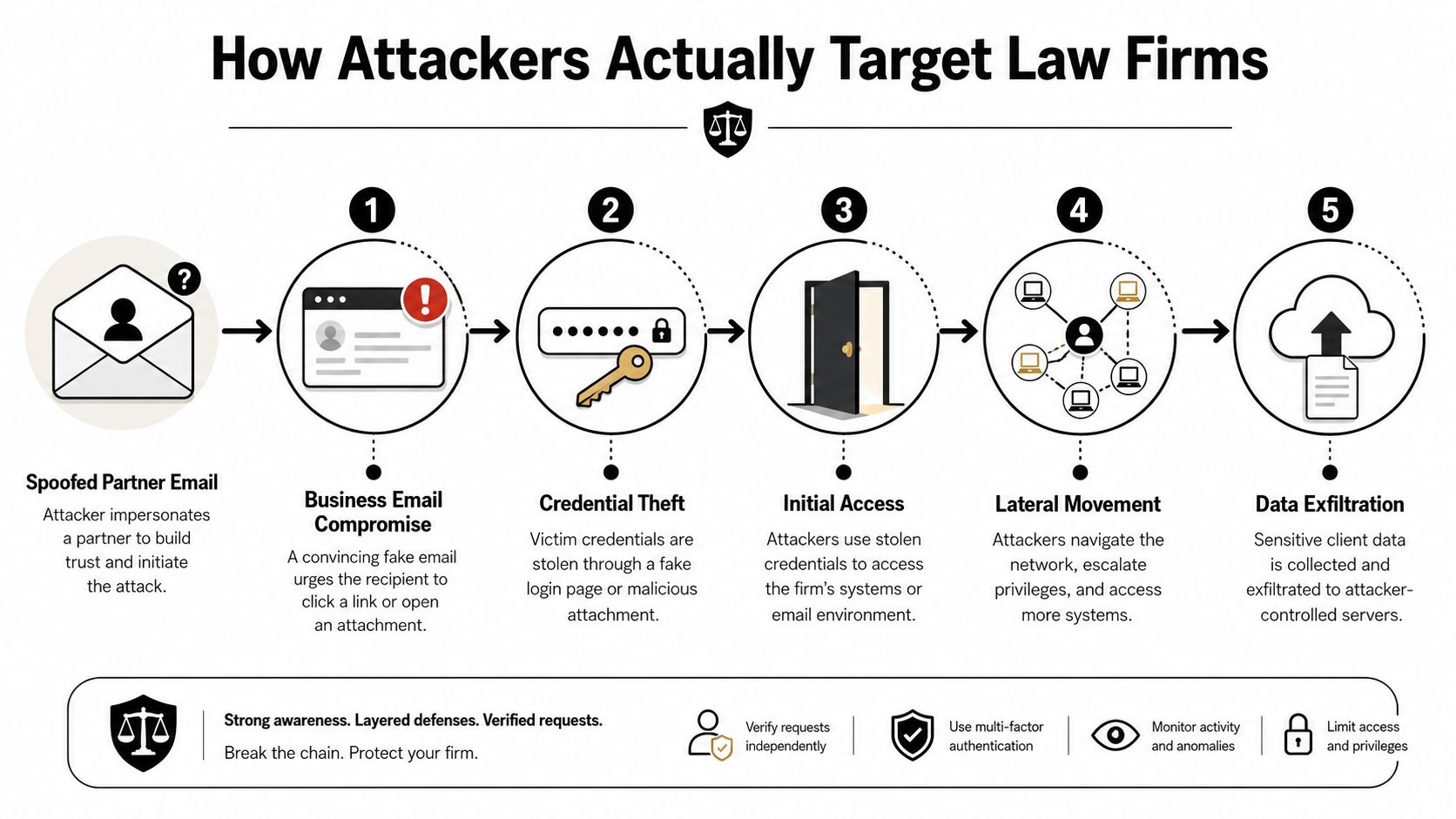
How Attackers Actually Target Law Firms
The initial stage of an attack chain targeting a law firm is seldom sophisticated. It generally begins with email, since attorneys and staff rely on email all day. A forged message from a partner requests a document, a transfer, or a login, and someone replies promptly because the ask appears ordinary.
Business email compromise works because it merges with everyday operations. After credentials are taken, the attacker can remain in a mailbox, monitor deal activity, and gather enough background to make the following message appear authentic. At that point, the attack no longer resembles spam and begins to resemble a workflow.
Then comes double extortion ransomware, where the attacker encrypts systems and also threatens to disclose the data. In a legal setting, that secondary threat is particularly damaging because matter files frequently hold privileged material and valuable client information. The operational impact is not only downtime; it is the worry that a malicious actor now possesses the firm's secrets.
The issue with third parties is equally grave. Recent data from the legal industry found that 42% of legal organizations were impacted by a cybersecurity or information-security incident caused by a third-party vendor or supply-chain partner in the last 12 months, and 32% were impacted multiple times legal-industry security report. This places case-management platforms, e-discovery providers, transcription vendors, and outsourced IT within the attack surface rather than treating them only as service providers.
AI introduces an additional layer. That same 2026 report states 92% of firms now use AI but only 41% invest in AI training law-firms technology challenges. This does not mean AI is inherently the threat. It means unofficial workflows, unauthorized data use, and poor review practices open new paths for sensitive material to travel where it should not.
The central control requirement is evident. When the attack begins in email, the firm requires email security, identity controls, visibility into vendors, and logging that detects unusual activity before data exfiltration occurs.
Core Technical Controls That Protect Client Data
Begin with identity, since the majority of legal breaches grow far more severe once stolen credentials are reused. Phishing-resistant MFA should be present across every remote-access route, every cloud application, every privileged account, and every vendor console. If a partner objects that it introduces friction, that is acceptable; such friction costs less than explaining a privilege leak to a client.
Build the defense chain in order
Role-based access control must track the real matter structure instead of a broad office hierarchy. The billing clerk has no need for access to litigation strategy, and the transactional team has no need for the family-law archive. When access is too permissive, any compromise turns into a firm-wide incident.
Encrypted email and secure document transfer ought to be the default for client communication involving sensitive material. If the firm still depends on attachment habits and ad hoc forwarding, then the email system is doing the attacker's work for it. On the endpoint side, EDR-style telemetry matters because you must see suspicious process launches, unusual file encryption, and lateral movement signals.
Network segmentation remains undervalued in law firms. Practice groups, finance, and infrastructure should not all reside in a single flat trust zone, since ransomware moves more quickly when the environment is permeable. Backups require the same rigor; they ought to be tested, immutable when feasible, and kept outside the production domain so a single stolen admin credential cannot eliminate the recovery path.
For a compact technical reference on client-data protection, the protect client data guide serves as a useful guide.
A control that produces no evidence is only partially a control.
Such evidence is important. MFA logs reveal whether a login was challenged, access records indicate whether a user reached a matter they should not have, endpoint telemetry shows how far malware traveled, and backup validation demonstrates whether recovery is real or merely presumed. Unified Security Stack can occupy a place in this stack as one SIEM/XDR option for log collection, correlation, and compliance reporting, which helps when a firm wants detections and audit evidence in a single location.
The trade-off is simple. Stronger controls may slow certain workflows, yet weak controls slow every workflow following a breach. Law firms ought to select the first type of inconvenience.
Monitoring, Logging, and Preserving Evidence Without Waiving Privilege
Most firms understand that they should log events. Fewer understand how to convert those logs into defensible evidence without causing a privilege problem. That gap is significant because an incident is not merely a technical occurrence; it is an evidentiary record the firm may need for insurers, regulators, and potentially later disputes.
Centralize the right signals
A SIEM is not an indulgence in this setting; it is the point where identity events, endpoint alerts, cloud logs, email security events, and backup failures can be linked before the story is lost. Real-time correlation counts because a lone failed login says little, but failed login plus impossible travel plus mailbox rule creation presents a different picture. That is the sort of sequence that turns noisy alerts into a defensible detection.
Retention must be tamper-evident and centered on incident review, rather than merely storage quotas. Preserve the logs that reveal authentication, privilege changes, mailbox forwarding, backup jobs, endpoint alerts, and vendor access. Then ensure investigative notes remain inside counsel-led channels, since the privilege issue is not hypothetical.
Scholarly research on law-firm cyber incidents contends that ambiguity over what was taken, who was responsible, and whether clients were harmed weakens conventional deterrence, while privilege can also discourage documenting investigations in ways that aid future defense SSRN analysis on cyberattacks and law firms. This means the firm must separate technical fact collection from broad disclosure, and do so quickly.
Make the proof portable
Framework mapping is useful here. A platform that maps detections and evidence to HIPAA, GLBA, CMMC, or ISO 27001 can reduce audit effort and make the post-incident package simpler to compile. The goal is not to transform lawyers into security engineers; it is to ensure the firm can demonstrate what occurred, what was contained, and what was remediated.
The evidence preservation guide is worth having close at hand if your team must structure the record after a breach. It reinforces the same discipline law firms require, preserve logs, preserve chain of custody, and keep the investigation under counsel when privilege is at issue.
A firm that handles this correctly can answer difficult questions without speculation. That is the distinction between a clean incident file and a scramble.
Incident Response That Honors Confidentiality and Notification Duties
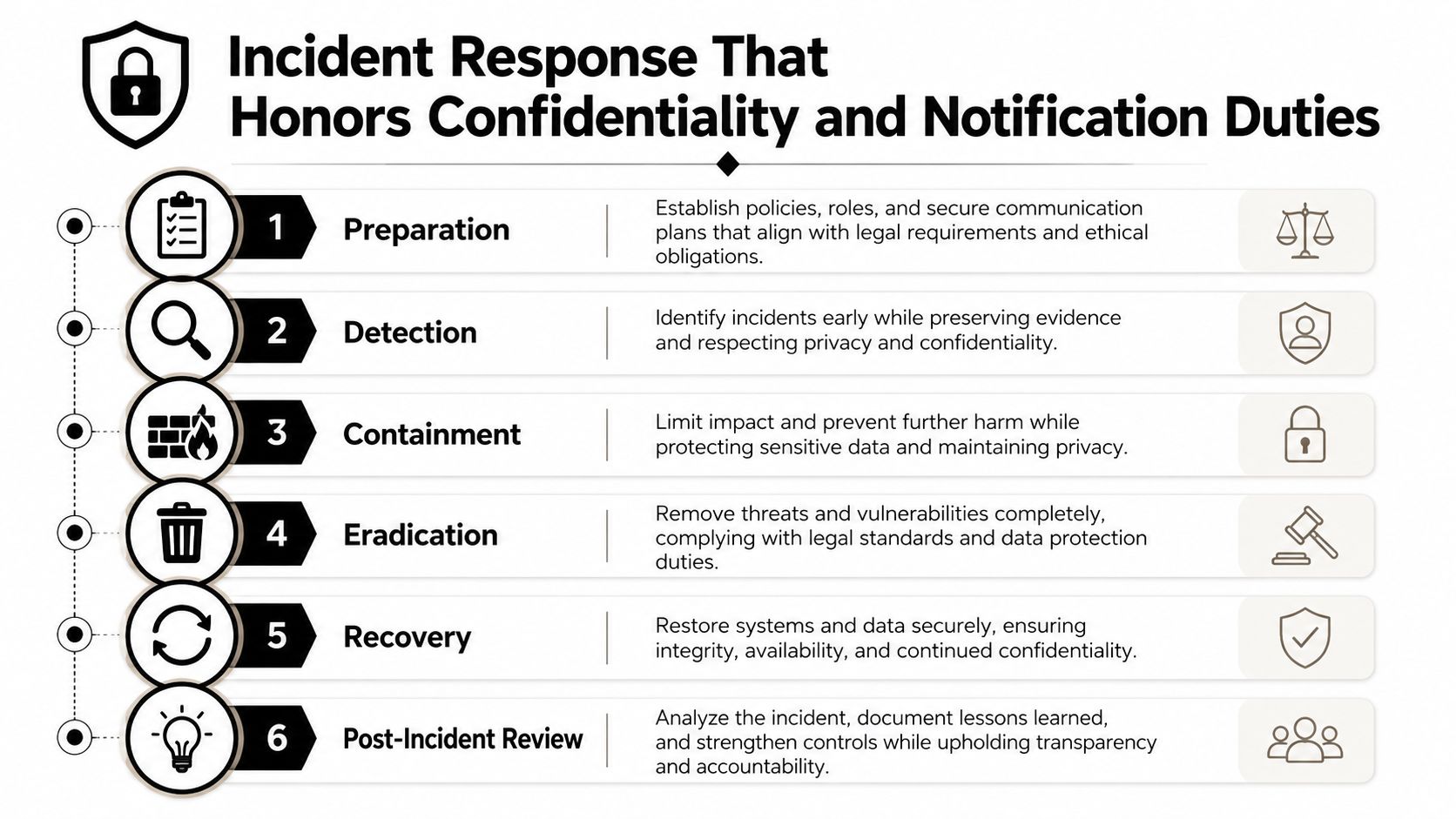
A law firm incident response plan must withstand legal pressure as much as technical pressure. Containment comes first, followed by communication, and that communication must not provide the attacker with a second route into the firm. If email is compromised, out-of-band communication is necessary, because compromised mailboxes cannot be relied upon for crisis coordination.
The first 24 hours need one owner
One individual must have explicit authority to isolate systems, contact outside counsel, notify insurance, and halt risky changes. Everyone else must understand the chain of command before an incident begins. Detection should yield a narrow fact pattern, what was touched, what was encrypted, and which accounts moved. Containment means limiting the blast radius, disabling compromised accounts, blocking suspicious sessions, and preserving machine state.
Eradication and recovery are where firms often become careless. Rebuilding before the entry point is verified simply invites the same attacker back through the same gap. Restore from tested backups, check file integrity, and ensure privileged systems are clean before they reconnect to production.
A practical security incident response plan 2026 should define those roles, approvals, and handoffs in plain language, not leave them buried in a policy that no one uses.
Notification and privilege have to move together
Notification duties follow the facts, not fear. Clients, insurers, and regulators need timely, accurate information, yet the firm should not circulate investigative notes simply to appear cooperative. A review led by counsel protects the technical work while still yielding the facts necessary for disclosure.
Quarterly tabletop exercises are the correct discipline for mid-size and larger firms because they reveal weak handoffs before a real breach. The record should show who contacted whom, when the decision was made, and what was documented for the file. Unified Security Stack's incident response playbooks are valuable here because response orchestration and evidence capture must be linked, not treated as separate tasks.
You also require a clear evidence trail for the outside lawyers and insurers who will request it later. That means preserving logs, keeping chain of custody intact, and ensuring SIEM and XDR records can be provided without exposing more client data than necessary.
The strongest incident response plan is the one the managing partner can describe without calling on the IT manager.
That is the benchmark. If leadership cannot explain the process in plain language, the firm is not prepared.
A Practical Checklist for Small, Mid-Size, and Large Firms
Small firms require focus, not an expansive program. Begin with a password manager, phishing-resistant MFA, encrypted email for sensitive matters, and immutable cloud backup that has been tested for restoration. Add a written incident contact list and a brief vendor review for any service that handles client data.
Mid-size firms require greater structure. Place privileged access under stricter control, review vendor risk in writing, and test the incident response plan with both IT and counsel present. This tier should also have a basic SIEM or XDR layer monitoring authentication, endpoint alerts, and backup failures, because manual review does not scale once the firm has several practice groups.
Large organizations require assigned security accountability and reporting that withstands audit scrutiny. This calls for dedicated security personnel, monitoring at the SIEM/XDR level, compliance evidence mapped to frameworks, and a formal AI-use policy covering training and approval processes. Governance demands are greater at this tier, since one vulnerable branch or office can expose the entire firm.
No matter which of the three tiers applies, a single principle holds. When a firm cannot show proof of access control, logging, backup testing, and incident decision-making, its program is insufficient for the risk it bears. Cost is important, yet so is the cost of telling a client that their matter file was exposed in a breach.
Common Questions Lawyers Ask About Cyber Security
Must you notify clients about a cyber incident when data theft is not yet confirmed? Frequently, yes, if the circumstances raise a real confidentiality or notice concern. Avoid holding out for complete certainty once the firm knows systems were accessed or encrypted, since waiting tends to make the disclosure appear worse.
Is it possible for lawyers to use AI tools without violating confidentiality? Yes, but only with safeguards in place. When a tool may retain prompts, learn from input, or transfer data to a vendor that has not been vetted, it must be reviewed before any client material is pasted into it.
What problem does cyber insurance address? It may reduce certain financial losses, yet it cannot take the place of logging, backups, or disciplined response. Insurance offers after-the-fact protection; it is not a replacement for the controls that limit a breach's scope from the start.
Is it truly possible for a small firm to satisfy the same ethical standard as a large one? Certainly, since the standard turns on reasonableness, not firm size. A solo practice with strong MFA, consistent backups, and sound access control can be more defensible than a bigger firm with unclear policies and no proof.
The correct perspective is straightforward. For lawyers, cybersecurity is a matter of client duty, supervision, and continuity. Approach it in those terms, and selecting technology becomes far simpler.
Unified Security Stack offers legal teams a practical method to centralize logs, correlate alerts, and maintain compliance evidence in a single location without making the firm operate a full-time SOC. If you are working to close the distance between privilege, proof, and recovery, go to Unified Security Stack and assess how SIEM, XDR, and response playbooks can align with your firm's risk profile.