Managed SOC Services: Your 2026 Selection Guide
The managed security services market is projected to reach US$ 87.9 Billion by 2033, up from US$ 41.3 Billion in 2026 at an 11.4% CAGR according to Persistence Market ResearchThat number matters because it recasts managed SOC services from a niche outsourcing decision into a mainstream operating model for security teams that cannot afford blind spots, delayed response, or constant hiring battles.
Most in-house teams do not fail for lack of tools. They fail because security operations wears people down. Alerts keep coming, the environment keeps shifting, and those who know the stack are also the ones asked to cover architecture, audits, cloud assessments, and incident calls. This is why more leaders treat managed SOC services as an operating choice, not merely a product purchase.
If you're responsible for selecting or reshaping security operations, it helps to ground the discussion in the day-to-day realities of protecting businesses from cyber threats, particularly if your environment covers cloud platforms, endpoints, identity systems, and on-prem infrastructure. It also helps to grasp the ongoing operational load described in the Unified Security Stack review of top cybersecurity pain points, as the majority of SOC sourcing choices begin there.
Table of Contents
- The Rise of the Outsourced Security Operations Center
- Deconstructing Managed SOC What You Actually Get
- Choosing Your Model In-House vs Co-Managed vs Fully Managed
- Integrating with Your SIEM XDR and SOAR Stack
- The Business Case Benefits vs Risks of Outsourcing
- How to Choose a Managed SOC Partner A Vendor Checklist
- Implementation Roadmap and Real-World Use Cases
- Conclusion Your Next Steps in Security Operations
The Rise of the Outsourced Security Operations Center
Cybersecurity Ventures projects that the worldwide cyber workforce shortfall will hit millions of open roles during this decade, and that recruiting strain quickly appears within security operations teams. A 24×7 SOC requires more than a handful of skilled analysts. It requires dependable coverage, detection engineering, incident response, platform administration, and sufficient bench strength to sustain those duties through attrition, time off, and major incidents. For many organizations, sending part of that work to a provider has become a staffing choice first and a technology choice second.
This change is not solely a matter of expense. It concerns how operations actually run.
Security leaders must oversee cloud workloads, identity systems, endpoints, SaaS applications, remote users, and third-party connections using the same group responsible for audits, policy efforts, and internal initiatives. Many teams can create a strong daytime operation. Fewer can maintain overnight and weekend coverage, tuning, and response quality over time without exhausting staff.
Why now
Three forces commonly push organizations toward an outsourced or co-managed SOC.
- Coverage that holds up after hours: Adversaries adapt to your staffing schedule. When the queue is left until morning, dwell time and business impact typically rise alongside it.
- Hybrid stack complexity: Security operations currently cover Microsoft and Linux endpoints, cloud-native telemetry, identity providers, firewalls, SaaS audit logs, and frequently an existing SIEM or XDR the business has no intention of replacing.
- Audit and reporting demands: Regulators, customers, and cyber insurers increasingly want proof of monitoring, escalation, case handling, and follow-through, not merely evidence that tools were bought.
The real trigger tends to be operational strain. Teams begin by adding one more product, then one more feed, then one more dashboard. Eventually they reach the point described in these top cybersecurity pain points identified in internet trends analysis: too many alerts, insufficient context, and excessive manual work needed to turn the data into usable action.
What changed in buyer expectations
Buyer expectations are more exacting than they were several years ago. Security teams once accepted outsourced alert monitoring if it lowered noise. That no longer suffices. The current purchasing standard leans toward co-managed operations centered on the stack you already possess, particularly in hybrid environments where cloud telemetry, on-prem systems, and open-source tooling must all operate in concert.
This is important for organizations running Elastic, Wazuh, Security Onion, Microsoft Sentinel, Splunk, or a blend of native cloud controls with SOAR playbooks added on top. A provider that operates only within its own closed platform creates another operations silo. A provider able to ingest your telemetry, tune detections in your SIEM or XDR, and share workflows with your internal team generally delivers greater long-term value.
I have watched this difference determine how vendor selections turn out. The issue is not whether a provider has a SOC. The issue is whether that SOC can work within your environment without imposing a rip-and-replace effort you never budgeted for.
A sound outsourced SOC arrangement can improve resilience while preserving internal ownership of risk decisions, sensitive systems, or regulated response actions. That explains why the market continues to expand. Organizations seek stronger execution, broader coverage, and a practical means of protecting businesses from cyber threats without having to recreate every SOC capability in house.
Deconstructing Managed SOC What You Actually Get
A managed SOC is an operational capability, not an inbox for alerts. You are acquiring investigators, processes that establish response authority, and technology that connects your telemetry to action. If a provider merely forwards notifications from its own console, you continue to shoulder the difficult work in-house.
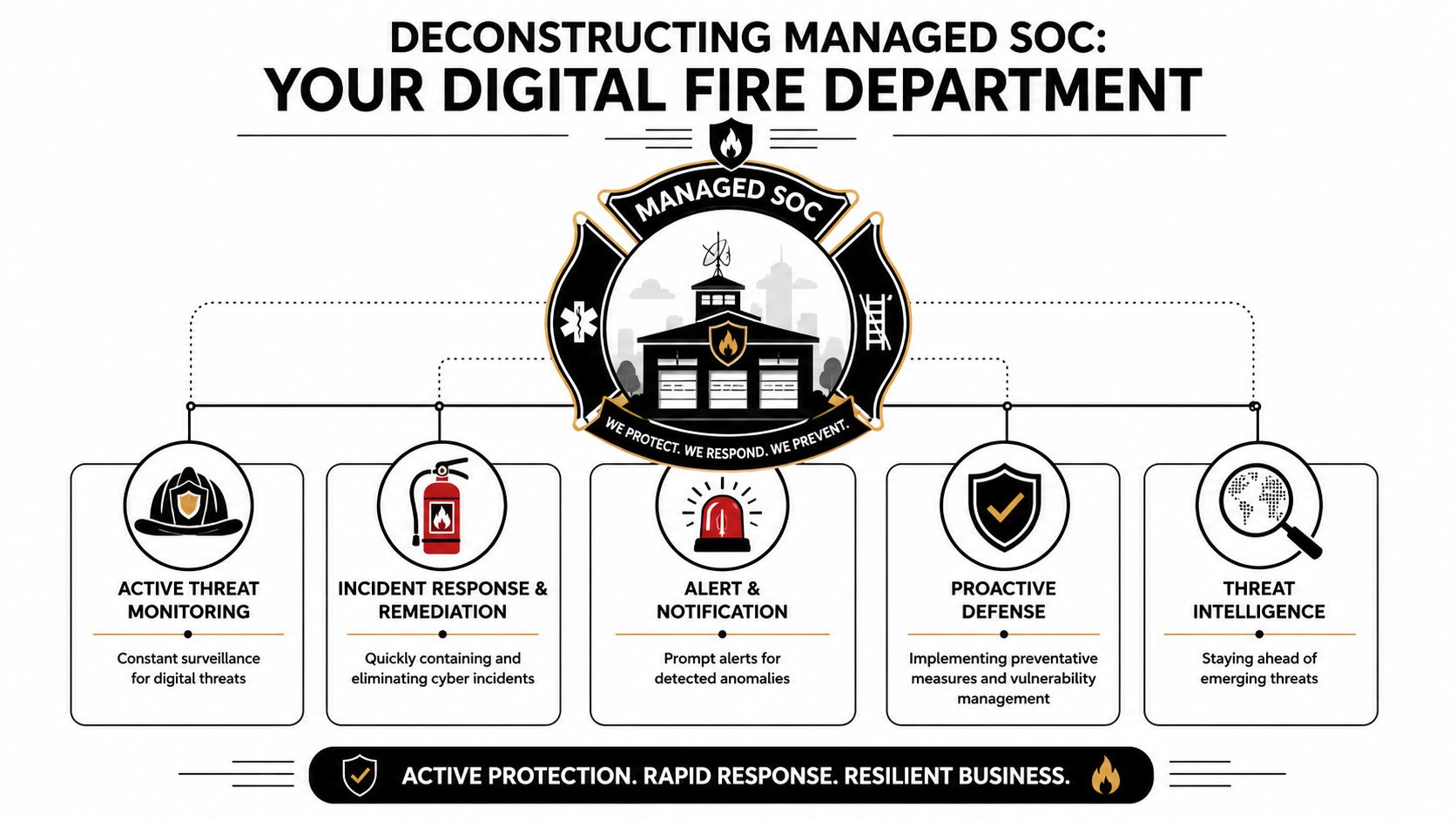
The useful question is straightforward. Which tasks does the provider remove from your team, and which tasks remain yours at 2 a.m. during an incident?
People, process, and technology
People assess if the service is valuable in operations. A credible managed SOC provides tier 1 and tier 2 analysts for triage, detection engineers who can tune rules within your actual stack, and senior responders for situations that require judgment instead of a scripted playbook. In co-managed arrangements, named contacts are important. You must know who owns detection changes, who leads service reviews, and who can authorize containment when your internal lead is unavailable.
Process shapes whether the service withstands pressure. Strong providers document triage thresholds, escalation paths, evidence handling, containment choices, change control, and post-incident review. They also clarify decision rights. If account disablement, host isolation, or ticket closure rules remain vague in the statement of work, anticipate delays and blame during a live incident. For teams improving that aspect of the operating model, this overview of critical incident response services guidance serves as a helpful resource, since it frames response as repeatable operations rather than a one-time project.
Technology is the point where many evaluations fail. What matters is not whether the provider offers a portal. What matters is whether the provider can operate within the stack you already use, particularly across hybrid environments and open-source tooling. This entails support for your SIEM, XDR, EDR, SOAR, cloud telemetry, identity signals, and ticketing workflow. If your team builds on Elastic, Wazuh, Security Onion, Microsoft Sentinel, Splunk, or a mixed stack, ask whether the provider tunes detections in that environment, ingests custom logs there, and documents use cases there. Teams considering a cost-conscious operating model can weigh that approach against this guide to building a 24/7 SOC with free and open-source technologies.
When a provider requires all operations to move into a closed platform, it creates a second control plane. For the vendor, that may streamline service delivery, yet it often slows investigations for your internal team and undermines long-term knowledge transfer.
What usually stays on your side
Internal ownership remains even under a fully managed service. Monitoring, investigation, and sometimes containment fall to the provider. Business risk, production change approval, privileged access decisions, and any response step affecting regulated data, customer-facing systems, or legal exposure stay with you.
A workable split usually looks like this:
| Responsibility | Usually provider-led | Usually client-led |
|---|---|---|
| Monitoring and triage | Yes | Sometimes in co-managed setups |
| Detection tuning | Shared | Shared |
| Containment actions | Shared by playbook | Approval and business risk decisions |
| Root cause analysis | Often provider-led | Shared with system owners |
| Compliance evidence review | Shared | Final accountability remains internal |
The best providers clarify this boundary before onboarding begins. They specify the playbooks they can run directly, those that need approval, and the systems excluded because of safety, compliance, or operational risk.
Buyer conversations often overlook another point. A managed SOC should strengthen your security content over time. Following incidents, the provider should refine detections, cut false positives, add enrichment, and document gaps in logging or asset coverage. That is even more important in co-managed environments, where the value is not merely round-the-clock monitoring. The value lies in a service model that enhances the stack you already own rather than replacing it.
Choosing Your Model In-House vs Co-Managed vs Fully Managed
The appropriate model hinges less on ideology and more on operating constraints. Certain organizations require sovereign control due to internal policy or specialized environments. Others seek relief from round-the-clock operations. Most fall somewhere between.
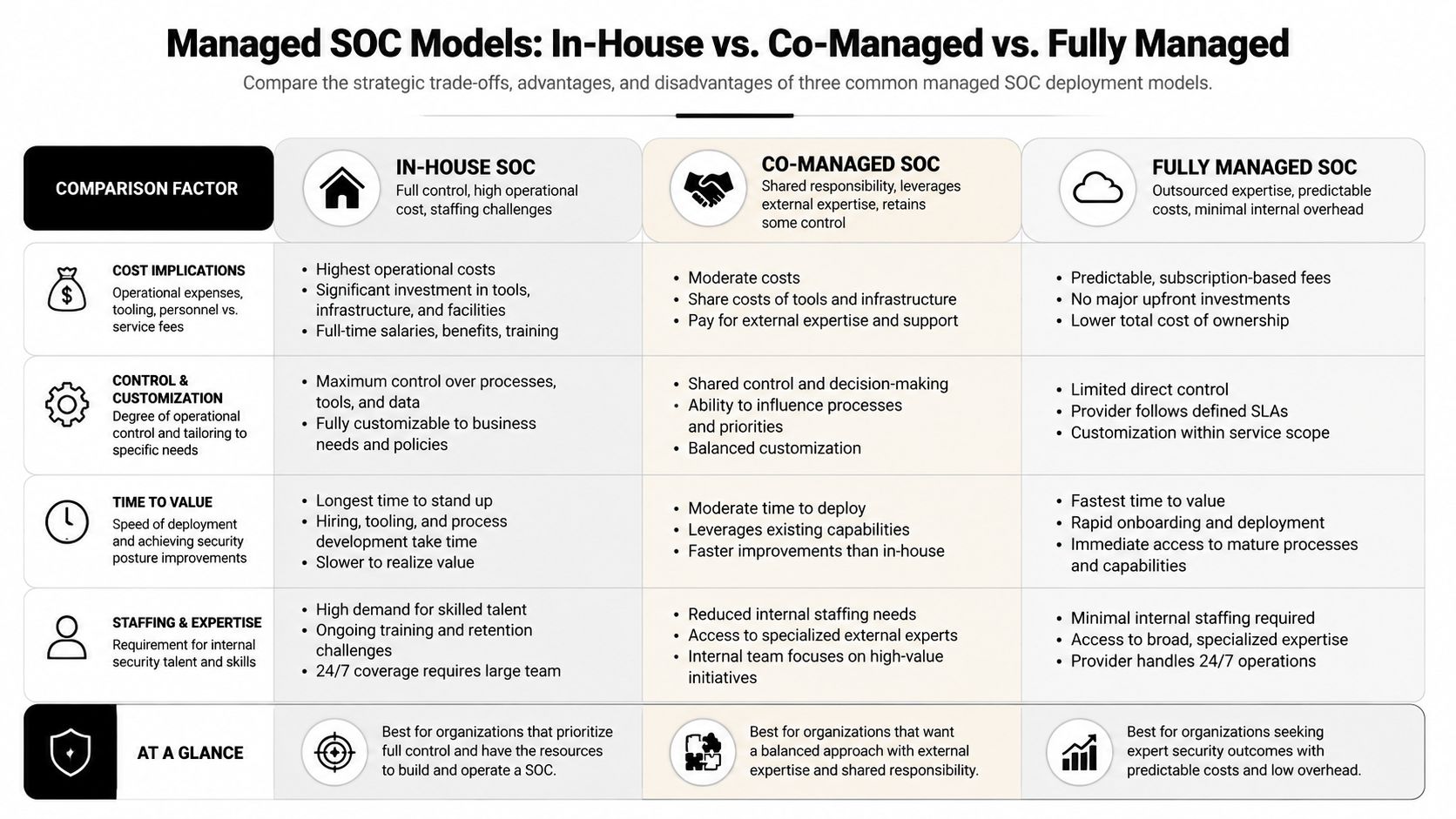
The market signal is unmistakable. The SOC as a Service market is projected to reach USD 23.91 billion by 2034, and the large enterprise segment is projected to hold 58.45% of the market share in 2026, as reported by Fortune Business Insights. Large and complex organizations are not outsourcing because security is simple. They are doing so because complexity makes selective outsourcing practical.
Where each model fits
Here is the blunt take.
| Model | Best fit | Strength | Main drawback |
|---|---|---|---|
| In-house | Large teams with mature staffing and deep internal process discipline | Full operational control | Expensive to sustain and hard to staff continuously |
| Co-managed | Teams that want to retain oversight but offload 24×7 operations or specialist functions | Balance of context and coverage | Requires clear role boundaries |
| Fully managed | Organizations that need fast coverage with limited internal SOC capacity | Lower internal overhead | Risk of losing business context if the provider operates too far from the environment |
An in-house SOC functions when an organization already possesses the people, tuning discipline, leadership support, and budget stability needed to run operations continuously. The benefit is direct control over telemetry, workflows, and prioritization. The drawback is that every capability must be staffed, trained, covered, and maintained internally.
A fully managed SOC functions when coverage is the pressing issue. This model may ease operational burden quickly, but it can also slide into shallow service delivery if the provider fails to understand your asset criticality, business processes, or change windows.
Why co-managed often wins
Co-managed usually aligns best with real environments, particularly hybrid estates. The internal team retains what only it can do effectively. Business context, executive messaging, change authorization, and ultimate risk decisions. The provider assumes continuous monitoring, triage, playbook execution, specialized investigations, or after-hours support.
That structure proves particularly valuable if you are already building with flexible tooling, including open-source options. Teams pursuing that path can weigh the staffing burden against the architecture in Unified Security Stack's guide to building a 24/7 SOC with free and open-source technologies. The technical stack accounts for only half the equation. The other half is who operates it at 2 a.m.
A co-managed SOC succeeds only when both sides align on escalation depth, authority to act, and ownership of tuning. Without that alignment, shared responsibility turns into shared confusion.
A practical test is straightforward. If your existing team can manage strategy, architecture, and high-severity decisions but cannot sustain constant operational pressure, co-managed is typically the best option.
Integrating with Your SIEM XDR and SOAR Stack
Integration determines whether many managed SOC deals become valuable or turn into costly disappointment. The provider should not act as a separate console with visibility into only partial telemetry. It should build on the tools and data sources you already trust, whether they reside on-prem, in cloud platforms, or in both.
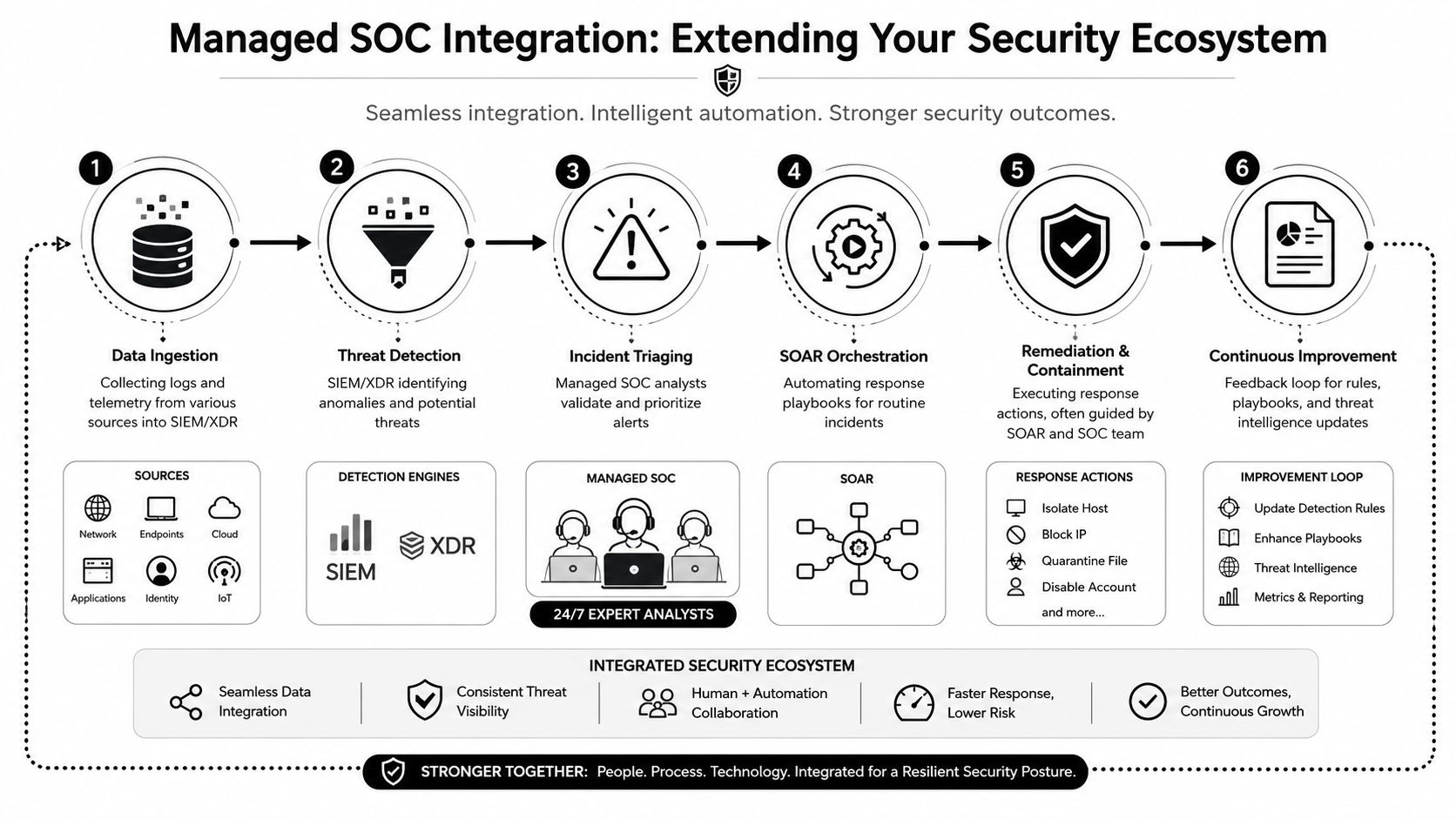
How the data flow should work
The sound pattern appears as follows.
- Ingestion starts broadly. Logs and telemetry come from endpoints, identity providers, firewalls, cloud services, SaaS applications, vulnerability scanners, and core infrastructure.
- Correlation happens centrally. The SIEM or XDR layer connects related signals into an event worthy of a case rather than a heap of unrelated alerts.
- Analysts validate context. The managed SOC team determines whether the alert signals malicious activity, operational noise, or a control gap.
- SOAR playbooks execute defined actions. That can involve enrichment, ticket creation, user disablement requests, host isolation, or indicator blocking where authority exists.
- Findings feed back into tuningRules and playbooks get better only when false positives, missing context, and response friction are fed back into them.
Strong providers prove their worth through that feedback loop. Managed SOC services do more than monitor telemetry. They make your telemetry usable in operations.
Open-source and hybrid reality
Hybrid environments make everything more complex. Certain logs arrive via APIs; others come through Syslog or agents. Cloud control-plane events act differently than endpoint telemetry. Identity alerts can be high value yet low volume. Network devices tend to generate substantial noise and minimal context unless correlation is tuned with care.
That is why I favor providers that can operate with the client's current stack rather than pushing a proprietary silo. If your team runs an open-source or mixed environment, the provider should back it with clean onboarding, field mapping, parser maintenance, and shared detection logic. One example is Unified Security StackIt brings together SIEM, SOAR, and XDR functions for hybrid environments and can act as part of a managed or co-managed operating model. The brand is not the point. Flexibility is the point.
A provider that can't explain how it handles these integration questions will create friction fast:
- Data ownership: Who holds the raw logs, normalized records, detections, and case history?
- Bidirectional actions: Can the SOC initiate containment within your existing endpoint or identity tools?
- Parser and schema control: Who updates field mappings when cloud services or devices alter formats?
- Open export paths: Can you migrate detections, cases, and evidence if the relationship ends?
Your SOC is not your SIEM. Your response process is not your XDR. Managed SOC services create value only when people, tooling, and workflows are linked cleanly.
When a provider answers integration questions with marketing language rather than workflow detail, that is a warning sign.
The Business Case Benefits vs Risks of Outsourcing
Organizations that outsource security operations generally do so for one reason. Missed alerts, slow triage, and analyst burnout cost more than the service.
That business case stands only if the provider matches your environment. In hybrid estates, the question is not merely whether a managed SOC costs less than round-the-clock hiring. The real question is whether the provider can operate within your existing SIEM, XDR, SOAR, cloud telemetry, identity controls, and ticketing flow without requiring a costly rebuild. This is why co-managed models frequently make better financial sense than a full handoff. They retain internal context while moving repetitive monitoring and first-line response to a partner.
Where the value shows up
The payoff generally shows up in four areas.
- Lower staffing pressure: Creating genuine 24×7 coverage in-house requires recruiting, training, scheduling, and retaining analysts across every shift. Many teams underrate that burden until turnover occurs.
- Better use of senior talent: Internal engineers and architects devote less time to clearing noisy queues and more time to addressing root causes, tuning controls, and shrinking the attack surface.
- More consistent operations: A mature provider can maintain stable triage, escalation, and case handling through nights, weekends, vacations, and internal reorganizations.
- Stronger evidence trails: Strong providers document alerts, investigations, and response actions in a manner that supports audits, incident reviews, and board reporting.
The hidden benefit is focus. Security teams usually know what they should improve, such as identity hygiene, segmentation, cloud guardrails, or logging coverage, but they never have the time. Outsourcing part of the SOC function can free up that time.
There is also a benefit at the stack level that buyers overlook. A provider that supports open-source or mixed platforms can prolong the life of tools you already own. If the service can run in your SIEM or ingest from products like Unified Security Stack alongside commercial controls, you avoid paying twice for monitoring, once in software and again in a bundled black-box service.
Where outsourcing breaks down
Context loss poses the greatest risk.
An external analyst can follow the playbook and still misunderstand business impact. A privileged login after midnight might be routine for your infrastructure team, but a high-risk indicator for finance or HR. If asset criticality, user roles, and exception patterns are not kept current, the provider will either escalate excessive noise or overlook what matters.
The second point of failure is authority. Without clear assignment of who may disable an account, isolate a host, block an IP, or authorize cloud containment, response velocity drops quickly. I have watched this undermine SOC programs that were otherwise strong. The tools were deployed. The agreement was in place. The decision rights remained undefined.
False coverage is the third risk. A managed SOC will not repair absent logs, limited endpoint visibility, inadequate identity controls, or outdated asset inventory. It may reveal these issues fast, but it cannot offset them over the long term.
The practical trade-off
Outsourcing delivers the most value when viewed as an operating model choice rather than a purchasing shortcut. A fully managed service can cut internal workload the most, but it also builds the greatest reliance on the vendor's processes and assumptions. Co-managed service requires more from your team, yet it typically performs better in hybrid environments because internal staff retain ownership of business context, tuning priorities, and containment approvals.
That is the lens I suggest for evaluation. Do not limit the question to whether it will reduce cost. Instead, ask the following:
- Which tasks leave my team, and which tasks remain?
- Can the provider work with our existing SIEM, XDR, and open-source data sources rather than requiring a platform replacement?
- When data formats change, who is responsible for detection tuning, parser repairs, and log quality?
- Which response actions is the provider allowed to perform without prior approval?
- How difficult would it be to leave the relationship while preserving detections, case history, and operational knowledge?
A credible business case accounts for both savings and friction. When a vendor can demonstrate clear coverage, defined responsibilities, and smooth integration with your current stack, outsourcing may enhance response quality and allow internal teams to focus on higher-value security work. Without those conditions, you are not purchasing efficiency. You are purchasing another coordination challenge.
How to Choose a Managed SOC Partner A Vendor Checklist
Buyers of managed SOC services frequently overlook a single decision point. The difficult part is not verifying that a provider offers a 24×7 queue. The difficult part is verifying that the provider can work within your stack, escalation rules, and response boundaries without adding delay or requiring a tooling reset.
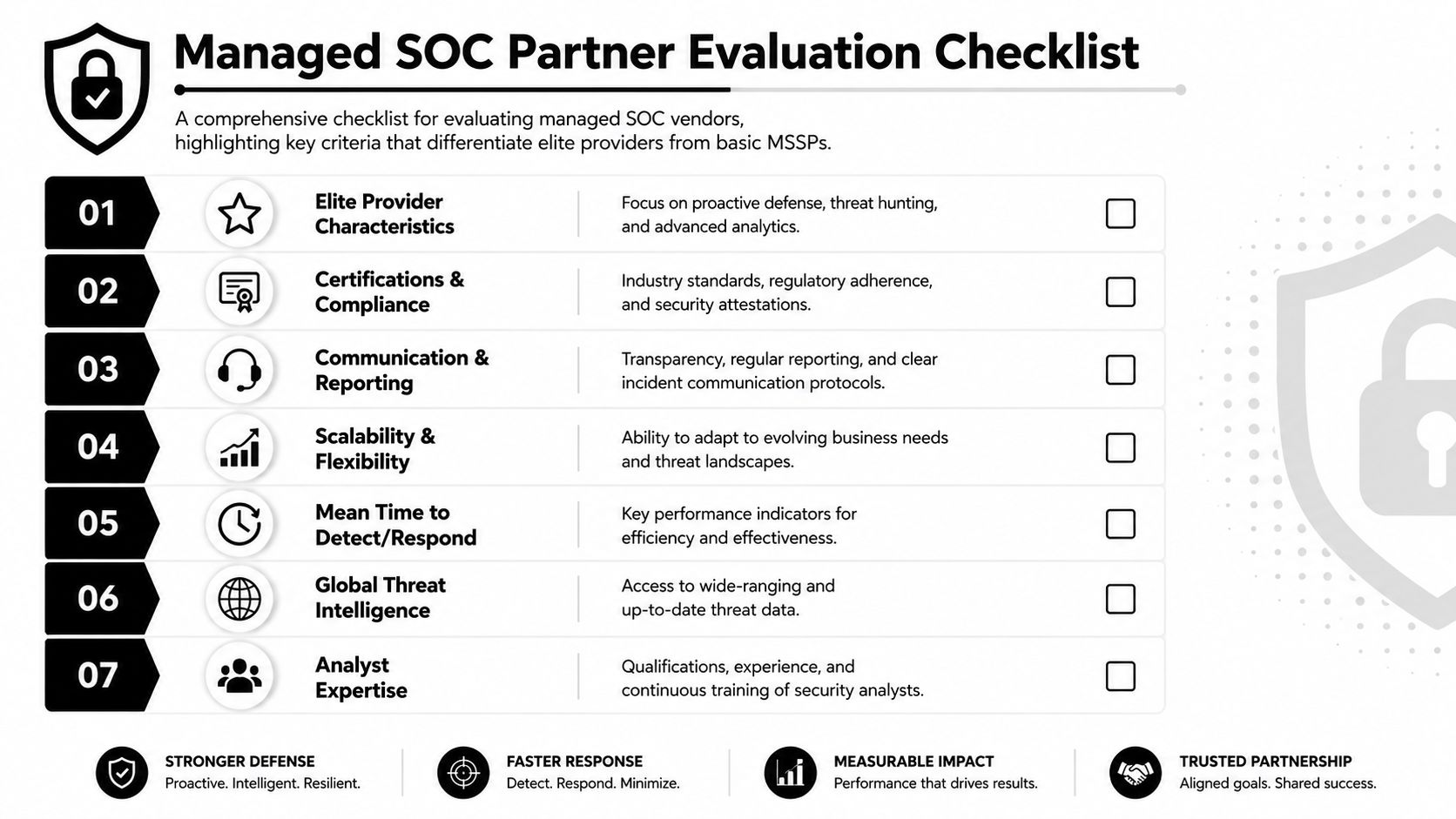
This gap is most evident in hybrid and co-managed environments. UnderDefense observes that many organizations now operate hybrid security operations, but pricing and responsibility divisions for co-managed service are often left unclear during the sales process (UnderDefense). This represents a procurement risk, but it is also an architecture risk. If a vendor cannot clearly define shared ownership, anticipate confusion about tuning, approvals, and incident handoffs after the service begins.
Capable providers distinguish themselves through operational specifics, not marketing copy. They can describe how they ingest data from commercial and open-source tools, how they sustain parsers as formats evolve, and how they prevent disruption to existing detection logic in a client-owned SIEM, XDR, or SOAR stack. They also make clear where their analysts' responsibilities end and where your team must take over.
The checklist that matters
Apply this checklist during demos, RFPs, and technical validation calls.
- Role clarity: Obtain a written RACI covering monitoring, triage, investigation, tuning, containment approval, evidence collection, and service review.
- Integration fit: Ask how the service integrates with your SIEM, XDR, SOAR, identity platform, ticketing system, cloud telemetry, and network controls. If you use open-source components, ask the same question about them.
- Detection ownership: Establish who authors and tunes detections, who maintains correlation rules, and who repairs broken parsers or field mappings.
- Threat hunting capability: Determine whether threat hunting is planned analyst work with hypotheses and reporting, or merely marketing language around alert review.
- Analyst depth: Ask how cases progress from Tier 1 triage to senior investigation, malware analysis, or incident coordination.
- Vulnerability linkage: Check whether exposure data can influence detection priority, alert routing, or investigation context.
- Compliance outputs: Ask for example reports, audit materials, case records, and evidence bundles that satisfy your regulatory requirements.
- Pricing transparency: Demand a detailed, item-by-item account of how a co-managed model changes when your team retains some triage, approval, engineering, or incident response duties.
A single practical check can distinguish established vendors from those that are mostly noise. Have them describe a detection failure triggered by a log schema change in a hybrid environment. A strong provider will cover ownership, response time, validation methods, and rollback steps. A weak one will fall back on broad claims about platform coverage.
RFP questions worth asking
Straightforward questions yield better answers.
- Which detections are yours to own and tune, and which stay under client control?
- What is your approach to supporting hybrid cloud, on-prem, and open-source telemetry without a platform replacement?
- Which response actions can you perform directly, and which need explicit client approval?
- Who keeps parsers, field mappings, and normalization logic current as data sources evolve?
- What method do you use each month to measure alert quality, false-positive rate, investigation depth, and incident results?
- How is pricing affected if our internal team retains some triage, engineering, or incident handling work?
- If we change provider or bring operations back in-house, how do you export detections, case data, runbooks, and service knowledge?
I also suggest requesting a working session with the staff who will actually deliver the service, not only the sales group. Examine one alert flow, one tuning workflow, and one escalation path linked to your existing stack. If the provider cannot demonstrate how its SOC operates with your environment as it stands today, the relationship will prove more difficult than it appears on paper.
Evaluate co-managed pricing together with integration design as a single subject. Cost becomes meaningful only once responsibilities, tool ownership, and response authority are settled.
The best shortlist typically consists of vendors that respond to operational questions precisely, openly document trade-offs, and work with your existing stack, including hybrid and open-source elements, rather than urging unneeded replacement.
Implementation Roadmap and Real-World Use Cases
SOC transitions typically fail because of operational issues, not because of tools. The usual pattern is well known. Teams link data before establishing ownership, enable detections before validating routing, and expect an outside analyst team to deduce business risk from logs by itself.
A managed SOC deployment succeeds more often when the service is viewed as a change to the operating model with technical dependencies, rather than a monitoring extra. This is especially true in hybrid environments where the stack already combines cloud controls, on-prem infrastructure, and open-source or partly customized SIEM, XDR, and SOAR components.
A practical rollout path
I typically divide implementation into four operational phases.
Phase 1: Defining scope and designing controls. Begin with asset groups, identity providers, cloud accounts, network boundaries, compliance requirements, and incident contacts. Next, establish who owns triage, who may contain hosts or disable accounts, and which systems remain subject to internal approval. In co-managed models, this step determines whether the provider delivers value quickly or waits months for clarification.
Phase 2: Data intake and validation. Connect telemetry, then confirm parser quality, field mappings, timestamps, enrichment, and tenant separation. Hybrid and open-source stacks require added focus at this point. A provider might claim support for your SIEM or data lake, but the key test is whether it can operate with your existing schemas, custom collectors, and inconsistent log quality without requiring a platform replacement.
Phase 3: Detection refinement and workflow alignment. Adjust detections based on actual activity, not vendor defaults. Confirm case severity rules, after-hours procedures, suppression logic, and approval gates for response actions. If the provider relies on its own portal while your team uses a different SIEM, XDR console, or ticketing system, define that handoff now before incidents reveal the gaps.
Phase 4: Operations in steady state. Conduct monthly reviews covering alert quality, missed coverage, response times, parser drift, and closed-loop incident outcomes. This is also when you decide which engineering remains in-house. Many teams retain content tuning for business-specific detections while the provider manages monitoring and initial investigation.
Use case for a regulated enterprise
A mid-sized healthcare organization frequently adopts a co-managed model for practical reasons. Its internal team understands clinical workflows, privileged access risk, and change windows. It typically lacks the staffing depth to handle continuous monitoring, overnight investigation, and ongoing detection engineering simultaneously.
An effective structure divides responsibilities clearly. The provider covers round-the-clock monitoring, triage, and first-level investigation for identity, endpoint, firewall, and cloud telemetry. Internal personnel retain control over clinical systems, downtime-sensitive assets, legal review, and executive communications. This division limits coverage gaps while preventing an external team from having unchecked response authority in sensitive settings.
Integration specifics count for more than the service category. When an organization already operates a blend of commercial endpoint tools, cloud-native logs, and an open-source SIEM layer, the provider must engage that stack as it stands. Capable providers can standardize that telemetry, maintain audit evidence, and return case data into the client's current systems. Less capable providers demand a rip-and-replace effort before they will operate.
What good looks like in practice:
- Alerts that arrive overnight get triaged by a person responsible for response, rather than being deferred to the morning shift.
- Incident documentation contains timestamps, analyst notes, and containment decisions that withstand audit scrutiny.
- Vulnerability findings get assessed alongside live detection context, which places exposed systems showing active abuse indicators at the front of the queue.
- Internal teams devote less effort to reconciling several consoles and more effort to making decisions on actions that affect the business.
Use case for an MSP
MSPs confront a distinct scaling challenge. They might already handle endpoints, firewalls, cloud services, and backups for numerous clients, yet they do not have enough skilled analysts to provide credible SOC coverage for every tenant.
Under that model, the managed SOC partner must slot into an established service business rather than rival it. The MSP retains client ownership, service packaging, and account coordination. The SOC partner provides monitoring, deeper investigation, threat hunting, and documented response procedures.
Three design decisions usually determine whether the arrangement holds up under pressure:
- Multi-tenant operations: Client data, detections, and cases need to remain isolated even as analysts work efficiently across tenants.
- Shared workflow control: The MSP requires explicit rules covering what the SOC may handle directly, what needs MSP approval, and what has to be escalated to the end client.
- Tool compatibility: When the MSP relies on an open-source SIEM, a shared XDR console, or a custom ticketing workflow, the SOC partner ought to integrate with it rather than push every client onto the provider's chosen stack.
Vendor assessments often lack depth. For MSP and co-managed deployments, the central question is not whether the provider has SIEM, XDR, or SOAR features. It is whether the provider can run cleanly across your hybrid telemetry sources, maintain data ownership boundaries, and enable shared responsibility without continual manual workarounds.
A useful evaluation approach is straightforward. Have the provider demonstrate a single tenant onboarding flow, one parser change process, one cross-tool investigation, and one containment action requiring approval on a stack similar to yours. If that demonstration fails once open-source components or client-owned tooling are involved, the operating model will fail later as well.
The strongest implementations seldom have the longest feature list. They are the ones with clean data onboarding, clear responsibilities, and a provider able to operate within the hybrid stack you already use.
Conclusion Your Next Steps in Security Operations
Managed SOC services become sensible when security operations exceed the internal team's time, coverage, or expertise. The main decision is not whether outsourced monitoring seems appealing. It is whether your organization requires in-house control, a co-managed partnership, or a fully managed service with little internal overhead.
The best results stem from three early decisions. Choose the appropriate delivery model. Confirm the provider can integrate with your current SIEM, XDR, and SOAR stack. Establish clear roles, escalation authority, and co-managed pricing before signing the contract.
Begin with the checklist. Examine your existing telemetry, staffing constraints, and incident workflows. Then have vendors demonstrate how they would operate within your environment, not only in their demo portal.
If you're comparing platforms for a co-managed or managed SOC model, Unified Security Stack This is one option to review. It merges open-source SIEM, SOAR, and XDR capabilities for hybrid environments, making it useful when you require flexible integrations, shared response workflows, and compliance-oriented visibility without being locked into a closed tooling model.