Security Orchestration Tools: A CISO’s Guide to SOAR
Your SOC likely has capable tools already. A SIEM gathers logs. An EDR detects suspicious endpoint activity. Firewalls, identity systems, ticketing platforms, and threat intelligence feeds each contribute. Even so, the team still wastes too much time moving indicators between consoles, checking the same alert twice, and writing up the response afterward.
That's the operational gap security orchestration tools are meant to close.
Market evidence reflects the pressure driving that change. The worldwide security orchestration market was valued at USD 1.59 billion in 2024 and is projected to reach USD 6.51 billion by 2035, driven by rising cyber threats and the need to streamline security processes, according to Market Research Future's security orchestration market analysis.
Table of Contents
- Beyond the Alert Flood A New Approach to Security
- What Are Security Orchestration and SOAR Platforms
- Orchestration vs SIEM vs XDR Clarifying the Confusion
- The Anatomy of a Security Orchestration Platform
- Bringing Orchestration to Life with Playbook Examples
- How to Choose and Implement a Security Orchestration Tool
- Strategic Use Cases and Common Pitfalls to Avoid
Beyond the Alert Flood A New Approach to Security
A common SOC routine unfolds this way. The SIEM raises an alert. An analyst switches to the EDR console, then reviews a firewall dashboard, then opens a threat intel browser tab, then files a ticket, then contacts the identity team since the user account might need disabling. Each task is easy by itself. The issue is that the cycle repeats throughout the day.
That is why tool sprawl causes more damage than many roadmaps acknowledge. Teams do not fail from a shortage of detections. They fail because response work is split across too many systems, each with its own data model, permission model, and workflow.
Security teams seldom require another standalone console. They need a method to make the existing stack operate as a single system.
Security orchestration shifts the operating model. Rather than having analysts manually move context between products, the platform manages coordination. Alerts arrive, context is enriched, actions are initiated, and the incident record tracks the case from triage to closure.
The shift from tool ownership to workflow ownership
This is the shift in mindset. Mature teams no longer ask only whether coverage exists and begin asking whether the response path can be executed cleanly.
A strong orchestration program helps with that by:
- Reducing swivel-chair work: Analysts no longer input the same evidence into several systems again.
- Standardizing common actions: Defined workflows carry out email quarantine, endpoint isolation, user disablement, and ticket creation.
- Improving consistency: The night shift manages the same phishing incident using the same logic as the day shift.
- Making existing tools more useful: A SIEM alert gains more value when it automatically retrieves asset context, identity context, and threat intelligence.
Why this matters to leadership
For CISOs and SOC managers, orchestration is more than a technical convenience. It is an operating control. It shows whether the organization can turn detections into repeatable actions without draining the people who run the SOC.
What Are Security Orchestration and SOAR Platforms
Orchestration is best illustrated by an orchestra. The musicians already possess their playing skills. The conductor is not there to take their place. Instead, the conductor helps them start as one, stay in time, and produce a single unified outcome. Security orchestration tools serve the same function across SIEM, EDR, firewalls, IAM, ticketing, and threat intelligence.
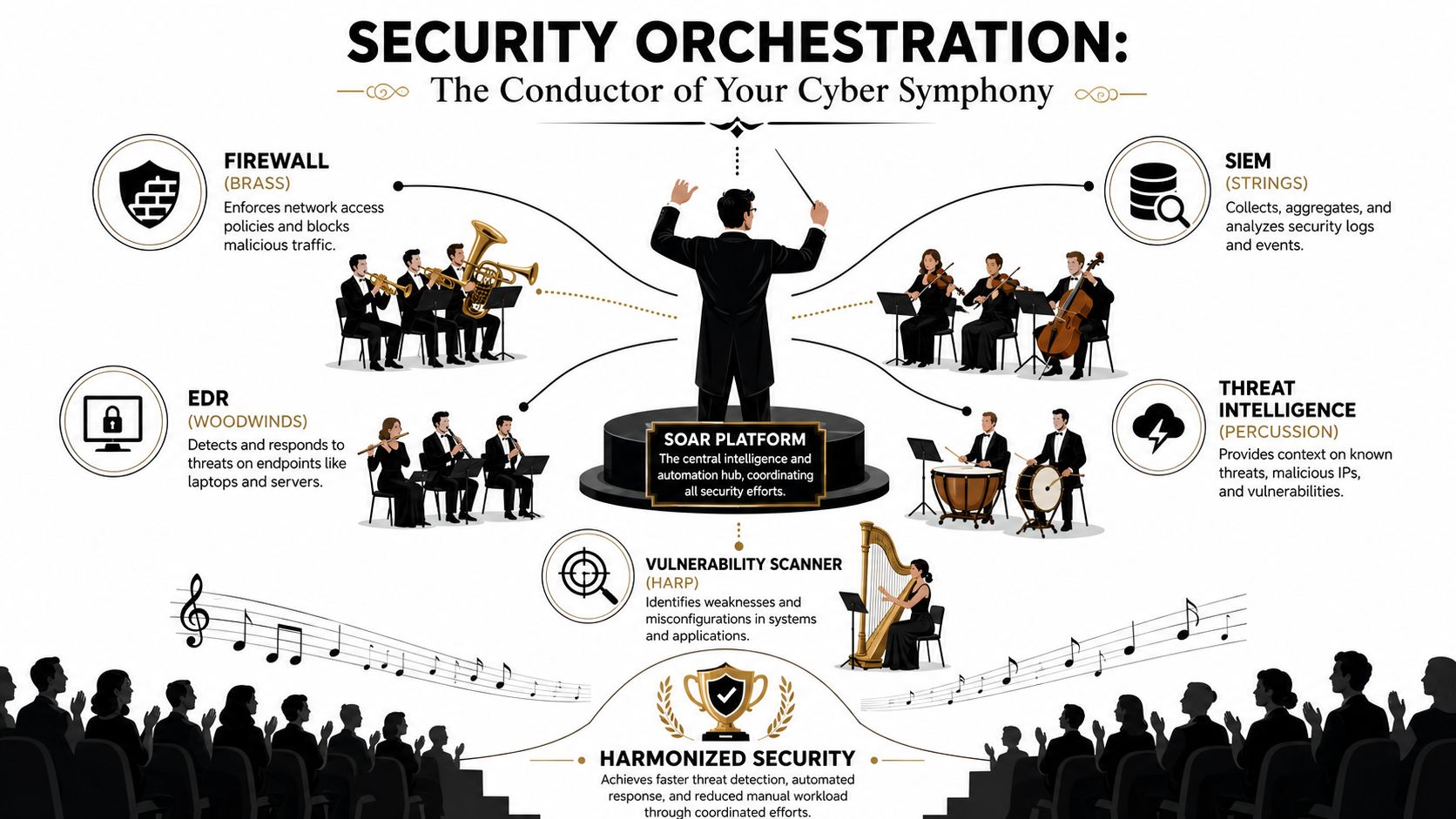
The market language you'll see most often is SOAR, an abbreviation of Security Orchestration, Automation, and Response. The worldwide SOAR market is expected to reach USD 2.3 billion by 2027, serving as a single point of control for managing security tools and automating workflows to improve threat-handling decisions, according to MarketsandMarkets on the SOAR market.
Orchestration is the coordination layer
Orchestration serves as the connective tissue. It joins tools, data flows, and actions into a single process. If an endpoint alert should trigger enrichment from threat intelligence, validation against identity data, containment in EDR, and a ticket for desktop support, orchestration ties those steps together.
That concept is not limited to cybersecurity. For a non-security example of how coordinated automation enhances business operations, this practical view of how process automation helps SEQ companies is helpful because it demonstrates the same pattern: fragmented tasks become manageable when the workflow is built as a system.
The four parts that make SOAR useful
SOAR is frequently described as a single product category, yet it becomes easier to evaluate when divided into components.
- Orchestration: This layer handles integration. It connects tools and controls the movement of information among them.
- Automation: This covers task execution. It carries out repeatable actions without requiring an analyst to click through each step.
- Intelligence: This layer provides context. It enriches alerts with asset criticality, user details, threat reputation, and associated activity.
- Response: This is the outcome. The platform goes beyond detection. It helps with containment, remediation, notification, and documentation.
Practical rule: If a product claims to automate security yet cannot consistently coordinate actions among the tools you already have, it is not providing the full operational value that people expect from SOAR.
An effective SOAR platform also provides analysts with a shared workspace. The strongest implementations do more than execute scripts. They keep incident handling visible, reviewable, and auditable.
Orchestration vs SIEM vs XDR Clarifying the Confusion
Security leaders frequently compare SOAR, SIEM, and XDR as though one ought to replace the rest. That is generally the wrong purchasing lens. These tools overlap at the margins, yet their core focus differs.
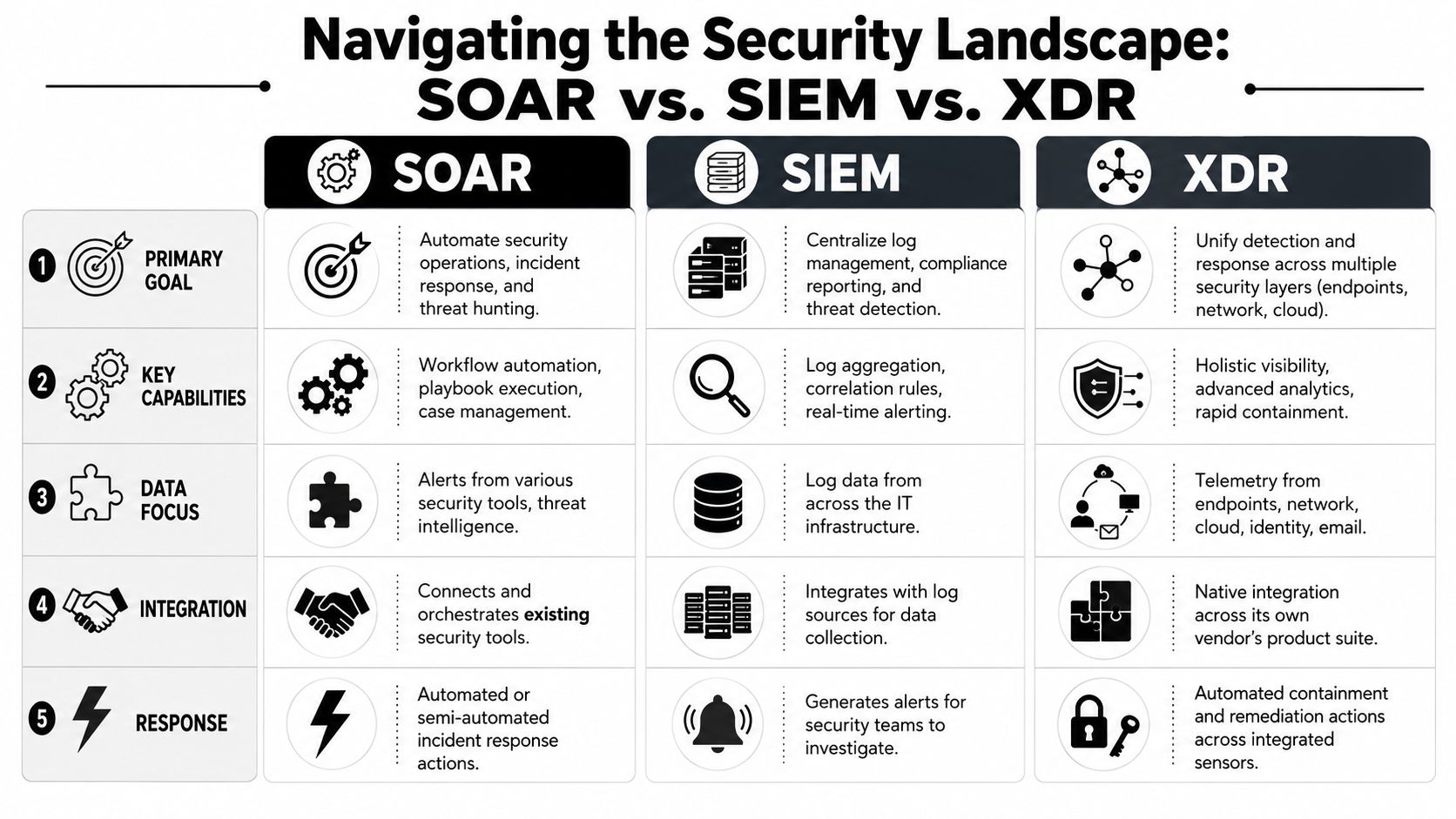
They solve different operational problems
| Platform | Primary job | Typical data focus | What it usually does best |
|---|---|---|---|
| SIEM | Centralize and correlate events | Logs across infrastructure, apps, identity, network, cloud | Detection, search, reporting, historical analysis |
| XDR | Detect and respond across tightly integrated domains | Endpoint, identity, cloud, network, email telemetry | Fast cross-domain detection and native containment |
| SOAR | Coordinate workflows across tools and teams | Alerts, cases, threat intel, response actions | Triage, enrichment, automation, case handling |
A simple way to understand it:
- SIEM is the detective. It collects evidence and identifies suspicious activity patterns.
- XDR acts as the initial line of defense. It observes activity across linked control points and often can contain threats quickly within its own ecosystem.
- SOAR serves as the incident commander. It determines what other systems must do next and moves the workflow forward.
How the stack works in practice
Within a mature environment, these categories strengthen one another.
A SIEM might spot suspicious authentication patterns. An XDR platform might verify endpoint activity linked to that same user. A SOAR platform can then add context to the case, initiate account review, isolate the affected host, open the service ticket, and maintain the evidence chain.
That relationship matters when you review vendors. Some products present themselves as all-in-one yet are strongest in just one layer. If you are assessing a broader detection and response architecture, this overview of threat detection and response solutions aids in clarifying where orchestration belongs within a broader stack.
Do not ask which category comes out ahead. Ask where your team is losing time right now. A detection gap, a response gap, and an integration gap are not the same challenge.
The largest implementation error here is assuming that a new XDR rollout eliminates the need for orchestration. It might cut down on some handoffs within a single vendor ecosystem. It typically does not remove the need to coordinate with identity, firewalls, ticketing, compliance evidence, or custom business workflows.
The Anatomy of a Security Orchestration Platform
A security orchestration platform performs best when you grasp how it works, not merely its marketing category. At its core, the platform is a control layer that takes in inputs, normalizes them, applies workflow logic, and initiates actions through connected systems.
What sits at the center
Its core is the orchestration engine. It receives alerts and telemetry from tools including SIEM, EDR, firewalls, IAM platforms, and scanners. Strong platforms support native and custom connectors alike, which matters because no actual environment is as standardized as the architecture diagram implies.
According to SAFE's overview of SOAR capabilities, SOAR platforms integrate capabilities through native or custom connectors for RESTful APIs and webhooks, and they include built-in case management modules that track the incident lifecycle for compliance with frameworks like NIST and ISO 27001.
Once data arrives at the platform, normalization is critical. Various tools characterize the same event differently. The orchestration layer has to translate those discrepancies into common workflow context, enabling playbooks to operate consistently.
Why case management matters more than teams expect
Many buyers fixate on connector counts and ignore case handling. That is an error. Playbooks generate action, while case management generates accountability.
A usable platform should let teams:
- Track ownership: Who examined, approved, escalated, or resolved the incident.
- Preserve evidence: Alerts, artifacts, notes, and actions remain linked to the case.
- Support audit review: The record ought to capture not just what occurred, but why that response path was selected.
- Handle exceptions: Not every workflow should reach complete automation. Analysts require checkpoints.
Playbooks are where architecture becomes operations
Playbooks provide the decision logic. They set out what occurs when a trigger fires, which enrichment steps are needed, what conditions determine branching, and which actions are cleared to run.
Effective playbooks are rarely huge in practice. To remain maintainable, they stay focused and opinionated, and they connect to scenarios that repeat. A workflow for phishing triage. A workflow for suspicious logins. A workflow for malware containment. A workflow for privileged account review.
The architecture is not complex because it is advanced. It is complex because it must mirror the messiness of real operations. That is why shallow integrations fall short. If a platform can read data but cannot write back actions, update tickets, or maintain the case trail, the SOC still ends up handling manual glue work.
Bringing Orchestration to Life with Playbook Examples
Ideas become clear more quickly when you see the workflow in action. This is what practical orchestration looks like when a platform takes over the routine steps analysts once did manually.
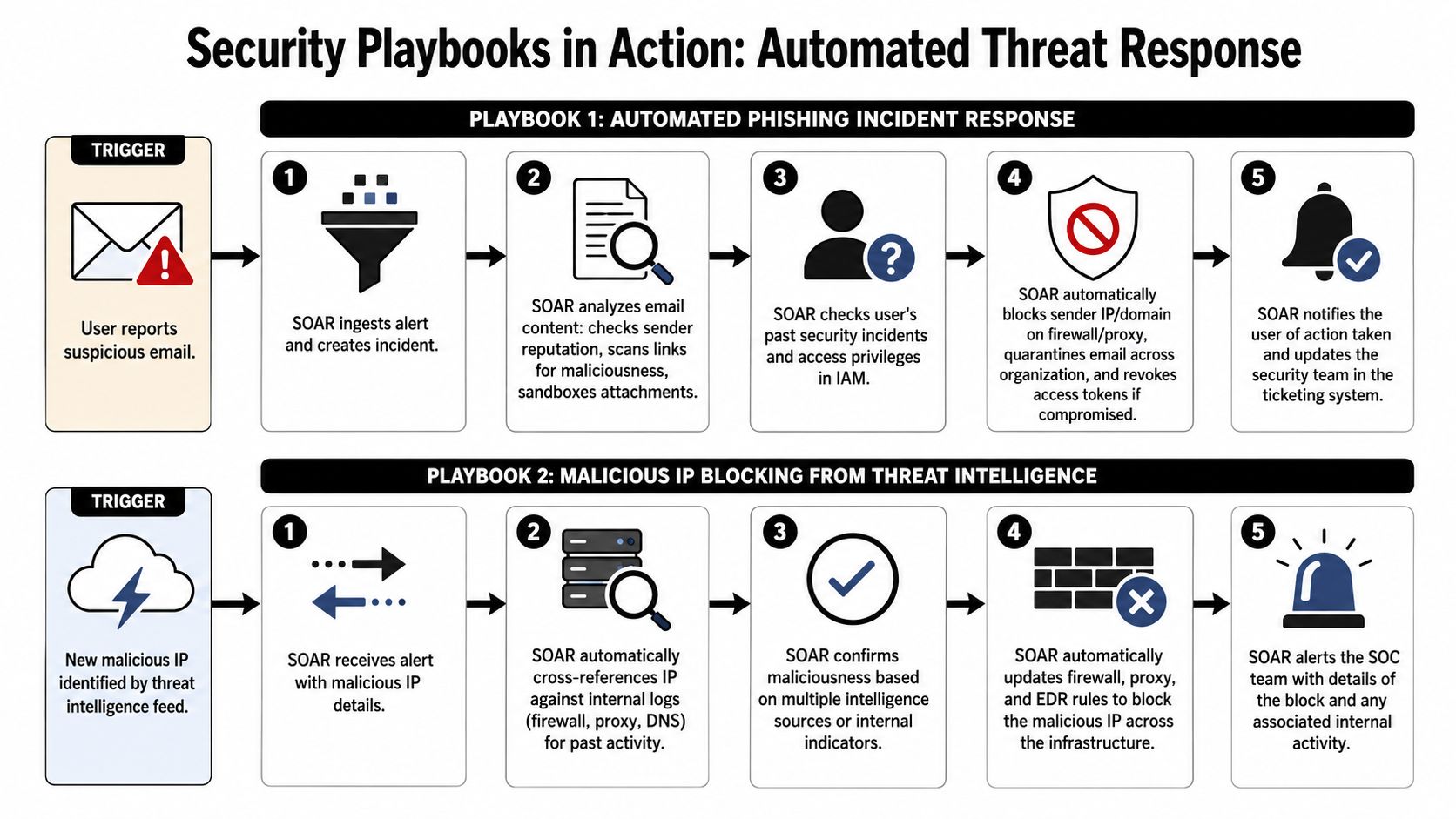
Phishing response playbook
A user flags a suspicious email. That should not trigger a string of copy-and-paste work spread across five consoles.
A solid playbook usually follows a path like this:
- Ingest the report: The platform creates a case and captures the message details.
- Enrich the evidence: It evaluates sender reputation, inspects links, and sends attachments to a sandbox when the environment includes one.
- Check business context: It retrieves IAM details to determine if the user has privileged access or a record of related incidents.
- Take approved actions: It can quarantine the email, block the sender domain or related indicators through integrated controls, and alert affected teams.
- Document the trail: The incident record updates on its own with actions, artifacts, and analyst notes.
Many teams blur the distinction between runbooks and playbooks. This explanation of Cyber Command, LLC insights deserves a read because it distinguishes fixed operational procedures from decision-based response workflows.
For teams building these workflows, examples of incident response playbooks can help turn theory into action sequences your SOC can sustain.
Malware containment playbook
Another common pattern begins with an EDR alert linked to suspicious endpoint behavior.
The workflow often looks like this:
- Trigger arrives from EDR: The platform opens a case and records host, user, process, and hash context.
- Threat context is added: The platform reviews available intelligence sources and local activity connected to the indicator.
- Containment is executed: When confidence and policy permit, the orchestration flow isolates the endpoint or blocks related indicators through connected controls.
- Downstream work is assigned: A ticket routes to desktop, infrastructure, or incident response for reimaging, collection, or recovery tasks.
- Closure criteria are tracked: The case stays open until the validation steps finish.
Later in the same workflow, this walkthrough helps visualize how automated response paths are usually presented to SOC teams:
The best playbook is not the longest one. It is the one your analysts trust enough to run.
How to Choose and Implement a Security Orchestration Tool
Many SOAR evaluations fail because the buyer begins with features rather than operational friction. The right question is not which platform has the largest library. It is which workflows are consuming analyst time, causing delays, or leaving audit gaps.
What to evaluate before you buy
A hard trade-off in this market is integration debt. CISOs frequently compare open-source and commercial platforms by license cost first, but maintenance is the larger issue. A central challenge is measuring the ROI of that integration debt, since maintaining dozens of shallow integrations can cost more than the benefit of avoiding vendor lock-in.
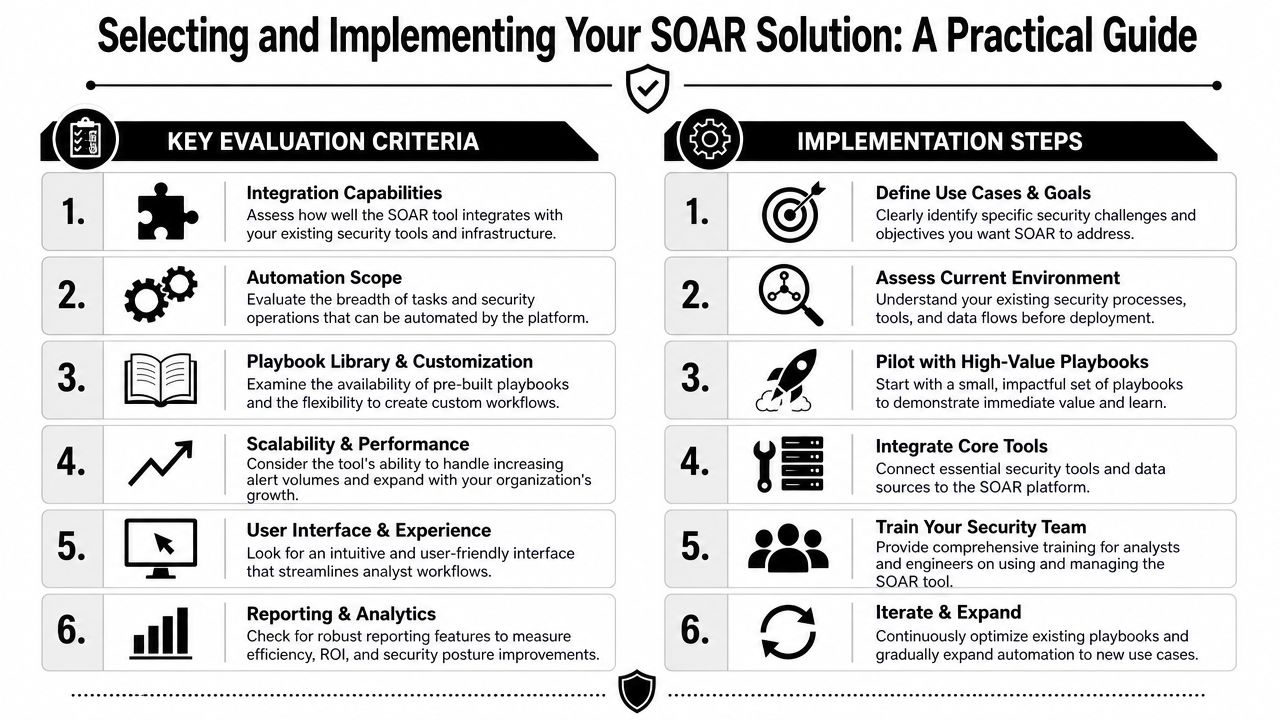
Use these criteria when you review platforms:
- Depth of integrations: Is the platform limited to ingesting alerts, or can it also initiate actions, update tickets, and write status back?
- Workflow design model: Certain teams prefer low-code building tools. Others require scripting freedom. What you need is a model your engineers can maintain.
- Case handling: Analysts will return to spreadsheets, chat threads, and isolated ticket notes whenever the incident record is weak.
- Compliance workflow support: Teams in regulated environments should ask how evidence is kept intact during automated and semi-automated actions.
- Operational fit: Even a product that appears polished in a demo can fail when your team cannot tailor it to your process.
This is also the right place for single mentions of platforms. Tools in this category include IBM QRadar SOAR, Cortex XSOAR, Splunk SOAR, Microsoft Sentinel, and open platforms like Unified Security Stack, which brings together SIEM, SOAR, and compliance workflow capabilities in one stack for hybrid environments.
If your priority is reducing repetitive response effort, it helps to review what incident response automation shifts in routine SOC operations before you finalize requirements.
A rollout sequence that usually works
Do not begin with your most complicated workflow. Begin where the process is common, painful, and limited in scope.
- Choose a single high-volume use case. Common starting points include phishing triage and endpoint containment, since they involve several tools and happen repeatedly.
- Map the current process. Record who performs each task, where approvals take place, and what data sources are needed.
- Prioritize connecting essential systems at the outset. SIEM, EDR, IAM, ticketing, and email controls typically carry more weight than long-tail integrations.
- Automate enrichment ahead of enforcement. Teams gain trust in the platform more quickly when it reliably collects context first.
- Introduce controlled response actions. Begin with actions approved by analysts, then expand automation in areas where confidence is strong.
- Conduct a weekly review of exceptions. Unsuccessful runs and edge cases reveal more than demos that succeed.
Choose based on maintainability, not on how large the demo environment is.
Strategic Use Cases and Common Pitfalls to Avoid
The value of security orchestration varies based on who owns the outcome. CISOs generally focus on risk reduction, audit readiness, and whether staff time is going to high-value work. SOC managers focus on queue flow, escalation quality, and consistency of response. MSSPs and MSPs focus on repeatable service across clients without making each new tenant a custom engineering effort.
Where different teams get value
For operations teams, the most compelling case is measurable efficiency. Mature SOAR implementations cut analyst workload by 40% on average, cut mean time to respond from 4.2 hours to 1.1 hours, and achieve 65% higher incident closure rates, according to this ScienceDirect study on SOAR outcomes.
That kind of improvement matters in different ways:
- CISO teams: Improved operational consistency and a more transparent record of incident handling.
- SOC managers: Reduced manual triage, fewer repeated clicks, and more analyst time for genuine investigation.
- MSSPs and MSPs: Standardized response patterns that can be tailored from one client to the next without recreating the practice each time.
- Compliance leaders: Improved evidence preservation occurs when case actions, notes, and approvals remain tied to the workflow.
Organizations pursuing wider workflow modernization frequently encounter related questions concerning AI-supported operations. This practical review of enterprise AI transformation solutions is helpful because it presents automation as an operational design decision, not merely a tooling exercise.
What usually breaks a SOAR project
The most frequent failure modes are not technical.
- Automating a bad process: When approvals lack clarity and ownership is contested, automation merely speeds up confusion.
- Overbuilt playbooks: Extended workflows with many branches appear impressive but fall apart when exceptions are handled.
- Weak stakeholder alignment: Teams in identity, endpoint, network, and compliance must reach agreement on the platform's permitted actions.
- Ignoring integration debt: A low-cost platform turns costly once engineers spend their time maintaining fragile connectors.
- Treating SOAR as a side project: Without clear ownership of workflow quality, the library quickly becomes outdated.
The realistic goal is straightforward. Apply orchestration where repetition is frequent, context collection is predictable, and approved actions are clear. Allow space for analyst judgment when business impact is complex.
If you're evaluating options for a unified SIEM, SOAR, and compliance workflow stack, Unified Security Stack deserves attention. It enables log ingestion, automated response playbooks, and compliance mapping across hybrid environments, making it valuable for teams seeking to reduce tool sprawl while retaining flexibility in how they build and operate security operations.