Access Control Models Explained for Modern Security Teams
Most guides tell security teams to pick an access control model and continue. That guidance falls apart in actual environments, since the difficult part is not naming the model, it is maintaining least privilege, auditability, and enforcement in alignment while identities, attributes, and relationships continue to change across SaaS, cloud, endpoints, and network gear. In reality, the teams that succeed treat access control as an operational discipline, not a diagram in an architecture presentation.
Table of Contents
- Why Choosing a Model Is Not the Hard Part
- Understanding the Building Blocks of Access Control
- Comparing Major Access Control Models
- Threat Surface and Attack Implications
- Mapping Access Controls to Compliance Frameworks
- Implementation and Migration Strategies
- Auditing and Monitoring Access Controls in Practice
Why Choosing a Model Is Not the Hard Part
The old framing says the main decision is whether to use DAC, MAC, RBAC, or ABAC. That helps only until the first real audit, the first pressing exception, or the first hybrid deployment where a SaaS application, an endpoint policy, and a cloud permission set must all align. The breakdown comes from inconsistency, not from choosing a model.
The history of access control explains why this occurs. The field advanced from Lampson's 1969 matrix-based thinking to the Bell-LaPadula confidentiality model in 1973, then to the practical division between discretionary and mandatory control in the 1970s, and later to RBAC in 1992 as the dominant enterprise framework (Boutaba 2007, NIST IAM history). Each stage improved abstraction, but each also made implementation more reliant on governance.
The operational problem is drift
A role that appeared clean during design can turn messy after mergers, reorganizations, and cloud sprawl. Attributes can offer greater expressiveness, but they also rely on data quality, and that creates a new failure pattern when HR, IAM, or CMDB sources disagree. Put another way, the model can be sound while the deployment is fragile.
Practical rule: if your access control design cannot endure a policy exception, an emergency access grant, and a quarterly review without manual reconciliation, it is not yet operationally mature.
SIEM and XDR teams are brought in here. They are not merely checking for suspicious logins, they are verifying whether production access state still matches policy intent. That is why many effective programs separate policy from mechanismAfter that, rely on monitoring to verify the two remain aligned.
For practitioners, the question is not which model is purest. It is which combination I can enforce, observe, and audit without creating exception debt. That is the question most explainers skip, and it is the one that determines whether access control helps or just adds paperwork.
Understanding the Building Blocks of Access Control
Regardless of how policy wording changes, every access control design depends on the same fundamental elements. The Bulgarian Academy of Sciences survey points to subjects, objects, operations, permissions, and policies as the essential components, and that vocabulary is the only way to make authorization logic testable instead of vague (BAS survey). Once you think in those terms, policy reviews become much sharper.
What the pieces actually mean
A subject is the actor, normally a user, service account, or automated workflow. An object is the item being protected, for example a record, a file, a database table, or a device setting. An operation is the operation, such as read, write, delete, approve, export, or administer.
Permissions are the combinations that define what a subject may do to an object. Policies are the rules that determine when those permissions should take effect. A useful mental model is a building with keys, rooms, badges, and posted rules. The key by itself does not determine access; the rule does.
A policy engine that cannot clearly answer who, what, which action, and under what condition is a source of later audit pain.
That formal structure is important because modern authorization has to hold up in audits, incident investigations, and compliance mapping. The NIST verification guidance in the same source set makes a useful observation, formal policy presentations help demonstrate theoretical limits and reveal contradictions before they turn into production problems. That matters especially when access decisions feed SIEM correlation or XDR containment, since the logs need to show precisely which rule was evaluated and why.
A clean separation between policy and mechanism is what preserves the reusability of the enforcement layer. It also allows teams to map controls to ISO 27001, HIPAA, or PCI without rebuilding the underlying permissions engine each time the compliance team changes evidence requirements. If you need a brief refresher on the IAM side of that vocabulary, the overview of core IAM concepts for businesses is a useful companion.
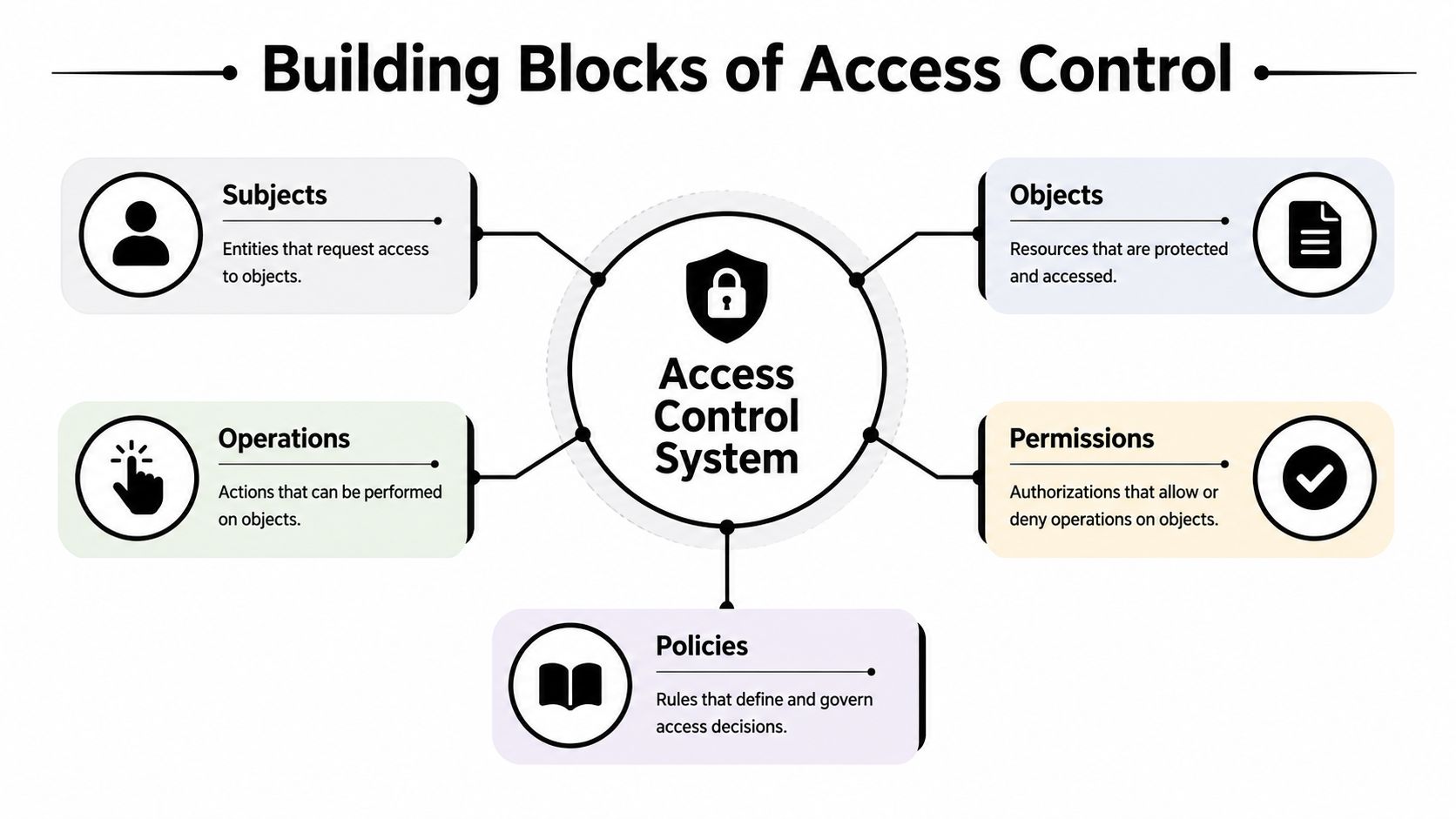
The practical lesson is straightforward. If you cannot trace a user action to a subject, object, operation, permission, and policy, your access control model is already too vague for serious operations.
Comparing Major Access Control Models
The useful comparison isn't “Which model is best?” It's “Which model matches the kind of change my environment experiences?” DAC suits cases where owners need to share directly. MAC is suitable when centrally enforced classification is important. RBAC is effective when individuals transition across steady job roles. ABAC functions effectively when context changes too frequently for static roles to keep pace.
Where each model fits
DAC, also known as discretionary access control, lets owners manage sharing. It is adaptable, yet that same adaptability becomes a risk once ownership is scattered across many systems and no one can justify a permission's presence. MAC, also called mandatory access control, is more restrictive since centrally set rules determine access, which supports tightly controlled environments but may seem inflexible in fast-paced business units.
RBAC became the dominant modern framework after formal introduction in 1992, then standardization in 2004 and revision in 2012 marked its maturity across major markets (NIST IAM history). It lowers administrative overhead through role reuse, which is precisely why it suits stable job functions. The drawback is role explosion as exceptions accumulate and each edge case turns into another role.
ABAC addresses that scaling problem by assessing attributes like user role, resource classification, time, location, or device context. NIST-aligned guidance frames RBAC and ABAC as the two main implementation approaches for modern authorization, particularly in multitenant and SaaS settings (NIST SP 800-192). ABAC is more flexible, yet it relies on reliable attribute governance, and that is where many implementations fail.
| Access Control Model Comparison | Best For | Administrative Overhead | Flexibility | Common Pitfalls |
|---|---|---|---|---|
| DAC | Small teams with direct owner-managed sharing | Low at first, then inconsistent | High for owners | Permission sprawl, weak governance |
| MAC | Regulated or highly classified environments | High | Low to moderate | Rigidity, slower business workflows |
| RBAC | Stable job functions and repeatable duties | Moderate | Moderate | Role explosion, exception creep |
| ABAC | Dynamic cloud, hybrid, and zero-trust environments | Higher upfront, better later | High | Attribute quality issues, policy complexity |
For teams looking at access governance patterns in a broader operational context, the guide to access governance for 2026 serves as a helpful reference. If you want more detail on attribute-driven authorization as a practical pattern, the internal explainer on attribute-based access control aligns naturally with this comparison.
The selection standards are simple. Apply RBAC when responsibilities are steady and simple to standardize. Apply ABAC when access must change according to context and identity data is trustworthy. Use MAC when centralizing policy is critical. Apply DAC only if the governance compromise can be accepted.
Threat Surface and Attack Implications
Access control models do more than shape administration; they also shape how attackers move. The wrong model will not always fail visibly. More often, it opens a silent route to privilege escalation, stale access, or policy confusion that later appears in SIEM and XDR telemetry as normal activity with the wrong business meaning.
How attackers exploit model-specific weaknesses
RBAC is frequently exposed to privilege accumulation. An attacker who takes a credential linked to a broad role can obtain more access than the immediate task needs, particularly when exception handling has produced oversized roles over time. That is why role reviews must search for unused permissions, not merely confirm that a role exists.
ABAC alters the situation, yet it brings new failure modes. If the attribute source is corrupted, outdated, or inconsistent, the authorization outcome can be incorrect even when policy logic is sound. Operationally, that appears when context should have blocked a user, but a faulty attribute record still allowed the request.
DAC is appealing to attackers because delegation can be lax and ownership can be fragmented. Once a low-trust user or service can reshare access, the blast radius can grow without a centralized approval point. MAC resists such drift more effectively, but misclassification or excessively broad classification groups can still yield unintended access paths.
The NIST survey on access-control models also flags risk-adaptive access control and ABAC as recognized directions for context-aware authorization, which matters in zero-trust and AI-driven environments where static roles age quickly (NIST privilege management survey). The attack surface is not only who can sign in; it is how frequently policy state changes under pressure.
Operational insight: if your detection content alerts only on failed logins, you are overlooking the more dangerous scenario: successful access with incorrect authority.
In SIEM, this means correlating unusual combinations of subject, object, action, and condition, rather than only failed authentication. In XDR, it means monitoring endpoint or identity events that reveal privilege use outside the expected job pattern. A policy drift alert is often more valuable than a brute-force alert because it shows the control plane is slipping before the breach becomes obvious.
Mapping Access Controls to Compliance Frameworks
Compliance teams do not need access control theory. They need proof that an actual control exists, performs consistently, and leaves an audit trail. That is why leading security programs treat access control as a compliance primitive, not a separate workstream.
Turning policy into evidence
The primary benefit of formal policy representation is traceability. If a policy can specify which subject may access which object with which action under what condition, the audit team can trace the decision all the way back to an explicit rule set (arXiv formal model). This is important for frameworks such as HIPAA, PCI DSS, ISO 27001, CMMC, GLBA, and SOC 2, where access reviews, privilege control, and evidence retention all come into play.
For example, HIPAA investigations frequently require clear access logs and termination procedures. PCI DSS calls for network segmentation and role-based access. ISO 27001 Evidence generally centers on the Statement of Applicability and risk assessment. SOC 2 Reviews tend to examine user access reviews and change management logs. The control names differ, but the operational pattern is unchanged: enforce access, record the decision, and retain the proof.
This is where SIEM and XDR enter compliance execution. They aggregate logs from cloud services, endpoints, and network devices, then correlate those events so auditors can follow a path from policy to alert to response. The compliance module in Unified Security Stack links access control to authentication and authorization controls, and this linkage is precisely what reduces evidence gathering time in practice.
Auditors seldom reject access control as a concept. They reject systems that cannot show who changed what, when, and why.
The compliance load becomes lighter when the enforcement layer remains stable and the evidence layer handles reporting. This is also why policy changes should prompt an impact assessment. If a role expands or an attribute rule changes, the resulting access implications must be visible in monitoring before the next review cycle.
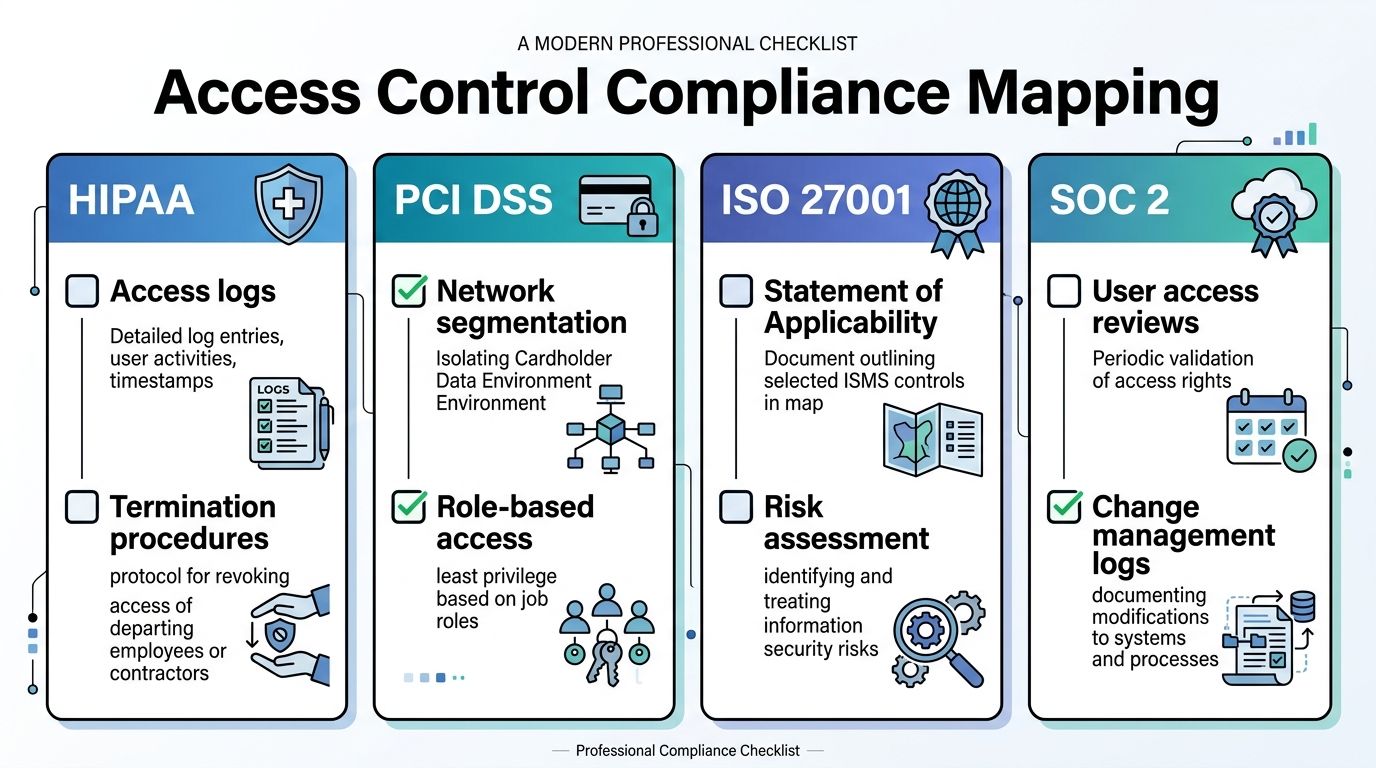
The strongest compliance posture is the one in which the access decision, the log record, and the review workflow all tell the same story.
Implementation and Migration Strategies
A majority of access control failures happen during transition rather than steady state. Teams either grant excessive access to prevent disruption, or they prepare inadequately and disrupt business workflows on day one. The correct approach is a phased rollout beginning with inventory and concluding with continuous validation.
Start with the actual permission graph
Inventory current permissions first, including human users, service accounts, automation identities, and inherited entitlements. That sounds basic, but it is where many ABAC and RBAC projects fail, because the team models the intended structure instead of the messy one already in production. If the current state is not understood, the migration becomes guesswork.
Then determine whether the target design requires a role hierarchy, attribute schemas, or a hybrid approach. In hybrid settings, a pure model typically breaks the first time a SaaS application, an endpoint policy, and a cloud permission set conflict. The more practical step is to establish the core roles, then use attributes to manage exceptions that would otherwise lead to role sprawl.
Governance is the difficult piece. Attribute-based approaches work only when data quality is dependable enough to rely on, which requires clear ownership of the source systems supplying the policy engine. If the HR feed, identity provider, and asset catalog disagree, the authorization layer will apply the bad data precisely as provided.
Roll out in narrow slices
A pilot should span one application family, one department, or one business process, rather than the entire enterprise. Throughout that pilot, use SIEM/XDR to monitor for blocked actions, excessive permissions, and requests depending on stale attributes. If logs reveal policy confusion, correct the policy before widening the scope.
The access rights auditor remains pertinent here, since migration often exposes hidden permission debt that no one wants to document by hand. For teams that must coordinate physical and logical access in a facilities setting, a useful external example is to run your gym more efficiently by following the same principle, provide only the access that aligns with the operational requirement.
Before broad enforcement, validate three things:
- Access intent aligns with the business process.
- Logging documents the sequence of decisions.
- Exception handling includes an owner and a path to expiration.
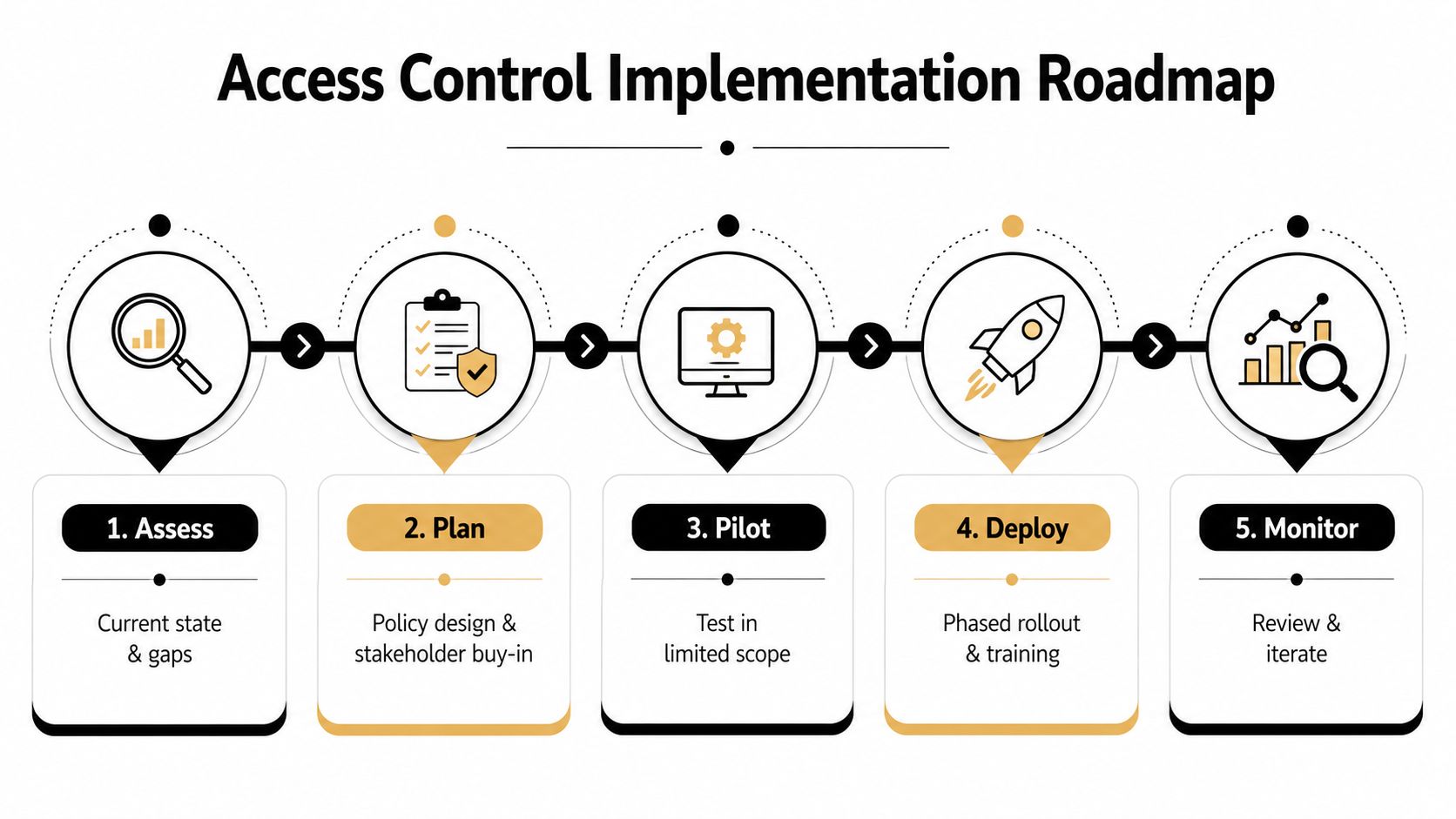
The order matters more than the tools. Evaluate the current state, design the policy, pilot within a limited scope, deploy in stages, then monitor and iterate until exceptions stop increasing faster than the controls.
Auditing and Monitoring Access Controls in Practice
Access control is meaningful only when you can demonstrate that it worked. In practice, that demonstration comes from centralizing logs, correlation rules, and investigation workflows that connect access decisions to policy intent. If the control exists but no one monitors its failure modes, the control is only partly real.
What a workable monitoring loop looks like
A security operations team should seek events indicating policy drift, privilege misuse, and abnormal access sequences. For instance, a user account that abruptly accesses a sensitive object outside its normal job pattern merits review even if the login succeeded. The same applies to service identities that begin touching resources they have never used before.
In SIEM, the correlation layer should examine authentication, authorization, endpoint, and cloud logs. In XDR, that same event chain can initiate containment when the access pattern points to stolen credentials or a compromised token. What matters is that detection logic mirrors the access model, not merely the raw event type.
A strong audit workflow does not end with alerting. It verifies the subject, object, action, and condition that were evaluated, then checks whether the access conformed to policy. This is why formal verification language matters in operations, because policies should be correct, complete, and consistent against the security goal, especially when manual review no longer scales (formal verification study).
Practical rule: If an alert cannot be traced back to the policy that permitted or denied the action, the investigation will take longer than necessary.
A platform such as Unified Security Stack can enable this type of workflow with access rights auditing, rule correlation, and compliance reporting within one stack. This matters because teams do not need more separate tools; they need a way to view authorization events alongside the rest of their security telemetry. The internal Active Directory auditing This capability matters most when identity stores serve as the authoritative source for enterprise access.
With proper monitoring, access controls turn into a component of detection engineering. Without it, they generate persistent incident noise, overlooked privilege abuse, and compliance friction. Typically, the deciding factor is whether the SOC owns the evidence chain.
Unified Security Stack enables security teams to link access control, SIEM correlation, automated response, and compliance reporting within a single operational workflow. If you're working to maintain consistent authorization across hybrid cloud, endpoints, and SaaS, visit Unified Security Stack and assess how its auditing, correlation, and compliance capabilities fit your access control program.