HIPAA Compliance Requirements a Practical Guide for 2026
Another cookie-cutter HIPAA checklist is not what healthcare security teams require. They require evidence. In 2025, healthcare data breaches revealed 168 million patient records, and the average cost of a single healthcare breach reached $10.93 million, the highest of any sector for the 14th consecutive year, according to Medha Cloud's healthcare breach analysis.
That information shifts the framing. HIPAA compliance requirements are not merely legal duties for privacy officers. They are engineering mandates for identity, logging, encryption, monitoring, retention, and response. If your team cannot demonstrate continuous control operation, you may possess policy wording but not a defensible security program.
The theory is already clear to most organizations. The tougher challenge is putting it into practice across endpoints, cloud apps, firewalls, identity providers, EHR systems, file shares, and vendor access. Compliance efforts frequently stall there. For a wider healthcare governance perspective, Simbie AI's guide to compliance serves as a helpful companion resource alongside the technical implementation work covered here.
Table of Contents
- The High Stakes of HIPAA Compliance in 2026
- Deconstructing the Four Core HIPAA Rules
- The Three Pillars of the HIPAA Security Rule
- Common Gaps and Costly Compliance Failures
- Implementing Technical Safeguards A Practical Blueprint
- Automating Compliance with a Unified SIEM and XDR
- Building Your Audit-Ready Evidence Locker
The High Stakes of HIPAA Compliance in 2026
Healthcare organizations face a severe imbalance. A single exposed mailbox, a single contractor account with excessive permissions, or a single unmonitored export path can trigger a breach that escalates into regulatory scrutiny, legal costs, patient notifications, and months of remediation. HIPAA compliance requirements matter because healthcare systems store data that attackers can profit from and patients cannot readily replace.
The larger error is viewing HIPAA as a matter of policy binders. It is not. HIPAA is a control design challenge. Security leaders must show that access is limited, activity is recorded, sensitive data is safeguarded in transit and at rest, and suspicious behavior is examined before a human reviewer requests screenshots and reports.
Why the stakes are operational, not just legal
Compliance programs typically break down in the operating layer. The policy states that access is role-based, yet the directory still holds stale accounts. The standard states that logs are reviewed, yet those logs are scattered across appliances and cloud consoles. The incident plan is in place, yet the business associate never signed terms that align reporting duties across the chain.
Practical rule: A control that cannot produce evidence when requested is not sufficiently mature for healthcare.
That is why effective HIPAA programs resemble security architecture rather than paperwork. They assign owners for logs, encryption, account lifecycle, vendor oversight, and incident response. They also narrow the distance between a compliance statement and the telemetry required to prove it.
What security teams need instead of a checklist
A workable program usually includes three traits:
- Continuous visibility: Teams require consolidated telemetry from endpoints, network controls, identity systems, cloud platforms, and applications that process ePHI.
- Control-to-evidence mapping: Every requirement ought to correspond to an artifact, such as a log, alert, access review, change record, or signed agreement.
- Automated monitoring: Alerts for failed logins, unusual exports, privilege changes, and anomalous access must operate continuously, not just in advance of an audit.
That is the practical perspective for the remainder of this guide. HIPAA compliance requirements become manageable when every rule is converted into technical controls and auditable evidence.
Deconstructing the Four Core HIPAA Rules
HIPAA comprises four core rules, and each generates technical work that can be monitored, tested, and demonstrated. Teams that view them as separate legal documents generally miss the operational point. The rules intersect in access design, logging, vendor control, incident handling, and evidence collection.
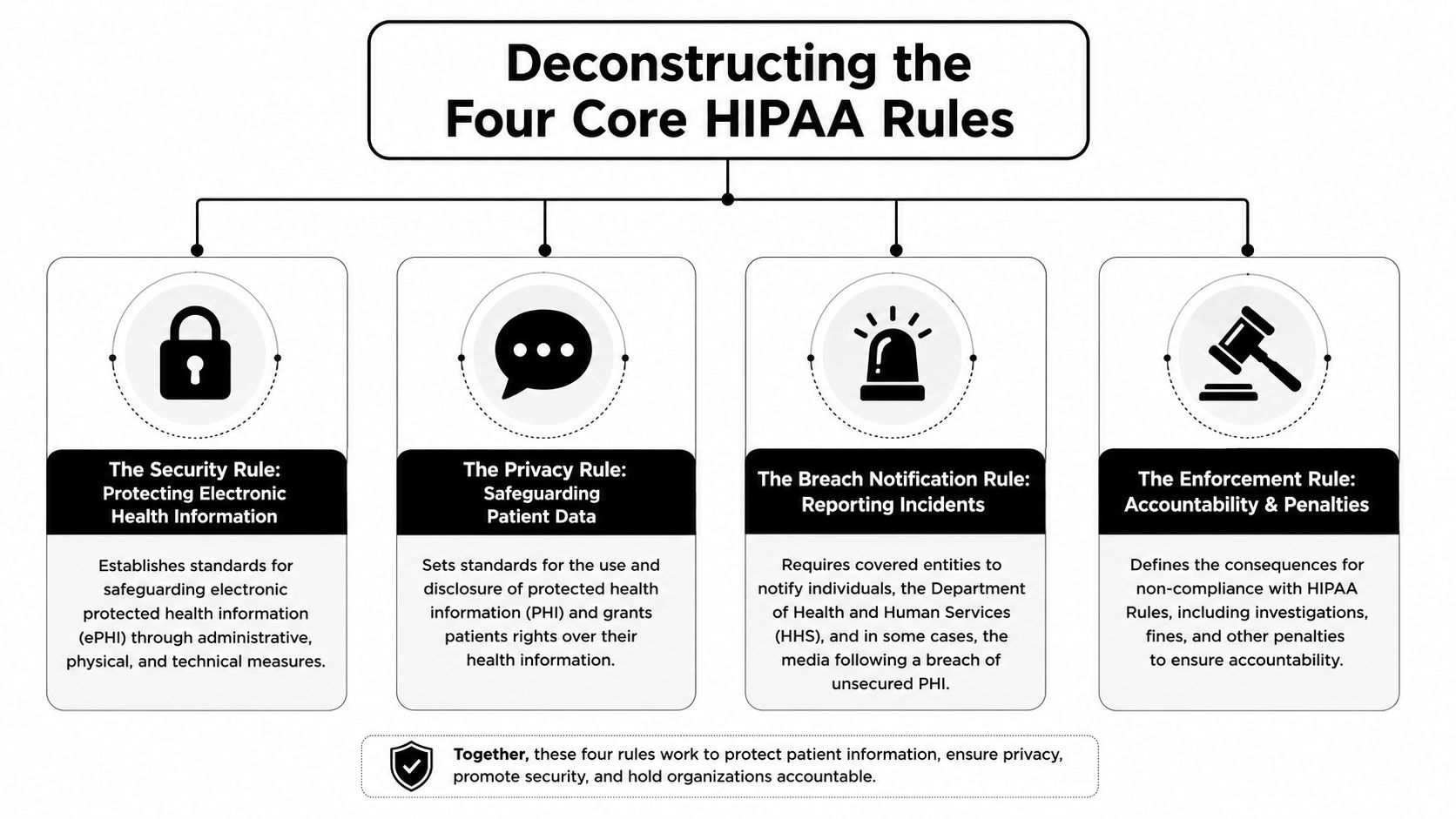
The Privacy Rule It defines how PHI may be used and disclosed. For security and engineering teams, this appears in minimum necessary access, application workflow boundaries, data retention decisions, and whether a dataset should be identifiable at all. Privacy is not merely a policy concern. It informs permissions, data models, and what should or should not appear in logs, exports, and analytics pipelines.
The Security Rule It applies those expectations to ePHI and converts them into safeguard requirements. Architectural design becomes essential, covering identity controls, audit logs, encryption, endpoint telemetry, configuration baselines, and alerting. A unified SIEM and XDR platform such as Unified Security Stack helps by centralizing the evidence trail, correlating access and security events, and keeping control validation continuous rather than episodic.
The Breach Notification Rule It governs what happens after an impermissible disclosure or a confirmed compromise of unsecured PHI. That requirement is frequently mistaken for a legal deadline issue. It is also a telemetry issue. If teams cannot reconstruct who accessed what, from where, on which device, and whether data left the environment, they cannot confidently determine the incident's scope or defend their reporting decision.
The Omnibus Rule and enforcement framework It extends those obligations to business associates and their subcontractors. Delegating a workload does not delegate accountability. If a billing vendor, SaaS provider, call center, or managed service provider handles PHI, their access paths, logging coverage, and incident reporting terms must withstand audit and a real event.
For organizations reducing exposure at the design stage, methods for de-identifying healthcare data It can reduce both privacy risk and breach impact when applied correctly.
Why technical teams need all four in scope
Security teams often build their program around the Security Rule and leave the rest to legal or compliance. That division creates predictable points of failure.
- Privacy decisions influence access control. When a department gathers more data than its workflow needs, IAM and application permissions tend to widen along with it.
- Breach response relies on evidence that is retained. Notification choices depend on log integrity, user context, asset context, and sufficient retention to rebuild the timeline.
- Vendor governance requires technical controls. A signed BAA covers only part of it. You still need scoped accounts, MFA, session visibility, alerting, and rapid revocation.
- Enforcement risk increases when records do not mirror reality. Written policies can claim one thing, while endpoints, cloud tenants, and third-party integrations reveal another.
The practical conclusion is straightforward. HIPAA serves as one operating model. Privacy defines limits. Security applies controls. Breach notification checks whether monitoring and response are sufficient. The enforcement layer demands evidence.
This is why mature programs align every rule with artifacts a platform can generate on request, including access logs, alert histories, configuration records, investigation notes, and vendor activity trails. A modern SIEM/XDR stack does not substitute for governance, but it provides compliance teams with something auditors and incident responders both trust.
The Three Pillars of the HIPAA Security Rule
The Security Rule stands on three safeguard categories: Administrative, Physical, and TechnicalTeams frequently over-invest in the technical side because purchasing tools is easier than correcting governance. In practice, the three pillars strengthen one another. Poor risk analysis weakens good logging. Weak facility controls weaken strong application controls.
HIPAA's technical safeguards specifically mandate Access Control, Audit Controls, Integrity, Person or Entity Authentication, and Transmission Security, including implementation specifications such as unique user IDs and encryption aligned with NIST standards like AES-256, as outlined in this HIPAA software development guide.
Administrative safeguards
Administrative safeguards form the management layer. They determine who owns the program, how risk is evaluated, how access is approved, how incidents are escalated, and how workforce members are trained.
In real environments, teams define:
- Risk analysis cadence: Annual assessment is the baseline, not the entire program.
- Access governance: Joiner, mover, and leaver processes must line up with clinical and vendor workflows.
- Security operations procedures: Alerts require triage logic, escalation routes, and response playbooks.
Physical safeguards
Physical safeguards are frequently undervalued because they seem old-fashioned. They remain important. A badge-controlled server room, secure workstation placement, controlled device disposal, and media handling procedures are still part of the trust boundary around ePHI.
These controls matter even more in hybrid care settings, where clinicians, contractors, and support staff move among offices, clinics, and remote environments. A locked rack is not sufficient if laptops, removable media, and shared workstations fall outside policy.
Technical safeguards
Technical safeguards are the most visible and measurable. They are also the simplest to audit poorly when controls exist without evidence.
| Safeguard Type | Objective | Example Implementation Specifications |
|---|---|---|
| Administrative | Govern how security is planned, assigned, and maintained | Risk analysis, workforce training, incident procedures, access approval workflows |
| Physical | Protect facilities, devices, and media that store or access ePHI | Controlled facility access, workstation controls, device disposal procedures |
| Technical | Enforce digital protection and accountability for ePHI | Unique user IDs, audit controls, authentication, integrity controls, encryption using AES-256 |
The strongest programs do not treat these as separate workstreams. They connect them. For instance, an identity control is not merely a login requirement. It links policy, HR workflow, MFA settings, privileged access, endpoint telemetry, and alert review.
A HIPAA control is complete only when the organization can demonstrate who owns it, how it operates, and what evidence it generates.
That is the distinction between nominal compliance and defensible compliance.
Common Gaps and Costly Compliance Failures
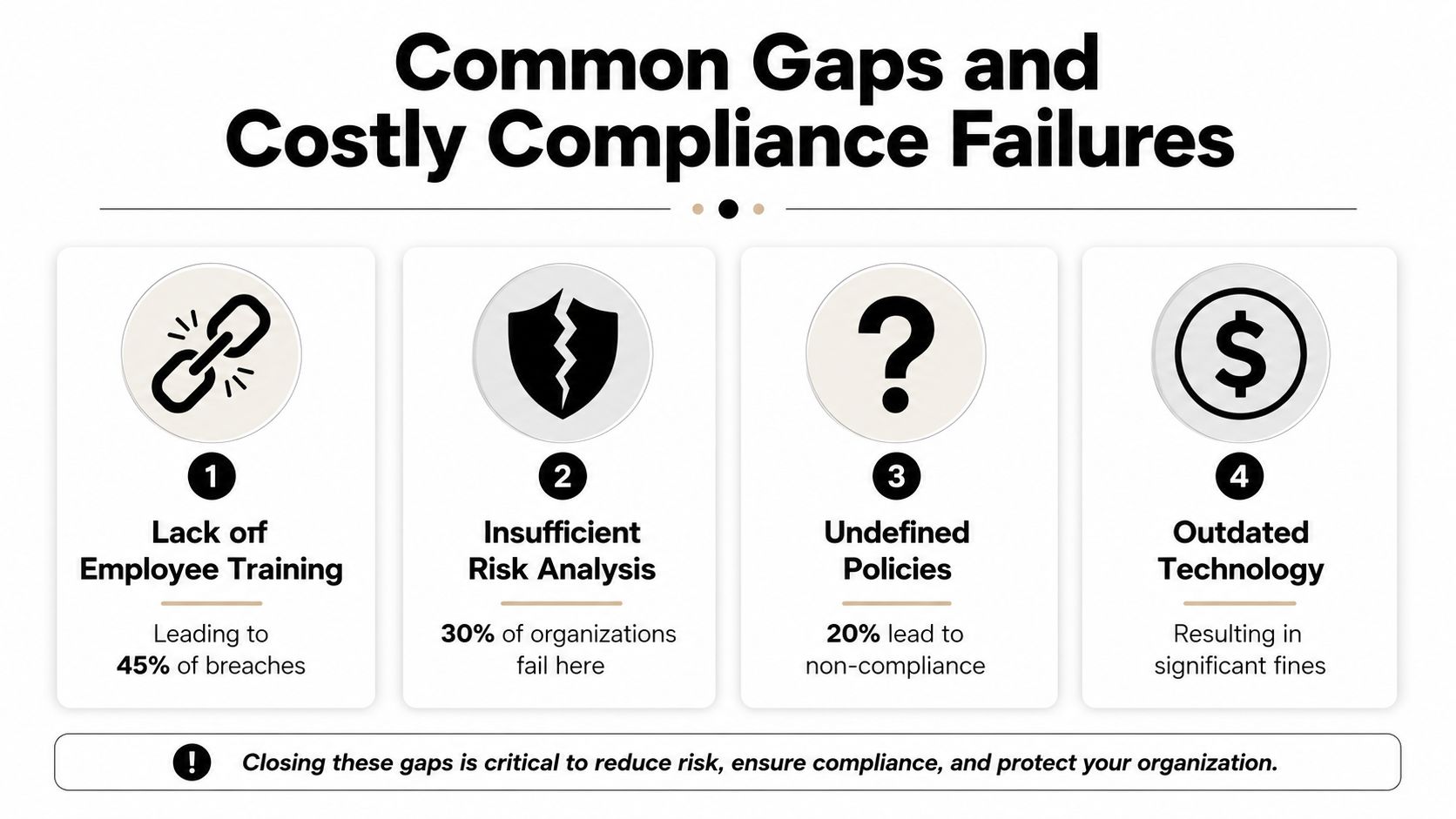
The largest HIPAA mistake is not malicious conduct. It is assuming documented intent is sufficient. OCR investigations consistently show that the dangerous failures are operational, recurring, and preventable.
The clearest illustration is risk analysis. Not performing the annual security risk analysis mandated by the Security Rule remains the most frequently cited failure in OCR investigations, which led to the launch of a specific Risk Analysis Initiative in October 2024 targeting non-compliant entities, according to Gitnux's HIPAA statistics summary.
The paperwork myth
Organizations often claim they finished a risk assessment when they actually finished a questionnaire. Those are not the same. A genuine risk analysis follows where ePHI lives, how it travels, who may access it, which systems expose it, what logs are available, and which controls are absent or inconsistent.
A spreadsheet can record findings. By itself, it cannot uncover unknown assets, stale permissions, weak log coverage, or insecure data paths.
Where teams usually break down
The recurring weak points tend to look familiar:
- Identity drift: User accounts persist beyond staff changes, vendor engagements, and temporary projects.
- Fragmented logging: EHR access logs, firewall logs, endpoint events, and cloud audit trails reside in separate locations.
- Weak BAA operations: Contracts are present, but onboarding and offboarding fail to enforce least privilege or monitoring.
- Shallow breach analysis: Teams classify each incident as either clearly reportable or clearly harmless without recording the technical rationale.
One subtle area is often mishandled. Separating a reportable breach from a low-probability compromise requires a documented technical risk assessment. Smith Law's HIPAA analysis shows how that documented analysis can prove decisive in an enforcement review.
Security teams encounter trouble when they can describe a control in a meeting but cannot reconstruct the event trail that demonstrates it worked.
The practical takeaway is straightforward. HIPAA compliance requirements break down where monitoring, ownership, and documentation are weakest.
Implementing Technical Safeguards A Practical Blueprint
Technical safeguards succeed when they are precise, observable, and assigned to system owners. General security statements offer little help. Engineers must know which events to log, which sessions to end, which cryptographic standards to apply, and how long artifacts must remain accessible.

Start with evidence-producing controls
Audit logging is required. HIPAA logging must record four immutable data elements for each ePHI interaction: user identity, timestamp, action performed, and source location, and the logs need tamper protection with a minimum 6-year retention policy, as detailed in this developer-focused HIPAA checklist.
That requirement immediately translates into technical tasks:
- Who: Link actions to unique user identities, not shared accounts.
- When: Maintain trustworthy timestamps across systems.
- What: Capture read, write, delete, and export actions where the platform permits it.
- From where: Record device or session origin so investigators can tell expected access from suspicious access.
For integrity monitoring, teams also require mechanisms that reveal when protected files, configurations, or binaries were altered. A targeted control such as file integrity monitoring for regulated environments helps bridge the gap between general logging and verifiable change tracking.
Map each safeguard to a system owner
The second error is deploying controls without ownership. HIPAA's technical requirements typically span multiple teams, so every control requires an accountable operator.
Consider the core areas:
- Access control: Unique user IDs, emergency access procedures, automatic session controls, and permission review processes span IAM, EHR administration, and endpoint management.
- Integrity: Hash validation, change monitoring, and tamper detection fall to system administrators, application owners, and SOC analysts.
- Transmission security: Data in transit should rely on TLS 1.2 or TLS 1.3, while data at rest should use AES-256, with key management performed through validated cryptographic modules, consistent with the implementation guidance summarized earlier.
Systems that hold ePHI and contain critical vulnerabilities likewise need prompt remediation, while annual penetration testing and ongoing vulnerability scanning belong in day-to-day operations, not treated as sporadic audit preparation. BAAs follow the same rule. They must be in place before a vendor accesses PHI, and the reporting duty must fit the incident response workflow, not stay solely in legal storage.
Automating Compliance with a Unified SIEM and XDR
Manual HIPAA operations break down for one simple reason. Controls sit in many locations. Identity data resides in one system. Endpoint telemetry resides in another. Firewall events, SaaS audit logs, vulnerability findings, and EHR activity all come in different formats and at different intervals. Examining them one by one does not establish continuous monitoring. It produces periods of blindness.
Manual compliance doesn't scale
Healthcare settings contain a strong human factor. 68% of healthcare breaches stem from human error or inadequate access controls, and smaller practices often struggle to implement instant alerting and anomaly detection the Security Rule expects because they lack the tools, according to Rectangle Health's HIPAA checklist discussion.
This is precisely the role SIEM and XDR play. A consolidated platform can:
- Ingest evidence broadly: Collect log data from cloud services, endpoints, network devices, identity providers, and applications that handle ePHI.
- Correlate behavior: Tie failed logins, privilege changes, unusual exports, remote access, and malware or endpoint events together into one investigative timeline.
- Map detections to compliance controls: Link alerts and reports to the safeguard they are meant to support.
- Retain evidence centrally: Maintain searchability for investigations, audits, and breach analysis.
One practical example is HIPAA compliance automation workflows, which bring monitoring and reporting into line with control requirements rather than making teams create each rule and evidence path from zero.
What a unified platform should actually do
Many vendors claim HIPAA support. The more useful question is whether the platform helps your team prove HIPAA compliance requirements on a continuous basis.
In practice, a unified SIEM/XDR should support at least four operating functions:
- Centralized audit collection for authentication activity, administrative actions, file access, endpoint detections, and network traffic.
- Correlation rules for suspicious patterns like repeated failed access that precedes a successful login and significant data transfers.
- Alert workflows that route incidents, retain analyst notes, and document the remediation performed.
- Compliance reporting that lets evidence be exported by control, system, timeframe, or incident.
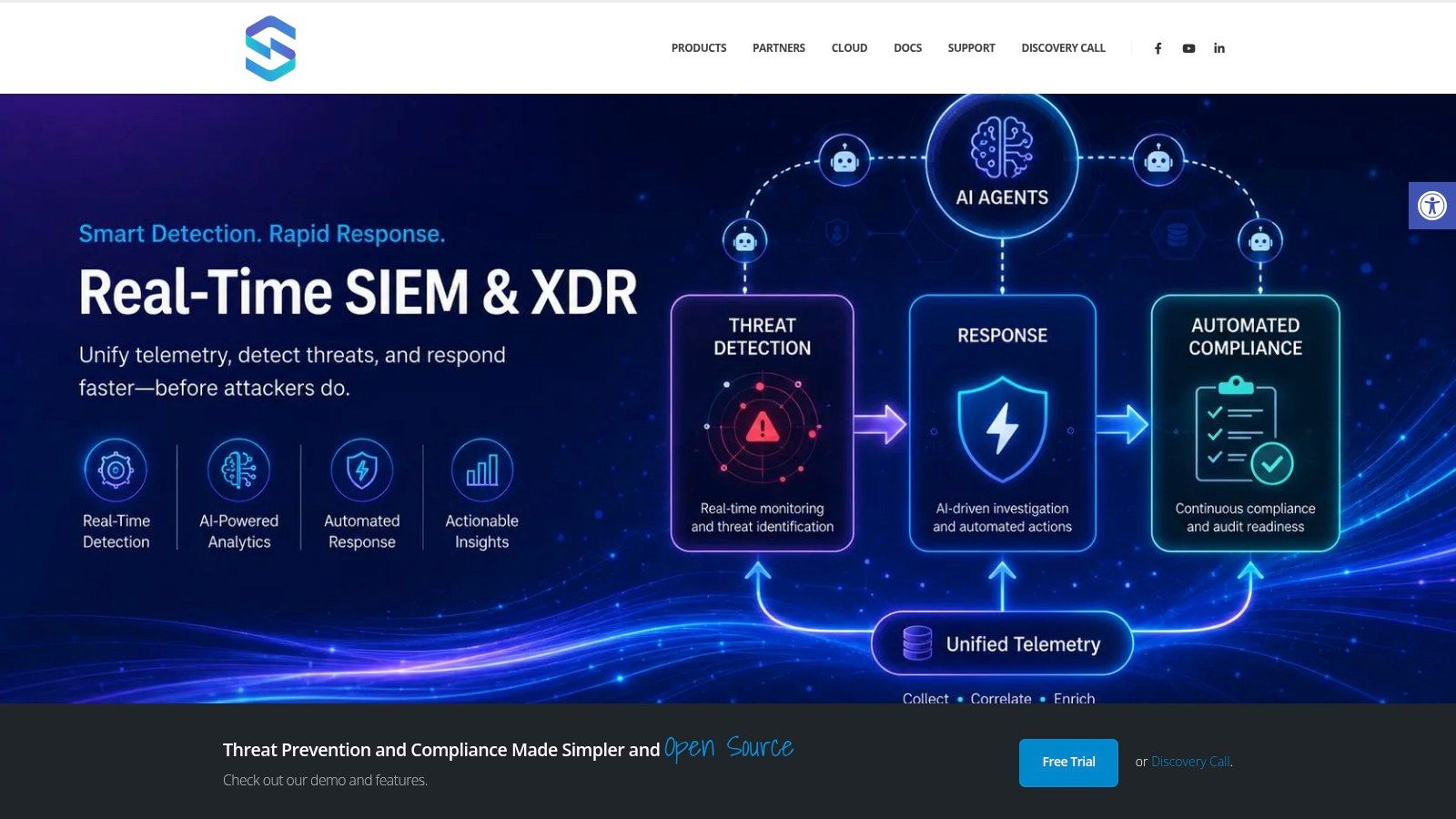
A platform such as Unified Security Stack fits this approach by combining SIEM, XDR, automated response, and compliance mapping in one stack. The key point is not the product category label. It is whether your team can move from fragmented console reviews to one defensible evidence stream.
A quick product walkthrough helps make that concrete:
Effective automation does not replace judgment. It removes the repetitive evidence collection that prevents analysts from applying judgment well.
This distinction is significant in healthcare. The platform should speed up reviewers rather than conceal the reasoning they need during an investigation or audit.
Building Your Audit-Ready Evidence Locker
Audit readiness is largely a matter of retrieval. Many organizations have some correct controls, but they cannot assemble evidence quickly enough, or they discover too late that one team kept logs, another team kept policies, and no one kept the decision trail that tied them together.
What auditors usually want to see
A reliable evidence locker usually contains:
- Risk analysis artifacts: The latest assessment, remediation decisions, and documentation of follow-up.
- Access evidence: Records for user provisioning, role reviews, privileged access approvals, and access logs.
- Monitoring evidence: History of alerts, investigations, tuning records, and documented reviews of system activity.
- Vendor documentation: BAAs, security review documentation, and evidence of access boundaries for third parties.
- Training and policy records: Staff acknowledgment and up-to-date approved procedures.
How to keep evidence ready all year
The clearest pattern is centralization. When logs, alerts, investigations, and reports come together in a single search layer, audit preparation becomes a reporting task rather than a scavenger hunt. That is why centralized log management for compliance operations carries so much weight in healthcare settings.
Design the evidence locker around scheduled exports and retained context. Tie reports to controls, keep timestamps intact, file investigation notes alongside the matching alert, and hold on to the documentation that records why an incident received the classification it did. That final element matters for breach analysis and for supporting conclusions that a compromise was unlikely.
You are in solid shape if your team can answer three questions fast: what took place, who held access, and what evidence proves the control worked as intended.
If you're evaluating how to turn HIPAA compliance requirements into continuous technical evidence, Unified Security Stack merits consideration within that process. It offers security teams the means to consolidate logs, correlate activity, automate detection, and generate compliance-oriented reporting rather than treating HIPAA as an annual documentation drill.