What is the difference between SIEM and Next-Generation SIEM
Cyber threats keep changing, so the tools organizations use to defend themselves must change as well. It is time to move from your traditional SIEM to a Next-Gen/Next-Generation SIEM solution with stronger cyber protection capabilities. Let's look at the reasons.
Next-Generation SIEM vs. traditional SIEM
In 2005, SIEM tools transformed computing by easing IT professionals' work in managing security for business systems. Initially, traditional SIEM solutions were designed for centralized log management, gathering and aggregating log data from various sources in a secure, separate location. Consequently, logs remain intact during a compromise or hardware failure, helping organizations track and monitor suspicious activity that signals cyber threats. However, traditional SIEM lacks the automated real-time threat detection and incident response capabilities that a Next-Gen SIEM platform provides.
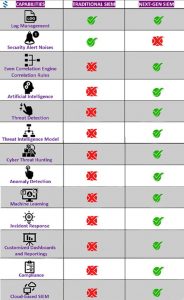 Difference between SIEM and Next-Generation SIEM by Unified Security Stack
- Security Alert Noises
When traditional SIEM is implemented, IT teams are flooded with security alert noise that is hard to handle daily. As a result, many teams tend to classify alerts as false positives to cope with alert fatigue. Therefore, security analysts lose critical alerts that indicate threats, and organizations become compromised. The first SIEM generation required expert data analysis and a skilled team able to filter out the growing avalanche of false positives to find the real security threats.
Using a Next-Gen SIEM platform like Unified Security Stack solves this issue through filters that standardize log fields and an AI-powered event correlation engine based on several correlations rules. In this manner, cybersecurity experts receive only critical alerts broken down by IP source and destination details, which eases forensic analysis and threat detection.
- Threat Detection
Threat detection is conformed by threat intelligence, cyber threat hunting, together with anomaly detection techniques. Anomaly detection helps identify events, behavior, and patterns that appear unusual or suspicious and may become threats to organizations. Unlike traditional SIEM, a Next-Gen SIEM includes this threat detection capability, allowing organizations to identify and predict threats and attack attempts.
By analyzing the environment, the machine learning anomaly-based engine of Unified Security Stack defines custom rules and baselines. This learning mechanism allows the system to learn from its environment and gain the ability to recognize abnormal and threatening behavior.
- Incident Response
The incident response team handles and manages security breaches for organizations. Typically, Next-Generation SIEM platform providers oversee the security incident process through a customized incident response plan in line with the client's requirements. Today, Next-Gen SIEM incorporates capabilities from Security Orchestration, Automation, and Response (SOAR) to accelerate threat detection and response.
Unified Security Stack supports incident response automation SOAR from its dashboard, supporting several actions such as isolating hosts, terminating processes, logging off, blocking users or IPs, etc.
- Customized Dashboards and Reportings
Traditional SIEM solutions provide a fixed collection of prebuilt dashboards and reports to meet most clients' typical compliance requirements. Yet not every environment is alike, and each organization has distinct use cases that require custom dashboards and reports. Once again, Next-Gen SIEM arrived to address this capability.
Unified Security Stack dashboards and reports can be created, changed, and removed without writing a single line of code. The whole solution has been built on a proprietary data visualization and analysis engine that enables any advanced user to build the entire stack from the ground up.
- Compliance
Organizations seeking to apply leading cybersecurity practices must include a SIEM that manages compliance. Regrettably, traditional SIEM and compliance remain unintegrated. Nevertheless, the Unified Security Stack cost-effective Next-Generation SIEM handles compliance with FISMA, HIPAA, GLBA, GDPR, SOC, PCI DSS, CMMC, and other standards.
- Cloud-based SIEM
As infrastructures become increasingly cloud-based, new service-oriented architectures emerge, and Internet and user traffic reaches unparalleled levels, a traditional SIEM cannot effectively monitor and defend against modern security threats. A cloud-based Next-Generation SIEM provides the quickest dissemination of threat intelligence. It also supplies the server time required to process large volumes of log data.
With the Unified Security Stack cloud-based SIEMEach user, application, device, server, and other endpoint can be efficiently and effectively monitored and managed. Unified Security Stack is also capable of receiving or pulling logs from a range of sources, such as Syslog, APIs, Webservice, and others. Currently, the platform integrates with Azure, AWS, and Google Cloud. It also integrates with SaaS and PaaS offerings, including Office365 and AWS Lamda.
A traditional SIEM, in its era, offered security for simple IT environments. However, with new advances in technological ecosystems, organizations require advanced tools to follow the best cybersecurity practices and effectively manage and monitor all vulnerabilities. Today, the Next-Generation SIEM platform is the most advanced solution to protect organizations in a proactive way against sophisticated threats and all types of cyber-attacks.