HIPAA Compliance Automation: Roadmap for CISOs 2026
Most healthcare security teams do not begin considering HIPAA automation out of a fondness for compliance tools. They begin when a new audit request arrives, someone needs six months of access reviews, policy attestations are stale across three separate folders, and the security team loses a week rebuilding evidence that ought to be available already. The issue is not that teams fail to understand HIPAA. It is that far too many programs still run like a periodic paperwork exercise, even as the environments they oversee change daily.
This is the gap that hipaa compliance automation is designed to fill. When done well, it does not substitute for your compliance program. It shifts the operating model away from manual collection and retrospective explanation toward continuous monitoring, structured evidence capture, and quicker remediation. For CISOs, the key questions are not only which platform has the strongest dashboard. The core questions are architectural and governance-driven: where automation operates, what data it accesses, which decisions stay with people, and how to prevent creating a fragile machine that appears compliant while drifting below the surface.
Table of Contents
- Navigating HIPAA Beyond the Annual Audit
- What Is HIPAA Compliance Automation
- Mapping HIPAA Safeguards to Automated Controls
- Architecting Your Automated Compliance Engine
- Governance and Risk The Hard Questions of Automation
- Your Step-by-Step Implementation Roadmap
- HIPAA Automation FAQs
Navigating HIPAA Beyond the Annual Audit
The common failure pattern appears nearly identical across organizations. An audit, customer security review, or internal assessment nears. Security requests logs from IT. Compliance requests training records from HR. Someone pulls IAM data into spreadsheets. Policy documents are renamed, approved again, and circulated through email. The team then spends more time demonstrating that controls ran than strengthening the controls themselves.
That operating model is costly. It is also brittle. Evidence collected after the fact is more difficult to trust, more difficult to normalize, and more difficult to defend when an auditor asks how you know a control functioned consistently between checkpoints.
A stronger approach is to treat HIPAA as an operational discipline that never stops running. Well-planned automation can provide 300% to 500% ROI while cutting repetitive compliance workload by up to 70% through automating tasks such as access-log reviews, training tracking, and policy updates, according to ComplyJet's HIPAA automation benchmark. Those figures matter because they represent a change in how staff are allocated, not merely an improvement in tooling.
The cost of reactive evidence gathering
When teams stay manual, they create avoidable risk patterns:
- Evidence gaps accumulate: Logs expire, screenshots vanish, and control owners depart without recording what they did.
- Review quality drops under deadline pressure: People approve access reviews and policy checks merely to empty the queue.
- Security work gets displaced: Analysts use their time formatting artifacts rather than investigating drift, misconfigurations, or suspicious access paths.
Practical rule: If your compliance process depends on a repeated scramble to gather evidence, you do not have continuous assurance. What you have is periodic reconstruction.
For healthcare organizations preparing for internal reviews or medical industry cybersecurity audits, that difference is significant. Auditors and enterprise buyers increasingly want a team to show how controls are monitored, not merely how documents are kept.
The same principle holds for foundational telemetry. If logs are not centralized and retained in a way the compliance team can actually use, every later automation effort will be weaker. That is why a mature program typically begins with disciplined log management in compliance operations, rather than showy workflow orchestration.
What changes when automation is done right
The victory is not that audits go away. The victory is that audits no longer dictate how the team operates. Control evidence is gathered as systems run. Exceptions become visible sooner. Remediation turns into a tracked workflow rather than a post-audit promise.
This is the argument for hipaa compliance automation. It substitutes a standing control system for episodic validation, supporting security, compliance, and audit readiness simultaneously.
What Is HIPAA Compliance Automation
HIPAA automation means using connected systems to gather evidence, assess controls, and surface exceptions continuously rather than depending on periodic manual checks. The easiest comparison is physical security. Manual compliance is a guard who walks the building every few hours with a checklist. Automated compliance is a monitored environment with sensors, logs, and alerts that report problems as they arise.
A visual model helps:
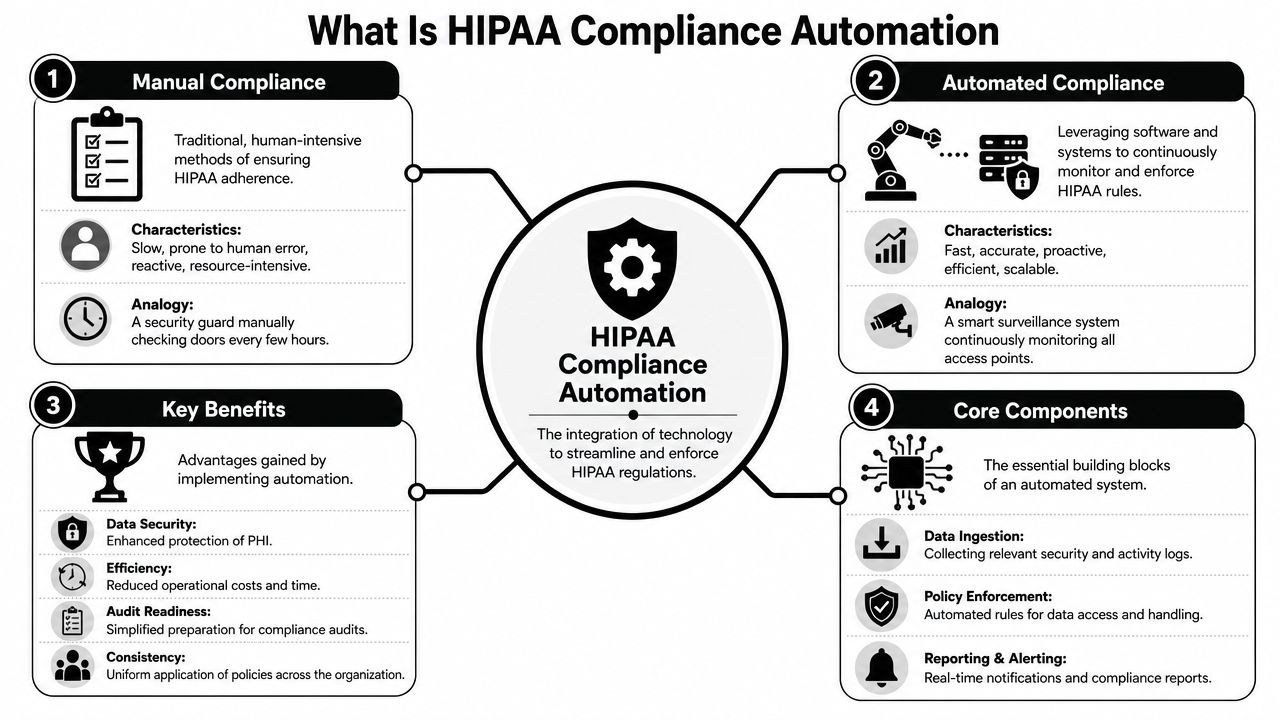
From snapshots to live controls
The most important change is the move to continuous control monitoring. Contemporary platforms call this monitoring controls 24/7, gathering evidence automatically, and flagging non-compliance as it emerges. The dashboard from one platform demonstrates the model with 91% evidence completion, showing how posture can become measurable in near real time rather than treated as an annual status exercise, as noted in Scytale's discussion of automation in healthcare compliance.
This is important because HIPAA does not function like an annual exam. Workforce access shifts. Cloud settings drift. Vendors get added. Logging pipelines fail. Policies age. If the control environment changes every week, point-in-time validation cannot say much about current reality.
The same reasoning extends beyond security telemetry. Messaging workflows, intake processes, and operational communication channels frequently handle regulated data indirectly. Teams assessing automation for outreach and operational workflows should also consider compliant communications for HIPAA because the compliance system boundary is usually broader than the security stack alone.
After the core concept, it helps to see the operating model in motion:
The three operating layers
In practice, hipaa compliance automation generally depends on three layers.
Data ingestion
The platform gathers logs, identity events, policy artifacts, training records, ticket statuses, and configuration data from the tools that already hold those details.Control evaluation
Mappings tie those facts to HIPAA safeguards. The platform assesses whether expected conditions are present, absent, outdated, or contradictory.Alerting and evidence generation
Exceptions set off notifications, tickets, or response playbooks. Simultaneously, the system retains supporting evidence in a format the compliance team can present.
A control that cannot deliver timely evidence is only partly implemented, even when the underlying security setting is correct.
This is why automation should be viewed as a live control fabric, not a reporting layer. If its only output is better-looking PDFs before an audit, the organization has digitized the old process rather than changed it.
Mapping HIPAA Safeguards to Automated Controls
The practical question is not whether HIPAA can be automated in principle. It is which safeguards gain the most from automation and which still rely on judgment. The strongest candidates are controls that demand repeatable evidence, frequent checking, or event-driven response.
Where automation fits best
Automation performs best when the control has clear technical signals. Access changes, failed logins, privileged role assignments, retention status, training attestations, and ticket closure evidence are simpler to automate than narrative risk acceptance or executive policy review.
That does not mean every safeguard turns into a machine rule. It means the machine manages the repetitive proof while people manage interpretation, prioritization, and accountability.
A useful design principle is to separate control execution, control evidence, and control ownership:
- Execution can be automated: deactivate dormant accounts, gather logs, verify encryption status, initiate review tasks.
- Evidence should be automated whenever possible: timestamps, authorizations, log extracts, configuration captures.
- Ownership stays assigned to people: the privacy officer, the IAM lead, security operations, and the infrastructure owner.
For teams standardizing evidence collection across the security stack, a SIEM-centered model is often the fastest way to anchor these mappings, making HIPAA compliance and SIEM integration valuable. It provides the program with a single location to correlate events and keep audit trails intact instead of spreading evidence across separate consoles.
HIPAA Security Rule Automation Mapping
| HIPAA Security Rule Citation | Requirement | Automated Control Example |
|---|---|---|
| §164.308(a)(1) | Risk management | Create recurring workflows that collect exception data from cloud, endpoint, and identity systems, then open remediation tickets for control drift |
| §164.308(a)(3) | Workforce security | Trigger joiner, mover, leaver workflows from HR or IAM events to provision, modify, and remove access consistently |
| §164.308(a)(4) | Information access management | Detect privileged access changes, approval gaps, or role conflicts and route them for review |
| §164.308(a)(5) | Security awareness and training | Track training assignment, attestation status, overdue completion, and evidence retention automatically |
| §164.308(a)(6) | Security incident procedures | Correlate suspicious events, notify stakeholders, and preserve incident evidence as part of a response workflow |
| §164.308(a)(7) | Contingency planning | Validate backup-job status, restoration test records, and failure alerts through integrated monitoring |
| §164.310(d) | Device and media controls | Record asset state changes, decommissioning approvals, and media handling tickets in a centralized evidence trail |
| §164.312(a) | Access control | Continuously evaluate account status, MFA enforcement, privileged role use, and dormant identities |
| §164.312(b) | Audit controls | Aggregate system and access logs, alert on anomalies, and retain searchable evidence for reviews |
| §164.312(c) | Integrity | Monitor for unauthorized changes to configurations, policies, or sensitive repositories |
| §164.312(d) | Person or entity authentication | Validate authentication events and detect unusual login behavior or repeated failures |
| §164.312(e) | Transmission security | Check encryption-related control states and alert when protected channels or approved workflows aren't being used |
The pattern is clear. The nearer a requirement sits to system state or recorded activity, the greater the value automation contributes. The nearer it sits to executive judgment, the more the system should assist the process rather than determine it.
Architecting Your Automated Compliance Engine
Most failing automation programs do not fail because the control library is weak. They fail because their data path is incomplete. A system cannot prove what it cannot see, and in healthcare settings the blind spots are often predictable: unmanaged SaaS, fragmented identity stores, absent endpoint telemetry, and policy artifacts stored outside any controlled repository.
The data path matters more than the dashboard
At the architecture level, the core pattern is simple. The system takes in logs, access-control data, and policy artifacts from IAM, SIEM, and cloud services so teams can spot drift early and keep an audit-ready state throughout the year, as described in Secureframe's comparison of manual and automated HIPAA workflows.
That sentence sounds easy. In practice, it requires deliberate decisions about collection method, normalization, and ownership.
- Agents perform well for servers and endpoints that require local visibility and dependable forwarding.
- APIs are frequently the cleanest route for cloud services, identity providers, ticketing systems, and training platforms.
- Syslog and network feeds remain important for appliances, firewalls, and legacy infrastructure.
- File and document ingestion is required when policy approvals, vendor reviews, or attestation records still come from outside the security stack.
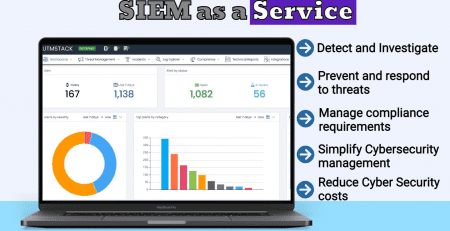
A representative dashboard can help teams see why centralization matters:
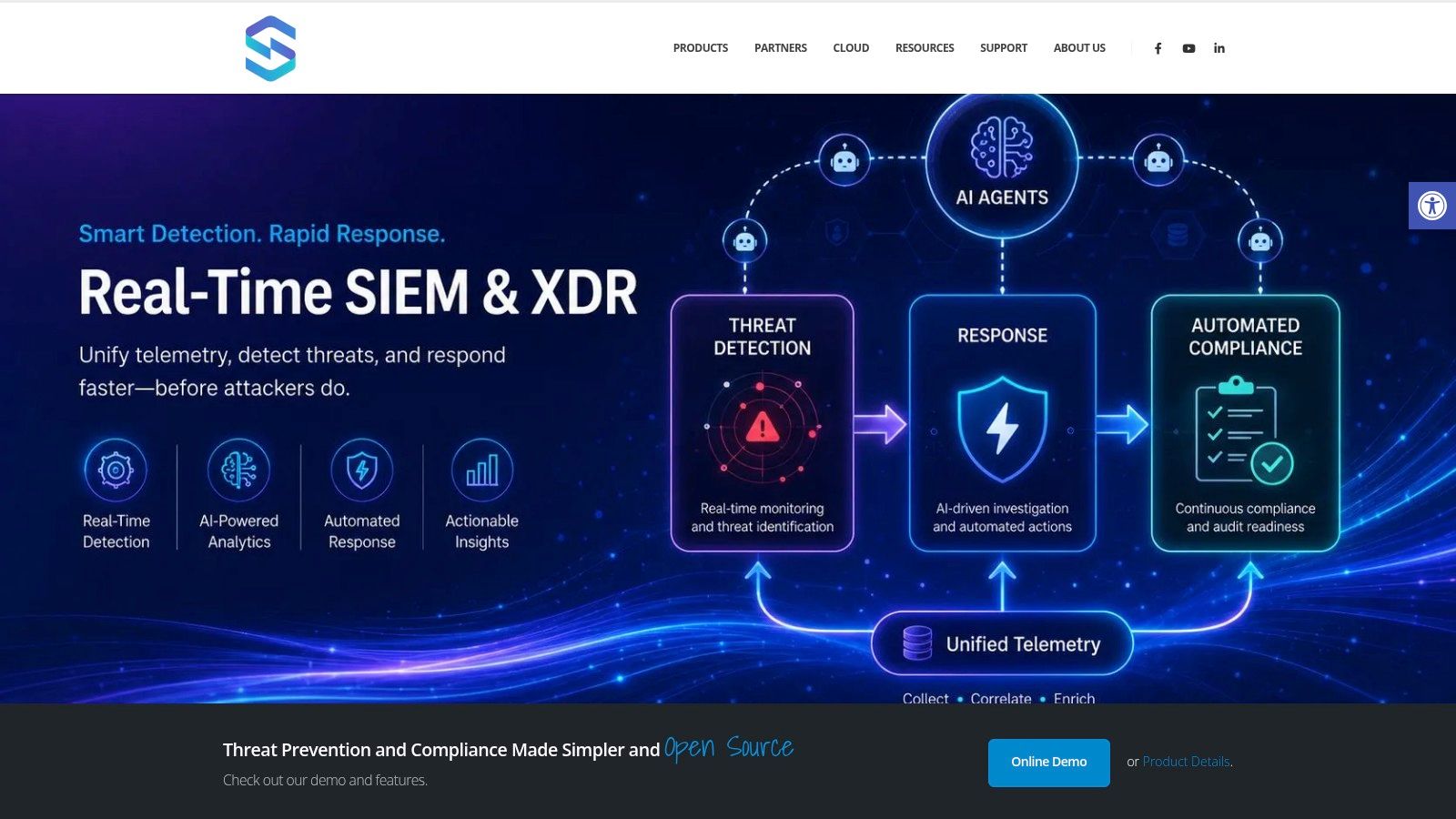
A practical reference architecture
The most effective pattern usually looks like this:
Collection tier
Ingest event data from endpoints, servers, IAM, EHR-adjacent systems, cloud workloads, email security, ticketing systems, and policy repositories.Correlation tier
Standardize identities, timestamps, assets, and event categories. Here, a SIEM or XDR layer converts raw telemetry into signals relevant to controls.Evidence tier
Keep the resulting artifacts in a manner that enables retention, searching, and retrieval for audits.Response tier
Run playbooks for triage, notification, containment, or remediation when control deviations are detected.
One option in this category is incident response automation with SOAR workflows, enabling teams to link alerts with repeatable actions like opening a compliance ticket, alerting a privacy officer, or isolating a device while preserving evidence. Unified Security Stack is one platform that unites SIEM, SOAR, and compliance workflows in a single stack.
Design the architecture with evidence fidelity as the first priority. Rapid alerts have value, but if you cannot rebuild who had access, what changed, and when it occurred, compliance value is constrained.
What does not work is launching an automation platform before the organization determines which systems are authoritative. If HR is the source for workforce status, IAM for account state, ticketing for approvals, and cloud control planes for configuration truth, those boundaries must be defined early for the platform. Otherwise, it generates noise, duplicate exceptions, and endless ownership disputes.
Governance and Risk The Hard Questions of Automation
The most critical decisions in HIPAA compliance automation are not technical defaults. They are governance choices that decide whether the tooling lowers risk or unintentionally creates another one.
SaaS versus private deployment is a compliance decision
One question many teams pass over too fast is where the automation system itself operates. A checklist centered on HIPAA automation asks whether the system can be run entirely on-premises, in a VPC, or in private tenancy with no outbound data transfer, particularly when logs themselves may hold PHI. It positions data residency and evidence immutability as primary design constraints in Onymos's HIPAA compliance automation checklist for 2025.
That insight should change procurement discussions. If the platform takes in identity events, application logs, case notes, workflow comments, attachments, or investigation artifacts, then the compliance tooling can, in practice, become part of the regulated environment, even if that outcome was unintended.
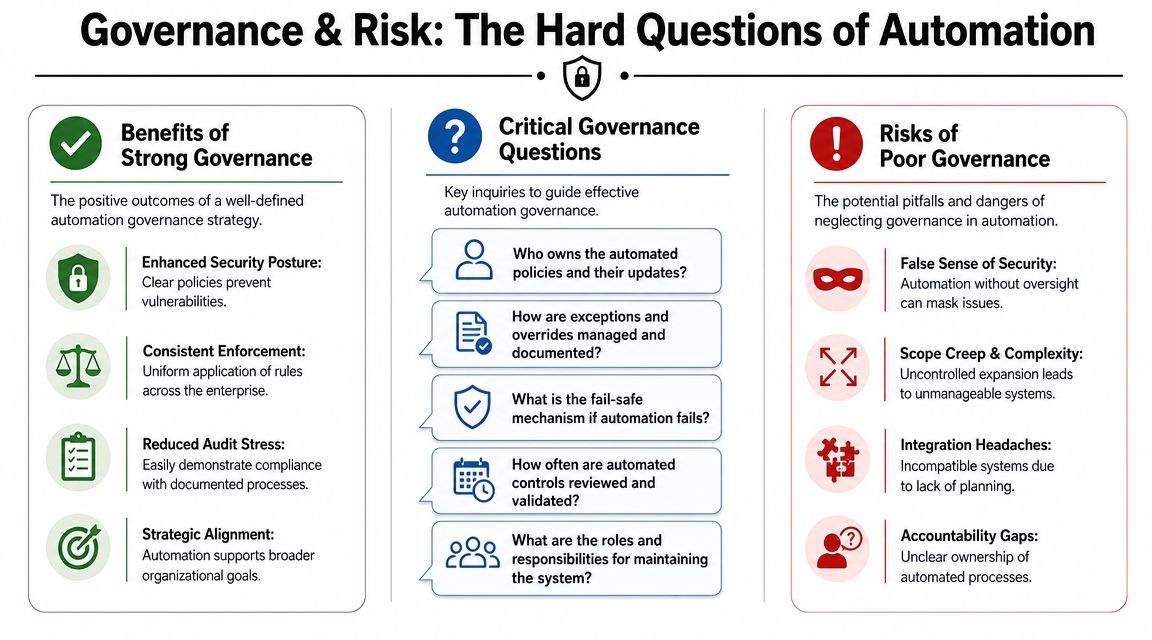
A CISO should force four questions before selecting the deployment model:
- What data enters the platform: raw logs, metadata alone, attachments, ticket notes, screenshots, or policy documents.
- Where that data is processed and stored: multi-tenant SaaS, a private tenant, a customer VPC, or on-premises.
- Whether outbound transfer is required: certain architectures presume analytics or evidence storage hosted by the vendor.
- How evidence is preserved: immutability, retention controls, export capability, and the ability to reconstruct during an audit.
A SaaS model may still be the correct option. However, it should be selected on purpose, with data classification and workflow design already established, not simply because it is easy to operate.
Define the automation boundary early
The second difficult question is what the machine can determine by itself. Automation excels at repeatable control checking. It is far weaker at judgment calls that depend heavily on context. Governance fails when teams blur that line.
Tasks that are often good candidates for high automation include:
- Routine log review support: aggregate, correlate, and identify events that require human attention.
- Evidence collection: access records, acknowledgments of policy, screenshots of controls, configuration states, approval trails.
- Workflow enforcement: reminders for reviews, escalations for overdue items, termination tasks, deadlines for remediation.
Tasks that should remain human-reviewed include:
- Formal risk acceptance: a system may prepare the evidence, yet an accountable leader accepts the residual risk.
- Annual policy review: Automation may monitor deadlines and approvals, yet policy wording remains with leadership.
- Business associate oversight: The workflow may monitor contracts and follow-ups, but vendor risk determinations still require judgment.
- Audit remediation sign-off: The system may verify that a task is complete, but a person must validate whether the fix is sufficient.
Automation should eliminate administrative work, not responsibility.
A frequent failure pattern is the illusion of continuous compliance. A green dashboard may conceal outdated mappings, failed connectors, unreviewed exceptions, or processes that no longer match how the environment works. Sound governance expects those failures to occur and defines who notices, who validates, and who may override the system when necessary.
Your Step-by-Step Implementation Roadmap
Most organizations should not attempt to automate the whole HIPAA program in one step. The safer route is to establish the evidence fabric first, then scale enforcement and response in stages. Vendors report gains including 90% faster compliance workflows and up to 80% automated evidence collection when standardized mappings and always-on checks replace manual sampling, according to Scytale's overview of HIPAA automation. The takeaway is not that all teams will obtain identical outcomes. It is that the operating model gets stronger when control checks are systematic.
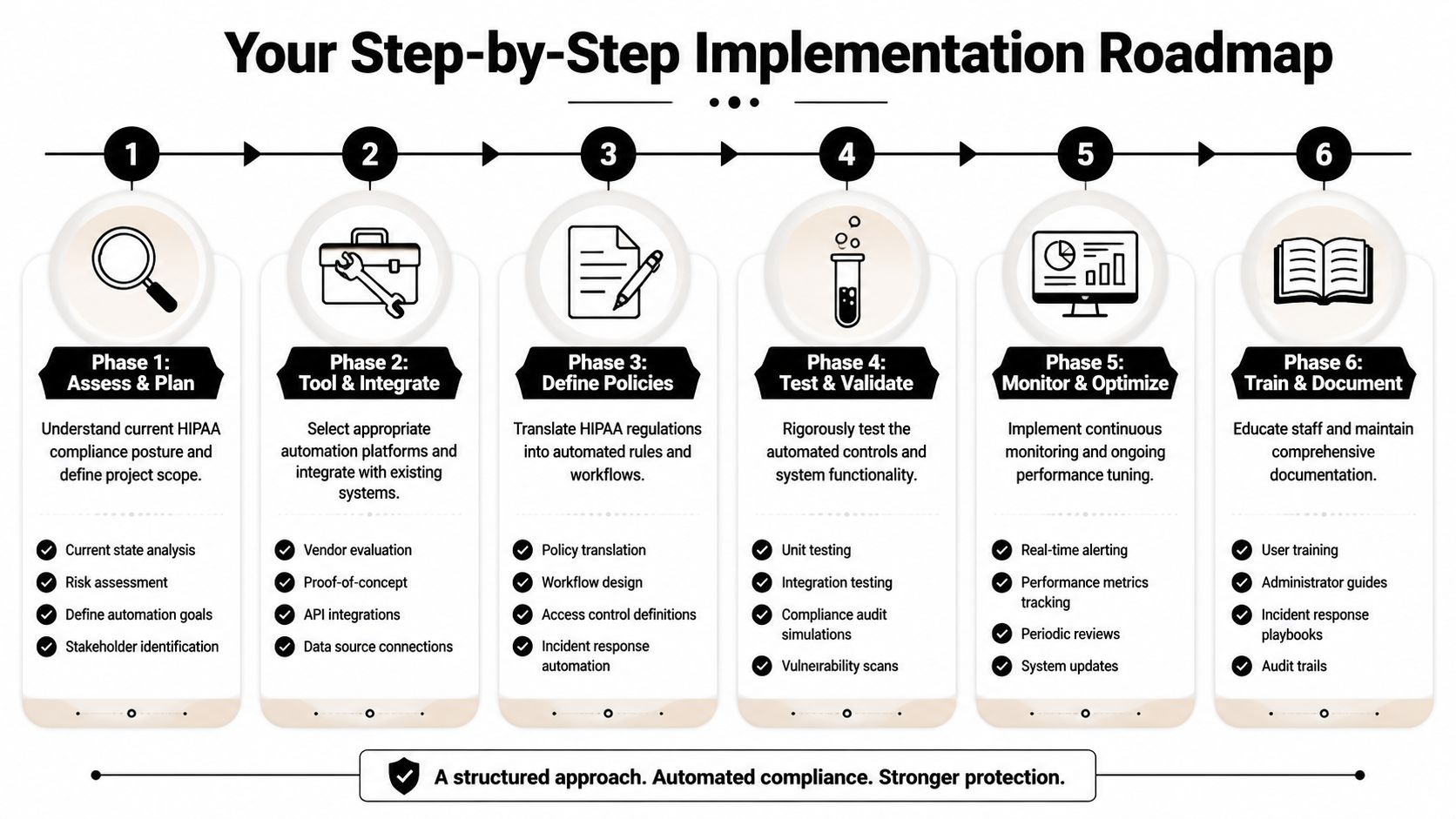
Phase the rollout like a security program
An actionable roadmap typically consists of six phases.
Assess and plan
Determine which systems create, store, process, or support ePHI workflows. Chart where identity, logging, ticketing, policy records, and training data currently reside. Decide which repositories serve as authoritative sources.Select tools and design architecture
Assess deployment models before anything else, not at the end. Determine whether the automation layer should sit in SaaS, a private environment, or on-premises according to the data it will take in and the evidence it must keep.Define policies and mappings
Convert HIPAA safeguards into operational checks. Many teams frequently stumble here. They purchase tools before defining what good looks like for account review frequency, privileged access approval, backup validation, and exception handling.Test and validate
Use simulations with actual workflows. Disable an account and check the evidence trail. Trigger a control failure and verify that the correct owner is alerted. Break an ingestion connector and see if anyone notices.
What to automate first and what to defer
The fastest gains typically come from controls that are highly repetitive and unambiguous.
- Start with collection-heavy tasks: support for access-log review, tracking of training status, capture of policy acknowledgments, and centralized retention of evidence.
- Then automate detection and routing: alerts for drift, reviews past due, privileged access exceptions, and creation of incident workflows.
- Add response carefully: disable accounts, isolate assets, or initiate containment only when ownership and rollback are clear.
Leave the following for later, even if the platform can technically support them:
- Complex exception logic tied to specialized clinical workflows
- Cross-functional approvals where legal, compliance, and operations need different review paths
- Executive attestations that still depend on narrative interpretation
Begin with controls that generate clear evidence and predictable actions. Postpone those that demand substantial interpretation.
Monitor and optimize
After the system goes live, examine connector health, exception volume, outdated rules, and unresolved findings. Tuning belongs to the compliance program rather than being an afterthought.Train and document
Each automated control requires designated owners, fallback procedures, and clear documentation. If the workflow fails, staff need to know how to operate manually until it is restored.
Phased deployment with clear ownership succeeds. Attempting to automate all safeguards simultaneously and only later finding that no one agrees on the system of record does not.
HIPAA Automation FAQs
Can automation make an organization fully HIPAA compliant
No. Automation assists a HIPAA program. It improves evidence collection, continuous monitoring, and workflow execution, yet it does not substitute for governance, policy ownership, risk decisions, workforce accountability, or legal review.
Does this apply to business associates too
Yes. Business associates frequently face the same operational challenge as covered entities. They must demonstrate safeguards, maintain audit trails, monitor risk, and prove that controls function over time, not only during a questionnaire cycle.
Where can AI help without overreaching
AI can support analysts with alert triage, evidence summarization, duplicate identification, and rule tuning. It should not be the ultimate authority for risk acceptance, disciplinary action, or any compliance claim that requires review by accountable people.
What's the most common mistake
Viewing automation as a reporting project. When source data is incomplete, accountability is ambiguous, or the deployment approach introduces additional PHI exposure, the organization ends up with more polished reports and the same operational weaknesses.
If you're building a HIPAA automation program and need a unified place to collect logs, correlate events, orchestrate response, and keep audit evidence usable, Unified Security Stack merits evaluation. It consolidates SIEM, SOAR, XDR, and compliance workflows onto one platform, which can streamline the architecture for healthcare teams seeking fewer isolated tools and clearer control ownership.