Mastering Data Exfiltration Prevention in 2026
Many security programs continue to view data exfiltration as a downstream effect of compromise. That perspective is too limited. The global average cost of a breach reached $4.44 million in 2025 according to Varonis's summary of 2025 data breach statistics, and that expense falls on operations, legal, compliance, and executive credibility, not only on the SOC.
In hybrid environments, the challenge becomes harder quickly. Sensitive data travels among SaaS apps, cloud workloads, laptops, file shares, data centers, managed devices, unmanaged browsers, and now AI interfaces that can turn into unapproved outbound channels with one paste. A useful prevention strategy must work across every one of them. It also must hold up in an audit, where merely having a tool is never sufficient. Teams need controls they can demonstrate, detections they can clarify, and response actions they can verify.
For organizations that are also tightening governance, this guide to data privacy for SMEs acts as a practical companion because it expresses privacy obligations in business language that security leaders can connect back to technical controls.
Table of Contents
- The High Cost of Unchecked Data Flow
- Mapping Data Exfiltration Attack Vectors
- Building a Layered Prevention Framework
- Detecting Threats with SIEM and XDR
- Automating Containment with SOAR Playbooks
- Measuring Success and Mapping to Compliance
- A Hybrid Environment Implementation Checklist
The High Cost of Unchecked Data Flow
Preventing data exfiltration should sit in the same discussion as resilience, regulatory exposure, and board reporting. Security leaders sometimes split breach prevention from financial planning, but attackers do not. After data exits the environment, the incident becomes harder to contain, harder to explain, and harder to defend before customers, partners, auditors, and regulators.
The real-world mistake is putting too much into inbound defenses while leaving outbound routes weakly controlled. Many teams can describe how malware entered. Fewer can say which sanctioned and unsanctioned channels let data leave, which users can send sensitive files to personal destinations, or which workflows depend on trust instead of technical enforcement. In a hybrid estate, that gap grows because business data resides in too many locations at once.
Security failure becomes a business event
A CISO usually takes over this problem in fragments. Email protections might be fully developed. Endpoint protections might vary. Cloud logging might have gaps. DLP might span some systems while leaving browsers, collaboration platforms, and AI interfaces uncovered. On its own, none of this looks disastrous. Together, it creates a routine setting in which data can escape with minimal friction.
Practical rule: When your team cannot identify the primary paths by which sensitive data leaves across cloud, on-prem, and browser sessions, you are not running a prevention program yet. What you have is disconnected controls.
Prevention has to be integrated
What succeeds is an integrated model. Policy sets what movement is acceptable. Identity limits who can reach what. Network and endpoint controls restrict where data may go. DLP and behavioral analytics examine what is being moved and how. Detection platforms link weak signals across the stack. Response automation reduces dwell time when someone evades policy or when an attacker leverages legitimate tools to blend in.
That type of architecture does more than prevent theft. It provides compliance teams with proof that controls are operating as intended. It provides risk leaders with a foundation for prioritization. And it provides the SOC with a way to tell a messy but legitimate business workflow apart from a real exfiltration attempt.
Mapping Data Exfiltration Attack Vectors
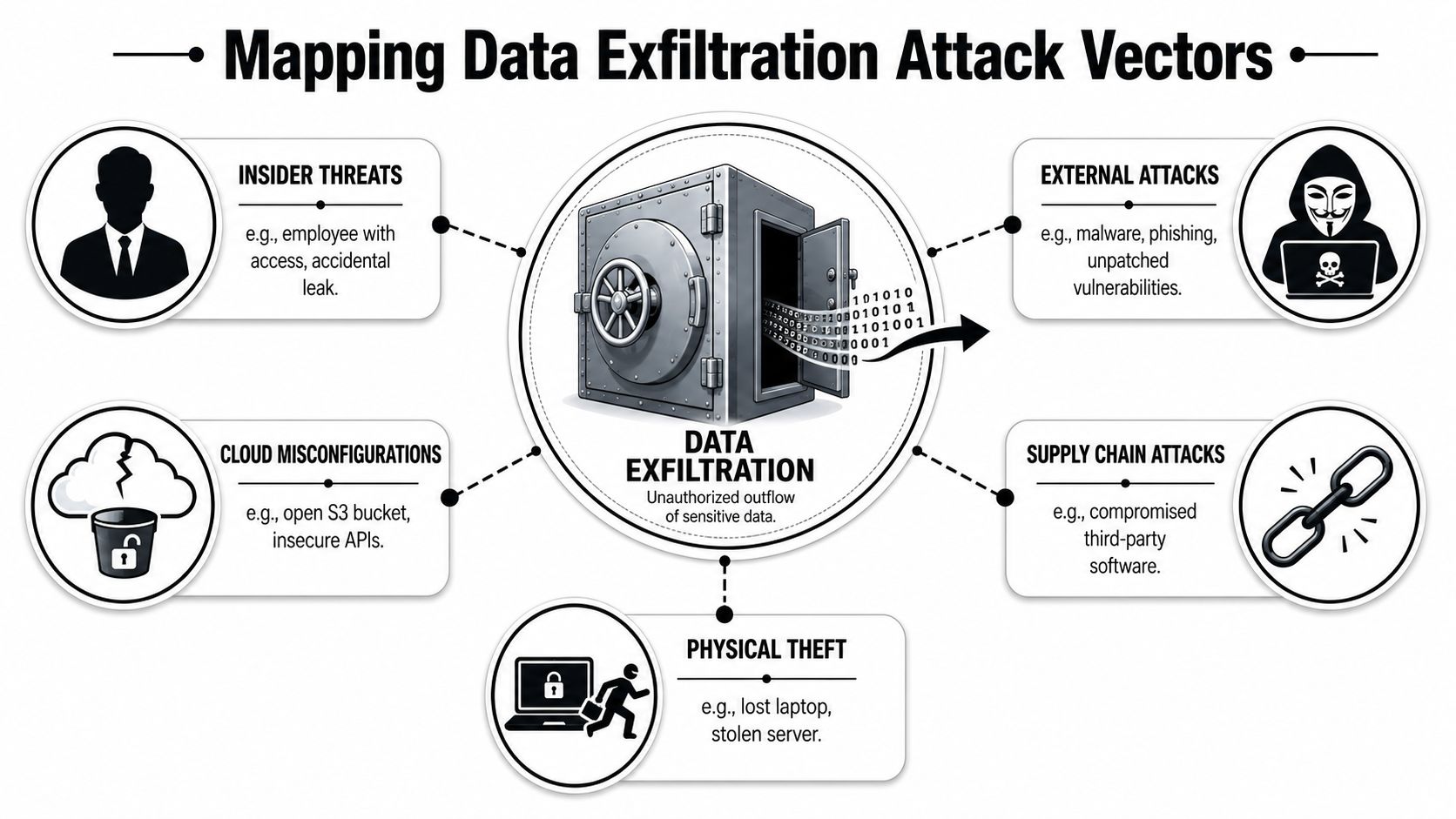
The easiest way to describe data exfiltration is this. You built a vault, but the back door opens onto loading docks, cloud apps, browsers, contractor laptops, and AI prompts. Attackers do not need to destroy the vault if they can use one of those exits without being noticed.
Why old threat models miss modern exits
Conventional models focus on email attachments, USB storage, and malware callbacks. These remain important, yet they no longer explain how data exits modern environments. An approved cloud platform can turn into an exfiltration channel when users sync sensitive files to personal tenants. A browser session can turn into an outbound path when employees upload reports to unsanctioned tools. A collaboration app can turn into a bridge between managed and unmanaged devices.
AI introduces another layer of complexity. Many legacy controls depend on exact patterns, file fingerprints, or known labels. Those approaches struggle when users paste fragments, summaries, code snippets, rewritten content, or derivative material into AI tools. Nightfall notes that a frequent unanswered question is how to stop exfiltration through unsanctioned AI tools and shadow cloud services, and that emerging 2025 data shows AI-powered misclassification and shadow AI usage are expanding vectors, with large language models increasingly used to circumvent pattern-based detection, as described in Nightfall's guidance on modern data exfiltration prevention practices.
Strong threat models do not merely list channels. They pinpoint trust failures. Who can move data, from where, to which destination, with what business justification, and under what degree of monitoring.
The vectors that matter in hybrid estates
In practice, the main categories are broader than is often documented:
- Insider movement through approved tools: Users frequently exfiltrate through platforms the organization already trusts. File sync, collaboration spaces, and shared drives create less friction than malware and often attract less suspicion.
- External compromise using valid accounts: Once an attacker gains access, they seldom need exotic tooling. They rely on the same cloud exports, admin consoles, remote sessions, and data access methods that your staff use every day.
- Shadow cloud and unsanctioned SaaS: Security teams can govern what they know about. They have difficulty with browser-based services adopted outside procurement and outside IAM.
- AI prompt leakage: The risk is not limited to full documents. Fragments, derivatives, and reformatted data can hold material business value even when content inspection overlooks them.
- Cloud misconfigurations and overexposed services: Hybrid environments produce handoff gaps. A workload may be hardened on-prem and loosely configured in cloud, or the reverse.
- Physical and endpoint loss: A laptop with cached files, local exports, saved tokens, or offline sync data can evade strong central controls when endpoint posture is weak.
- Third-party workflows: Vendors, managed service providers, and business partners often possess access paths functionally similar to those of insiders, but these are controlled by distinct contracts and review schedules.
One helpful gauge is whether your program treats exfiltration as a single occurrence or as a sequence. Actual incidents unfold as a sequence: access, staging, compression or transformation, destination selection, transfer, and cleanup. Every stage provides distinct chances to prevent, detect, or contain.
Building a Layered Prevention Framework
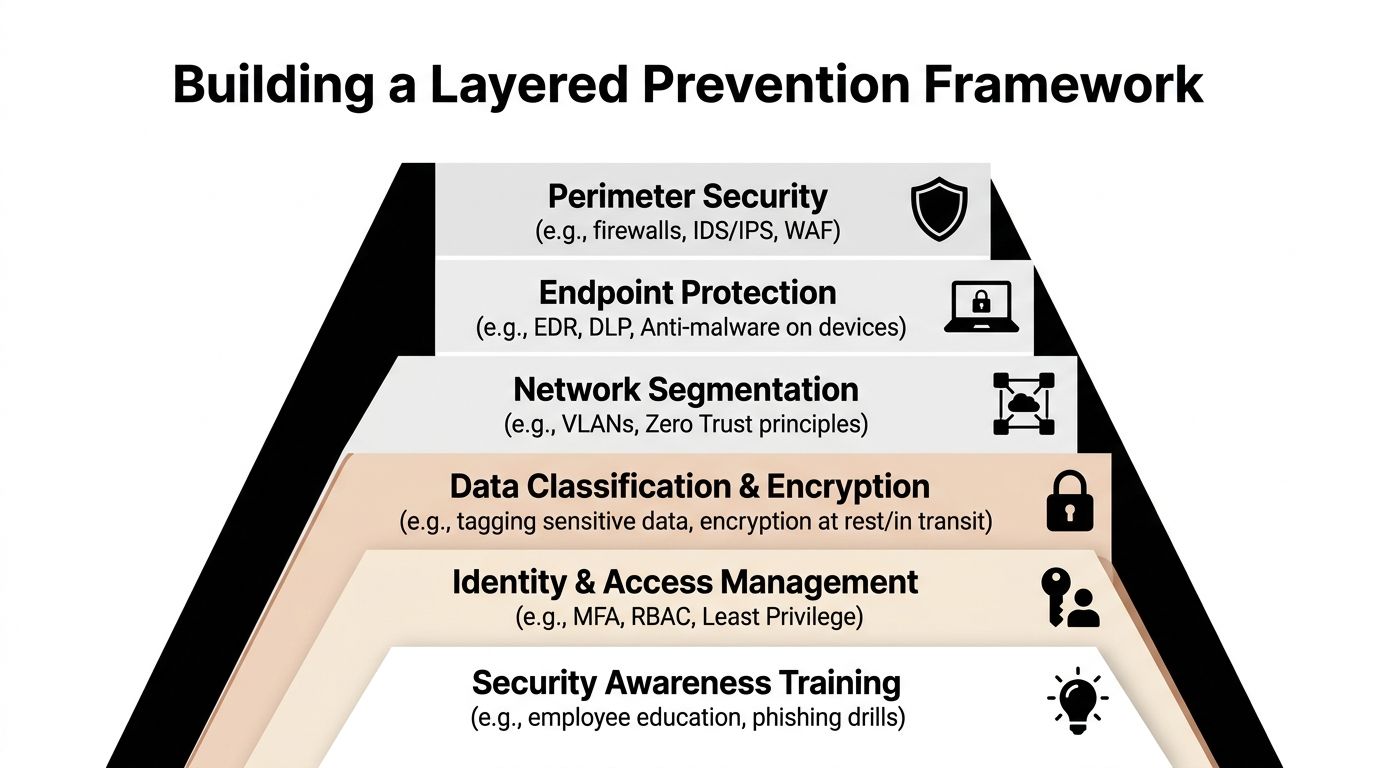
Data exfiltration cannot be stopped by any one tool. Defense in depth is the practical approach. Picture an onion: policy on the outer layer, enforcement in the middle, and identity and data governance at the center. When a layer fails, another should still make the transfer more difficult, more visible, or impossible.
When teams need to align on a shared operational view, a visual model is useful.
Start with policy that security tools can enforce
Most organizations already possess policies. The issue is that those policies are drafted for awareness rather than enforcement. An instruction to handle sensitive data appropriately gives little value to your DLP team, IAM team, or SOC.
Write policy as decision logic:
- Define data classes: Make the scheme simple enough for business owners to adopt. When classification is overly detailed, users disregard it and tools end up with poor labels.
- Define approved destinations: Identify approved cloud repositories, permitted email channels, allowed transfer methods, and forbidden categories, including personal file storage for company records.
- Define handling rules by role: Finance, legal, engineering, support, and leadership do not handle identical data through identical methods. Policy needs to account for those differences.
- Define exception handling: Controls that create too much friction break down if there is no sanctioned process for requesting an exception with an audit trail and approval from the business owner.
Additional materials can support the framework afterward, but the architecture must be established first.
Control the paths data actually takes
At this stage, many programs either turn practical or stay theoretical. Begin with the pathways that both your users and attackers depend on.
| Layer | What it should do | Common failure mode |
|---|---|---|
| Network egress controls | Restrict outbound traffic to known business destinations and inspect risky patterns | Teams allow broad outbound access because application mapping is incomplete |
| Endpoint protection | Monitor file movement, browser uploads, removable media, and local staging | Controls focus on malware but ignore user-driven transfer behavior |
| DLP | Apply content and context-aware controls to data in motion, at rest, and in use | Rules are too brittle, too noisy, or too dependent on exact matches |
| Encryption | Reduce exposure if files are copied or devices are lost | Keys and access are too widely distributed |
| Browser and SaaS controls | Govern uploads, copy-paste behavior, session context, and unsanctioned app use | Browsers become a blind spot outside endpoint agents |
The best designs presume users will take the simplest route. When the approved path is burdensome, they will turn to consumer cloud storage, personal email, pasting into chat, screenshots, or AI prompts. Security architecture must consider convenience. Any control people cannot reasonably use turns into shadow IT.
Operational advice: Deny clear high-risk destinations. Provide guidance for medium-risk actions. Record low-risk activity that is unusual. This progression yields better results than attempting to block everything outright from the start.
Close the loop with access governance
Least privilege remains important, though not as a catchphrase. It is important because exfiltration becomes far simpler when users retain access they no longer require. Access reviews should center on data exposure, not only application entitlements. Ask which users can access sensitive repositories, whether those rights remain justified, and whether machine identities possess greater export capability than planned.
Three controls deserve special attention in hybrid settings:
- Joiner, mover, leaver workflows require security participation. Role changes, contractor offboarding, and project-based access frequently leave stale permissions behind.
- Privileged session controls ought to address cloud consoles and on-prem admin paths together. Separating them according to infrastructure type leaves gaps.
- Service account governance is important because automated exports, backup jobs, and integration accounts can transfer substantial data volumes without the behavioral signals a human user would typically show.
A layered framework succeeds when every layer limits the blast radius. Policy expresses intent. Network and endpoint controls cut down the exits available. DLP and browser controls monitor movement. Access governance reduces who can reach sensitive data at all. Together, these elements make data exfiltration prevention believable in a hybrid environment.
Detecting Threats with SIEM and XDR
Even robust prevention programs will not stop every attempt. Detection reveals whether controls are effective, which users are moving toward risky behavior, and when an attacker is abusing legitimate access. In a hybrid environment, a SIEM and XDR stack proves its value by correlating signals that appear benign individually.
This includes cloud application logs, endpoint telemetry, identity events, file activity, firewall records, VPN sessions, browser events, and audit trails from collaboration platforms. Without correlation, analysts only see pieces. With correlation, they can identify a user signing in normally, reaching an unusual data set, compressing files locally, and then uploading them to a destination that falls outside normal business patterns.
What good detection looks like
Detection use cases need to be based on behavior rather than vendors. Begin with situations that reflect actual risk:
- Large outbound file transfers to personal cloud services: Link file access on endpoints to browser upload activity and outbound traffic records.
- Role-inconsistent access: Raise a flag when someone accesses repositories or file types that fall outside their ordinary role.
- Staging activity before transfer: Look for file compression, large-scale copying, widespread renaming, or odd buildup of files locally.
- After-hours or location-inconsistent access: On their own, these signals are insufficient, yet they gain significance when linked to the movement of sensitive data.
- AI tool interaction involving sensitive workflows: Where tooling provides that visibility, track copy-paste activity, browser session context, and access to protected documents just before a prompt is submitted.
A unified workflow is important in this context. If your team is considering platforms that bring together telemetry, correlation, and response, this overview of threat detection and response solutions can help you consider how those capabilities align within a single operating model.
High-risk windows need different logic
Timing is among the most frequently missed detection gaps. Cyberhaven notes that terminations, layoffs, and mergers drive a disproportionate share of exfiltration activity, and that detecting effectively during those windows calls for graduated enforcement models in Cyberhaven's discussion of data exfiltration prevention during high-risk windows.
This alters the way mature teams adjust detections. They do not apply a uniform model throughout the year.
During high-risk windows, strengthen monitoring around:
- Departing employees: Apply greater scrutiny to exports, archive creation, removable media use, personal cloud uploads, and repository access that falls outside recent work patterns.
- Teams under organizational change: Look for surges in collection activity, particularly among users who abruptly access strategic documents, customer lists, code repositories, or pricing material.
- Merger and acquisition periods: Concentrate on access across domains, newly created data-sharing routes, and temporary accounts or consultants who have wide visibility.
An effective SOC does more than generate alerts. It changes severity, limits approved destinations, and demands stronger justification for transfers during those periods. That approach often works better than broad lockdowns that interfere with legitimate work and lead to workarounds.
Mature detection distinguishes unusual behavior from unacceptable behavior. Before analysts can correctly classify a transfer attempt, they need context on role, data sensitivity, approved destinations, and timing.
Threat hunting also delivers more value when the environment is normalized. Search for combinations like unusual repository access, local staging, and outbound cloud activity. Search for users whose behavior shifted after HR events or role announcements. Search for systems that unexpectedly become conduits for data movement between cloud and on-prem repositories. Those patterns reveal what static alert logic frequently overlooks.
Automating Containment with SOAR Playbooks
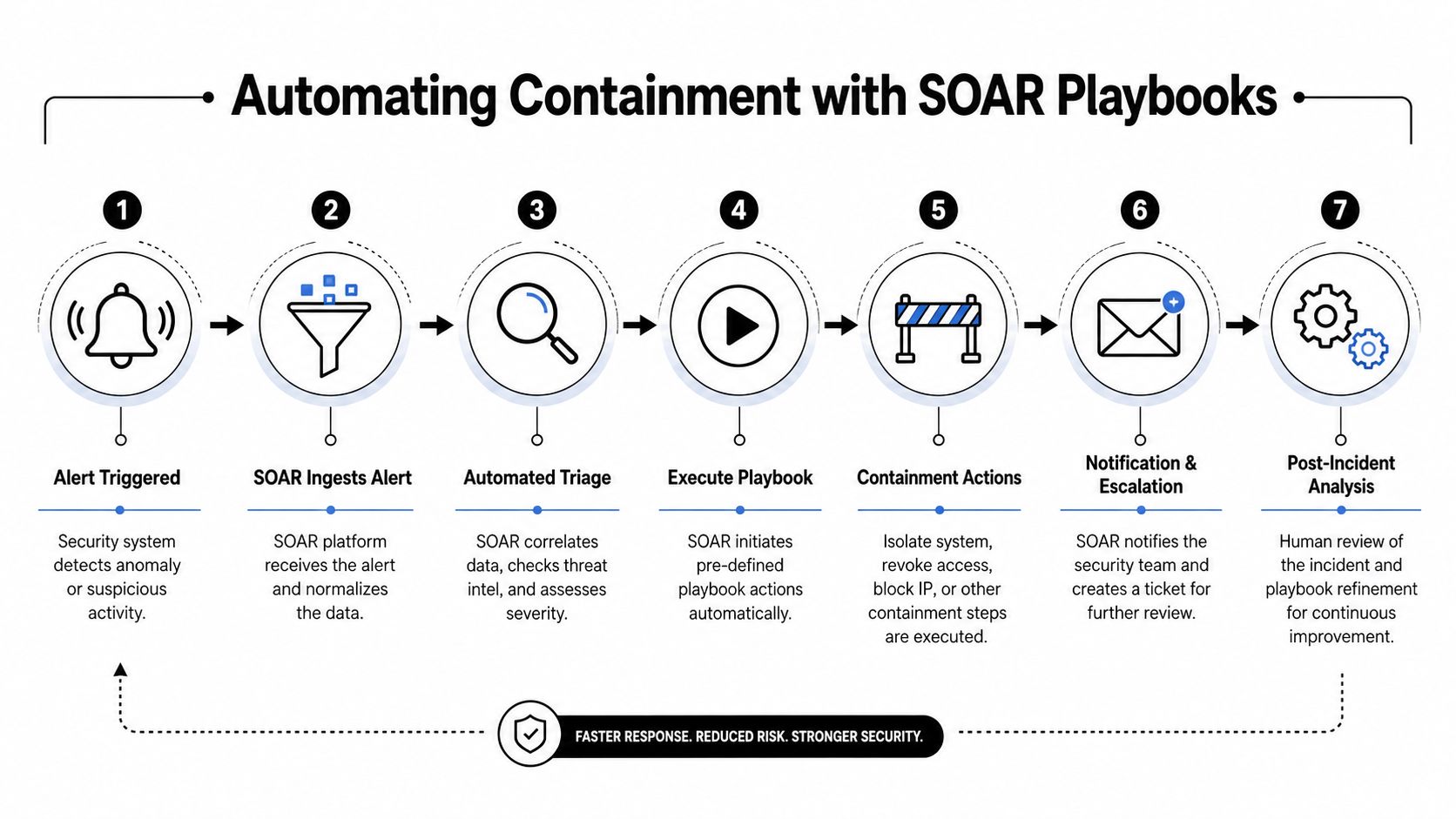
An alert without a response path is just a queue item. Containment is what makes data exfiltration prevention operational. In most environments, the first few minutes matter most, because once files reach a personal tenant, external workspace, or unsanctioned service, your control declines.
A practical containment story
A detection triggers on an engineer who opened an unusual set of design documents, built an archive on the endpoint, and started an outbound upload to an unapproved destination. No individual event proves intent. Combined, they warrant immediate triage.
A well-built SOAR playbook can do several things in sequence:
- Gather the alert context in one place. User identity, manager, endpoint, recent file activity, destination category, and any earlier related alerts.
- Determine whether the destination is sanctioned, recently approved through an exception, or unknown to the organization.
- Consult supporting systems. Use IAM to confirm role and status, endpoint tools to verify device posture, ticketing to identify known business projects, and integrated HR systems to determine active risk windows.
- Base containment on confidence level. This can mean briefly pausing the session, blocking the destination, revoking tokens, or isolating the endpoint from high-value systems.
- Open a case and attach all artifacts so the analyst does not need to rebuild context manually.
- Notify the correct people. Security comes first. HR or legal only when the incident meets the threshold set by policy.
- Log the result for tuning. False positive, policy violation, malicious intent, or legitimate exception.
The purpose of automation is not to remove people. It is to ensure people devote their time to judgment rather than swivel-chair work. Teams investigating orchestration patterns can evaluate options through this overview of security orchestration tools.
Where automation helps and where it hurts
Certain actions can be safely automated at an aggressive level. Others require approval from an analyst.
Automate confidently when the action is reversible and low-disruption:
- Enriching alerts
- Checking destination reputation
- Creating tickets and case files
- Collecting endpoint and identity context
- Blocking clearly prohibited destinations
Use gated automation when the action can disrupt business operations:
- Suspending user accounts
- Isolating endpoints used in production workflows
- Revoking cloud sessions for privileged users
- Quarantining shared files that multiple teams need
Automation performs best when every step addresses one question: what can the system determine reliably, and what still needs a human to interpret business context?
The most significant failure pattern is automating too much too early. Teams create playbooks that trigger hard containment on weak signals, then the business loses trust. Begin with enrichment and selective containment. Add stronger actions only after rule quality has improved and exception handling is disciplined.
Measuring Success and Mapping to Compliance
Security controls that cannot be measured are difficult to defend and easy to cut. That is especially true for data exfiltration prevention because executives do not keep buying better visibility forever. They want to know whether risk is decreasing, whether incidents are contained faster, and whether the control stack can withstand audit scrutiny.
Palo Alto Networks states that data exfiltration accounted for 94.6% of all confirmed security breaches in 2023, which is why organizations need measurable controls mapped to compliance obligations, as noted in Palo Alto Networks' overview of data exfiltration.
What to measure at the executive level
The strongest metrics connect to decisions, not vanity.
Use a compact dashboard that answers these questions:
- Are risky transfers decreasing: Monitor trends in unauthorized or policy-violating movement by channel, business unit, and data class.
- Are detections actionable: Watch alert quality, analyst disposition patterns, and the rules that create recurring noise.
- How quickly do we contain: Measure the time from alert creation to containment action for high-confidence exfiltration scenarios.
- Where are the gaps: Display unmanaged destinations, unclassified repositories, and systems that are not sending telemetry.
- Which business processes create exceptions: This reveals whether policy is unrealistic or whether certain functions require safer approved workflows.
A CISO does not need dozens of charts. They need a concise set of indicators that link controls to operational risk and to the cost of failure.
How controls become audit evidence
Compliance mapping often determines whether programs turn repeatable or stay manual. Auditors generally expect three things: the control is present, the control functions, and the organization reviews exceptions. A mature prevention program can demonstrate all three when logging, alerting, and evidence collection are centralized.
A useful approach is to map controls by function:
| Control area | Evidence you should be able to produce | Compliance value |
|---|---|---|
| Data handling policy | Approved policy versions, user acknowledgments, exception records | Shows governance intent and assigned accountability |
| Access governance | Access reviews, role definitions, revocation records, privileged approvals | Demonstrates least privilege and periodic review |
| Egress and DLP controls | Policy configurations, enforcement logs, block events, coaching prompts | Proves controls are operational |
| Detection and response | Alert records, analyst notes, playbook actions, case outcomes | Shows continuous monitoring and incident handling |
| Change management | Rule updates, tuning decisions, risk approvals | Demonstrates controls are maintained, not static |
The strongest programs do not handle audits as separate projects. They create evidence during normal operations. That reduces last-minute scrambling, improves consistency, and makes it simpler for security leaders to explain exactly how technical controls support frameworks such as CMMC, HIPAA, SOC 2, and PCI DSS.
A Hybrid Environment Implementation Checklist
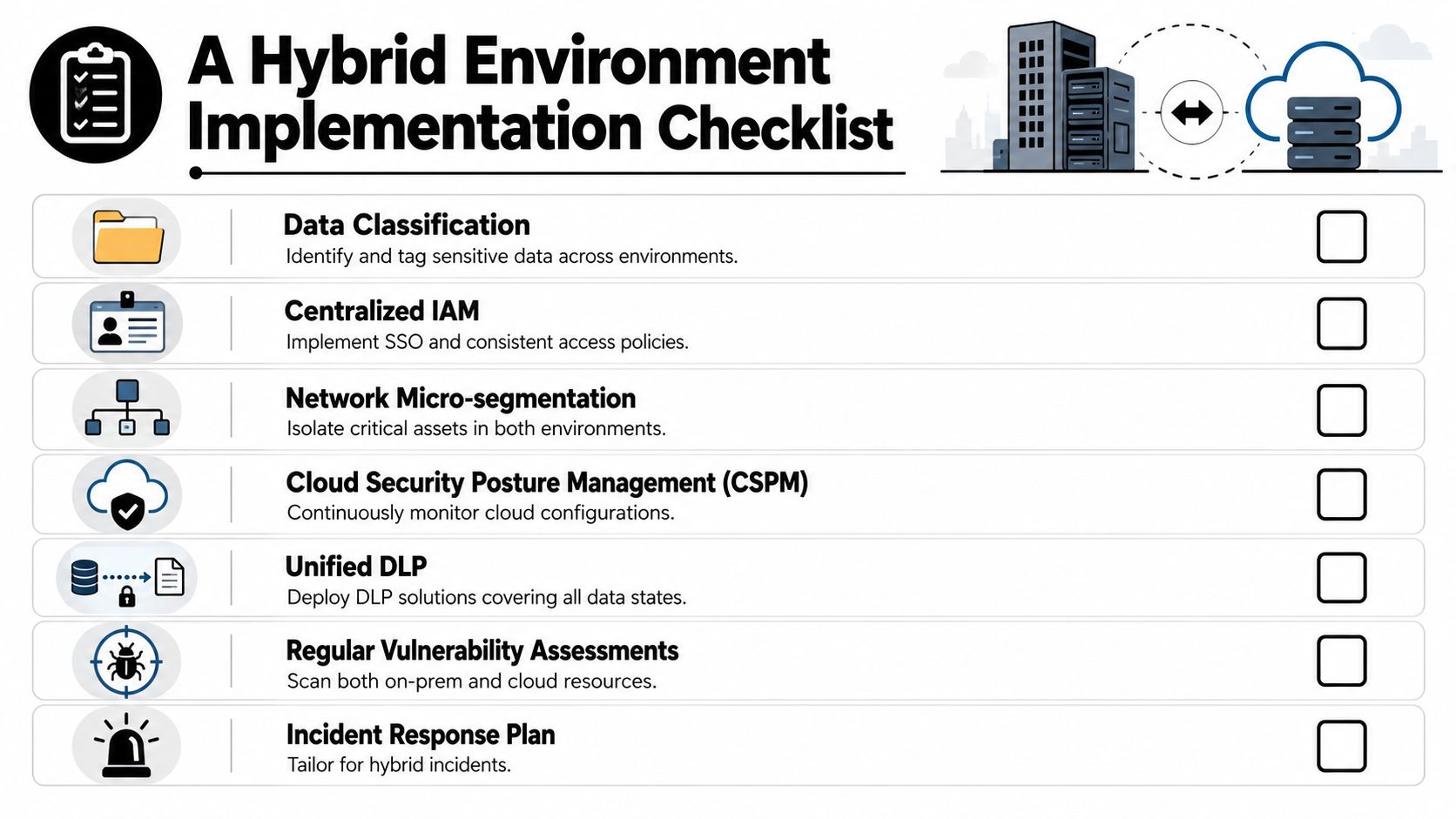
Hybrid environments break down when security architecture treats cloud and on-prem as separate problems. Attackers do not care where a workload runs. They care whether they can access, stage, and move data across trust boundaries without being detected. Implementation must reflect that reality.
A practical roadmap begins with visibility, then enforcement, then tuned detection, and finally automation.
For teams that need consistent oversight across cloud services and legacy infrastructure, this guide to cloud security monitoring serves as a useful reference point when unified visibility is being designed.
Phase 1 visibility and trust boundaries
Begin by answering fundamental questions precisely.
- Inventory sensitive data locations: Cover file shares, SaaS repositories, cloud storage, endpoints, backup systems, and collaboration platforms.
- Document approved destinations: Never leave this to assumption. Specify where sensitive data can travel, under what circumstances, and for which roles.
- Centralize telemetry: Consolidate cloud audit logs, endpoint events, firewall logs, identity activity, and file access records into a single analysis workflow.
- Map trust boundaries: Managed device into unmanaged browser, corporate tenant into personal tenant, production into user workspace, cloud into on-prem, and third-party access routes.
Phase 2 control deployment
After visibility is in place, add guardrails to the highest-risk exits first.
- Enforce egress limits on destinations that are clearly not business-related.
- Put endpoint controls in place for removable media, browser uploads, and local staging activity.
- Deploy DLP across high-value repositories and high-risk transfer routes.
- Where the endpoint agent cannot see enough on its own, add browser or SaaS session controls.
- Harden IAM for sensitive stores, privileged roles, and service accounts.
Phase 3 detection and response maturity
Now adjust the system for realistic operations.
- Write correlation rules around behavior chains: The combination of sensitive access, staging, and external transfer outweighs any single event on its own.
- Create high-risk window policies: Departures, layoffs, restructures, and strategic transactions require closer scrutiny and stricter exceptions.
- Build response playbooks: Begin with alert enrichment and containment that can be reversed. Introduce stronger actions as confidence grows.
- Review exceptions monthly: When the same transfer path repeatedly requires exceptions, redesign the workflow rather than struggle with the alert.
- Run tabletop exercises: Bring cloud and on-prem teams together. Many response delays stem from unclear ownership, not missing tools.
The best implementation plans cut down on ambiguity. People understand which data matters, where it can go, what the system will flag, and who may approve exceptions.
A data exfiltration prevention program that is dull in the best possible way lasts. Controls stay steady. Alerts can be explained. Exceptions are captured in writing. Evidence is straightforward to pull. In a hybrid environment, that is what a CISO requires.
Unified Security Stack combines SIEM, XDR, SOAR, and compliance management in a single platform for hybrid environments, making it a strong choice for teams that need centralized visibility, automated response, and audit-ready evidence without assembling a sprawling toolchain. To evaluate a unified approach to data exfiltration prevention, explore Unified Security Stack.