Vulnerability Scanning Best Practices for 2026
Scheduled vulnerability scans no longer constitute a dependable security program for hybrid environments. NIST's guidance frames scanning as an ongoing, risk-based control that must reflect evolving vulnerabilities, past results, authenticated coverage, and how findings relate over time (NIST vulnerability-scanning guidance). Industry practice is heading the same way. According to the 2023 data summarized by Bromium, 35% of organizations scanned continuously, 10% daily, and 26% weekly, while 26% still depended on monthly or quarterly cycles (Bromium's vulnerability management survey PDF).
Scan frequency is not the deciding factor. Dependable outcomes require an understanding of the asset inventory, intentional selection of authenticated and unauthenticated techniques, correlation of findings with SIEM, XDR, endpoint, network, and threat-intelligence telemetry, automated remediation, and follow-up scans that confirm exposure has been resolved. A scanner that generates a lengthy report with no owner, threat context, or validation process produces administrative effort, not demonstrable risk reduction.
The following 10 vulnerability scanning best practices shape an operating model. Begin with coverage and continuous detection, then layer in cloud ingestion, contextual prioritization, credentialed assessment, segmentation validation, compliance mapping, remediation verification, threat intelligence, zero-trust testing, and supply-chain coverage. Unified Security Stack is a pertinent example of a platform that combines vulnerability scanning with log correlation, SOAR, XDR, and compliance management.
Table of Contents
- 1. Ongoing Vulnerability Scanning With Real-Time Log Correlation
- 2. API-Driven Ingestion of Vulnerability Data From Cloud Environments
- 3. Prioritizing Vulnerabilities by Risk With Machine Learning Correlation
- 4. Authenticated Vulnerability Scanning for Thorough System Assessment
- 5. Validating Network Segmentation With Vulnerability Scan Data
- 6. Mapping Vulnerability Scanning Coverage to Compliance Frameworks
- 7. Tracking and Validating Remediation With Continuous Re-Scanning
- 8. Integrating Threat Intelligence to Contextualize Vulnerabilities
- 9. Assessing Zero-Trust Networks Through Vulnerability Scanning
- 10. Using Vulnerability Scanning for Software Supply Chain and Third-Party Risk Management
- 10-Point Vulnerability Scanning Best Practices Comparison
- Turn Scan Results Into Measurable Risk Reduction
1. Ongoing Vulnerability Scanning With Real-Time Log Correlation
Vulnerability scanning yields measurable risk reduction only when its findings tie into asset coverage, security telemetry, response actions, and proof that remediation succeeded.
Make the scan part of detection
Establish assessment triggers based on asset exposure, business impact, and operational tolerance. Low-traffic windows can limit disruption, whereas internet-facing systems and rapidly changing cloud workloads may need event-driven checks. Assign ownership before turning on automation, so every finding has an accountable team, a due date, and an exception route.
A useful correlation design links:
- Vulnerability and reconnaissance: Compare exposed services against port scans, service enumeration, and anomalous connection attempts. This helps separate a known weakness from active targeting.
- Vulnerability and exploitation: Generate an alert when exploit-like HTTP requests, suspicious process behavior, or abnormal authentication follows a finding. Analysts can then determine whether the vulnerable asset is under attack, rather than assuming severity proves exploitation.
- Vulnerability and response: Invoke SOAR playbooks to isolate an endpoint, block an indicator, create a remediation ticket, or seek analyst approval. Automated containment shortens response time, but high-impact actions should need approval when they might disrupt production.
Tie scanner findings to telemetry from SIEM, XDR, endpoints, networks, authentication, and applications. Preserve timestamps and asset identifiers so analysts can rebuild an exposure path and distinguish duplicate alerts from distinct activity. Use the compliance control mapping in Section 3 to retain evidence while avoiding compliance reporting as a separate manual effort.
Unified Security Stack's automated vulnerability scanning capabilities can underpin this linked workflow. Its correlation and LLM-assisted analysis can distill risk, propose remedial actions, and align findings with compliance evidence. Verify the automation through analyst review, particularly before isolation or blocking actions.
Assess whether the workflow cuts exposure windows and lowers unresolved exploitable findings, rather than merely counting completed scans.

2. API-Driven Ingestion of Vulnerability Data From Cloud Environments
Cloud exposure shifts with each deployment, account change, and autoscaling event. A scanner dependent on fixed targets may overlook ephemeral virtual machines, containers, managed services, and public addresses. API-based ingestion links cloud inventory and assessment data to the broader security operation, so coverage mirrors what is active.
Create a common data model prior to adding more feeds. Collect asset identifiers, vulnerability references, severity, ownership, timestamps, account or project context, and remediation status from AWS, Azure, Google Cloud, Qualys, Tenable, and Rapid7. Standardize those fields across accounts and tools. If not, one asset may appear under several identifiers, producing duplicate findings and inconsistent trend data.
The ingestion pipeline should react to change events. New instances, virtual machines, registries, container images, accounts, and workloads can initiate inventory updates or assessment workflows. Scan container images before release, then preserve the image digest and deployed workload relationship so a finding stays traceable after redeployment.
Apply these controls at the integration layer:
- Least-privilege access: Employ dedicated service accounts or roles able to enumerate assets and retrieve assessment results, with no unnecessary write permissions.
- Rate protection: Introduce caching, queues, retry handling, and provider-aware rate limits to avoid throttling during large imports.
- Pipeline alignment: Tie collection to build, release, and change-management events. Retain timestamps and assessment records for SOC 2 or HIPAA reviews.
- Ownership metadata: Bring in subscription, account, project, cluster, application, and service-owner fields. Routing relies on this context.
API data reveals inventory, configuration, and cloud relationships. It does not establish reachability. Merge it with internal and external scanning, network telemetry, and remediation records to verify exposure, assign accountable owners, and generate evidence linking cloud changes to risk reduction.
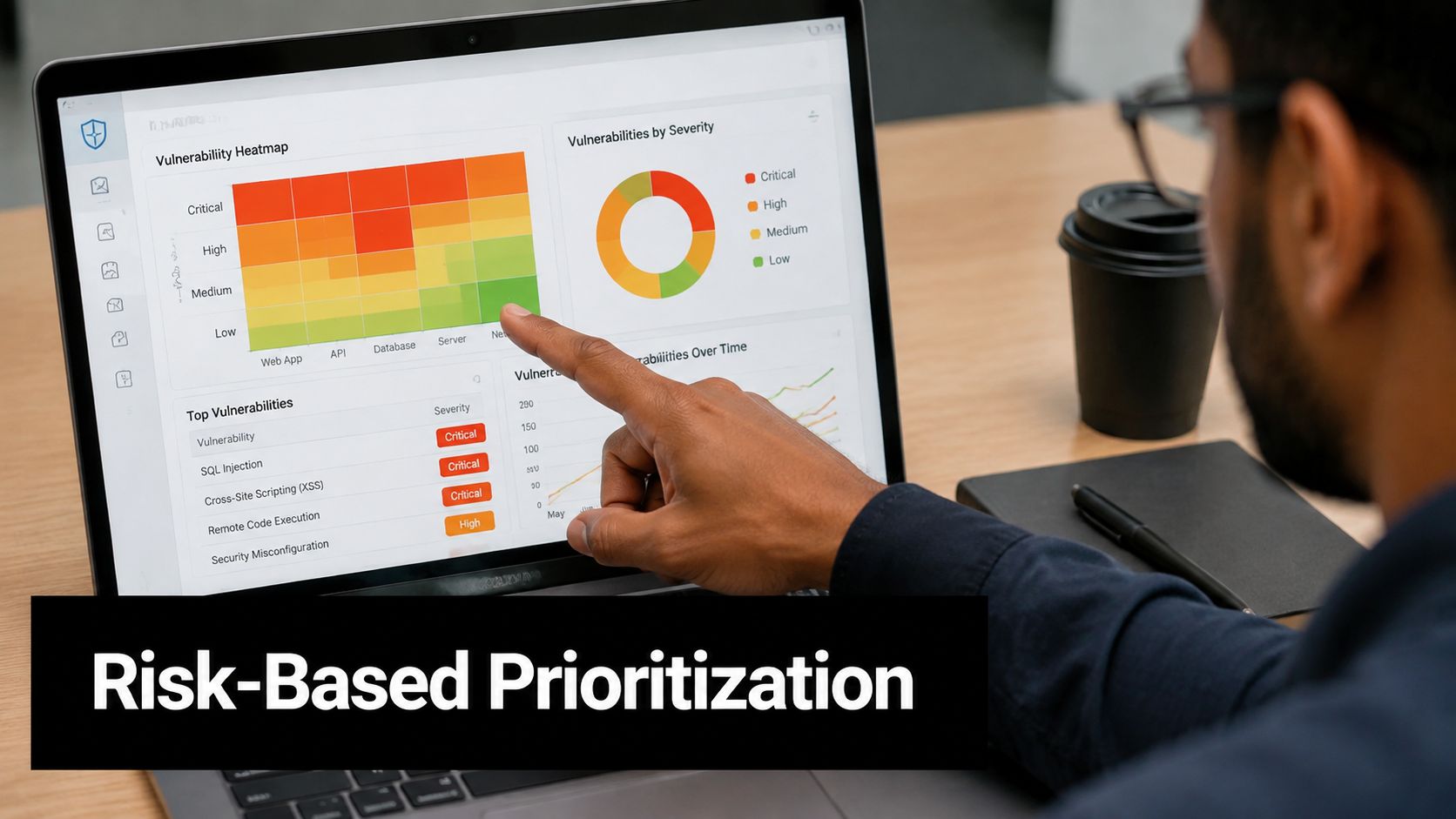
3. Prioritizing Vulnerabilities by Risk With Machine Learning Correlation
CVSS ranks technical severity, yet remediation decisions demand environmental context. Analysts should consider internet exposure, known exploitation, business dependency, surrounding controls, and endpoint or network telemetry that may point to hostile activity. Vulnerability scanning grows more useful when these signals link to ownership, threat intelligence, and remediation workflows.
Risk-based prioritization combines vulnerability metadata with exploitability indicators such as EPSS and the CISA Known Exploited Vulnerabilities catalogTenable's guidance advises monitoring coverage, authentication, asset coverage, scan frequency, and rescanning rather than relying on raw finding counts (Tenable vulnerability management KPIs). The aim is a queue that reflects probable harm and business impact, not just the highest severity labels.
Use machine learning as decision support
Machine learning and LLM-assisted analysis may connect asset criticality, threat intelligence, earlier remediation outcomes, and observed behavior. Consider those outputs advisory. Specify the inputs, demand an explanation for each consequential ranking, check recommendations against incident postmortems, and keep the decision record for CMMC or SOC 2 evidence.
A practical tagging model should capture:
- Business importance: Flag systems that support patient care, payment processing, regulated data, or authentication.
- Exposure context: Distinguish public, partner-accessible, internal, isolated, and compensating-control-protected assets.
- Operational ownership: Link infrastructure, application, and vendor owners to remediation queues.
- Threat relevance: Mark findings tied to active exploitation, suspicious local behavior, or relevant campaigns.
A medium-severity flaw on an exposed authentication service can demand quicker action than a higher-scored issue on a segmented, non-routable host. CVSS remains valuable. Context shapes how teams apply it, while telemetry and workflow data help confirm whether prioritization lowers exposure.
4. Authenticated Vulnerability Scanning for Thorough System Assessment
Authenticated scanning reveals weaknesses that network-only testing cannot reliably find. Unauthenticated scans display what an external or adjacent attacker can see and reach. Credentialed access provides insight into installed packages, local configuration, patch state, registry settings, and software that presents no useful service banner. The result is a more accurate picture of what resides inside each host.
Multiple expert guides recommend authenticated scans because they can reduce false positives, identify missing patches and configuration issues, and improve remediation accuracy (credentialed vulnerability scanning guidance). For high-fidelity host assessment, credentialed access can deliver greater value than more frequent scanning.
Control credentials, scope, and scan impact
Establish dedicated scan accounts limited to the permissions the assessment needs. Avoid reusing regular administrator accounts. Place secrets in an approved vault, rotate them per organizational policy, and track account activity with identity and endpoint logs. CIS guidance advises a dedicated scan account linked to specific machines or IP addresses, through local agents or remote scanners set up with privileged access (CIS Critical Security Controls v7.1 PDF).
Plan scans in coordination with system owners, particularly for sensitive production assets. Credentialed activity may generate audit events, set off detection rules, use host resources, or reveal weaknesses in fragile legacy applications. Start with critical asset groups, confirm the scan profile, and then widen coverage once results are reviewed. Retain scan configurations and findings as evidence for remediation choices and compliance reviews.
Use each method for the question it answers:
- Authenticated scans: Discover local software, absent patches, misconfigurations, and exposure tied to privileges.
- Unauthenticated scans: Examine external attack surface, services that are reachable, and boundary behavior.
- Agent or API methods: Broaden visibility to cloud and ephemeral assets as network reachability shifts.
An integrated program brings these views together, adds telemetry to findings, sends verified issues into remediation workflows, and verifies them again after fixes. No individual scan method delivers enough coverage for every asset or security question.
5. Validating Network Segmentation With Vulnerability Scan Data
Observed reachability validates segmentation, not a diagram or firewall export. Conduct vulnerability scans from representative network vantage points, then match discovered services and paths against approved access rules. This links asset coverage, exposure validation, and network telemetry within a single security operation.
In a payment environment, scan from guest, corporate, application, and external zones to find cardholder-data systems that are reachable outside their intended boundaries. In healthcare, determine whether public-facing web servers can reach systems that hold protected health information. In a CMMC environment, evaluate access from contractor, internet-connected, and other non-protected zones to systems that process controlled unclassified information.
Turn reachability into evidence
Align the scan plan with network engineering. Before testing, define allowed and denied paths, expected ports, source locations, and protected assets. Retain the scan configuration, results, firewall context, and remediation history so security teams and auditors can establish exactly what the evidence shows.
Practical rule: Consider unexpected reachability a security finding, even if the destination has no known CVE. Excessive access expands blast radius and may undermine a segmentation assumption.
Review exposure reports over time to spot drift. A new route, security-group rule, load balancer listener, or cloud peering connection can alter risk even when host software is unchanged. Forward unexpected access patterns to Unified Security Stack correlation rules so the SOC can distinguish approved changes from suspicious lateral movement and send confirmed issues into remediation workflows.
Treat the scan as controlled validation, not a substitute for architecture review or penetration testing. After network changes or corrective actions, scan again to verify that prohibited paths are closed and keep the results as operational and compliance evidence.
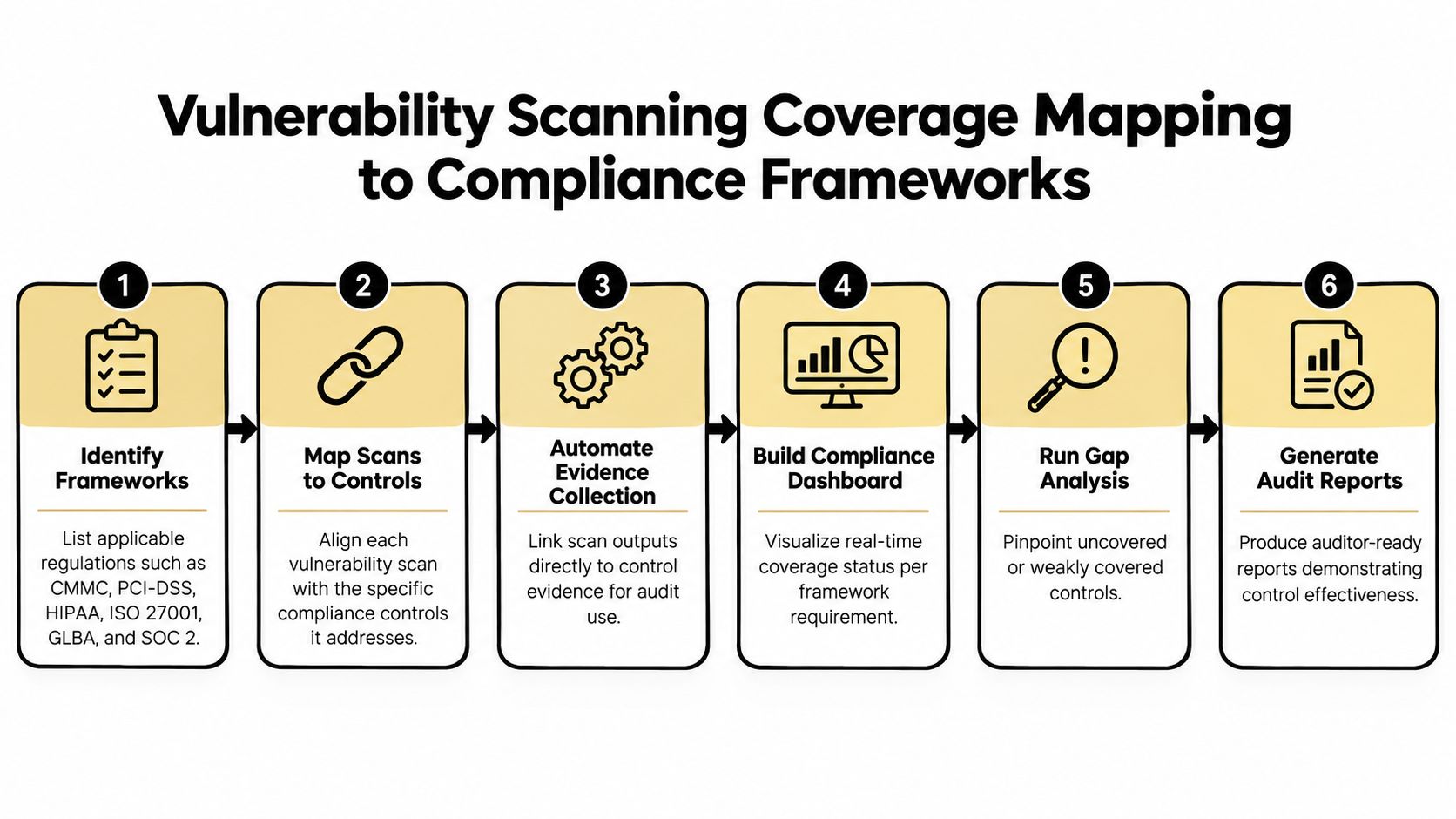
6. Mapping Vulnerability Scanning Coverage to Compliance Frameworks
Compliance evidence is valuable only if every scan has a clear purpose, scope, owner, cadence, and control mapping. A generic report may show scanning activity without proving that the organization assessed the assets and conditions a framework requires.
Link scanning activities to CMMC, PCI DSS, HIPAA, ISO 27001, GLBA, and SOC 2 controls. Do not view a single scan as evidence for every obligation. PCI DSS v4.0.1 mandates internal and external vulnerability scans at least once every three months, with no more than 90 days between scans. It further requires remediation and rescanning, with clean or passing results kept for the previous four quarters in internal and external environments (PCI DSS v4.0.1 documentation).
Build an evidence model
For each mapped control, record:
- Objective and scope: Determine covered assets, zones, applications, and cloud accounts.
- Method: Define testing as authenticated, unauthenticated, API, container, external, or internal.
- Cadence: Record the recurring schedule and the triggers for ad hoc assessments.
- Exceptions: Capture excluded systems, compensating controls, and risk acceptance.
- Closure evidence: Link findings to tickets, patching activity, rescan outcomes, and approvals.
A control map should reveal coverage gaps along with tests that passed. Examine it with stakeholders in security, infrastructure, application, risk, and audit, then revise it whenever ownership or architecture changes.
Unified Security Stack's compliance workflows can link detections and scan evidence to frameworks. The organization must still define how each control functions, which systems are in scope, and what evidence auditors should get.
Examine the mapping every quarter, even when scans occur more frequently. This review can uncover scope drift, newly added systems, expired exceptions, and controls that no longer align with the architecture.
7. Tracking and Validating Remediation With Continuous Re-Scanning
A vulnerability stays open until a follow-up assessment confirms the condition no longer exists. Closing a ticket right after deployment gives false assurance. Re-scanning can reveal incomplete rollouts, failed configuration changes, outdated package data, and regressions caused by later releases.
Remediation timelines should match the CISA guidance outlined in Section 3. That guidance links internet-accessible vulnerability management to coverage of all internet-accessible IP addresses, scan results at least weekly, and defined targets for critical and high vulnerabilities (CISA-related remediation timeline guidance). Adopt those timelines as operational targets for SIEM, XDR, and compliance teams, then establish service levels based on exposure, asset importance, and available compensating controls.
Close the loop in the workflow
Link scanner findings to ticketing, change management, asset inventory, and SOAR. A patch deployment event can initiate a validation scan once the system stabilizes. If the finding remains, the workflow should reopen or escalate the ticket rather than mark a false completion.
Track measures that show whether remediation reduces exposure:
- Validation success: Whether the remediation clears the initial follow-up scan.
- Recurring findings: Whether the weakness reappears following subsequent changes.
- Exception age: How long compensating controls or accepted risks stay active.
- Ownership quality: Whether findings get to the responsible team without manual reassignment.
- Exposure window: The time from discovery to remediation and verified closure.
The rescan must also reconcile asset identity. Decommissioned hosts, replaced instances, and renamed systems can lead to false closure when the platform loses continuity between the original finding and the current asset. Keep the finding, change record, scan result, and approval together so security and audit teams can verify the remediation path.
8. Integrating Threat Intelligence to Contextualize Vulnerabilities
A scanner can show that a vulnerable component is present. Threat intelligence can help establish whether attackers are targeting it, whether exploit code exists, and whether activity in your environment looks like exploitation. That context helps teams focus limited remediation capacity on issues with realistic attack paths.
Treat EPSS, CISA KEV status, vendor advisories, exploit intelligence, sector-specific feeds, and internal detections as separate signals. The goal is not to substitute for technical severity. It is to pair severity with evidence of exploitability, exposure, asset importance, and observed behavior. This method also helps analysts keep from treating each new CVE as an emergency.
Connect external context to internal telemetry
Create an enrichment pipeline that adds threat references to findings at ingestion. Next, correlate the enriched finding with firewall logs, DNS, proxy activity, endpoint process events, web requests, identity events, and dark web monitoring. A vulnerability on an isolated development host is not the same as that vulnerability on a public application receiving exploit-like traffic.
Threat intelligence has the most value when it changes an action. If an intelligence match does not alter priority, containment, monitoring, or remediation, review whether the feed is providing useful context.
Revisit the assumptions behind prioritization as the threat environment changes. Monitor which intelligence sources yield actionable findings and which create repetitive noise. Unified Security Stack's threat intelligence feed optimization approach can fit within a process that links vulnerability data to network, endpoint, and security-event context.
Do not rely solely on dark web alerts or external feeds. They may indicate interest, yet internal telemetry reveals whether your assets are being probed or exploited. The most effective workflow uses both.
9. Assessing Zero-Trust Networks Through Vulnerability Scanning
Zero trust is validated by real reachability, not by policy documents. By inspecting assets from untrusted zones, probing service boundaries, and contrasting discovered paths against the sanctioned identity and policy model, vulnerability scanning can determine whether access controls function as intended.
Record the architectural assumptions prior to scanning. Specify the users, workloads, service accounts, and devices permitted to reach each application, plus the necessary brokers, proxies, application tiers, and device-health checks. Such a baseline provides security teams with a benchmark for determining whether an open port reflects planned access or unnecessary exposure.
Scan from the perspective of an untrusted actor
Place scanning infrastructure in appropriate external, guest, partner, developer, and segmented zones. Within cloud environments, examine public endpoints and how security groups behave. For internal systems, conduct scans from user and workload segments rather than solely from a privileged security network. This method exposes paths that an administrative viewpoint may miss.
Correlate scan results with:
- Identity logs: Verify that access occurred through the anticipated identity and authentication path.
- Network policy logs: Validate the decisions made by firewalls, security groups, and microsegmentation.
- Endpoint telemetry: Look for signs of unanticipated service activation, process creation, or lateral movement.
- Application logs: Ensure application-layer authorization prevents direct or unauthorized access.
Unanticipated reachability merits a finding even if no scanner plugin identifies a CVE. For instance, a database directly reachable from user workstations can breach the zero-trust design, since that path provides more access than the application needs.
Apply Unified Security Stack correlation rules to generate alerts for suspicious activity during validation scans, and keep architecture-validation reports for security reviews and CMMC evidence. Scanning shows how controls behave, whereas identity and application testing evaluate authorization decisions. Bringing these sources together transforms scan results into an integrated assessment of exposure, policy enforcement, and audit readiness.
10. Using Vulnerability Scanning for Software Supply Chain and Third-Party Risk Management
Internal infrastructure represents just one portion of the attack surface. Applications rely on open-source packages, container base images, build tools, third-party APIs, managed services, and vendor-operated systems. A program that scans servers yet overlooks dependencies may miss a vulnerable library before it reaches production, while one that disregards vendors could lack a clear picture of inherited exposure.
Apply Software Composition Analysis to direct and transitive dependencies, container image scanning to build artifacts, API testing to exposed interfaces, and cloud assessments to vendor-managed resources where access allows. Ingesting SBOMs through CycloneDX or SPDX can support a dependency-aware view, especially when teams must determine which deployed applications include a newly disclosed component.
Put controls in the delivery path
Embed dependency and image checks within CI/CD, yet do not halt every build for every finding. Establish policies according to exploitability, runtime exposure, application criticality, reachable code paths, and available mitigations. Security and engineering teams need to align on exception handling before a release is stopped.
A useful supply-chain program includes:
- Component inventory: Keep package, image, service, and version relationships up to date.
- Build-time detection: Detect vulnerable dependencies prior to deployment.
- Runtime correlation: Link deployed components with endpoint, cloud, and application telemetry.
- Vendor accountability: Incorporate vulnerability disclosure, remediation, notification, and scanning expectations into security questionnaires and contracts.
- Evidence retention: Retain scan results, approvals, exceptions, and remediation validation for audit purposes.
Unified Security Stack's vulnerability scanning tools May be evaluated alongside purpose-built SCA, registry, cloud, and vendor-risk offerings. No scanner has visibility into every layer. A sound design links specialized findings to common ownership, prioritization, response, and compliance workflows.
10-Point Vulnerability Scanning Best Practices Comparison
| Item | Implementation complexity | Resource requirements | Expected outcomes | Ideal use cases | Key advantages |
|---|---|---|---|---|---|
| Continuous Vulnerability Scanning with Real-Time Log Correlation | High, SIEM/SOAR integration and custom correlation rules | High, compute, storage, and skilled SOC analysts | Rapid MTTD, prioritized active threats, reduced alert noise | Large enterprises, SOC-driven environments, compliance-critical orgs | Real-time correlation, reduced alert fatigue, automated audit evidence |
| API-Based Vulnerability Data Ingestion from Cloud Environments | Medium, API connector setup and IAM configuration | Moderate, API management, cross-account permissions | Visibility into ephemeral/cloud assets, unified vulnerability data lake | Cloud-native, multi-cloud, DevOps teams, MSPs | Agentless collection, handles ephemeral resources, CI/CD integration |
| Risk-Based Vulnerability Prioritization with Machine Learning Correlation | High, ML pipeline, model training and validation | High, historical data, ML expertise, threat feeds | Context-aware prioritized remediation, adaptive risk scores | Organizations with historical data and limited remediation capacity | Focuses on exploitable risk, improves remediation ROI, executive reporting |
| Authenticated Vulnerability Scanning for Comprehensive System Assessment | Medium, credential management and endpoint access setup | Moderate, secure credential stores, scheduled scans, admin accounts | Deep system visibility, fewer false negatives, config and patch insights | Compliance-driven environments, large endpoint fleets | Granular inventory, detects hidden issues, strong compliance evidence |
| Network Segmentation Validation Through Vulnerability Scan Data | Medium, coordinated scanning and topology correlation | Moderate, network-aware scanners, collaboration with network teams | Quantifiable segmentation proof, discovery of misrouted access paths | PCI/CMMC/HIPAA environments requiring segmentation audits | Provides audit-ready segmentation evidence, finds unexpected routes |
| Vulnerability Scanning Coverage Mapping to Compliance Frameworks | Medium, mapping scans to controls and dashboards | Moderate, policy mapping, cross-functional effort | Faster audits, clear coverage status, gap identification | Multi-regulation organizations, audit-heavy enterprises | Automated evidence collection, audit-ready reports, coverage visibility |
| Remediation Tracking and Validation Through Continuous Re-Scanning | Medium, automation and ticketing system integration | Moderate, increased scan frequency, ticketing/patching integrations | Verified fixes, regression detection, remediation KPIs | Orgs with remediation SLAs, patch management programs | Proof of remediation, reduces regressions, ties fixes to tickets |
| Threat Intelligence Integration for Vulnerability Contextualization | Medium, threat feed integration and correlation rules | Moderate, TI subscriptions, analyst validation effort | Early exploit warnings, improved prioritization accuracy | Organizations facing targeted threats, sector-specific risk profiles | Contextualizes vulnerabilities, flags active exploits, informs response |
| Zero-Trust Network Assessment Through Vulnerability Scanning | High, specialized scoping and untrusted-zone infrastructure | Moderate–High, dedicated scanning points, architecture expertise | Empirical validation of zero-trust controls, uncover implicit trust | Zero-trust adopters, cloud-native enterprises, security architecture reviews | Validates zero-trust assumptions, tests micro-segmentation, finds access gaps |
| Vulnerability Scanning for Software Supply Chain and Third-Party Risk Management | Medium–High, SCA and CI/CD integration, vendor assessments | Moderate, SCA tooling, maintenance of OSS vulnerability data | Early detection of vulnerable dependencies, vendor risk visibility | Software vendors, DevOps teams, organizations with third-party dependencies | Prevents supply-chain attacks, integrates into CI/CD, supports vendor due diligence |
Turn Scan Results Into Measurable Risk Reduction
Vulnerability scanning delivers value once it establishes a repeatable operating cycle. Begin by discovering and classifying assets across data centers, cloud accounts, endpoints, containers, applications, third parties, and internet-accessible addresses. CISA's guidance for internet-accessible systems stresses accurate inventory, full coverage of public IP addresses, and informing the scanning service when addresses are newly acquired or reassigned (CISA implementation guidance for internet-accessible assets). CISA BOD 23-01 likewise covers IP-addressable networked assets reachable over IPv4 and IPv6 in broad terms, so scope should not be confined to the traditional perimeter.
Then, specify the security question and select the method. External unauthenticated scans reveal what an attacker can reach from outside. Internal scans uncover lateral exposure. Authenticated scans surface patch and configuration state. API and agent approaches enhance coverage for cloud and ephemeral workloads, whereas SCA and image scanning tackle software supply-chain risk. A blended strategy is more dependable than using a single scan profile for every asset.
Scanning frequency ought to match risk and the pace of change. NIST frames scanning as ongoing and risk-driven, with refreshed vulnerability data, re-evaluation following new disclosures, comparison against prior results, and cross-result correlation (NIST RA-5 reference). CIS offers a defined baseline via weekly or more often SCAP-compliant scans, while authenticated assessment is advised for greater visibility (CIS Critical Security Controls v7.1 PDF). PCI DSS sets a compliance minimum of internal and external scans no less than every 90 days, yet a quarterly cadence by itself can lag behind rapidly changing systems.
Add context to findings using CVSS, EPSS, KEV status, asset criticality, exposure, exploit intelligence, endpoint behavior, network activity, and business context. Next, send the outcome to ticketing, change management, SOAR, and the accountable owner. Automated isolation or blocking may assist when telemetry points to active exploitation, though high-impact steps should be governed by well-designed approval and rollback processes.
Lastly, scan again to confirm remediation and align the evidence with compliance controls. Monitor asset authentication rate, coverage over a 90-day window, scan frequency, vulnerability coverage, exploitable-risk backlog, mean time to remediate, validation success, false-positive rates, and recurring findings. These indicators show whether the program observes the environment, focuses on the right efforts, and reduces exposure. Raw vulnerability totals can increase simply because discovery improved, even as real risk declines.
Unified Security Stack is one example of a unified SIEM, SOAR, and XDR approach that links vulnerability data with logs, endpoints, network activity, threat intelligence, automated response, and compliance evidence. The platform's open-source model and modular capabilities may fit teams seeking scanning as part of a wider security and compliance workflow instead of a standalone reporting tool.
Unified Security Stack merges vulnerability management with SIEM, SOAR, XDR, log correlation, endpoint and network visibility, threat intelligence, and compliance workflows across hybrid environments. Visit Unified Security Stack to assess how its unified platform can help your team link scan results to detection, remediation, validation, and audit evidence.