How to Achieve NIST 800-171 Compliance in 2026
You may be looking at an unfinished SSP, a stack of policy templates, and a subcontractor deadline that keeps drawing nearer. That is the usual shape of nist 800-171 compliance labor in defense contracting, and a frequent error is treating it as a documentation task rather than a control implementation program linked to contract eligibility, evidence, and operational discipline.
If you handle CUI for a DoD program, this is not discretionary paperwork. NIST states that defense contractors must put the recommended requirements into practice in NIST SP 800-171 to protect covered defense information under DFARS clause 252.204-7012 (NIST on who needs to follow it), and the standard itself was first published in 2015 prior to progressing through Rev. 2 and then Rev. 3 (NIST publication timeline). Handling it as a binder issue is how teams waste time, exceed budgets, and arrive at assessment with thin evidence.
Table of Contents
- Why NIST 800-171 Compliance Matters for Defense Contractors
- Grasping the Framework, Controls, and Rev. 3 Transition
- Scoping Your Environment and Building the Asset Inventory
- Running the 4-Phase Assessment and Prioritizing by Weight
- Mapping Technical and Administrative Controls to Your SIEM and XDR
- Automating Evidence Collection and Continuous Monitoring
- Common Implementation Gaps and How to Remediate Them
Why NIST 800-171 Compliance Matters for Defense Contractors
If you are a small or mid-sized supplier, the pressure often arrives in a chaotic sequence. A contracts manager sends along the DFARS language, procurement seeks assurance, security receives a spreadsheet, and someone schedules an assessor before the environment is prepared. That order is how teams turn a security program into a rush.
NIST SP 800-171 exists for non-federal systems that store, process, or transmit Controlled Unclassified Information, and it was built for the actuality of defense supply chains, not for a theoretical federal lab environment (NIST on who needs to follow it). The central point is straightforward. If your systems handle CUI, the contract may require the control set, and the assessment has no concern that your organization runs lean.
The business risk is operational, not abstract
Organizations that view compliance as paperwork typically pay twice. They pay first in staff hours to draft policy language, then again when an assessor requests proof that the control operates in production. That second cost is the costly one.
The most immediate risk is losing the contract, but the operational harm is wider. Poor scoping, absent logs, and incomplete MFA evidence mean the organization cannot defend its SPRS posture cleanly, and that introduces noise in every later review. I have seen contractors with capable technical teams fail because nobody owned the evidence path from endpoint to report.
Practical rule: if the control cannot be demonstrated in a SIEM, an XDR console, a policy export, or a documented workflow, it is not sufficiently real for assessment.
The right mindset is to run nist 800-171 compliance as an engineering program. That means assigning ownership, constructing detection and logging around the requirement set, and linking remediation to a timeline you can carry out.
Compliance is enforced through contracts
The standard is not enforced through goodwill. It is tied to procurement language, CUI handling, and supplier expectations across the defense ecosystem. Once the contract presumes protection, the responsibility moves to the contractor to show that the environment is controlled, monitored, and documented.
The simplest way to frame this is plainly: without control evidence, there is no defensible posture. The organization needs policy, certainly, but it also needs telemetry, exception handling, remediation records, and a System Security Plan that reflects the actual environment. If those elements do not align, the assessment begins from a weak position and the SPRS score suffers.
Grasping the Framework, Controls, and Rev. 3 Transition
A real nist 800-171 compliance program begins with structure, not with a heap of controls. Rev. 2 divides the work into 110 security requirements across 14 control families, including Access Control (22), Audit and Accountability (9), System and Communications Protection (16), and System and Information Integrity (7) (Rapid7's guidance on NIST 800-171 Rev. 2). That family model is precisely how SIEM and XDR should be structured. Telemetry, correlation rules, and response playbooks align cleanly with requirement families, whereas scattered alerts and unclear ownership do not.
Why the family structure changes how you build the program
A serious security architect begins where evidence is generated. Audit logging sits in one workflow, identity control in another, and configuration management in a third. That separation matters because it shows where logs must be gathered, where correlation rules should trigger, and which playbooks should be prepared when an assessor requests proof.
Use the family structure to allocate ownership with precision. Access control and identification typically reside with IAM and infrastructure teams. Audit and accountability fall to the SOC or SIEM owner. System integrity and communications protection require input from endpoint, cloud, and network defenders. That split keeps one team from assuming another team has already exported MFA evidence, tuned detections, or documented remediation.
For teams that need a comparison point across federal work, public sector frameworks can help demonstrate how control families are organized in other regimes. Use that reference to sharpen ownership and evidence paths, not to build a more attractive compliance deck.
Rev. 3 altered the form the work took
The publication history matters because it alters what you should anticipate from the standard. NIST initially published the standard in 2015, Rev. 2 arrived in February 2020, was updated through January 28, 2021, and was formally withdrawn on May 14, 2024 in favor of Rev. 3 (NIST publication timeline). That shift indicates more than a version increase. It compels teams to stop treating old SSP language as reusable boilerplate.
Rev. 3 alters the work's structure, so legacy artifacts require substantive review, not surface-level edits. Control wording, tailoring decisions, and assessment assumptions must all align with the current standard, or the documentation will diverge from the environment it claims to describe. Practically speaking, your SIEM exports, XDR response records, and policy evidence need to match how the control is implemented, not how it appeared in the last review.
If your team continues to build from Rev. 2 artifacts, keep assessing to the current baseline and begin remapping the control structure now. A useful companion for turning the control set into a real program is the Unified Security Stack CMMC compliance requirements page, particularly if you want to see how detection, logging, and response appear in practice.
Scoping Your Environment and Building the Asset Inventory

In most cases, programs are already failing before the assessment begins, because the boundary is incorrect. Unless you know precisely which systems store, process, or transmit CUI, every control conversation becomes vague. This covers on-prem servers, cloud workloads, SaaS tenants, contractor laptops, and less apparent layers such as orchestration services and API gateways.
Scope every component that touches CUI
The SSP must describe the actual system, not the org chart's version of it. When an AI agent handles CUI through an orchestration layer, that component falls within scope. If a model-hosting layer receives prompts or returns outputs containing CUI, that infrastructure is in scope as well. This also applies to automated pipelines, service accounts, and integration platforms that move sensitive content between tools.
This is what much mainstream guidance continues to overlook. Non-human system components can create significant SSP gaps when teams regard them as background tooling. The documentation must make clear where data travels, who owns every layer, and which controls apply at each step.
Define the boundary based on the data flow, not on the marketing diagram.
If you're formalizing the inventory, use a structure like this:
- Asset name: the precise system or component identifier, rather than a generic label.
- Data flow: the points at which CUI is received, handled, kept, or sent.
- CUI category: determine the content category and the context for handling it.
- Owner: the person or group accountable for that component.
- Applicable controls: the requirement families that apply, along with any exceptions.
That inventory belongs in your security operations workflow, not only in a GRC spreadsheet. If you need a workable tooling model for that effort, computer inventory management is easier to maintain when tied to log sources, endpoint agents, and asset drift detection instead of manual review cycles.
Build a defensible boundary diagram
A solid boundary diagram presents trust zones, data movement, and administrative ownership. It does not rely on assumptions. It should indicate where identity is enforced, where logs are gathered, where encrypted channels are mandatory, and where privileged administration occurs.
The test is straightforward. If an assessor can point to a system and ask why it is out of scope, you need a written answer supported by the SSP and the data flow inventory. If you cannot answer that clearly, include it in scope and document the control burden now. That costs less than defending a poor boundary later.
Running the 4-Phase Assessment and Prioritizing by Weight
The official assessment process is not inventive. NIST defines a four-step procedure, prepare for assessment, develop the assessment plan, conduct the assessment, and document, analyze, and report results, and it is based on SP 800-53A methodology (NIST SP 800-171 Rev. 3 assessment methodology). That sequence matters because evidence collection is simpler when the assessor can see a clean chain from preparation through reporting.
Start with the highest-value gaps
In DoD scoring, the implementation starts at 110 points, and each unmet requirement reduces the score by its assigned value (NIST SP 800-171 Rev. 3 assessment methodology). This means you should not fix controls in alphabetical order or based on department politics. You fix the largest point losses first, because those are the controls that raise the score fastest.
The 320 assessment objectives behind the 110 requirements make this a considerably deeper evidence problem than many teams expect (DoD assessment methodology). A shallow self-review often claims control implemented when the actual evidence shows poor scoping, weak documentation, or a compensating control that nobody linked to the SSP.
Here's a practical priority model for a mid-size contractor:
| Priority bucket | Example controls | Typical point weight | Evidence to prepare |
|---|---|---|---|
| Highest | MFA, privileged access restrictions, audit logging | High-weight gaps | Identity logs, MFA policy exports, admin access reports |
| High | Configuration baselines, system integrity, incident response evidence | Medium-high | Baseline snapshots, change records, incident exercises |
| Medium | User training, media handling, maintenance documentation | Moderate | Training attestations, disposal records, maintenance logs |
| Lower | Narrow administrative artifacts already supported elsewhere | Lower | Policy references, exception notes, scoped screenshots |
Use the assessment to expose evidence weaknesses
The primary failure point is typically not the control idea. It is the evidence chain. When a control exists but no one can demonstrate when it was enabled, who validated it, and where the output resides, the assessment turns into an argument rather than a review.
Rule of thumb: if the SSP indicates that a control is implemented, the assessor should be able to locate that control in a live system, a report, or a documented workflow within minutes.
That is why the four-phase process must be led by people who understand logging, identity, and remediation. A compliance analyst working alone will not identify the operational gaps. A SOC engineer working alone will not construct the narrative. The team requires both.
Mapping Technical and Administrative Controls to Your SIEM and XDR
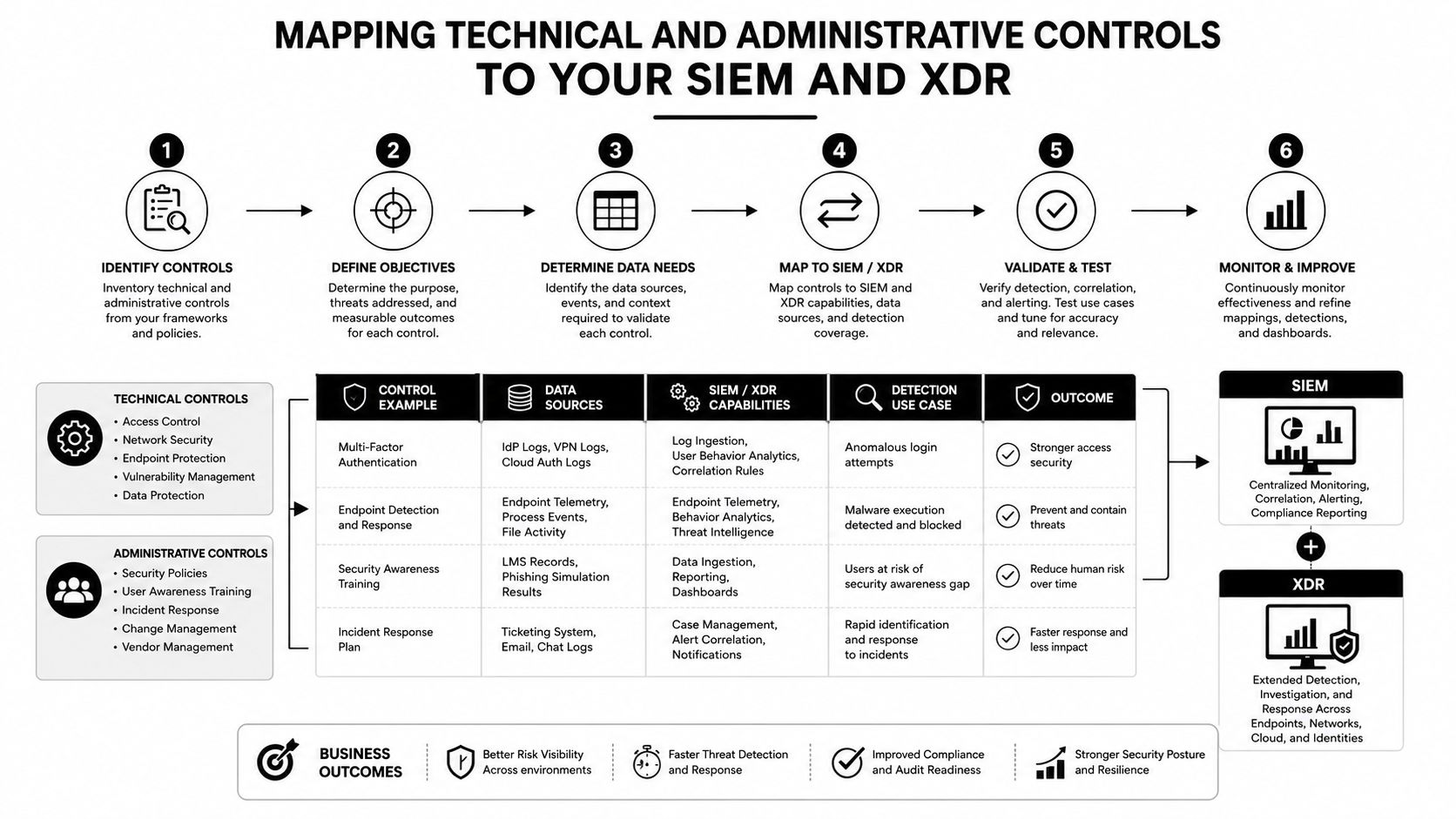
In an assessment, a control is not valid until your SIEM or XDR can demonstrate it operating. A polished policy set is useless if you cannot provide logs, alert history, and response records that align with the control statement. Map every control family to a specific log source, the detection logic that supports it, and the playbook that completes the cycle.
Build evidence from the telemetry you already trust
Under Rev. 2, organizations must create and retain system audit logs and records to support monitoring, analysis, investigation, and reporting of unauthorized activity, and they must use multifactor authentication for local and network access to privileged accounts and for network access to non-privileged accounts (NIST SP 800-171 Rev. 2). That requirement directly concerns SIEM use cases. When the control resides in identity, endpoint, cloud, or network tooling, the evidence should originate from those same systems.
Use these sources and controls together:
- Active Directory and identity logs: evidence MFA enforcement, privileged sign-in activity, and account lifecycle events.
- EDR telemetry: help validate endpoint integrity, detect suspicious process execution, and identify unauthorized changes.
- Cloud audit trails: reveal admin activity, storage access, and policy modifications across SaaS or cloud workloads.
- NetFlow and network security logs: help protect communications and examine anomalous traffic.
Telemetry delivers value only once it supports a defined workflow. A privileged login failure ought to raise an alert, include user and asset context, and retain the evidence bundle beside the control record. A configuration baseline deviation alert should be directed to configuration owners with the relevant change history attached. A questionable cloud administrative action should open an incident and send the timeline to the compliance folder.
Tie control families to named workflows
Avoid treating these controls as generic checkboxes. Assign them operational names within the SIEM or XDR platform so the team understands ownership and which output belongs in the SSP.
- Audit and Accountability: workflow for retaining logs and reviewing them each month.
- Identification and Authentication: MFA enforcement alongside tracking of exceptions.
- System and Communications Protection: verification of secure transport and review of traffic anomalies.
- System and Information Integrity: alerting on endpoint integrity and responding to malware.
- Configuration Management: detecting drift and attesting to the baseline.
That mapping should also guide how you export evidence. If a reviewer asks for proof, the export should contain the alert, the corresponding raw logs, the owner's response, and the closure note. In one instance, that difference turned a challenging search for evidence into a clean report package. You can build this around Unified Security Stack compliance workflows, which bring detection, correlation, and compliance evidence together in a single location, so security and audit no longer operate as separate teams.
Use compliance reporting as part of detection engineering
Top-performing teams do not view compliance reports as month-end theater. They embed report generation into the same workflows used for detection and response. An MFA violation, a configuration drift event, or a privileged access review then serves as both a security action and an evidence artifact.
If the SIEM is unable to show who accessed what, when, and under which control, the assessor will still request that information. Build that capability once, automate it, and keep exports linked to the appropriate requirement family.
Automating Evidence Collection and Continuous Monitoring
Collecting screenshots every quarter is a poor practice. It yields outdated evidence, increases manual effort, and creates gaps when the environment changes between reviews. Continuous monitoring is the stronger approach because it converts routine security operations into audit-ready output.
Make evidence a byproduct of operations
A unified SIEM/XDR with built-in compliance workflows ought to gather logs, enrich events, and assemble evidence without a separate project backlog. This covers log samples, MFA enforcement reports, configuration drift alerts, access-rights reviews, and vulnerability scan results. When those artifacts become part of the detection pipeline, auditors no longer receive static snapshots and instead get proof of how the environment operates.
A platform like Unified Security Stack can bring detection, correlation, and compliance evidence into a single location, preventing security and audit from working as separate teams. This matters because the evidence package should originate from the same system that observes the alert, tags the control, and documents the response.
Automate the first four evidence streams
Start with the outputs assessors ask for over and over:
- Log retention proof: demonstrate that audit data is gathered and retained.
- MFA enforcement proof: produce exports of identity policy and access logs.
- Patch posture evidence: include vulnerability findings and remediation status as attachments.
- Privileged access monitoring: link administrative actions, approvals, and alerts together.
That coverage is sufficient to handle most recurring evidence requests without last-minute effort. It also lowers the risk that a missing export or outdated screenshot makes a control appear incomplete.
Use centralized log management as the foundation. Without centralized collection, automation becomes fragmented scripts with no lasting audit trail.
Treat continuous monitoring as a control, not a dashboard
A dashboard does not serve as evidence. It is only a view. Continuous monitoring has value only if it produces an assessment package linking the event, control, owner, and remediation status. That distinguishes observing the alert from demonstrating that the control works.
When your evidence disappears while the engineer is on vacation, it was never a control. It was a person.
This is why the automation stack ought to cover policy exports, log retention checks, alert correlation, and SOAR-based evidence archiving. When those components are stable, compliance no longer struggles against detection engineering and instead builds on it.
Common Implementation Gaps and How to Remediate Them
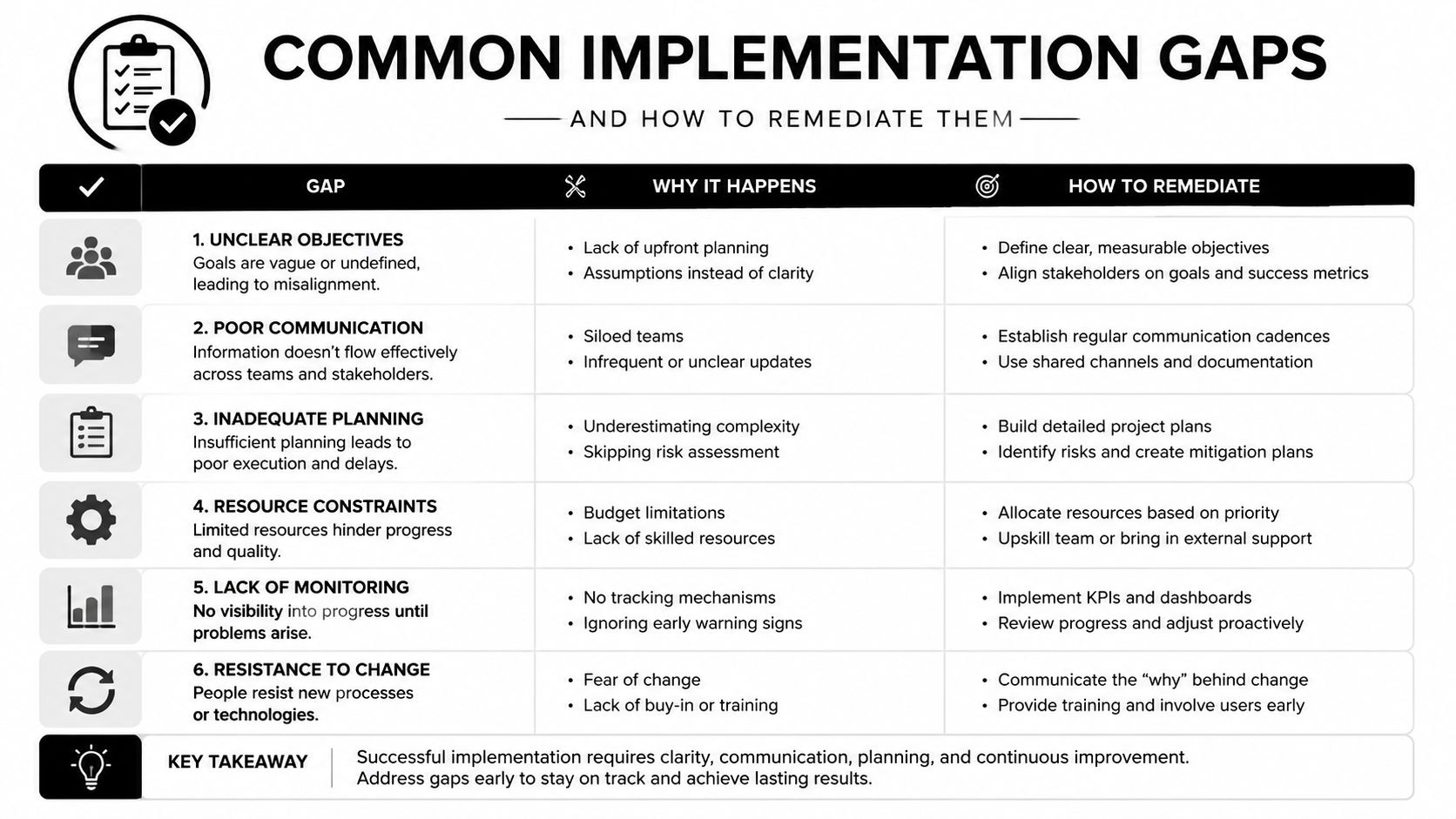
Defense contractors keep running into the same gaps because they treat nist 800-171 compliance as a compliance formality rather than an operational framework. A study on implementation gaps discovered zero organizations that were 100% compliant, average implementation at only 39%, and 61% of controls either not implemented or only partially implemented (implementation gap study). That same study revealed large firms averaging almost 60%, small-to-mid-sized firms averaging 34%, and more than 80% of companies missing 16 specific controls (implementation gap study).
The same controls fail for the same reasons
The breakdowns are easy to foresee. Event logging remains incomplete because no one owns retention policy, normalization, or alert review. Privileged MFA falls apart because exceptions multiply faster than enforcement, and the identity team never exports evidence that the policy is enabled. Encryption stalls when teams can describe the policy but cannot demonstrate its implementation state on live systems. Configuration management slips when change records, baseline drift, and approved exceptions reside in separate locations. Incident response testing is treated as a slide deck exercise rather than a playbook run that yields artifacts an assessor can verify.
Remediation must be direct. Correct the control in the live system before capturing proof. Enable the logs. Require MFA for privileged access. Align the baseline. Connect exceptions to an owner, a date, and a remediation path. Then link the evidence to the SSP and POA&M so the assessor can view the control, the operating process, and the follow-through together.
Do this first: correct the control in production, then document the proof. If teams reverse that order, they end up with paper compliance and weak operational support.
Cost and timeline pressure are genuine. Public guidance linked to the implementation gap study states that assessing and remediating gaps may take 8 to 15 months and cost roughly $50,000 to $200,000 (implementation gap study). Therefore, leadership must treat this work as a program involving staffing, tools, testing, and evidence validation, not a fast cleanup effort.
Build a 12-month skeleton that does not collapse
Adopt a sequence that aligns clearly with SIEM, XDR, and assessment evidence.
- Months 1 to 2: define the environment's scope, catalog assets, establish the SSP boundary, and specify which log sources send data to the SIEM.
- Months 3 to 5: correct identity controls, gather MFA enforcement exports, verify privileged access alerts, and ensure correlation rules address administrative activity.
- Months 6 to 8: strengthen configuration management, record vulnerability handling, and create incident response evidence through playbook-driven remediation rather than screenshots.
- Months 9 to 10: conduct the internal assessment, resolve clear POA&Ms, and revise control narratives to align with current logs and workflows.
- Months 11 to 12: practice evidence export, verify retention settings, confirm continuous monitoring results, and get ready for reassessment.
Tie every POA&M to a specific control that is partially implemented. When the remediation date, owner, or evidence path lacks clarity, the assessor will see the work as unclear as well. Faster contractors do not pursue every minor gap simultaneously. They close the controls that improve the score, make SIEM and XDR outputs defensible, and keep the environment simple to explain during review.