Ransomware Detection: Master Modern Strategies 2026
In 2024, ransomware was publicly disclosed in more than 5,600 attacks worldwide, with over 2,600 victims in the United States aloneThat same reporting states the FBI's 2024 IC3 report recorded 3,156 ransomware complaints, an 11.7% increase from the previous year, which serves as a useful reminder that this is not a niche malware issue. It is a lasting operational risk that continues to appear across sectors and environments (Fortinet's ransomware statistics summary).
That figure ought to alter how teams think about ransomware detection. If your approach begins with file encryption, you are already behind. Today's operators often engage identity systems, move laterally, stage data, and blend into regular administrative activity before they set off the business-impact event everyone sees.
The practical response is not to buy another endpoint tool. It is to build earlier, lower-noise detections across endpoint, network, identity, and cloud telemetry, then connect those detections to response actions that contain spread. That is the gap many teams still face. They can detect impact, but they cannot consistently detect intent.
A solid ransomware program sits inside the wider work of tracking today's top cyber security threats and how to prevent themRansomware merely tends to penalize delayed detection more conspicuously than most.
Table of Contents
- The Unseen Threat A Modern Approach to Ransomware Detection
- Understanding the Ransomware Attack Lifecycle
- Essential Telemetry and Log Sources to Monitor
- Key Ransomware Detection Techniques Explained
- Implementing Detections with Rules and Playbooks
- Tuning Detections and Validating Your Defenses
- Integrating Detection into Your Incident Response
The Unseen Threat A Modern Approach to Ransomware Detection
Ransomware detection breaks down when teams view encryption as the incident's beginning. It is not. Encryption is the noisiest moment, not the first one. By the time files begin changing at scale, the attacker has typically completed the work that mattered most: obtaining access, increasing privileges, mapping systems, and choosing what to strike.
That's why modern ransomware detection has to focus on precursor behaviorThe right question is not how to catch the ransomware binary. It is what the operator had to do before they could safely launch it. That shift alters your data sources, your rules, and your response logic.
Practical rule: If a detection triggers only during encryption, consider it impact confirmation rather than early warning.
A mature approach usually has three characteristics:
- It observes conduct, not merely malware names. Misused credentials, lateral movement, abnormal administrative actions, and data staging frequently appear before encryption.
- It extends across hybrid infrastructure. On-prem systems, SaaS, IaaS, VPNs, and identity providers each supply parts of the same intrusion.
- It lessens hesitancy among analysts. Detections need enough context that responders can isolate a host or disable an account without wasting time debating whether an alert is “real enough.”
The trade-off is clear. Earlier detections can generate more noise if they are poorly built. A file-encryption rule is dramatic and simple to explain. A rule for suspicious token use, abnormal remote administration, or odd file staging requires more tuning. Yet those earlier signals are what give defenders room to contain damage.
Teams that do this well do not pursue one perfect alert. They create a chain of evidence. That is the operating model this article follows: understand attacker flow, gather the right telemetry, build detection layers, tune aggressively, and automate the first response steps so the SOC can act while the incident remains containable.
Understanding the Ransomware Attack Lifecycle
Most ransomware intrusions follow a pattern. The specific tools vary, but the operator's task does not. They require access, persistence, privilege, reach, control, and then impact.
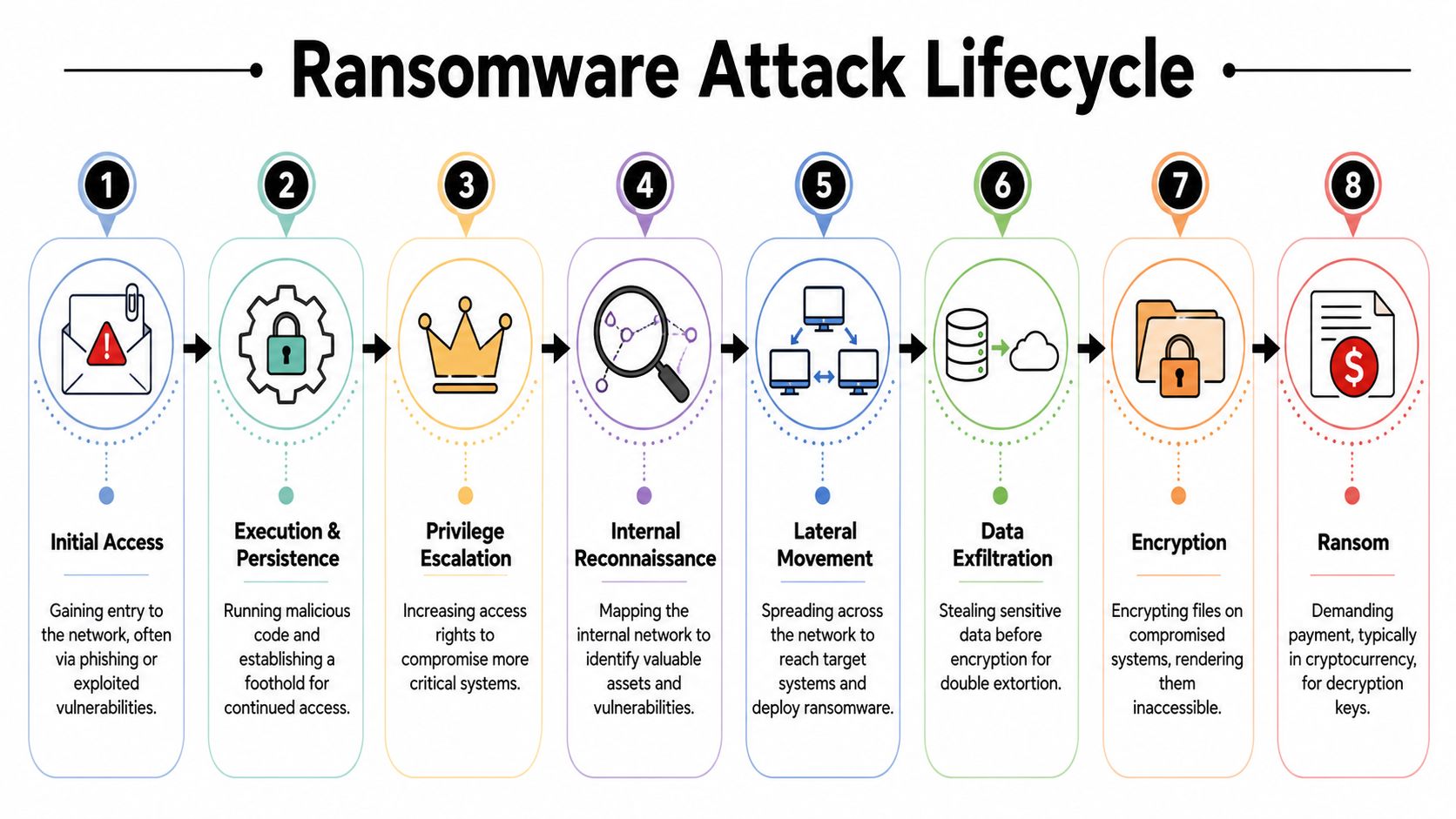
Effective hunting teams usually chart this sequence in the same way they would any targeted intrusion. If you're seeking a practical way to extend that approach, cyber threat hunting workflows help position ransomware as a hunt problem first and a malware problem second.
Attackers win before encryption
The initial access phase remains where many incidents start. That may involve phishing, exposed remote access, vulnerable internet-facing services, or stolen credentials. The detection error here is waiting for a known malicious file. Early access often resembles a legitimate login, a new remote session, or a user opening a built-in tool they do not usually use.
Execution and persistence follow. Attackers execute code, create scheduled tasks, misuse startup paths, or rely on living-off-the-land tools so they avoid a noisy payload. If your controls only search for a specific ransomware family, this stage can proceed with almost no resistance.
Privilege escalation and internal reconnaissance are where the intrusion begins to stand apart from normal user activity. An operator attempts to broaden access and map the environment. You will often observe account enumeration, directory queries, remote administration activity, and efforts to identify backup systems, file shares, hypervisors, or domain infrastructure.
The main detection opportunity is frequently the attacker's need to understand your environment faster than a typical user ever could.
What each phase looks like in practice
Lateral movement comes after reconnaissance. This is the phase when one compromised host ceases to be a workstation problem and becomes an estate-wide issue. Remote service creation, credential reuse, remote execution, and abnormal east-west traffic matter far more here than waiting for a ransom note.
Next comes data theft. Many attackers take data before encryption begins, since extortion is more effective when they can threaten both leak and outage. Defenders need to monitor for archive creation, staged file movement, unusual outbound transfers, and destination patterns inconsistent with normal business traffic.
The final two stages are the ones every executive sees:
- Encryption: Bulk file modifications, replacement actions, questionable process launches, backup interference, and service outages.
- Ransom: The attacker moves from concealment to pressure. At that stage, detection efforts turn into defining scope and containing the incident.
It helps to view the lifecycle as a bank robbery. The vault explosion draws attention, but the planning, key theft, guard scheduling, and movement inside the building occurred earlier. Ransomware detection improves when the SOC learns to spot the planning and movement, not only the blast radius.
Essential Telemetry and Log Sources to Monitor
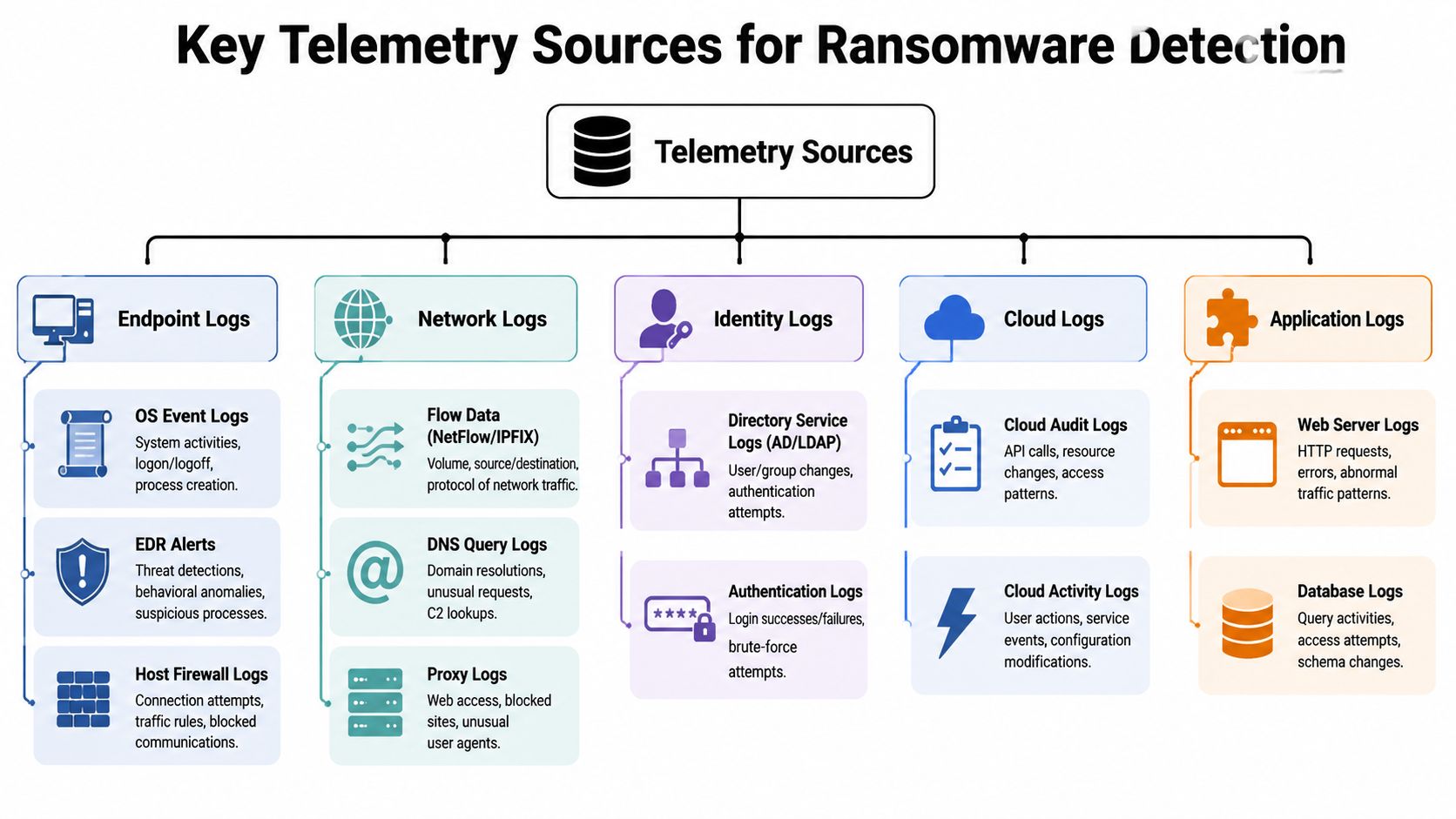
Ransomware detection can be no stronger than the telemetry it relies on. If you gather endpoint alerts yet disregard identity logs, you will overlook credential abuse. If you monitor cloud audit logs but fail to keep network flow, you will overlook lateral movement and staging paths. Strong visibility is not a single stream. It is the intersection of multiple streams.
A useful baseline comes from the fact that effective ransomware detection is strongest when it combines endpoint or EDR, network or NDR, and threat intelligence, because the earliest detectable signals are usually reconnaissance, credential theft, data staging, and lateral movement rather than the encryption event itself (Recorded Future on ransomware detection tools).
Endpoint data shows execution and impact
Endpoint telemetry addresses the fundamental questions about execution. Which process began, what launched it, which files changed, what user context was in place, and whether security controls were turned off or circumvented.
Focus on data that lets analysts reconstruct behavior, not just consume vendor verdicts:
- Process creation logs with parent-child relationships
- File activity telemetry around rapid rename, replace, copy, or delete patterns
- Service and task creation events
- Host firewall events that show unusual inbound or outbound activity
- EDR alerts that expose suspicious tools, script interpreters, or memory activity
Without this, encryption appears merely as files changing rapidly and little else. With it, you can trace the path leading to those changes.
Network and DNS reveal movement
Network telemetry often makes numerous pre-encryption detections apparent. Attackers who stay silent on disk still must move. They log in, scan, connect, enumerate, and exfiltrate.
Prioritize these sources:
| Telemetry source | What it helps detect | Why it matters |
|---|---|---|
| NetFlow or IPFIX | East-west movement and unusual transfer patterns | Shows spread and staging even when payloads are hidden |
| Firewall logs | Denied and allowed connections, rule exceptions, strange admin access | Highlights pivot points and containment opportunities |
| DNS logs | Odd lookups, newly observed domains, abnormal resolution patterns | Useful for command channels and staging activity |
| Proxy logs | Unusual web destinations and user agents | Helps confirm outbound activity tied to compromised accounts |
If your team is weak on log discipline, it helps to revisit the basics of understanding audit trails. Ransomware investigations frequently fail not because the team lacks ability, but because no one retained enough sequence and context to demonstrate what occurred.
Network logs seldom provide the complete picture on their own. They show you where to ask more precise questions.
Identity and cloud logs expose the quiet parts
Many ransomware operations still have weaknesses that can be detected. Identity logs reveal password spray attempts, impossible travel patterns, unusual MFA challenges, privilege changes, service-account misuse, and sign-ins from systems or workflows inconsistent with the typical activity of a user.
Cloud and SaaS logs bring an additional layer. Attackers more and more interact with storage, API actions, role assignments, admin panels, and sync tooling before encryption begins. In hybrid environments, those actions may be more important than a dropped executable.
At minimum, collect and normalize:
- Directory service activity
- Authentication success and failure events
- Cloud audit logs for resource and policy changes
- SaaS admin and access logs
- Application logs for exposed web and data platforms
Centralized gathering is important. A solution for centralized log management offers analysts a single timeline rather than five separate consoles. That does not generate detections on its own, but it makes correlation and triage achievable under pressure.
Key Ransomware Detection Techniques Explained
No individual technique reliably catches ransomware. Signature matching has value. Behavioral detection is more durable. Machine learning can assist with drift and anomaly detection. Correlation is what transforms scattered weak signals into a high-confidence case.
The error is staking the entire program on only one of them.
Why signatures still matter but don't carry the program
Signature-based detection remains relevant. It is quick, deterministic, and effective against known artifacts. When a ransomware family, tool hash, domain, or file pattern is already known, signatures can halt repeat activity with minimal ambiguity.
But signatures fail precisely where modern attackers take advantage. They do not cope well with renamed tools. They have trouble with commodity admin utilities. They offer little help when the attacker uses valid credentials and built-in components.
That's why signature-only approaches tend to detect known bad things, whereas ransomware operations often spend the majority of their time operating through systems your environment already trusts.
Behavioral detections catch what malware names miss
Behavior-based detection is more technically robust than signature-only approaches because it watches mass file renaming, copying, and replacing, anomalous process behavior, and suspicious network flows such as outbound connections to unknown destinations or large transfers outside normal hours (BlackFog on effective ransomware detection strategies).
This matters because defenders need patterns that endure tooling changes. Attackers can exchange payloads. They cannot avoid producing behavior.
Good behavioral logic often watches for combinations like these:
- Rapid file modification with suspicious parent process activity
- Unusual use of script interpreters followed by archive creation
- Remote administration activity paired with authentication anomalies
- Large outbound transfers after internal share access
- Backup or recovery interference near privilege escalation events
Behavioral rules certainly require tuning. Backup jobs, software deployment, patching, migration work, and scripted administration can all appear messy in raw logs. That does not mean behavior-based detection is defective. It means context must be included in the rule.
Analyst advice: Do not ask whether a behavior is suspicious by itself. Ask whether the sequence is operationally sensible for that user, host, and time window.
Correlation is where confidence comes from
Mature SOCs depend most on correlation, since ransomware seldom reveals itself through a single flawless signal. Instead, you see a collection of events that gain meaning only after they are linked.
A practical correlation might combine:
- A privileged sign-in from an unusual source
- Directory enumeration or suspicious account access
- Remote execution on multiple hosts
- Archive creation or file staging
- Outbound transfer anomalies
Each individual item could have a reasonable explanation. The sequence generally does not.
Machine learning and anomaly detection can also be helpful in this area, particularly for identifying unusual changes in user behavior, service account activity, or host communication patterns. They are valuable for bringing forward candidates that warrant review. They are less valuable when accepted as independent truth. In ransomware detection, ML should assist investigation and tuning rather than substitute for analytic reasoning.
Here's the practical comparison:
| Technique | How It Works | Best For Detecting | Key Limitation |
|---|---|---|---|
| Signature-based detection | Matches known indicators, hashes, strings, or patterns | Known malware families and reused tooling | Weak against new variants, renamed tools, and credential-driven attacks |
| Behavioral detection | Watches suspicious actions and sequences on hosts and networks | Encryption activity, exfiltration, misuse of admin tools | Can generate noise without tuning and context |
| Machine learning or anomaly detection | Flags deviations from established baselines | Unusual account use, process execution, and traffic patterns | Can be opaque and difficult to operationalize without analyst review |
| Event correlation | Links low-signal events across systems into one alert | Pre-encryption attack chains and multi-stage intrusions | Depends on good normalization, timing, and telemetry coverage |
If I had to reduce this to practice, the operational answer is straightforward. Retain signatures for fast gains. Put substantial investment into behavioral rules. Apply anomaly detection to expand visibility. Treat correlation as the control that makes the entire system workable.
Implementing Detections with Rules and Playbooks
Detection programs deliver value when they are turned into rules the SOC can rely on and playbooks the SOC can execute without making up each step. That means moving away from the instruction to watch for ransomware and toward explicit logic tied to attacker behavior.
The urgency around this is not hypothetical. A Dragos industrial ransomware analysis for Q1 2025 found 708 ransomware incidents affecting industrial entities worldwide, up from about 600 in Q4 2024. North America accounted for 413 incidents, roughly 58% of the total, and the Cl0p group jumped from 2 incidents in Q4 2024 to 154 in Q1 2025That sort of shift is precisely why fixed rule sets deteriorate over time and why real-time detection logic must remain adaptable.
Build rules around attacker sequences
An effective ransomware rule typically brings together several conditions within a brief time span. For instance:
User-centric rule
- A single account authenticates to systems it doesn't normally touch
- The same account triggers remote execution or admin tooling
- File staging or archive activity follows soon after
Host-centric rule
- A process spawns from an unusual parent
- The host begins rapid file rename or replacement activity
- Outbound transfer activity rises at the same time
Share-impact rule
- One endpoint accesses multiple network shares
- File modifications spike across those shares
- Backup or shadow-copy related actions appear on the same host
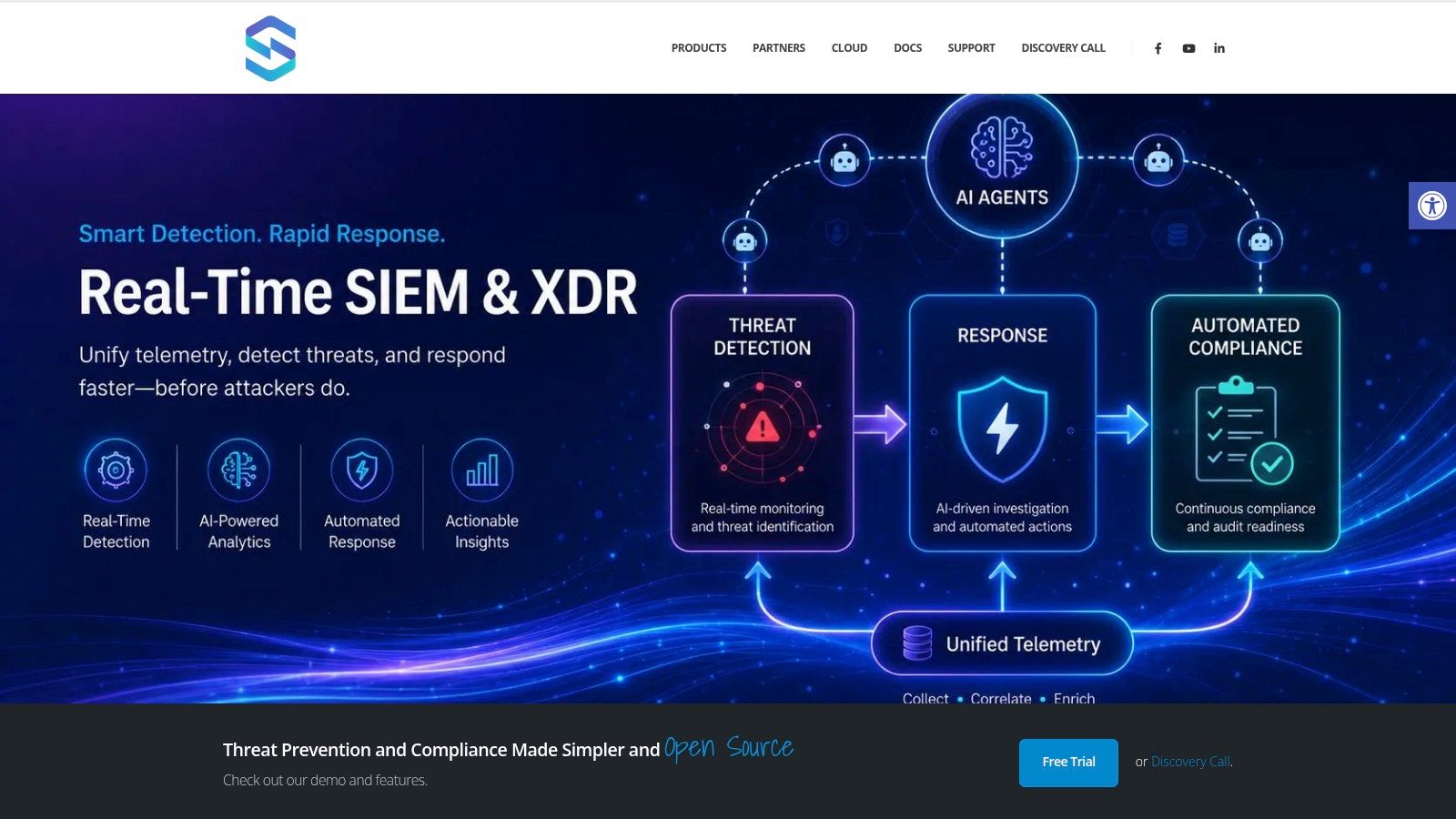
A single reference to tooling fits in naturally. Unified Security Stack can collect endpoint, network, and cloud logs by way of APIs, Syslog, NetFlow, and agents, then perform correlation at ingestion so teams can create these rules in a single place rather than piecing together separate workflows. This is less a product message and more an operational necessity. If your logic sits in disconnected consoles, so will your response.
A practical rule should answer three things before it ever fires in production:
- What attacker behavior is this trying to catch
- What legitimate activity looks similar
- What action the SOC is allowed to take automatically
Automate the first containment steps
When a rule reaches sufficient confidence, it should set off a limited playbook. Not an expansive incident process. Only the initial actions that contain spread while keeping analysts in control.
A common ransomware playbook looks like this:
- Isolate the endpoint from the network while preserving management access.
- Disable or suspend the user account if identity misuse contributes to the signal.
- Block active indicators already linked to the incident, for example known destinations or suspicious process execution paths.
- Open a high-priority case with host, user, timeline, and correlated evidence included.
- Notify the right humans according to asset criticality, business unit, and incident severity.
Here's a short walkthrough worth embedding in team training after you've built your own detections:
The trade-off with automation never changes. When a rule is weak, automation magnifies errors. When a rule is mature and carefully scoped, automation reduces the time attackers have to grow their foothold. In ransomware, that difference in time is often everything.
Tuning Detections and Validating Your Defenses
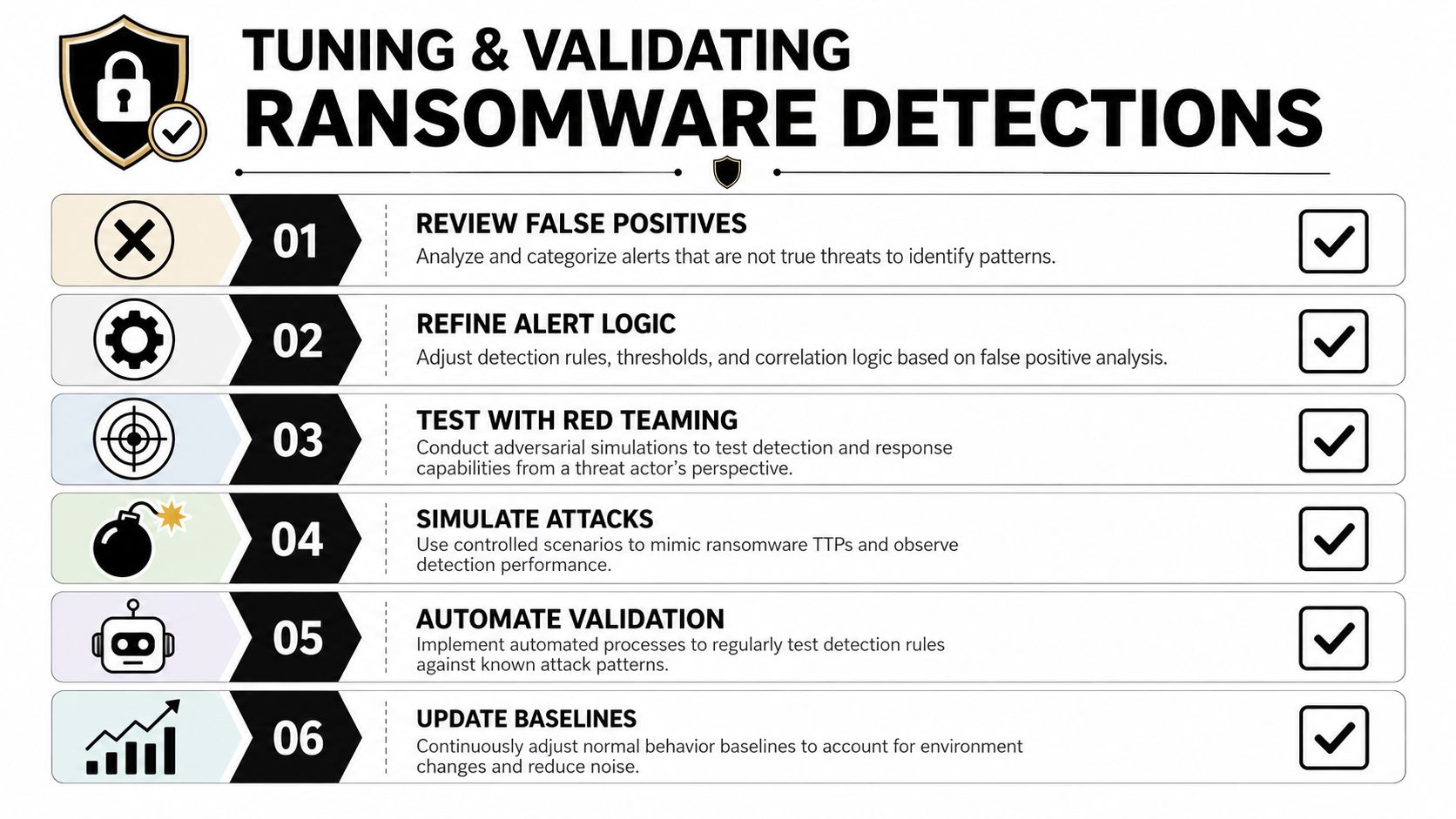
Most ransomware detection programs do not fail from a shortage of ideas. They fail because alerts are noisy, thresholds are set without rigor, and no one checks whether a rule remains effective after the environment changes.
That issue is drawing greater attention. A gap in public guidance concerns how to detect ransomware when defenders are buried in false positives and alerts come too late to prevent impact. Discussion of the subject increasingly identifies tuning, validation, and deception as missing layers, and one guide cites research asserting that honeypot-style deception can detect encryption in roughly 12 seconds (Vectra on ransomware detection).
Most noisy rules fail because context is missing
A threshold alone is seldom sufficient. A rule such as more than X file changes in Y minutes seems reasonable until your backup team, endpoint management team, or storage team performs entirely legitimate work and overwhelms the queue.
Start tuning with context layers:
- User context: Does this identity belong to an admin, a service account, a standard employee, or automation?
- Asset context: Is the host classified as a file server, VDI image, engineering workstation, or backup appliance?
- Time context: Did it occur inside a maintenance window, or at an unusual hour for that team?
- Change context: Had an approved migration, deployment, or patching event taken place?
Next, establish explicit exceptions for recurring, validated patterns. Do not create broad allowlists. Define narrow operational exceptions with owners and review dates. Otherwise your tuning turns into permanent blindness.
A silent dashboard may indicate mature tuning, or it may indicate that the team quietly filtered out the exact activity it intended to catch.
Validation separates comforting dashboards from real coverage
Even a tuned rule cannot be trusted until it has been tested. Validation should involve controlled simulations of the behaviors that matter to you: atypical process chains, fast file operations, suspicious share access, archive creation, outbound staging, and account misuse.
Good validation habits include:
- Run controlled simulations that emulate ransomware-adjacent behavior without causing harm.
- Test across environments since workstation logic frequently breaks down on servers and cloud workloads.
- Verify playbook outcomes so that isolation, account controls, and ticket creation occur as intended.
- Review misses and near misses since rules that nearly fired typically reveal what context remains absent.
Deception also has a role in the stack. Honeyfiles, decoy shares, and trap credentials can provide high-fidelity alerts with much less noise than broad anomaly rules. They will not replace endpoint and identity analytics, but they create a valuable tripwire when an attacker has already gotten past preventive controls.
If your team intends to focus seriously on one discipline this year, choose this one. Improved tuning does more than lower noise. It determines whether analysts trust the system enough to respond quickly.
Integrating Detection into Your Incident Response
Ransomware detection matters only when it improves the speed and quality of response. An alert delivered without ownership, context, or an approved action path is merely a costly notification.
This is even more important in hybrid environments. One angle that is often underserved is detecting ransomware before encryption starts in cloud and hybrid environments, especially when the intrusion involves identity misuse, API abuse, and lateral movement across SaaS, IaaS, and on-prem systems rather than a simple malicious file on one endpoint (Commvault on ransomware detection).
Detection has to change responder behavior
An effective incident response workflow begins with detection content that already accounts for what a responder needs. This means every alert should answer:
- What happened
- Where it happened
- Who or what is involved
- Why the alert is high risk
- What the responder is authorized to do next
When the SOC must manually gather host history, identity context, cloud actions, and related network activity on every occasion, response will fall behind. Ransomware penalizes that delay at once.
Detection engineering and incident response also require governance to support them. Teams that formalize escalation paths, ownership, evidence handling, and service workflows tend to respond more cleanly. Work on integrating GRC and ITSM is valuable in this context because ransomware response is not only technical containment. It involves accountability, documentation, and risk decisions that must withstand scrutiny after the crisis call ends.
Hybrid response needs one operating picture
In practice, response breaks down when each team views only its own console. Cloud spots API anomalies. Identity spots risky sign-ins. Endpoint spots suspicious execution. Network spots unusual flows. No one spots the full intrusion fast enough.
The operational remedy is a unified detection and response view that links alerts to assets, users, cloud actions, and response playbooks within a single case flow. This enables security teams to isolate a host, disable a compromised account, preserve evidence, and notify stakeholders without debating whose data is authoritative.
When done correctly, ransomware detection becomes the entry point to incident response, not a separate discipline. It provides responders with an earlier start, cleaner evidence, and a stronger chance to contain the blast radius before encryption turns a security event into a business outage.
If you're building a ransomware detection program that has to work across endpoints, identity, network, and cloud, take a look at Unified Security Stack. It is an open-source SIEM, SOAR, and XDR platform designed to centralize telemetry, correlate events in real time, and trigger response playbooks in hybrid environments.