A 2026 Guide to What a Security Operations Center Is
A security operations center serves as a core function that persistently monitors, identifies, examines, and addresses cyber threats throughout every environment an organization uses. The worldwide SOC market was valued at USD 42.85 billion in 2024 in one estimate and is projected to reach USD 91.88 billion by 2034, while another estimate places it at USD 52.3 billion in 2025 with a projection of USD 130.2 billion by 2034 (market estimate).
This expansion mirrors a practical fact. A firewall, endpoint agent, cloud console, or SIEM dashboard does not protect the business on its own. A person or a system must continually gather security telemetry, tell a real compromise apart from an expected event, investigate scope, contain the threat, and record what happened. The SOC is the operating model that makes these activities repeatable.
Table of Contents
- What a Security Operations Center Really Is
- SOC Delivery Models and How to Choose One
- People, Process, and Technology Inside the SOC
- How SOC Workflows Run From Alert to Recovery
- The Modern SOC Tech Stack Explained
- Key SOC Metrics and KPIs That Matter
- Modern Trends Shaping Today's SOC
- Building or Maturing Your SOC with Unified Security Stack
What a Security Operations Center Really Is
A security operations center, or SOC, is a centralized operating function for continuous security monitoring, threat detection, investigation, and incident response. It may be housed in a dedicated room, run through a distributed team, be delivered by an outsourced provider, or combine analysts with automation. The room is optional. The operating discipline is not.
SOCs grew out of early defense-oriented monitoring teams in the mid-1970s and became a distinct enterprise function by the late 1990s and early 2000s. Industry accounts tie early SOC concepts to military and government command centers, while major outbreaks such as Code Red, Nimda, and SQL Slammer drove large enterprises, banks, and critical infrastructure operators to centralize monitoring and response (SOC history and structure). The critical change was from improvised IT troubleshooting to a dedicated capability for continuous vigilance.
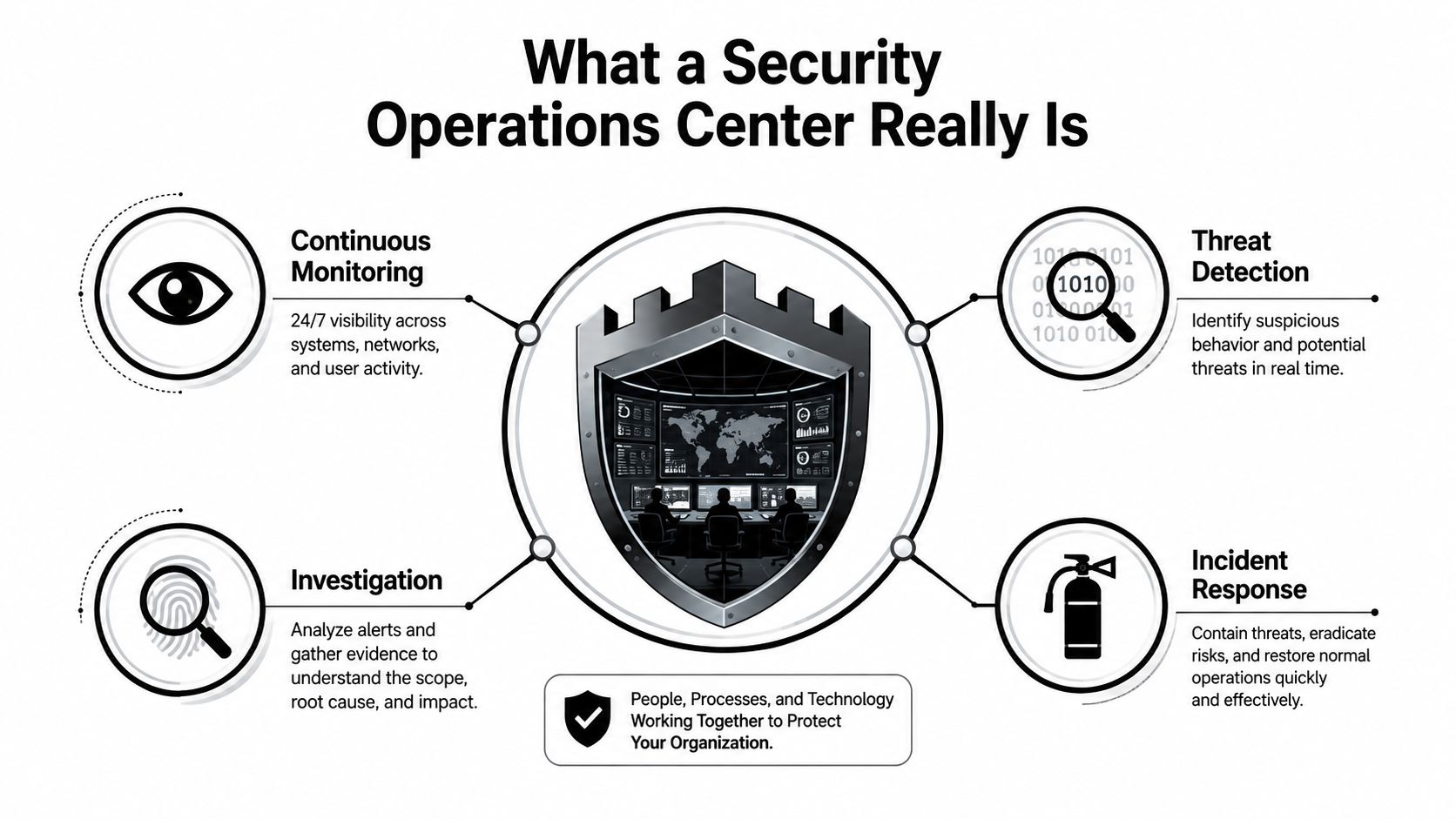
The four functions that define the model
- Monitoring: Gather telemetry from endpoints, networks, identities, applications, cloud services, and security controls.
- Detection: Use correlation rules, behavioral analysis, and threat intelligence to spot suspicious activity.
- Investigation: Add context, rebuild events, establish scope, and distinguish false positives from incidents.
- Response: Contain the threat, eradicate it, restore operations, communicate, and preserve evidence.
NIST describes the SOC as a focal point for computer network defense, supported by personnel and tooling that continuously fuses, correlates, analyzes, and responds to security-relevant events from multiple sources (NIST incident response control). That definition explains why a SOC is not merely an alert queue. Its value comes from converting varied telemetry into prioritized, coordinated action.
A SOC may take the form of a broad hierarchy or a compact hybrid group. A headcount or a product license alone does not demonstrate that an organization possesses SOC capability. The measures that matter are round-the-clock coverage, defined processes, quantifiable response, and unambiguous accountability. For readers who are building the personnel side, this SOC analyst job description for 2026 offers helpful context about responsibilities and role expectations.
SOC Delivery Models and How to Choose One
The right SOC model depends less on branding than on who owns the decisions at three critical moments: what gets investigated, who can contain it, and who remains accountable when the response is inconvenient.
An internal SOC affords an organization the greatest control. Its analysts grasp business systems, data sensitivity, user behavior, and operational priorities. The trade-off is significant: the organization has to provide round-the-clock coverage, pay for the technology stack, maintain detection engineering, and retain hard-to-find expertise. Staffing pressure is a core challenge. An excerpt from a 2025 SOC survey reports that 62% of organizations say they aren't doing enough to retain top SOC talent, with average tenure of 3–5 years (2025 State of the SOC survey).
A co-managed SOC divides duties. Internal staff might own high-risk investigations, stakeholder communication, and remediation, while an outside provider manages continuous monitoring, initial triage, or threat hunting. This model keeps internal context but demands a precise responsibility matrix. Unclear escalation rules cause delays exactly when both teams assume the other side has acted.
A fully managed MDR or MSSP model moves much of the detection and response operation to a provider. It provides quicker time-to-value and predictable operational ownership, but the customer loses some customization and must verify access, evidence handling, escalation authority, and response boundaries.
| Dimension | In-House SOC | Co-Managed SOC | MDR/MSSP |
|---|---|---|---|
| Control | Highest internal control and customization | Shared control defined by contract | Provider-led operations |
| Context | Deep business and environment knowledge | Internal context supplemented by provider expertise | Provider depends on customer-provided context |
| Staffing | Organization owns coverage and retention | Shared staffing burden | Provider supplies operational coverage |
| Cost profile | Capital and staffing investment | Shared investment | Service-based operating cost |
| Best fit | Mature, complex enterprises with security staff | Teams needing additional coverage or specialist support | Organizations without sufficient SOC personnel |
Regulatory requirements also matter. Healthcare, finance, government contracting, and payment environments may demand specific evidence, access controls, retention practices, and separation of duties. Before choosing a model, document the systems in scope, required coverage, response authority, compliance obligations, and handoff expectations. A managed SOC service can be assessed against those requirements instead of bought as a vague monitoring promise (Unified Security Stack managed SOC services).
People, Process, and Technology Inside the SOC
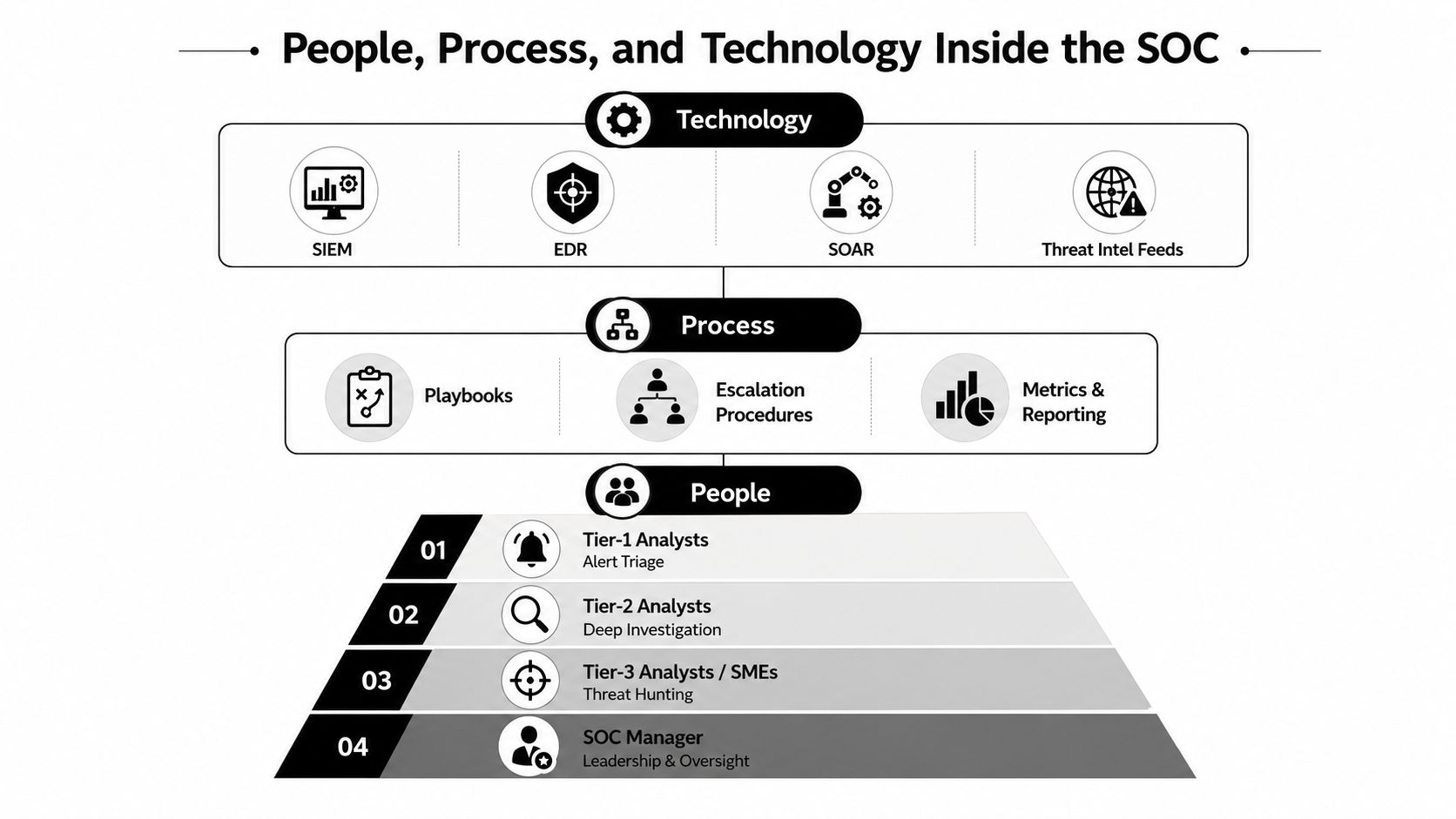
An effective SOC has separate duties, not merely a set of security job titles. Tier-1 analysts examine incoming alerts, provide basic context, filter out known benign activity, and escalate suspected true positives. Tier-2 analysts conduct deeper investigations, correlate identity, endpoint, network, and cloud evidence, and establish the scope of an incident. Tier-3 analysts and threat hunters Conduct intricate investigations and proactively hunt for adversary activity that automated detection failed to catch.
The SOC manager is responsible for the operating cadence. This covers shift staffing, escalation routes, runbook standards, detection priorities, reporting, and alignment with IT, legal, privacy, and business stakeholders. In smaller organizations, a single person may fill multiple roles, yet those responsibilities still require clear ownership.
Process turns expertise into repeatable action
A mature process defines analyst actions before an incident turns stressful. It addresses triage, severity assignment, escalation, evidence preservation, containment approval, recovery validation, and post-incident review. Shift handoffs should document active investigations, outstanding actions, impacted assets, and business owners. Quality assurance should review a sample of closed alerts and assess whether analysts reached defensible conclusions.
Technology amplifies these people and processes:
- SIEM: Connects events across multiple sources and provides analysts with a shared investigation view.
- SOAR: Runs playbooks for enrichment, ticketing, notification, and response.
- EDR: Provides telemetry covering endpoint processes, files, users, and response.
- XDR: Expands associated detection and response into endpoint, identity, email, cloud, and additional domains.
- NDR: Reveals network activity, including behavior that endpoint controls cannot see.
The stack breaks down when every tool builds its own queue. A SIEM alert ought to deliver the evidence required for investigation, SOAR should eliminate repetitive manual work, and EDR or NDR should provide the telemetry and containment actions that settle uncertainty. People are still accountable for judgment, particularly when automated action might disrupt a critical service.
How SOC Workflows Run From Alert to Recovery
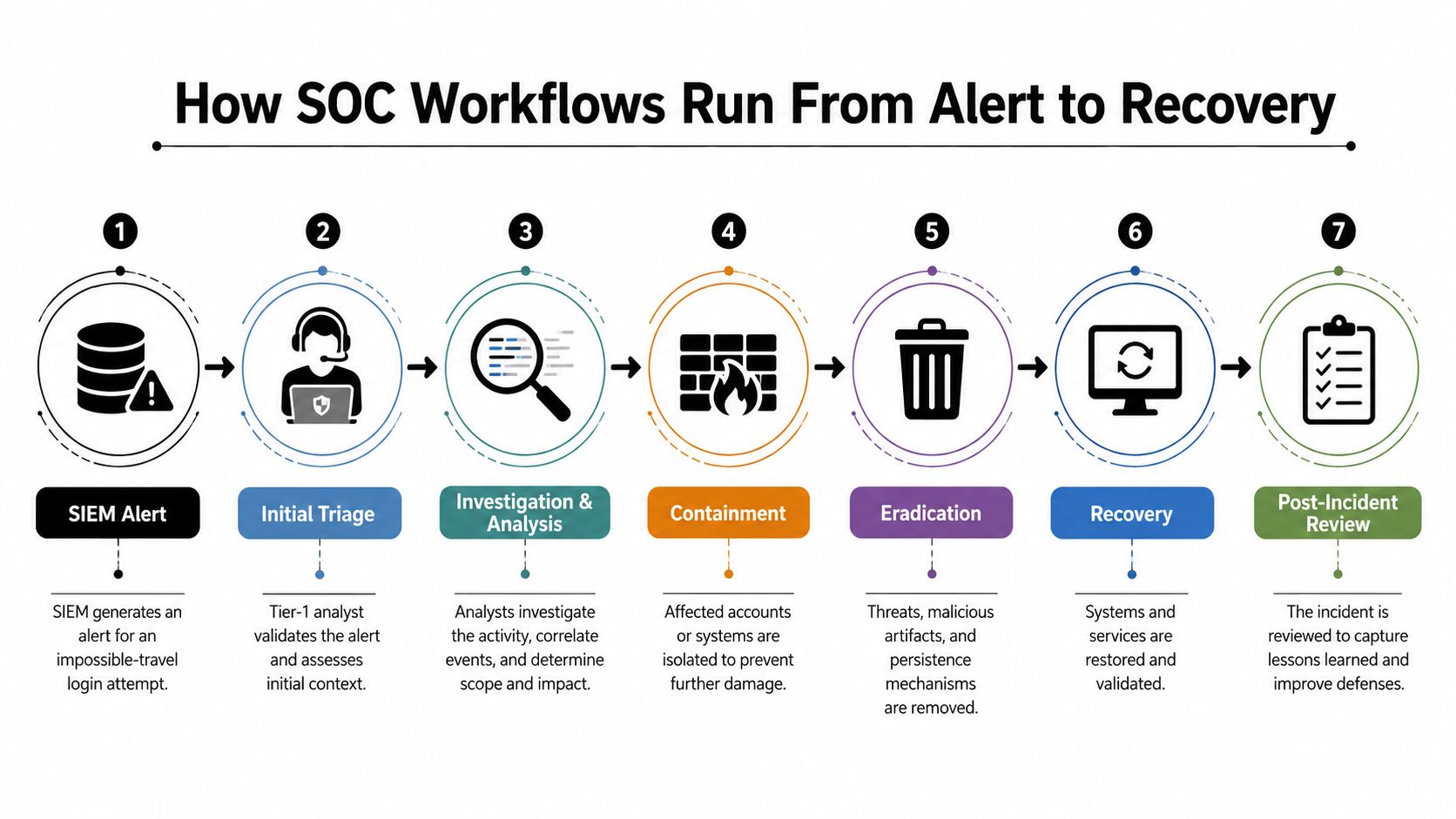
At 02:14, a SIEM correlation rule triggers on an impossible-travel sign-in for a finance user. The alert arrives in the Tier-1 queue with identity, authentication outcome, source location, device details, and recent account activity attached. The analyst verifies whether the user was traveling, whether the device is known, and whether other sign-ins or privilege changes happened near the same event.
The first decision is not hack versus no hack. It is whether the available evidence justifies escalation. Tier 1 assigns severity, records the reasoning, and sends the alert to Tier 2 when the activity remains suspicious or affects a sensitive account.
Investigation separates suspicion from scope
Tier 2 shifts from the identity event to EDR telemetry. The analyst examines the endpoint process tree, recent authentication activity, browser and email context, and associated alerts. The evidence indicates credential abuse, yet the endpoint process history does not confirm execution or persistence. That difference alters the containment plan. The team must secure the account without needlessly taking a critical workstation offline.
Tier 3 and the SOC manager coordinate actions through the approved response path:
- Terminate the user's active sessions.
- Require users to re-enroll their Multi-Factor Authentication devices.
- Stop the suspicious source at the suitable edge control.
- If the evidence justifies it, isolate the endpoint using EDR.
- Look for associated activity across finance identities and systems.
- Document each action, approval, timestamp, and outcome in the case.
The incident then proceeds through eradication and recovery. Analysts verify that unauthorized sessions are removed, validate the endpoint, restore normal access under controlled conditions, and watch for recurrence. The case record should include the original alert, enrichment results, queries, screenshots or evidence references, decision points, containment actions, and recovery approval. A practical security incident response workflow can assist with formalizing those transitions.
A post-incident review uncovers the root cause, timeline gaps, detection weaknesses, and playbooks requiring revision. The team might adjust the impossible-travel rule, add a device-trust condition, enhance identity enrichment, or alter the escalation path for finance accounts. The goal is not simply to close the ticket. It is to make the next investigation faster and more dependable.
The Modern SOC Tech Stack Explained
A SOC stack ought to be built as a detection pipeline, not gathered as a shelf of separate products. Visibility is the first challenge. If identity, endpoint, cloud, email, DNS, and network events are not collected and normalized, later correlation cannot restore the missing context.
A practitioner guide organizes log sources by ingestion priority. Tier 1 covers identity provider logs, EDR telemetry, cloud audit logs, email security gateway logs, DNS queries, and firewall or network-flow data. Tier 2 covers WAF, proxy, VPN, database audit, and SaaS logs. Tier 3 covers asset inventory, vulnerability results, threat intelligence, and HR data for enrichment and correlation (SIEM log source guidance).
| Layer | Problem It Solves | Role in the Pipeline | Unified Security Stack Example |
|---|---|---|---|
| Log collection and normalization | Disconnected, inconsistent telemetry | Ingests and standardizes events | Cloud, on-premises, endpoint, API, Syslog, and NetFlow collection |
| SIEM | Isolated events hide attack patterns | Correlates activity and prioritizes detections | Correlation rules, real-time analysis, and UEBA |
| SOAR | Analysts repeat enrichment and response steps | Runs playbooks, routing, and notifications | Predefined and custom orchestration workflows |
| EDR | Endpoint activity is difficult to reconstruct | Provides process and host evidence plus containment | Integrated endpoint telemetry and response |
| XDR | Attacks cross security domains | Connects endpoint, identity, email, and cloud signals | Cross-domain detection and response |
| NDR | Endpoint tools miss network behavior | Detects suspicious communication and lateral movement | Network sensors and flow visibility |
What each layer should contribute
The SIEM serves as the analytical hub. It should connect a suspicious login to device posture, endpoint activity, privilege changes, and network behavior, instead of producing separate alerts for each event. UEBA can help spot activity that deviates from a user or entity's normal pattern, but analysts still require explainable evidence.
SOAR is best suited to deterministic tasks. Enriching an IP, pulling identity context, opening a case, alerting an owner, or isolating a host under approved conditions are strong automation candidates. A playbook that acts without guardrails can cause an outage, so response authority and rollback steps must be part of the design.
EDR and XDR provide investigative depth and response reach. NDR contributes visibility where endpoint agents are unavailable or where traffic patterns expose lateral movement. Unified Security Stack combines these functions into an open-source SIEM, SOAR, and XDR platform, with log ingestion, correlation, UEBA, endpoint telemetry, network sensors, and automated workflows. The practical test is whether a single alert can pass through collection, correlation, enrichment, investigation, and response without making analysts copy evidence across silos.
Key SOC Metrics and KPIs That Matter
A SOC manager should review metrics that describe speed, quality, coverage, workload, and learningAlert counts on their own provide weak evidence. A team may close numerous alerts yet overlook high-impact activity, or lower volume by suppressing detections that ought to stay visible.
Mean Time to Detect, MTTDTracks how rapidly suspicious activity turns into a recognized detection. Mean Time to Respond or Recover, MTTRMeasures how long it takes to contain and restore affected systems. Automation guidance links code, playbooks, and AI-assisted workflows to shorter detection, triage, and containment times.incident response automation guidance).
An open-source SOC operations reference provides explicit targets that teams can use as starting mechanics: MTTD under 30 minutes, MTTR under 60 minutes for critical or high incidents, mean time to acknowledge under 10 minutes, false-positive rate under 10%, closure rate of at least 95%, and post-incident review completion within 72 hours for critical or high events (SOC operations targets).
| Metric | What It Measures | Realistic Target | Where to Track in Unified Security Stack |
|---|---|---|---|
| MTTD | Time from relevant activity to detection | Under 30 minutes | Detection and incident dashboards |
| MTTR | Time to respond to critical or high incidents | Under 60 minutes | Case timeline and response reporting |
| Mean time to acknowledge | Queue responsiveness | Under 10 minutes | Alert queue metrics |
| False-positive rate | Detection quality and tuning | Under 10% | Rule performance and alert analytics |
| Closure rate | Operational completion | At least 95% | Case management reporting |
| Post-incident review | Learning discipline | Within 72 hours for critical or high events | Incident workflow records |
NIST incident-handling guidance also supports tracking total labor spent across detection, analysis, containment, eradication, and recovery, not just ticket volume (NIST incident-handling guideInclude analyst workload, unresolved queue age, critical-asset telemetry coverage, and log-source onboarding to reveal burnout and visibility gaps before they turn into operational failures.
Modern Trends Shaping Today's SOC
Cloud-native and hybrid environments have transformed collection. Analysts now examine activity spanning cloud control planes, SaaS applications, remote endpoints, identity providers, and on-premises infrastructure. A SOC that watches only the data center can have a refined dashboard and a major blind spot.
Automation-first triage is emerging as the practical answer to this complexity. Playbooks can enrich alerts before analysts view them, pull related events, assign ownership, and take low-risk actions. LLM-assisted workflows can summarize an incident, draft search queries, identify related alerts, and propose investigative paths. They should aid analyst judgment, not make irreversible decisions.
Consolidation and identity focus
XDR represents a shift toward linked telemetry and coordinated response. Consolidation can cut swivel-chair investigation, yet it may also create reliance on a single vendor's data model and response controls. Architects should evaluate export options, detection transparency, API access, and how the platform treats sources beyond its native ecosystem.
Identity is now a core SOC focus because authentication, privilege, session, and device-trust events link users to business access. Detection engineering should therefore regard identity telemetry as a primary source, together with endpoint and network data.
Compliance is also shifting into day-to-day operations. Requirements connected to PCI, HIPAA, SOC 2, ISO 27001, NIS2, CMMC, and GLBA are simpler to sustain when evidence, access events, response records, and control mappings are collected during routine workflows instead of being compiled at audit time. The SOC shouldn't maintain a separate compliance archive. It should generate defensible evidence from the same investigations and controls used to safeguard the environment.
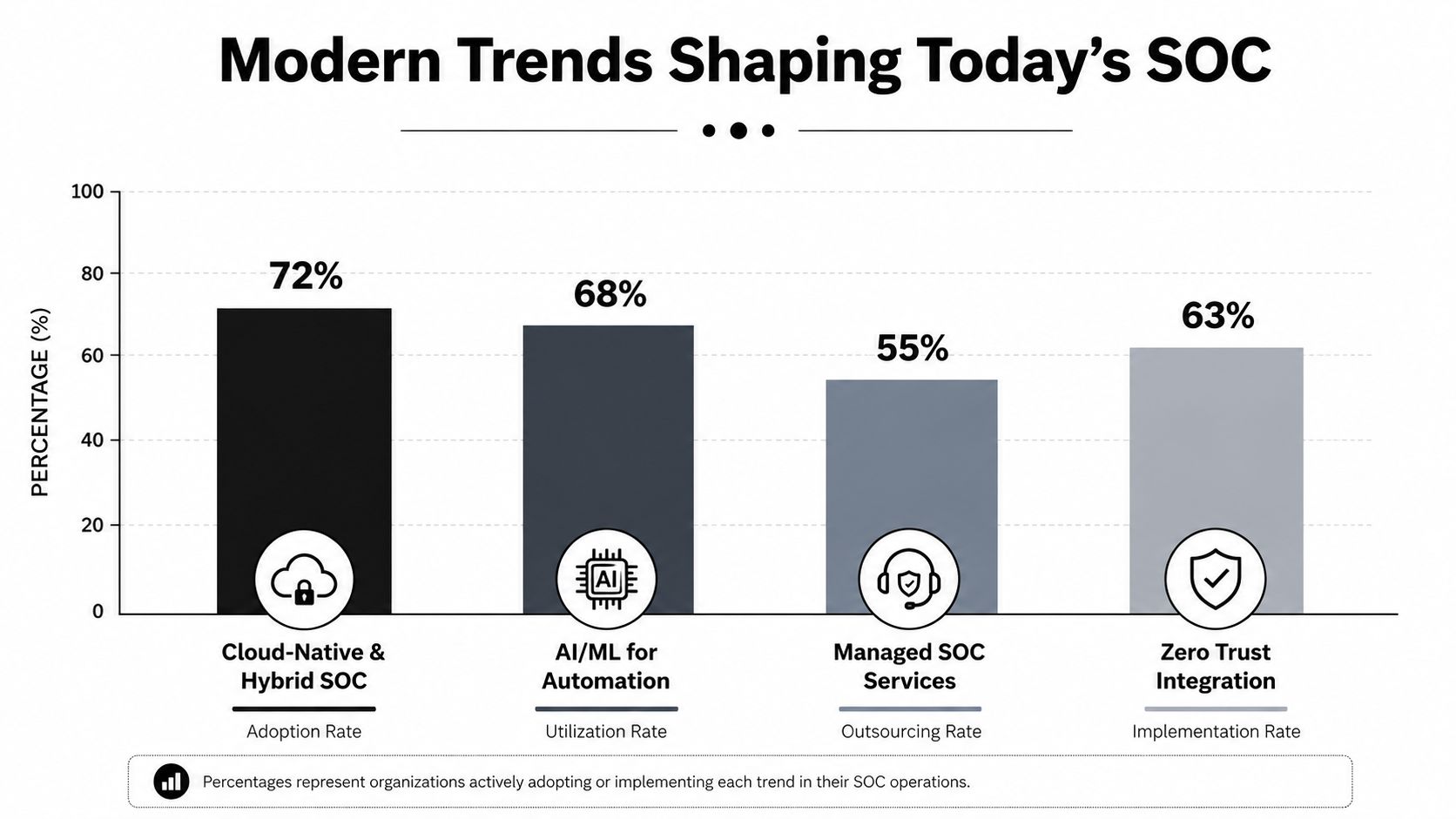
The practical implication is clear. Begin with the telemetry and response decisions that matter most, then automate stable workflows and add advanced analysis once the underlying data is trustworthy. Buying an AI layer before fixing asset inventory, identity logging, or ownership typically yields faster summaries of incomplete evidence.
Building or Maturing Your SOC with Unified Security Stack
A practical SOC roadmap begins with visibility, not a command center. Start by identifying critical assets, identity systems, cloud accounts, endpoints, network controls, and compliance boundaries. Define who receives an escalation and who can authorize containment. Then onboard the most valuable telemetry first, including identity, EDR, cloud audit, email, DNS, and firewall data.
A staged implementation path
Stage 1, gain visibility. Gather and normalize logs from firewalls, endpoints, cloud services, and identity providers. Build a limited set of high-confidence correlation rules for account compromise, privilege misuse, malware behavior, and suspicious network activity. Confirm that analysts can investigate an alert without opening a separate console for each supporting event.
Stage 2, add automation for repeatable response. Deploy SOAR playbooks for phishing, brute-force activity, and ransomware containment. Start with enrichment and notification, then introduce controlled actions such as session revocation, endpoint isolation, or account restriction once approval and rollback procedures have been tested.
Stage 3, strengthen context and hunting. Incorporate threat intelligence, UEBA, vulnerability data, asset information, and case management. Leverage these sources to rank detections for exposed or business-critical systems and to search for activity that did not set off a predefined rule.
Stage 4, make measurement operational. Create dashboards covering MTTD, MTTR, acknowledgement, false positives, closure, review completion, asset coverage, and analyst workload. LLM-assisted workflows can condense cases and assist with rule tuning, but every recommendation should remain open to review.
A concise maturity check asks five questions:
- Visibility: Have critical identity, endpoint, cloud, network, and application sources been onboarded?
- Detection: Do rules address the organization's highest-impact attack paths?
- Automation: Are analysts able to enrich, route, and contain routine incidents in a consistent way?
- Response: Does documentation exist for authority, handoffs, evidence, recovery, and review?
- Compliance: Is the team able to generate pertinent control evidence from operational records?
Organizations that need a practical starting point can use this guide to build a 24/7 SOC with free and open-source technologiesThe key decision is still whether to run operations in-house, split responsibilities with a provider, or use MDR. The platform ought to enable that choice instead of prescribing it.
Unified Security Stack provides an open-source SIEM, SOAR, and XDR platform that gathers telemetry, correlates detections, coordinates response, enables endpoint and network visibility, and organizes compliance evidence. Visit Unified Security Stack to assess how its unified approach might underpin your SOC roadmap, whether you are developing internal capability or preparing a co-managed operating model.