
Network Traffic Analysis: A Guide to Modern Threat Detection
Your team likely runs a SIEM, endpoint telemetry, firewall logs, and an expanding queue of alerts nobody wants to tune just ahead of a board update. Then an incident review reveals what security leaders repeatedly discover: the attacker did not have to overcome every control. They simply had to traverse an area of the environment that no one monitored closely enough.
That is where network traffic analysis gains operational significance. It is not another dashboard, nor does it replace endpoint or identity telemetry; it is the layer that reveals who communicates with whom, how frequently, across which protocols, and in patterns that depart from the baseline. For a CISO, the benefit is straightforward. It reduces visibility gaps, raises triage quality, and provides the SOC with a signal it can automate against when implemented with care.
Table of Contents
- Why Network Traffic Analysis Is Now Essential
- Understanding the Fundamentals of NTA
- Key Data Sources and Collection Methods
- Core Network Traffic Analysis Techniques
- Practical Threat Detection Use Cases
- Integrating NTA with SIEM and XDR
- Your NTA Implementation Checklist
Why Network Traffic Analysis Is Now Essential
Many security programs continue to uncover the same difficult reality during investigations. The perimeter alert triggered. The endpoint tool detected some of the activity. Identity logs revealed suspicious sign-ins. Yet no one observed the internal movement with enough clarity or speed to halt it before it expanded.
That visibility gap grows larger in hybrid environments. Cloud workloads, branch offices, remote users, service-to-service communication, and encrypted traffic all diminish the usefulness of payload-centric monitoring on its own. Security teams require a means to observe behavior across the environment, not merely events generated by separate control points.
Network traffic analysis grew essential as soon as networks ceased to be simple client-server estates and began acting more like distributed systems. The category has also emerged as a definite market priority. Grand View Research estimated the global NTA market at USD 4.52 billion in 2024 and projects USD 6.21 billion by 2030, a 5.0% CAGR, reflecting steady demand as cloud adoption and distributed architectures increase the need for continuous monitoring (Grand View Research market analysis).
Why older visibility models fall short
Conventional packet inspection retains value, particularly in limited forensic cases. However, it does not scale effectively as the sole approach, and its visibility diminishes when payloads are encrypted.
Contemporary network traffic analysis is more effective because it does not rely wholly on content. It examines communication patterns, timing, volume, destinations, and protocol use. This offers defenders a practical method to identify unusual behavior even when they cannot inspect the contents of a session.
Practical rule: If your team cannot define normal east-west communication for your critical assets, you lack a dependable method to detect abnormal east-west movement.
What the business gets from it
For a CISO, this is less about another technical capability and more about operational advantage:
- Better detection context for incidents that span endpoint, identity, cloud, and network layers
- Faster scoping when investigators need to know what a compromised system touched
- Higher-confidence automation because network evidence can validate whether an alert reflects real activity
- Reduced reliance on a single control type in environments where agents, logs, or payload inspection are incomplete
NTA matters today because attackers do not remain within product categories. They travel through infrastructure.
Understanding the Fundamentals of NTA
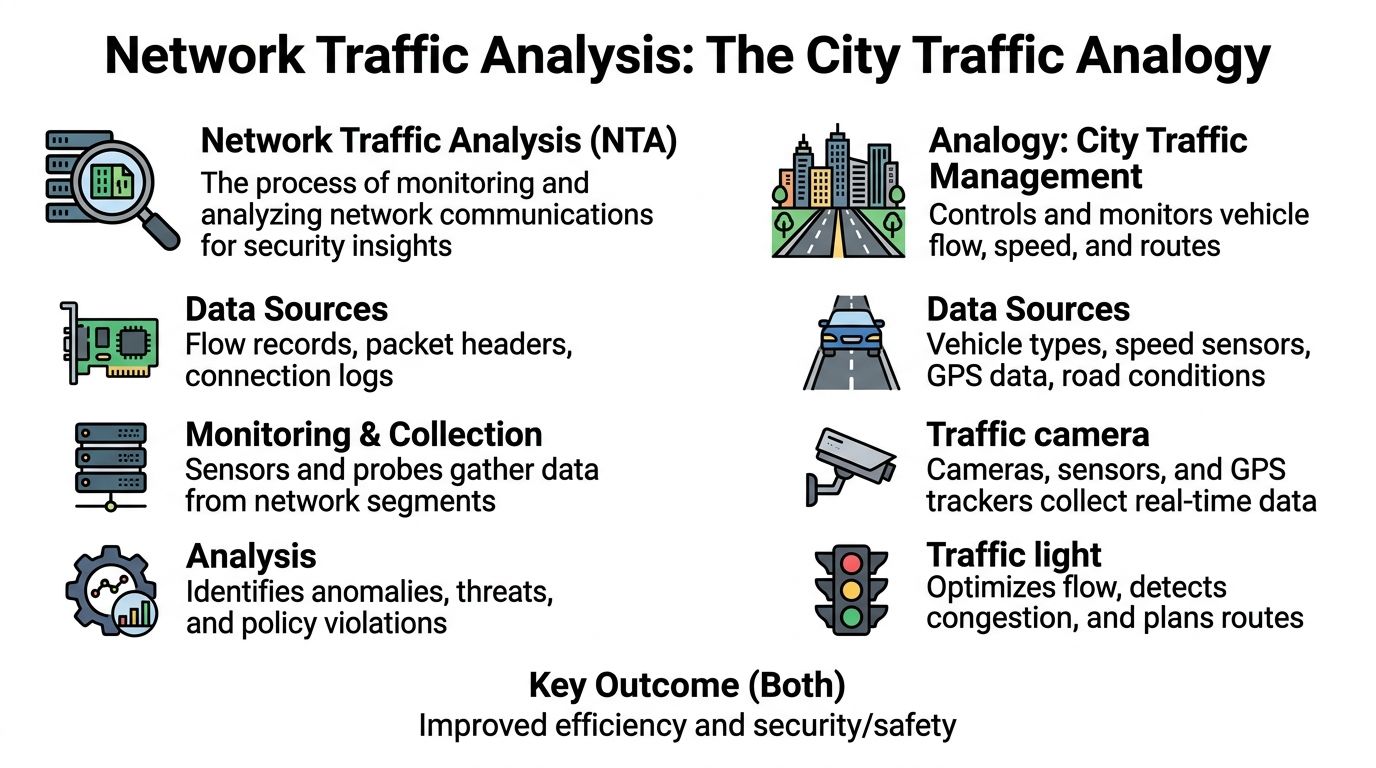
The easiest way to explain network traffic analysis is through a city traffic comparison. A city does not have to inspect the contents of every vehicle to understand congestion, risky routes, or abnormal movement. It observes where vehicles originate, where they head, how quickly they travel, when traffic surges, and which roads suddenly see unusual use.
Networks act no differently. Vehicles are packets. Traffic patterns are flows. NTA hones in on those patterns.
What NTA actually watches
A key transformation in NTA was the shift from basic packet inspection to flow-based monitoring using technologies such as NetFlow. That transition elevated NTA from a troubleshooting specialty into a core security layer that remains effective when traffic is encrypted because it relies on metadata rather than payload alone (Kentik explanation of NTA evolution).
In practice, NTA watches communication characteristics such as:
- Source and destination relationships between users, servers, subnets, and external services
- Protocol and port usage that doesn't match expected application behavior
- Timing and session behavior such as recurring connections at unusual intervals
- Volume and directionality that can signal scanning, staging, or exfiltration
That's why NTA is useful for both north-south traffic and east-west traffic. North-south indicates traffic entering and leaving the environment. East-west indicates traffic moving within it, which is frequently where investigations become costly.
How baselines make it useful
Raw telemetry is not the objective. The objective is knowing what normal looks like for your business.
A finance application server ought to communicate with a limited set of systems in predictable ways. A developer subnet may be noisy yet still consistent in its own pattern. A domain-adjacent asset contacting a rarely used internal service after hours could be entirely legitimate, or it could be the first meaningful sign of credential abuse. NTA works because it creates context around those differences.
A sound NTA deployment does not attempt to handle every protocol identically. It treats predictable systems as high-value baselines and noisy systems as areas where correlation matters more than isolated alerts.
Where NTA differs from DPI
Deep packet inspection asks, “What is inside the car?”
Network traffic analysis usually asks, “Why is that car taking this route, at this time, at that speed, and why are ten others suddenly following it?”
DPI is best when you require content-level detail and can bear the cost and complexity. NTA is best when you need broad, continuous visibility across modern infrastructure, especially where encryption restricts payload inspection.
For most enterprises, the practical solution is not one or the other. It is flow-first visibility everywhere, with deeper packet inspection where it is justified.
Key Data Sources and Collection Methods
Selecting NTA data sources is an architectural choice, not a tooling item to check off. The wrong collection model produces blind spots, storage problems, or both. The right one delivers broad coverage without overwhelming the network team or inundating the SOC.
The main collection options
Teams usually rely on four data sources in some combination.
| Data Source | Granularity | Network Overhead | Primary Use Case |
|---|---|---|---|
| NetFlow or IPFIX | Flow metadata | Low to moderate | Broad visibility, baselining, anomaly detection |
| sFlow | Sampled flow metadata | Low | High-throughput environments where scalability matters most |
| PCAP | Full packet detail | High | Forensics, protocol troubleshooting, selective deep investigation |
| Device and security logs | Event records and summaries | Low | Context, policy decisions, and correlation with traffic behavior |
Flow records generally convey the program. They scale effectively and retain the metadata that matters for detection. Packet capture offers deeper evidence, but only where the operational cost is justified. Logs supply the control-plane context that transforms traffic observations into analyst-ready conclusions.
A strong starting point is to pair flow data with network device monitoring so the security team can link communication changes to device state, routing problems, and interface behavior.
Unidirectional versus bidirectional flow design
One of the most overlooked NTA decisions is whether to rely on unidirectional flows, bidirectional correlation, or the two together. Traffic records are generally directional at the Internet layer, so teams can review them as one-way streams or combine them into request-response conversations. Unidirectional data is lighter and scales more easily, while bidirectional correlation strengthens incident reconstruction and anomaly baselining (LSU research on flow direction trade-offs).
Many teams underestimate how much that trade-off matters.
- Use unidirectional flow data when throughput is high, retention is important, and broad visibility is your main objective.
- Use bidirectional correlation when the SOC requires richer conversation context during investigations.
- Use both selectively provided the platform keeps cost and complexity in check.
What works in real environments
Flow-only collection suits broad detection and operational baselining. It falls short when analysts require payload-level proof for a particular protocol abuse case.
PCAP performs well at chokepoints, sensitive enclaves, and selective forensic tiers. It is not suited to be an always-on solution everywhere.
Logs are effective for clarifying policy actions, identity events, and application behavior. They cannot replace true network visibility, since they reveal only what a device or application elected to record.
Gather the least heavy data that still solves the question your analysts must solve. If you gather the heaviest data in every place, the program grinds to a halt before the first real investigation.
Core Network Traffic Analysis Techniques
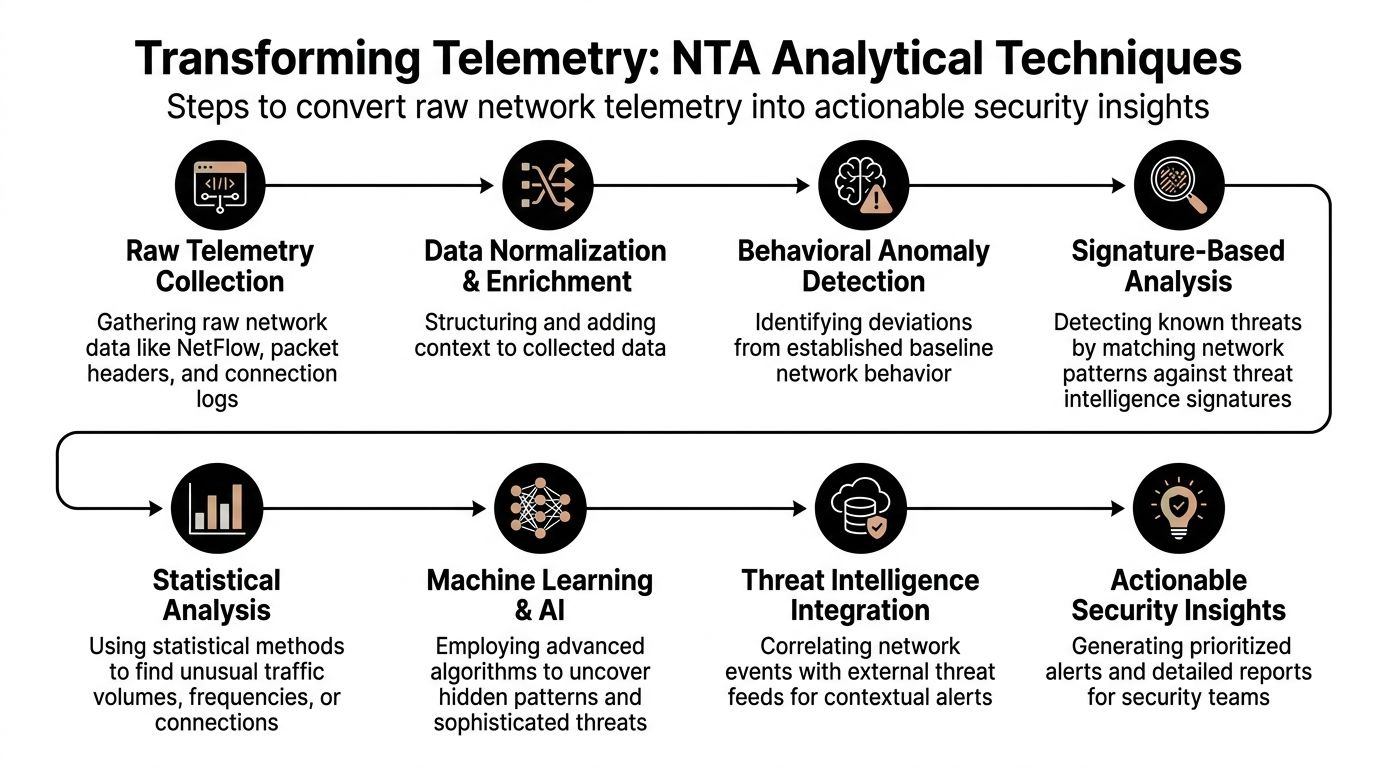
Strong NTA tools do not deliver value by retaining more telemetry. They deliver value by turning network behavior into a compact set of signals the SOC can rely on. That calls for a layered analysis pipeline, not one detection method.
Start with baseline and statistical analysis
Any effective NTA program starts by forming a baseline. The platform learns routine traffic relationships, communication timing, transfer volumes, protocol usage, and usual destinations for systems, segments, and service groups.
After that, statistical analysis makes the initial pass. It spots frequency shifts, transfer behavior spikes, unusual connection distribution, or new communication paths. This may not be glamorous, yet it detects a substantial share of meaningful issues because many attacks still appear as departures from expected behavior.
Add behavioral analytics and correlation
Anomaly detection forms the following layer. Present-day NTA depends more and more on flow metadata such as IP addresses, ports, protocols, traffic volume, timing, and connection behavior rather than payload inspection, which allows it to detect threats like command-and-control activity and data exfiltration even when channels are encrypted (NetWitness overview of metadata-driven NTA).
That becomes much more effective when correlated with controls such as an intrusion detection and prevention system. A network anomaly on its own can be weak. A network anomaly combined with an IDS signature and a suspicious authentication event is generally worth an analyst's attention and may warrant automation.
What high-value analysis looks like
The strongest NTA pipelines usually combine several methods:
- Behavioral baselining to understand what a host, subnet, or application normally does
- Rule-based detection for clearly suspicious patterns such as prohibited protocols or unexpected external destinations
- Threat intelligence enrichment to add context when a destination, service, or pattern maps to known risk
- Asset context so the platform knows whether the behavior involves a kiosk, domain service, privileged workstation, or crown-jewel application
That final point is where many deployments break down. If the tool lacks knowledge of an asset's business role, it views a lab device and a finance server too much alike. Analysts then tune around noise rather than enhance detection quality.
The best NTA detections usually aren't “rare traffic.” They're “rare traffic from an asset that should be boring.”
Why encrypted traffic is still visible
Encryption conceals payload content. It does not conceal that systems communicated, when they did so, how often they did it, how much data moved, or whether the destination and protocol pattern matched the baseline.
That leaves NTA among the few security controls that continue to yield signal as encrypted traffic becomes the norm.
Practical Threat Detection Use Cases
The quickest way to assess whether NTA justifies the effort is to examine the attack paths it reveals better than most other controls. Three use cases are relevant in nearly every enterprise environment.
Lateral movement inside the estate
An attacker gains an initial foothold on a user system. Endpoint telemetry can show the process tree, yet it frequently will not show the full shape of internal movement across neighboring systems. NTA closes that gap by exposing new internal communication paths that do not match historical behavior.
Common signals include:
- A workstation initiating connections to peer workstations when that pattern is normally absent
- A server reaching laterally into unrelated subnets outside its usual application dependencies
- A burst of internal service discovery behavior that looks like reconnaissance rather than normal application traffic
East-west visibility proves its worth. Even a minor deviation, like a system starting to contact internal services it has never reached before, can shift an investigation from vague suspicion to actionable containment.
Data exfiltration without obvious malware indicators
Data theft rarely signals its presence through malware signatures. It resembles a legitimate business system transmitting traffic. What matters is whether the destination, duration, and transfer pattern are plausible.
NTA proves especially valuable when data leaves through permitted channels. Analysts can identify outbound transfers that continue far longer than usual, unexpected relationships with destinations, or a server whose data movement begins in a way inconsistent with its function. This remains effective even if the content cannot be examined.
What usually works:
- Baselines for outbound behavior by asset class
- Alerts tied to unusual external relationships, not volume alone
- Correlation with change windows and approved business processes
What usually doesn't work:
- Static thresholds with no asset context
- Treating all outbound bulk transfer as equally suspicious
- Relying on firewall logs alone to infer impact
Command-and-control that tries to stay quiet
Numerous command-and-control channels are built to avoid notice. They rely on steady intervals, small connections, and protocols the environment already permits.
Even so, NTA can reveal them, since low and slow traffic frequently carries a behavioral signature. Small connections repeated to unusual destinations, odd timing, uncommon protocol and port pairings, or a host that starts beaconing consistently all become visible against a solid baseline.
Traffic that stays quiet is not necessarily safe. Across many breaches, the most useful signal is traffic whose discipline makes it look abnormal.
All three use cases point to one practical takeaway. NTA seldom succeeds by proving content is malicious. It succeeds by demonstrating suspicious behavior early enough for the SOC to respond.
Integrating NTA with SIEM and XDR
An independent NTA tool helps with investigations. It seldom suffices for current response operations. When network evidence remains in a separate console, analysts must switch tools manually, reconstruct context by hand, and determine under pressure whether an alert warrants containment. That lag is where many SOCs lose time.

The operational issue is not whether NTA ought to work with SIEM and XDR. It should. The issue is how to integrate it without generating signal overload.
Integration latency is an often overlooked challenge. A 2025 SANS survey found that 68% of SOC teams fail to automate responses due to NTA-SIEM integration latency, and teams need guidance on tuning thresholds and fusing flow data with SIEM correlation to trigger SOAR playbooks without generating false positives (Cisco discussion of NTA and SOC integration challenges).
What a workable architecture looks like
The most effective model is a layered pipeline:
- Ingest flow telemetry early sourced from routers, switches, firewalls, cloud flow logs, and security sensors.
- Normalize and enrich immediately paired with asset identity, subnet role, business owner, and threat context.
- Correlate before indexing where possible so noise from low-value traffic does not turn into long-term storage noise.
- Promote only high-confidence detections into automated response workflows and incident queues.
That final step is important. If every unusual flow becomes an alert, analysts will silence the category. If incidents are created only from correlated events with rich context, NTA begins to support automation rather than impede it.
How to reduce alert fatigue
SOC teams tend to make one of two errors. They tune too broadly and become overwhelmed by benign anomalies, or they tune too narrowly and overlook the gradual behavioral changes NTA excels at detecting.
A better pattern is to create tiers of action:
- Observation tier for weak anomalies that feed baselining and hunt workflows
- Analyst review tier for suspicious traffic plus at least one supporting signal
- Automated action tier for detections that combine network behavior, asset criticality, and confirming evidence from another control
One practical example is using behavior anomaly detection within a unified workflow, so network deviations are evaluated together with endpoint and log evidence instead of being elevated to standalone alarms.
Where a unified platform helps
Here, architecture counts more than brand. An open-source SIEM/XDR platform like Unified Security Stack can take in logs, NetFlow, Syslog, API-fed cloud events, and agent telemetry, then correlate them in real time before indexing. This method helps because it cuts duplicate alerts and allows automated playbooks only once multiple signals align.
The impact is substantial in daily SOC operations. Rather than a network analyst using one console and an endpoint analyst using another, the team operates from a common incident context. This makes containment decisions quicker and easier to defend.
A short walkthrough helps make the integration model concrete:
What to automate and what not to automate
Automate only reversible, evidence-based actions. Quarantine a host, enrich a case, raise logging levels, block a known-bad destination, or open an incident with network context attached.
Do not automate destructive actions from a single traffic anomaly. NTA is powerful, yet the safest response design still relies on correlation and confidence scoring before altering production behavior.
Your NTA Implementation Checklist
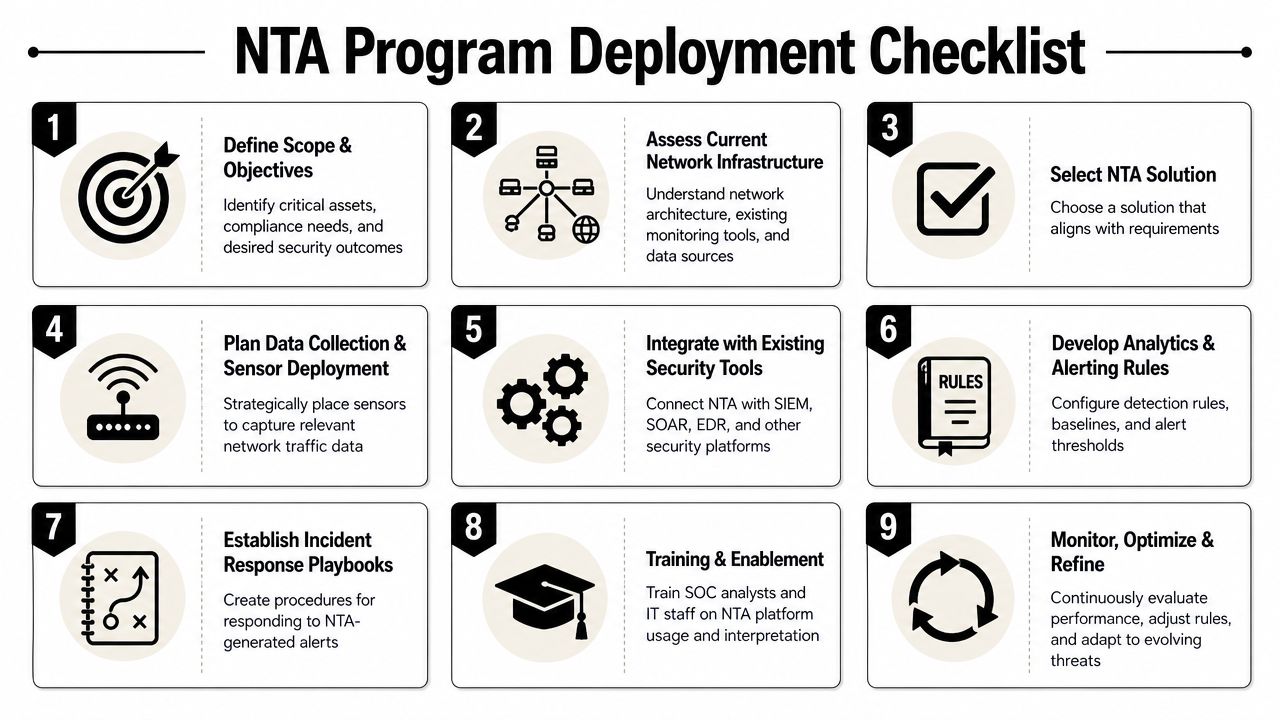
Most NTA programs fail because teams acquire visibility before determining which decisions it should support. Begin with operational outcomes. Then construct the telemetry and automation around those outcomes.
The practical rollout sequence
- Begin by defining the objectives for detection. Choose a limited set of priority outcomes, including lateral movement, command-and-control, and suspicious outbound transfer from sensitive systems.
- Identify the critical network segments. Concentrate on data center chokepoints, cloud entry and exit paths, privileged enclaves, and the internal routes around high-value assets.
- Select the appropriate collection model. Rely on flow records at scale, logs to provide context, and packet capture only when deep inspection is operationally warranted.
- Tag assets prior to tuning detections. Do not judge traffic from a domain-adjacent server the same way as traffic from a test box.
- Build a baseline window. Allow the program enough time to learn business rhythm before enabling aggressive alerting.
- Create alert tiers. Keep hunt signals separate from analyst-review alerts and automated-response candidates.
- Connect with SIEM and SOAR early on. If NTA is not connected to response workflows, it becomes just another console rather than a force multiplier.
- First, validate playbooks using safe actions. Begin with enrichment, case creation, and containment actions that can be reversed.
- Continuously evaluate exceptions. Shifts in the business, changes in the cloud, and new applications will invalidate prior assumptions.
What success looks like
Success is not simply that we collect NetFlow now. Success is more specific.
- Analysts can explain why a network alert matters
- Investigators can scope affected systems quickly
- The SOC can automate some containment actions without guessing
- Security leadership can show that network telemetry supports detection, response, and audit needs
Shape the NTA program around decisions rather than dashboards. If a detection cannot alter triage, containment, or investigation quality, it is not mature enough yet.
If your team wants to operationalize network traffic analysis inside a unified detection and response workflow, Unified Security Stack is one option to assess. It unites SIEM, SOAR, and XDR capabilities with ingestion for logs, NetFlow, Syslog, APIs, and agents, making it a fit for teams that want correlated detection and automated response without managing a set of disconnected tools.