Managed SIEM Services: Your 2026 Buyer’s Guide
You already sense it when your team is buried under alerts, compliance keeps requesting better evidence, and no one wants to take on a 24/7 rotation that exhausts staff within six months. A managed SIEM services model exists because most security teams do not fall short on intelligence; they fall short on capacity, maintenance, and triage discipline. The challenge is not acquiring visibility but preserving its usefulness as the environment, threats, and audit schedule continue to shift.
Table of Contents
- Why Managed SIEM Services Are Reshaping Security Operations
- Comparing MSSP, Managed SIEM, and Co-Managed Models
- Core Capabilities to Evaluate in a Managed SIEM Platform
- The Hidden Costs and True Total Cost of Ownership
- Evaluation Checklist and SLA Framework for Vendor Selection
- Real-World Use Cases and Measurable Outcomes
- Actionable Next Steps for Implementation
Why Managed SIEM Services Are Reshaping Security Operations
A midsize security team typically does not choose to outsource SIEM operations during a tidy budget cycle. It reaches that point after three weeks of alert backlog, after the person who loosely owns logging is reassigned to another project, and after auditors request evidence that takes hours to pull together from half a dozen tools. At that stage, managed SIEM services stop appearing as a convenience and start appearing as an operating model that keeps the business defensible.
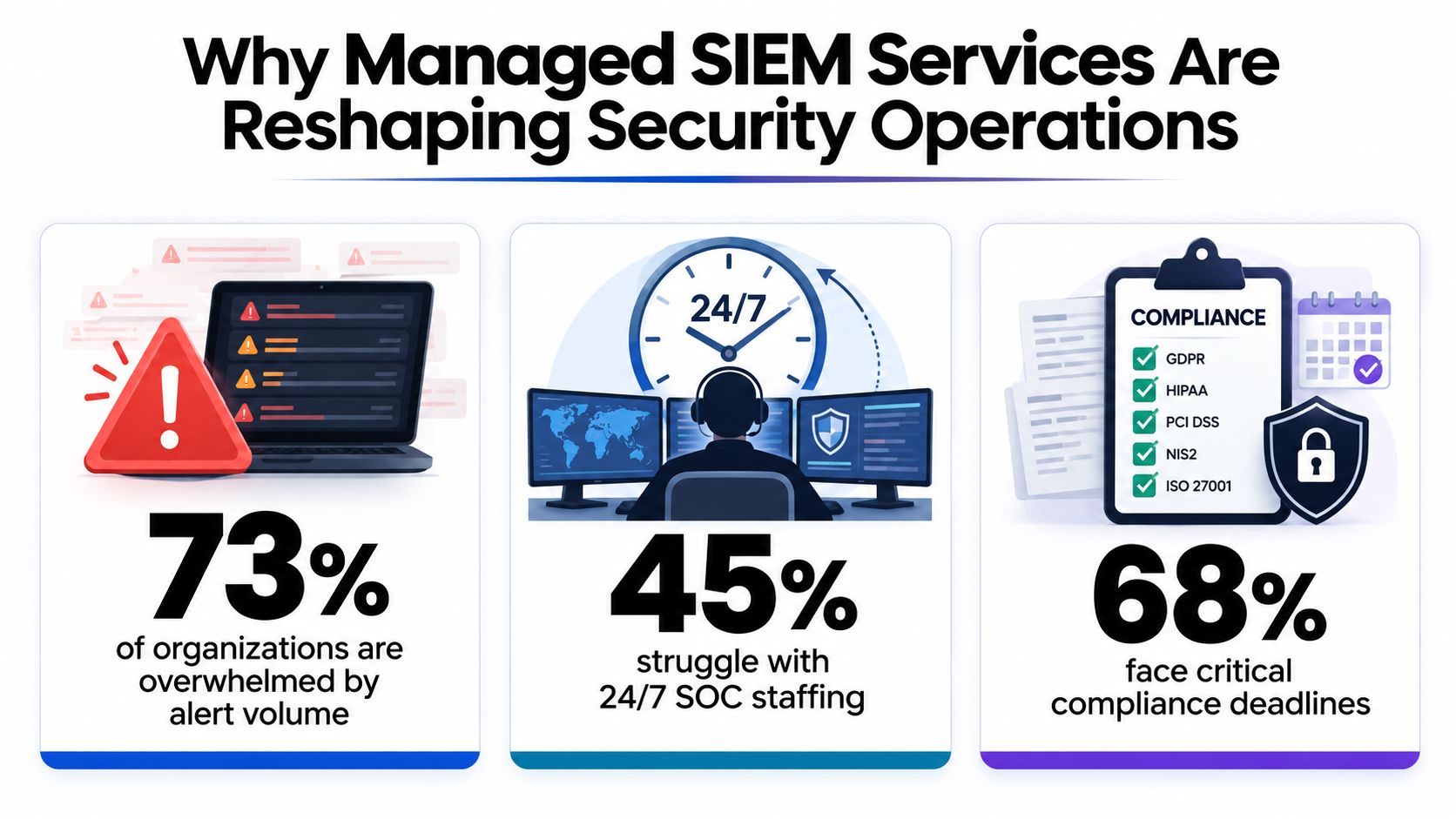
The service model is clear-cut. A provider manages data collection, threat analysis, and expert validation or response, while your team receives prioritized findings rather than raw event noise. In practice, this means continuous ingestion from endpoints, firewalls, cloud platforms, SaaS applications, identity systems, and network devices into a centralized repository, then correlation and analyst review to lower false positives and escalate real issues. That operating pattern mirrors the one used in practical managed service designs, including the managed SOC model described by Unified Security Stack managed SOC services, in which a unified platform serves as the foundation for collection, detection, and response workflows.
That change is most important in regulated environments. Healthcare, finance, and government-adjacent organizations require coverage that does not end at 5 p.m., and they need reporting that can withstand audit scrutiny. Published market estimates indicate managed SIEM is growing from USD 7.5 billion in 2023 to USD 16.0 billion by 2028, implying roughly 16% annual growth MarketsandMarkets managed SIEM market estimate.
Practical rule: if your team cannot consistently tune detections, triage alerts, and generate evidence when needed, your issue is not tooling. Your issue is the operating model.
The service also suits environments where the customer needs visibility without owning every control surface. That is why buyers frequently compare it to physical access systems, such as cellular vs NFC gate access, where the value lies less in the hardware itself and more in who manages the flow, the exceptions, and the audit trail. Managed SIEM operates the same way. The provider runs the machinery, yet the organization still must control policy, scope, and response thresholds.
Comparing MSSP, Managed SIEM, and Co-Managed Models
A SIEM contract may appear simple on paper and still cause confusion when alerts begin to flow. The distinction between MSSP, managed SIEM, and co-managed SIEM is not the name. It is who owns the log pipeline, who modifies detections, who approves exceptions, and who must respond when an alert turns into an incident.
Operating responsibility offers the clearest distinction among these models. An MSSP usually combines several security services, managed SIEM concentrates on logging and detection, and co-managed SIEM splits day-to-day tasks between the provider and the in-house team. Within a mature SOC, co-managed SIEM enables internal analysts to keep authority over policy and response choices. In a smaller setting, fully managed SIEM eases the staffing load and avoids having to create an entire internal monitoring capability from the ground up. For a practical illustration of that service model, see managed SOC services.
Service Model Comparison
| Dimension | MSSP | Managed SIEM | Co-Managed |
|---|---|---|---|
| SIEM infrastructure ownership | Often provider-owned, but broader service scope varies | Provider owns and runs the SIEM platform | Shared, with clear split of duties |
| Correlation rule tuning | May be included as part of a wider bundle | Core part of the service | Shared between provider and internal analysts |
| First-level triage | Usually covered, but service breadth can dilute focus | Central function of the service | Shared, often with internal escalation paths |
| Incident response escalation | Depends on contract and bundle scope | Typically included in a defined workflow | Joint process, frequently adapted to internal needs |
| Compliance reporting | Can be included, sometimes as an add-on | Commonly included in the model | Often customized to internal control needs |
| Best fit | Broad outsourcing of multiple controls | Organizations that want SIEM operations offloaded | Teams that want help but won't give up oversight |
The concealed cost often lies in the handoffs. Compliance obligations such as HIPAA, PCI DSS, and CMMC do not only alter what gets logged; they alter how fast evidence must be produced, who approves containment, and whether the provider can act without waiting for internal approval. That is why the least expensive proposal can turn into the most expensive once you add integration work, rule maintenance, evidence collection, and additional coordination meetings.
Co-managed SIEM fails when neither team owns rule approval timelines. Alerts accumulate, exceptions remain open, and both sides assume the other will resolve the false positives. The model works only when the provider and the internal team have a clear division for tuning, escalation, and incident decisions. Fully managed SIEM is more sensible when the provider must own the platform, the detections, and the monitoring workflow end to end. MSSP bundles can still be valuable, but they often obscure how much depth the SIEM function receives.
A better way to evaluate the model is through control. If your team must retain policy authority, co-managed SIEM is the cleaner option. If your staff cannot realistically tune detections or review evidence consistently, outsourcing the SIEM layer eases operational strain. If you seek a platform that can support in-house operations, co-managed workflows, or a fully outsourced model without altering the underlying architecture, an open-source backbone such as Unified Security Stack can fill that role without requiring a separate tool stack.
The vendor that claims it can do everything frequently owns very little with sufficient depth.
The final decision is not only about the monthly service cost. It is about how much internal ownership you can retain, how much integration work you are prepared to fund, and whether the operating model still stands when an incident demands a fast decision.
Core Capabilities to Evaluate in a Managed SIEM Platform
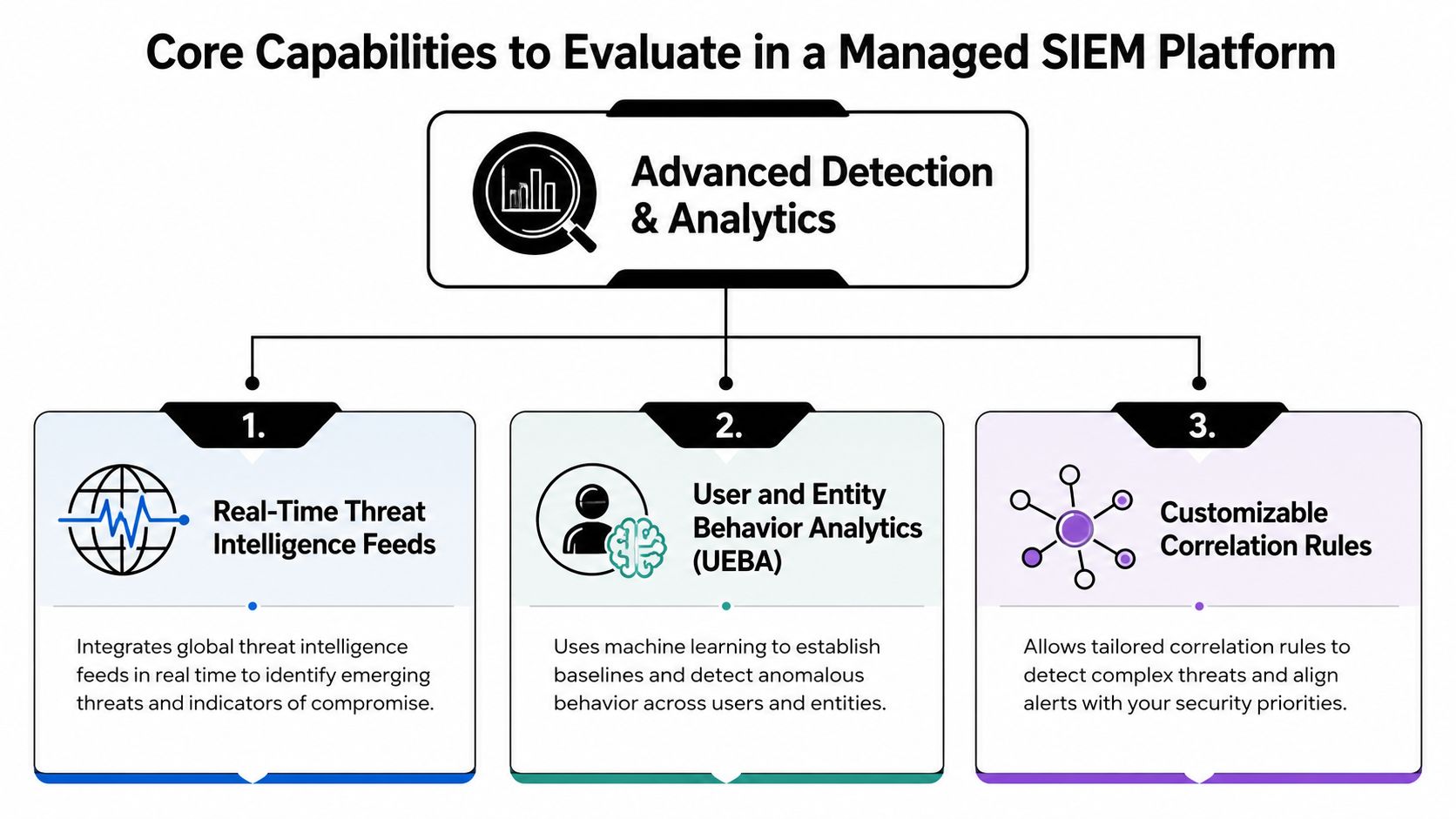
A managed SIEM can appear polished in a demo and still fail in production if the underlying platform is weak. The gap between a commodity monitoring service and a serious detection program usually appears in ingestion quality, rule engineering, and how quickly analysts can separate signal from noise.
Ingestion and correlation come first
Begin with the log pipeline. Ask if the service can ingest data through APIs, Syslog, NetFlow, and agents, since different environments reveal different blind spots. A provider that supports only a limited set of connectors will compel you to compromise visibility just to launch the project.
Real-time correlation before indexing also matters. Unified Security Stack, for instance, is positioned as an open-source SIEM, SOAR, and XDR platform that ingests from cloud services, network devices, and endpoints through those same common methods, then correlates events in real time before indexing to reduce noise and speed detection. That architecture is a valuable benchmark when you are comparing vendor proposals, because it makes the ingestion and normalization layer visible rather than treating it as a black box.
Detection engineering should be custom, not generic
The next check concerns detection maintenance. A provider should not simply depend on a generic rule pack and label it a managed service. UnderDefense describes platform management as covering health monitoring, performance tuning, storage optimization, and index management, plus custom rule tuning against the customer's environment, which is exactly what keeps alert fatigue from swallowing the team UnderDefense's managed SIEM guidance.
Another question to raise is how false positives are reduced. This is the point where LLM-assisted triage has begun to carry weight. Used well, it can help condense noisy alerts, group similar events, and speed up analyst review. Used poorly, it turns into a shortcut that conceals weak detection logic.
Good question to ask: which detections are tailored to the customer, and which are taken from a generic library with no tuning for the environment?
Response and compliance need to be operational, not decorative
A serious service should also include SOAR-driven response playbooks, not merely dashboards. NetWitness describes managed SIEM as a remote SOC model in which the provider deploys, monitors, tunes, and operates the platform while providing detection, investigation, compliance reporting, and response NetWitness on managed SIEM services. That is the benchmark to measure against, because monitoring without response is merely better reporting.
Unified Security Stack's SIEM on cloud is worth examining as a reference point if you want to compare cloud-delivered capabilities without being trapped in a closed architecture. The important factor is not the label; it is whether the platform can bring telemetry together, enable correlation, and back response workflows without forcing you to rebuild the stack later.
The Hidden Costs and True Total Cost of Ownership
The most common error in a managed SIEM purchase is to compare subscription price with salary cost and stop there. That conceals expenses that emerge after onboarding, especially once ingestion expands, integrations increase, and compliance asks for special handling.
A more precise model considers the vendor invoice, the internal labor needed to oversee the vendor, and the friction caused by data handling rules across jurisdictions. Panther directly cautions buyers to budget 25% to 50% for hidden costs and to define requirements around compliance, integrations, SLAs, budget, and data sovereignty before signing Panther's managed SIEM buying guidance. That warning matches what many teams discover only after the contract is signed.
The cost buckets buyers miss
The typical hidden costs become predictable once you know where to look.
- Data movement charges can surface when logs cross regions or cloud boundaries.
- Ingestion-based pricing can penalize you for enhancing coverage.
- Premium support tiers can become unavoidable when expectations for incident response increase.
- Compliance report add-ons may transform a baseline service into a collection of add-ons.
- Internal vendor-management time becomes an actual line item when your team must follow up on support, review outputs, and validate rule changes.
If that sounds like cost allocation tasks in a finance platform, that is because it is. For a helpful mental model, cost allocation techniques for ai teams helps show how overhead is concealed inside shared services and why a clear allocation method matters before you compare vendors.
Build the TCO around operating reality
A true TCO estimate ought to answer several questions before procurement is engaged. How many log sources will be brought onboard? Who handles connector failures? What happens when compliance asks for a new report format? Which team takes ownership of the vendor relationship after go-live?
That is where an open-source foundation such as Unified Security Stack changes the calculation for some organizations. Its centralized log management and modular stack can lower lock-in and make integration choices more flexible, which matters if you want to keep options open for in-house, co-managed, or fully outsourced operations. See centralized log management if you are comparing the operating model from a platform standpoint.
The main takeaway is straightforward. Managed SIEM can surely reduce operational burden, but only if you account for the costs the contract does not advertise. If you fail to do so, the service appears less expensive than it is, right until the first renewal.
Evaluation Checklist and SLA Framework for Vendor Selection
A feature-by-feature comparison will not reveal whether a managed SIEM provider can withstand strain. What you need is a checklist that examines how the service responds when log volume spikes, a connector fails, or compliance requests proof inside a tight audit deadline.
Begin with deployment flexibility. The provider should clarify how it supports cloud, hybrid, and on-prem environments without imposing a uniform rollout. Then press on integrations, since a SIEM that cannot connect cleanly to identity, endpoint, cloud, and network systems will create gaps that analysts ultimately bridge by hand.
What to verify before you sign
- Deployment flexibility: verify that the service can support cloud, hybrid, and on-prem architectures without requiring you to redesign your environment.
- Integration breadth: request evidence of maintained connectors, rather than a promotional list of potential integrations.
- Compliance mapping: check that frameworks within your scope are supported, particularly when you require reporting ready for audits.
- Detection engineering maturity: find out who authors the rules, who signs off on changes, and how tuning for your environment is managed.
- Incident response workflow: confirm the escalation path for alerts, who is paged, and what context accompanies them.
SLA wording is just as important as the technical checklist. You need definitions for mean time to detect, mean time to respond, escalation thresholds, commitments for log retention, and reporting frequency. Those terms have value only if the provider can demonstrate how it measures them and what occurs when performance drops.
The video below can serve as a helpful companion as you stress-test the vendor conversation.
Negotiation rule: if the SLA fails to specify who owns each handoff along the incident path, it is not an SLA; it is marketing material.
Warning signs typically emerge early. A vendor that refuses to discuss connector maintenance, avoids clear retention definitions, or remains vague about compliance reporting is signaling that the service is thinner than it appears. This also applies to platforms that hide response work behind premium tiers. If faster detection is the central promise, the service should prove it in the contract, not in a slide deck.
Real-World Use Cases and Measurable Outcomes
Managed SIEM becomes credible only when it alters daily operations. The outcomes that count are less about abstract maturity and more about whether a team can resolve incidents faster, respond to auditors more cleanly, and spend less time piecing together evidence from disparate systems.
Healthcare is the clearest example. HIPAA drives organizations toward disciplined access logging, consistent review, and evidence that can be defended. Managed SIEM supports this by centralizing logs and generating compliance reporting without making the internal team babysit the platform, which is why healthcare buyers typically prioritize audit readiness over impressive detection language.
Financial services teams assess the same service through a different lens. PCI DSS and GLBA create stricter expectations for log review, investigation, and retention discipline. A managed SIEM that handles triage and reports cleanly gives finance teams a more dependable audit path than scattered logs and manual review cycles.
Government contractors face a different pressure point. CMMC requires stronger logging and incident response practices, so the service must support evidence collection as part of operations, not after the fact. Providers able to map detections and reports back to control requirements reduce the rush that often occurs during assessment preparation.
Organizations that select an open-source platform like Unified Security Stack often do so because they want greater transparency into how detections, logs, and response artifacts are handled. That does not eliminate the need for process discipline, but it does make the actions of the service easier to see.
One practical way to gauge success is to ask three questions after deployment.
- Did alert quality improve enough that analysts no longer recheck obvious noise?
- Did audit evidence become easier to generate without additional manual effort?
- Did the organization retain sufficient control to adjust the model later should regulations, staffing, or geography shift?
Those are business results rather than product capabilities. They are also the results executives recall when renewal season approaches.
Actionable Next Steps for Implementation
The quickest route to a failed managed SIEM rollout is to begin with wide deployment and no decision framework. A phased approach is more effective because it surfaces integration gaps early and stops the team from overcommitting before the service demonstrates its value.
Phase 1 Discovery
Begin with an audit of log sources and a review of compliance gaps. Identify the systems most critical for detection and the frameworks relevant to the business, then determine where logging is missing, excessive, or unavailable. This stage should conclude with a basic inventory, a prioritized list, and a clear picture of which sources fall within the pilot scope.
Phase 2 Pilot
Constrain the pilot to a portion of critical assets and the detections most important to the business. The objective is to verify ingestion, rule tuning, and alert routing before expansion. If the provider cannot manage those fundamentals reliably, the issue will only become more costly at scale.
Phase 3 Rollout
Broaden coverage, introduce custom correlation rules, and educate the internal owners who will work with the service every day. This is also the point where the operating model should be settled, whether fully managed, co-managed, or partly in-house. Unified Security Stack can enable that journey because it brings together log management, vulnerability scanning, access rights auditing, endpoint protection, dark web monitoring, file tracking, and response playbooks in one stack, giving teams space to evolve without changing platforms.
Phase 4 Optimize
After the environment stabilizes, plan ongoing tuning and review. Detections shift, assets change, and auditors routinely request one more artifact than anticipated. The service remains valuable only if someone continually measures what it detects, what it overlooks, and where the workflow becomes slow.
If you are building a 90-day plan, keep it straightforward. Audit first, pilot second, and expand only once the alert pipeline and reporting workflow prove reliable under real conditions. That is how you prevent managed SIEM from becoming an expensive subscription rather than an effective security operating model.
A CTA for Unified Security Stack.