SIEM on Cloud: Modernizing Threat Detection for 2026
Your team is familiar with this pattern already. The on-prem SIEM remains in operation, yet it now acts as a bottleneck rather than a force multiplier. Cloud logs show up delayed or incomplete. SaaS activity lives in disconnected consoles. Endpoint and identity events do not align cleanly. Analysts waste time switching between tools, and even then they question whether the alert is genuine.
That's why the conversation around SIEM on cloud has shifted. The focus is no longer on pursuing a newer deployment model. It is about whether your detection stack can match the way the business runs today: remote workers, expanding SaaS, cloud control planes, hybrid infrastructure, and log volumes that seldom stay level for long.
Leaders considering a shift to cloud SIEM typically do not need another sales pitch. What they need is a grounded assessment of architecture, deployment options, concealed expenses, and the operational effort needed to make the platform valuable once it is live.
Table of Contents
- The Tipping Point for Legacy SIEM
- Understanding Cloud SIEM Architecture and Components
- Cloud SIEM Deployment Models SaaS vs Self-Hosted vs Hybrid
- Strategic Benefits and Realistic Trade-Offs
- Mastering Log Ingestion and Correlation in Hybrid Environments
- Navigating Security Compliance and Scaling Costs
- Evaluating and Choosing Your Cloud SIEM
- Migration and Operational Best Practices
The Tipping Point for Legacy SIEM
An older SIEM generally does not break down in a single moment. It deteriorates operationally.
At first, teams filter more aggressively because ingestion capacity is limited and storage is costly. Next, cloud and SaaS logs are brought in inconsistently because legacy connectors were designed for network devices and Windows events, not platforms driven by APIs. Eventually, the SOC begins trusting just a narrow slice of alerts because too much context resides outside the platform.
That is the breaking point. The tool remains in place, yet it no longer mirrors the environment it is meant to protect.
Today's enterprise produces telemetry across endpoints, SaaS, IaaS, and multi-cloud environments, and that data must be centralized for correlation. Cloud SIEM grew out of that change. Platforms collect logs through APIs, normalize them into one view, and run analytics so teams can spot threats faster than manual review allows, while scaling more readily as volume increases, as covered in Splunk's overview of SIEM and cloud-delivered analytics.
Legacy SIEM difficulties are usually not a detection issue at the outset. They are a data movement and correlation issue that in time turns into a detection issue.
What makes this urgent in operational terms is the gap between legacy collection assumptions and modern attack paths. An adversary does not care where the signal sits: Microsoft 365, an endpoint agent, AWS activity, or an on-prem firewall. The order is what counts. If your SIEM cannot piece that order together quickly, your analysts must correlate from memory and browser tabs.
Common symptoms show up early:
- Alert queues expand at a quicker rate than triage capacity.
- Investigations demand manual switches among cloud, endpoint, and identity tools.
- Retention policies are driven by hardware limitations rather than investigative requirements.
- SOC confidence falls because detections do not carry enough context to be conclusive.
The strategic rationale for SIEM in the cloud begins at that point. This is not modernization in the abstract. It is a transition from monitoring limited by infrastructure to an operating model designed for distributed telemetry and ongoing correlation.
Understanding Cloud SIEM Architecture and Components
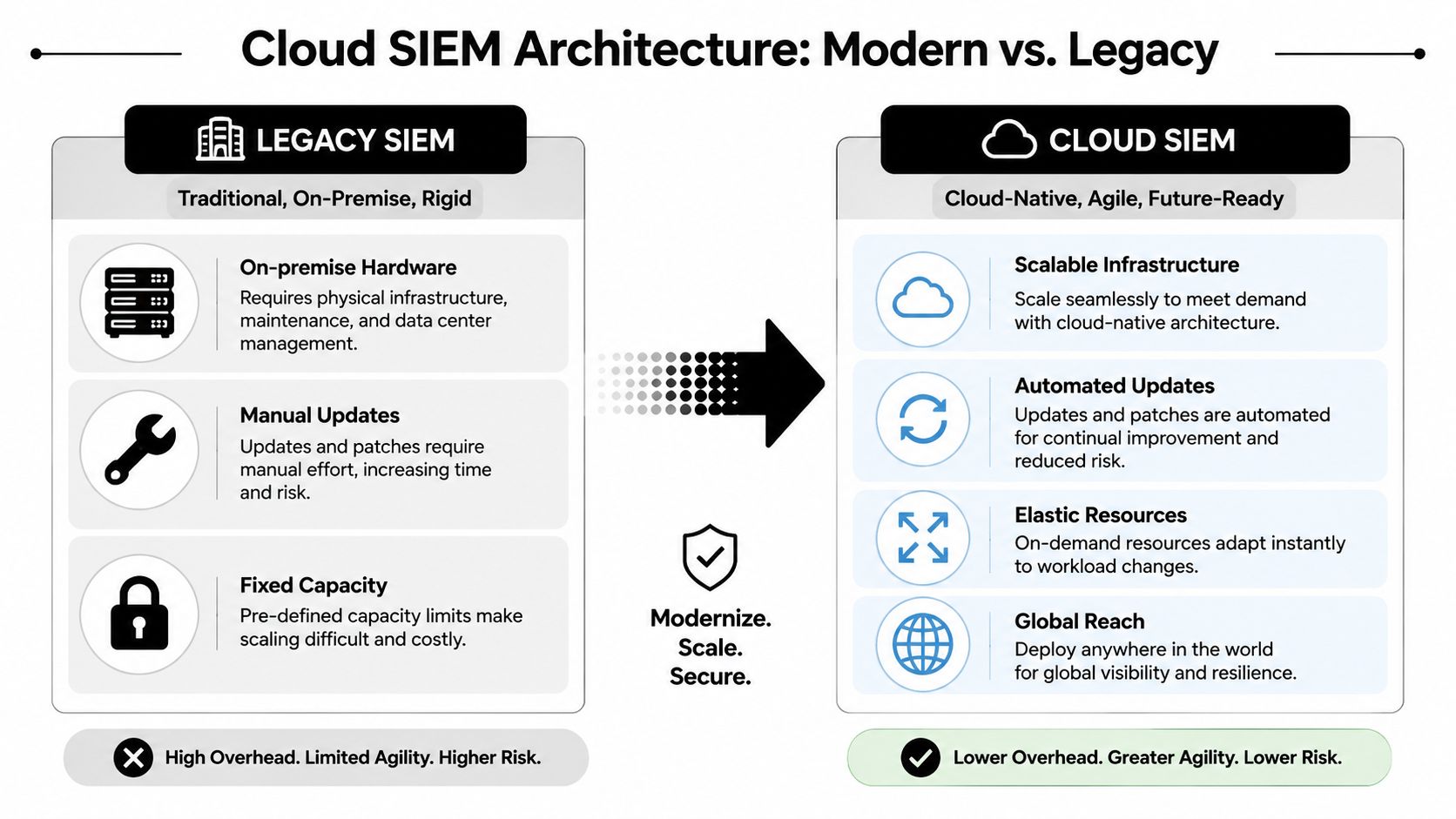
One helpful way to view the architectural change is this: a legacy SIEM resembles a local library with restricted shelf space, set staffing, and a manual intake counter. A cloud SIEM is more like a digital archive with distributed intake, searchable storage, and processing capacity that grows when demand surges.
That change is important because modern telemetry does not come in a single format, from a single network, on a single schedule.
Why the architecture changed
Cloud SIEM exists because organizations must gather data from endpoints, SaaS platforms, IaaS environments, and multiple clouds, then normalize that telemetry into a single analytical workflow. Practically speaking, the platform takes in data through APIs and other collectors, standardizes fields, and runs analytics over a shared dataset rather than making analysts compare raw logs from disconnected systems. A brief explainer on what a cloud SIEM is is helpful if you need a fast technical baseline before evaluating vendors.
The most significant architectural difference is not merely where hosting occurs. It is where scale and correlation happen. In a cloud-native model, storage and compute scale with workload. This allows the analytics layer to continue processing even when event volume surges, rather than forcing teams to choose between performance, retention, and data breadth.
The core building blocks
Four components underpin most dependable cloud-based SIEM designs.
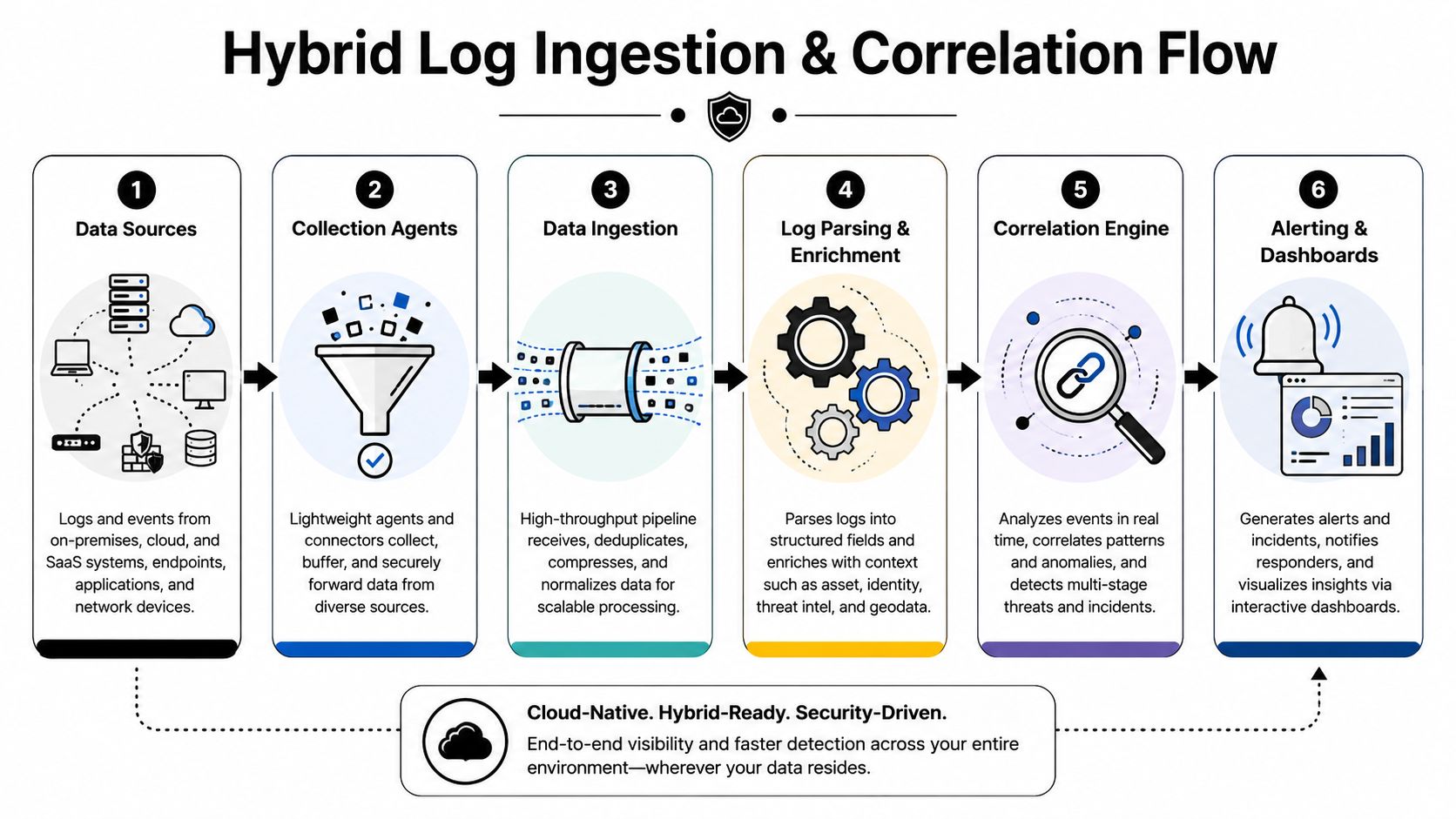
- Ingestion layer: APIs, agents, syslog relays, and cloud-native connectors pull telemetry from systems such as Microsoft 365, endpoint agents, identity providers, and cloud platforms.
- Normalization and enrichment pipeline: Raw events are translated into shared fields so the platform can evaluate disparate sources side by side. Usernames, host identifiers, geolocation context, asset tags, and severity labels all require uniform structure.
- Analytics and correlation engine: Low-level events are connected by rules and behavioral logic to produce detections with greater confidence. In this case, a login anomaly, a privilege change, and suspicious endpoint behavior form one incident rather than three separate alerts.
- Response and orchestration layer: A strong cloud SIEM goes beyond alerting. It routes detections into playbooks, ticketing systems, case management, or containment actions.
Practical rule: When a vendor focuses mainly on dashboards, ask how data is normalized, where long-term telemetry is stored, and what occurs between ingestion and alert generation. That is where a platform either builds trust or produces noise.
Optimal architectures further divide hot investigation data from less expensive historical storage. This design decision influences much more than cost. It decides whether your team can search across a wide forensic window without reconstructing the system whenever retention requirements shift.
Cloud SIEM Deployment Models SaaS vs Self-Hosted vs Hybrid
Decisions about deployment models seldom come down to ideology. They concern who operates the platform, where the data resides, and how much operational responsibility your team prefers to retain.
Many failed SIEM on cloud initiatives begin with the mistaken belief that cloud means one single model. It does not. A multitenant SaaS SIEM, a self-hosted deployment in your own cloud account, and a hybrid architecture can each be valid. They address different problems.
How the models differ in practice
SaaS SIEM Works best when speed and reduced platform-management overhead are the top priorities. The vendor takes care of the service layer, upgrades, and much of the infrastructure lifecycle. Your team concentrates more on onboarding data, tuning detections, and executing response. This model frequently fits lean internal SOCs and distributed organizations that do not want to run SIEM infrastructure as a specialty.
Self-hosted cloud SIEM Makes sense when control is the main driver. Some teams need stricter management of data paths, more extensive customization, or the capacity to align the platform with internal engineering standards. This path can succeed if you already run mature cloud infrastructure and have staff who can handle scaling, storage, resilience, upgrades, and performance tuning. It is not a quick route to simplicity.
Hybrid SIEM It is often the right choice when some telemetry can move freely to cloud analytics and some cannot. That situation commonly arises in regulated environments, older datacenter-heavy estates, or organizations with network enclaves and legacy systems that remain operationally important.
If your team is also weighing the infrastructure implications beyond SIEM, the ARPHost cloud infrastructure guide Serves as a useful reference for evaluating public versus private cloud trade-offs at the hosting layer.
Cloud SIEM Deployment Model Comparison
| Criterion | SaaS SIEM | Self-Hosted Cloud SIEM | Hybrid SIEM |
|---|---|---|---|
| Management overhead | Lowest platform overhead for the customer | Highest. Your team runs the stack | Shared. More pieces in motion than either pure model. |
| Time to deploy | Usually faster | Slower because architecture and operations are customer-owned | Moderate to slow depending on data paths |
| Customization | Depends on vendor controls and APIs | Highest flexibility | Moderate. Customization is frequently divided among environments. |
| Data sovereignty | Provider-dependent | Stronger customer control | Useful when only part of the data can move |
| Cost structure | Subscription-oriented, easier to start | More operational ownership and cloud cost management | Can be efficient, but integration complexity adds cost |
| Maintenance responsibility | Mostly vendor-managed | Customer-managed | Shared between customer systems and cloud service |
| Best fit | Lean teams and fast rollouts | Mature engineering teams needing control | Regulated or mixed environments |
A managed service model delivered through the cloud also belongs in this conversation. If you are comparing SaaS operation approaches, SIEM as a service Provides a helpful frame because it underscores the distinction between consuming software and consuming outcomes.
A single difficult fact holds true for all three models: select the model your team can run consistently, not the one that appears most flexible in a slide deck.
Strategic Benefits and Realistic Trade-Offs
The most compelling reason to shift SIEM to the cloud is not convenience. It is that legacy economics frequently skew security decisions.
As on-premises storage grows costly, teams begin rationing telemetry. They cut sources, shorten retention, or lower fidelity. That makes later investigations more difficult. A key driver for cloud SIEM adoption is the capacity to use cloud repositories or security data lakes for longer-term analytics, hunting, and compliance review, which raises the odds of uncovering slow-burn attacks over days, weeks, or longer, as discussed in Graylog's analysis of why cloud SIEM makes operational sense.
Where cloud SIEM changes the economics
Extended retention produces a practical benefit. Analysts can pose better questions because the data remains available. You are not pushed into a limited, real-time-only security posture in which anything not detected immediately is effectively out of reach.
Automation is the second key advantage. When detections link directly to orchestration or response playbooks, teams no longer treat each alert as a new manual investigation. That does not eliminate the need for analysts. It eliminates repetitive steps that introduce delay and inconsistency.
A workforce benefit also matters in mature programs. Security engineers should devote more time to improving detections and less to maintaining storage tiers, rebalancing clusters, or justifying hardware budgets.
What the marketing pages usually skip
The cloud model carries its own drawbacks when poorly designed.
- Egress and bandwidth: Moving data carries cost. Fetching, relaying, and multi-region flows may grow costly or sluggish.
- Vendor lock-in: Vendor-specific schemas, query syntaxes, and bundled content may turn later migration into a painful effort.
- Shared responsibility confusion: Even with a managed service, your team remains responsible for onboarding data, validating rules, and designing response.
- Sovereignty and residency: Certain environments are unable to place every log category onto a provider-run platform absent legal and policy review.
Cloud SIEM reduces certain infrastructure burdens. It does not eliminate the need for architectural discipline.
The balanced business case is clear. Cloud-based SIEM generally provides teams with improved scalability, wider retention, and more practical operations across hybrid environments. Yet those benefits appear only when leaders cost out the whole lifecycle, comprehend data movement, and refrain from treating the vendor as the owner of detection strategy.
Mastering Log Ingestion and Correlation in Hybrid Environments
Most cloud SIEM results are determined well before the first alert is triggered. They are determined in ingestion design.
When logs arrive late, lack enough context, or come in incompatible formats, the analytics layer cannot save the program. Teams then fault false positives when poor collection strategy is the actual problem.
Three ingestion patterns that actually work
Hybrid environments typically require more than one collection approach.
API-based ingestion for SaaS and cloud platforms
For sources such as Microsoft 365 and cloud audit systems, this is the cleanest path. It maintains provider-native semantics and lessens the need for fragile parsing.Agent-based collection for servers and endpoints
Agents are valuable when process, authentication, file, or endpoint telemetry is needed with low latency and consistent metadata. They also ease collection from systems that do not expose rich APIs.Forwarders and collectors for network and legacy systems
Firewalls, switches, legacy applications, and industrial or datacenter systems frequently still depend on traditional forwarding patterns. That is expected. The crucial step is to route them into the same normalization pipeline your cloud-native sources use.
A mature program ties ingestion to use cases, not merely the number of sources. If identity threat detection is the objective, prioritize identity providers, cloud control plane logs, endpoint context, and privileged activity before adding less valuable noise.
For teams refining this layer, log management and correlation in SIEM is the proper lens because it moves discussion away from dashboards and back to data quality.
What correlation should do before an analyst sees the alert
A cloud SIEM that works well correlates cloud control plane telemetry, including AWS CloudTrail or Azure Monitor, with endpoint and network logs. That cross-source analysis transforms raw events into detections with greater confidence, because a single malicious sequence can be identified even when no individual event appears clearly suspicious, as outlined in Kaseya's guide to cloud SIEM architecture and deployment.
This marks the distinction between event management and true detection engineering.
A practical example looks like this:
- A user logs in from an atypical context in a SaaS platform.
- Within the cloud identity layer, a privilege change comes next.
- An endpoint associated with that identity begins making suspicious outbound connections.
- A firewall logs traffic that aligns with staging or lateral movement.
On its own, each signal may be weak. When correlated, they create a defendable incident.
Effective correlation takes load off analysts before triage begins. Poor correlation simply turns noise into bigger noise.
Strong cloud SIEM workflows also add context to alerts before they reach the queue. Asset importance, user role, recent changes, and scheduled maintenance windows all contribute. Analysts should not need to rebuild basic context by hand. The system ought to handle that first.
Navigating Security Compliance and Scaling Costs
Compliance and cost are often where SIEM choices turn political. Security seeks wider visibility. Finance seeks predictability. Audit seeks lasting evidence. Operations seeks fewer moving parts. A workable cloud SIEM strategy must satisfy all four.
Compliance gets easier when the data is centralized
A centralized security logging platform helps because evidence no longer sits in separate admin consoles. Audit teams can retrieve reports from a single location, and investigators can follow activity across identity, endpoint, application, and infrastructure layers without manually joining records.
That does not mean compliance happens automatically. Teams still need retention policies, access controls, report mapping, and evidence-handling practices suited to the frameworks they care about. Yet cloud SIEM does lessen one of the worst operational failures in audit preparation: missing data that was never gathered or was removed too soon.
One useful planning step is to pair your compliance duties with a simple risk assessment before platform pricing. The Server Scheduler guide to security risk analysis is a practical reminder that log collection ought to track risk and control needs, not merely technical ease.
Cost models fail when teams price only ingestion
Buyer mistakes multiply, particularly as Palo Alto Networks explicitly warns that cloud SIEM planning must account for bandwidth and cost as log volume grows, and market analysis cited there shows consolidation pressure as 44% of organizations said they used one vendor for a security platform in 2024, up from 33% in 2023, a sign that budget pressure is influencing architecture choices toward fewer platforms (Palo Alto Networks on cloud SIEM economics and consolidation).
The hidden costs usually sit in these categories:
- Retention tiers: Retaining data in searchable form for investigations costs more than basic archiving.
- Query performance: Certain platforms charge for advanced searches or make historical queries painful to run.
- Data transfer: Cross-region ingestion, replication, and outbound exports may catch teams off guard later.
- Tool overlap: Buying a SIEM while keeping separate log analytics, detection content, and compliance tools leads to quiet duplication.
A better budgeting model separates three layers:
| Cost layer | What to evaluate |
|---|---|
| Core platform | Ingestion model, tenant structure, included analytics |
| Data lifecycle | Searchable retention, archive handling, restore workflow |
| Operational overhead | Tuning effort, integration maintenance, analyst workflow impact |
The takeaway is straightforward. Elasticity helps, but it does not make telemetry free. If you fail to govern what you ingest, how long you retain it, and which data truly requires high-performance search, cloud SIEM can turn into a cost problem dressed up as flexibility.
Evaluating and Choosing Your Cloud SIEM
Choosing becomes simpler once you stop asking which platform offers the longest feature list and begin asking which one matches your operating model.
A cloud SIEM that shines in a demo may still fail if it cannot cleanly ingest the right sources, expose data through usable APIs, or support the detection logic your team requires.
The shortlist should start with fit, not feature count
Begin with integrations. Not merely the count. Ask which of your existing platforms have mature connectors, which fields are normalized by default, and how much custom parsing is necessary. A weak connector library makes every onboarding effort a small engineering project.
Next, examine the analytics model. You need to know how the platform manages rule logic, enrichment, suppression, cross-source correlation, and historical search. A product that can ingest everything but correlate little will drown analysts in event noise.
Open-source and extensible choices merit serious consideration here. For teams that want greater control over customization and reduced lock-in risk, platforms such as Splunk, Microsoft Sentinel, Elastic-based approaches, and Unified Security Stack sit at different points on the trade-off spectrum. The comparison worth making is not brand reputation. It is how much control, maintenance, content ownership, and cloud dependence your team wants to bear.
Here is a helpful checkpoint before you watch the vendor video below: if the workflow appears smooth in a demo, confirm whether that smoothness relies on paid managed services, premium connectors, or significant pre-work by the vendor team.
Questions worth asking in every proof of concept
Let the proof of concept test operations under pressure, not merely the UI.
- Ask for real ingestion tests: Include representative cloud, SaaS, endpoint, and network sources in the trial.
- Inspect rule quality: Examine a small set of detections closely. Evaluate context, correlation depth, and how usable they are for analysts.
- Test API access: If your engineers require custom workflows, the platform shouldn't conceal essential functions behind manual UI steps.
- Validate search behavior: Historical investigation often reveals where products feel sluggish and disjointed.
- Review exit costs: Assess schema portability, export methods, and the difficulty of future migration.
Choose the platform your team can tune, govern, and defend internally. Avoid the one that delivers the most impressive demo dashboard.
A sound decision usually hinges on one question: will this platform make your detection program stronger, or will it create another engineering and finance burden that security must own forever?
Migration and Operational Best Practices
The most orderly migrations are not always the quickest. They are the ones with strict source inventory, clear use cases, and an overlap window where old and new systems can be compared accurately.
Teams get into trouble when they rush from procurement to full cutover without validating data quality, tuning content, or deciding what counts as good for detections.
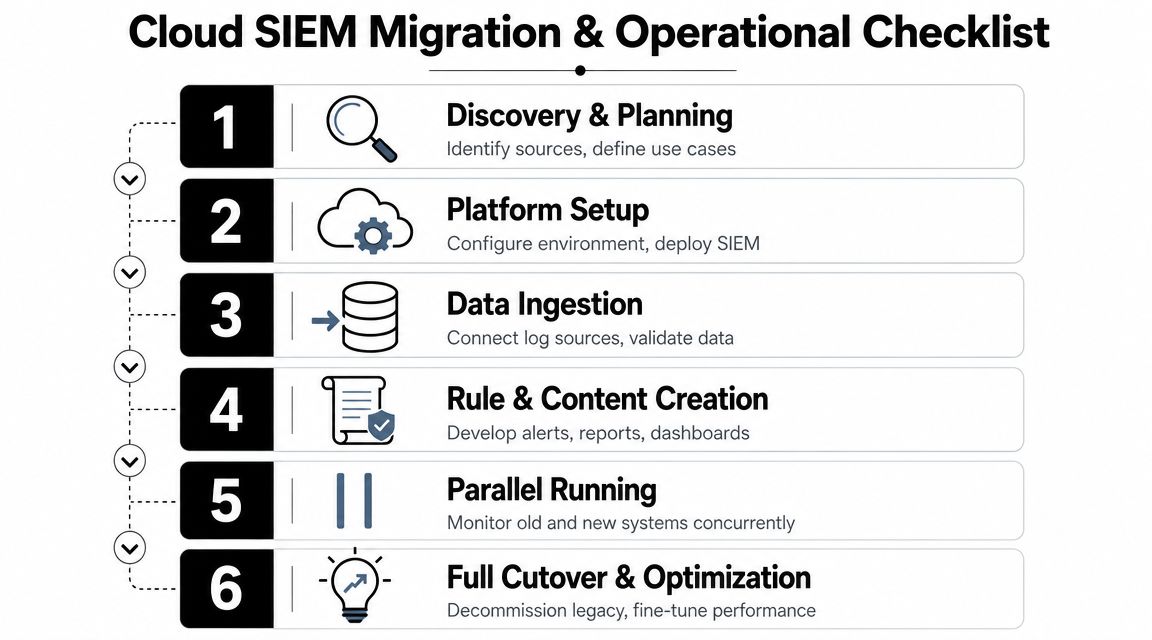
A practical migration path
A dependable migration typically moves through six phases.
Discovery and planning
Catalog data sources, owners, current retention, existing alerts, and compliance dependencies. Separate high-value sources from nice-to-have noise.Platform setup
Set up the target environment, define access models, and establish data handling rules early. Do not leave role design until later.Initial ingestion
Bring the highest-priority cloud, identity, endpoint, and network sources in first. Confirm field mapping before switching on broad alerting.Rule and dashboard creation
Move only the rules that remain important. Legacy SIEMs often accumulate detections no one trusts or uses.Parallel running
Operate both systems long enough to contrast coverage, alert quality, latency, and analyst workflow. This process exposes clear gaps.Cutover and cleanup
Decommission old feeds and hardware only once the new platform shows stability under normal and heightened event conditions.
A brief checklist can help, yet discipline counts more than templates. Teams should record ingestion assumptions, parser exceptions, and rule ownership along the way. When that knowledge remains tribal, the platform deteriorates after the first staffing change.
What strong operations look like after cutover
Many SIEM on cloud initiatives either progress or falter at this point. The real work begins now.
Guidance from Exabeam and CISA points out that default SIEM rules are often too generic for cloud threats, and recommends custom detections for cloud IAM privilege escalation, unusual SaaS data access, and hybrid lateral movement so the platform reflects modern attack paths (Exabeam on cloud SIEM detection gaps and cloud-focused use cases).
That means post-migration operations should include:
- Continuous rule tuning: Eliminate noisy detections, refine thresholds, and introduce context from assets, users, and business processes.
- Cloud-native detection engineering: Create rules for IAM abuse, SaaS data access anomalies, control plane changes, and cross-environment movement.
- Response integration: Connect the SIEM with orchestration, ticketing, and containment workflows so analysts don't repeat manual actions.
- Cost review: Review ingestion and retention on a regular basis. Teams frequently find months later that low-value sources are using premium storage.
- Content ownership: Designate specific individuals to own parsers, high-severity rules, and reporting packs.
For a cloud SIEM to be effective, the team must treat detection content as an ongoing system, not a one-off setup task.
Leaders should also demand a regular operating review. That review should examine false positives, source health, search performance, retention use, and whether detections align with actual attack paths in the environment. A cloud platform eases iteration. It does not handle that iteration on your behalf.
If you're evaluating SIEM on cloud options and want an open-source platform that combines SIEM, SOAR, and XDR for hybrid environments, Unified Security Stack is one choice to assess alongside commercial SaaS and self-hosted options. What matters is selecting a platform your team can run effectively, tune continuously, and align with your detection, compliance, and cost requirements.