ISO 27001 Requirements: A Guide for 2026 Certification
If you're pursuing certification, you're likely facing the same situation many organizations see. Policies are stored in shared folders, risk decisions are buried in meeting notes, control owners give inconsistent answers, and audit preparation becomes a rush to show that security work took place. The difficulty is usually not seeing why ISO 27001 matters. It is turning the standard into repeatable operational proof.
That disconnect explains why many ISO 27001 initiatives lose momentum. Teams review the clauses, assemble a documentation package, and still struggle when an auditor requests evidence of control ownership, monitoring, review, and corrective action over time. Organizations that complete certification smoothly do not view the standard as paperwork. They create an Information Security Management System, or ISMS, that links risk decisions to technical controls and then to evidence.
Table of Contents
- Beyond the Audit Navigating the ISO 27001 Landscape
- The Core Requirements Understanding Clauses 4-10
- Demystifying Annex A The Menu of Security Controls
- Creating Your Statement of Applicability The Heart of Your Audit
- From Paper to Practice What Audit Evidence Looks Like
- Automating ISO 27001 Compliance with SIEM and XDR
- Your ISO 27001 Implementation Checklist and Pitfalls to Avoid
Beyond the Audit Navigating the ISO 27001 Landscape
Much ISO work begins too late. Leadership wants the certificate, customers want confidence, procurement wants a timeline, and the security team inherits a compliance effort that touches governance, operations, engineering, HR, vendors, and legal. That is when the standard can seem like a weight rather than a management system.
That perspective is reversed. ISO 27001 is most effective when used as a business framework for managing information risk in a structured manner. The certificate is important, but its biggest value is that the organization learns to define scope, assign ownership, assess risk, apply suitable controls, review performance, and improve using evidence.
It is evident the market has shifted that way. Over 45,000 ISO/IEC 27001 certificates were active worldwide as of 2022, with annual growth around 15 to 20%, and the 2022 revision consolidated 114 controls into 93 organized into organizational, people, physical, and technological themes according to Copla's summary of ISO/IEC 27001 requirements and certification criteria.
Practical rule: If your ISMS emerges only one month before the audit, you lack a security operating system. What you have is an audit project.
Teams that avoid problems embed compliance into daily operations. They link risk treatment to control execution and make evidence gathering routine. A current SIEM or XDR platform changes the cost equation for that work because logs, alerts, ownership records, review workflows, and incident artifacts can be preserved and accessed as audit evidence rather than recreated manually.
The Core Requirements Understanding Clauses 4-10
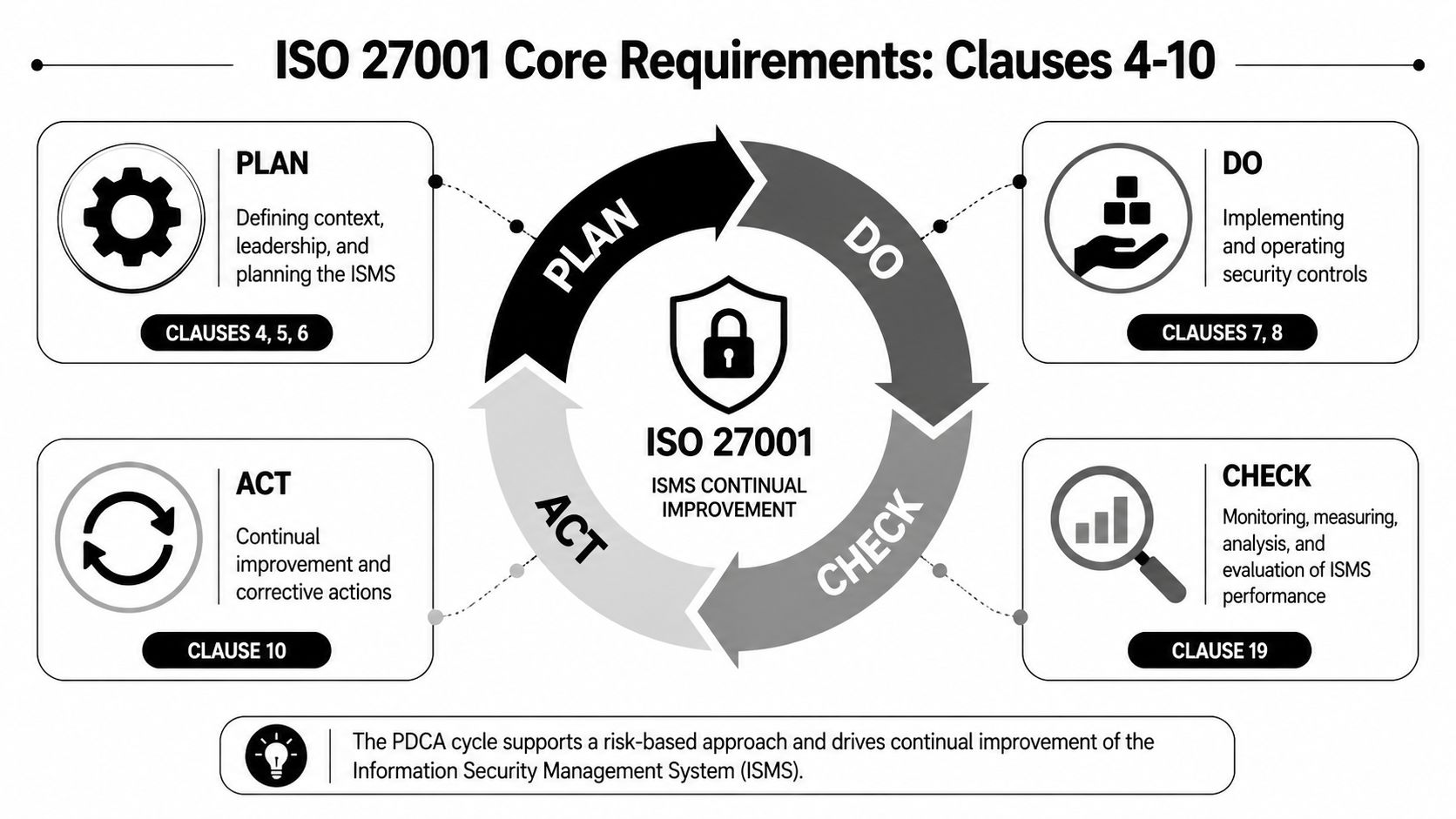
ISO 27001 requirements are easier to understand when you stop viewing them as separate clauses and instead read them as a management cycle. Clauses 4 through 10 make up the auditable core of the ISMS. They describe how the organization defines its security context, plans risk treatment, operates the program, verifies whether it works, and corrects what does not.
Why the clauses work as a system
The cleanest way to interpret them is through Plan, Do, Check, Act.
| PDCA stage | Clauses | What it means in practice |
|---|---|---|
| Plan | 4, 5, 6 | Define scope, leadership commitment, risk method, objectives, and treatment approach |
| Do | 7, 8 | Provide resources, competence, awareness, documentation, and run the controls |
| Check | 9 | Monitor performance, run internal audits, and conduct management review |
| Act | 10 | Correct nonconformities and improve the ISMS |
Within Clause 4, teams establish what the ISMS encompasses. This includes organizational boundaries, services, data, locations, technology, dependencies, and interested parties. Weak scope definition makes every later task harder. Controls get chosen without clear rationale. Asset inventories become unreliable. Suppliers fall into unclear territory. Evidence grows fragmented because no one can tell what should sit within the ISMS.
Clause 5 addresses leadership, though not in a ceremonial way. An auditor is not seeking a signature and a kickoff slide. They want evidence that top management assigned roles, supported objectives, backed the ISMS, and took part in review.
Clause 6 is the central point. Here, you establish risk assessment and risk treatment. If the approach is inconsistent, undocumented, or detached from real systems and processes, the rest of the ISMS becomes superficial.
Where teams usually fail
The failures that occur most often are not exotic. Over 70% of major non-conformities arise from either a poorly defined ISMS scope under Clause 4.3 or an inadequate risk assessment and treatment plan under Clause 6.1, as described in Teleport's explanation of ISO/IEC 27001:2022.
This matches what experienced practitioners observe in audits. When scope is weak, teams cannot reliably answer basic questions such as:
- Which systems count: Do cloud workloads, contractor endpoints, and third-party managed services fall within scope?
- Who owns the risk: Does every major treatment decision have a named owner?
- What evidence proves operation: Can the team demonstrate repeatable execution, rather than only a drafted policy?
Clauses 7 and 8 shift the ISMS from design into operation. Clause 7 addresses support functions such as resources, competence, awareness, communication, and documented information. Clause 8 addresses operational planning and control. In this operational phase, your controls, workflows, and records must work.
A policy demonstrates intent. An operating record demonstrates execution.
Clause 9 calls for monitoring, internal audit, and management review. In these areas, many programs heavy on documentation appear weak. They can describe the ISMS, but they cannot show trend data, review minutes, ownership follow-up, or measurement criteria that withstand scrutiny.
Clause 10 completes the cycle. Nonconformities must lead to corrective action and improvement. If the same issues show up in internal audit, security incidents, and management review without documented follow-through, the ISMS is not improving. It is repeating itself.
Demystifying Annex A The Menu of Security Controls
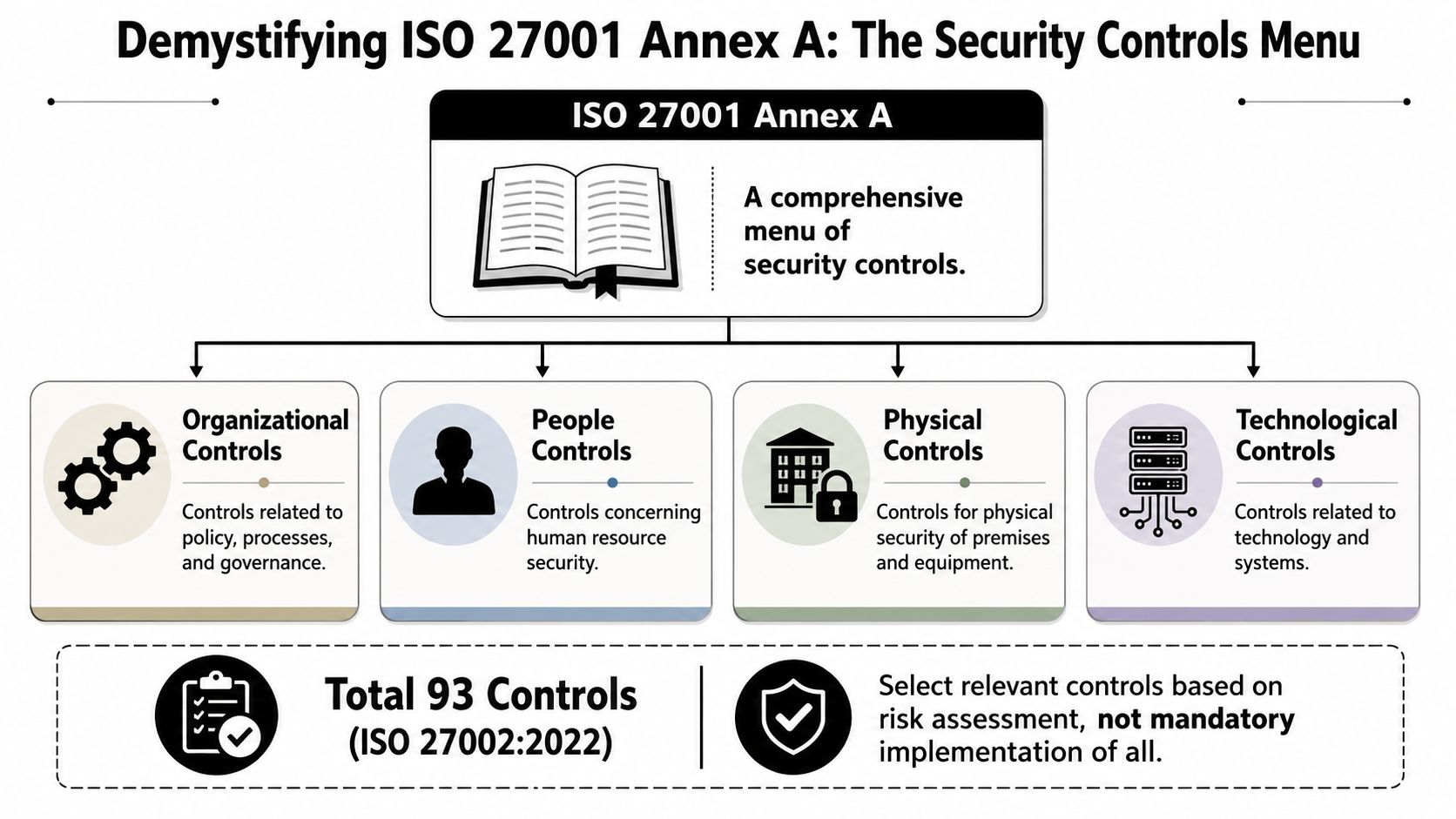
People get confused by Annex A because they assume each listed control has to be implemented exactly as written. That is not how ISO 27001 works. Annex A is a control catalogue supporting risk treatment. It helps you decide how to address risks found through your Clause 6 process.
How to read Annex A correctly
A more effective way to think is this. Clauses 4 through 10 explain how to run the management system. Annex A provides a menu of security controls you may apply according to risk.
This matters because a checklist mentality leads to bloated control sets, weak ownership, and documentation that no one maintains. A risk-based method yields fewer control decisions that are better justified.
The 2022 revision groups 93 controls into four domains, which makes the structure easier to work with:
- Organizational controls encompass policy, governance, supplier relationships, incident management, and other management practices.
- People controls include screening, awareness, responsibilities, and security measures tied to personnel.
- Physical controls concern premises, equipment, environmental safeguards, and physical monitoring.
- Technological controls cover logging, access control, configuration, masking, secure coding, filtering, and comparable technical safeguards.
What changed in the 2022 revision
The update introduced controls that more accurately mirror today's operating environments. It added 11 new controls, such as A.5.23 for cloud security, A.8.9 for configuration management, and A.8.28 for secure coding. Audit results also indicate that organizations that view Annex A as a mere checklist have almost twice as many findings. according to DataGuard's breakdown of ISO 27001 Annex A.
These additions are not just theoretical. They reflect issues auditors keep encountering in hybrid environments.
| Control | Why it matters operationally | What weak implementation looks like |
|---|---|---|
| A.5.7 Threat intelligence | Teams need a defined way to consume and act on relevant threat information | A feed exists, but nobody reviews or applies it |
| A.5.23 Cloud services security | Shared responsibility must be documented and enforced | Teams assume the provider covers everything |
| A.8.9 Configuration management | Baselines and deviations need control | Changes happen ad hoc with no approved standard |
| A.8.11 Data masking | Sensitive data exposure needs technical safeguards | Masking is assumed in design but not verified |
| A.8.28 Secure coding | Application risk treatment requires development controls | Security is delegated entirely to a scanner |
Annex A does not ask if you can implement everything. It asks if you can justify what you selected and excluded, and why that decision fits your risk landscape.
Many programs become over-engineered. They place every feasible control in the SoA, then struggle to demonstrate ownership and operation. A smaller, risk-based set with clear justification usually withstands scrutiny better than a maximalist set that no one can operate.
Creating Your Statement of Applicability The Heart of Your Audit
If the risk assessment is the brain of the ISMS, the Statement of Applicability, or SoA, is the document that demonstrates to the auditor how the brain connects to the body. It ties identified risks to chosen controls and clarifies why each Annex A control is included or excluded.
What a usable SoA must do
A robust SoA does not merely list controls. It makes your rationale visible. For each Annex A control, it should show whether the control applies, how that conclusion was reached, who owns it, and where the supporting evidence is stored.
An auditor should be able to trace a risk in your register to a treatment decision, then to the SoA, then to the policy, procedure, technical implementation, and operating evidence without guessing. If that chain breaks, the audit becomes an interview exercise rather than an evidence review.
This very document is a common point of failure. ISO 27001:2022 guidance under Clause 6.1.3 requires organizations to select controls and rigorously justify exclusions based on their specific risk assessment, and auditors are increasingly focused on that point, as outlined in Optro's guidance on ISO 27001 certification requirements.
What weak SoAs look like
Weak SoAs usually fail in one of three ways:
- Generic applicability language: Saying something is not relevant to the business is not a justification.
- No inheritance logic: Responsibilities for cloud or managed services are not separated between provider and customer.
- No link to evidence: The SoA identifies a control but does not show how its operation can be verified.
A practical SoA review should test these questions:
- Is the team able to explain the exclusion? If a control is excluded, is there a risk-based rationale rooted in actual scope and architecture?
- Can the owner be identified right away? If no one is accountable for the control, no one will keep the evidence current.
- Can proof be retrieved quickly by an auditor? If evidence must be pieced together from email threads and spreadsheets, the SoA is not operational.
The best SoAs remain concise without becoming shallow. They reflect actual architecture, actual risk acceptance, and actual ownership boundaries.
From Paper to Practice What Audit Evidence Looks Like
For a smooth audit versus a difficult one, the deciding factor is often the quality of evidence. Plenty of organizations have documents. Far fewer have records demonstrating that controls operate consistently.
Weak evidence versus strong evidence
That is how the difference shows up in practice.
| Control area | Weak evidence | Strong evidence |
|---|---|---|
| Access control | An exported user list with no review date or owner | A current access review record tied to approvers, timestamps, and remediation actions |
| Logging and monitoring | Archived raw logs with no indication of review | A live dashboard showing collection status, alert rules, retention, and recent investigations |
| Incident handling | A written procedure only | Ticketed incidents with triage notes, response steps, closure, and lessons learned |
| Asset disposal | A checklist signed internally | Chain-of-custody records plus a certificate of hard drive destruction when media destruction is outsourced |
| Configuration control | A baseline document in a folder | Approved change records, drift detection output, and exception approvals |
When it comes to logging controls, a central platform is essential because it consolidates scattered artifacts into a single audit trail. Teams that use centralized log management for security monitoring are typically able to show not just that logs exist but that they were ingested, retained, queried, and used for control operation.
What auditors want to verify
Auditors usually test three things beneath the surface:
- Design: Did the control have a clear enough definition to operate?
- Operation: Did the control operate across a meaningful period?
- Ownership: Did anyone review the results and respond to exceptions?
Quality evidence addresses the next question before the auditor needs to raise it.
So screenshots alone are not sufficient. Policies without records are not sufficient either. Robust evidence brings together system output, human review, timestamps, approvals, and corrective action when required.
For instance, access control evidence becomes more convincing when it contains the review criteria, the identity of the reviewer, removed access, and proof that exceptions were closed. Logging evidence becomes more convincing when it contains data source coverage, alert tuning, investigation records, and retention settings. Disposal evidence becomes more convincing when internal asset records match vendor destruction documentation.
Teams run into problems when they gather evidence just for the audit period. That method produces static snapshots. Auditors gain more confidence when records demonstrate that the control formed part of routine operations.
Automating ISO 27001 Compliance with SIEM and XDR
Manual evidence gathering fails quickly in hybrid environments. Cloud services, endpoints, identity platforms, firewalls, SaaS tools, and infrastructure each produce records at different rates and in different formats. If the ISMS relies on people to collect that material during an audit, control verification will consistently trail actual operations.
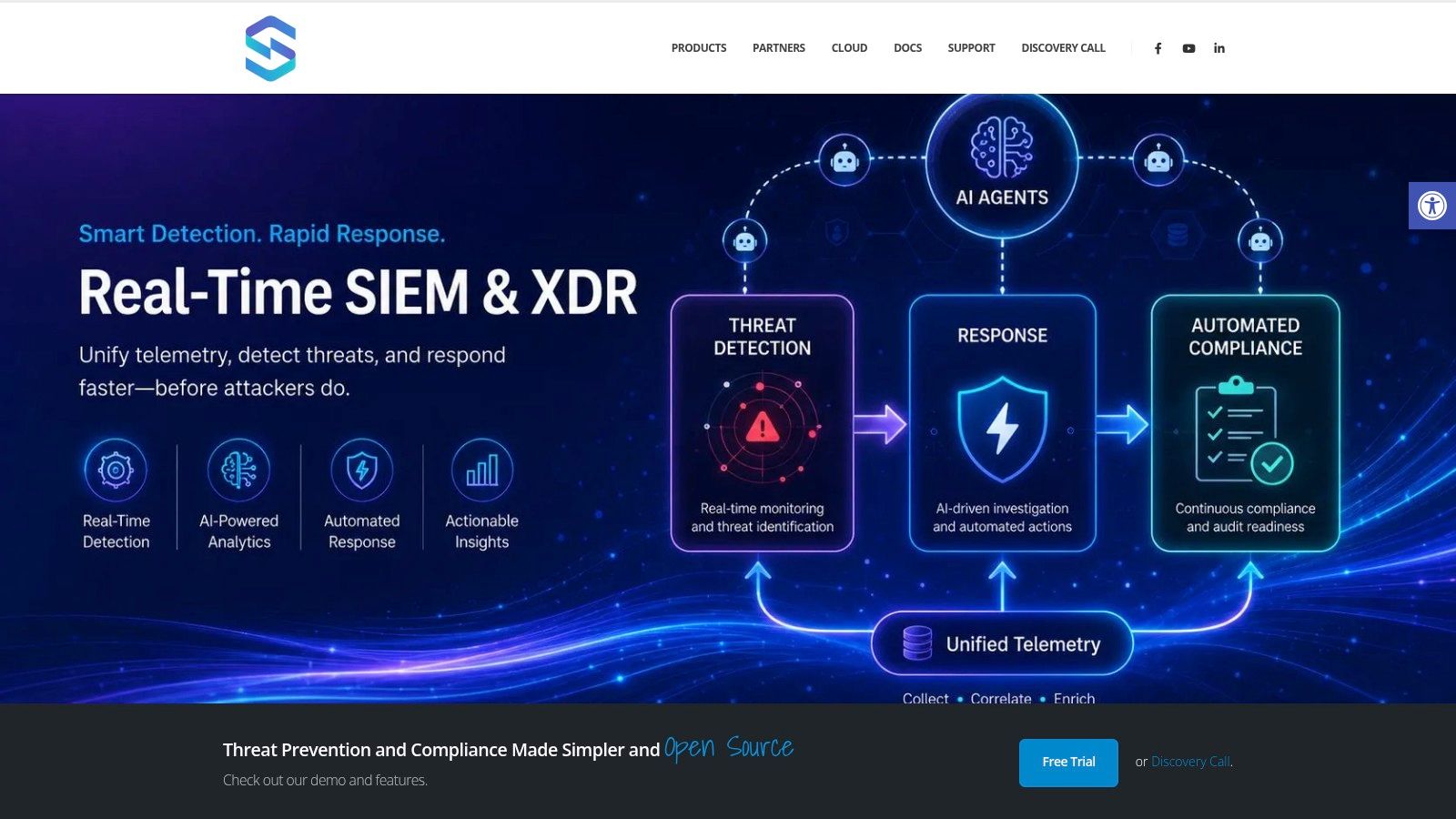
A SIEM and XDR stack alters this by embedding evidence collection within detection and response.
Where automation fits the standard
The most compelling use case is not automation pursued merely for its own sake. It is traceability. The logic of the standard expects organizations to identify risks, deploy controls, name owners, track performance, and preserve evidence. A sound security platform supports that sequence.
For ISO 27001 requirements tied to monitoring and technical controls, the platform should help you:
- Collect logs centrally: Events from endpoints, network devices, cloud services, and identity systems must arrive in a single searchable location.
- Map events to control objectives: Logging, access changes, incident actions, and configuration deviations ought to be linked to the applicable controls and owners.
- Preserve review records: Generating alerts alone is not sufficient. The team must demonstrate who reviewed them and what occurred afterward.
- Support incident workflows: Detection has to link to investigation, containment, communications, and post-incident improvement.
Platform choice also matters here. When comparing architectures, a useful first step is to understand the operational distinction between SIEM and XDR in modern security operationsFor ISO work, the key question is not which acronym is trendier. It is whether the platform can capture evidence across your real environment and keep it tied to auditable workflows.
A practical example is public-facing web applications. If your risk treatment covers protecting application availability and monitoring suspicious access patterns, your team may need insight into attacker behavior involving scraping and evasion. Technical references on subjects such as defeating anti-bot detection can help security teams model how hostile automation appears in logs and detections, even when the compliance driver extends beyond application security.
What a compliance ready security platform should produce
A platform suited to compliance should generate outputs that an auditor can verify without an extensive explanation. In practice, this means:
| Capability | Compliance value | Evidence it should generate |
|---|---|---|
| Centralized ingestion | Supports logging and monitoring controls | Data source inventory, collection health, retention records |
| Correlation rules | Shows monitoring activity and detection logic | Alert histories, rule ownership, tuning records |
| Case management | Proves incident handling execution | Tickets, timelines, assignments, response notes |
| Automated playbooks | Shows repeatable response actions | Workflow runs, approvals, containment records |
| Compliance dashboards | Connects technical data to framework views | Control mapping, exceptions, review outputs |
A platform like Unified Security Stack can serve that purpose because it brings together SIEM, SOAR, and XDR capabilities with compliance mapping. The real value is not the label. It is that logs, alerts, response actions, and framework-aligned reporting can reside in one system instead of being reassembled across separate tools and spreadsheets.
A short product walkthrough helps make that more concrete:
Top-performing implementations also organize metadata for audit purposes. Logs should be tagged by source, system owner, business service, and, where possible, related control domain. Alerts should point to the appropriate playbooks. Evidence exports should be easy to pull for management review, internal audit, and certification audits.
Compliance added only afterward does not work. If the platform captures security telemetry but no one links it to ownership, risk treatment, and review, you still end up reconstructing it manually.
Your ISO 27001 Implementation Checklist and Pitfalls to Avoid
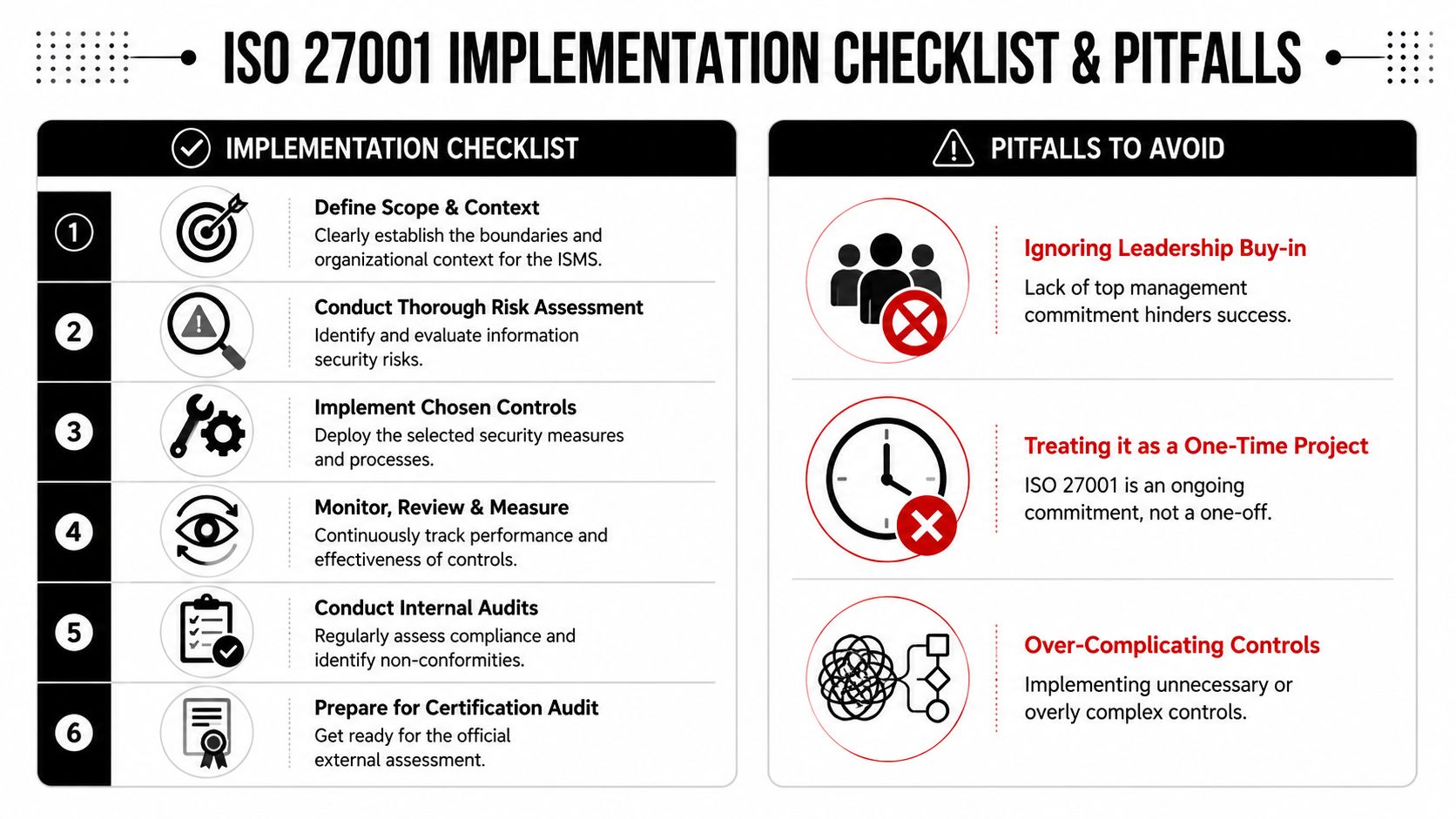
Certification becomes easier when the sequence is disciplined. Most programs that fail do not collapse because the standard is too difficult. They collapse because scope was unclear, ownership was weak, and evidence stayed manual for too long.
A practical implementation sequence
A workable path usually looks like this:
- Set the scope carefully. Before you write controls, define entities, systems, services, locations, and dependencies.
- Secure visible engagement from leadership. Set accountable roles, approval routes, and review duties.
- Create a risk method that people can repeat. If two assessors would reach vastly different conclusions, the method is not ready.
- Use the SoA to select controls. Apply the risk treatment logic rather than a generic checklist.
- Make evidence collection operational. Internal audit becomes easier when records already reside in systems and workflows.
- Review and improve prior to certification. Correct internal nonconformities early, then verify that corrective actions effectively closed the gap.
For governance teams that need broader tooling around controls, policies, assessments, and workflows, a review of GRC platform categories and evaluation criteria can help determine what belongs in GRC and what should be evidenced straight from security operations systems.
Pitfalls that slow certification down
Some mistakes show up repeatedly:
- Treating ISO as an IT-only task: HR, legal, operations, engineering, and leadership all influence the ISMS.
- Writing policies before defining scope: Documentation expands quickly, yet much of it will fail to align.
- Confusing control existence with control operation: A drafted procedure does not prove that the process ran.
- Over-complicating the SoA: More controls do not create a stronger audit position if you cannot justify or operate them.
- Ignoring ongoing review: Management review, internal audit, and corrective action are where the ISMS demonstrates maturity.
Certification is typically fastest along the path with the least rework. Clear scope, disciplined risk treatment, and automated evidence outperform a massive documentation project every time.
If you are serious about ISO 27001 requirements, build the system to survive after the certificate is issued. That is the point of the standard.
If you want to reduce manual audit prep and tie security operations directly to ISO 27001 evidence, Unified Security Stack is worth assessing as part of your stack. It lets teams centralize logs, correlate events, execute response workflows, and tie technical evidence to compliance requirements without depending on scattered exports and last-minute document collection.