HIPAA Compliance Reporting: A Playbook for Security Teams
A healthcare security team seldom receives a clean warning before HIPAA compliance reporting becomes real. One week it is a patient complaint about access, the next it is an OCR request for records, and the next it is a suspected breach that requires a defensible timeline, not a rush for screenshots. In that setting, a SIEM is more than a detection tool; it is the system that turns logs, alerts, and evidence into a reporting record auditors can follow.
Table of Contents
- Beyond the Checklist Why Proactive Reporting Matters
- Building Your Foundation with Required Logs and Retention
- Mapping HIPAA Controls to SIEM Detections
- The Breach Reporting Workflow From Incident to Notification
- Automating Evidence Collection for Stress-Free Audits
- Common Pitfalls in HIPAA Reporting and How to Avoid Them
Beyond the Checklist Why Proactive Reporting Matters
A CISO receives the OCR letter on a Monday morning. The request is not asking whether the team has a policy binder; it is asking for documentation that proves how a complaint was handled, who reviewed it, which systems were touched, and whether the response was consistent with the organization's controls. That is the point where HIPAA compliance reporting ceases to be an administrative duty and becomes a test of operational memory.
Since the HIPAA Privacy Rule's compliance date in April 2003, OCR had received over 374,321 HIPAA complaints and initiated over 1,193 compliance reviews as of October 31, 2024, which shows that complaint-driven enforcement has stayed active for more than two decades (HHS OCR enforcement highlights). A reactive team may respond to one email. A reporting framework can address a complaint, a breach inquiry, and a follow-up audit using one consistent evidence trail.
Logs are not evidence by themselves
A SIEM may hold huge volumes of events yet still leave a team exposed when no one can explain what those events mean. Auditors expect to see who reviewed the incident, when the alert fired, how the decision was made, and what control failed or worked. That is where a reporting workflow must link access logs, audit logs, change records, and case notes into one chronology.
Practical rule: if a record cannot support the narrative of discovery, escalation, review, and remediation, it is not audit-ready evidence yet.
This is another reason healthcare engineering teams often deliver stronger outcomes when security, compliance, and platform owners collaborate early. For organizations that require build support around these workflows, healthtech engineering services can help when the internal team needs assistance translating controls into usable operations. When the reporting process is embedded in the SIEM and ticketing path, the organization spends less time rebuilding events after the fact.
A useful reference point is a compliance automation approach such as the one described in Unified Security Stack's HIPAA compliance automation workflow, where monitoring and reporting are viewed as part of daily operations instead of a one-time review. That mindset matters because OCR reviews ask not only whether a policy exists but whether the organization can prove it worked when it mattered.
Building Your Foundation with Required Logs and Retention
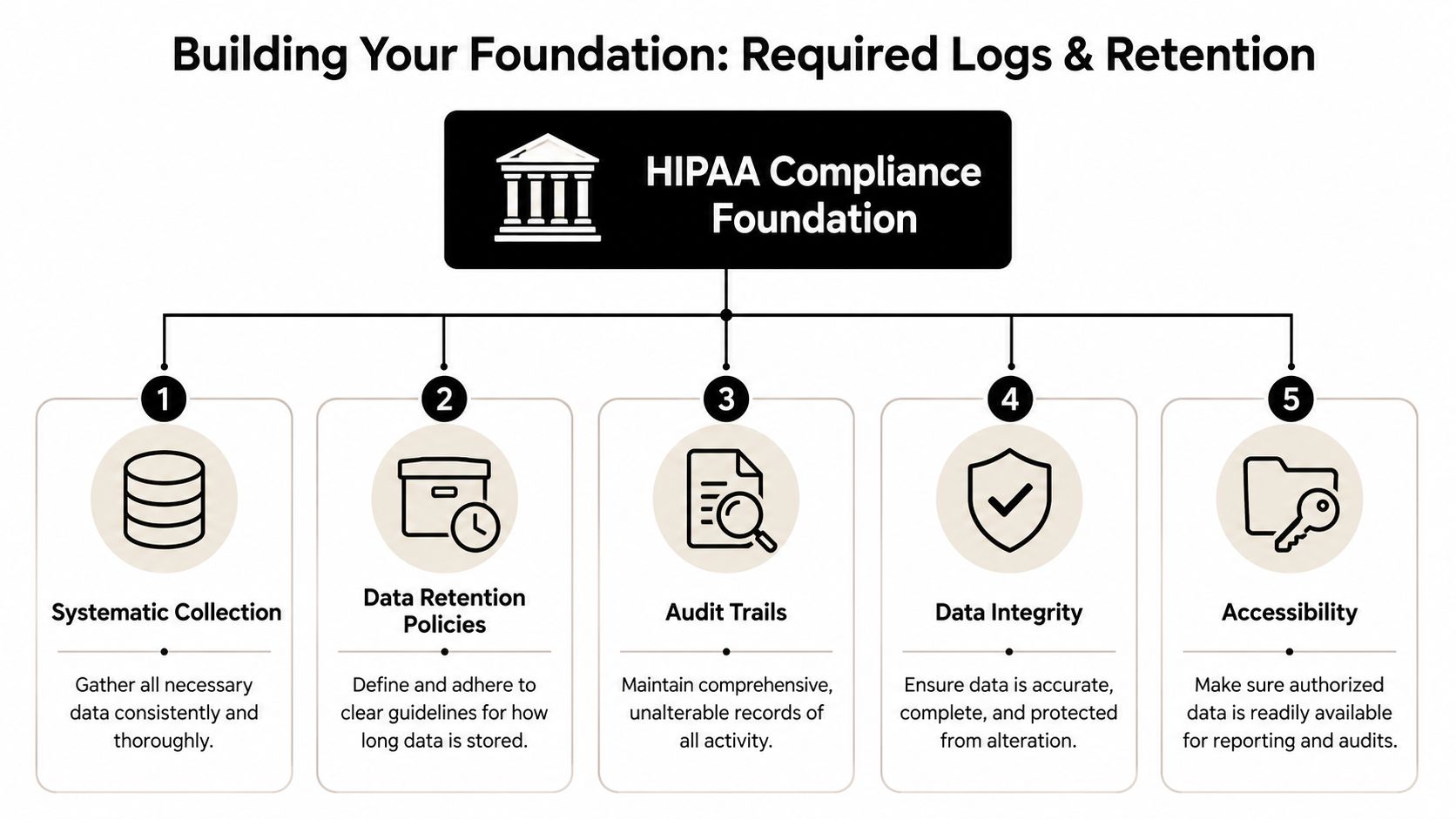
HIPAA reporting collapses quickly when the evidence base is weak. The Security Rule demands administrative, physical, and technical safeguards for ePHI, including risk assessment, access controls, encryption, and audit logging, so the logging program has to reflect those obligations instead of a generic IT baseline (HIPAA compliance requirements overview).
Start with the log sources that explain access and change
A defensible HIPAA log set usually starts with the systems that can show who accessed ePHI, what changed, and whether controls were bypassed. That includes server authentication logs, application access logs, privileged action logs, security device logs, and any records connected to audit controls on systems that hold patient data. Physical access records also matter when a facility or protected area is in scope, since the reporting story often depends on whether a person had both logical and physical access.
A centralized log platform helps by giving the team one shared timeline across sources. A SIEM should gather from endpoints, identity systems, firewalls, EMRs, cloud services, and privileged access tools, then normalize those records so an investigator can follow the sequence without moving between consoles. If the logs are scattered, the reporting package turns into a manual reconstruction effort.
Operational takeaway: capture the log before you need the explanation. Once an incident begins, missing telemetry becomes a compliance problem in itself.
Retention needs to support the report, not just storage policy
Retention is not only about storing data. It is about preserving enough detail for the review, the root cause analysis, and the later audit that may ask why the incident was or was not reported. Many teams set a six-year retention target for HIPAA evidence because later review often relies on older records, change history, and policy proof, but the practical goal is simpler: keep the records long enough to support the organization's response and documentation duties.
An internal platform such as Unified Security Stack centralized log management works well when retention, search, and case review need to reside in one place. That reduces the common failure mode in which logs exist but the team cannot retrieve them fast enough to support a filing window or regulator inquiry.
The retention rule should distinguish hot storage for active investigations from colder archives for long-term proof. That keeps search performance usable while maintaining evidence integrity. More importantly, it allows security and compliance teams to show that records were not edited, overwritten, or selectively retained after an event.
Mapping HIPAA Controls to SIEM Detections
A policy is conceptual in nature. A detection rule functions operationally. When each safeguard maps to a matching SIEM condition, HIPAA compliance is far easier to defend, because the organization can then prove it did not merely publish standards; it monitored for violations.
For teams evaluating controls as part of expert cybersecurity due diligence advice, the same logic holds. Due diligence looks stronger when the evidence shows alerting, review, and escalation instead of a passive statement that controls exist.
Turn safeguards into concrete alerts
The objective is not to copy the regulation clause by clause. The objective is to convert it into events the SIEM can identify. For instance, access control turns into alerts for repeated failed logons to an EMR system, or privileged logins from unusual accounts. Audit controls turn into alerts when logs are disabled, cleared, or stop arriving from a critical system. Integrity controls turn into monitoring for suspicious changes to user permissions, retention settings, or configuration baselines.
| HIPAA Safeguard (§) | Requirement | Example SIEM Correlation Rule / Alert |
|---|---|---|
| Access control | Limit access to ePHI to authorized users | Alert on repeated failed EMR logons followed by a successful login from the same account |
| Audit controls | Record and examine activity in systems with ePHI | Alert when audit logging stops, is cleared, or a log source goes silent |
| Integrity | Protect ePHI from improper alteration or destruction | Alert on unexpected privilege changes, file modification spikes, or disabled retention settings |
| Administrative safeguards | Manage risk and enforce procedures | Alert on missing review of high-severity incidents or overdue evidence tasks in the case queue |
| Physical safeguards | Restrict access to facilities and devices | Alert on physical access events that occur outside normal patterns for sensitive areas |
| Technical safeguards | Protect access and transmission of ePHI | Alert on unencrypted transfers, new external sharing paths, or abnormal remote access behavior |
Use the SIEM to prove control operation
A strong SIEM rule does more than trigger an alert. It builds a case record. That record ought to capture the detection event, the analyst's assessment, the final determination, and any handoff to privacy or compliance personnel. If the team cannot demonstrate that progression, the control might be documented but not actually operating.
When a control leaves no trace in the logs, proving it was active at the time of the incident becomes difficult.
This is why XDR can augment SIEM, particularly when endpoint telemetry, identity events, and cloud signals must be correlated at speed. The security team can then connect the technical event to the HIPAA safeguard rather than handling compliance as a standalone spreadsheet task. Reporting is more reliable when detection and evidence form one workflow.
The Breach Reporting Workflow From Incident to Notification
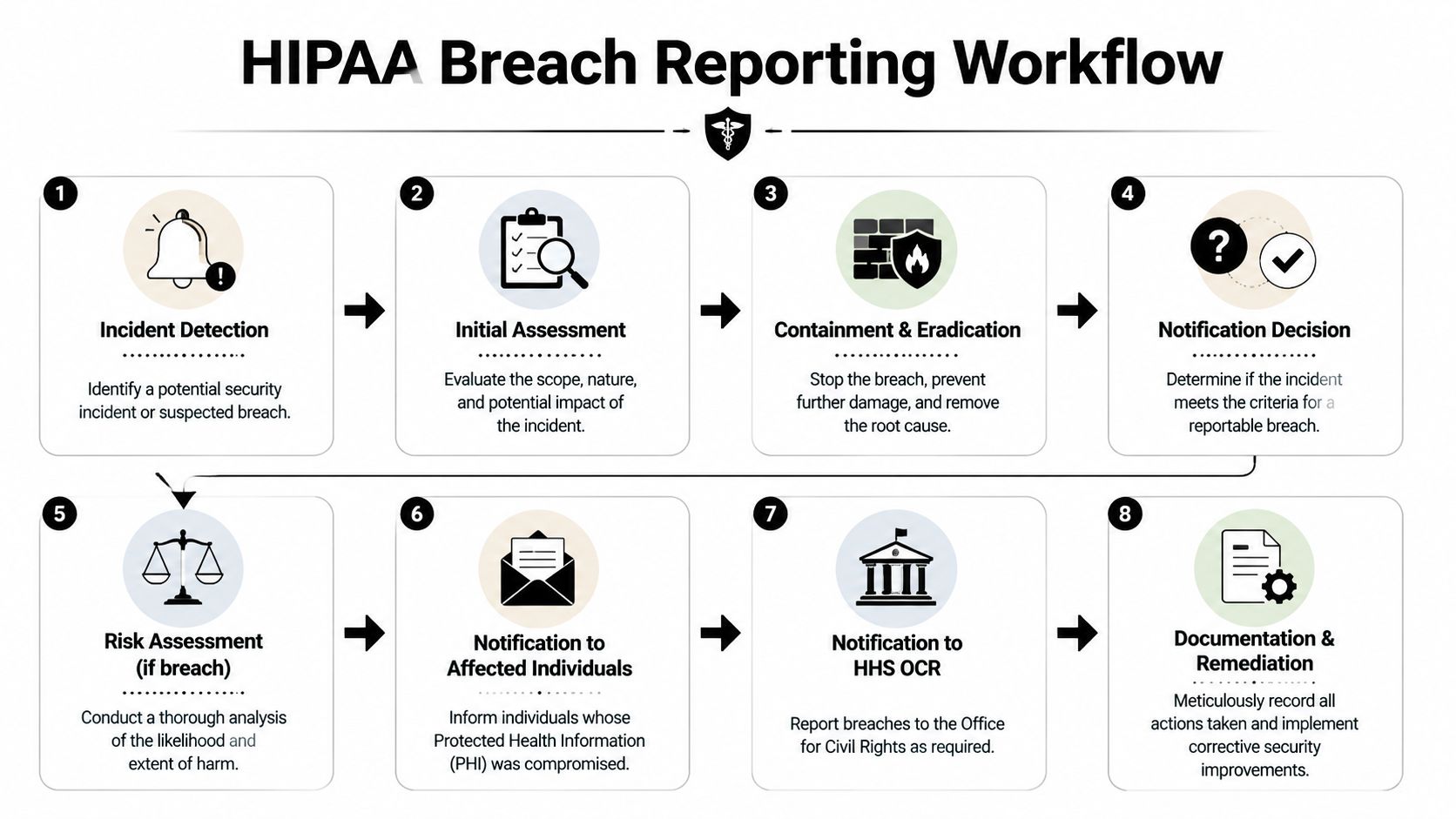
A suspected breach requires a set sequence, since panic can ruin timelines. The initial task is to determine whether the event involves unsecured PHI, because the Breach Notification Rule only applies after that threshold is met (HHS breach notification overview). The next task is to preserve sufficient context so that the later judgment can be defended.
Follow the clock, not the noise
As soon as the SIEM flags a possible incident, time is already counting. The team should record when it was discovered, which systems were affected, which users were involved, and what initial containment steps were taken before debate begins over the final classification. If the event turns into a reportable breach, the timing of that first discovery is critical because HIPAA deadlines run from discovery, not from when it is convenient.
For breach-related HIPAA reporting, covered entities must notify affected individuals within 60 days, and OCR reporting is annual for breaches affecting fewer than 500 individuals but must occur within 60 days after discovery for breaches affecting 500 or more individuals (HIPAA reporting requirements summary). OCR's breach basics guidance also notes that most breaches have to be reported without unreasonable delay and no later than 60 days after discovery, while smaller breaches are submitted annually to HHS (CMS HIPAA Basics).
Classify the event before the notification path splits
The line between a security incident and a reportable breach is where many teams burn time. Internal events may be closed within the case system, but if unsecured PHI was involved, the process changes to individual notice, HHS notice, and at times media notice depending on breach size (HHS breach notification overview). Business associates also must notify covered entities, so the chain of responsibility cannot be casual.
A practical workflow looks like this:
- Identify and maintain. Lock down the applicable logs, alert history, and asset context within the SIEM.
- Initial triage. Verify whether PHI, identity data, or clinical data was involved.
- Containment. Stop additional access, isolate accounts, and retain evidence.
- Breach decision. Decide whether the event is reportable.
- Risk analysis. Record the scope and likelihood of compromise.
- Notification planning. Prepare patient, HHS, and media pathways where required.
- Submission. Submit through the proper channel and retain proof of submission.
- Remediation. Document corrective actions and close the loop in the case record.
That framework keeps the process defensible when auditors ask why one incident was escalated and another was not.
Automating Evidence Collection for Stress-Free Audits
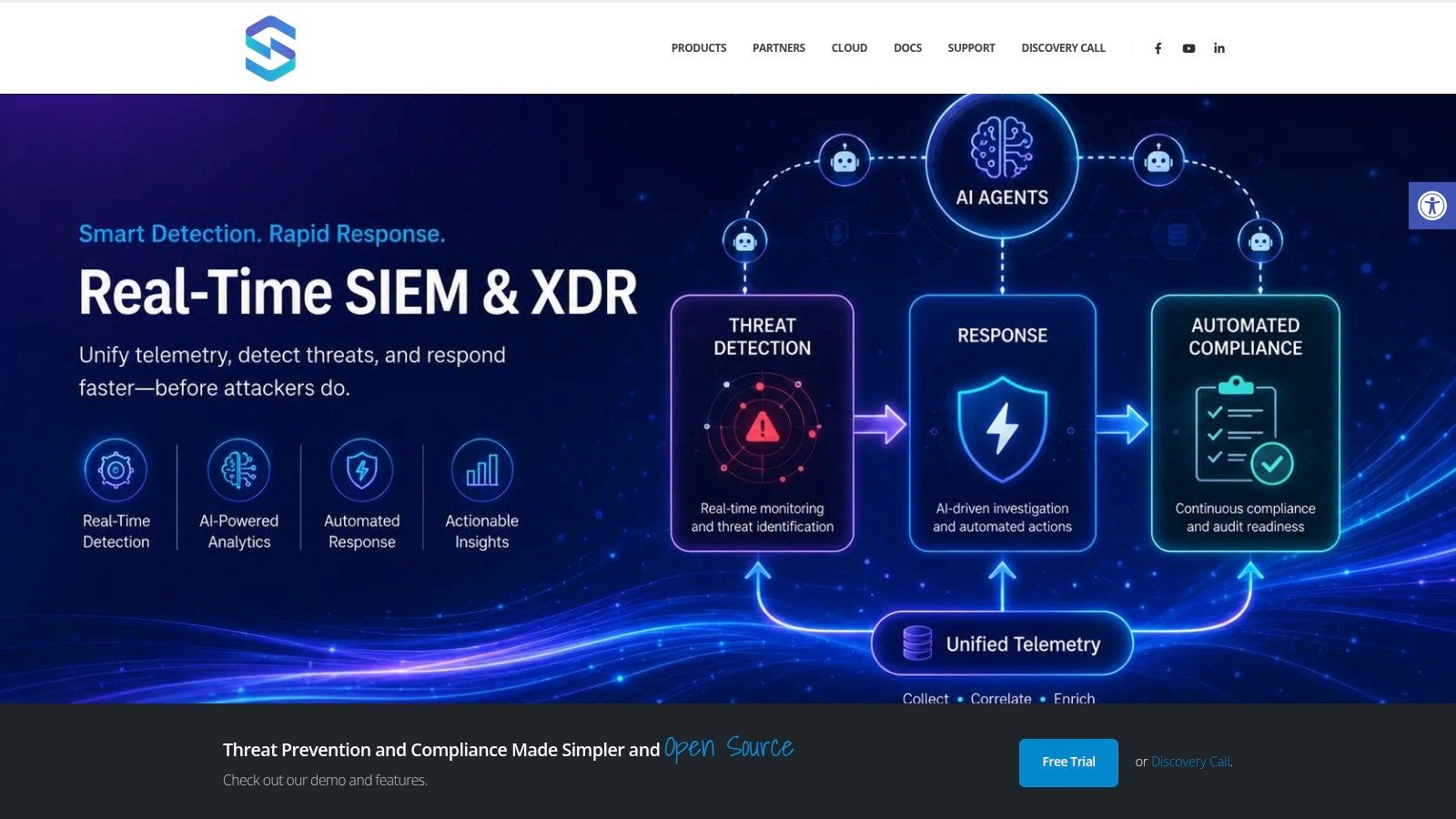
Manual audit preparation is where capable teams lose the most time. One person retrieves logs, another exports screenshots, a third searches old ticket threads, and the final report is pieced together from fragments that do not always align. A SIEM with compliance workflow support turns that into a continuous evidence stream rather than a last-minute scramble.
Evidence should be collected as part of monitoring
The best audit package is not assembled in a spreadsheet. It comes from the same platform that already sees the alerts, logs, and response actions. That allows the compliance team to attach proof to the event while details are still fresh, rather than reconstructing what occurred weeks later.
One effective method is to automate collection of account validation, security alerts, login activity, file and system access, cloud activity, unsuccessful logons, and privilege escalation records within the SIEM. Unified Security Stack's compliance workflow is one example of a platform that connects monitoring and evidence handling, so the report is produced from the operating environment rather than rebuilt manually. The benefit is not only speed; it is consistency.
The evidence package should match the event record
An auditor seldom wants raw noise. They want the event, the control, the review, and the remediation narrative in a single place. When the SIEM retains that trail, the team can produce a report without asking half the department to recall who approved what.
The scale of that need keeps growing. 2025 was described as the worst year on record for large healthcare data breaches, with 772 breaches involving 500 or more records reported to HHS and roughly 139.7 million people affected (ComplianceDocsHQ breach statistics). That level of volume makes automated triage and evidence preservation less of an optional extra and more of a basic operational requirement.
Strongest audit readiness comes from evidence gathered while your controls were in operation.
A mature workflow likewise keeps the chain from the SIEM to the case file intact. That means retaining the alert, the analyst note, the supporting logs, and the final disposition as one set. With that in place, the organization can respond to auditor questions without reconstructing the incident from the beginning.
Common Pitfalls in HIPAA Reporting and How to Avoid Them
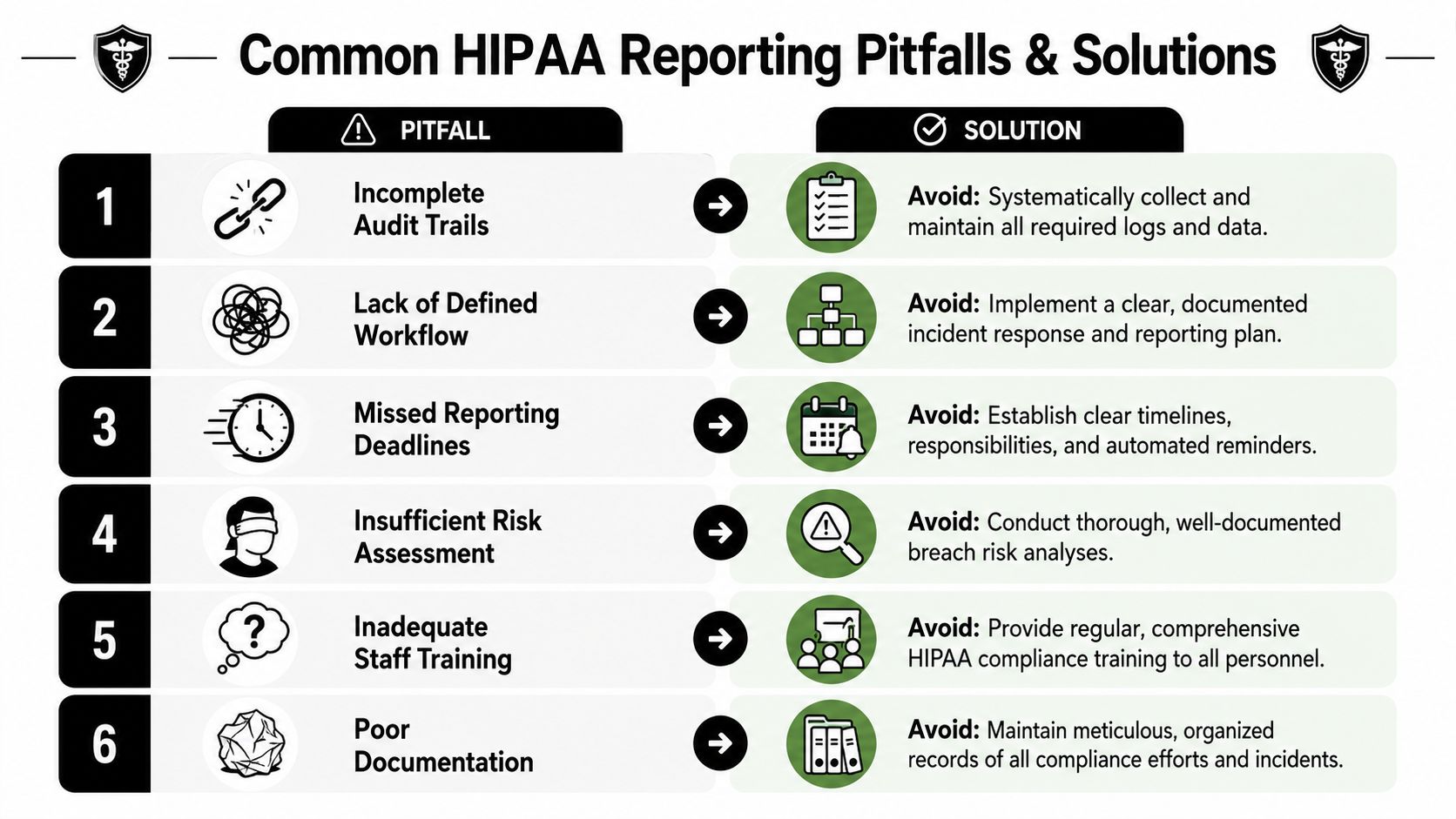
Most reporting failures do not stem from a single dramatic error. They stem from small gaps that accumulate: a missing log source, a delayed escalation, a weak risk assessment, or a policy that states one thing while the tooling does another. OCR's enforcement history makes this plain, since complaint-driven reviews keep revealing problems that organizations believed were already addressed (HHS OCR enforcement highlights).
Technical gaps create the biggest blind spots
Missing audit trails are the simplest way to lose a case. If the SIEM is not gathering data from the identity layer, the application layer, and the core systems that store ePHI, the team cannot prove what occurred. The remedy is direct: define log sources in advance, retain them centrally, and verify that the retention policy aligns with investigation needs.
Process flaws turn incidents into reporting failures
A frequent failure is an absent decision path. Teams know an issue exists, but no one is certain who determines whether it is a reportable breach, who informs compliance, or who approves the final package. The remedy is a documented workflow with named owners, time-bound escalation, and a case record that captures each decision point.
Human error usually shows up as delay
Missed deadlines frequently result from uncertainty, not neglect. People wait for additional facts, additional approvals, or another meeting, while the reporting window continues to narrow. The remedy is easy to describe and difficult to enforce: use automated reminders, SIEM case routing, and preset deadlines for review and escalation.
Documentation has to match reality
When policies state that logs are reviewed, but the SIEM shows no review activity, the gap soon becomes clear. When the organization says risk analyses are conducted, but no evidence of them is retained, OCR can ask the obvious follow-up. The remedy is alignment: write the policy to reflect the operating process, then demonstrate the process through logs, tickets, and preserved reports.
The most effective HIPAA reporting programs do not pursue perfection. They create a repeatable evidence loop in which the SIEM captures the event, the response team classifies it, and compliance can present the trail from start to finish. If your team wants that workflow to be simpler to run and review, examine closely how Unified Security Stack can centralize detection, evidence preservation, and compliance reporting in one place.