Behavior Anomaly Detection: A Practical Guide for 2026
Your SOC likely already has alerts for known bad hashes, suspicious domains, impossible travel, and malware signatures. Yet an incident can still get through. The attacker signs in with valid credentials, reaches systems that the user can ordinarily access, and proceeds slowly enough to remain under static thresholds. In isolation, nothing appears clearly malicious. The issue is not just visibility. It is that your tools continue to ask whether they have seen this exact pattern before.
This is where behavior anomaly detection proves its value. It seeks activity that is out of the ordinary for a user, host, application, or network segment, even if the event does not match a known indicator of compromise. In practice, this makes it effective against the threats security leaders worry about most: compromised identities, low-and-slow lateral movement, insider misuse, and blended attack chains that remain close to normal operations.
Table of Contents
- Beyond Signatures The Rise of Behavior Anomaly Detection
- What Behavior Anomaly Detection Actually Is
- The Engine Room Algorithms and Data Sources
- From Detection to Response SIEM and XDR Integration
- Making It Work Deployment Tuning and Metrics
- Real World Threats and Practical Use Cases
- Limitations Compliance and Your Unified Security Stack Strategy
Beyond Signatures The Rise of Behavior Anomaly Detection
In mature settings, a common breakdown unfolds like this. Endpoint protections block commodity malware. Email security filters out clear phishing. The SIEM raises alerts for known bad indicators. But the adversary logs in with a valid account, relies on everyday admin utilities, and spreads actions over multiple systems, leaving no individual event looking severe enough to warrant escalation.
Signature-based detection remains important. It is fast, proven, and efficient against known threats. However, it fails when the threat is new, altered, or intentionally built to look like routine business activity.
Behavior anomaly detection emerged from the wider field of anomaly detection. IBM characterizes anomaly detection as identifying observations or events that depart from what is usual, standard, or expected, and observes that the modern security meaning arose as teams shifted from signature-only monitoring to baseline-driven analysis of activity such as user, network, and system behavior. That shift is one reason it became foundational to SIEM and XDR, because it helps uncover threats that do not match known indicators of compromise, as IBM outlines in its overview of anomaly detection in security analytics.
Why signatures alone stop short
A signature provides a straightforward answer: does this event match a known bad pattern?
Behavior anomaly detection poses another question: is this event, or this series of events, unusual for this entity in this context?
That difference matters when attackers:
- Use valid credentials and blend into normal authentication traffic
- Live off the land with administrative tools already present in the environment
- Move slowly to avoid simple volume thresholds
- Chain weak signals together so each step looks harmless on its own
Practical rule: If your detection stack only identifies what has already been named and cataloged, it will perform poorly against identity abuse and novel tradecraft.
What changed in real operations
Security teams do not need behavior analytics because signatures failed entirely. They need it because known-bad matching leaves gaps. Modern environments are spread across SaaS, cloud workloads, endpoints, remote users, and APIs. In that setting, unusual behavior often becomes the first meaningful clue.
For a CISO, that means behavior anomaly detection is not so much a feature as a detection strategy. For a SOC lead, success will not come from enabling a model and waiting for magic. It comes from defining what normal should mean for a specific entity, then tuning until alerts are both credible and actionable.
What Behavior Anomaly Detection Actually Is
At 2:13 a.m., a payroll service account starts retrieving data from systems it has never accessed. The login goes through. No malware fires. No signature matches. The behavior is what draws attention. For that account, at that hour, in that area of the environment, it does not fit.
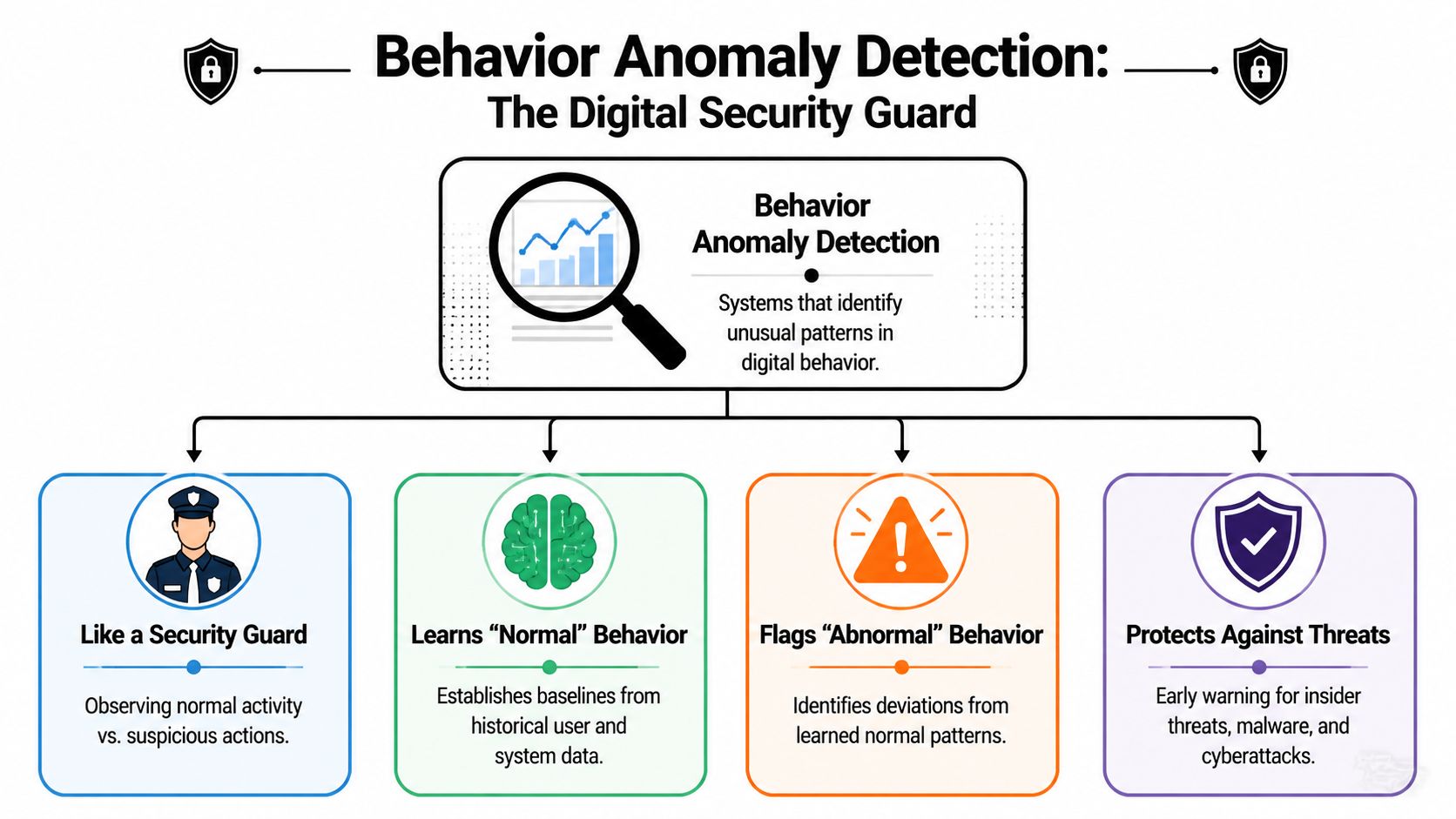
Behavior anomaly detection does exactly that. It builds a model of what is normal for a user, host, service account, application, or workload, then assigns a score to activity outside that pattern. The benefit is not in calling something anomalous. The benefit is in judging whether the deviation is credible enough for an analyst to examine and limited enough to tune without overwhelming the queue.
Baselines are the core idea
A baseline is an operational model of expected behavior. In practice, that model needs specificity. Treating normal user activity as one broad category is not useful. A finance analyst, a DevOps engineer, a domain controller, and a backup service each require different expectations against which to be measured.
Good baselines usually account for several dimensions at once:
- User context such as common login hours, usual devices, and normal resource access
- Host context such as expected processes, network peers, and typical admin activity
- Time context such as weekday patterns, after-hours exceptions, and maintenance windows
- Change context such as new deployments, role changes, travel, or temporary project access
Trust is either earned or lost. When a baseline is too broad, the system raises flags on normal variation and analysts no longer believe it. When it is too tight, the model views any planned change as suspicious. Teams that derive value from behavior analytics devote time to deciding which entities need separate baselines and which can use a shared one.
Behavior models also work best when paired with event correlation and artificial intelligence in security operations, because an unusual event gains more value when the platform can connect it to identity changes, endpoint activity, and network context.
Later in the workflow, examples help more than definitions alone.
Three ways anomalies show up
Analysts generally encounter anomalies in three forms. Each creates a distinct triage challenge.
| Type | What it means | Security example |
|---|---|---|
| Point anomaly | A single event stands out on its own | A user authenticates from a system they have never used before |
| Contextual anomaly | The event looks suspicious only in context | A large data transfer during hours when that team is normally inactive |
| Collective anomaly | The sequence is suspicious even if each step appears routine | A chain of admin actions that suggests staging, privilege use, and exfiltration |
Point anomalies are the simplest to explain, but they are often the noisiest. Contextual and collective anomalies typically lead to better investigations because they consider timing, role, and sequence. They also demand better data quality and more tuning.
That balance is important. A SOC can tolerate some noise when alerts are simple to validate. It has difficulty when an alert only states that a score passed a threshold without explanation. Effective behavior anomaly detection does more than mark rare activity. It shows why the activity is unusual for that entity and what evidence caused the score to rise.
Teams that want a practical view of anomaly modeling in time-based data can also review ThirstySprout for anomaly detection.
Behavior anomaly detection does not replace rules, signatures, or threat intelligence. It serves a different purpose. It helps security teams uncover misuse of valid access, drift in trusted systems, and subtle attack chains that do not appear malicious until compared with established behavior.
The Engine Room Algorithms and Data Sources
A behavior alert depends on two factors. The model must detect activity that is clearly out of the ordinary, and the data behind it must capture how people, systems, and services actually operate in your environment.
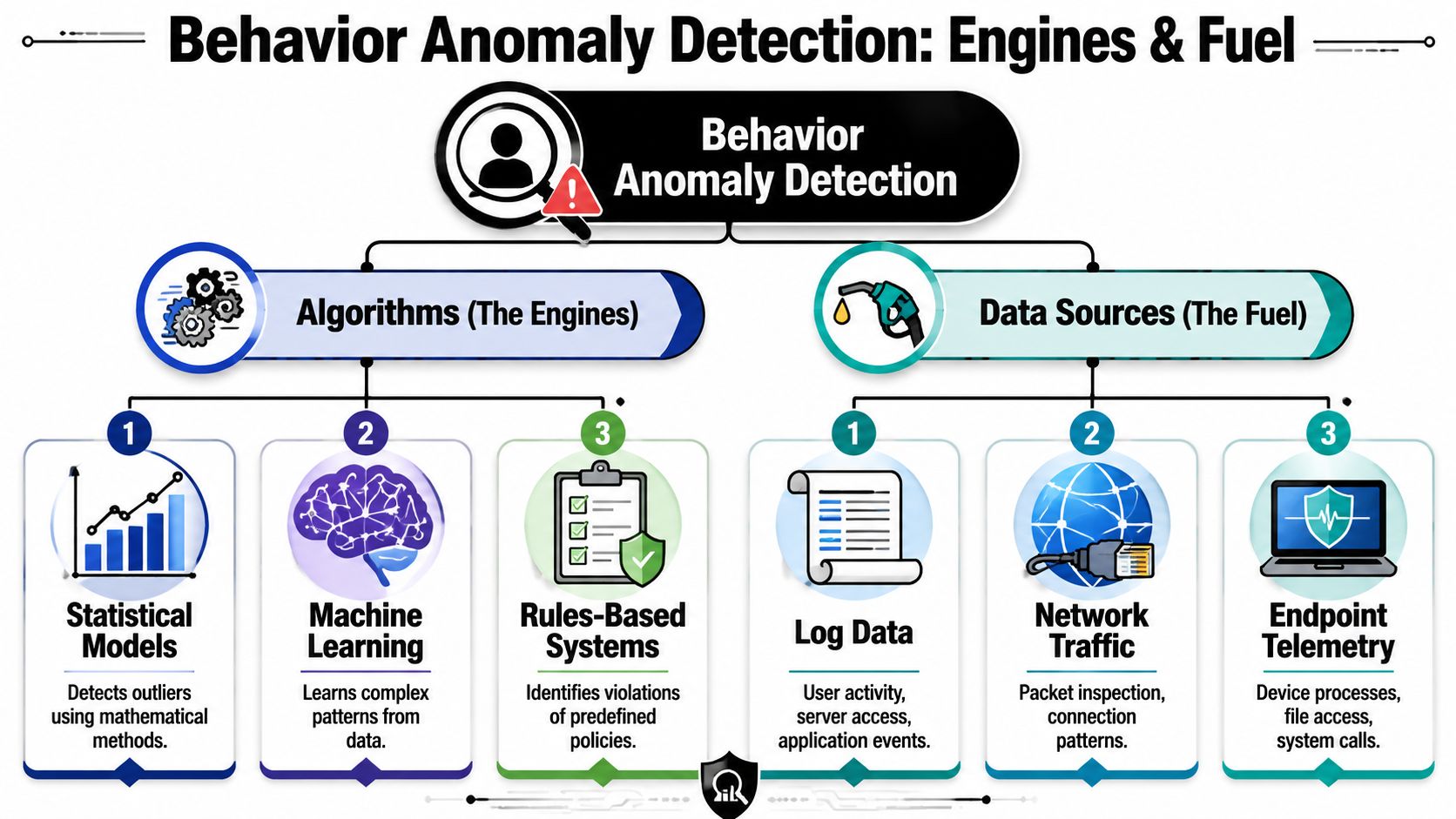
Statistical methods for fast outlier detection
Classical statistical methods still have a role in security operations. They are quick, simple to explain to analysts, and valuable when a SOC needs a baseline signal it can review without wondering what the model did. Exabeam characterizes anomaly detection as baseline deviation and spotlights practical methods for finding activity that departs from established norms in its survey of behavior anomaly detection techniques and best practices.
Methods such as Z-score, IQR, and Grubbs' test do well with clear-cut shifts. A service account that suddenly authenticates far more often than usual, or a workstation that begins sending traffic to a destination pattern outside its normal range, can be flagged quickly with fairly little tuning.
Their shortcomings become apparent quickly in real investigations. Slow privilege abuse, low-volume data staging, and attacks that remain within normal volume bands often slip past statistical screens unless the model also accounts for sequence, role, peer group, and time.
Machine learning when labels are scarce
Most SOC teams lack clean labeled training data for every abuse case they care about. This is why unsupervised approaches stay common in behavior analytics. Methods including Isolation Forest and Local Outlier Factor can help uncover anomalous entities or sessions without needing a catalog of prior incidents.
The trade-off concerns operational clarity. These models may rank unusual behavior effectively, but their value depends on the features they receive. When identity logs handle device names unevenly, cloud logs come in late, or account types are not standardized, the model ends up learning your collection issues instead of attacker behavior.
That is typically the point where trust fails.
In practice, feature engineering determines whether an alert can be acted on. Effective pipelines consistently encode time of day, peer group, asset criticality, authentication outcome, privilege level, and recent change activity. Teams that work with event streams and time-based data can also examine ThirstySprout for anomaly detection, which describes time-series patterns in a manner that aligns well with security telemetry.
Deep learning and sequence-aware models
Certain behaviors are meaningful only when viewed as a sequence. Failed logins followed by a successful login from a new host, a spike in administrative API calls, and then unusual data access tell a richer story than any single event alone. In those situations, sequence-aware models like LSTMs or comparable deep learning methods can help uncover patterns that simpler techniques overlook.
They also set a higher standard for deployment.
Deep models demand more data, more compute, and greater attention to explainability. In a mature detection engineering program, that burden can be warranted for high-value use cases like identity compromise, cloud control-plane abuse, or multi-stage insider activity. In a new SOC, a simpler model backed by stronger evidence often works better because analysts can validate it quickly and tune it confidently.
The data sources that matter most
No algorithm can repair poor telemetry. Sparse, delayed, or inconsistent inputs create noisy alerts, regardless of how advanced the model appears on paper.
Teams usually get the best results by prioritizing a mix of:
- Identity telemetry, including authentication events, MFA outcomes, privileged role use, and service account behavior
- Endpoint telemetry, including process creation, file access patterns, persistence changes, and EDR alerts
- Network telemetry, including flows, east-west communication, uncommon peer relationships, and unusual protocol use
- Cloud and SaaS logs, including admin API activity, mailbox access, storage operations, and configuration changes
- Asset and business context, including criticality, owner, business unit, and maintenance schedules
Coverage matters, yet alignment matters more. Identity anomalies are much easier to trust when the same user also shows up in endpoint, network, and cloud events linked to a sensitive asset. That is the reason event correlation and artificial intelligence in security operations is important within a SIEM or XDR stack. Correlation provides the analyst with enough context to distinguish a rare but approved change from the early stages of an attack.
From Detection to Response SIEM and XDR Integration
At 2:13 a.m., the SOC receives an alert about unusual access by a finance user. By itself, that signal does not answer the important question. Is this an attacker, a late-night admin task, or an undocumented business process? Behavior anomaly detection begins to prove its value when that alert enters a SIEM or XDR workflow that can add evidence, rank risk, and help guide a response decision.
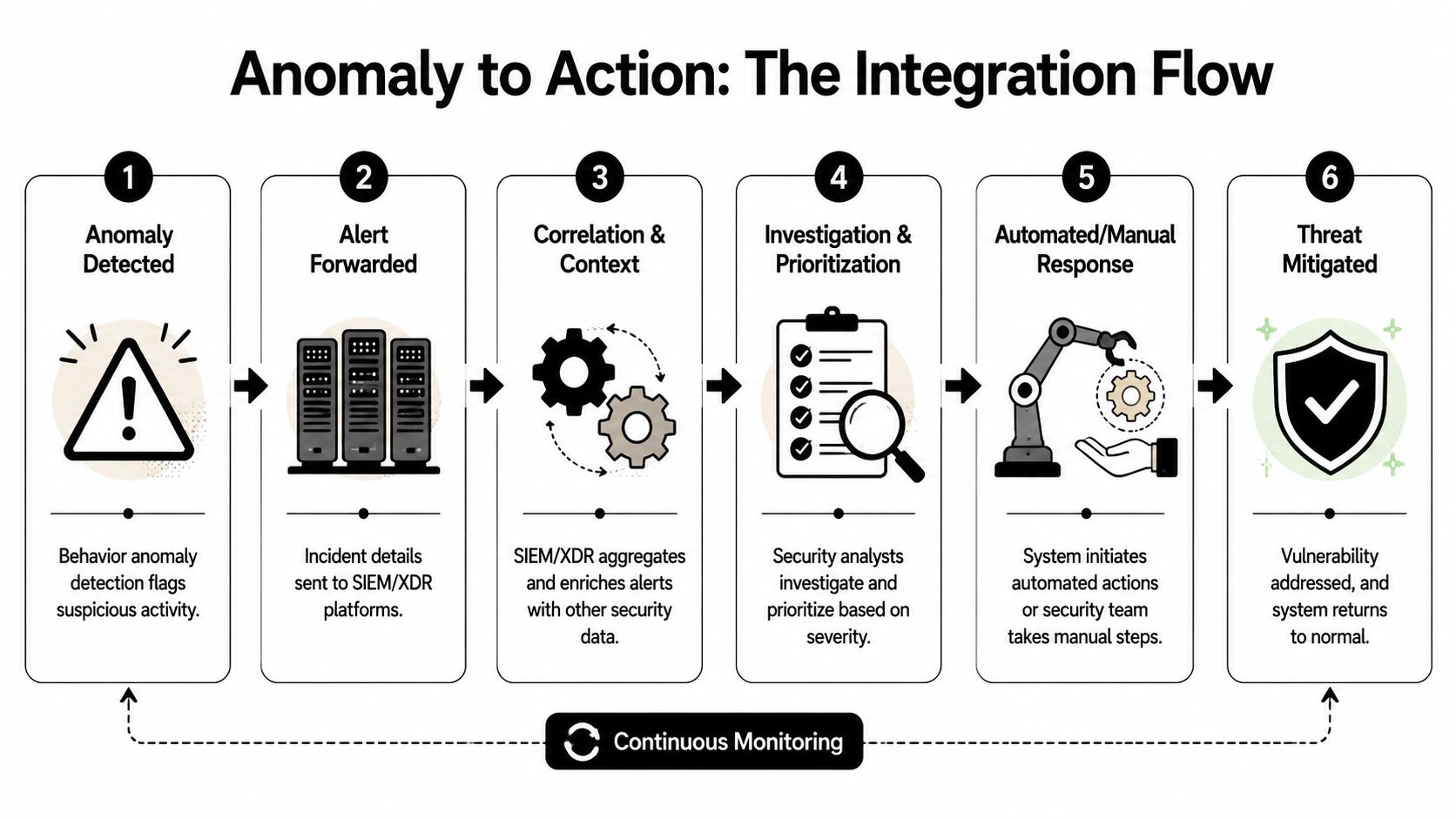
What correlation adds
Behavior models excel at surfacing activity that deviates from a baseline. They are less capable of proving intent. That gap explains why mature teams combine anomaly detections with signatures, threat intelligence, asset context, and analyst workflows instead of treating the model as a stand-alone control.
The operational value of correlation is straightforward:
Context
The alert is linked to the user, host, asset criticality, recent changes, and related detections on the same timeline.Validation
An anomaly with low confidence gains credibility when it coincides with malware events, identity risk, impossible travel, or command execution on an endpoint.Prioritization
The queue shrinks when the platform prioritizes privileged accounts, sensitive systems, and multi-signal activity.Actionability
Analysts can create a case with evidence already gathered, or launch a playbook when combined signals cross a response threshold.
Correlation also lets teams cut false positives without losing visibility. A rare event on its own generates work. A rare event combined with suspicious process activity, privilege use, and access to a sensitive asset creates a case worth investigating.
A practical response flow
In practice, the pipeline usually works like this:
- A detection event lands from UEBA, NDR, EDR, or a custom analytic
- The SIEM or XDR enriches it with identity, endpoint, cloud, and asset records
- Correlation rules and analytics score adjacent activity such as failed logins, new persistence, mailbox access, or unusual destinations
- Case logic promotes the event from anomaly to incident candidate when the evidence crosses a defined threshold
- Response actions start through analyst review, automation, or both
One real-world example clarifies the value. A user opens sensitive files outside business hours. On its own, that may be routine. If that same chain also includes a new device, a recent MFA enrollment, atypical PowerShell activity, and outbound transfers from the endpoint, the platform has sufficient context to prioritize the case and contain it more quickly.
Uncorrelated anomaly alerts generate triage work. Correlated anomaly alerts generate starting points for investigation.
For distributed teams, a SIEM on cloud deployment model aids in consolidating telemetry, enrichment, and response across on-prem, cloud, and remote endpoints without requiring every control to reside in one physical location.
Automated response has a place at this layer, though only within guardrails. Isolating a host, raising authentication requirements, disabling an account, or creating a ticket with attached evidence can reduce analyst effort and shorten dwell time. Such actions should be driven by corroborated signals and explicit policy thresholds, not by an ambiguous anomaly score by itself. That approach builds trust in the system rather than training analysts to disregard it.
Making It Work Deployment Tuning and Metrics
A SOC typically loses faith in behavior anomaly detection in much the same pattern. The first week appears encouraging. By the third week, analysts are closing alerts in bulk because the system continues to surface behavior that is theoretically unusual but benign in the business context.
That failure begins during deployment, not within the model.
Teams achieve stronger outcomes when they run anomaly detection as an operational program with owners, review criteria, and tuning cycles. The objective is not to flag every deviation. The objective is to bring forward the deviations that merit analyst time, then explain them clearly enough that the team can act without speculation.
Start with narrow use cases
Enterprise-wide baselining may sound mature, yet early deployments generally benefit from a narrower scope. Broad models can indicate that something uncommon occurred. They frequently cannot indicate whether the alert belongs with an identity analyst, an endpoint analyst, or no one at all.
Start where the business impact is clear and the review path is short:
- Privileged identity monitoring for admin accounts, break-glass users, and service principals
- Crown-jewel system access for finance platforms, healthcare records, source repositories, and identity infrastructure
- Lateral movement indicators such as remote execution, unusual peer relationships, and administrative access paths
- Data handling workflows such as large exports, unusual storage access, and abnormal access timing
This gives the model a clear purpose. It also gives the SOC a repeatable method to determine what is benign, what requires tuning, and what should become an incident.
Measure what operations actually feel
Many teams continue to place too much emphasis on model accuracy. That metric offers limited value in security operations because normal activity far outweighs suspicious activity. A system may appear statistically strong and still consume analyst time.
A better scorecard reflects the day-to-day cost of running the tool:
- Precision to show how many alerts are worth opening
- Recall to test whether known attack patterns are being surfaced
- F1 to balance detection coverage against noise
- AUC-ROC as one view of model discrimination, not the only one
- Time to triage to show whether analysts can understand the alert quickly
- Suppression and exception rates to reveal where the baseline conflicts with normal business activity
Those metrics are important because false positives create a real operational cost. Each weak alert competes with actual incidents for analyst attention. Teams confronting that problem should also review practical ways to reduce false positives in SIEM systems, particularly when anomaly alerts share a queue with lower-confidence detections.
Another metric warrants attention. Track how frequently analysts concur with an alert after review. That straightforward feedback loop often reveals more about trust than a dashboard packed with model statistics.
Explainability is required for trust
Analysts do not need a lesson in feature engineering. They need sufficient evidence to answer one simple question quickly: why did the system care about this behavior?
Studies on explainable unsupervised anomaly detection in healthcare make the same practical point. The workflow proves more useful when it helps investigators see why activity was flagged and supports well-informed decisions, as covered in the study on explainable anomaly detection for informed investigation.
Operational test: If an analyst cannot account for the alert during a brief review, that alert will not last in the SOC queue.
Strong anomaly alerts pair the baseline with the deviation. They reveal what shifted, across what period, and which related signals boosted confidence. They do not conclude with a score.
| Weak alert | Strong alert |
|---|---|
| High anomaly score for user | User accessed a system they have not historically used during an unusual time window after a change in authentication pattern |
| Host behavior anomaly detected | Host initiated a new lateral connection pattern and launched processes that do not fit the asset role |
| Abnormal file activity | File access volume and target location differ from the user's normal workflow and peer group behavior |
That presentation alters analyst behavior. Clear evidence produces faster triage, stronger escalation decisions, and more precise tuning. Opaque alerts typically get suppressed.
Tune for change, not for a static environment
Today's environments never stay static. Teams shift roles. Cloud workloads expand and contract. Contractors join for short-term projects. Business travel, acquisitions, and seasonal operations can each distort a baseline.
Approach tuning as a continuous practice. At the outset, examine newly formed alert clusters each week. Create exceptions with care, and set expiration dates whenever feasible. Distinguish temporary business events from lasting changes in behavior. In mature programs, baselining by peer group and adding asset-role context frequently yield steadier outcomes than relying solely on individual user history.
Teams that realize value from behavior anomaly detection are not pursuing an ideal model. They keep a platform that analysts have confidence in, track whether it reduces effort or adds noise, and adjust it as the environment evolves.
Real World Threats and Practical Use Cases
Behavior anomaly detection proves its worth when activity is harmful yet appears authorized on paper. The account exists. The tool is sanctioned. The system has approval. The pattern is what differs.
Compromised credentials that look legitimate
Someone signs in without failure. No brute-force pattern shows up. MFA might even be in use. Tools based on signatures typically register a routine authentication event.
Behavior anomaly detection poses more difficult questions. Does this person typically reach this application? Is the sign-in time odd for the individual or the team? Did the session rapidly enter resources beyond the user's usual scope? Has the account started accessing systems it has not used before?
This is frequently how stolen credentials come to light. The reason is not that the sign-in is impossible, but that the behavior around it departs from the account's baseline.
Insider misuse and quiet data theft
Insider risk often has less to do with malware and more to do with departures from role-based patterns. An employee who has authorized access starts retrieving data at odd hours, viewing records beyond their project, or shifting files in a manner inconsistent with their peer group.
A fixed rule can overlook this when no firm threshold is breached. A behavioral model can mark the sequence as atypical for that individual, particularly if it brings together timing, access scope, and changes in destination.
Here, analyst context is especially important. HR activity, project shifts, and exceptions approved by managers can all shape how the situation is read. The anomaly engine ought to deliver the signal. People reviewing it should determine intent.
Lateral movement on ordinary infrastructure
Lateral movement seldom makes noise at the outset. Attackers commonly rely on remote administration tools, account delegation, service creation, and normal network routes. Every step may resemble ordinary IT work.
Many of the best detections arise from routine events that look suspicious only once viewed as a pattern.
Behavior anomaly detection can reveal this by monitoring host-to-host connections, atypical administrative sequences, and new service activity on systems that normally stay consistent. A workstation that abruptly starts server-side administrative work, or a server contacting peers beyond its usual communication pattern, warrants scrutiny even when no signature triggers.
In these situations, behavior anomaly detection justifies its cost and the attention of analysts. It provides the team with a means to examine suspicious patterns before the threat has fully revealed itself.
Limitations Compliance and Your Unified Security Stack Strategy
Behavior anomaly detection has drawbacks. If you roll it out as a black box over everything, it will let you down.
Where behavior anomaly detection struggles
One major problem is baseline driftFidelis observes that normal behavior is continuously shifting because of hybrid work, cloud migration, and related factors, and that effective anomaly detection depends on adaptive baselining and feedback loops. Fidelis also notes that broad enterprise-wide monitoring may be less effective than models scoped to particular use cases in its discussion of anomaly detection at scale in dynamic environments.
That shows up in practice when:
- Cloud estates change quickly and yesterday's normal no longer applies
- Remote work shifts activity patterns across time zones, devices, and networks
- SaaS adoption fragments visibility across many admin surfaces and APIs
- Business events distort the baseline during launches, migrations, audits, or acquisitions
One practical approach to considering operating models and process discipline for teams in transition is to examine frameworks beyond security as well. This overview of Tekk.coach Bmad alternatives is a helpful reminder that workflow design and feedback loops can be just as important as the tool.
Why it still matters for compliance
Behavior anomaly detection also offers compliance benefits, particularly when it creates audit trails that can be defended. Regulated teams require more than detection alone. They need proof of user activity, access patterns, investigation steps, and response actions.
That aligns closely with frameworks focused on access monitoring, incident handling, and evidence retention. A strong anomaly workflow can assist reviews in healthcare, financial services, and contractor settings because it documents what deviated, why it was examined, and what action the team took afterward.
A practical operating model
If you're building this into a modern stack, keep the operating model tight:
- Prioritize identity, endpoint, and cloud admin telemetry first since those datasets typically reveal meaningful behavioral change at the earliest stage.
- Model narrow use cases before broad coverage so baselines remain understandable.
- Correlate anomaly alerts with other detections prior to escalating to containment.
- Use feedback loops from analysts to reduce recurring noise and strengthen trust.
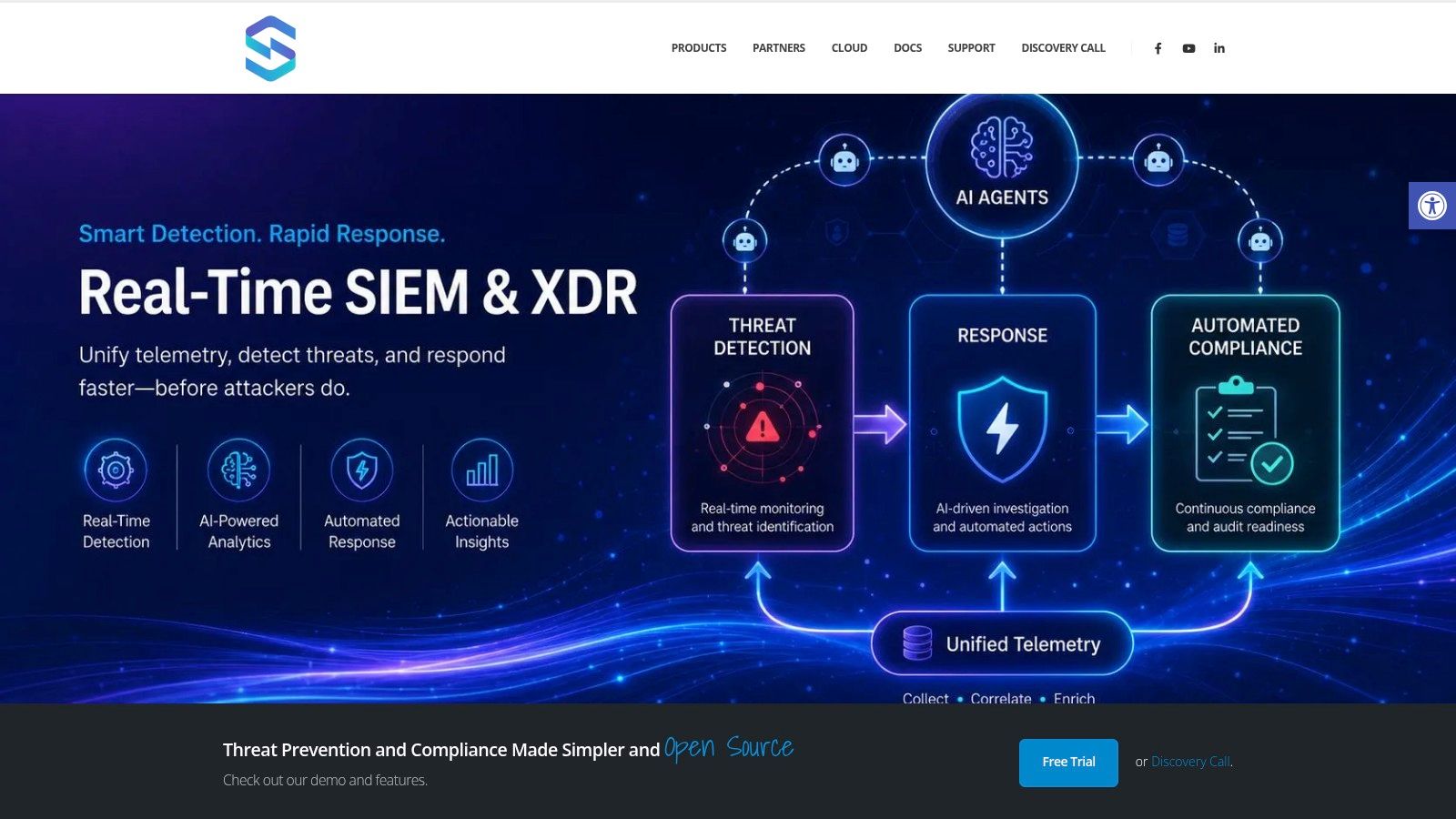
- Treat Unified Security Stack as one integration layer option when you require SIEM, SOAR, and XDR functions unified in one location, particularly for ingesting logs from cloud services, network devices, and endpoints, correlating events in real time, and tying compliance evidence to investigations.
Behavior anomaly detection is effective when it becomes part of a disciplined detection program. It breaks down when teams expect a model to take the place of engineering, tuning, and analyst judgment.
If you're evaluating how to operationalize behavior anomaly detection inside a unified security workflow, Unified Security Stack merits a look for teams that need SIEM, SOAR, XDR, and compliance functions on the same platform. It can help consolidate telemetry, correlate anomaly signals with other events, and automate response steps so analysts spend less time chasing isolated alerts and more time investigating incidents with context.