Indicator of Compromise: The SOC Playbook
Enterprises missed 60% of incidents because their existing tools produced no high-confidence alerts, according to Kaspersky's 2025 compromise-assessment findingsAn indicator of compromise has value, yet static matching by itself will not consistently expose an adversary who knows how to hide within ordinary activity.
That difference is important for any SOC that relies on a SIEM, EDR, or XDR platform. An IOC may tie a suspicious file, registry change, DNS request, or command-and-control trace to an intrusion, yet its worth hinges on context, data quality, and the response that follows. The real question is not whether your platform keeps indicators. It is whether your team can distinguish a significant signal from a harmless lookalike, query historical telemetry, and combine several weak clues into an incident that can be defended.
Table of Contents
- The Reality of Modern Threat Detection
- Understanding IOC Taxonomy and Levels
- Detection and Correlation Techniques
- Investigation and Triage Playbook
- Limitations and the Decay of Indicators
- Operationalizing IOCs with Unified Security Stack
The Reality of Modern Threat Detection
A security analyst begins with an alert that appears simple. An endpoint reports a file hash tied to malware. A network sensor logs a connection to a suspicious domain. A user account logs in from an unusual location. Every event may warrant attention, but none by itself proves that an attacker has gained control of the environment.
NIST defines an indicator of compromise as a technical artifact or observable indicating that an attack is imminent, in progress, or may already have taken place. The definition, recorded in the NIST glossary entry for indicator of compromise, positions IOCs within formal incident response and anomaly analysis. It also provides defenders a wider operating window than the usual assumption that an IOC only detects an infection that has already occurred.
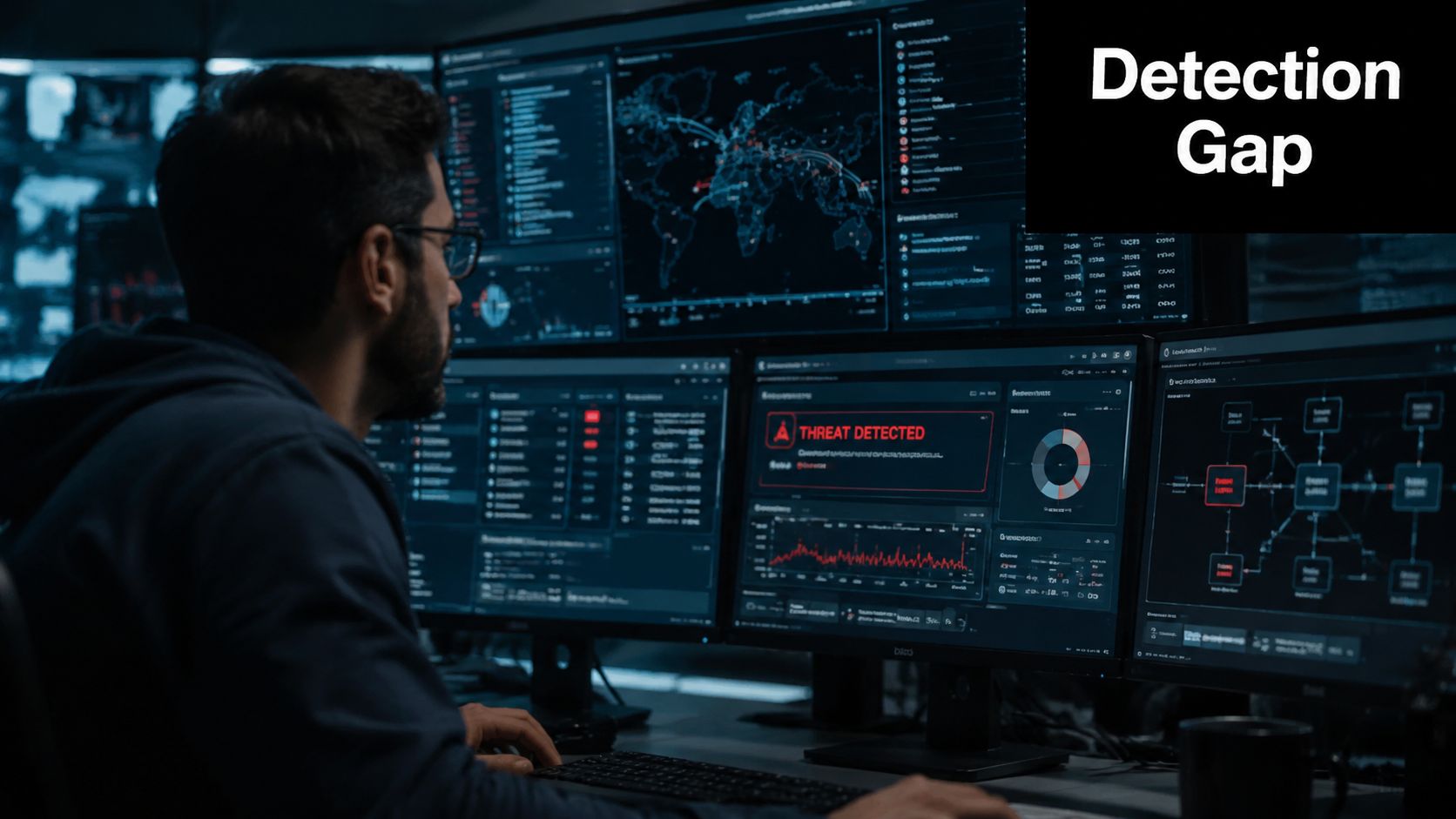
Why the alert alone isn't enough
A hash match may identify a known file, but it will not always identify a renamed payload, a memory-only technique, or an adversary who uses legitimate administration tools. An IP address can show up in threat intelligence, yet infrastructure changes, shared hosting, and compromised services can render the same address ambiguous. The SOC must assess who accessed what, from which device, through which process, and what took place right before and after the match.
Practical rule: View an IOC as evidence that alters investigation priority, not as a verdict that concludes the investigation.
Detection engineering distinguishes mature operations from alert collection. Analysts require endpoint, identity, network, cloud, and application telemetry that can be linked around a user, host, process, session, or time window. Without that contextual evidence, a SIEM may produce technically accurate alerts that still draw analyst attention without demonstrating risk.
This principle also applies to external exposure. A suspicious email, credential event, or unusual data transfer can be easier to assess when the organization understands its local threat environment and common attack paths. Teams reviewing phishing and data breach warnings for Atlanta can apply that context to enhance awareness content and prioritize monitoring for the threats most relevant to their environment.
Traditional signature-based detection continues to have a purpose. Known hashes, domains, and malware patterns match quickly and can aid blocking or containment. They fall short when defenders treat them as a full detection strategy, since attackers can alter artifacts while keeping the same objective, access path, or behavior.
Understanding IOC Taxonomy and Levels
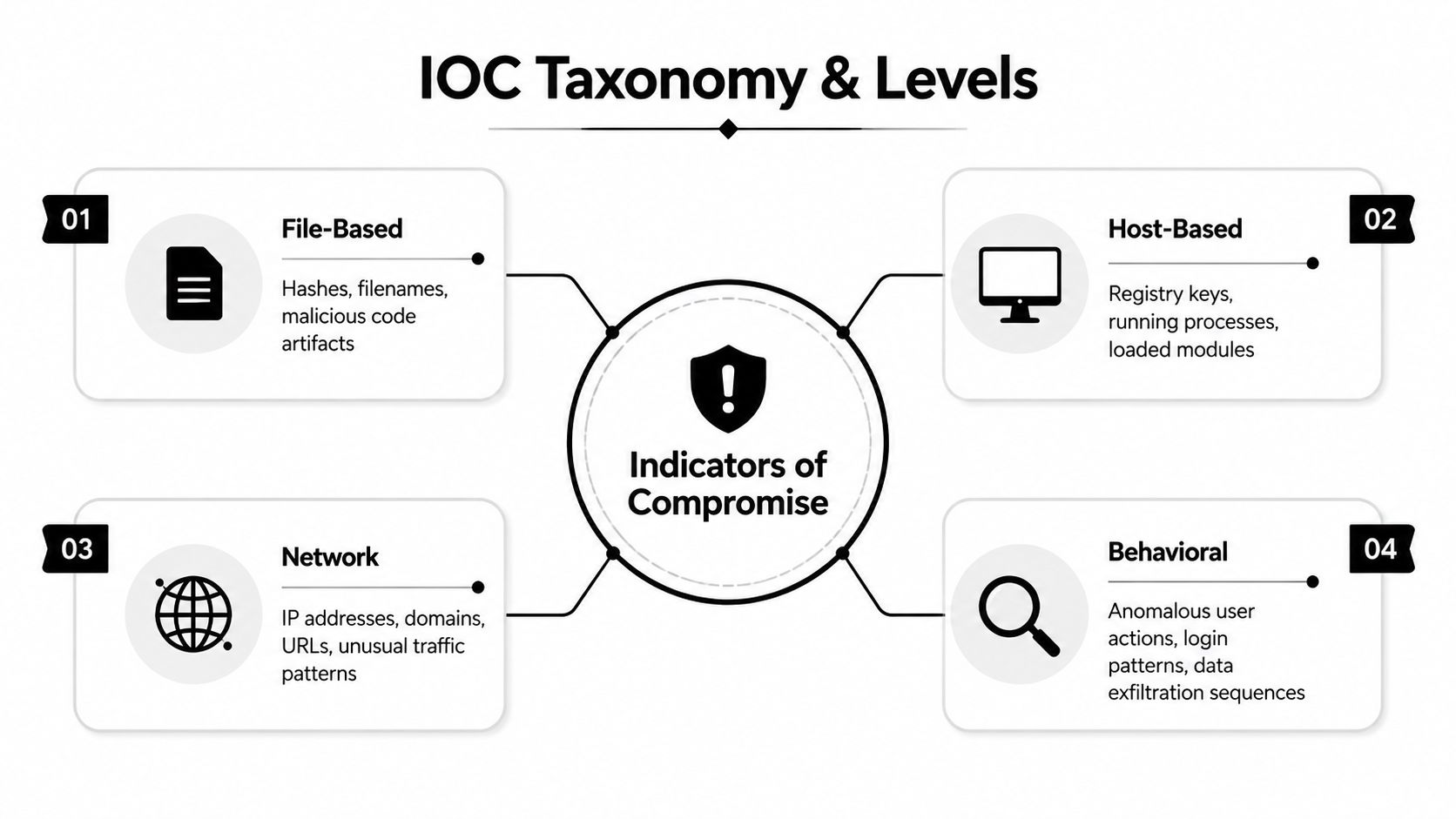
A practical IOC taxonomy begins with the source of evidence, then asks how reliably that evidence links to malicious activity. The main categories overlap in actual use, and the best detections often merge them instead of depending on a single isolated artifact.
File-based indicators
File indicators include hashes, filenames, and malicious code artifacts. A known SHA256 value can help an EDR identify a payload consistently, while a filename or file path can assist hunting when the attacker uses a recognizable staging location. Hashes are exact for the specific file observed, but that exactness also restricts them when adversaries recompile, modify, or deliver another payload.
Network indicators
Network IOCs include IP addresses, domains, URLs, and unusual traffic patterns. They can enable blocking, threat-intelligence enrichment, and retrospective searches across DNS, proxy, firewall, and NetFlow records. A single network artifact warrants caution because infrastructure may be transient or shared. The NIST SP 800-53 control guidance for host and network forensic artifacts shows how registry changes and URL or protocol elements tied to command-and-control activity can serve as useful detection inputs.
Host-based indicators
Host evidence covers registry key values, running processes, scheduled tasks, loaded modules, persistence locations, and modifications to security-relevant configuration. These artifacts help answer a key question: what did the endpoint do after the suspicious file appeared or the unusual connection took place?
NIST's control example centers on artifacts like registry key creation and network elements tied to malware command and control. That makes host-based evidence useful for correlation rules, not only forensic reports.
Behavioral indicators
Behavioral indicators describe sequences and relationships, for example an odd sign-in followed by elevation, code injection, creation of an archive, and data sent outbound. Such patterns are harder to defeat than a single hash, yet they call for stronger telemetry and disciplined tuning. An activity that signals compromise on a server could be routine on an administrator's workstation.
A matched set across layers generally carries more weight than a single artifact. A suspicious file that starts an unusual process, establishes persistence, and contacts a related destination provides the analyst with a coherent story. The RFC 9424 specification codifies the relationship between observable artifacts and attacker tactics, techniques, procedures, tooling, and infrastructure, including observations at both network and endpoint levels.
Detection and Correlation Techniques
Matching static IOCs addresses a limited question: was this specific artifact present in telemetry? This is useful for familiar threats, quick blocking, and looking back through history. It loses strength when shared infrastructure, outdated intelligence, user-created content, or benign software that looks like malicious tools are present in the environment.
RFC 9424, published on 2023-02-26, explains that IOCs are observable artifacts that can assist defenders in proactively blocking malicious traffic or code execution, confirming that an intrusion happened, and linking activity to a known intrusion set. It further describes retrospective hunting, in which defenders pair newly obtained indicators with past DNS queries or email attachment hashes. That method works only if the relevant logs have been kept and have not been altered, including by techniques like timestomping. See the RFC 9424 publication record for official reference purposes.
Matching versus correlation
A static IOC rule could fire on a SHA256 hash, IP address, domain, filename, or path. Vendor documentation for Cortex XDR/XSIAM separates these straightforward rules from correlation rules that rely on XQL to examine relationships across multiple events and sources. This distinction matters in operations:
| Detection approach | What it does well | Where it struggles |
|---|---|---|
| Static IOC match | Finds known artifacts quickly and supports blocking | Misses modified artifacts and creates ambiguity around benign matches |
| Multi-event correlation | Connects identity, endpoint, network, and process activity | Requires consistent telemetry and more tuning |
| Behavioral detection | Detects suspicious sequences without depending on one artifact | Can be noisy when normal administrative behavior is poorly modeled |
A useful correlation rule may demand a suspicious destination, a newly spawned process, and an atypical user or host context before it escalates. The rule does not have to state that any single event is malicious. It needs to find a combination that justifies investigation.
This is the design principle behind detection engineering for SIEM and XDR environments. Correlation ought to lessen ambiguity by supplying context, not merely pile on conditions until the rule cannot be tested. Analysts should assess which fields account for the alert, which exceptions reflect legitimate activity, and whether the resulting incident gives a responder enough evidence to take action.
Detection design is most effective when each condition answers a question tied to the attack path.
Correlation is not a substitute for IOC feeds. It is the layer that helps a SOC determine whether an IOC matters for a given asset, account, process, or session. That distinction cuts alert fatigue while retaining the speed and coverage that static indicators offer.
Investigation and Triage Playbook
An IOC alert should initiate a repeatable investigation. Analysts require a consistent route from validation to containment, particularly when the same indicator shows up across endpoints, cloud workloads, and network devices.
Validate the match
First, validate the raw event. Confirm the timestamp, source, destination, asset identity, process lineage, user account, and the precise artifact that matched. Determine whether the value originated from a trusted sensor or an incomplete parser, and establish whether the event indicates execution, observation, download, or simply a reference in a document.
Next, evaluate the local context. A file hash on a quarantined attachment does not have the same urgency as that hash running under a privileged service account. A domain lookup from a sandbox may be normal, whereas the same lookup from a finance workstation followed by archive creation merits immediate escalation.
Enrich and scope
Incorporate threat-intelligence context, endpoint history, identity activity, and related network events. Look for the indicator across historical logs, then pivot on associated users, hosts, processes, and destinations. Retrospective hunting matters greatly because an alert may reveal a long-running intrusion instead of a new event.
Apply an LLM where it enhances analyst workflow, not where it substitutes for evidence. An integrated model can summarize related events, suggest rule-tuning candidates, group duplicate alerts, and flag missing context for review. The analyst must still verify the underlying events and approve actions that might disrupt business operations.
Contain with control
Once the scope proves credible, start a response playbook, whether predefined or custom. Actions may involve isolating an endpoint, deactivating a compromised account, blocking a destination, gathering forensic artifacts, and creating an incident record with the evidence retained. Automation ought to act more decisively on high-confidence combinations and more cautiously on a lone ambiguous IOC.
The incident response playbook guidance offers a practical model for linking detection, investigation, and response actions. Each automated step should have an owner, an audit trail, and a rollback path. Containment that disrupts a critical system without sufficient context can cause operational damage while the original alert stays unresolved.
Limitations and the Decay of Indicators
An IOC is not a permanent truth about an attacker. It is a time-limited observation whose value shifts as infrastructure, payloads, and defensive coverage evolve. Teams that load an indicator feed and never check age, confidence, provenance, or observed relevance will eventually turn detection content into noise.
Kaspersky's 2025 compromise-assessment findings reported that 30.8% of incidents had activity older than three months, while 52% of high-severity compromises had activity that predated that period. The oldest uncovered incident had lasted for four years, according to the same compromise-assessment findings. Those findings make historical search and behavior-based investigation more important than assuming a current alert marks the start of an attack.

False positives are a data problem
Format-based extraction can confuse benign entities with malicious indicators when context is disregarded. A 2026 study reported 126 false positives from one IOC search system, in which legitimate entities were wrongly flagged for resembling IOC patterns. A different dataset held 64 false positives where relationships that were inferred, not indicators stated explicitly, were handled as IOCs. These findings appear in the 2026 research on context-aware IOC extraction.
The answer is not to silence every source that generates noise. It is to add provenance and confidence, standardize observables, keep owner-assigned allowlists, and validate detections with realistic benign activity. Analysts must be able to tell why an indicator was added, when it was last seen, which source supplied it, and what assets it touches.
An outdated indicator may be more harmful than none at all if analysts start ignoring that alert category.
IOC aging also shapes retention policy. When DNS, email, endpoint, and identity records vanish quickly, defenders cannot establish whether a new indicator existed during an earlier compromise. Log preservation is not merely a compliance task. It directly decides whether retrospective hunting can rebuild the attack path.
Operationalizing IOCs with Unified Security Stack
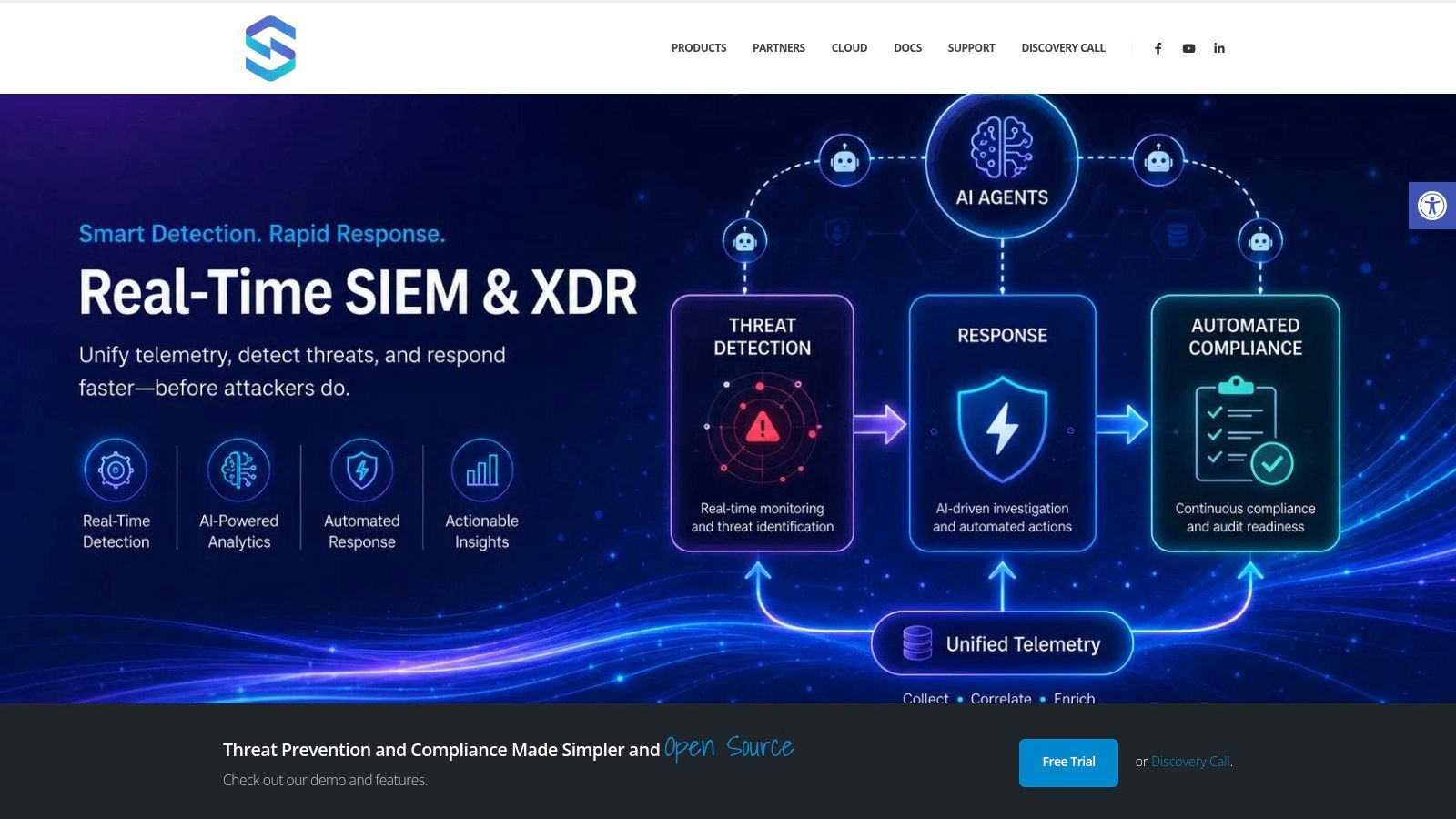
A mature IOC program links four capabilities: collection, enrichment, correlation, and response. A unified SIEM and XDR platform can take in telemetry from cloud services, network devices, and endpoints via APIs, Syslog, NetFlow, and agents, then correlate events prior to indexing. This architecture helps teams cut duplicate noise while keeping the relationships that investigations require.
The platform should allow both direct searches and reusable detection content. Analysts must be able to search IP addresses, domains, file hashes, URLs, suspicious paths, registry keys, and user agents, then pivot to related activity. Detection engineers need conditions that combine multiple event types, apply asset and identity context, and generate an incident explaining why that combination is significant.
Build an IOC lifecycle
Begin by giving every feed and rule an owner. Document source, confidence, first and last observation, affected technologies, expiration criteria, and the response action. Separate blocking rules from hunting rules, since a low-confidence indicator can help with searching without being safe to block automatically.
Next, tie detection to response. A high-confidence endpoint and network combination can initiate isolation or collection, while one match may generate a lower-priority investigation task. Integrated LLM capabilities can help summarize alerts, recommend tuning changes, and ease repetitive triage, but the SOC should retain the original evidence and require human approval for disruptive actions when risk is unclear.
Support compliance without losing technical depth
IOC evidence also supports governance processes. A platform that links detections and preserved evidence to CMMC, HIPAA, PCI, GDPR, SOC 2, ISO 27001, and GLBA can narrow the divide between security operations and audit readiness. The mapping alone does not make a control effective. Teams still need documented ownership, suitable retention, validated response procedures, and proof that alerts are reviewed.
Unified Security Stack brings together SIEM, SOAR, and XDR capabilities with threat intelligence, threat hunting, automated playbooks, vulnerability scanning, access-rights auditing, endpoint protection, dark web monitoring, and file tracking. Its product documentation states support for threat-intelligence searches and correlation across security events, while its open-source licensing model targets organizations seeking an extensible security and compliance stack.
Outcomes still hinge on feed quality. Employ IOC threat-intelligence feed optimization to assess duplication, confidence, aging, source reliability, and how feed entries relate to actual detections. The objective is not to gather every conceivable indicator. It is to sustain a defensible set of observables that analysts can tie to behavior, investigate through retained history, and convert into proportionate response actions.
If your SOC must go beyond standalone hash, domain, and IP matches, consider how Unified Security Stack can bring together IOC searches, multi-event correlation, automated response playbooks, and compliance evidence in a single open-source platform. Visit Unified Security Stack to discover the platform and see whether it meets your SIEM, XDR, threat-hunting, and incident-response needs.