Optimizing Your Threat Intelligence Feed in SIEM & XDR
Your SOC dashboard is packed, your analysts are worn out, and your ticket queue keeps expanding. One alert indicates a user clicked a suspicious link. Another reveals a connection to an external host. A third highlights unusual endpoint behavior. None are clearly linked to one another, and none come with enough context to show you what deserves attention first.
That is the point at which a threat intelligence feed ceases to be a mere add-on and becomes operationally valuable. A feed can indicate whether that domain has been tied to malware delivery, whether a file hash belongs to a known family, or whether a vulnerability is actively exploited in the wild. Without this context, teams pursue noise. With it, they can triage more quickly and respond with greater confidence.
This is even more important in open-source SIEM and XDR settings, where teams frequently seek flexibility while maintaining visibility. If you track external chatter, actor activity, or criminal communities, understanding related collection sources also helps. For instance, teams that broaden their external monitoring might want to monitor Telegram's dark side with Statiko as part of wider intelligence collection concerning new campaigns and leak activity.
Table of Contents
- Introduction to Threat Intelligence Feeds
- Understanding Key Concepts of Threat Intelligence Feeds
- Exploring Feed Types and Data Formats
- Implementing Ingestion and Enrichment Workflows
- Integrating and Tuning Feeds in SIEM XDR with Unified Security Stack Examples
- Evaluating Feeds with Metrics and KPIs
- Overcoming Common Challenges and Best Practices
- Conclusion and Next Steps
Introduction to Threat Intelligence Feeds
A threat intelligence feed is a flow of external security data that enables your tools to recognize known malicious infrastructure, malware artifacts, attacker behavior, and at times wider campaign context. Simply put, it provides your SIEM, EDR, XDR, firewall, or case management workflow with an external perspective on what defenders have already observed elsewhere.
This external perspective is important because internal telemetry seldom explains itself. A DNS request, a process launch, or a failed login can appear ordinary until it matches something already linked to phishing, credential theft, ransomware staging, or exploit delivery. The feed provides that missing clue.
In daily operations, teams typically do not struggle with whether alerts exist. Their challenge is which alerts deserve attention now. Threat intelligence feeds help address that question by giving otherwise isolated events reputation, relevance, and urgency.
Practical rule: A feed has value only if it changes a decision. If it does not affect triage, correlation, blocking, hunting, or patching, then it is merely additional data.
A strong feed program benefits more than the SOC as well. It can assist malware research, CVE prioritization, detection engineering, and compliance reporting aligned with frameworks such as HIPAA, GLBA, PCI, CMMC, and ISO 27001. Security leaders value this because the same intelligence that enhances alert handling can also strengthen risk communication and support spending decisions.
The remaining work is operational. You must understand what type of feed you are ingesting, how to normalize it, how to enrich it, where to correlate it, and how to prevent stale indicators from becoming recurring false positives.
Understanding Key Concepts of Threat Intelligence Feeds
The term threat intelligence feed is used loosely. Some vendors mean a basic list of bad IPs. Others mean a richer stream that contains malware families, actor tags, vulnerability exploitation context, and confidence metadata. If your team does not distinguish those ideas early, implementation becomes messy quickly.
The way these products have expanded in the market shows how vital they have become. The threat intelligence feeds market has a valuation of $7.2 billion in 2025 and is projected to reach $27.9 billion by 2034, with a 14.8% CAGR, according to Market Intelo's threat intelligence feeds market analysis. This expansion aligns with what defenders already experience in practice. Teams require quicker external context within security operations.
For a concise foundation on the broader discipline behind feeds, Unified Security Stack's overview of threat intelligence is a useful primer.
What a feed really contains
At the most basic level, a feed begins as data gathered from sources such as honeypots, malware labs, open-source intelligence, dark web monitoring, security vendors, and internal telemetry. This raw material becomes valuable once it is converted into security-relevant entities including:
- Indicators of compromise including domains, URLs, file hashes, or network artifacts.
- Behavioral clues which indicate repeated adversary techniques.
- Context fields for instance, confidence, source, malware family, campaign name, or targeted sector.
- Response hints which indicate to an analyst whether to block, investigate, isolate, or monitor.
For defenders, it serves as a newswire. Raw events arrive from every direction. What matters is filtered, labeled, and distributed by the feed provider or an internal intelligence process.
Why normalization matters before detection
Feeds seldom come in a single clean format. One source might deliver JSON. Another might expose TAXII collections. A third might provide flat text or CSV. If your SIEM takes in each source as-is, your rules become fragile because field names, severity labels, timestamps, and object types do not align.
Normalization solves that problem. It maps varying feed structures into a shared schema so correlation logic can operate consistently. Rather than writing separate logic for every source, analysts can pose one question across all of them: did this endpoint, user, process, or network event touch a known malicious indicator?
When a feed lacks normalization, analysts must make sense of idiosyncrasies from each source. With normalization, the platform handles that effort up front.
Tactical operational and strategic intelligence
Feeds do not all serve the same purpose. Security teams frequently mix up three distinct layers:
| Intelligence type | What it contains | Best use |
|---|---|---|
| Tactical | Raw IOCs such as hashes, domains, and URLs | Fast matching, blocking, enrichment |
| Operational | Campaign details, malware clusters, TTP context | Triage, hunting, detection tuning |
| Strategic | Business risk, targeting trends, executive context | Investment planning, leadership reporting |
This distinction is important in SIEM and XDR design. Tactical feeds are quick and suited to machines. Operational feeds help analysts grasp why an alert is significant. Strategic intelligence helps a CISO describe exposure to the board without overwhelming them with event data.
Exploring Feed Types and Data Formats
Security teams usually do not fall short due to a lack of feeds. They fall short because they take in the wrong combination. A raw blacklist can help with immediate matching, yet it will not help an analyst explain a suspicious sequence of behavior. A strategic advisory can brief leadership, yet it will not connect directly into automated detection logic.
Threat intelligence feeds aggregate diverse data sources including open-source intelligence, commercial feeds, internal logs, and collaborative sharing with trusted partners to identify patterns, trends, and IOCs that define threat actor TTPs, as described in Unified Security Stack's threat intelligence documentation.
To complement external threat sources, teams that want deeper exposure visibility often pair feeds with dark web monitoring for businessesparticularly where credential leaks or actor chatter may precede direct attacks.
The main feed categories
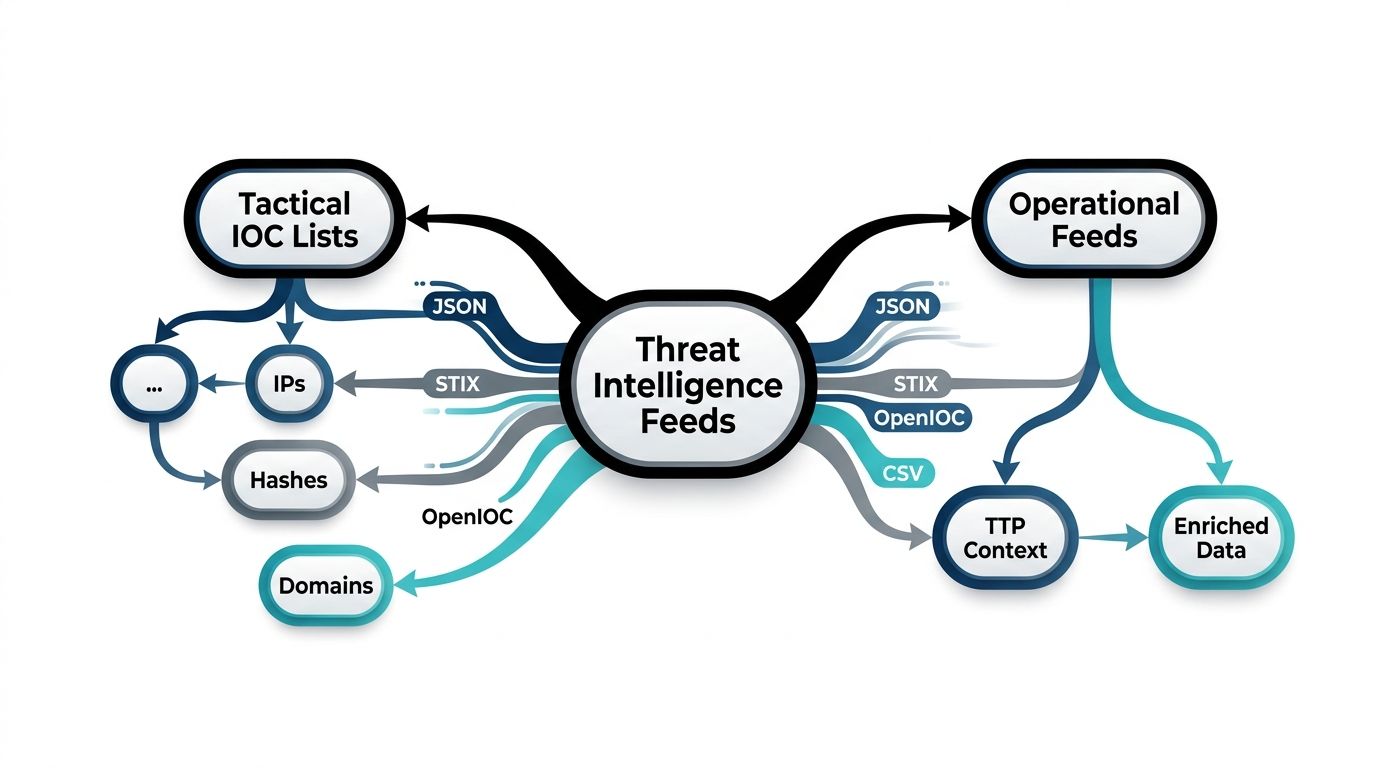
A practical approach to classifying feeds is to consider what they help you accomplish.
Tactical IOC feeds represent the most commonly encountered type. They include domains, hashes, URLs, and comparable indicators. They are easy to automate and fit well with SIEM correlation, EDR enrichment, and firewall blocklists. Their weakness lies in context. A match shows that something came into contact with a suspicious indicator, but not necessarily whether that activity merits high priority.
Operational feeds extend beyond that. They carry TTP tags, campaign labels, malware associations, sector targeting, or actor references. These are more valuable for threat hunting, malware research, and stronger correlation rules because they allow analysts to link isolated events into a broader pattern.
Strategic feeds or advisories are less concerned with direct rule matching and more with planning. They can outline adversary priorities, industry risk, or vulnerability exploitation trends. They are relevant to CISOs, risk leaders, and compliance teams, especially when aligning threat activity with regulated environments.
Open source versus commercial feeds
The open-source versus commercial decision is not really about free versus paid. It is about curation, metadata quality, and operational burden.
Open-source feeds often deliver strong coverage and broad community visibility. They can be useful for research, detection prototyping, and cost-conscious programs. However, teams usually need to handle more manual filtering, trust validation, and lifecycle management.
Commercial feeds frequently deliver richer context, cleaner schemas, and improved automation support. They may offer confidence scores, actor mapping, exploit relevance, or sector-specific intelligence. That is not to say every commercial feed is good. It means the burden often shifts from the customer doing basic cleanup to the provider doing more upstream.
A useful comparison looks like this:
| Feed source | Strength | Tradeoff |
|---|---|---|
| Open-source feed | Broad visibility and low entry cost | More manual validation |
| Commercial feed | Better enrichment and support | Budget and vendor review |
| Industry sharing | Sector relevance | Variable format quality |
| Internal feed | Highest environmental relevance | Limited external coverage |
Common formats security teams actually see
The format of the data dictates how difficult integration will be.
- STIX provides a structured method to represent threat information, particularly when you need relationships between indicators, malware, campaigns, and actors.
- TAXII serves as the transport mechanism that many platforms use to share STIX data.
- MISP JSON is widely used in intelligence-sharing communities and often carries extensive community context.
- OpenIOC shows up in certain legacy or specialized workflows.
- CSV and flat text remain common, particularly alongside simpler IOC lists.
The feed that is simplest to ingest is not always the simplest to operationalize. Flat files remain straightforward at the connector layer and burdensome at the tuning layer.
For SIEM and XDR teams, the central issue is not which format is theoretically superior. It is which format retains enough meaning for your detection pipeline without requiring continual parser maintenance.
Implementing Ingestion and Enrichment Workflows
The most significant error teams make is treating feed ingestion as a single-step import. Pull data in, drop it into the SIEM, and expect improved detection. That typically results in duplicate indicators, stale entries, mismatched fields, and increasing alert fatigue.
Threat intelligence feeds function by taking in raw data from varied sources, such as honeypots, malware analysis labs, OSINT, and dark web monitoring, then normalizing and enriching it into standard formats like STIX 2.1 and TAXII 2.0 before automated pipelines turn raw IP addresses or file hashes into actionable alerts. This normalization process is essential because it lowers noise by up to 60% in SIEM environments, according to Cycognito's explanation of threat intelligence feeds.
For teams thinking about the enrichment layer beyond security-specific tooling, Streamkap's real-time data enrichment provides a helpful framework for considering how streaming context alters decisions further downstream.
A robust workflow also relies on clean event intake from the broader environment. That is why centralized telemetry is important. Centralized log management provides one shared foundation for enrichment and correlation.
A practical ingestion pipeline
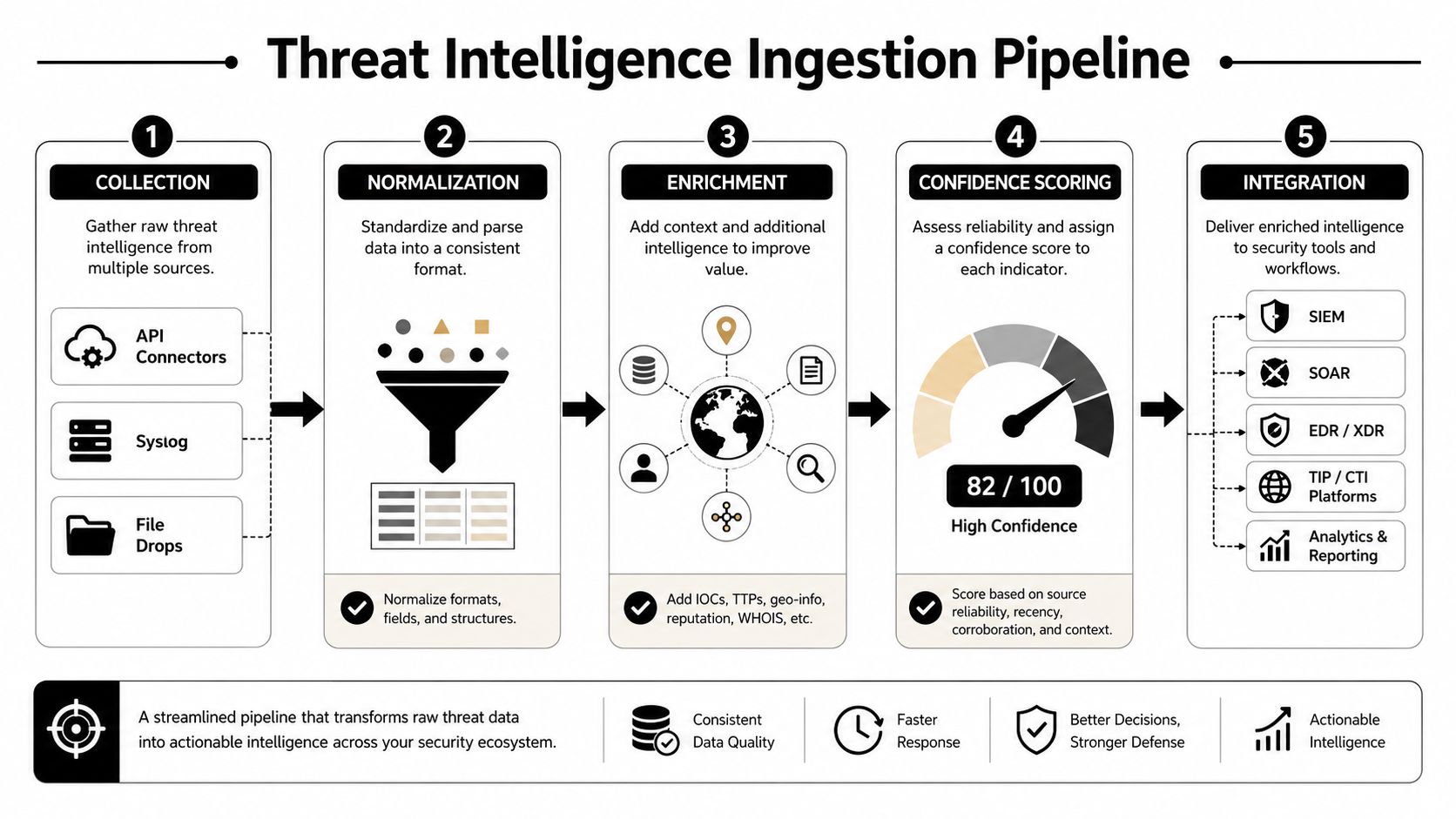
A pipeline suited to production typically includes five stages.
Collection
Ingest feeds via API connectors, TAXII clients, file drops, or scheduled fetchers. Here, dependability counts more than sophistication. Retries, source health monitoring, and readable failure logs are essential.Normalization
Map source fields to a shared schema. Normalize timestamps, indicator types, confidence labels, and source attribution. This step either prevents or produces many detection problems.Enrichment
Attach meaningful context. Associate indicators with asset criticality, geography, threat families, business units, exposed services, or past case history. An indicator on a test workstation and that same indicator on a domain controller are not equivalent.Scoring and filtering
Determine what is actionable now, what should be kept for hunting, and what should be suppressed. At this point, weigh confidence, recency, source reliability, and relevance to your environment.Integration
Route the curated output to SIEM, XDR, SOAR, ticketing, and response playbooks. Do not push every raw feed object to every control. Align the output with the purpose of each control.
Where enrichment turns data into context
Enrichment is the point at which a feed ceases to be merely a list.
Imagine a feed reports a domain as malicious. That is useful but not complete. If enrichment shows the domain is tied to credential phishing, that finance users recently visited related content, and that the indicator is part of an active campaign targeting your sector, triage priorities shift at once.
Security teams often enrich with:
- Asset context in order to determine whether a match affects crown-jewel systems.
- User context for example, department or privileged status.
- Threat context such as malware family, actor association, or exploit linkage.
- Historical context for example, whether the indicator has fired previously and how earlier cases were closed.
Field note: When enrichment does not change priority, routing, or response, it is merely decorative. Retain only context that alters action.
Why lifecycle management belongs in the pipeline
Indicators lose value over time. A malicious IP today can be reassigned later. A domain used briefly in a phishing campaign may become dormant. A hash may remain relevant longer, though its surrounding context still changes.
This means ingestion requires expiration logic, review windows, and retention that accounts for each source. Without such controls, a useful feed yesterday turns into a noisy feed next month. In open-source SIEM and XDR environments, this is even more important because teams often have more flexibility than guardrails.
A mature workflow regards freshness as a component of data quality, not something added later.
Integrating and Tuning Feeds in SIEM XDR with Unified Security Stack Examples
Open-source SIEM and XDR environments are powerful because teams can shape the workflow around their environment rather than adapting the environment to the workflow. They also reveal every weak assumption. If feed quality is poor, correlation logic is loose, or enrichment is thin, the platform will amplify those problems faithfully.
A realistic integration example
Consider a mid-sized SOC that monitors cloud workloads, endpoints, identity logs, and email telemetry. The team ingests a commercial phishing feed, a community malware hash feed, and an internal watchlist derived from prior incidents. In Unified Security Stack, the first move is not to turn on blanket matching across every source. It is to map fields into a schema the platform can correlate consistently.
This mapping typically covers indicator type, source name, confidence, first seen, last seen, expiration, and contextual tags. If one source marks confidence as high while another uses integers or plain text notes, the team must normalize it before rule logic can be trusted.
Once mapping is complete, analysts build focused correlation rules. A domain match in web logs may produce enrichment alone. That same domain match combined with a suspicious mailbox event or endpoint execution chain may produce a high-priority alert. A hash observed in endpoint telemetry may launch a containment playbook only if the host is tagged as production or the related process lineage appears abnormal.
A threat intelligence feed proves its value not when it is ingested but when a decision must be made.
How to tune correlation without drowning analysts
Many teams begin with a rule that alerts whenever an indicator matches. That approach is understandable and usually incorrect. Layered correlation is a better model.
Use one rule for simple enrichment. It labels events with feed context and keeps the evidence searchable. Use a separate one for compound detections. The second rule triggers only if the intelligence match coincides with another suspicious condition, like odd authentication activity, questionable process lineage, or a critical asset tag.
A useful tuning pattern looks like this:
| Rule pattern | Best use | Risk if overused |
|---|---|---|
| Match only | Fast tagging and hunting pivots | Too many low-value alerts |
| Match plus asset criticality | Prioritized response | Misses lower-tier hosts used for staging |
| Match plus behavior | High-confidence detections | More engineering effort |
| Match plus repeated sightings | Noise control | May delay first-response action |
In XDR, this tuning approach works especially well because endpoint, identity, cloud, and network signals can reinforce one another. A single match may mean little. A pattern across domains means much more.
Using AI assisted triage carefully
Unified Security Stack contains integrated large language model support for triage and rule assistance. Used well, it can help analysts summarize related alerts, spot obvious overlaps, and speed up case review. Used poorly, it can give teams a false impression that the feed itself is accurate.
The right approach is to let AI assist with interpretation, not with blind trust. For instance, if a correlation rule combines a domain hit, an endpoint event, and a suspicious mailbox action, the model can summarize the chain and propose investigative next steps. It should not be the only mechanism deciding whether a raw indicator is safe to auto-block.
Treat AI triage as a junior analyst who works fast and needs oversight. It can reduce friction. It should not replace validation on high-impact actions.
A practical workflow inside Unified Security Stack might look like this:
- Connector stage retrieves external feeds and internal watchlists according to a schedule.
- Normalization stage converts source-specific fields into common IOC fields.
- Correlation stage connects those fields with logs from endpoints, identity providers, cloud services, and secure email tools.
- Triage stage uses platform automation and AI assistance to group related events.
- Response stage starts a case, launches a playbook, or refreshes a dashboard depending on confidence and asset impact.
This sequence is especially useful for regulated teams. In healthcare, a feed match connected to access anomalies around protected systems may warrant immediate escalation under HIPAA-aligned workflows. In finance, GLBA and PCI-sensitive assets may call for tighter confidence thresholds before automation. In government contractor environments, CMMC-focused teams may prefer stronger evidence chains and audit-friendly case histories over aggressive blocking.
The goal is not to make every feed action automatic. The goal is to make every feed action deliberate.
Evaluating Feeds with Metrics and KPIs
Security teams can name the feeds they subscribe to. Fewer can say which ones reliably enhance detection quality. That is the gap that metrics ought to close.
In 2023, 57.8% of organizations used threat intelligence to prioritize vulnerabilities and exposures, while 57.0% used it to enhance SOC and SIEM performance, per Recorded Future's state of threat intelligence findings. Those figures are useful not as evidence that a particular feed is good, but as a reminder that feed value should be measured against concrete operational outcomes.
What to measure first
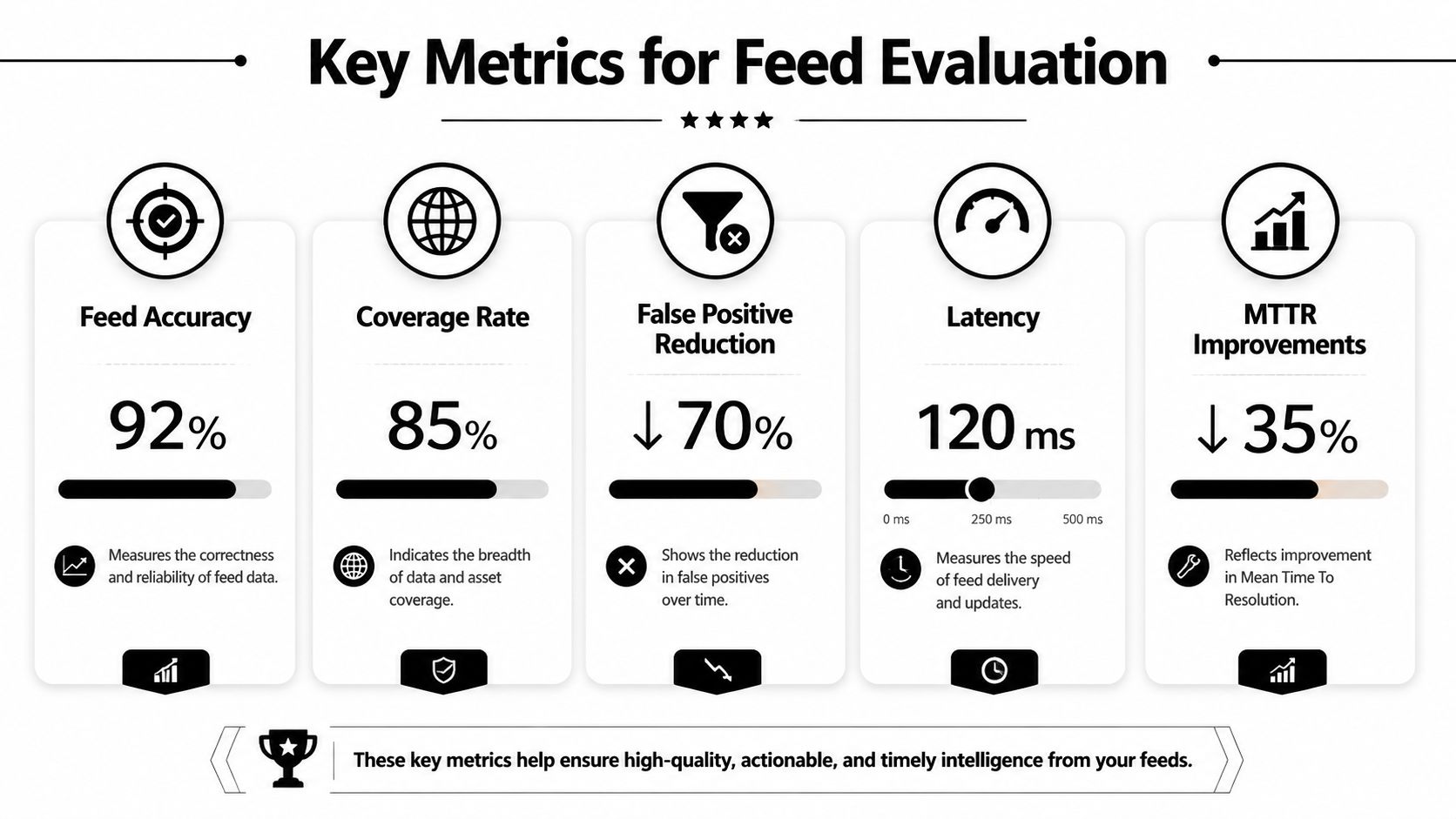
Begin with five actionable KPIs.
- Feed accuracy refers to how frequently a match yields something useful.
- Coverage rate means whether the feed helps across your true attack surface, not only in a single log source.
- False positive reduction asks whether tuning and enrichment are lowering wasted analyst effort.
- Latency measures how fast fresh intelligence becomes searchable and actionable.
- MTTR improvement asks whether cases shaped by feed context move more quickly from alert to containment.
Notice what is not on the list. Feed volume. More indicators do not automatically mean better protection.
How to score a feed in practice
A practical evaluation process is simple enough to run each month.
- Sample alerts that the feed influenced.
- Distinguish enrichment-only matches from cases that altered analyst action.
- Examine suppressions and indicators that have expired.
- Assess performance by source, indicator type, and rule path.
- Decommission feeds that add workload while failing to enhance decisions.
You can also maintain a short scorecard:
| KPI | What good looks like |
|---|---|
| Accuracy | Analysts trust matches often enough to act on them |
| Coverage | Relevant detections appear across key systems |
| Latency | Fresh intelligence reaches detections quickly |
| Noise control | Alert quality improves after filtering and expiry |
| Response value | Cases move faster with less manual look-up |
Effective feed measurement centers on analyst choices, not vendor claims.
If your dashboards cannot reveal which feed tags surfaced in high-value cases, which sources produced recurring false positives, and which indicator types expired quickly, then you are not truly assessing the feeds. You are simply tallying them.
Overcoming Common Challenges and Best Practices
Threat intelligence feeds tend to break down in mundane ways. Indicators are noisy. Metadata is inconsistent. Expiration logic is weak. The integration appears complete in theory, yet it does not match how analysts investigate alerts.
One of the most important operational risks is IOC lifecycle decay. Stale indicators may cause false positives, since many open-source sources do not clearly document lifecycle management or confidence scoring for automated blocking, as noted in Doppel's discussion of threat intelligence feed risks.
The three problems that break most feed programs
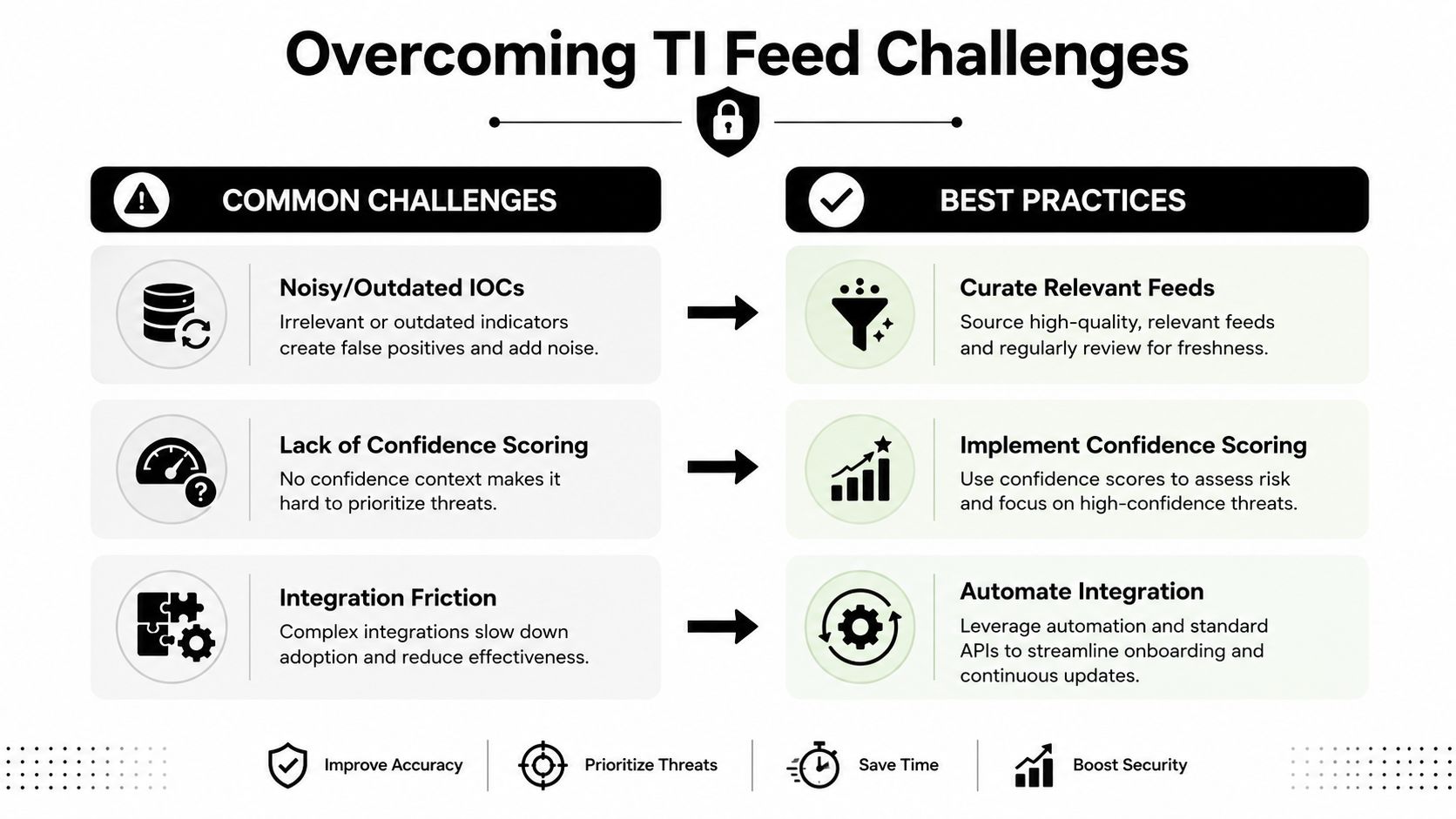
The first problem is stale indicators. Teams onboard them a single time and continue matching against them indefinitely. This produces repeated low-value hits and, over time, trains analysts to disregard the feed.
The second is missing confidence context. If a source does not state how reliable or current an indicator is, your automation lacks safeguards. That is tolerable for enrichment. It is risky for blocking.
The third is integration friction. Varying schemas, duplicate objects, and parser drift make the feed appear more mature than it actually is. The connection is present, but the operational quality is not.
Best practices that hold up in production
The most effective programs do not pursue maximum volume. They select for relevance.
- Curate by environment: If your environment is heavily cloud-based and identity-focused, prioritize sources that strengthen cloud, email, and authentication detection instead of sending every conceivable network IOC into the stack.
- Expire aggressively: Tactical indicators should not remain active forever. Incorporate expiration and review logic into the pipeline.
- Separate use cases: Apply some feeds solely for enrichment, others for alerting, and a far smaller group for automated blocking.
- Weight by asset criticality: A match on a sensitive server, payment workflow, or privileged identity should receive a different ranking than a match on a disposable test asset.
- Feed back analyst outcomes: When analysts keep flagging a source as noisy, revise suppression logic or decommission the source.
A mature team also distinguishes between collection confidence and response confidence. A feed might be trustworthy enough to annotate an event, yet not trustworthy enough to initiate a quarantine or firewall block by itself.
The strongest feed policy is trust applied selectively. Begin with enrichment. Move to detection only once the source demonstrates its value.
Governance for long term feed quality
Feed quality is not static. New providers emerge, older lists deteriorate, attacker infrastructure shifts, and your own environment changes. Governance prevents the program from drifting.
Set clear ownership for these questions:
- Which team authorizes a new feed?
- What is the least metadata it requires?
- What is the retention period for indicators?
- For which use cases is automation allowed?
- Under what conditions is a feed downgraded or retired?
That governance should also tie into compliance and audit requirements. If your organization aligns detections and evidence with HIPAA, GLBA, PCI, ISO 27001, SOC 2, or CMMC workflows, you need documented rationale for why a feed was trusted, how it shaped a decision, and when it was retired. Sound governance does not impede security. It prevents the intelligence layer from turning into an undocumented source of risk.
Conclusion and Next Steps
A threat intelligence feed has value only when it enhances an actual workflow. That may involve stronger SIEM correlation, more precise XDR triage, improved vulnerability prioritization, quicker malware investigation, or response decisions that are easier to defend. The mechanics count. Feed type, format, normalization, enrichment, lifecycle handling, and KPI review all determine whether the outcome is signal or noise.
Often, the most effective next move is small and specific:
- Choose a single feed with a well-defined use case.
- Map it into a shared schema.
- Apply it for enrichment before full alert generation.
- Introduce expiry and confidence handling from the outset.
- Assess whether it influences analyst decisions.
That approach outperforms loading multiple feeds into production and expecting the platform to sort them out. Security operations improve when intelligence is operationalized with care, not when it is gathered aggressively.
If you're building an open-source SIEM, SOAR, or XDR program and want a unified way to ingest telemetry, correlate feed data, automate response, and support compliance workflows, Unified Security Stack deserves consideration. It consolidates detection, response, log management, and compliance support into a single platform built for hybrid environments, which makes it a practical place to turn threat intelligence into everyday security operations.