
Top 10 Open Source SIEM Tools for 2026
By 2 a.m., a queue packed with unprocessed Windows events, firewall records, and repeated alerts is no longer an issue of tools; it is an operational one. Another dashboard will not help the team. What it requires is a SIEM capable of collecting the correct data, standardizing it, correlating it sufficiently to reveal actual incidents, and remaining sustainable once the first deployment is complete.
This explains why open source SIEM options continue to appear in serious assessments. They let teams govern retention, deployment approach, and detection rules without an immediate lock-in to commercial costs or vendor-run processes. Open source use has also become widespread enough that selecting it is no longer unusual. The more difficult issue is whether a particular tool suits the staff and infrastructure it will support.
In many rollouts, I observe the same error. Teams evaluate feature checklists before considering parser effectiveness, storage expense, time spent tuning detections, or who will keep the platform running half a year later. Being free to download does not mean it is inexpensive to run. A compact IT group with simple compliance requirements should not select the same stack as an experienced SOC seeking packet inspection, threat hunting, and tailored detection engineering.
This guide is structured around that practical distinction. Rather than viewing every initiative as the same type of SIEM, it groups these tools into helpful categories, including all-in-one platforms, search-first stacks, SOC distributions, and correlation engines. The comparison portion also aligns typical scenarios, such as compliance reporting, threat hunting, and teams with limited staff, with the tools best suited to them.
Table of Contents
- 1. Unified Security Stack
- 2. Wazuh
- 3. Elastic Security
- 4. Security Analytics in OpenSearch
- 5. Security Onion
- 6. Graylog Open
- 7. HELK
- 8. Prelude SIEM
- 9. Sagan
- 10. SEC
- Top 10 Open-Source SIEM Tools: Feature Comparison
- Final Thoughts
1. Unified Security Stack
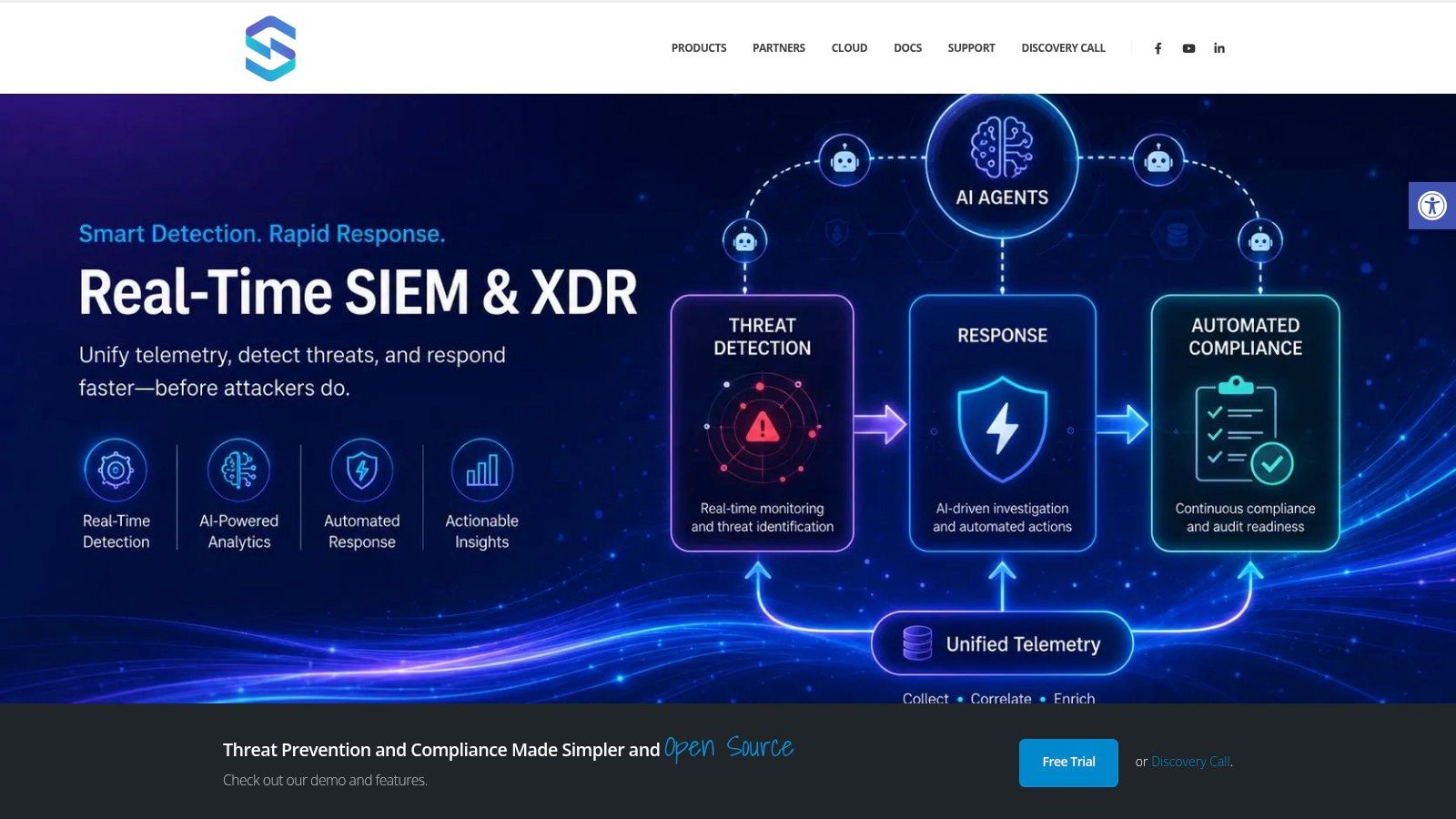
A frequent failure mode in open source SIEM projects follows this shape: log collection succeeds, several detections trigger, and then the team discovers that reporting, enrichment, response actions, and audit proof are scattered across separate systems. Unified Security Stack is among the few tools here that treats SIEM as an all-in-one platform, not as a correlation engine with a collection of neighboring components.
That distinction matters greatly for teams requiring operations, compliance, and endpoint visibility within one console.
Why Unified Security Stack stands out
Unified Security Stack brings together log management, vulnerability scanning, access-rights auditing, endpoint protection, dark-web monitoring, file tracking, and automated playbooks in a single modular stack. It additionally aligns evidence with frameworks including CMMC, HIPAA, SOC 2, ISO 27001, PCI, GDPR, and GLBA. For teams under regulation, this can eliminate substantial manual reporting effort.
That compliance emphasis is often where many open source SIEM deployments become costly in real-world use. As noted in analysis cited by Lumifi, 75% of security teams using open-source SIEMs must build custom compliance workflows, adding 3 to 6 months of development time per auditIf audit readiness ranks high among your needs, Unified Security Stack merits early consideration rather than being postponed as a later reporting integration project.
In this list, I would place Unified Security Stack in the all-in-one platform category rather than the build-your-own stack category. That difference matters when selecting a tool by use case. A team centered on compliance operations or MSSP delivery generally gains more from broad native coverage than from extensive customization.
Practical rule: When one team is responsible for both detections and audit evidence, lower reporting and documentation burdens first. Detection depth provides value only when the team can run the platform consistently.
A further practical benefit involves day-two operations. Unified Security Stack is designed to cut down noisy ingestion and provide analysts with cleaner data earlier in the pipeline, which can decrease duplicate triage effort. It also supports centralized log management for security operations, which is important when logs remain distributed across cloud services, endpoints, and on-premises systems.
Where it fits best
Unified Security Stack is suited to midsized businesses, MSPs, MSSPs, and internal security teams seeking a single platform for monitoring, response workflows, and compliance reporting. It is also a compelling option when cloud telemetry, endpoint data, and audit evidence must all be operational from day one.
The compromise is the same one I encounter with any broad security platform. You still require tuning, integration effort, and personnel who understand detections well enough to distinguish noise from incidents. Teams that want complete control over each component might find lighter correlation-focused tools simpler to adapt, though they should anticipate more assembly effort as a result.
2. Wazuh
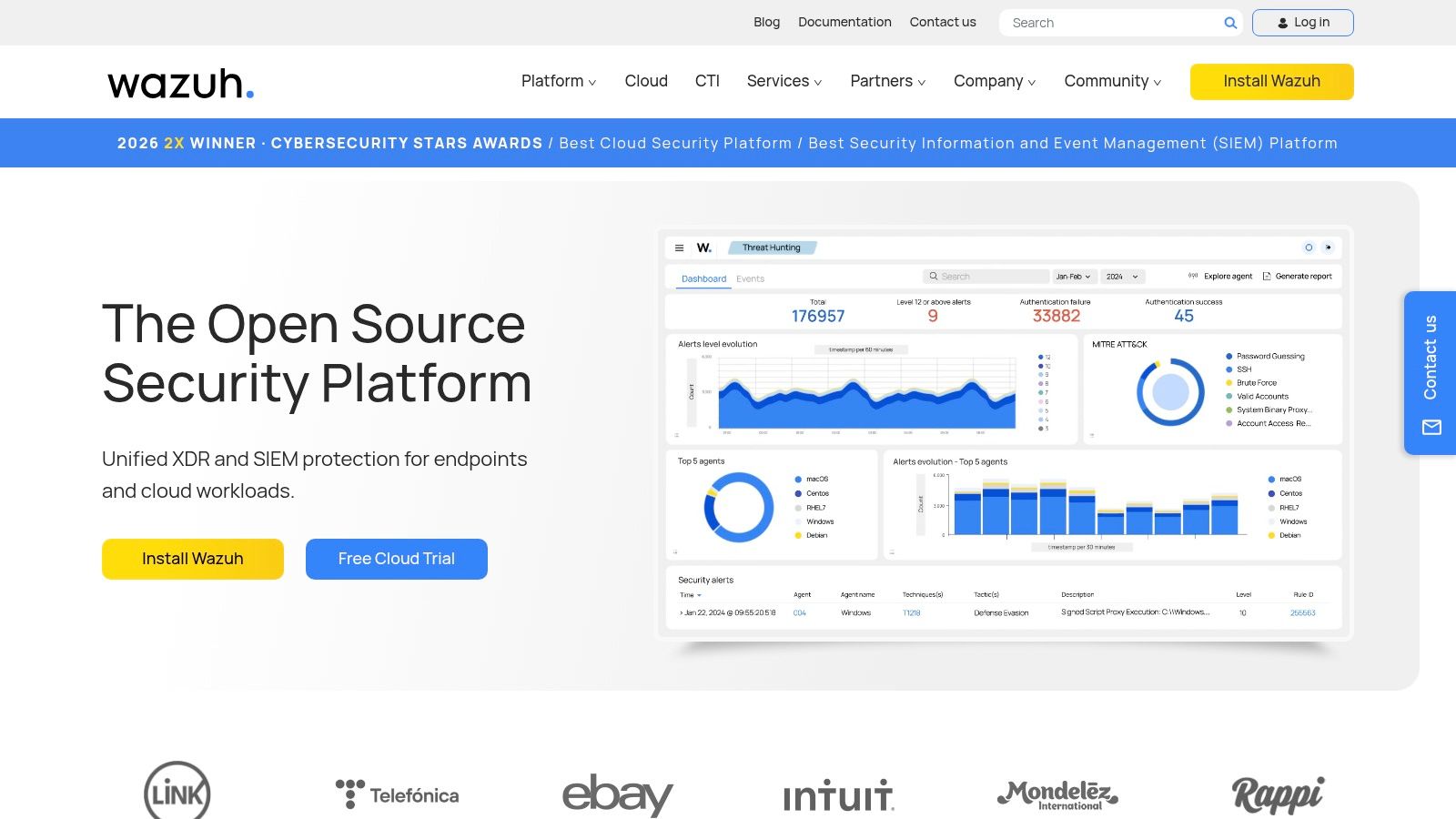
Wazuh is the initial tool many practitioners test when they need an actual SIEM without beginning with bare components. That is sensible. It merges SIEM and XDR-style functions with host-based intrusion detection, file integrity monitoring, vulnerability detection, cloud security monitoring, and active response scripting. A practitioner report called Wazuh the most comprehensive open source SIEM platform and pointed to support for PCI DSS, GDPR, and HIPAA monitoring in its compliance workflows, plus beginner-friendly deployment experience in the field, as discussed in this open-source SIEM guide featuring Wazuh.
Why teams start with Wazuh
Wazuh offers a reliable route from lab to production. You can begin with agents, expand rule-based detections, link standard integrations, and use it as the core of centralized log management without instantly deploying an expansive SOC stack.
It is a strong fit for teams seeking endpoint visibility and compliance dashboards alongside event monitoring. It is also among the simpler platforms to justify internally, since the feature set is familiar and the deployment model is widely understood.
Even so, Wazuh is not magic. Tuning requires time, particularly at scale. The ruleset can become noisy if you ingest broadly before determining what matters in your environment.
Wazuh performs best when you manage it as a detection program rather than merely a log repository. Deploy agents carefully, remove noisy rules early, and validate each active response action in a test environment first.
For smaller teams, that operational discipline is the difference between “free SIEM” and “another console nobody trusts.”
3. Elastic Security
An analyst receives the alert, moves into raw events, crafts a sharper query in real time, and continues investigating until the pattern becomes clear. That describes the type of team Elastic Security is built for.
Elastic Security is suitable for organizations already using Elasticsearch and Kibana, or for teams ready to approach the SIEM as an engineering effort rather than a ready-made product. It excels in detection engineering, search-led investigations, telemetry exploration, and handling large data volumes. For distributed environments or teams running a cloud-based SIEM deployment, Elastic can scale effectively when data pipelines and cluster management are maintained correctly.
Best fit for search-heavy environments
Within this list, Elastic is notable as the option for security teams seeking control over data parsing, storage, enrichment, and querying. That adaptability is important for threat hunting and tailored detections, particularly in settings with uncommon log sources or in-house applications. Analysts at ease with queries and engineers able to sustain ingestion pipelines tend to gain considerable value from it.
The downside is operational workload.
Elastic offers smaller teams little margin for error. Strong outcomes rely on schema discipline, thoughtful index planning, continuous rule tuning, and staff capable of resolving stack issues when search performance or ingestion fails. Teams seeking quicker time to value often find that Elastic provides a robust foundation, yet not a completed SOC workflow.
This makes Elastic better suited to mature detection programs than to teams using a free license to buy time. If deep search and customization are required, it is a solid choice. If you need a simpler route to day-one coverage, a more opinionated tool in this list will typically be a better fit.
4. Security Analytics in OpenSearch
OpenSearch Security Analytics is a pragmatic choice for teams seeking a community-driven SIEM experience built on OpenSearch instead of Elastic's present licensing model. If OpenSearch already supports your observability or log retention, this is among the more straightforward ways to expand that investment into security monitoring.
The platform provides detections, dashboards, event correlation, and threat intelligence ingestion within the wider OpenSearch ecosystem. This appeals to organizations that want a stack that is more clearly open and do not need every workflow polished on day one.
A cleaner path for OpenSearch shops
OpenSearch Security Analytics performs best when an organization has already committed to OpenSearch operations. In that situation, the SIEM layer feels complementary rather than disruptive. Analysts can rely on familiar search patterns while steadily developing security-focused content.
The downside is maturity. The ecosystem lags behind Elastic's in maturity, as shown by content availability, community examples, and depth in some workflows. It remains fully usable, yet it rewards teams ready to close gaps.
Many security leaders favor this model because it reduces lock-in. That is a valid point. Keep in mind, though, that less lock-in usually means greater ownership responsibility. Someone must still validate detections, normalize logs, and preserve field consistency over time.
5. Security Onion

Security Onion is less a single SIEM product and more a turnkey SOC distribution. That distinction matters. It excels when your team wants network monitoring, packet visibility, IDS telemetry, hunt workflows, and cases in one deployable platform.
For many defenders, Security Onion is the quickest path to meaningful visibility in a lab, a security program pilot, or a production network where packet capture and sensor data are as important as conventional logs.
Best when network visibility matters most
Security Onion's greatest strength is operational completeness. Alerts, dashboards, hunting views, cases, and packet access are already included. You can also add security orchestration tools around it once the team is prepared for broader response workflows.
Teams run into trouble when they assume Security Onion addresses every SIEM problem equally well. It is powerful for network-centric visibility, but broad enterprise log correlation still relies on what you ingest and how effectively you maintain detection content. It also requires careful resource planning, since packet capture, indexing, and multi-sensor deployments can become demanding.
Field note: When your incident responders request PCAP during investigations, Security Onion often fits better than a generic log-first SIEM.
For blue teams focused on east-west traffic, DNS anomalies, Suricata alerts, and hunt workflows, it continues to be one of the most practical open deployments available.
6. Graylog Open

Graylog Open is a capable log management platform that many teams attempt to convert into a SIEM. Sometimes that succeeds. Sometimes it produces a partially built security stack that never fully matures.
Graylog Open performs best when the primary requirement is collection, search, dashboards, parsing, and operational log visibility. Its pipelines and notifications are valuable, and it is generally accessible for infrastructure teams that need centralized logging first.
Strong log operations, limited native SIEM depth
The main shortfall is that Graylog Open does not function as a complete SIEM in the sense most purchasers intend. Its open edition misses advanced correlation and the focused detection depth that SIEM tools provide. Should you want wide-ranging security analytics with guided response, you will need to construct much of it on your own or shift to Graylog's paid security offerings.
That does not mean it is a poor option. It means the option has a defined scope. For internal IT, platform groups, and smaller businesses that require improved log operations ahead of a mature SOC process, Graylog Open may serve as a sound initial move.
Choose it when log disorder is the issue at hand. Avoid selecting it with the expectation of a full, turnkey detection program.
7. HELK
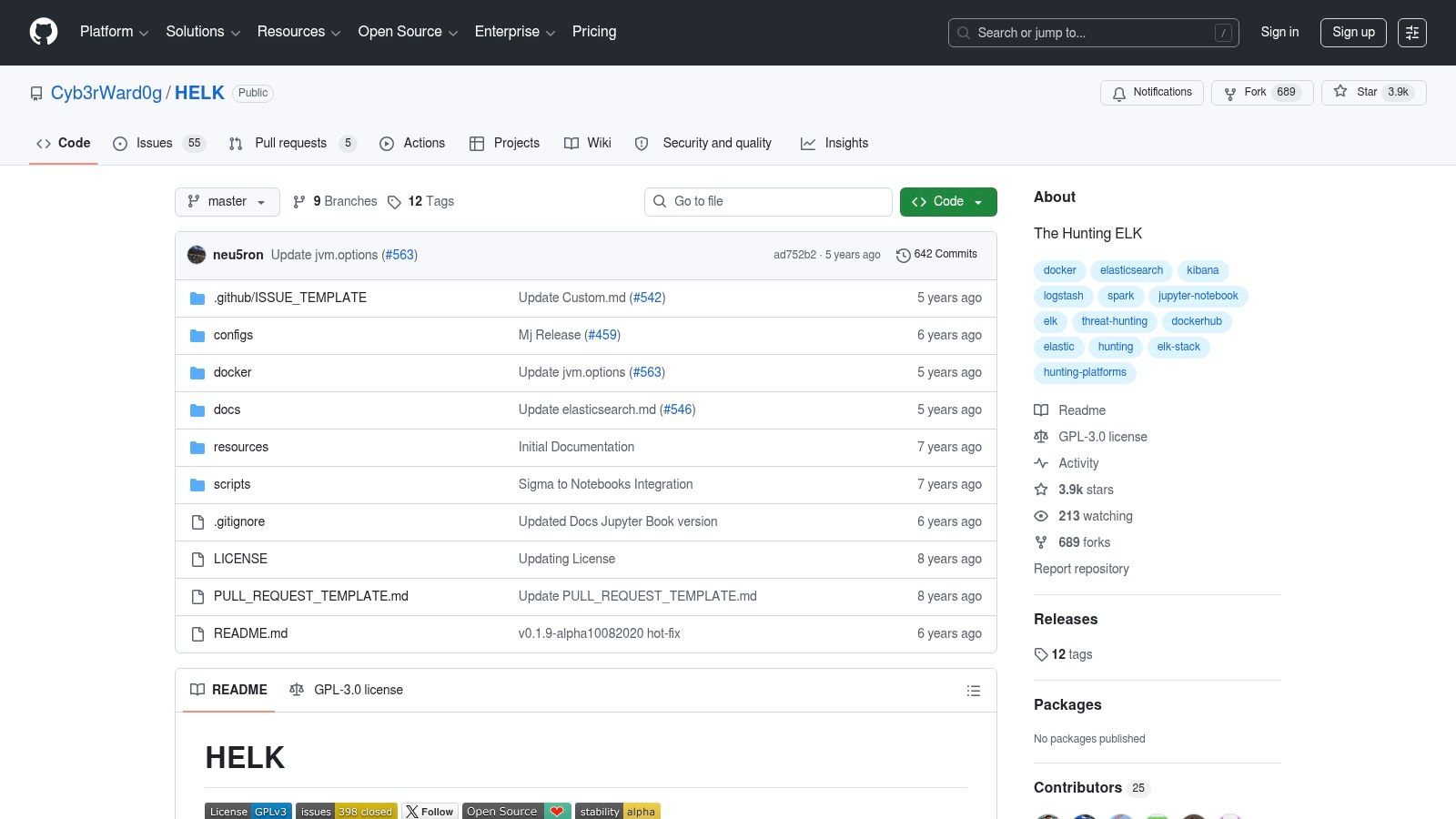
HELK is primarily a project for detection engineering and threat hunting. That is precisely the reason many practitioners favor it. It offers a quick path to stand up a working lab using Elastic components, community content, and hunting workflows, and it makes no claim to be a finished enterprise product.
When you conduct purple-team exercises, develop analytics in a test environment, or educate analysts, HELK proves useful right away. You can deploy it, supply it with data, and begin refining detections with fewer formalities than a production-grade platform demands.
Excellent for labs and detection engineering
HELK excels at experimentation since it adopts community methods and scripted installation. Analysts may try out concepts, confirm hunting hypotheses, and use familiar rule techniques within a realistic setting.
The drawback lies in support and lifecycle management. This is a community-driven project. It offers no enterprise support guarantees, and upgrades call for caution since the underlying components evolve over time.
I would not place HELK at the core of a regulated production SOC unless the team already understands why it wants that trade-off. I would certainly use it to train analysts, prototype detections, or validate logging and hunting designs before investing in a larger stack.
8. Prelude SIEM
Prelude SIEM has existed long enough to gain respect from those who appreciate standards-based design. It is a mature choice offering a GPL community edition, and it focuses on structured alert handling and correlation instead of trendy modern presentation.
That fact makes Prelude more appealing to practitioners than to marketing departments. If standards, message normalization, and durable architecture matter to you, Prelude remains relevant.
A standards-oriented option
Prelude uses IDMEF for alert exchange and provides an event correlator, a manager, and the Prewikka web interface. Its true value lies in that standards focus. It delivers a more formalized model than numerous newer DIY stacks.
The compromise is suitability. Prelude's community edition fits smaller settings, educational purposes, and teams that specifically seek its architecture. Organizations wanting quick-start workflows, extensive native cloud integrations, or modern analyst usability might consider it dated next to newer platforms.
That does not mean outdated. It means selective. Prelude performs best when the team knows precisely why a standards-based SIEM suits its environment better.
9. Sagan

Sagan serves as a correlation engine rather than a full SIEM. When you treat it as such, it performs excellently. If you look for dashboards, case management, storage, and analyst workflow ready to go, you will be let down fast.
Its attraction is simple. Sagan provides real-time, rule-based correlation across log streams with a Snort-like style that many defenders already grasp. It is quick, lightweight, and adaptable.
Use it as a correlation layer, not a complete platform
Sagan works best when storage and visualization are already handled but you require more precise real-time correlation logic than your present stack delivers. Teams frequently combine it with Elastic, OpenSearch, or Graylog and allow Sagan to manage specialized detection logic within the stream.
Such modularity is potent for skilled engineers. It helps less for lean teams that need a single platform to cover everything. You still have to build the surrounding system on your own.
This pattern repeats with numerous open source SIEM tools. Correlation may be outstanding on its own, yet the security program still requires dashboards, triage flow, retention design, and response process around it.
10. SEC
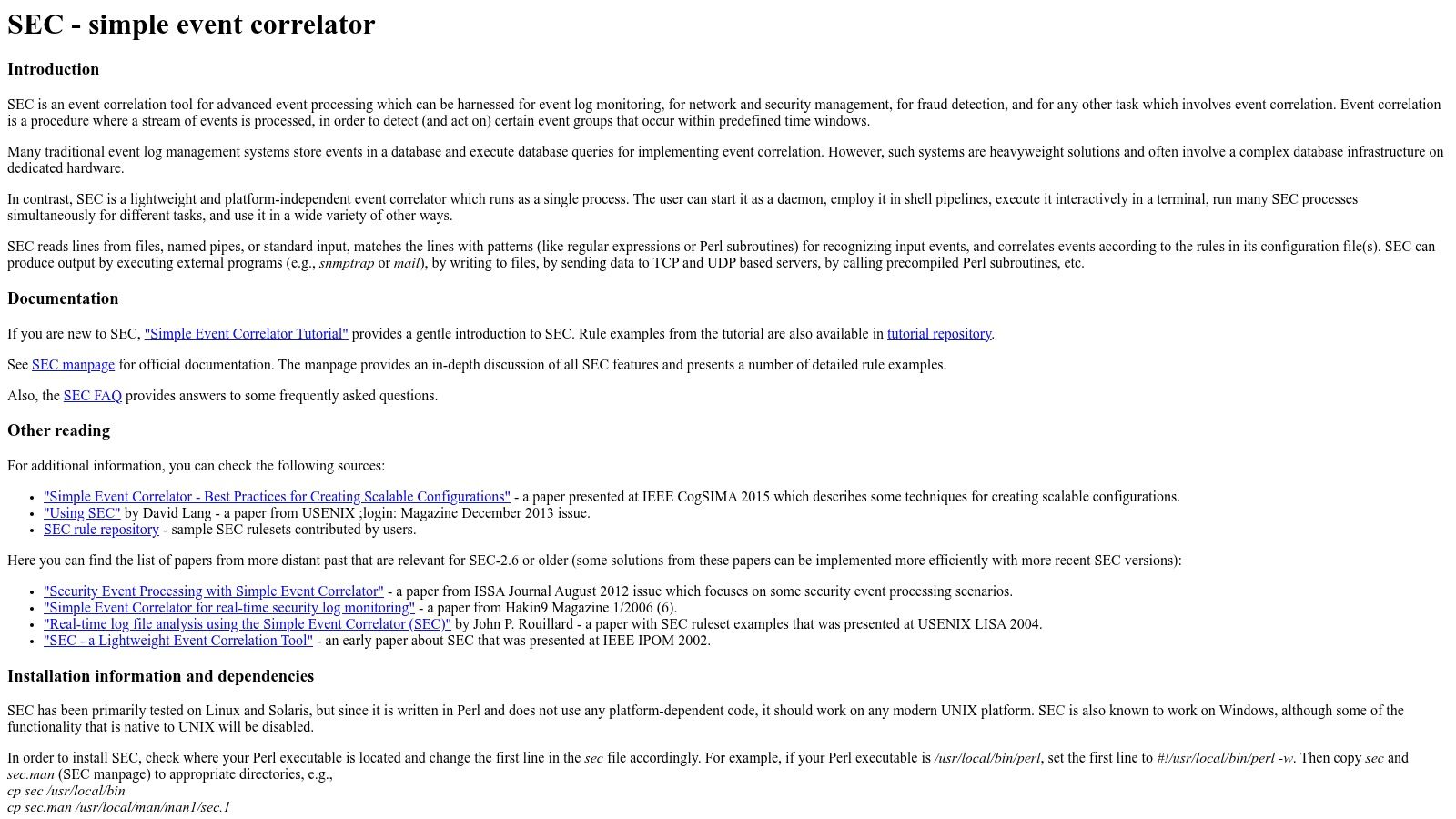
SEC, also known as Simple Event Correlator, is a tool that seasoned operators value. It makes no attempt to impress with a polished interface. It simply performs event correlation well when a lightweight, reliable rule engine is needed in a custom pipeline.
Where Sagan comes across as a specialized detection component, SEC comes across as glue. It ingests events from files, pipes, and stdin, then brings pattern logic, suppressions, thresholds, aggregation, and stateful conditions to bear in real time.
Best for custom pipelines
SEC works best when your team is constructing a custom architecture and needs exact control over how correlation behaves. It is particularly valuable in Unix-centric settings where logs already flow through scripts, brokers, and bespoke handlers.
Its drawbacks are clear. It lacks a native storage layer, a refined analyst interface, and an integrated case workflow. SEC is meant to drive a broader design, not stand in for one.
That makes SEC a solid tool for engineers and a poor fit for executive buying. It should be used by practitioners who know precisely which gap they are addressing.
Top 10 Open-Source SIEM Tools: Feature Comparison
| Product | Core features ✨ | Quality ★ | Value / Price 💰 | Target audience 👥 | Unique selling points |
|---|---|---|---|---|---|
| Unified Security Stack 🏆 | SIEM + SOAR + XDR, real-time ingestion correlation, LLM-assisted triage, compliance workflows | ★★★★☆ | 💰 Open-source; cost-effective; demo/trial & commercial support via contact | 👥 Mid-enterprise, regulated orgs, SOCs | ✨ Real-time correlation at ingestion; 30B IOCs; integrated LLMs & built-in compliance mappings |
| Wazuh | Rule-based detections, FIM, vuln scanning, compliance dashboards | ★★★★ | 💰 Free self-host; paid support options | 👥 SMBs → enterprise, community SOCs | ✨ Strong community, broad integrations (Elastic/OpenSearch, Splunk) |
| Elastic Security | Prebuilt detection rules, timelines/cases, response workflows, analytics | ★★★★☆ | 💰 Dual-license; core free-to-source limits; advanced features often paid | 👥 Large-scale telemetry users, detection engineers | ✨ Hundreds of maintained rules from Elastic Security Labs; scalable search |
| OpenSearch Security Analytics | Detections, dashboards, correlation, threat intel ingestion | ★★★☆ | 💰 Apache-style licensing; cost-effective if on OpenSearch | 👥 OpenSearch users, community-driven teams | ✨ Apache-licensed SIEM experience; integrates natively with OpenSearch |
| Security Onion | SOC distro with Alerts, Hunt, PCAP, Suricata/Zeek sensors | ★★★★ | 💰 Free distro; paid training/appliance options | 👥 Network-centric SOCs, threat hunters, labs | ✨ Turnkey SOC stack with full-packet capture and hunt workflows |
| Graylog Open | Centralized log ingest, pipeline processing, search & dashboards | ★★★☆ | 💰 Free core; paid Graylog Security for full SIEM | 👥 Teams wanting simple log mgmt with upgrade path | ✨ Easy to deploy; clear commercial upgrade to SIEM features |
| HELK | Containerized ELK for hunting, prebuilt dashboards, Sigma compatibility | ★★★☆ | 💰 Free/community project | 👥 Labs, red/blue teams, detection engineers | ✨ Fast scripted hunting lab; good for experiments and training |
| Prelude SIEM (CE) | IDMEF-based alert exchange, event correlator, Prewikka web UI | ★★★ | 💰 Free community; commercial tiers for scale | 👥 Small orgs, education, standards-focused users | ✨ Standards-oriented (IDMEF) design for interoperability |
| Sagan | Multi-threaded, Snort-style log correlation engine, flexible rules | ★★★ | 💰 Free, lightweight | 👥 DIY SIEM builders, sysadmins needing custom correlation | ✨ High-performance rule syntax similar to Snort for real-time correlation |
| SEC (Simple Event Correlator) | Lightweight event correlator, thresholds, suppressions, state machines | ★★★ | 💰 Free; tiny footprint | 👥 Integrators building custom SIEM pipelines | ✨ Mature, powerful rule language for embedded correlation |
Final Thoughts
A SIEM that appears strong in a feature comparison can still struggle in day-to-day operations. The key factor is typically not sheer capability. It is whether the tool suits the team that must operate it weekly, tune detections, repair parsers, assist investigations, and generate audit evidence.
This list is most useful when read by tool category rather than rank alone. All-in-one platforms suit teams that need detection, response, and compliance support in a single place. Search-first stacks suit teams that already know how to construct pipelines and maintain content. SOC distributions are appropriate when packet data, network sensors, and hunt workflows shape the investigation model. Correlation engines fit modular environments where the team intentionally builds its own architecture.
The practical question is straightforward. Which work are you trying to simplify?
When compliance and wide coverage with minimal assembly come first, Unified Security Stack and Wazuh are reasonable places to start. When the objective is threat hunting and tailored data work, Elastic Security, OpenSearch Security Analytics, and HELK are more appropriate. When the environment is network-intensive, Security Onion is a standout. When a small team needs log management first and space to expand, Graylog Open is often the safer choice. When the plan is to build around lightweight detection components, Sagan and SEC remain worthwhile.
Analysts cited by Exabeam argue that 80% of open-source SIEM deployments fail within two years due to inadequate engineering resources, not technical flaws. This aligns with what security teams encounter in practice. Issues tend to emerge after deployment, when log sources shift, correlation rules become outdated, dashboards no longer mirror reality, and no one is responsible for content maintenance.
That is why the comparison table is important. It should help connect an actual use case to the correct tool category, rather than directing every reader to the same conclusion. A small IT team responding to audit requests has different requirements than a mature SOC running packet capture and hunt workflows. A detection engineer creating custom pipelines should assess these tools differently than a compliance-focused security manager.
Compliance should be considered early. Some open-source SIEMs can handle audit and reporting work effectively. Others introduce manual reporting debt that becomes apparent only when auditors request mapped controls, historical evidence, approval trails, and repeatable workflows. Open source can perform that work, but only when the operating model enables it.
Teams hiring for these settings should expect engineering depth, not merely platform administration. Those who succeed here generally understand data pipelines, detection logic, log normalization, and automation. That is why roles such as this advanced cyber developer role are increasingly commonplace in security operations.
Unified Security Stack remains a viable option for teams seeking SIEM, SOAR, XDR, and compliance management in a single platform without having to build every integration and workflow from the ground up.