What Is an Intrusion Detection System and How It Works
You are staring at a noisy SOC queue, the EDR console is full of endpoint chatter, the firewall looks clean, and yet something still feels off. That is the gap an intrusion detection system is meant to close. It does not replace your firewall, EDR, or XDR stack; it provides the layer that turns raw network and host activity into security signals a SOC can triage.
Table of Contents
- Why Intrusion Detection Still Matters in 2026
- What an Intrusion Detection System Is
- Network, Host, and Hybrid IDS Compared
- Signature, Anomaly, and Hybrid Detection Techniques
- How IDS Connects to SIEM, XDR, and SOAR
- Tuning IDS Rules and Reducing False Positives
- Compliance Mapping and Best Practices
Why Intrusion Detection Still Matters in 2026
A less experienced analyst might burn an entire shift closing alerts that never turn into incidents. A more experienced one recognizes the opposite problem: a malicious session traversing the network without context, without meaningful correlation, and with nobody detecting it until the investigation has become complicated. IDS remains important because it bridges the space between raw activity and an alert the SOC can actually apply.
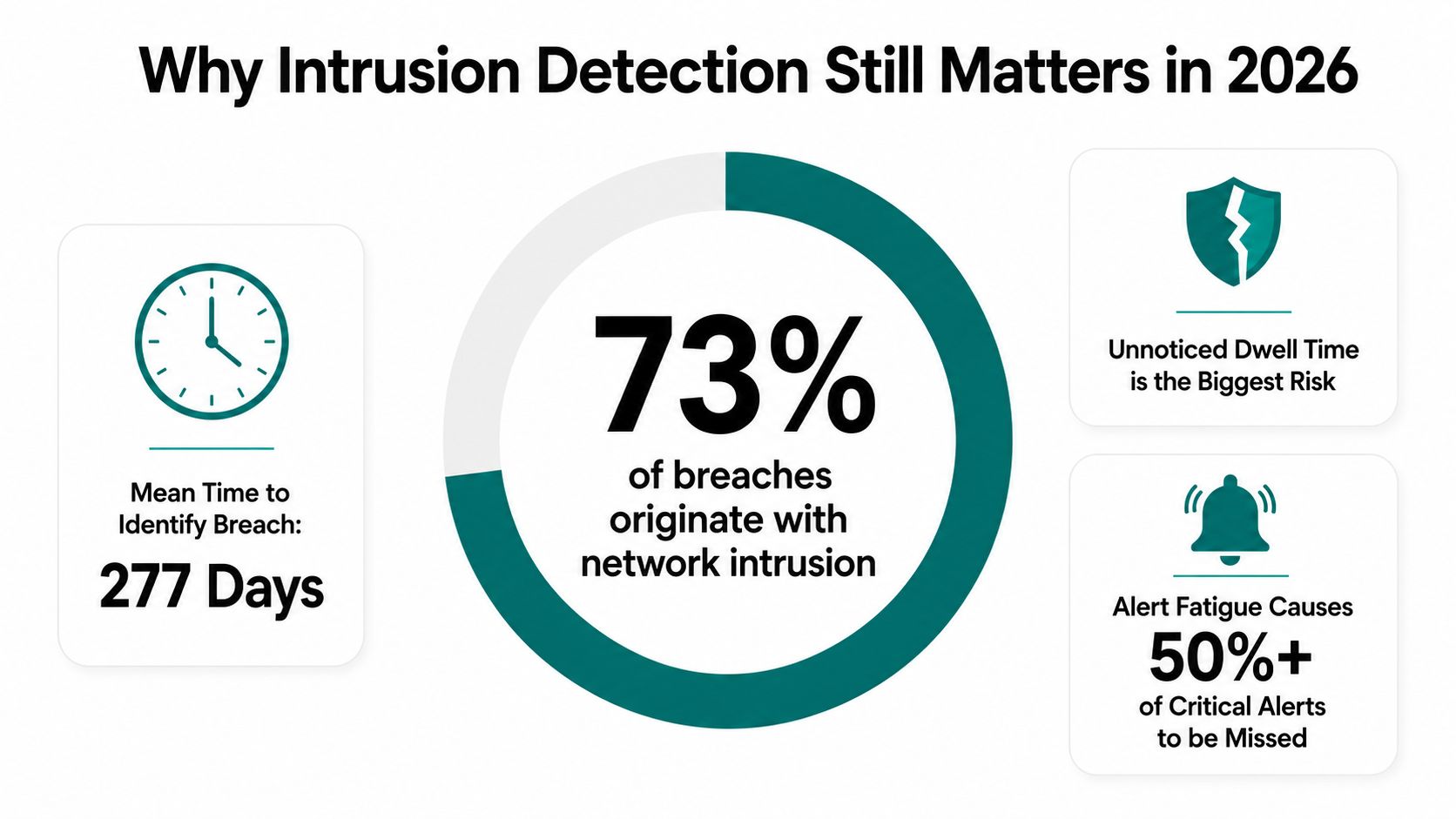
An intrusion detection system occupies the detection layer within the stack. One survey defined IDS as systems that detect malicious network traffic and computer activity beyond the reach of conventional firewalls, and it divided the field into signature-based IDS and anomaly-based IDS Springer. This matters because the task is not simply to generate alerts. It is to convert chaotic telemetry into organized evidence that a SIEM can correlate and a SOC can act upon. A packet capture, an endpoint event, and an unusual login become valuable only when IDS helps align them.
Where it fits in a modern stack
IDS is the detection layer that provides the rest of the stack with something understandable to use. Firewalls apply broad control, EDR monitors endpoints, and XDR seeks to unify telemetry, yet IDS still detects traffic and behavior that other tools might overlook or cannot contextualize fast enough. The NIST IDS architecture describes that work as information sources, analysis, and response, which is a sounder way to think about it than treating it as merely another alarm box.
This matters in regulated settings because the alert must do more than enable triage. It may need to feed a case in the SIEM, back an incident record, or help an analyst demonstrate how a control operates against HIPAA, PCI, CMMC, ISO 27001, or GLBA requirements. In practice, a noisy rule is not merely irritating; it weakens the evidence trail your team relies on.
That same reasoning appears in practice. A note about local cybersecurity risks for Atlanta businesses makes the case clearly, attack surface is connected to how a business operates, so detection priorities must align with real traffic, real users, and real exposure.
IDS matters because it provides visibility where point controls end. In a mature SOC, that visibility becomes evidence, triage material, and a control signal for response, not simply another banner in a dashboard.
What an Intrusion Detection System Is
A breach frequently begins with something minor, an unusual login pattern, a strange packet sequence, or a process that should not be communicating on the network. An intrusion detection system is the layer that monitors for those signs and flags activity that could indicate compromise, policy abuse, or an effort to bypass security controls. NIST describes it as monitoring events in a computer system or network and analyzing them for signs of intrusions the NIST definition of intrusion detection.
That definition is helpful because it distinguishes IDS from ordinary logging. A log platform retains records. An IDS examines those records, along with live traffic or host signals, and attempts to determine whether the pattern appears suspicious enough to matter.
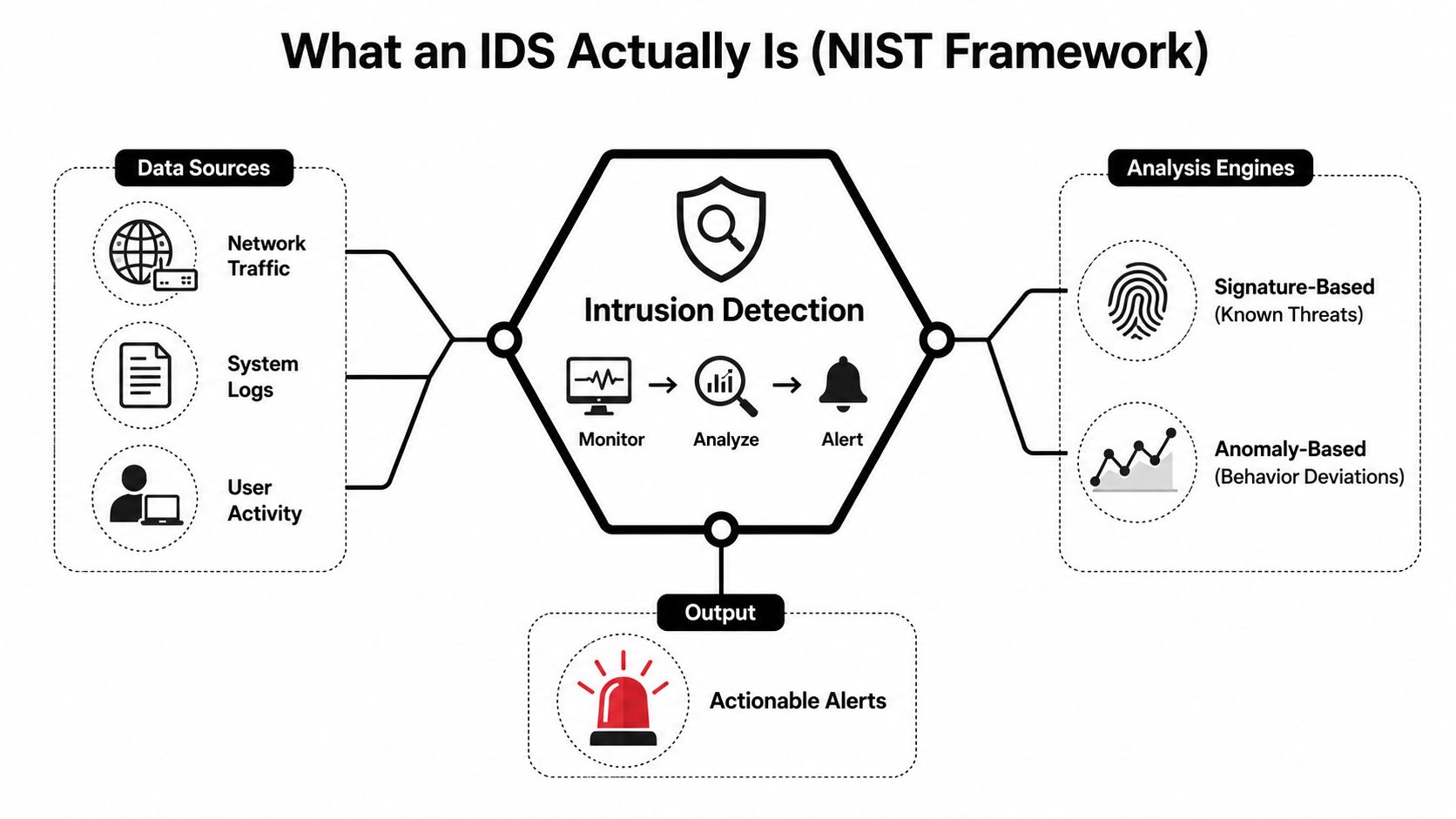
The easiest way to tell them apart is this: logging reports what happened, while IDS indicates what could have been an intrusion. A Windows event log might display repeated authentication failures. An IDS can take that pattern, compare it against other telemetry, and decide whether it resembles password spraying, lateral movement, or just an awkward user. That difference matters in a SOC, since analysts need alerts that already carry some interpretation, not an unprocessed mass of events.
What an IDS does inside the security stack
An IDS is not a device that stops traffic. It is the detection layer that helps the rest of the stack comprehend what is taking place. Firewalls enforce access rules, endpoint tools observe host activity, and SIEM, XDR, or SOAR systems help correlate signals and act on them. IDS fills that middle layer and turns packet traces, endpoint indicators, and application events into material an analyst can examine.
This is why a properly tuned IDS adds value beyond incident response. It also aids compliance efforts. A detection that maps directly to HIPAA, PCI, CMMC, ISO 27001, or GLBA provides the security team with a clearer account of how the control performed and why the alert was significant. For that to succeed, the rule needs to be understandable, the alert path needs to be consistent, and the evidence needs to hold up under review in the SIEM.
A useful internal reference for traffic analysis is network traffic analysis in the context of IDS and SIEM. It helps illustrate where packet visibility ends and detection logic begins.
A simple field example makes the difference clearer. If a sensor sees a sudden surge of outbound connections to an uncommon country, that is not just a log entry; it is a sign that something on the network may be preparing exfiltration or beaconing to command infrastructure. If an endpoint sensor observes PowerShell starting from an unusual parent process and then reaching the same destination, the alert acquires context. The IDS is translating raw evidence into a security decision.
In practice, noise is the trade-off. An IDS with broad rules may reveal more suspicious activity, but it can also flood the team with benign anomalies. An IDS with narrow rules is less noisy, yet it might overlook early indicators of abuse. Effective operations depend on tuning, examining false positives, and retiring rules that no longer suit the environment, so detections stay useful rather than turning into background static.
That is where the term adds value. It identifies a detection function, not merely a box on the network.
Network, Host, and Hybrid IDS Compared
In most cases, a SOC does not pick network visibility over host visibility; it decides how large a blind spot it can accept. NIDS watches network traffic at strategic points, while HIDS monitors endpoint evidence on a given host. Palo Alto Networks frames the distinction plainly: NIDS examines packet and flow patterns, whereas HIDS looks at logs, file integrity changes, and application behavior on the device itself. Palo Alto Networks IDS overview.
This division matters because the attack chain does not remain in one location. Reconnaissance and exploitation attempts often show up on the wire first. Privilege escalation and local persistence frequently appear on the endpoint. Lateral movement may create suspicious SMB or remote administration traffic. Exfiltration can be clear in flows, or it can be concealed in host behavior.
What each sensor sees during an attack chain
A NIDS A sensor observes traffic patterns crossing a segment. It excels at detecting known exploit signatures, suspicious protocol sequences, and traffic that diverges from typical network use. It is far less effective when the suspicious activity stays local to the endpoint, particularly if the attacker has little need to move across the wire.
A HIDS An agent captures the host's own narrative. File integrity changes, unexpected process starts, odd script behavior, and log activity all surface here. It is far stronger at detecting insider misuse or local compromise, yet it will not show the attacker's wider path through the environment.
A hybrid approach completes the picture. Network sensors capture the flow, host sensors capture the endpoint, and the SOC gains a stronger timeline for triage. This is why most mature environments avoid framing it as an either-or decision.
Here's the practical difference in one sentence: NIDS tells you something odd moved across the network, HIDS tells you what the endpoint did about it, and hybrid coverage lets you connect the two without relying on guesswork.
A deployment limited to the network may overlook local abuse. A deployment limited to hosts may overlook lateral movement. In practice, attackers rely on both.
Unified Security Stack's network traffic analysis serves as a helpful example of how teams can bring together traffic inspection and host telemetry within a wider security workflow without making either a standalone island.
For leadership, the comparison that counts is coverage, not sophistication. When the business includes servers, endpoints, remote users, and cloud-connected workloads, hybrid visibility is generally the safer premise.
Signature, Anomaly, and Hybrid Detection Techniques
A coffee shop offers the simplest way to grasp detection logic. A signature rule is the barista who remembers the exact drinks on the menu. Anomaly detection is the barista who notices when a regular suddenly orders something outside their pattern. Hybrid detection is the barista who knows the menu and also sees when ordering behavior appears off.
The comparison remains valid because every method addresses a distinct problem. It also introduces a distinct type of operational load.
Signature detection
Signature-based IDS checks observed activity against established patterns. Practically speaking, a known exploit string, a malicious file hash, or a protocol pattern linked to a documented attack can produce a match. It is the most effective choice when you already know what to seek.
The drawback is clear. Signatures are accurate, yet their value depends on the rule set and how quickly it is updated. If the attacker alters the tactic sufficiently, no match may ever occur.
Anomaly detection
Anomaly-based IDS establishes a baseline of normal behavior and marks major deviations. This can help detect unusual outbound DNS patterns, odd user behavior, or traffic that does not match the environment's usual shape. The difficulty is that defining normal is hard in a messy enterprise.
This is why anomaly detection can produce noise. A baseline built around one department's habits may look quite different after a rollout, a shift to remote work, or a seasonal business cycle. The method has value, but it requires patient tuning.
Hybrid detection
Hybrid systems merge the two approaches. They apply known patterns where the threat is understood and behavioral deviation where the attacker seeks novelty. Production SOCs generally prefer that combination, since a single method usually lacks either speed or context.
To assess vendor claims well, ask what the product matches, which baseline it learns, and how it explains an alert. AI detection without a defined rule lifecycle often translates into additional triage work for the analyst.
How IDS Connects to SIEM, XDR, and SOAR
On its own, an IDS alert is only a signal. It gains value when the rest of the stack can put it in context, compare it against other telemetry, and determine the response. That is where SIEM, XDR, and SOAR come in.
A SIEM normalizes the event and correlates it with other logs. An XDR platform unites endpoint, network, and cloud signals into a wider attack view. A SOAR engine can convert the result into a playbook, isolate the host, block the source, or create a ticket.
The goal is not to automate every step. It is to stop making people manually cross-reference every raw alert.
The alert journey in a real SOC
A NIDS or HIDS sensor triggers first. The SIEM takes in the event, adds identity or asset context, and cuts noise by linking it to other records. The XDR layer lets the investigator determine if the alert belongs to a broader attack path. Once triage is steady, SOAR can then engage and launch the agreed response.
Unified Security Stack is able to operate that type of pipeline using APIs, Syslog, and NetFlow, which is one reason it is relevant to this discussion. It is not the sole method for constructing the workflow, but it demonstrates how open tooling can connect detection and response without turning IDS into a dead-end alert source.
Overton Security's SOC best practices guide is a useful ally when you are attempting to organize the human side of that workflow, particularly around handoffs, escalation, and operational discipline.
Practical rule: IDS should supply investigation first and automation second. When alert quality is weak, automation just accelerates the error.
Unified Security Stack's threat detection and response solutions present the same concept from a different angle: detection first, followed by orchestrated response after the signals become trustworthy.
The clear mental model is straightforward. SIEM arranges. XDR adds context. SOAR takes action. IDS provides the evidence that gives the rest of it value.
Tuning IDS Rules and Reducing False Positives
An effective IDS program depends entirely on alert quality. When every packet appears suspicious, analysts lose trust in the console. When rules are overly strict, the team fails to see the attack path it was meant to catch. That balance is why IDS tuning is an engineering responsibility, not a one-time configuration step.
Within a SOC, the IDS is one detection layer in a broader stack, not an isolated box that calls out and then waits. The raw alert requires SIEM context, XDR endpoint telemetry, and a person who can separate a genuine compromise from ordinary admin noise. For instance, a port scan from an unknown host might be important on a database subnet yet harmless on a lab segment. Once asset value and user behavior are tied to it, the same packet can carry very different meaning.
The measures applied in IDS research mirror that reality. Teams assess Accuracy, Precision, Recall, F1-score, False Positive Rate, and ROC-AUC because each one answers a different operational question about quality and noise 2022 IDS review. Another review points out that evaluation sets are often reserved as an independent subset of roughly 10 to 15% of the data, which is a practical safeguard against overfitting.
How those metrics map to real decisions
Precision indicates how many alerts are worth a person's time. Recall shows how much malicious activity you are detecting. False Positive Rate shows how frequently the rule raises a false alarm. F1-score helps keep precision and recall in balance when neither can be ignored. ROC-AUC provides you with a broader sense of separability when you compare detectors.
That terminology is not academic ornamentation. It distinguishes a rule you retain, a rule you suppress for a time window, and a rule you retire because it causes more difficulty than benefit. In practice, a noisy web exploit signature can remain useful after the threshold is adjusted, while a host rule linked to a retired application may belong in the archive.
The rule lifecycle
A sound rule begins with an observation, is baselined against normal behavior, and is then adjusted through thresholds and suppressions. Mature teams follow a straightforward lifecycle: create, validate, tune, monitor, and retire. If the rule works only in the first week, it likely was not built for operations.
The practical question is whether the detection still fits the environment it monitors. A login alert that triggers for every backup job, or a process rule that still watches software no one uses, only teaches analysts to disregard the console. Detection engineering treats that cleanup as part of the work, not an afterthought, and Unified Security Stack's detection engineering page is a helpful reference for that operating model.
Large language models are beginning to assist in the triage layer. In practice, this involves summarizing noisy alerts, proposing wording changes, and helping analysts find patterns across related detections. The model does not substitute for judgment, but it can reduce the time from alert to a useful hypothesis.
Reworx Recycling's secure data destruction guide is a pertinent reminder that legacy media, retired systems, and decommissioned data sources still require controlled handling. A clean detection program is easier to trust when the underlying data lifecycle is disciplined as well.
A practical checklist helps here:
- Baseline First: grasp what normal looks like before broadening the rule.
- Tune Before Adding: cut down false positives on the rules already in place.
- Hold Out Validation Data: maintain a distinct portion for evaluation rather than tuning on the entire set.
- Retire Stale Rules: when a rule no longer corresponds to useful behavior, retire it.
- Use Automation Carefully: Let LLMs help with triage, not decide the final response.
The strongest IDS deployments are not the loudest ones. They are the ones a SOC can rely on at 2 a.m. without questioning every alert.
Compliance Mapping and Best Practices
IDS evidence matters because compliance teams require proof of monitoring, not merely claims of coverage. Logs, alerts, and retained detections help demonstrate that an organization is watching access, integrity, and anomalous behavior across its environment. That is relevant across HIPAA, PCI DSS, CMMC, ISO 27001, SOC 2, and GLBA, especially in cases where audit logging and incident traceability matter.
Mapping by control family is the simplest approach. Network sensors enable access monitoring and anomaly visibility. Host sensors provide file integrity, process monitoring, and endpoint evidence. SIEM retention gives auditors one consistent location to find review and escalation records.
What to emphasize for auditors
For HIPAA and GLBA, concentrate on access tracking and evidence of abnormal access to systems holding sensitive data. For PCI DSSHighlight the importance of oversight within cardholder-data environments, along with the capacity to examine suspicious network traffic and host-based events. For CMMC and ISO 27001, demonstrate your ability to detect, correlate, and preserve security-relevant activities. For SOC 2, the story centers on consistency in monitoring, detection, and response.
Best practice is simple. Start with one sensor type, usually the one covering your most critical assets. Centralize events in a SIEM before scaling to broader hybrid coverage. Measure False Positive Rate before you continue adding rules. Only automate containment once triage is stable. Choose open platforms with flexible correlation over closed appliances that make rule changes difficult.
Buyers often end with the same question: does IDS still matter in the face of modern threats? It does, since modern threats still need to move, persist, and exfiltrate somehow, and IDS exists to see those behaviors. What sets it apart from EDR and XDR? EDR concentrates on endpoints, XDR brings together multiple telemetry sources, and IDS is the detection lens that can inform both.
If you are assembling or improving a SOC stack, begin by linking one IDS use case to one compliance obligation, then grow outward. Unified Security Stack is an option for teams seeking IDS, SIEM, SOAR, and compliance workflows in one open stack. A CTA for Unified Security Stack.