Centralized Log Management: Guide, Compliance & Blueprint
Security alerts seldom fail due to a shortage of data. They fail when that data is spread out.
At 2 a.m., this often feels familiar. The firewall uses one timestamp format, while the domain controller uses a different one. In the cloud console, the event you need sits behind three menus. The application server outputs plain text that only a single engineer can interpret. An analyst copies fragments into notes, attempting to rebuild an event sequence across systems that were never built to tell one story together.
This is where investigations lose speed and risk increases. Because every clue sits in a separate log silo, teams fail to connect a suspicious login, a privilege change, a cloud API call, and an outbound connection. By the time anyone assembles the full picture, the incident has already grown or the audit request has become a manual hunt for evidence.
Centralized log management addresses this by converting fragmented records into a unified operational system. It collects logs from servers, applications, network devices, cloud platforms, and security tools into a searchable platform, then normalizes, indexes, and stores them for investigative use and retention, forming a foundational layer for threat detection, troubleshooting, and compliance reporting according to LogManager's overview of centralized log management.
Table of Contents
- From Data Chaos to Security Control
- Why Centralized Logging Is a Business Imperative
- Core Architecture and Data Sources
- Mapping Log Management to Compliance Mandates
- Implementation Best Practices and Operational Realities
- A Practical Blueprint Using Unified Security Stack
- Measuring Success and Continuous Improvement
From Data Chaos to Security Control
Most often, the breaking point is not the first alert. It is the fifth, when the team understands that each answer means signing in to yet another console.
A VPN login appears unusual, yet now someone must review identity logs, endpoint telemetry, firewall records, and the target server. The timestamps do not line up neatly. Field names vary. One device labels the user field account, another calls it principal, while a third simply writes an unstructured sentence. That is not analysis. It is translation work during an incident.
Security teams frequently inherit this condition over time. The organization introduces a cloud platform, a new SaaS application, another firewall vendor, a remote workforce, and additional compliance requirements. Logging expands alongside the environment, yet it expands in fragments. The outcome is extensive telemetry with limited control.
Logs kept in silos give a false sense of visibility. Records exist in every direction, yet there is no dependable way to search, correlate, and retain them as a single body of evidence.
Centralized log management alters how operations work. Rather than having each system explain itself on its own, the organization continuously gathers events into a single location, processes them into a practical structure, indexes them for search, and keeps them accessible for investigations and retention. That change matters because it provides the SOC, IT operations, and compliance staff with one shared record of activity rather than disconnected pieces.
The control benefit is immediate:
- Investigators search once: They do not manually switch between consoles for each incident.
- Engineers compare events across systems: They can align authentication, network, cloud, and application activity along a single timeline.
- Auditors pull evidence from a governed repository: They do not have to wait while every infrastructure team exports screenshots and raw files.
This is why centralized logging is not merely another tool category. It is the layer that converts raw event exhaust into security control.
Why Centralized Logging Is a Business Imperative
It is easy to present centralized logging as an infrastructure cleanup effort. That description sells it short. It is a risk-reduction system that directly affects detection, response, and audit readiness.
Detection improves when systems stop speaking different languages
Threats do not remain within a single product boundary. A suspicious sequence frequently begins in identity, reaches an endpoint, travels through a server, and leaves evidence in network or cloud logs. When those events stay in separate silos, the team only sees disconnected anomalies. When they are normalized into a shared structure and correlated before analysis, the team can detect activity that would otherwise appear harmless on its own.
That's the core value described in SolarWinds' explanation of centralized log management. Logs from servers, firewalls, endpoints, cloud services, and applications are gathered, parsed into a uniform structure, and correlated across systems. This lowers format variance, enriches events with context, including host, user, and timestamp, and supports searching across an indexed corpus. The practical result is higher detection quality and faster investigations.
Response gets faster when search replaces scavenger hunts
In an incident, access and context are what make speed possible.
A centralized platform provides responders with a single query surface, a single timeline, and a single place to test assumptions. Rather than asking who can access the cloud logs, the team asks what occurred before and after this event. That is a far better question, and it becomes possible only when the data has already been collected and made searchable.
A mature setup usually changes response in a few specific ways:
- Scope gets clearer: Teams can determine if an event was limited to a single host or tied to a wider campaign.
- Hand-offs improve: SOC analysts, infrastructure engineers, and compliance staff all operate from one shared event record.
- Containment decisions get more confident: When correlated evidence is already available to the team, it becomes simpler to block a user, isolate a device, or escalate an incident.
Audits stop becoming emergency projects
Compliance teams do not require additional dashboards. What they require is evidence capable of withstanding scrutiny.
Centralized logging is valuable because the repository serving security operations can likewise enable retention, access control, and audit review. This transforms the audit process. Rather than asking several administrators to export logs from separate systems, the organization can search for the pertinent events, demonstrate alignment with retention policies, and prove that access to logs is itself governed.
Practical rule: When evidence collection relies on undocumented, informal knowledge, your logging program lacks the maturity required for security and compliance alike.
IT leaders can see a clear business rationale. Centralized logging cuts operational friction, raises the quality of security analysis, and provides auditors with a dependable source of truth. Together, these benefits reduce the likelihood that an incident or audit turns into a cross-team scramble.
Core Architecture and Data Sources
A sound centralized logging design is not a mystery. It is a pipeline. When a single stage underperforms, the remaining system grows noisy, slow, or costly.
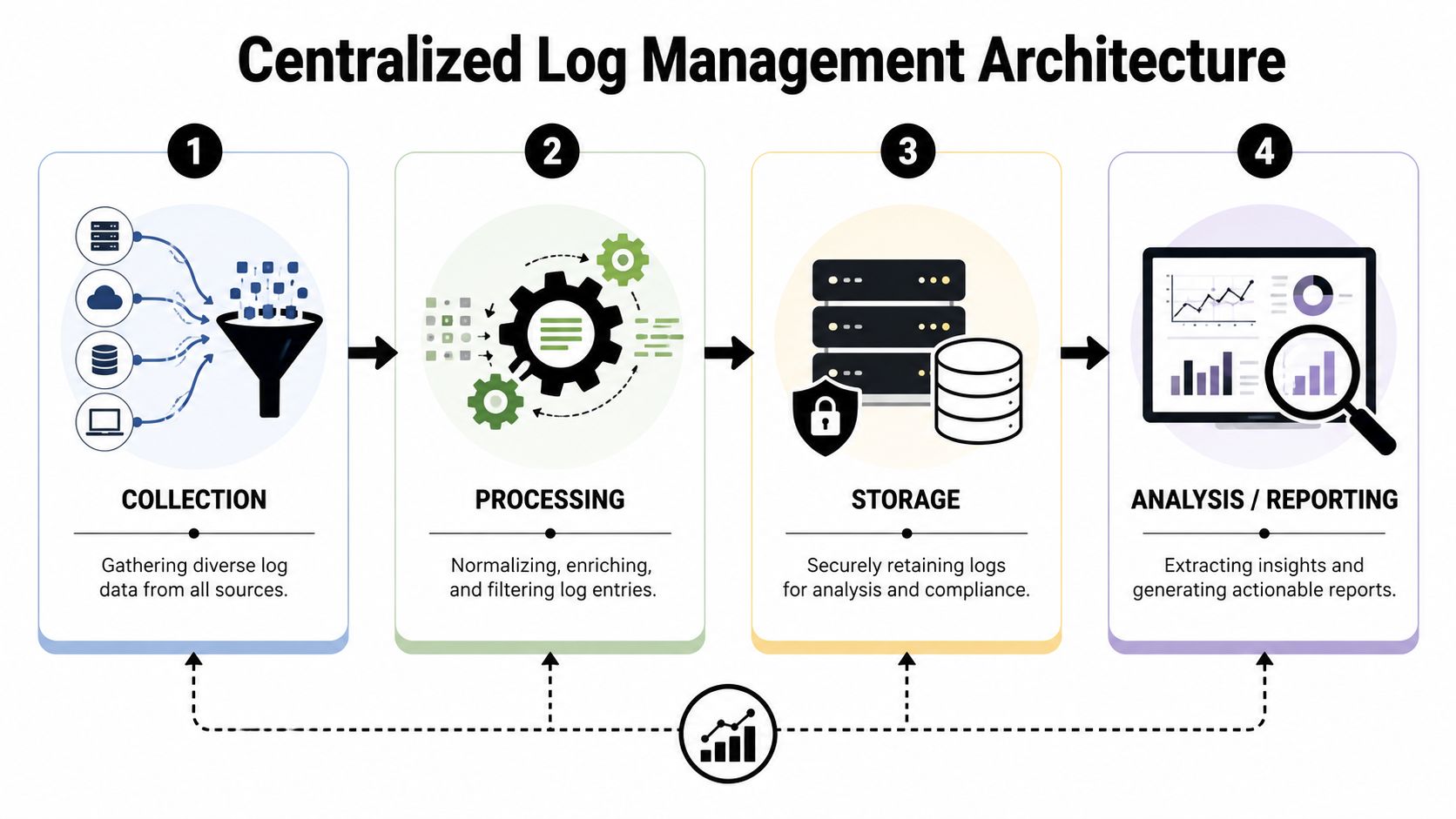
The four-stage pipeline
A high-performing architecture is commonly described as collection, processing, indexing, and visualization, as outlined in CrowdStrike's centralized logging overviewOnce logs are indexed centrally, teams can conduct rapid searches across recent and historical data. Structured formats such as JSON or XML also make machine-assisted analysis feasible, since plain text is hard to query at scale. In regulated environments, the same architecture supports retention and access-control policies required by frameworks such as HIPAA and PCI DSS.
It works much like a mail sorting facility.
| Stage | What happens | Why it matters |
|---|---|---|
| Collection | The platform ingests logs from numerous systems. | Incomplete collection means that every search further down the pipeline contains blind spots. |
| Processing | Parsers pull out fields, standardize formats, and add context to events. | Raw text is turned into usable data for reporting and detection. |
| Indexing and storage | A searchable repository with retention controls holds the events. | This is where decisions are made about search speed, cost, and preservation of evidence. |
| Analysis and reporting | Stored data becomes action through dashboards, queries, alerts, and reports. | Here, operators conduct incident investigations and produce audit output. |
For teams evaluating platform design, Unified Security Stack's log management and correlation SIEM approach This serves as a useful example of how those stages fit together in a security workflow rather than as isolated features.
Which data sources matter most
Collection methods should align with the source, not force every system into one identical ingestion pattern.
- Agents on servers and endpoints: Useful when you need reliable local collection, deeper system telemetry, or support for applications that cannot export cleanly on their own.
- Syslog from network and security devices: Because firewalls, switches, routers, and appliances frequently transmit events in this manner, Syslog serves as the backbone for many network logging deployments.
- APIs for cloud and SaaS services: Cloud platforms and business applications frequently make logs available through API-based collection instead of traditional forwarding.
- Flow records such as NetFlow: These do not take the place of event logs, yet they provide valuable traffic context for investigations and anomaly review.
Where architecture decisions go wrong
The majority of issues begin during processing.
When parsing is inconsistent, one field appears under multiple names, making searches fragile. When normalization is shallow, correlation rules break because user, host, action, and timestamp data do not align. When teams omit enrichment, analysts must mentally reconstruct business context that the system should already provide.
Processing is the point at which raw records become operational evidence. When that stage is weak, search turns into guesswork and alerts become noisy.
The second failure that commonly occurs is viewing storage as a passive container. It is not. Storage architecture determines whether the system stays responsive, whether historical investigations are feasible, and whether retained logs remain valuable as audit evidence instead of merely consuming space.
Mapping Log Management to Compliance Mandates
Regulatory pressure frequently drives organizations to centralize logging, yet many teams still deploy it as a technical archive rather than a control system. That is an error. Auditors generally care less about the tool name and more about whether logs are complete, governed, reviewable, and linked to specific control objectives.
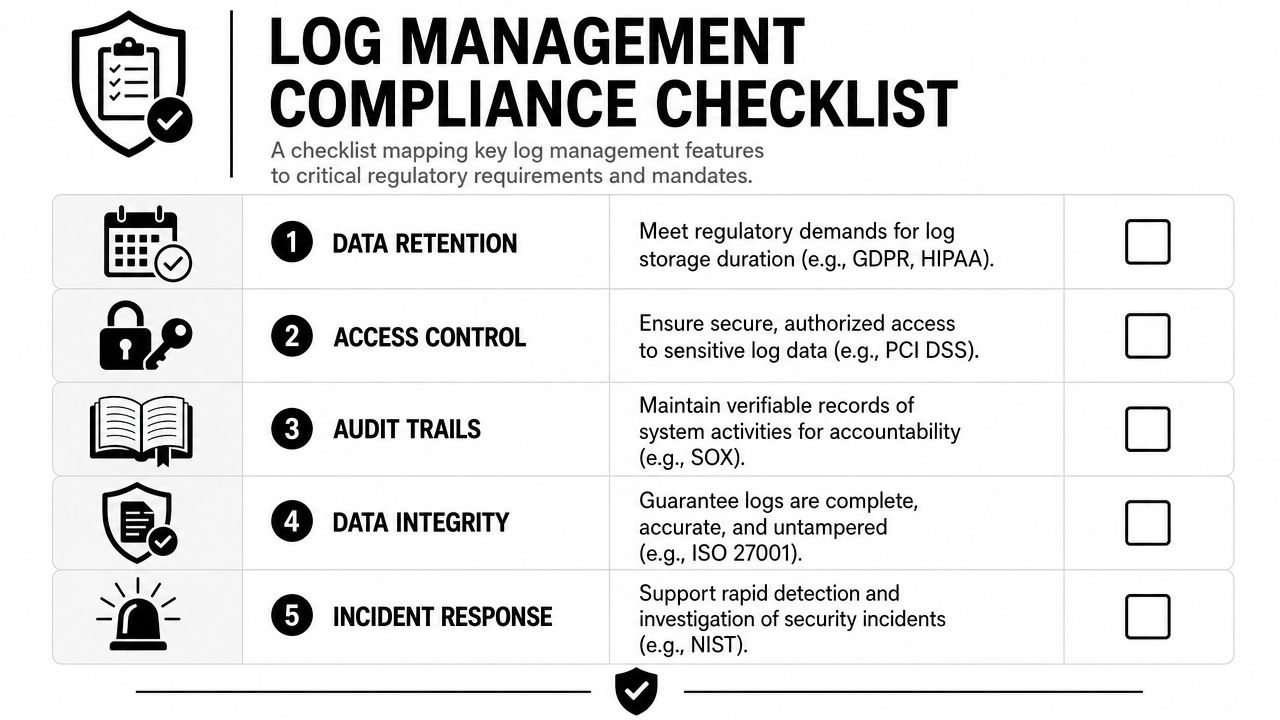
What auditors usually expect to see
Most compliance reviews come back to the same practical questions:
- Can you identify who accessed sensitive data or systems?
- Are you able to demonstrate that logs were retained and protected properly?
- Can you show monitoring, review, and follow-up on incidents?
- Can you generate evidence without depending on manual rebuilding?
A central repository is useful because it enables retention and access-control policies in regulated settings, letting one log stream support both security operations and audit evidence with fewer gaps, as the earlier architecture discussion noted.
How common frameworks map to log types
The clearest way to consider compliance logging is according to evidence type.
| Framework area | Log examples | What the organization needs to demonstrate |
|---|---|---|
| HIPAA auditability | Access logs, authentication events, admin actions, records of activity around systems handling protected health information | That access and system activity can be reviewed and investigated |
| PCI DSS Requirement 10 | User access logs, privilege changes, firewall events, administrative actions, system event records related to cardholder data environments | That access to network resources and cardholder-related systems is tracked and monitored |
| SOC 2 Security criteria such as CC7 | Authentication failures, endpoint alerts, changes to security controls, suspicious network activity, review workflows | That monitoring exists, anomalies are investigated, and response procedures are supported by evidence |
Practically, this requires gathering more than generic system logs. You need authentication data from identity systems, administrative activity from servers, deny and allow events from security controls, and application logs that reveal access to sensitive workflows.
Why shadow IT breaks clean audit trails
The most difficult compliance issues are not always within systems you already know about. They frequently originate from tools that the business adopted without central oversight.
When teams rely on unsanctioned SaaS apps or disconnected cloud services, the organization loses clear visibility into user activity, retention, and access control. This undermines both security monitoring and audit evidence. For leaders facing that risk, IT Cloud Global on compliance risks created by shadow IT deserves review because it clarifies why undocumented systems produce monitoring and governance gaps.
A practical compliance-focused logging program should include:
- Known critical systems first: Logs from identity, firewall, endpoint, server, cloud control plane, and sensitive applications.
- Evidence ownership: For every source, a responsible party must own retention, parser quality, and access governance.
- Control mapping: Queries and reports need to match real framework requirements, not generic dashboard widgets.
Teams looking for a more direct bridge between operational logging and audit evidence can also review Unified Security Stack's overview of the role of log management in compliance.
Implementation Best Practices and Operational Realities
Most logging programs do not fail because the team neglected to collect data. They fail because they collect an excess of the wrong data in the costliest part of the stack.

Stop trying to index everything
A frequent error is treating a log everything approach as a maturity objective. It is not. It often signals that the team has not defined use cases, retention tiers, or search priorities.
The economic trade-off is easy to overlook during early planning. Common guidance often covers collection, normalization, indexing, and search well, but it typically does not measure the long-term burden that storage and indexing create as sources and retention requirements expand. Cribl's discussion of centralized log management points out that hidden cost and latency trade-off and makes the case that selective centralization can be the wiser route, especially in hybrid environments.
A more workable model looks like this:
- Primary searchable tier: Logs relevant to security and compliance that analysts need to query frequently.
- Secondary retention tier: Logs with less value are archived for history, troubleshooting, or legal hold, though they are not fully indexed for rapid retrieval.
- Filtered-out noise: Recurring events of little value that drive up expenses while offering no gain in detection or evidence quality.
You do not gain visibility by centralizing every event. You gain it by keeping the events that lead to better decisions.
Retention should follow use cases
Any retention choice should begin with two questions: What does compliance require the organization to retain? What does the security team rely on during investigations?
Those requirements do not always match. Certain logs are critical for near-term detection yet become less useful over time. Other logs are seldom searched but still need to be available for audit or review. Applying one policy to all data adds expense without adding clarity.
A practical retention policy usually separates:
- Operational investigation data: Rapid access, with active search windows that are short to medium.
- Compliance evidence: Managed retention supported by documented access and integrity controls.
- Troubleshooting-only data: Stored in a location engineering can access without putting strain on the SIEM tier.
For organizations refining that balance as part of broader response planning, this guide to cybersecurity solutions for Saskatchewan businesses offers helpful context for incident response and recovery choices that frequently influence retention priorities.
Enrichment makes logs operationally useful
Raw events seldom answer business questions by themselves. A successful login is insufficient when the analyst must still determine if the user is privileged, if the endpoint is critical, or if the host sits in a sensitive environment.
Enrichment addresses this by adding context prior to or during analysis. Common useful fields are:
- Asset criticality: Is this a test server or a production database?
- User role: Does the account belong to finance, engineering, or a privileged admin group?
- Environment tag: Production and staging environments, remote offices, and regulated segments.
- Security context: Known threat indicators, links to previous alerts, or ownership of controls.
Absent enrichment, centralized logging turns into a vast searchable archive. With enrichment, it turns into a system that supports operational decisions.
A Practical Blueprint Using Unified Security Stack
A current blueprint must go beyond collection and search. It needs to cut noise before storage, retain valuable context, enable automated workflows, and generate evidence that compliance teams can rely on.
What a unified design looks like in practice
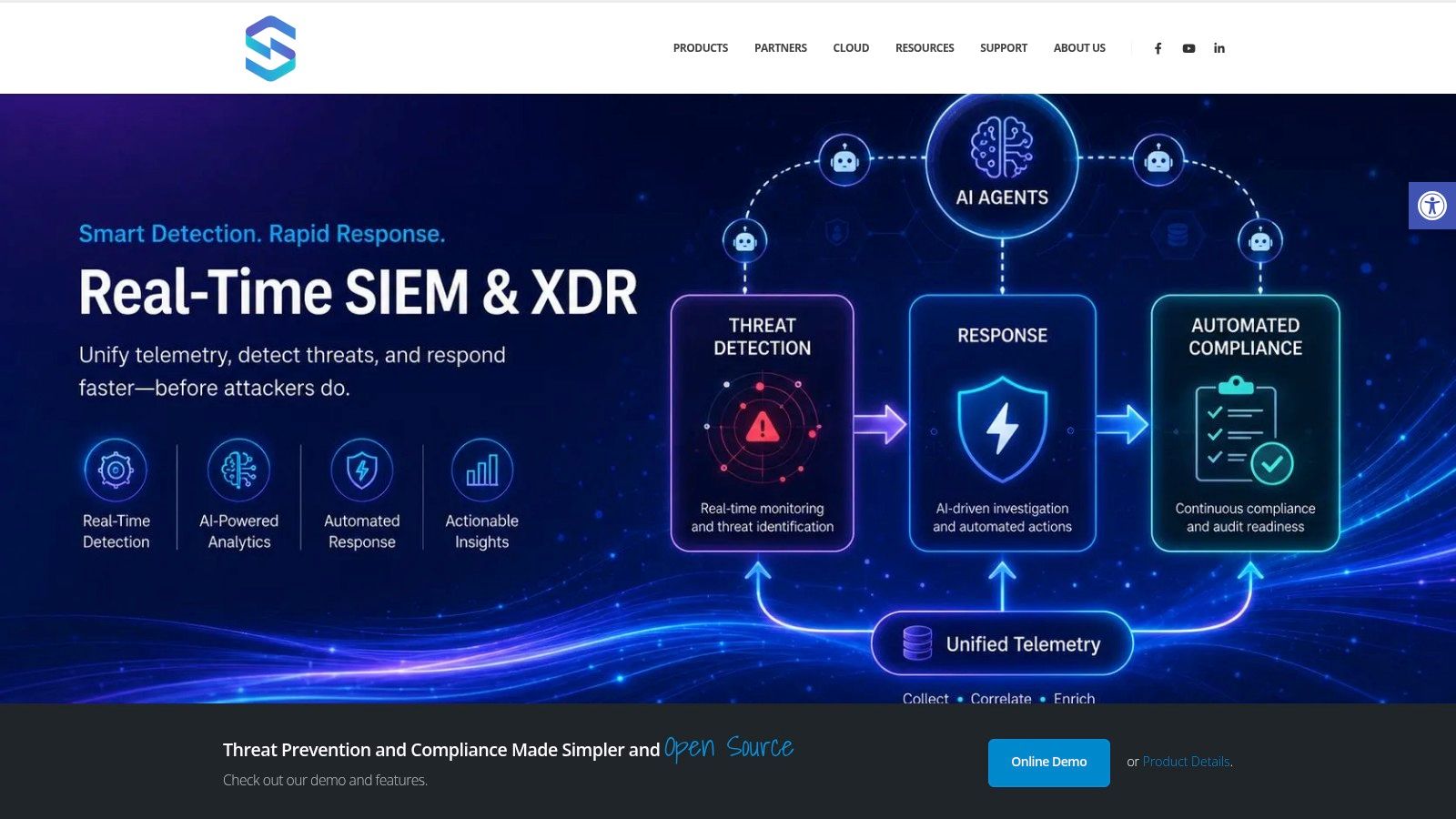
A workable deployment typically begins with wide ingestion coverage. In a hybrid setting, this means taking in logs from endpoints and servers via agents, from network devices via Syslog, from traffic sources via NetFlow, and from cloud services via APIs. After that, the platform must normalize and correlate events soon enough that teams are not storing chaos in a bigger container.
This is where platforms in the SIEM and XDR category diverge. Some function as storage systems with dashboards. Others operate more like security pipelines. If you are assessing cloud-centric architectures, Unified Security Stack's cloud SIEM overview illustrates the type of deployment model many teams now seek in distributed environments.
This also explains why security leaders care more and more about convergence. A logging platform that shares context with response workflows, endpoint data, and compliance reporting tends to be more usable than separate tools linked by fragile hand-offs. For a wider view of that consolidation trend, this overview of the benefits of unified threat management serves as a valuable supplementary reading.
Where AI-assisted triage helps and where it needs boundaries
The recent course of the industry is plain. Log platforms are combining normalization, enrichment, analytics, automation, and AI support more often. Logz.io's review of centralized log management practices and tools reflects that trend and also highlights the most important gap. Organizations still require governance, accuracy checks, and operational boundaries for those workflows.
This is a reasonable warning. AI-assisted triage can help summarize alerts, highlight likely links among events, and cut down on repetitive analyst work. It should not turn into an unreviewed decision-maker for containment, interpretation of evidence, or compliance claims.
A useful blueprint applies AI in constrained ways:
- Alert triage: Explain what caused an alert to trigger and which associated events should be examined.
- Rule tuning support: Suggest changes to parsers or correlation logic in response to noise that has been observed.
- Investigation acceleration: Assist analysts in examining broad collections of events while still requiring validation.
A platform such as Unified Security Stack matches this model by combining log ingestion from agents, Syslog, NetFlow, and APIs with real-time correlation before indexing, plus built-in AI support for triage, rule tuning, and false-positive reduction. The architecture matters more than the name. It reflects a wider shift away from the old collect, store, search pattern toward pipelines that improve signal quality before the analyst touches the data.
Here's a short product walk-through that helps make that architecture concrete:
Measuring Success and Continuous Improvement
The success of a centralized logging initiative should be measured by results, not by how much data is ingested.
Operational metrics matter most. Can analysts look into incidents while making fewer manual jumps? Can compliance personnel pull evidence without having to pursue several administrators? Are parsing and enrichment strong enough for searches to produce reliable results?
A practical scorecard includes:
- Faster investigation flow: Analysts are able to go from an alert to a timeline without switching among several systems.
- Cleaner audit evidence gathering: Compliance teams can respond to evidence requests using the central repository rather than assembling one-off collections.
- Lower alert friction: The team devotes less effort to clearing noisy events and more to confirming events that matter.
- Better source coverage: Logs arrive reliably from critical systems, and absent sources are identified promptly.
When performance slips, start with a short troubleshooting sequence:
- Check source health: Are events still coming from critical devices, servers, and cloud connectors?
- Review parser quality: Did a product update or schema change break field extraction?
- Validate enrichment: Are user, asset, and environment fields still being applied accurately?
- Test search performance: Do index and retention decisions slow typical investigations?
- Review rule output: Are correlation rules generating valuable cases, or merely adding noise to the queue?
The aim is not to gather more logs in the next quarter. It is to make the logging system more dependable, easier to search, and better matched to actual security and compliance needs.
If you're evaluating how to consolidate log collection, correlation, compliance evidence, and response workflows in one stack, Unified Security Stack is worth reviewing. It offers security teams a practical route from siloed logs to a unified SIEM, SOAR, and XDR operating model, without viewing centralized log management as only a storage initiative.