What Are Syslogs and How They Power Modern SIEM Detection
You are midway through a busy SOC shift when a firewall alert arrives late. The device should have sent logs through syslog, but the path relied on UDP and the network discarded the messages under load. Once an auditor asks for proof, the team has an investigation, a hole in the timeline, and no reliable evidence trail to show what occurred.
That's the answer to what are syslogsThey are more than simple text files. Syslog is a standardized message-logging protocol that allows the device that generates an event, the system that stores it, and the software that analyzes it to remain separate, which explains why it is still common in routers, Linux servers, firewalls, and mail systems. To a security team, that architecture is important because it converts routine operational noise into evidence you can search, correlate, and defend during an audit. CloudOrbis Inc. on event logging is a valuable reference if you want to go deeper into why event logging belongs in the security stack, not merely the ops stack.
Table of Contents
- Why Syslogs Matter in Modern Security Operations
- Inside a Syslog Message and Its Core Components
- Transport Protocols and the Reliability Trade-Off
- How Syslogs Drive Detection and Compliance Evidence
- Best Practices for Collection, Parsing, and Retention
- Hardening Syslog Pipelines for Security and Compliance
- Integrating Syslogs into a SIEM and XDR Platform
- Common Misconceptions and the Road Ahead for Syslog
Why Syslogs Matter in Modern Security Operations
A firewall drops a brute-force attack, and the sole reason anyone finds out is that the firewall's syslog message reaches the SIEM. If that message is lost in transit, the analyst may still observe the network noise, yet the evidence of the defensive control is absent. That is how a technical logging decision becomes a compliance problem.
Syslog addresses a fundamental coordination challenge. The host that produces the event does not have to know how the collector retains it or how the SOC examines it, since the protocol standardizes the event at the edge and passes it along for centralized processing. That separation explains why Syslog has stayed relevant across routers, Linux servers, firewalls, and mail systems since the 1980s, when Eric Allman helped launch it as part of Sendmail, and why it later evolved into the IETF-defined formats many teams still run today through RFC 3164 and RFC 5424 (HAProxy glossary on syslog).
Practical rule: if a system cannot demonstrate that it generated the event, collected it, and kept it intact, do not regard the log as evidence.
To a SOC analyst, this means syslog forms part of the detection path, not a side channel. It supplies central log management, enables alerting, and allows teams to compare events from diverse systems without converting every source into a custom format. If you are developing a collection strategy, a centralized approach such as Unified Security Stack centralized log management is more sensible than dispersed local logs since the SIEM can correlate them in a single location.
The operations perspective also matters. Syslog serves as the connective tissue linking legacy and modern infrastructure, which is why contemporary observability pipelines continue to rely on it. Even if the underlying systems cover decades of technology, the protocol provides security teams with one ingestion model for investigations, triage, and audit readiness.
Inside a Syslog Message and Its Core Components
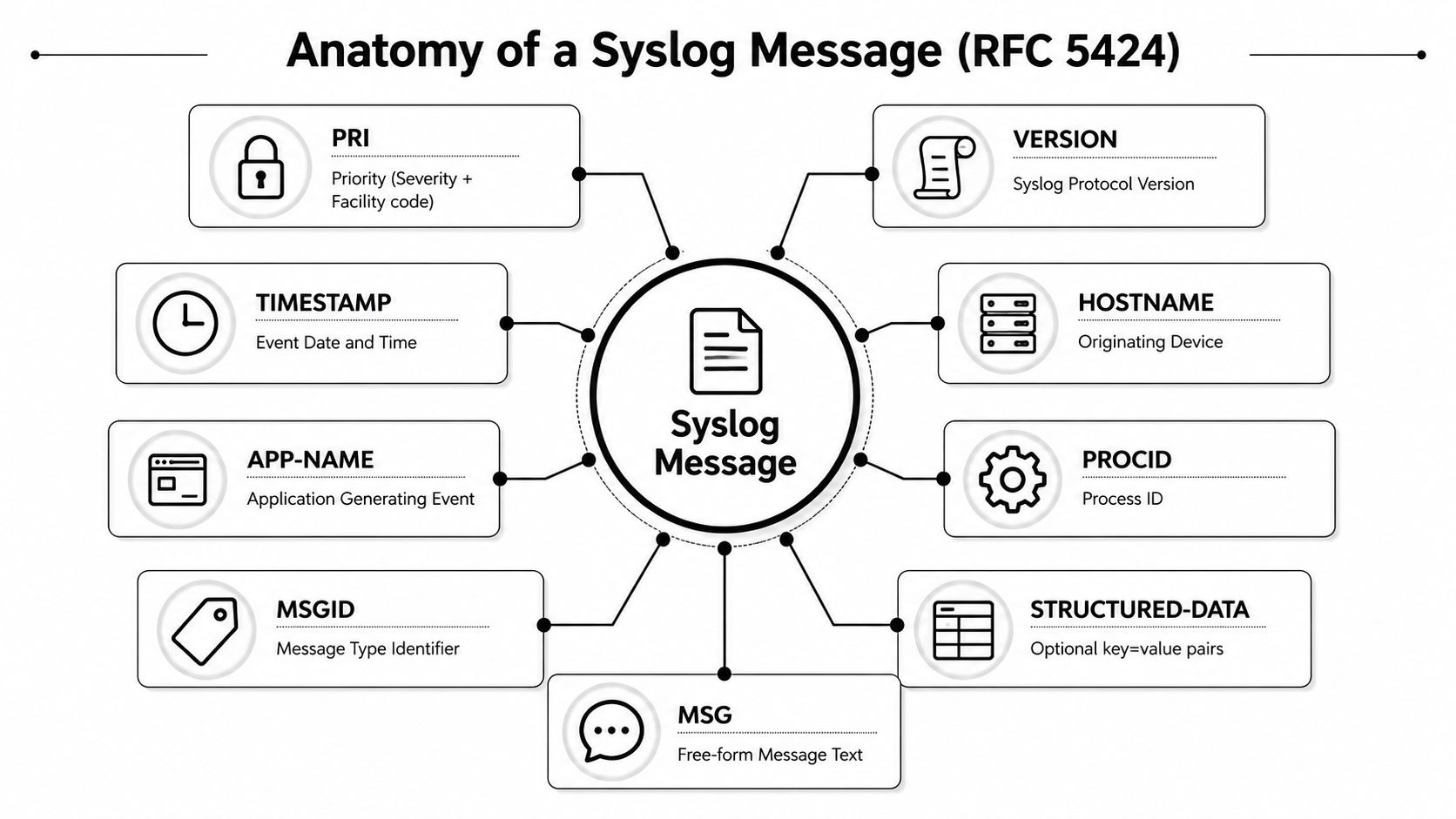
A syslog message appears simple only until you parse it one field at a time. In RFC 5424, the grammar is fixed as <PRI>VERSION TIMESTAMP HOSTNAME APP-NAME PROCID MSGID [STRUCTURED-DATA] MSG, and that structure enables a SIEM to handle a firewall event and a Linux auth event in the same manner. The message is normalized before the analyst sees it at all, which lowers ambiguity and allows correlation across devices and applications (RFC 5424).
Start with PRI and the message envelope
The first number, PRI, encodes both facility and severity. The formula is PRI = facility × 8 + severity, so the collector can retrieve both dimensions from a single field. This matters during triage because severity helps distinguish noise from urgent events, whereas facility helps determine the source class, such as kernel, auth, or mail.
Following PRI is the protocol version, then the timestamp, hostname, app name, process ID, and message ID. The structured-data section is where RFC 5424 proves particularly valuable for security work, since it can carry machine-parseable key/value data rather than requiring the SOC to extract everything from free text. The final MSG The field is the message body, in human-readable form.
The contrast with RFC 3164 is largely a question of maturity and precision. RFC 3164 is the legacy BSD format that remains common on older devices, whereas RFC 5424 provides richer grammar, UTF-8 handling, and timestamps with greater precision for cross-region analysis. A sample event may arrive appearing as one line, but the collector can break it into parsed fields that an analyst can filter within seconds.
A normalized syslog record offers greater value than a raw string since the SIEM can route it by severity, source class, or application ID without having to guess.
That is the essential mental shift. You are not merely receiving text; you are receiving an event envelope with sufficient structure to support detection logic.
Transport Protocols and the Reliability Trade-Off
Transport determines whether the message counts as evidence or merely a hopeful duplicate of evidence. Syslog often travels over UDP, TCP, or TLS, and the transport choice changes both delivery reliability and operational burden (syslog-ng internal statistics and transport guidance). For a SOC, that trade-off is not theoretical, since a dropped authentication event can disrupt an incident timeline.
| Transport | Reliability | Encryption | Typical Use Case | Trade-Off |
|---|---|---|---|---|
| UDP | Lower, can drop under congestion | No | High-volume device telemetry | Lightweight, but it can lose messages |
| TCP | Better delivery assurance | No | Structured log forwarding where delivery matters | Adds connection state and buffering |
| TLS | Better delivery assurance | Yes | Security and compliance logs | More secure, but adds certificate management |
Legacy RFC 3164 messages are commonly treated as limited to 1024 bytes, while RFC 5424 and transport guidance around RFC 6587 support more structured payloads and more reliable delivery over TCP/TLS (Uptrace syslog guide). That distinction matters when authentication details, usernames, or config-change context would otherwise be truncated.
UDP is not the right default for high-value sources, particularly authentication, authorization, and audit trails. TCP or TLS provides delivery assurance, whereas UDP remains acceptable for lower-value, high-volume telemetry where occasional loss does not ruin the investigation. Operationally, you choose between a lightweight collector path and a defensible evidence path.
When monitoring network devices, the transport choice likewise shapes the design of the collector tier. Unified Security Stack network device monitoring belongs in that discussion, since the collector must reliably receive device syslog before the SIEM can put it to any useful purpose.
How Syslogs Drive Detection and Compliance Evidence
Syslog gains its strength when one event serves two purposes. A failed login may fire a brute-force correlation rule, while that same record can satisfy an audit requirement for access monitoring and incident review. This is why teams that regard logs as security evidence tend to achieve better results than teams that use them only for troubleshooting.
One event, many downstream uses
Once normalized, a syslog record can move into a SIEM rule, a SOAR playbook, and a compliance report without needing rewrites each time. The fields that matter are already present in the message, including timestamp, hostname, severity, and message body, since they serve as anchors for correlation across endpoints, cloud services, and network devices. Inside a SOC, this allows you to connect a Linux host login failure, a firewall deny event, and a suspicious configuration change on an appliance.
Structured logging also lowers friction here for regulated environments. Syslog can underpin evidence workflows for frameworks such as HIPAA, GLBA, PCI DSS, CMMC, and ISO 27001 when the pipeline maintains integrity and the SIEM keeps the data searchable. A clear failed-login record, for instance, can serve both detection and later review if an auditor asks how access attempts were monitored.
An IDS or sensor deployment makes this even clearer. The ARPHost Snort deployment guide is a helpful companion read if you are integrating network detections into a wider logging pipeline, since sensor output only becomes actionable when the SIEM can align it with other syslog evidence.
If one event cannot serve both detection and audit, the logging pipeline is not strong enough for security work.
This explains why correlation engines rely on consistent syslog structure. They are not merely searching for message text; they are assembling a timeline that narrates an attack or a policy violation. When syslog is normalized properly, that story is easier to substantiate.
Best Practices for Collection, Parsing, and Retention
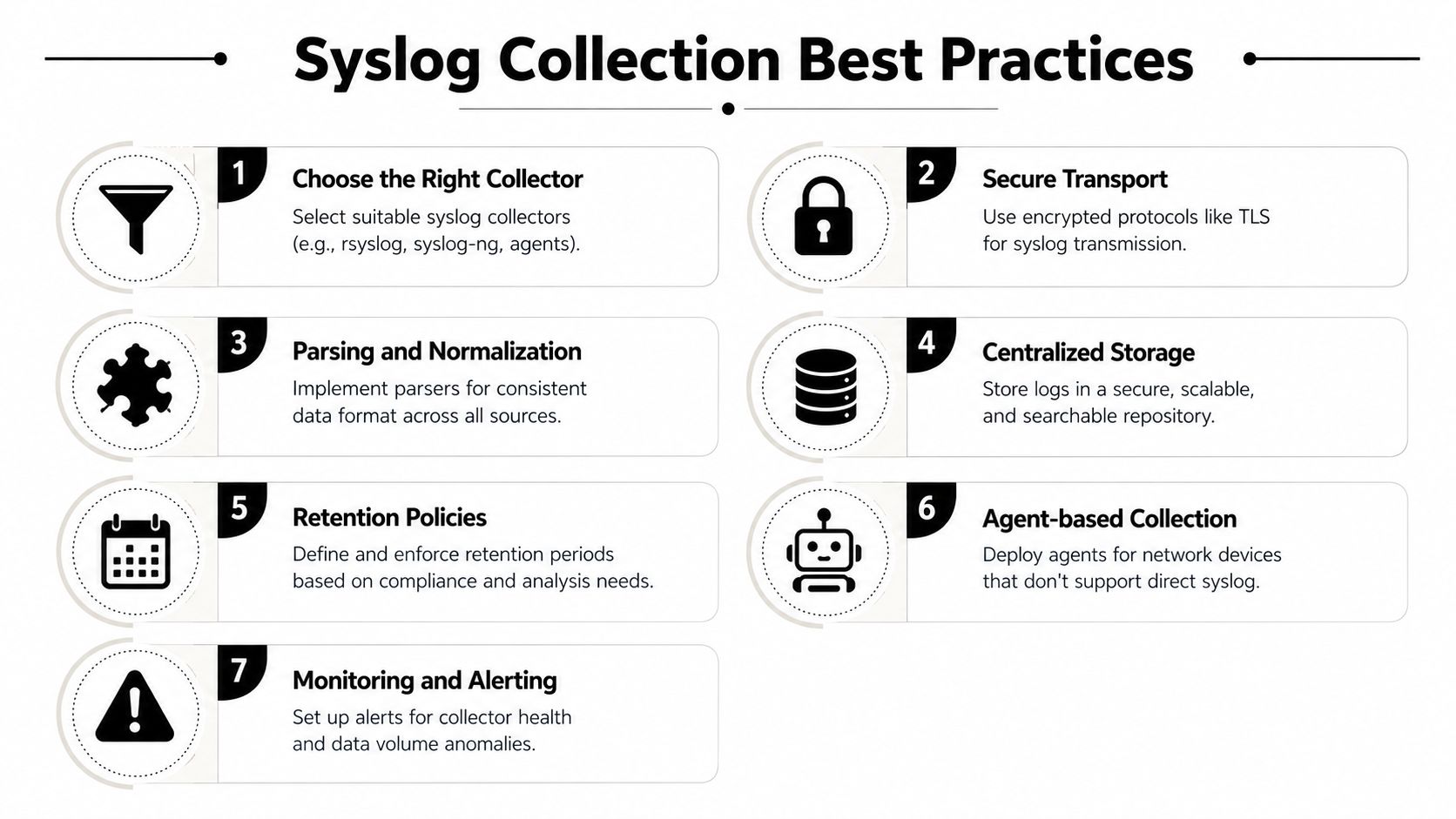
Effective syslog work begins with collection, not the dashboard. A collector that drops messages, misinterprets timestamps, or saves logs in the wrong schema can make even a capable SIEM appear unreliable. The practical checklist is straightforward, yet each item counts.
Build the pipeline in layers
Begin with the collector itself. Use agents when a device cannot send logs directly, aggregate the stream on a SIEM or XDR server, and monitor collector health so a silent failure does not resemble a quiet environment. A collector that reports its own throughput and loss provides a way to spot backpressure before it turns into evidence loss.
Parsing and normalization come next. Parsing extracts fields such as source IP, username, or action from the message, while normalization turns vendor-specific formats into a consistent schema so correlation rules function across different devices. Without this step, each log source becomes a custom exception, and the analyst winds up reading raw strings rather than working with fields.
Retention should be driven by business and regulatory requirements, not by whatever free disk space is available. For evidence-grade logs, use immutable storage or similarly protected archives, and size the storage plan according to expected event volume rather than estimates. This keeps log history accessible when an investigation or audit arrives months later.
A few troubleshooting habits save a lot of time in production:
- Dropped messages: Look for queue pressure and receiver overload before you blame the sender.
- Clock skew: Synchronize timestamps early, or your timeline will appear incorrect even if the messages are intact.
- DNS resolution issues: Adopt stable naming and carefully verify source identity when hostnames determine routing.
Operational habit: if a collector cannot demonstrate what it received and what it dropped, it cannot be trusted as the front door for security evidence.
A platform like Unified Security Stack can fit in naturally, because it ingests syslog from devices and applications and then correlates it within the same pipeline. The point is not the brand but the architecture: one place to collect, normalize, search, and retain.
Hardening Syslog Pipelines for Security and Compliance
Syslog collectors, transport, and storage now belong within the security boundary. That is the only reasonable approach when the pipeline handles authentication events, IP addresses, configuration changes, and potentially sensitive application data. A weak logging path means a weak evidence chain.
Lock down the transport and the collector
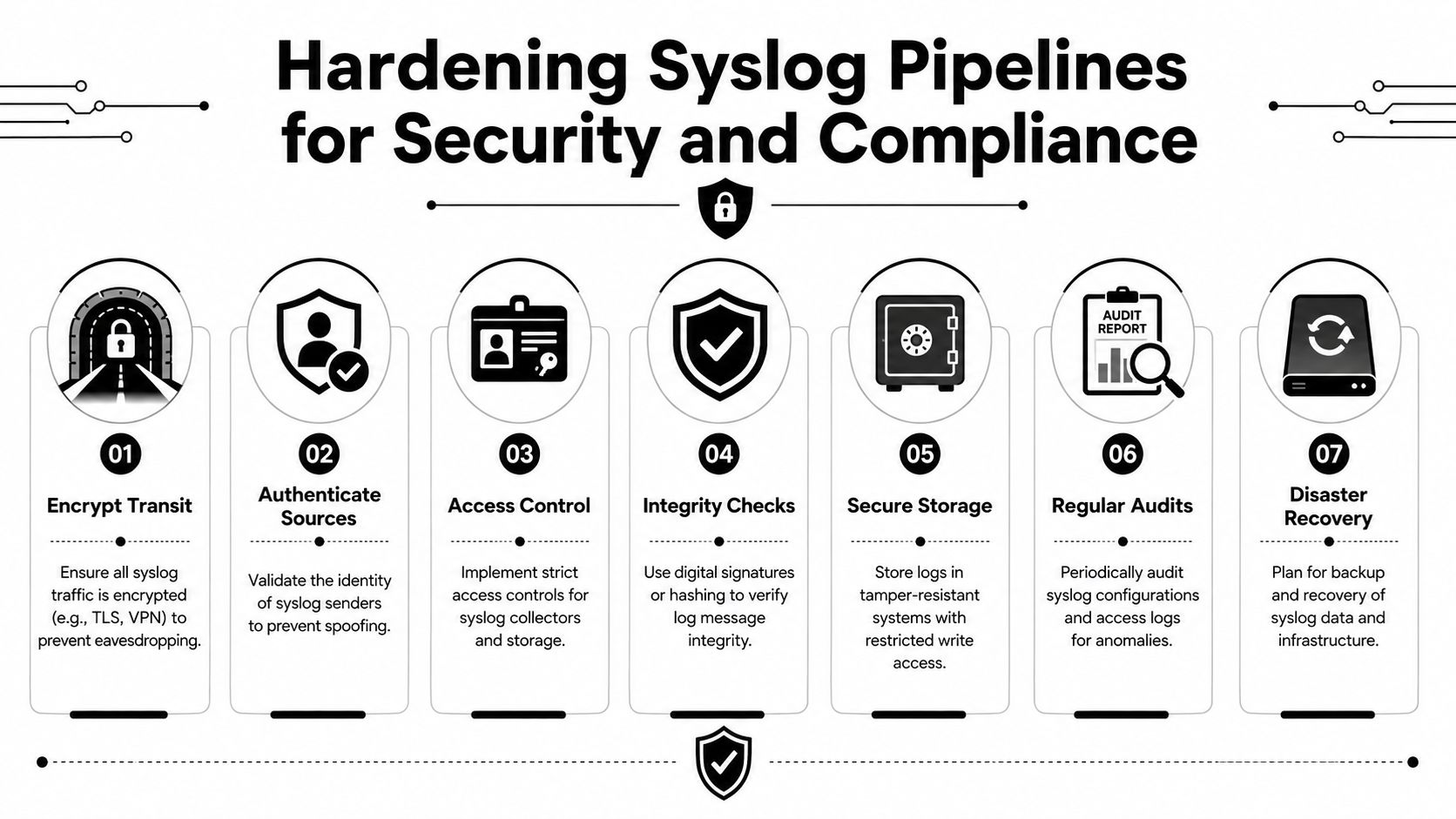
In-transit encryption is foundational, not an enhancement. TLS The syslog stream is protected from passive interception, while mutual authentication between sender and collector helps prevent spoofed sources from contaminating the evidence set. If you still rely on plaintext across untrusted networks, you are treating log traffic as casual telemetry rather than security data.
Access control for stored logs is equally important. RBAC should constrain who may read, forward, or delete log data, and access to the SIEM itself should be recorded. Append-only or immutable storage makes tampering harder, which matters when logs form part of a legal or compliance record.
Integrity controls belong between collection and analysis. Signing batches or applying hashing can help reveal alteration, particularly in retention tiers used for investigations or audits. The goal is to ensure that the message reviewed later matches the message the sender generated.
Treat the log path like a critical system
Security teams frequently harden endpoints but overlook the pipeline that demonstrates those endpoints acted correctly. That is an error. A compromised collector can silence alerts, change timelines, or quietly remove evidence that would reveal a breach.
Think in controls, not convenience:
- Encrypt transit: Transport logs using TLS or a different protected channel.
- Authenticate sources: Ensure only authorized senders can transmit syslog.
- Restrict access: Control who can read or change log storage.
- Protect integrity: Where feasible, adopt immutable storage or message hashing.
- Audit the auditors: Record who accessed the SIEM and at what time.
- Plan recovery: Ensure backups cover the collection path, not only the data.
For anyone comparing logging architecture to broader cloud change, the discussion around real costs of cloud modernization serves as a reminder that every additional layer brings operational responsibility. Hardening syslog is part of that responsibility, not an optional cleanup task afterward.
Integrating Syslogs into a SIEM and XDR Platform
A useful syslog stack begins when the collector delivers clean data to a SIEM or XDR platform, not when the device first sends the line. Direct your firewalls, servers, and applications to a central listener, confirm that fields arrive as expected, and then create detections based on the parsed data. If severity, hostname, or app name is absent, repair ingestion before writing the rule.
Make the ingestion path boring and predictable
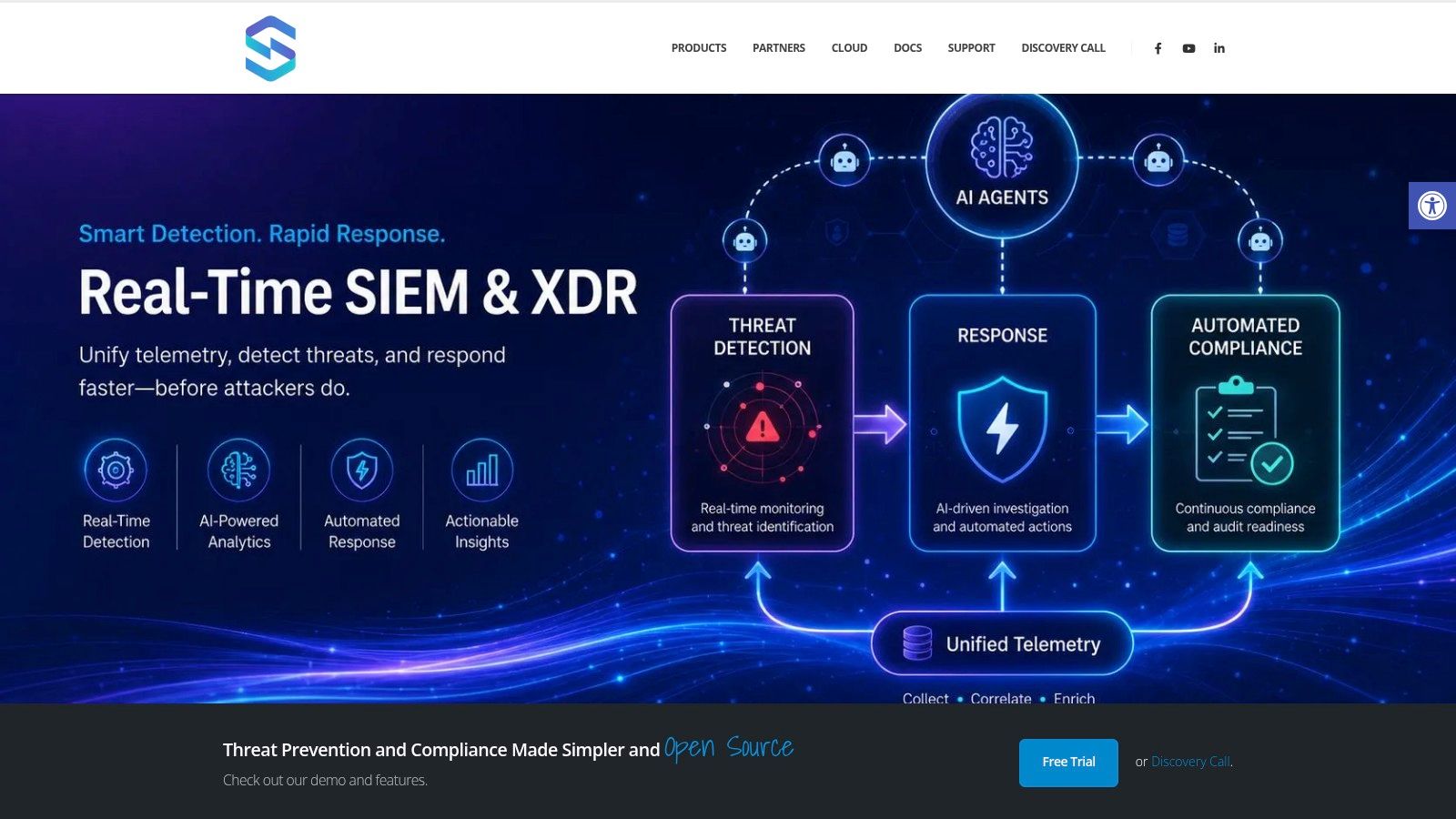
A SIEM listener ought to accept standard syslog formats and make parsed fields available for rules and dashboards. This provides a single location to normalize data from network devices, endpoints, and cloud sources. If the platform also offers agents that proxy syslog and related telemetry, the team can onboard devices unable to send directly without creating custom collection chains.
Correlation rules are where the value becomes visible. A rule combining syslog from an endpoint, a cloud service, and an identity provider can transform isolated events into one attack narrative, which is much more useful than pursuing separate alerts. Built-in LLM assistance can support triage and rule drafting, but the foundation remains clean syslog fields.
The video below offers a practical walkthrough of the wider platform flow.
Tuning is important once ingestion begins. When the collector is too noisy, correlation rules become overwhelmed by low-value events. When timestamps drift or certificates fail, the analyst observes gaps that resemble incidents even though they are merely pipeline problems.
A cloud-hosted SIEM option such as Unified Security Stack on cloud suits teams seeking centralized syslog handling without building everything from scratch, and it keeps collection, correlation, and reporting in a single place. That is especially helpful when detections must map back to compliance evidence rather than separate operational and audit systems.
Common Misconceptions and the Road Ahead for Syslog
Syslog is not obsolete, insecure by default, or too basic to matter. It remains the lowest-common-denominator protocol for heterogeneous environments, which is precisely why it persists in mixed estates containing legacy appliances, Linux servers, and cloud-connected tools. Its simplicity is why it bridges infrastructure generations so effectively.
The common mistake is to confuse simple with weakSyslog alone does not provide semantic richness or inherent trust, so the surrounding pipeline must deliver parsing, encryption, access control, and retention discipline. Once those are in place, it becomes a durable evidence layer for detection and compliance.
If you are modernizing the stack, begin with the fundamentals. Audit existing syslog sources, turn on TLS wherever the sender supports it, and test whether your SIEM can normalize the formats already in use. Then consider a unified platform that can collect, correlate, and report across detection and compliance workflows without making the log path more difficult to run.
Syslog will continue to evolve alongside cloud-native logging, but it will not disappear. For security teams, that means the winning approach is not to replace syslog but to manage it as a strategic control.
Unified Security Stack combines syslog collection, correlation, and compliance reporting in one platform, so your logs can serve both detection and audit needs without additional plumbing. If you want to centralize syslog ingestion and connect it to SIEM and XDR workflows, visit Unified Security Stack and assess how it suits your environment.