Security Event Management: A Practical Guide for Modern SOCs
A SOC may possess extensive telemetry, a current SIEM, and a queue that remains unmanageable in practice. Analysts rotate among identity, endpoint, cloud, and network consoles as low-confidence alerts pile up. The issue typically is not insufficient data. It is the absent operational layer that converts dispersed events into decisions, investigations, and repeatable response.
Security event management supplies that layer. It establishes how teams gather security-relevant events, ready them for analysis, link related activity, determine what merits an incident, and retain evidence for later investigation or audit. A mature program also regards detection tuning and runbook upkeep as ongoing work, not as tasks finished at deployment.
Table of Contents
- Why SOC Teams Are Still Drowning in Alerts
- What Security Event Management Means
- The Core Pipeline From Raw Logs to Real Incidents
- Where SEM Stops and SIEM, SOAR, and XDR Begin
- Data Sources, Hybrid Ingestion, and Common Architectures
- KPIs, Compliance Retention, and Measurable Outcomes
- Runbooks, Tooling Evaluation, and Migration Considerations
Why SOC Teams Are Still Drowning in Alerts
A normal SOC shift begins with a queue crowded by unresolved alerts. Analysts might move between identity, endpoint, firewall, cloud, and ticketing systems, seeking to establish whether each notification is a genuine threat, a routine administrative action, or a duplicate of an earlier investigation. The queue expands when rules create alerts without sufficient context for a confident decision.
The operational gap sits between collected log volume and usable detection qualityA firewall can log connection activity, an identity provider can log authentication, and an EDR platform can log process execution. Those events become valuable only when the team can synchronize their timestamps, identify the pertinent user and asset, connect activity across sources, and clarify what action should follow.
Why noise enters the queue
Low-fidelity rules are one cause of overload. Another is missing cross-source correlation. A suspicious login may appear benign in an identity console, while a new process on that user's endpoint may appear ordinary by itself. Combined, the events can support a far stronger investigation path.
Runbooks expose a second gap. Some SOCs maintain formal documents, yet analysts still rely on tribal knowledge to determine which evidence to gather, who authorizes containment, and when to close an alert. A practical incident response planning guide can help leaders codify those decisions before a high-pressure event reveals what is missing.
Operational rule: A detection is not complete when it triggers. It is complete when an analyst can comprehend it, respond to it, and document the outcome consistently.
The answer to alert fatigue is not to disable detections. Teams must review rule logic, suppression, deduplication, entity context, and escalation paths as a whole. This guide to reducing false positives in SIEM systems serves as helpful context for that tuning effort.
The remainder of the discipline follows a practical order: define security event management, run the event pipeline, establish boundaries with SIEM, SOAR, and XDR, select an architecture, measure outcomes, and sustain runbooks and integrations. That progression helps security leaders assess whether their platform generates intelligence or simply stores costly data.
What Security Event Management Means
A login from an unknown location may seem minor by itself. An endpoint process, privilege change, or cloud action can also appear ordinary. Security event management decides whether these separate observations turn into an actionable investigation or stay as expensive data at rest.
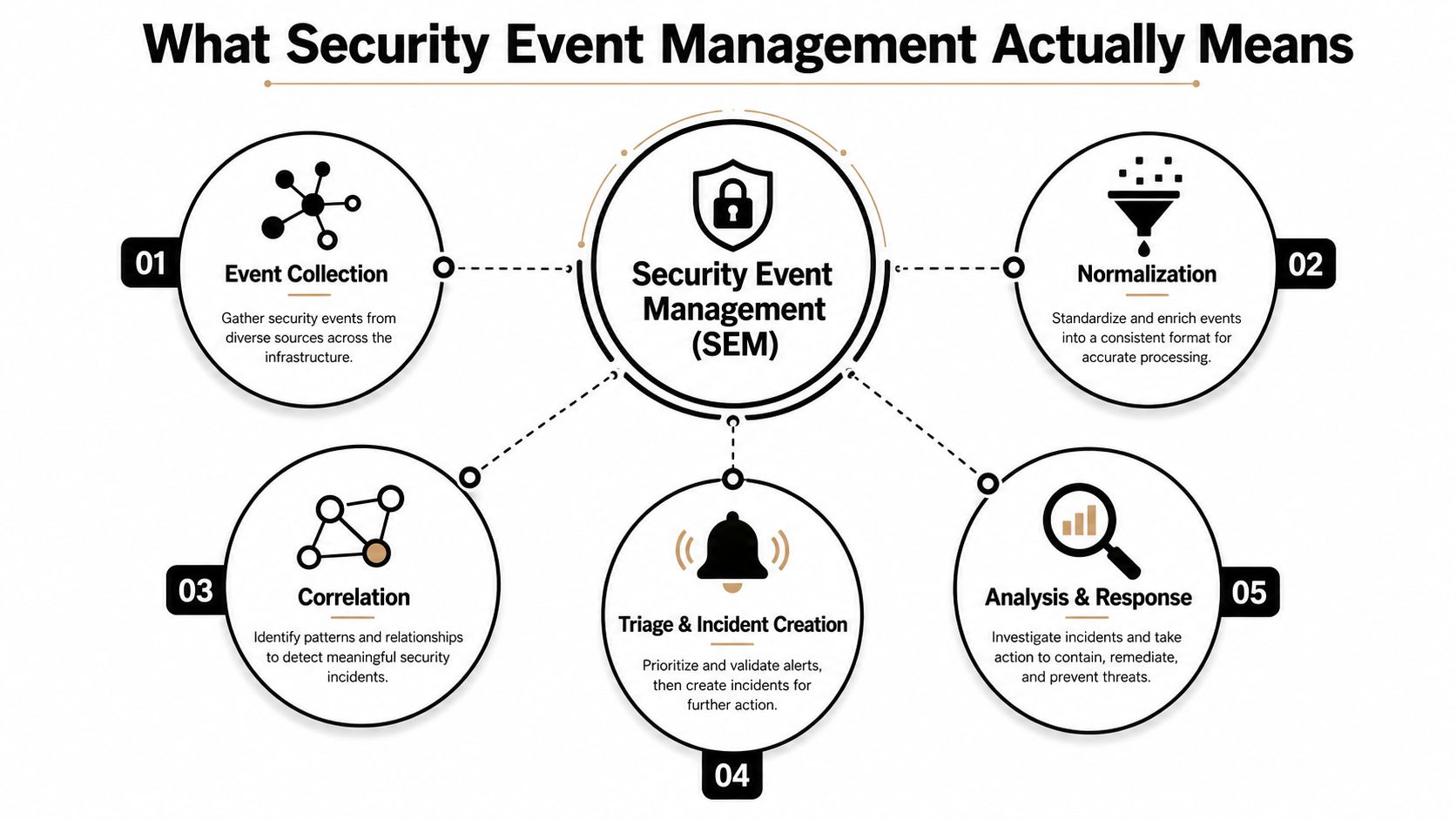
Security event management is the operational discipline that converts security events into decisions. It encompasses gathering relevant activity, normalizing its fields, correlating events across sources, triaging findings, enabling investigation and response, retaining evidence, and adjusting the process as conditions shift. The missing layer is the operational judgment surrounding the platform, particularly correlation quality and runbook design.
A water-treatment plant offers a helpful analogy. Water comes from various sources with uneven composition. The plant filters and standardizes it, checks relationships and quality, eliminates duplicate effort, then sends usable output to the next stage. Sending every intake sample straight to a household would overwhelm the system and yield little confidence.
Security event management follows the same logic:
- Collection collects events from endpoints, networks, identities, applications, and cloud services.
- Normalization places records from multiple vendors into a common structure, enabling analysts to compare users, assets, actions, and times.
- Correlation connects activity that could constitute a single attack sequence rather than leaving it as separate alerts.
- Triage sets relevance, severity, ownership, and incident status.
- Response directs investigation, containment, recovery, and documentation.
SEM is a discipline, not a product label
A SIEM frequently serves as the main platform for this activity. It holds events, supports searching, runs detection rules, and surfaces alerts. Security event management covers more. It includes accountability, evidence requirements, tuning schedules, escalation procedures, retention choices, and playbooks that outline analyst actions when a case fits specific criteria.
SOAR manages orchestration and response automation. It can take in a validated alert, collect enrichment, open a ticket, seek approval, isolate an endpoint, or block an indicator through an API. SEM determines which signal deserves an actionable case and what evidence and response requirements that case carries. SOAR carries out approved workflows.
XDR Usually delivers vendor-integrated detection across chosen areas like endpoint, identity, network, and cloud workloads. It can provide rich context within the ecosystem it supports, while SEM practices evaluate coverage, bring in other sources, validate detections, and oversee response.
SIEM, SOAR, and XDR support distinct parts of security event management, which is the process of handling events.
Purchasing another platform will not fix poorly parsed data, overlapping rules, undocumented exceptions, weak correlation, or unclear containment authority. Security leaders should ask what each tool adds to the operational chain, which runbooks direct action, and what remains the SOC's responsibility.
The Core Pipeline From Raw Logs to Real Incidents
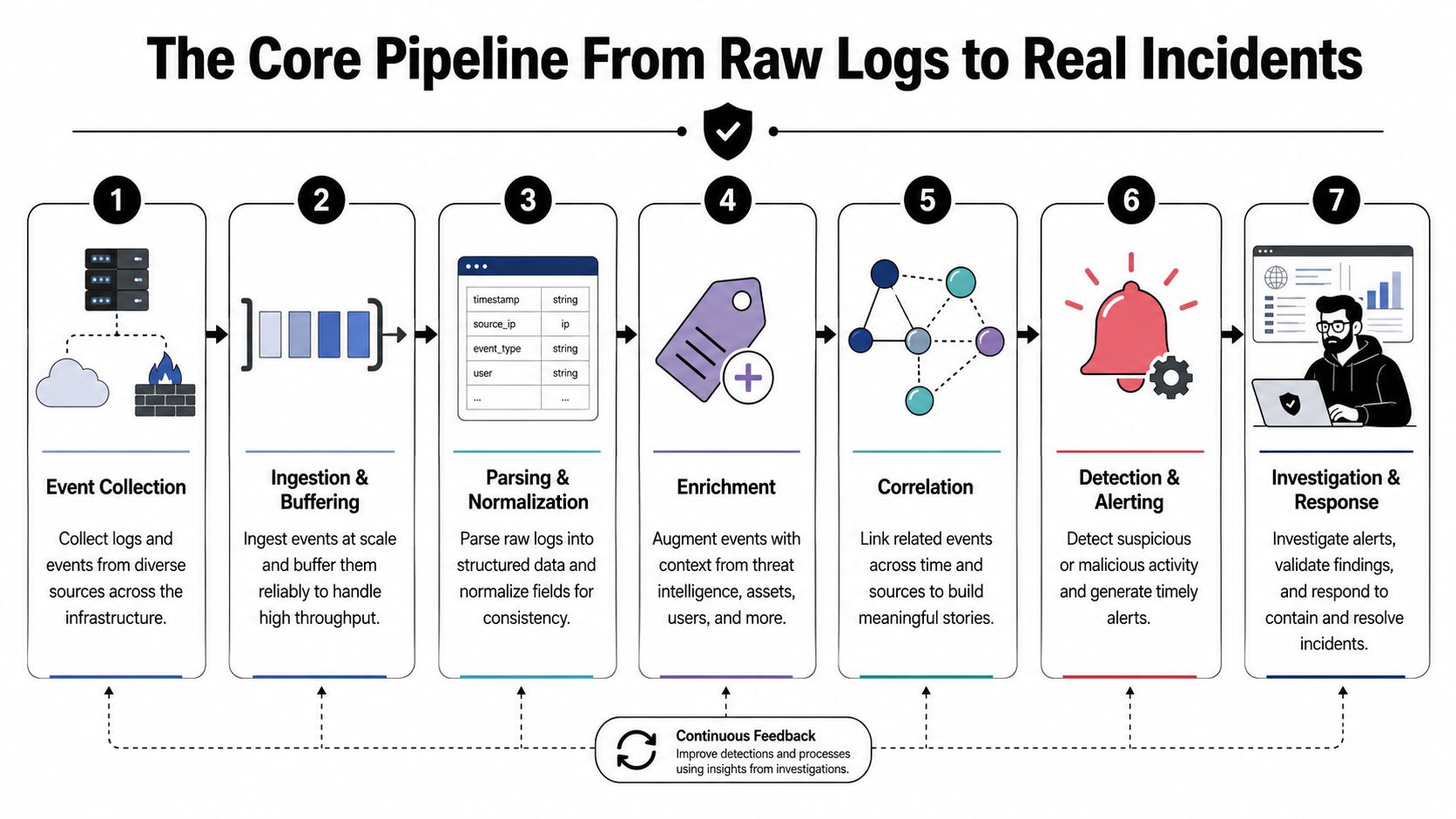
A dependable SEM program works as a linked pipeline. Each stage must generate information the next stage can trust. Incomplete collection makes correlation weak. Inconsistent parsing turns investigation into a manual translation exercise.
Collection and ingestion
Collection begins with agents, syslog forwarders, APIs, cloud control planes, endpoint tools, identity providers, and network devices. The design should determine which sources are critical for detection, which support investigation, and which exist mostly for audit or operational context.
Ingestion and buffering safeguard the pipeline when a source emits a sudden surge of activity. Lacking queueing and backpressure, scans, outages, or configuration changes may swamp downstream processors and hold back the events analysts need most.
Parsing, normalization, and enrichment
Parsing extracts fields from records specific to each vendor. Normalization maps those fields into a common schema, for example a consistent model for user, host, source, destination, process, action, and outcome. Aligning timestamps to UTC is important when analysts reconstruct activity across regions and systems.
Enrichment adds context the original event may not include. Asset criticality, user role, vulnerability information, business ownership, identity risk, and threat intelligence can shift the priority of an otherwise ordinary event.
Under-parsed logs generate noise here. If a username, process name, or outcome is buried in an unstructured message, downstream rules may overlook it or produce broad matches.
Correlation and detection
Correlation links related activity through rules, behavioral baselines, and cross-source joins. A sequence with an unusual authentication, a privileged action, and suspicious endpoint execution merits different treatment than three unrelated records.
The correlation engine should filter, aggregate, deduplicate, mask when necessary, and assist root-cause analysis. A study found that an optimized correlation method was 21 times faster than a baseline simple event correlator in real-time response and 2.5 times more efficient in execution time in its published comparison. Those figures describe that study's approach, not a universal result, but they show why correlation architecture affects analyst-facing performance.
Overlapping rules and noisy baselines are common points of failure. More rules can increase apparent coverage while lowering the clarity of each alert.
Alerting, investigation, and response
Alerting should generate a severity, a reason, relevant entities, supporting evidence, and a clear next action. Deduplication stops repeated records from becoming repeated analyst work. Suppression covers known benign patterns, but every suppression needs an owner, scope, expiration logic, and review history.
Investigation ought to allow an analyst to pivot by entity, time, process, user, and related incident. A case needs to answer what occurred, when it occurred, which assets were involved, and what evidence backs the conclusion.
Response translates that conclusion into action. Playbooks can direct credential resets, endpoint isolation, firewall changes, ticket handoff, or stakeholder notification. During high-volume scans, alert flooding frequently emerges at this stage because many similar events arrive before the platform groups them.
Retention and evidence access
Retention calls for hot, warm, and cold tiers matched to operational and forensic requirements. Hot data enables fast investigation. Warm data balances cost against query access. Cold data can retain evidence economically, yet unindexed or hard-to-retrieve storage may conceal exactly the records investigators need.
Teams designing centralized log management should validate retrieval, not merely ingestion. A retention policy delivers operational value only when authorized analysts can find, interpret, and export relevant evidence within the available time.
For a practical perspective on how organizations structure event-management data work, security leaders can review the Faberwork LLC EMS case studies. The practical takeaway is architectural: data processing, storage, and access patterns ought to mirror the decisions the organization needs to make.
Where SEM Stops and SIEM, SOAR, and XDR Begin
The simplest way to distinguish these categories is to give each one a job. SEM establishes the process and quality standard. These platforms enable specific activities inside that workflow, yet none removes the need for ownership and governance.
| Capability | SEM Discipline | SIEM | SOAR | XDR |
|---|---|---|---|---|
| Primary responsibility | Define, operate, and improve the event-to-response process | Collect, search, correlate, detect, and report | Orchestrate and automate response actions | Curate and correlate telemetry across an integrated vendor ecosystem |
| What it receives | Events, alerts, investigation findings, and operational feedback | Logs, events, threat intelligence, and security data | Validated alerts and response context | Endpoint, identity, network, and cloud signals supported by the platform |
| What it hands off | Cases, evidence requirements, severity, and response decisions | Alerts and investigation context | Actions, approvals, tickets, and status updates | Findings and enriched detections for broader SOC workflows |
| What it keeps | Tuning, coverage governance, runbooks, retention, and quality assurance | Platform configuration, rules, indexes, and dashboards | Playbooks, connectors, and execution records | Vendor-specific detections, integrations, and telemetry relationships |
| Main trade-off | Operational consistency versus ongoing ownership | Control and breadth versus cost and administration | Response speed versus automation risk | Integrated coverage versus vendor dependence |
SIEM historically took in much of the SEM pipeline, which is why teams sometimes treat the terms as interchangeable. That shorthand turns dangerous when a platform's ability to ingest and alert is mistaken for a full operating model.
SOAR operates downstream of detection. It can automate repetitive actions, but automation ought to rest on alert confidence, approval policy, and rollback capability. A playbook that isolates a production system based on weak correlation can cause more operational harm than the original event.
XDR may narrow the investigation path by surfacing vendor-curated relationships across supported domains. The trade-off is coverage beyond that ecosystem and the organization's capacity to inspect or modify detection logic. A wider SEM practice keeps responsibility for gaps with the team.
For modern SOCs, the practical model is hybrid. SEM stays the discipline, while SIEM, SOAR, and XDR become interchangeable or complementary tooling options. Teams evaluating SIEM and XDR should weigh not only feature lists, but also data ownership, rule transparency, response authority, and exit options.
Data Sources, Hybrid Ingestion, and Common Architectures
A single environment seldom serves as the source of modern SOC telemetry. Potential on-premises sources include firewalls, Active Directory domain controllers, EDR agents, VPN systems, databases, and industrial control systems. Potential cloud sources include AWS CloudTrail, Azure Activity logs, Google Cloud Audit Logs, Microsoft 365, Okta, SaaS audit records, and Kubernetes events.
Ingestion should align with the source and the required freshness. Agent-based collectors perform well for host telemetry and local files. Syslog forwarders are suitable for network and infrastructure devices. APIs can fetch SaaS and cloud records, while event hubs and cloud-native pipelines such as Kinesis or Pub/Sub can stream activity into processing systems.
Normalization determines portability
Schemas unique to a vendor complicate migration and cross-source correlation. A normalization layer should translate equivalent concepts into common fields while retaining the original record as evidence. It should also log parser version, source identity, ingestion time, event time, and any enrichment applied.
Retention planning should be part of the architecture conversation from the outset. Hot, warm, and cold tiers influence query speed, investigative workflow, storage cost, and audit-request fulfillment.
Common deployment shapes
An on-premises SIEM with centralization can fit organizations that need strict local control and have established infrastructure teams. A cloud-native SIEM can make elastic ingestion simpler and support distributed environments, but leaders must understand the economics of data transfer, query, and retention.
Hybrid architectures pair local collection with cloud analysis or tiered storage. MSSP and MDR platforms provide multi-tenant separation, delegated administration, and shared workflows. Data lakehouse patterns rely on object storage for durable retention and separate query engines for investigations, which can offer flexibility but may demand more engineering around schemas, access control, and detection latency.
| Environment Profile | Recommended Architecture | Ingestion Style | Storage Tiering |
|---|---|---|---|
| Smaller environment with limited security engineering | Managed or cloud-native SIEM | Agents, APIs, and managed connectors | Hot operational data with policy-based archive |
| Large on-premises estate with sensitive systems | Centralized on-premises or hybrid SIEM | Syslog, agents, collectors, and controlled forwarding | Local hot and warm tiers with protected cold evidence |
| Cloud-heavy organization with distributed workloads | Cloud-native SIEM or lakehouse-supported design | Cloud streams, APIs, event hubs, and workload agents | Cloud hot and warm data with object-storage archive |
| MSSP or MDR serving multiple customers | Multi-tenant platform with strict tenant boundaries | Tenant-aware collectors, APIs, and syslog | Segregated hot data with governed shared archive patterns |
| High-retention environment with varied query needs | Hybrid lakehouse pattern | Buffered streaming into normalized object storage | Hot indexes, warm query stores, and cold immutable retention |
Selection should be guided by investigation patterns, not marketing labels. Ask what data must be immediately searchable, which sources require near-real-time correlation, who controls storage, and how analysts will retrieve evidence during an incident.
KPIs, Compliance Retention, and Measurable Outcomes
A dashboard should indicate whether the pipeline helps people make decisions. Counting ingested events or generated alerts can incentivize the wrong behavior. Security leaders need metrics connected to detection quality, analyst effort, response execution, coverage, freshness, and evidence access.
Useful operational measures include:
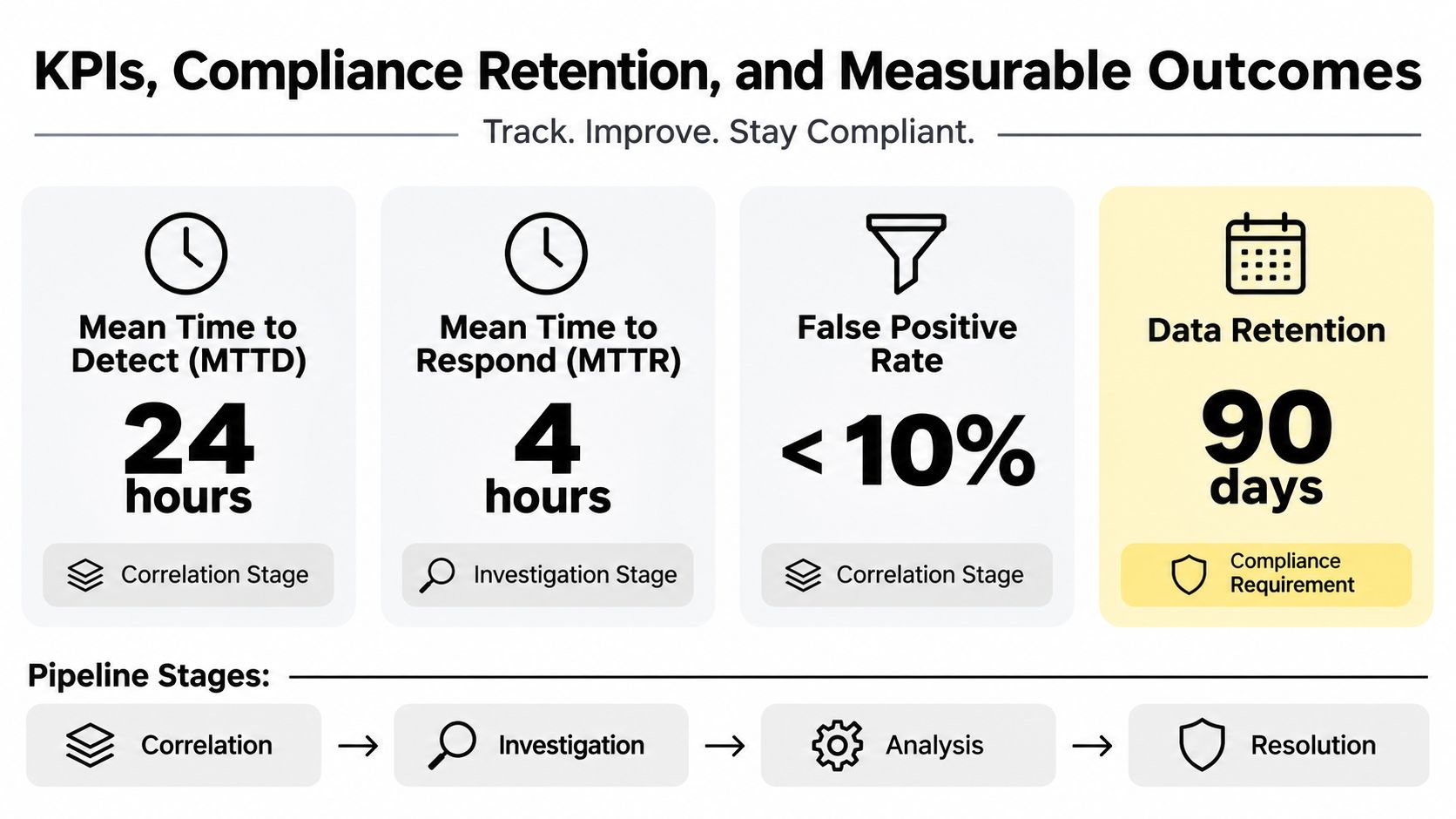
- Mean time to detect, or MTTD: The duration required for the organization to identify a confirmed security condition.
- Mean time to investigate, or MTTI: The time analysts require to determine scope, cause, and confidence.
- Mean time to respond, or MTTR: The duration needed to carry out the approved containment or remediation path.
- Alert fidelity ratio: The proportion of alerts that lead to a meaningful investigative result.
- False-positive rate: The share of alerts resolved as benign after review.
- Coverage gap percentage: The percentage of important assets, behaviors, or attack paths that lack validated detection.
- Ingestion freshness: The lag between when an event is created and when it becomes available for detection or search.
- Analyst handling time: The work needed for each alert, covering enrichment, investigation, documentation, and closure.
Retention is both a control and an investigation capability
PCI DSS v4.0 Requirement 10.7 requires at least 12 months of audit log retention, with three months immediately available for analysis, as described in this security log retention compliance reference. The practical consequence is clear: archived storage by itself will not work if analysts cannot search the window that is immediately available.
Canada's Government Security Control Profile for cloud-based government services requires events and logs to remain at least three months online and six months in storage, while security-incident-related events and logs must be retained for at least two years under its event-logging guidance.
Australian guidance notes that incident discovery can take up to 18 months and that some malware may dwell on a network for 70 to 200 days before overt harm as discussed in its event-logging and threat-detection guidance. These points justify a retention choice grounded in forensic requirements and relevant obligations, rather than just the cost of storage.
Measurement principle: Combine each speed metric with a quality metric. Quicker alert closure is not progress when analysts resolve uncertain cases or overlook relevant evidence.
Evidence for compliance ought to be drawn from the same operational records the SOC uses. Retention status, parser health, rule ownership, alert decisions, response approvals, and case timelines can serve both management review and audit readiness without creating a separate evidence workflow.
Runbooks, Tooling Evaluation, and Migration Considerations
A runbook must allow an L1 analyst to carry out initial response steps without uncertainty. It should include an exact trigger, necessary evidence, decision points, escalation ownership, containment directions, and rollback conditions.
In the case of an identity alert, the runbook may call for the user, source context, authentication result, device, location context, related endpoint activity, and recent privilege changes. It should specify when to disable an account, when approval is needed, and how to restore access if the activity is legitimate.
Build runbooks around decisions
Strong runbooks answer four questions:
- What triggered the case: Identify the detection logic, severity threshold, and exceptions.
- What evidence is required: State the fields, time range, related entities, and screenshots or exports when needed.
- Who owns the next decision: Name the analyst, incident commander, system owner, legal contact, or business approver.
- How containment is reversed: Record rollback, validation, and recovery steps before enabling automation.
Tuning needs a consistent schedule. Examine rules that generate recurring benign cases, review suppression exceptions, compare alert outcomes against the original logic, and document every change. A rule is not improved simply because it yields fewer alerts. The team must confirm that meaningful behaviors still produce usable incidents.
Evaluate the tooling behind the process
A procurement or architecture review should examine:
- Ingestion breadth, encompassing agents, syslog, APIs, cloud streams, and endpoint integrations.
- Correlation transparency, covering rule testing, event lineage, suppression, and version control.
- Query latency, particularly across the hot and warm investigation windows.
- Retention cost curves, encompassing archive retrieval and export costs.
- Role-based access control, evidence preservation, and administrative separation.
- Multi-tenant separation for MSP and MSSP functions.
- API maturity for handing off to SOAR, ticketing, enrichment, and response actions.
- Migration support, covering export formats, parser portability, and historical replay.
A platform such as Unified Security Stack brings together SIEM, SOAR, and XDR capabilities alongside centralized event collection, real-time correlation, alert handling, automated playbooks, and compliance workflows for frameworks such as CMMC, HIPAA, SOC 2, ISO 27001, PCI, GDPR, and GLBA. Its open-source model and integrations make it an option to consider when a team needs a unified security event management stack across hybrid environments.
Migrate without losing detection coverage
Operate the old and new pipelines side by side while checking source completeness, parser output, timestamps, enrichment, and alert routing. Where the platform allows it, replay historical data, then compare rule parity and examine differences instead of assuming equivalent names yield equivalent results.
Prior to cutover, confirm that tickets open correctly, response permissions function, dashboards show the required entities, and cold data stays retrievable. MSSP engagements require the same rigor, with clear agreements covering data residency, contractual SLAs, tenant separation, escalation, and shared responsibility.
The desired outcome is not merely a quieter dashboard. It is a SOC where analysts get fewer cases with better context, runbooks drive consistent actions, and leaders can show how telemetry supports detection, response, and compliance.
Unified Security Stack lets security teams merge collection, correlation, alert triage, automated response, and compliance evidence into a single operational workflow spanning hybrid environments. Examine the platform's capabilities and determine whether Unified Security Stack aligns with your SOC architecture, retention model, and runbook strategy.