Your Audit-Ready PCI DSS Compliance Checklist for 2026
Investigations reviewed by the PCI Security Standards Council showed that breaches within PCI scope frequently involved card data. Teams already recognize the risk. The challenge is proving, month after month, that controls around that data remained in place and kept working.
This explains why many PCI DSS audits get stuck at the same points: evidence spread across sources, scope changes left undocumented, firewall rules that shifted after a change window, and logs that are present but never centralized. When the assessor requests proof, the security team ends up gathering tickets, exports, screenshots, scan results, and archived logs rather than delivering a clean record from a single system.
A practical PCI DSS compliance checklist must do more than restate the twelve requirements. It should explain how to gather evidence, how to track control drift, and how to prove to an auditor that a control operated continuously. PCI DSS 4.0 sets a higher standard. A one-time screenshot is weaker evidence than a system that records changes, alerts on exceptions, and preserves the audit trail.
This checklist follows that model. Every requirement is matched with a SIEM/XDR workflow that makes a manual control observable: firewall changes forwarded to a central console, default-account detections linked to asset inventory, access events correlated with identity data, and malware or vulnerability findings kept as audit evidence. With a platform like Unified Security Stack, teams can bring together log collection, alerting, case management, and network device monitoring for firewall and infrastructure visibility rather than treating PCI as an annual scramble for documentation.
That model shifts the trade-off. Policy, ownership, and technical controls are still necessary, but you devote less time to gathering evidence manually and more time correcting gaps while they remain small. For security teams operating hybrid, SaaS-heavy, or rapidly changing environments, that distinction often determines whether PCI becomes a repeatable process or an annual scramble.
If your environment is subscription-heavy or cloud-native, this guide to PCI for SaaS businesses provides helpful background on the areas where scope and shared responsibility often become unclear.
Table of Contents
- 1. Requirement 1 Deploy and Maintain Firewall Configuration
- 2. Requirement 2 Avoid Vendor-Supplied Defaults for System Passwords
- 3. Requirement 3 Safeguard Stored Cardholder Data
- 4. Requirement 4 Encrypt Cardholder Data While in Transit Over Public Networks
- 6. Requirement 6 Build and Maintain Secure Systems and Applications
- 6. Requirement 6 Build and Maintain Secure Systems and Applications
- 7. Requirement 7 Limit Access to Cardholder Data Based on Business Need-to-Know
- 8. Requirement 8 Verify User Identity and Authenticate Access to System Components
- 10. Requirement 10 and 11 Monitor and Track All Access to Network Resources and Cardholder Data, and Test Security Systems and Processes Regularly
- 10. Requirement 10 and 11 Monitor and Track All Access to Network Resources and Cardholder Data, and Test Security Systems and Processes Regularly
- PCI DSS 10-Requirement Comparison Matrix
- From Checklist to Continuous Compliance
1. Requirement 1 Deploy and Maintain Firewall Configuration
The first control remains one of the simplest to misread. Teams often hear firewall and assign the requirement to the network team. Assessors do not stop with the device configuration. They expect segmentation rationale, rule review, change history, and proof that traffic between the cardholder data environment and all other systems is explicitly governed.

In practice, firewalls from Palo Alto Networks, Fortinet, Check Point, and Cisco can all meet this area when the team enforces deny-by-default policy, documents permitted flows, and reviews changes consistently. The platform is rarely what fails most often. The usual causes are undocumented exceptions and stale rules left in place after a project ended.
Boundary control that auditors can actually verify
A solid operating model sends firewall logs, configuration-change events, and administrator actions to a SIEM, allowing you to prove both design and operation. With network device monitoring in Unified Security Stackteams can centralize events from firewalls, switches, and other network infrastructure, then correlate rule changes with change tickets and admin sessions rather than reviewing each source by hand.
Useful checks in this requirement include:
- Map the CDE boundary clearly: Record the subnets, VLANs, cloud security groups, and VPN paths that fall within scope.
- Review exceptions aggressively: Temporary allowances turn into lasting risk when no one removes them on time.
- Log administrator activity: When rule changes lack a named owner, audit friction appears right away.
- Watch east-west traffic: Perimeter controls by themselves do not demonstrate segmentation.
Practical rule: Unless you can demonstrate who altered a firewall rule, the reason for the change, and which traffic later matched that rule, you are not ready for an audit.
Maintenance is the trade-off. Fine-grained segmentation lowers exposure, yet it raises rule counts and review effort. This stays manageable if the SIEM labels rule changes, surfaces unusual traffic routes, and retains evidence on an ongoing basis. Otherwise, firewall compliance turns into a screenshot drill, and screenshot-based compliance seldom withstands genuine examination.
2. Requirement 2 Avoid Vendor-Supplied Defaults for System Passwords
This requirement seems elementary because it is elementary. It is also among the controls that teams inadvertently break during rollouts, migrations, appliance replacements, and emergency rebuilds. Default accounts, preset SNMP strings, factory web interfaces, and inherited service credentials continue to appear in environments that otherwise appear mature.
Here, process matters more than tool selection. Microsoft Intune, Jamf, Red Hat Satellite, Ansible, Puppet, and Chef all assist in standardizing secure baselines. Vulnerability scanners like Tenable, Rapid7, and Greenbone help identify weak configurations after deployment. The gap typically lies between build standards and production drift.
Defaults come back during change windows
The most secure approach is to view secure configuration as a repeatable baseline rather than a one-time hardening effort. Build images should remove or disable default accounts prior to production. After deployment, checks should confirm that unnecessary services remain disabled, web admin consoles are not exposed, and local admin credentials have not drifted from policy.
What works well:
- Standard images and templates: Hardening efforts should be designed for consistent reuse.
- Configuration drift monitoring: Detect defaults that reappear after patching or appliance replacement.
- Asset inventory tied to ownership: Each device class, payment appliances included, needs a designated owner.
- Exception logging: Older systems that offer few password options require compensating controls and documented treatment.
Relying only on policy does not work. When the deployment pipeline does not enforce the baseline, staff facing delivery pressure will take shortcuts.
One practical audit consideration: do not merely prove that defaults were changed. Prove that you can detect when defaults come back. This matters especially in PCI DSS 4.0 environments, where continuous validation counts for more than annual declarations. If your PCI DSS compliance checklist still handles Requirement 2 as a commissioning activity, it lags reality.
3. Requirement 3 Safeguard Stored Cardholder Data
For Requirement 3, strong architecture saves more work than strong documentation. When teams can cut stored cardholder data via tokenization, truncation, or improved payment flow design, every downstream control gets easier. If they retain more than necessary, encryption by itself will not save the audit.

The operational difficulty is not just selecting cryptography. It is finding where data has landed: databases, exports, backups, object storage, email attachments, support tools, and legacy reporting jobs. Teams that omit discovery frequently encrypt the primary datastore yet leave secondary copies exposed.
Reduce what you store before you encrypt what remains
Encryption platforms like HashiCorp Vault, cloud KMS services, Thales, and payment tokenization providers can help. Yet the most valuable question is simpler: why does this system retain cardholder data at all?
One industry guide notes that PCI Council requirements are organized into 6 control categories, 12 steps, and more than 250 sub-requirements affecting 400+ security controls, and it also notes that merchants complete a Self-Assessment Questionnaire annually (PayJunction PCI DSS checklist guide). This is a useful reminder that stored-data protection is never only an encryption checkbox. It generates evidence duties across inventory, access control, key management, scanning, logging, and disposal.
For this requirement, the most effective evidence set usually includes:
- Data discovery results: Demonstrate where PAN-related data is present and where it is absent.
- Key access logs: Demonstrate who accessed key material or key management systems.
- Backup handling records: Encryption of primary storage offers no benefit when backups are unmanaged.
- Retention and deletion proof: Once the business need has ended, removal should follow, not archiving.
Retain less, segment more, and make key access visible. Together, these reduce both the impact of a breach and the scope of an audit.
Application complexity is the trade-off. Tokenization and field-level protection may complicate integrations, reporting, and troubleshooting. From an auditor's viewpoint, however, fewer locations storing sensitive data is nearly always the cleaner answer.
4. Requirement 4 Encrypt Cardholder Data While in Transit Over Public Networks
Teams typically satisfy this requirement at the browser edge and miss it in less obvious areas. Internal APIs over untrusted links, admin sessions to payment infrastructure, vendor tunnels, backup transfers, and message queues often receive less attention than the public payment page.
A solid tool stack for this includes certificate management, vulnerability scanning, reverse proxy controls, and SIEM visibility into failed handshakes, protocol mismatches, and deprecated ciphers. F5, NGINX, HAProxy, cloud load balancers, Venafi, and native cloud certificate managers can all fit, based on architecture.
Certificate hygiene is part of compliance hygiene
Robust transport encryption depends on disciplined certificate tracking and renewal. Teams need visibility into certificate age, issuing authority, expiry, and consistent deployment across every in-scope endpoint, not just customer-facing ones. Administrative traffic also requires attention. SSH, HTTPS admin consoles, API gateways, and remote support paths warrant identical review.
A few practical review points make this requirement easier to sustain:
- Find unmanaged certificates: Legacy internal services often become blind spots.
- Disable weak protocols consistently: A single overlooked endpoint can quickly raise audit questions.
- Log TLS failures centrally: A pattern of repeated failures may point to a configuration error or active probing.
- Validate after changes: Freshly deployed proxies and service meshes frequently create unintended downgrade routes.
Compatibility is the trade-off. Older clients and inherited business applications can push teams to retain weaker settings past the appropriate point. In those cases, record the exception, contain it, and define a path to remove it. Do not act as if the risk vanished just because a compensating story is available.
6. Requirement 6 Build and Maintain Secure Systems and Applications
Requirement 6 typically reveals whether security evidence connects to the software delivery process or sits in disconnected tools. A team might perform SAST, DAST, dependency scanning, patching, and change control, but still struggle during an audit when it cannot demonstrate one clear path from finding to fix to production validation.
PCI DSS v4.0 increases pressure on that chain. Custom code, third-party libraries, emergency patches, and approved exceptions all require records that withstand review. Auditors will raise practical questions. What was discovered, who authorized the change, when did it go live, and how can you prove production now aligns with the approved state?
GitHub Advanced Security, GitLab, Snyk, SonarQube, Burp Suite, Nessus, Qualys, Wazuh, and ordinary patch systems can each help satisfy this requirement. Correlation is the difficult part.
Build an auditable trail from code finding to production state
A workable process links four evidence types:
- Development findings: Results from SAST, DAST, and software composition analysis connected to a repository, branch, and commit.
- Change approval: A Jira or ServiceNow ticket, or another record, that documents review, risk acceptance, and deployment approval.
- Deployment evidence: CI/CD logs, package versions, container image digests, or patch job outputs that identify what changed.
- Runtime validation: File integrity monitoring, EDR, vulnerability rescans, and application logs originating from the production asset.
That connection is where a SIEM or XDR platform moves beyond a log store and begins to assist with Requirement 6. For instance, Unified Security Stack can take a Snyk alert for a vulnerable library, retrieve the associated GitHub commit hash from the CI pipeline, connect it to a Jira change ticket, and then link that ticket to a file integrity monitoring event on the production server showing the updated package or application file was deployed. Rather than four screenshots from four teams, you get a single timeline.
This counts during remediation as well as audit preparation. Security can confirm that a critical dependency issue was resolved within policy. Engineering can demonstrate that the deployed artifact aligns with the approved change. Audit staff can follow the record without pursuing people through Slack and email.
Requirement 6 controls work better when evidence is continuous
For most organizations, the recurring review points are predictable:
- Patch high-risk systems on a defined timeline: Stricter timeframes are required for internet-facing assets and CDE-connected servers.
- Scan code and dependencies before release: Prevent builds with critical findings from moving forward, or approve them through a formal process.
- Review custom code changes: Peer review and secure coding checks must be recorded, not presumed.
- Validate production after deployment: Verify that the version, package, or container deployed is the one that was approved.
- Track exceptions and compensating controls: Constraints in legacy applications require assigned owners, review dates, and a plan for removal.
Speed is the trade-off. Emergency fixes, fragile payment applications, and inherited codebases frequently make teams choose between making an immediate change and following full process discipline. PCI does not prohibit emergency action, yet it does require proof that the action was authorized, tested to the extent feasible, and reviewed afterward. If that proof relies on manual collection, the process will fail under pressure.
A SIEM/XDR workflow lowers that risk. Configure correlation rules to trigger alerts when a production file changes without a corresponding approved ticket, when a critical CVE stays open beyond the patch SLA, or when a deployment happens but the next scan never shows the expected vulnerability closure. These are specific Requirement 6 checks, and they generate evidence as the work occurs rather than a week before the assessor shows up.
Teams that manage Requirement 6 effectively treat secure development and secure operations as a single control set. The checklist item is not simply running scans. The checklist item is demonstrating that findings, fixes, approvals, deployments, and runtime state all align.
6. Requirement 6 Build and Maintain Secure Systems and Applications
Requirement 6 is the point where compliance and engineering discipline either strengthen one another or come into conflict. When development, infrastructure, and security teams already handle code review, vulnerability management, patch governance, and change control jointly, this area stays manageable. When those processes are distributed across teams with distinct tools and no common evidence model, audits become chaotic quickly.
SAST, DAST, software composition analysis, patch management, and file integrity monitoring all contribute in this area. GitHub Advanced Security, GitLab, Snyk, SonarQube, Burp Suite, Nessus, Qualys, and Wazuh are frequently used components. None removes the requirement to connect findings with remediation and production state.
Tie development evidence to operational telemetry
A major shift under PCI DSS v4.0 is the emphasis on continuous monitoring and targeted risk analysis for customized approaches, which reflects the move from periodic compliance toward continuous assurance (Scale Computing overview of PCI compliance requirements). This is most important in Requirement 6, since custom applications and local exceptions produce precisely the type of risk decisions that must be documented and defended.
The strongest approach is to connect these signals:
- Code and dependency findings: What was discovered prior to release.
- Change records: What entered production, and at what point.
- Runtime alerts: Whether the modified system subsequently exhibited suspicious behavior.
- File integrity events: Whether critical files were altered outside approved deployment paths.
A secure SDLC is useful, yet audit-ready evidence results from demonstrating that secure development controls remained connected to production reality.
What does not work is generating separate exports from development tools and expecting the assessor to connect them in their own mind. Central correlation is much more convincing. When a patch was delayed, present the risk decision, compensating monitoring, and follow-up validation as one traceable chain.
7. Requirement 7 Limit Access to Cardholder Data Based on Business Need-to-Know
Least privilege appears simple until actual group memberships are reviewed. Access often builds up around projects, support emergencies, contractor onboarding, and inherited roles. Months afterward, individuals still retain permissions that no one can justify.
Identity governance tools such as Microsoft Entra ID, Okta, SailPoint, and CyberArk can make this more orderly. Yet even in environments with strong tooling, auditors commonly identify the same weak areas: shared administrative pathways, broad support roles, and inconsistent review of privileged access to databases, payment gateways, and jump hosts.
Least privilege fails quietly unless you review it
This requirement gains from role design that reflects real work rather than organizational charts. Finance support, payment operations, developers, DBAs, and incident responders frequently require different portions of access, and combining them creates preventable scope and evidence issues.
A practical review model looks like this:
- Define access by task, not by team name: “Can troubleshoot payment failures” is more useful than “belongs to IT operations.”
- Use time-bound elevation where possible: Standing privilege is seldom required.
- Review access after role changes: Internal transfers often present more risk than new hires.
- Correlate access with activity: Inactive privileged accounts remain a persistent audit issue.
A further issue that is often overlooked is continuous scope validation. Checklist material often covers initial scoping, segmentation, inventory, and quarterly scans, but it seldom explains how to prove scope stayed accurate after cloud changes and new connections. That gap matters particularly in hybrid environments where scope drift may remain undetected (XMCyber discussion of continuous PCI scope drift).
For Requirement 7, this means access reviews must cover newly connected systems and services, not only the original in-scope list.
8. Requirement 8 Verify User Identity and Authenticate Access to System Components
Requirement 8 often becomes the point at which auditors determine whether identity controls actually operate or merely appear to exist. Unique IDs, MFA, session controls, and authentication logging are all expected. The central question is whether you can reconstruct who accessed what, through which path, and with what level of assurance.
SSO platforms and MFA providers assist, but they do not complete the work on their own. Okta, Duo, Microsoft Entra ID, Ping Identity, and CyberArk all enable strong authentication. The audit burden remains: proving unique identification, tracking administrative actions, removing stale accounts, and demonstrating that authentication events are retained and reviewable.
Identity evidence has to survive the audit
A sound practice is to consolidate directory changes, failed login bursts, privilege elevation, remote admin events, and service-account usage into one review workflow. This provides the assessor with a consistent chain from identity to action. Teams that use Unified Security Stack Access Rights Auditor can bring access-rights review data into the same compliance process that contains broader monitoring evidence, reducing the usual rush between IAM and security operations.
One topic that is often under-explained is cost and control selection. Public guidance generally lists the 12 requirements clearly, but many teams still struggle to prioritize controls without over-engineering them. Recent guidance stresses targeted risk analysis, continuous monitoring, and evidence readiness, yet it also leaves room for costly mistakes if you automate the wrong items first (Thoropass discussion of PCI checklist tradeoffs and operating model design).
The most useful priorities in this requirement are usually:
- Unique IDs everywhere: Shared accounts undermine attribution.
- MFA on administrative and remote paths: This generally lowers actual risk while also easing audit resistance.
- Rapid deprovisioning: Departed employees and inactive contractors remain frequent findings.
- Authentication log retention: An incomplete event trail weakens the control narrative.
10. Requirement 10 and 11 Monitor and Track All Access to Network Resources and Cardholder Data, and Test Security Systems and Processes Regularly
Many PCI findings still stem from weak logging, incomplete review processes, and testing performed only just before the audit. Requirement 10 and 11 require a different operating model. Teams must capture evidence continuously, detect suspicious activity promptly, and prove that controls were tested on schedule.
For PCI, this requires audit trails that link a user, system, or service account to a given action. It also calls for required security tests at a set frequency and preservation of the records they generate. When logs are present but can't be searched, correlated, or delivered with context, the control offers less assurance than it appears to.
A mature SIEM forms the center of the operating model for these requirements. It gathers logs from firewalls, servers, endpoints, cloud platforms, databases, identity providers, and payment applications, and keeps them in one place for review and retention. When used effectively, it eases a common audit challenge: evidence scattered across too many consoles, owners, and manual tasks.
The practical objective is not simply ingestion. The practical objective is traceability.
Under Requirement 10, gather and examine events relevant to the cardholder data environment: authentication activity, privilege changes, policy changes, administrative actions, access to sensitive data, malware detections, and efforts to tamper with logs. A platform with centralized log management for PCI evidence and investigations assists security teams in keeping those records searchable and consistent with retention expectations without creating a separate process for each system.
Under Requirement 11, testing activities must feed into a unified evidence trail. Rather than siloing internal and external scans, file integrity monitoring, wireless assessments, and penetration tests in separate folders reserved for audit week, all these outputs should integrate into the standard monitoring workflow alongside production alerts. This approach enables teams to prove not just that testing happened, but that the results were properly reviewed and remediated. For practical advice on scheduling and documenting scan activities, refer to vulnerability scans for PCI DSS.
One trade-off appears fast. If you alert on every authentication event and every port change, analysts spend time on noise and stop reviewing what matters. If you filter too aggressively, you miss the very records an assessor will request after an incident or failed control. A better approach is to tune for high-value events in the cardholder data environment first, then broaden coverage once retention, ownership, and review discipline are stable.
Business Research Insights projects growth in the PCI compliance software market, which aligns with what many audit teams already observe in practice: organizations are moving from spreadsheet-based evidence collection to tools that enable continuous monitoring and audit readiness. Spending alone does not solve the problem. Control mapping, alert tuning, and evidence retention still require deliberate design.
A workable checklist for these two requirements looks like this:
- Send all in-scope security logs to a central platform: Cover network devices, servers, endpoints, IAM, databases, and payment applications.
- Verify time synchronization: Log timelines quickly become unreliable when systems drift.
- Retain logs according to PCI expectations: Make recent data easy to access for review while keeping older data available for investigation and audit support.
- Define daily or scheduled review responsibilities: An assessor will ask who reviews alerts, what those reviews examine, and how exceptions are managed.
- Automate correlation for high-risk events: Review should be triggered by privilege escalation, disabled logging, repeated failed access, suspicious remote administration, and changes to critical files.
- Track testing artifacts in the same evidence process: Vulnerability scans, penetration tests, file integrity monitoring alerts, and remediation proof should be retrievable without difficulty.
- Document response and closure: When detection lacks investigation records, it adds avoidable friction during audits.
This is often where teams struggle because Requirement 10 and 11 expose operational gaps that other controls may conceal. Logging must be complete. Testing must occur on schedule. Evidence must be organized before the QSA requests it. A process driven by SIEM/XDR transforms that from a recurring scramble into a repeatable control.
10. Requirement 10 and 11 Monitor and Track All Access to Network Resources and Cardholder Data, and Test Security Systems and Processes Regularly
These two requirements often determine whether most PCI programs mature or stall. Logging, alerting, scans, penetration testing, file integrity monitoring, and evidence retention are not isolated side duties. They form the system that demonstrates every other control functioned.
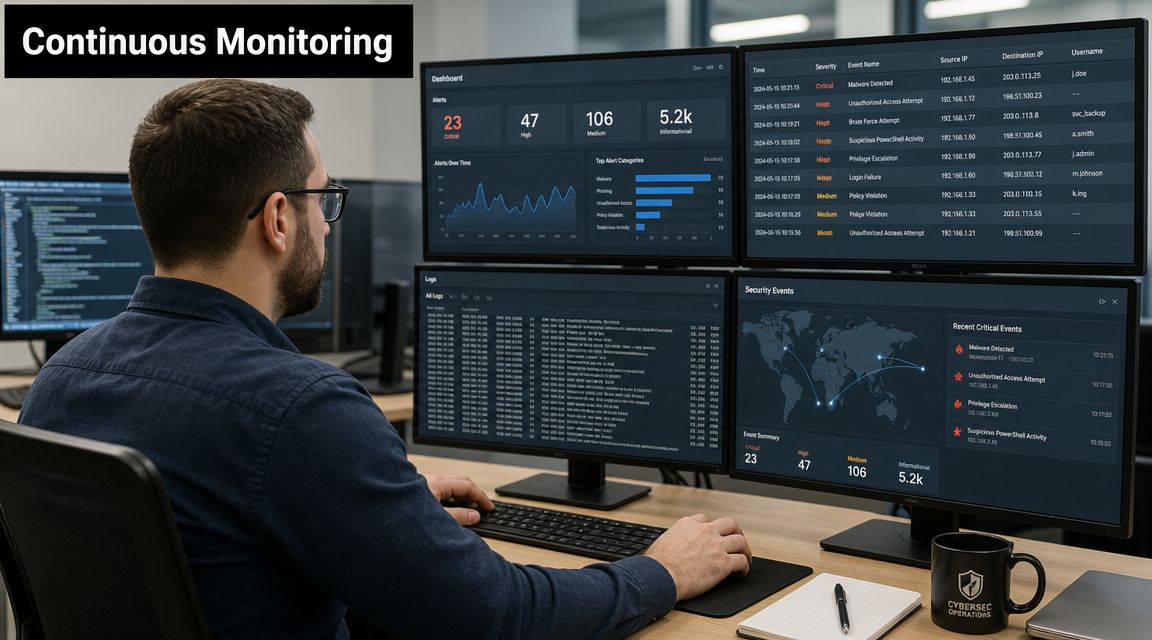
PCI guidance becomes very detailed at this point. It requires quarterly external and internal vulnerability scans, annual penetration testing, and retention of at least one year of logs, with the most recent three months readily accessible for review (PCI SSC quick guide timing requirements). Those deadlines transform a generic security stack into a genuine compliance operating model.
This is where SIEM earns its budget
A robust SIEM or SIEM/XDR solution consolidates logs from firewalls, endpoints, cloud environments, databases, identity services, and payment systems. It preserves forensic evidence, supports alert triage, and enables teams to demonstrate that suspicious access, configuration modifications, malware incidents, and test findings were reviewed within their proper context. This represents the tangible benefit of a platform such as Unified Security Stack, especially when paired with centralized log management for audit evidence and retention.
Tooling demand is one of the strongest market signals behind this shift. An independent market report forecasts the global PCI compliance software market to reach USD 1.79 billion in 2026 and USD 3.81 billion by 2035, representing a 9.2% CAGR (Business Research Insights PCI compliance software market projection). The reason is clear in practice. Manual evidence collection cannot keep pace when logs, assets, users, and cloud services are constantly changing.
Use these controls as the daily engine of the PCI DSS compliance checklist:
- Aggregate logs centrally: Collect data from endpoints, firewalls, cloud environments, databases, IAM, and payment systems.
- Protect log integrity: Limit deletion and changes that are not authorized.
- Review alerts in context: Correlate identity, endpoint, and network activity prior to escalation.
- Track scan cadence: Missing quarterly scans are straightforward findings that should not occur.
- Tie pen tests to remediation: A report lacking closure evidence is only half a control.
- Run file integrity monitoring on critical systems: Particularly in locations hosting payment applications or sensitive configurations.
When Requirement 10 and 11 are weak, demonstrating every other requirement grows more difficult, even if the control itself is present.
For teams that need to strengthen the testing side, this overview of vulnerability scans for PCI DSS acts as a valuable complement to the logging strategy.
PCI DSS 10-Requirement Comparison Matrix
| Requirement | 🔄 Implementation complexity | ⚡ Resource requirements | 📊 Expected outcomes | 💡 Ideal use cases | ⭐ Key advantages |
|---|---|---|---|---|---|
| Requirement 1: Install and Maintain Firewall Configuration | Medium-High, complex rule sets & segmentation | Medium, firewalls, monitoring staff | ⭐⭐⭐⭐, strong network isolation; audit trails | Segmentation of CDE, multi-datacenter networks | Prevents unauthorized access; reduces attack surface |
| Requirement 2: Do Not Use Vendor-Supplied Defaults for System Passwords | Low, procedural change across assets | Low, inventory & enforcement tools | ⭐⭐⭐, eliminates common default-credential risks | New system deployments, device provisioning | Removes low-hanging fruit; simplifies audits |
| Requirement 3: Protect Stored Cardholder Data | High, encryption/tokenization design & key mgmt | High, crypto, key management, storage changes | ⭐⭐⭐⭐, data rendered unusable if stolen | Databases, backups, removable media | Minimizes breach impact; defense-in-depth for data |
| Requirement 4: Encrypt Cardholder Data in Transit Across Public Networks | Medium, TLS configuration and cert mgmt | Medium, certs, scanning, monitoring | ⭐⭐⭐⭐, prevents MITM and protects integrity | Web apps, APIs, payment endpoints | Protects data in transit; builds customer trust |
| Requirement 5: Protect Systems Against Malware | Medium, endpoint coverage and EDR tuning | Medium-High, EDR/AV agents, SOC integration | ⭐⭐⭐⭐, faster detection; reduced dwell time | Workstations, servers, remote devices | Reduces malware-driven breaches; enables automated response |
| Requirement 6: Develop and Maintain Secure Systems and Applications | High, SDLC changes, testing, training | High, SAST/DAST, patch mgmt, developer resources | ⭐⭐⭐⭐, fewer vulnerabilities in production | CI/CD pipelines, in-house applications | Prevents app-layer flaws; speeds patching & remediation |
| Requirement 7: Restrict Access to Cardholder Data by Business Need-to-Know | Medium-High, RBAC design & reviews | Medium, IAM tooling, periodic reviews | ⭐⭐⭐⭐, limits exposure from compromised accounts | Role-driven organizations, large user bases | Enforces least privilege; simplifies audits |
| Requirement 8: Identify Users and Authenticate Access to System Components | Medium, unique IDs, MFA deployment | Medium, identity systems, MFA, logging | ⭐⭐⭐⭐, strong authentication; auditability | Administrative access, SSO/MFA rollouts | Reduces account compromise; enables traceability |
| Requirement 9: Restrict Physical Access to Cardholder Data | Medium, physical controls & visitor processes | Medium-High, badges, CCTV, secure storage | ⭐⭐⭐, prevents device/media theft; supports forensics | Data centers, on-prem storage of media | Blocks physical theft; provides evidentiary logs |
| Requirement 10 & 11: Track/Monitor Access & Regularly Test Systems | Very High, centralized logging, testing program | Very High, SIEM/SOAR, storage, scanners, staff | ⭐⭐⭐⭐⭐, comprehensive visibility; rapid detection | Regulated environments, continuous monitoring programs | Full audit trail; automates detection, scanning, reporting |
From Checklist to Continuous Compliance
PCI DSS programs seldom fail because teams lack a checklist. They fail because proof is spread across firewalls, identity systems, endpoints, ticketing tools, scanners, and spreadsheets. When the assessor requests evidence, the team is piecing together history rather than presenting a functioning control set.
An effective PCI DSS compliance checklist functions best as an ongoing control program linked to the entire cardholder data environment and the everyday systems that create evidence. That shifts the work. Quarterly scans, annual penetration tests, access reviews, log retention, malware response, and change validation cease to be standalone audit tasks and turn into routine security operations.
The practical benefit of a SIEM/XDR-centered approach is straightforward. The same telemetry that detects attacks can also demonstrate that controls stayed in effect. Firewall rule changes, privileged access events, failed log collection, endpoint detections, vulnerability findings, and configuration drift should appear in a single place, with timestamps, ownership, and retention matched to audit requirements.
Under PCI DSS 4.0, the more difficult question is no longer whether a control existed at a single point in time. The more difficult question is whether the team can demonstrate that the control remained effective through patch cycles, personnel changes, cloud migrations, emergency firewall updates, and application releases. Many teams can provide policies and screenshots. Fewer can show when logging stopped on a payment server, when an admin role grew beyond scope, or whether a segmentation change was reviewed and tested after implementation.
That is why mature PCI programs minimize manual collection wherever possible. Keep scope narrow. Store as little cardholder data as possible. Standardize how systems are built. Bring authentication, logging, and alerting under central management. Review privileged access on a risk-based cadence, not merely according to the audit calendar. Keep evidence inside the control itself, so the record is available before anyone requests it.
Automation delivers the greatest value where tasks are repetitive and easily overlooked. Examples include alerts for disabled log sources, correlation of malware events with in-scope assets, flags for unauthorized firewall changes, tracking of overdue remediation from vulnerability scans, and retention of access review records with clear approval history. These measures do not replace control owners or assessor judgment. They close blind spots and make exceptions simpler to investigate.
I apply a simple test with security teams. If an assessor asked tomorrow for proof of recent segmentation changes, privileged access reviews, anti-malware actions, quarterly scan results, retained security logs, and remediation from the last pen test, could the team deliver it in hours rather than days? If not, the checklist still leans too heavily on manual follow-up.
Payment data retains its value, so PCI work does not get easier by waiting for the audit window. Programs that withstand scrutiny tend to share the same characteristics. Clear scope. Consistent evidence. Automated monitoring. Fewer handoffs. That is how a checklist turns into a continuous compliance process.