What Is SIEM and How It Works: Complete Guide 2026
SIEM serves as a centralized platform that collects, normalizes, and correlates logs from across an environment in real time to identify threats and satisfy compliance requirements. Gartner's 2024 reprint documents the growth of the SIEM market from $5.03 billion in 2022 to $5.7 billion in 2023, a 13% annual growth rate Gartner's definition of SIEM.
You are probably facing the challenge that SIEM was designed to address. A VPN logs failed sign-ins, an identity provider captures an unusual authentication, an endpoint identifies a suspicious process, and a cloud platform records a privilege change. Every tool sees only one piece. Your security team must judge whether those pieces indicate normal activity or a single attack.
A SIEM unites those pieces. It gathers security events, converts differing formats into one common structure, searches and indexes the data, and runs detection logic across sources and time ranges. The technology is important, but the operational discipline around log quality, detection tuning, investigation, and response is equally important.
Table of Contents
- A SOC Day That Shows What SIEM Really Does
- The Core Pipeline of Collection, Normalization, and Correlation
- From Correlated Events to Detection Rules and Alerts
- How SOAR and XDR Turn Alerts Into Automated Response
- Deployment Models From Self-Hosted to Cloud and Open Source
- Compliance Mechanics for HIPAA, PCI DSS, CMMC, and More
- Why SIEM Is Not Set and Forget
- What to Look for in a Modern SIEM Platform
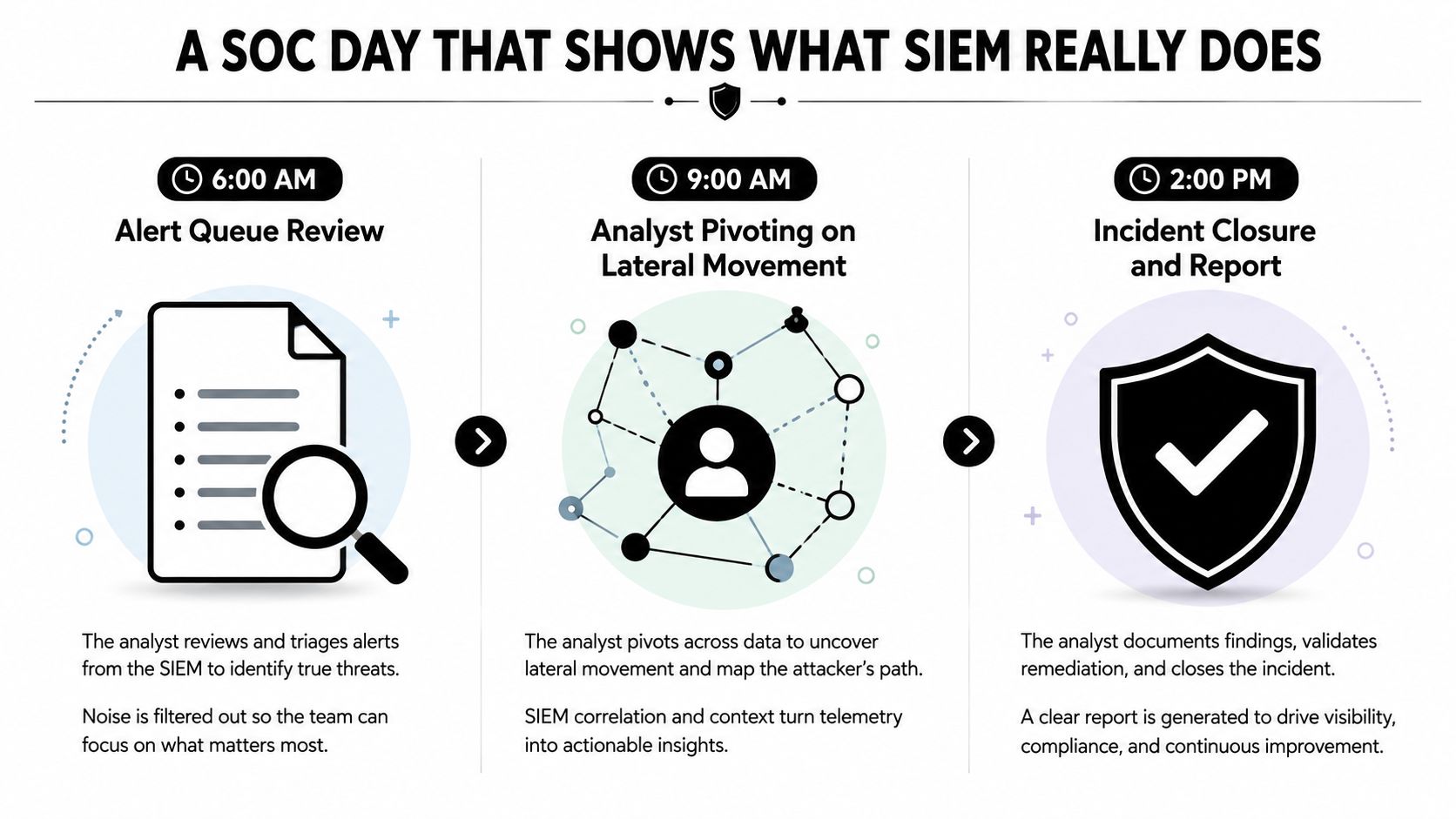
A SOC Day That Shows What SIEM Really Does
At 6:00 a.m., a SOC analyst opens the alert queue. A single alert flags repeated authentication failures against a VPN concentrator. Viewed alone, that event might signal a forgotten password, a misconfigured client, or an attacker probing credentials.
The analyst pivots within the SIEM and uncovers a related event. The same user account completed a successful administrator login from an unusual location soon after the failed attempts. The identity provider logged a successful MFA challenge, while another source showed a privileged role assignment. The analyst now has a linked investigation instead of several disconnected log entries.
The three questions behind the investigation
The analyst's workflow follows the same pipeline that explains what is SIEM and how it works:
- Collection: Did the platform ingest the VPN, identity, endpoint, and cloud events?
- Normalization: Can it consistently compare the username, source, timestamp, action, and outcome from each system?
- Correlation and detection: Do the combined events align with a rule or behavioral pattern that merits investigation?
At 9:00 a.m., the analyst widens the search to identify lateral movement. The SIEM links the suspicious account activity with endpoint and network telemetry, helping the analyst determine whether the account reached additional systems.
By 2:00 p.m.At that point, the analyst has either deemed the case authorized activity and closed it, or documented an incident timeline, affected assets, response actions, and retained evidence for later review. That same record can assist forensic investigations and compliance reporting, because a SIEM retains more than the alert. It also keeps the related activity.
Practical rule: A SIEM alert starts an investigation; it does not prove that an incident occurred.
This is why a modern SIEM should be treated as a living operating discipline, not a passive log collection device. Analysts keep connectors operational, check timestamps, adjust rules, examine false positives, and revise response playbooks. The platform provides the common evidence layer, yet people determine whether the signal indicates risk and what action follows.
The Core Pipeline of Collection, Normalization, and Correlation
A SIEM pipeline converts incompatible machine records into a security signal. The work begins before a detection rule executes, since poor collection or inconsistent data can undermine advanced correlation.
Collection brings the environment into view
A SIEM can ingest events from endpoints, identity providers, network devices, firewalls, cloud workloads, applications, and SaaS services. Typical transport mechanisms include agents deployed on systems, Syslog from network devices, and API connectors for cloud and SaaS platforms. The U.S. Department of Defense defines SIEM platforms as systems that gather, centralize, and analyze logs to enable cybersecurity monitoring and response (NIST Special Publication 800-92).
Imagine a VPN concentrator logs repeated failures. The identity provider logs an MFA event. A cloud platform logs a role assignment. An endpoint logs a new process. Collection decides whether the SIEM can view those events together or whether the investigation will have a blind spot.
Normalization translates vendor language
Every source follows its own event format and naming conventions. One product may label a field src, another might use source_address, while a third might store the value within a nested JSON object. Normalization parses those records and maps them to a common schema with uniform fields for the user, source IP, action, timestamp, asset, and outcome.
Keeping timestamps synchronized is just as important. If the VPN event seems to happen after the privilege change because systems rely on mismatched clocks, a rule might not detect the sequence. An effective pipeline thus parses events, standardizes fields, and aligns time before correlation.
For teams documenting any operational process, a visual tech recruiting workflow pipeline provides a helpful analogy. Just as a recruiting process guides records through consistent stages so teams can compare candidates, SIEM normalization places events into comparable fields so analysts can compare activity.
Indexing makes investigation practical
Once parsing and normalization are complete, the platform indexes event fields for search and investigation. Indexing lets an analyst query by account, asset, source, action, or time range rather than reviewing raw records individually. Storage design also separates frequently accessed data from longer-term evidence, based on the platform and compliance requirements.
Correlation then assesses how events relate to one another. NIST log-management guidance describes event correlation as identifying relationships between two or more log entries, and describes rule-based correlation as the most common way to match multiple logs into a security-relevant incident (NIST correlation guidance).
A rule could link multiple VPN failures, a successful MFA challenge, and a newly assigned privileged role inside a set time frame. The SIEM can then show that sequence as a single incident with supporting evidence, instead of making an analyst piece it together manually. The value lies in the relationship among events, not in log volume by itself.
From Correlated Events to Detection Rules and Alerts
Correlation proves valuable when a security team converts it into a detection hypothesis it can defend. A rule captures what the team considers suspicious activity and which evidence ought to prompt review.
A threshold rule could catch repeated authentication failures from a single source. A sequence rule might demand failures followed by a successful login and a privilege change. A behavioral rule could flag an account reaching systems beyond its usual pattern. Teams can also map detections to MITRE ATT&CK tactics, which helps show whether their content covers credential access, privilege escalation, lateral movement, or other parts of an attack path.
The engine usually performs several actions before an alert reaches an analyst:
- Matching: It assesses fields, sequences, thresholds, and time windows.
- Scoring: It sets severity based on the rule, the affected asset, identity, and possible impact.
- Deduplication: It consolidates repeated matches so a single ongoing activity does not generate a separate alert for each event.
- Enrichment: It incorporates asset ownership, identity context, endpoint details, and threat-intelligence data.
- Routing: It routes the alert to a queue, ticketing system, notification channel, or automated playbook.
Common SIEM Detection Rule Categories
| Rule Type | Example Logic | MITRE Tactic |
|---|---|---|
| Signature-based | Match a known malicious hash, domain, or event pattern | Command and Control |
| Threshold-based | Trigger after repeated authentication failures within a time window | Credential Access |
| Sequence-based | Detect failed logins followed by successful access and privilege change | Privilege Escalation |
| Behavioral | Flag access that differs sharply from a user or entity baseline | Discovery |
| Correlation-based | Join endpoint, identity, and network activity into one incident | Lateral Movement |
The operational difficulty lies in determining which matches merit human review. A 2025 security-operations survey found that over 70% of respondents struggle with alert fatigue and false positives, with many seeing more than 10,000 alerts per day (Department of Defense practitioner guidance). Those numbers point to an operational issue, not a justification for abandoning SIEM.
Analysts adjust thresholds, introduce suppression conditions, filter out known maintenance activity, and add business context to rules. They must also measure coverage. A 2025 industry analysis reported that organizations detected only 36% of relevant threats, while 28% of detection rules were broken or unused (industry analysis on detection coverage). More ingestion will not correct outdated logic. Detection engineering, rule validation, and routine review determine whether collected data turns into effective protection.
Teams building or auditing this layer can use a practical detection engineering resource for organizing how rules are developed, tested, and maintained.
How SOAR and XDR Turn Alerts Into Automated Response
A SIEM detects a suspicious pattern. SOAR, or security orchestration, automation, and response, decides what should occur next and coordinates the actions. It can open a ticket, enrich an indicator, query another security system, request approval, or run a playbook.
XDR, or extended detection and response, adds deeper telemetry and response capabilities across endpoints, networks, identity systems, and other connected controls. It can help the response workflow verify what occurred on a host and take containment actions that a log platform alone cannot carry out.
A ransomware-stage response
Suppose the SIEM identifies suspicious behavior tied to the early phase of a ransomware operation. A SOAR workflow can:
- Generate a high-severity incident from the matched events.
- Check endpoint telemetry for processes, users, and recent activity.
- Have threat-intelligence services enrich hashes, domains, or other indicators.
- Direct the EDR component to isolate the host.
- Collect any available forensic information, such as a memory snapshot.
- File a Jira ticket with the timeline and response actions attached.
- Route the matter to an analyst when the action impacts a critical system.
Decision boundaries remain with the analyst. Isolating a workstation through a playbook can be suitable when endpoint detection confidence is high. Applying that same action to a production server might call for approval, change coordination, or another containment measure.
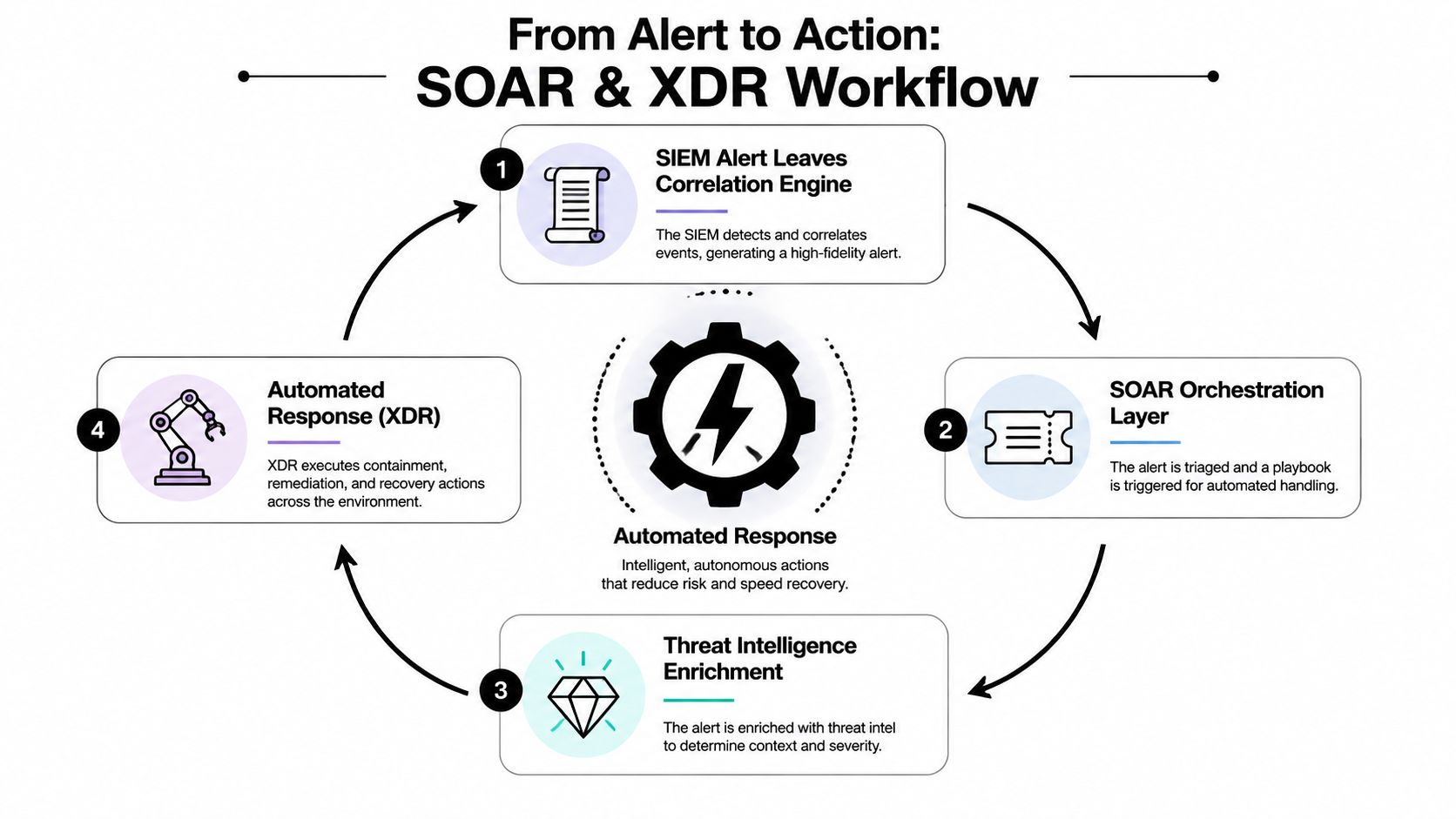
Shared context is the benefit of a unified stack. In the modular approach of Unified Security Stack, SIEM, SOAR, and XDR components can share data models and identity rather than move fragile payloads between unrelated products. What is relevant security orchestration tooling should still be assessed against your current endpoint, ticketing, identity, and approval workflows.
Automation ought to grow only when confidence rises. A quick response to an incorrect detection can cause an outage more quickly than a delayed response to a genuine threat.
Deployment Models From Self-Hosted to Cloud and Open Source
The choice of deployment model alters who controls the data, who bears the operational burden, and how predictable costs remain. No single architecture is universally correct.
| Dimension | Self-Hosted | Cloud-Native SaaS | Open-Source / Hybrid |
|---|---|---|---|
| Control | Strong control over infrastructure, storage, and data location | Provider manages the platform and infrastructure | Flexible control across customer-managed and hosted components |
| Cost model | Infrastructure and personnel costs are visible but ongoing | Consumption-based pricing can vary with ingestion | Licensing may be flexible, while infrastructure and expertise remain responsibilities |
| Time to detection | Often slower during capacity planning and integration | Usually faster to begin after connectors are available | Depends on deployment skills and integration readiness |
| Operational burden | Storage, upgrades, scaling, and availability require internal ownership | Provider handles much of the platform operation | Teams choose which layers to operate and which to manage externally |
| Data sovereignty | Often strongest for restricted or sensitive environments | Depends on provider architecture, contracts, and region | Can keep selected data on premises while sending other telemetry to a managed tier |
Self-hosted control
A standard self-hosted SIEM gives an organization direct control over retention, access, network placement, and storage. It can satisfy data-sovereignty requirements and fit constrained environments. The drawback is operational depth. Engineers must manage collectors, storage, indexing, upgrades, backups, capacity, and availability.
Cloud-native speed
A cloud-native SIEM cuts infrastructure effort and may ease onboarding in environments dominated by cloud services. Usage-based ingestion can be hard to predict when verbose sources, additional workloads, or longer retention raise data volume. Teams need filtering and retention policies before the bill surprises them.
Open-source and hybrid flexibility
Open-source and hybrid stacks can offer greater control over deployment decisions while letting teams choose which logs stay on premises and which go to a managed tier. Such flexibility does not eliminate the need for skilled operations, but it can bring architecture into line with regulatory limits and budget constraints.
For teams evaluating hosted deployment options, Unified Security Stack's SIEM cloud approach offers a benchmark for examining how cloud delivery, centralized detection, and hybrid telemetry could work together. The correct decision starts with where data resides, staffing, response expectations, and retention requirements, not merely with a feature checklist.
Compliance Mechanics for HIPAA, PCI DSS, CMMC, and More
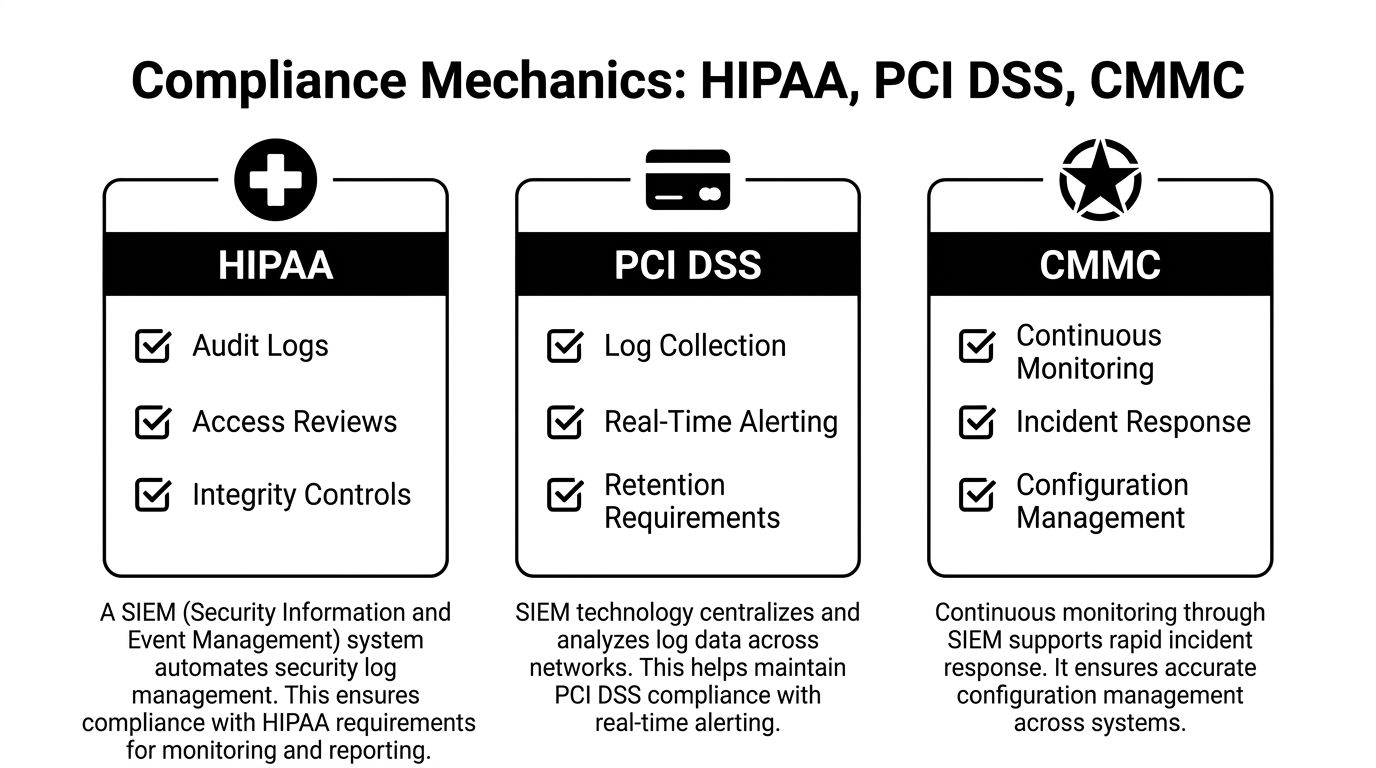
Reliable event records are the foundation of compliance evidence. A SIEM backs that evidence by gathering activity, retaining it, enabling searches, and demonstrating that someone reviews the pertinent events. It does not make an organization compliant on its own. Policies, access controls, incident procedures, and governance still decide whether the control works effectively.
HIPAA and healthcare access records
HIPAA audit controls require mechanisms that record and examine activity within systems that contain or use ePHI. HIPAA additionally mandates routine review of audit logs, access reports, and security incident tracking reports (HIPAA audit-log requirements). A SIEM can bring together access events, privileged-user activity, authentication records, and review workflows so investigators can determine who accessed a system, what action took place, and when it occurred.
PCI DSS retention and retrieval
PCI DSS v4.0.1 requires audit logs to be retained for at least 12 months, with the most recent three months immediately accessible for analysis (PCI DSS logging requirements). This requirement has a direct impact on SIEM architecture. Storage tiers, access permissions, search performance, integrity safeguards, and exportable reports all affect whether the organization can generate usable evidence during an assessment or investigation.
CMMC, GLBA, ISO 27001, and SOC 2
CMMC programs rely on auditable events, monitoring, and incident response evidence. A SIEM can help align collected events and investigations with the organization's control objectives, yet assessors will still check whether the process is documented and consistently followed.
GLBA mandates protections for customer information, including oversight of how that information is accessed. ISO 27001 programs often rely on event logging and protective monitoring to support information-security controls. SOC 2 assessments review whether organizations detect and respond to anomalies through operational controls.
A defensible compliance workflow should include:
- Defined scope: Determine which systems, accounts, applications, and data stores need monitoring.
- Retention policy: Align retention periods and accessibility with the obligations that apply.
- Integrity protection: Limit changes to retained evidence and document access to it.
- Review records: Retain proof that analysts or responsible personnel reviewed relevant activity.
- Report generation: Build dashboards and export options that link events with required controls.
- Response linkage: Illustrate how important findings progress through investigation, containment, and closure.
Reporting for compliance works best when it draws on the same operational data that supports detection and investigation.
Why SIEM Is Not Set and Forget
Even a running SIEM can gather logs continuously yet still fail to deliver reliable detection. It needs a steady operational cadence that keeps data sources healthy, rules current, and analysts ready to act.
The first variable is tuning cadence. Analysts examine false positives, tune thresholds, create exclusions for sanctioned activity, and remove rules that no longer match the environment. A detection that was appropriate before a network redesign can turn noisy later. A new identity provider or cloud workload may likewise call for new parsers and use cases.
The second variable is analyst capacity. Alert queues require clear ownership, escalation routes, investigation standards, and runbooks. The Department of Defense practitioner guidance directly notes that SIEM and SOAR platforms are not set-and-forget tools and need continuing skilled human effort (practitioner guidance on SIEM and SOAR operations).
Data quality controls the ceiling
Effective correlation relies on reliable inputs. Frequent causes of failure are:
- Unparsed application logs: Critical fields stay locked inside vendor-specific text.
- Clock differences: Events show up out of sequence.
- Incomplete agent deployment: Certain endpoints do not report activity at all.
- Broken connectors: A source ceases sending data.
- Stale detection logic: Rules no longer align with current attack paths.
- Missing business context: The SIEM lacks awareness of which assets or accounts are critical.
This yields a straightforward operating principle. Vendor choice matters, yet rule maintenance, source validation, runbook updates, and regular performance review determine whether the platform delivers useful results. A SIEM needs owners, service-level expectations for data sources, change-management processes, and regular reviews of detection coverage.
What to Look for in a Modern SIEM Platform
Assess a SIEM as an operating system for security work, not merely a dashboard with ample storage. Begin with the sources your environment relies on, such as identity platforms, endpoints, network devices, cloud services, SaaS applications, and custom applications.
Five decision axes deserve close attention:
- Ingestion breadth: Review native connectors, agent behavior, Syslog and API support, and ways to extend parsers.
- Detection flexibility: Evaluate rule languages, sequence logic, behavioral analytics, threat-intelligence integration, and mapping to MITRE ATT&CK.
- Storage economics: Learn about hot, warm, and cold retention choices, searchability, access controls, and compliance retrieval windows.
- Automation interfaces: Confirm built-in SOAR playbooks, ticketing integrations, approval gates, and XDR response actions.
- Operating cost: Weigh infrastructure, ingestion, retention, staffing, upgrades, and support across self-hosted, SaaS, open-source, and hybrid approaches.
Have vendors show how quickly they reach a first useful detection after onboarding, describe how they validate detection content, and demonstrate how analysts investigate a correlated incident. Ask as well how the platform tracks false positives and broken rules. AI-assisted triage, open-source stacks like Unified Security Stack, and unified SIEM, XDR, and SOAR platforms may alter how teams balance analyst workload and detection coverage over the next 24 months, but the core questions will remain: Can the platform gather the right evidence, generate trustworthy signals, and help people take action?
Unified Security Stack provides an open-source SIEM, SOAR, and XDR platform that brings together log management, real-time correlation, automated response, vulnerability scanning, access-rights auditing, endpoint protection, and compliance workflows. Visit Unified Security Stack to assess how a unified stack could assist your hybrid environment, detection engineering, incident response, and evidence requirements for HIPAA, GLBA, CMMC, PCI, ISO 27001, or SOC 2.