Multi-tenant Cloud Architecture
Today organizations have been able to recognize over the years the benefits of implementing a Cloud-based SIEM Service when it comes to scalability, cost, and security. Still, before you run workloads in the cloud, you need to understand which architecture to adopt in order to safeguard your business and your customers’ data. With the goal of helping you implement a cost-effective SaaS SIEM Service, we share the advantages of multi-tenant over a single-tenant cloud architecture.
What Does Single-tenant and Multi-tenant Cloud Architecture Mean?
A single-tenant a cloud computing setup is reserved for one particular customer (company). That means every single-tenant architecture includes its own separate database and software instance for each customer. In short, with a single-tenant model, the underlying infrastructure supports just one customer, and no resources are shared.
A multi-tenant an architecture where one software instance, one database, and the supporting infrastructure are shared among several customers (companies). Even so, the data of each customer remains isolated and cannot be seen by other tenants.
Multi-tenant and Single-tenant Cloud SIEM Architecture Compared
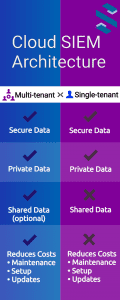
Single-tenant environments are built for organizations that want their data kept secure and private. This model tends to be favored by startups and smaller businesses, since they do not have to share their data with other companies. Still, it is an option that means paying considerably more money.
Conversely, when companies share one environment in a multi-tenant architecture, SaaS SIEM vendors are able to realize savings and pass them along to the platform cost. If your organization shares a multi-tenant-hosted solution, you can cut the expense tied to setup, maintenance, and updates. There is no need to pay expensive maintenance fees to keep your SIEM platform current. Keep in mind that vendors release new features and updates all the time. So, by subscribing to a SaaS SIEM, you can bring down your cybersecurity budget cost.
Many believe that using a multi-tenant cloud architecture (alongside companies not associated with yours) can weaken security control. Yet, Unified Security Stack adopts the following good cybersecurity practices to protect your environment within multi-tenant architecture:
- Hosting companies on one server held on secure hardware managed by a limited number of people.
- Isolating the data of each company and keeping it invisible to other tenants.
- Allowing secure connections through separate private ports so that each company can access the platform.
Unified Security Stack’s SaaS Multi-tenant
Unified Security Stack uses a SaaS multi-tenant architecture to safeguard the infrastructure of multiple companies from one Federation Server. That way, its IT team can manage and monitor your network through an affordable package that strengthens your security and brings down cybersecurity costs.
The platform connects with the most popular cloud providers (Azure, Google Cloud, and AWS) as well as other applications by way of APIs. Also, it includes all essential cybersecurity solutions such as:
- Tailored Reporting, Visualizations, and Dashboards.
- Threat Management.
- Incident Response.
- Log Analyzer.
- Compliance.
- Assets Management.
- Vulnerability Scanning Tools.
- Identity Management.
- File Classification.
Feel free to request a free demo to see how we help you secure your infrastructure and lower costs with a multi-tenant architecture.