GLBA Security Requirements: A 2026 Compliance Guide
The most popular advice about GLBA security requirements is also the least valuable: reviewing the policy each year, gathering signatures, and storing the evidence in an audit folder. That method might demonstrate that someone signed off on a program. It does not demonstrate that multifactor authentication safeguards every applicable system, that logs record unauthorized access, or that the incident response team can recognize a reportable event fast enough to respond.
The revised Safeguards Rule altered the operating benchmark. Financial institutions must now have a written information security program backed by risk assessments, technical safeguards, testing, monitoring, governance, and response procedures. For a security architect, the practical question is no longer whether a policy exists. It is whether reliable telemetry can be generated to show that the control functioned, detected the correct activity, and resulted in corrective action.
Table of Contents
- Why GLBA Compliance Is No Longer a Paperwork Exercise
- Understanding the GLBA Safeguards Rule Framework
- Required Information Security Program Elements
- Mapping Technical Controls to Audit Evidence
- Common Compliance Gaps and How to Remediate Them
- Building Your GLBA Implementation Checklist
- Achieving Continuous Compliance Through Automated Monitoring
Why GLBA Compliance Is No Longer a Paperwork Exercise
The original Safeguards Rule established a significant baseline. It was initially issued in 2002 and became effective on May 23, 2003, mandating that covered financial institutions keep administrative, technical, and physical safeguards via a written information security program. The FTC continues to describe the rule as requiring covered companies to develop, implement, and maintain a program intended to protect customer information. (FTC Safeguards Rule)
That baseline was intentionally flexible. It called for an institution to create a program tailored to its environment, yet the current rule introduces much greater operational detail. The FTC completed its major update in 2021, the amendment became effective on January 10, 2022, and most key provisions became applicable on June 9, 2023. (Congressional Research Service analysis)
The control must produce evidence
The amended requirements include multifactor authentication, encryption, written risk assessments, continuous monitoring or defined testing, service-provider oversight, an incident response plan, and annual board reporting. These are not simply policy subjects. Each one generates an evidence requirement.
An examiner might request identity-provider records proving MFA enforcement, evidence of encryption configuration, vulnerability and penetration-testing results, alert investigations, vendor assessments, incident-response exercises, and written reporting from the qualified individual. A spreadsheet marked as implemented will not satisfy those questions.
Practical rule: View every GLBA control as a system required to generate an auditable record, rather than as a line in a policy.
Continuous monitoring is important because security conditions shift between formal reviews. A privileged account obtains access, a cloud integration creates a new data path, a logging connector breaks, or an alert rule no longer matches altered event fields. A static assessment can record the intended design, yet only operational telemetry can demonstrate whether that design still works.
Notification creates an operational deadline
The 2023 breach-notification amendment became effective on May 13, 2024. It obligates certain financial institutions to notify the FTC as soon as possible, and no later than 30 days after discovery, when an unauthorized acquisition of unencrypted customer information affects 500 or more consumers. (FTC announcement)
That trigger renders annual discovery processes insufficient. The organization has to know what occurred, when it discovered the event, what information was involved, and how many consumers might be affected. The FTC report must contain the name and contact information of the institution, the categories of information exposed, the known date or date range, the number of affected consumers, and a general description of the event. (FTC notification guidance)
A compliance program unable to rebuild those facts from logs, endpoint data, identity events, and case records is not operationally prepared, no matter how comprehensive its policy library appears.
Understanding the GLBA Safeguards Rule Framework
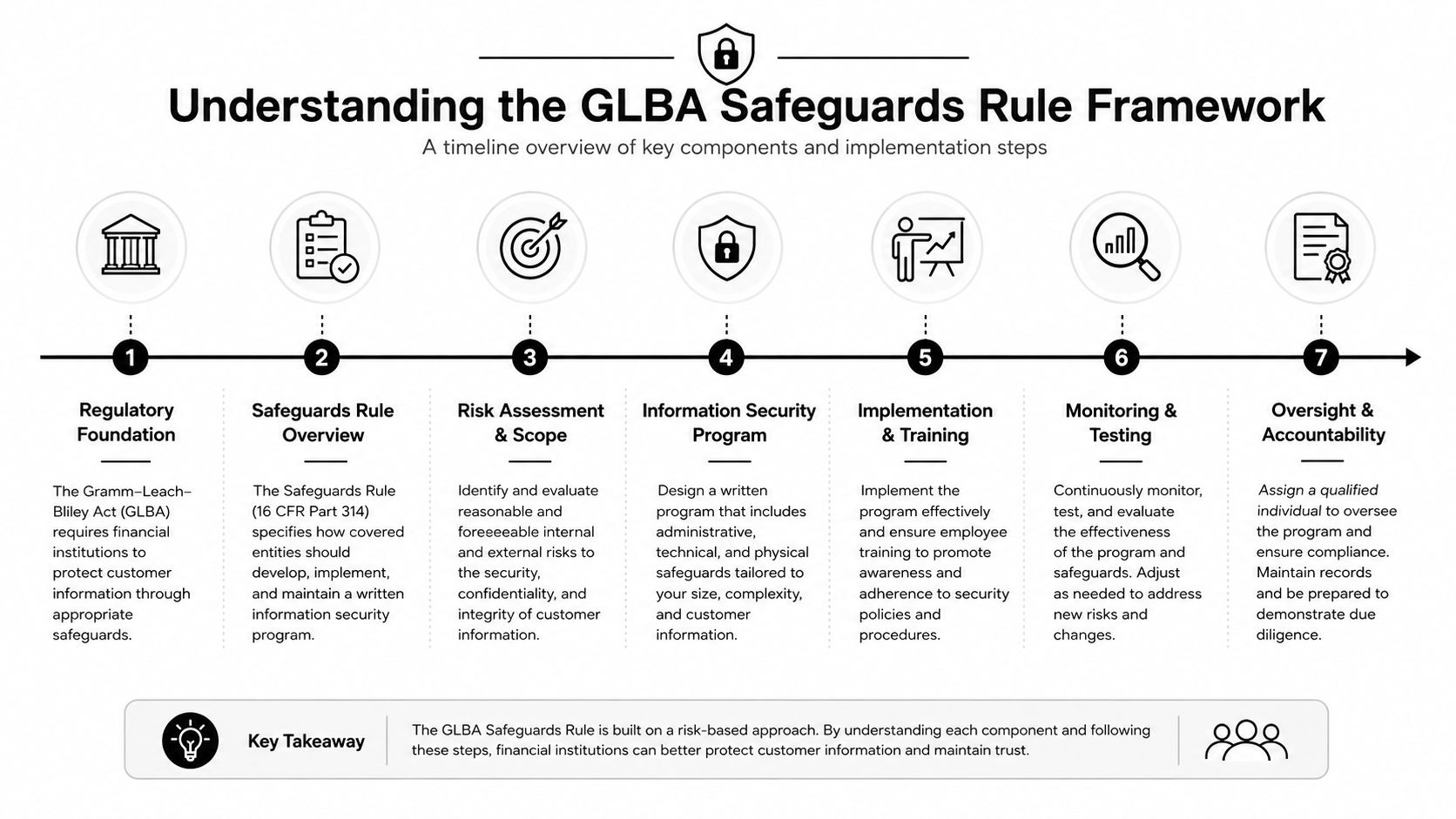
The framework rests on three safeguard categories: administrative, technical, and physical. Administrative safeguards cover governance, risk assessment, training, vendor management, and accountability. Technical safeguards cover access controls, MFA, encryption, logging, monitoring, testing, and response tooling. Physical safeguards protect facilities, devices, media, and other physical locations where customer information could be accessed or lost.
The Interagency Guidelines call for an effective information security program that is suitably matched to the complexity of the institution. They also call for contractual safeguards for service providers that access customer information, forming a control chain that reaches beyond the network of the organization. The same guidance covers the security, confidentiality, integrity, and proper disposal of customer information. (Federal Reserve Interagency Guidelines)
Governance has a named owner
The FTC rule requires a qualified individual to provide oversight of the information security program. This person needs adequate authority and access to evaluate risk, coordinate technical teams, monitor deficiencies, and report program status to the board or equivalent governing body at least once per year.
The small-entity threshold requires careful treatment. Institutions that keep customer information on fewer than 5,000 consumers are relieved of four requirements, including the written risk assessment and annual board report. (FTC Federal Register notice) That exemption does not remove the broader obligation to protect customer information, and it should not serve as a reason to discard risk-based documentation.
Outsourcing doesn't outsource accountability
Cloud hosts, managed service providers, payroll platforms, loan-origination vendors, and support contractors can all handle customer information. The institution is still responsible for setting contractual expectations, assessing provider safeguards, monitoring relevant activity, and retaining evidence that oversight took place.
A useful companion resource on the broader discipline is this practical guide to what is cybersecurity risk management. For GLBA purposes, risk management ought to link identified threats to safeguards, owners, testing results, and decisions. A vendor questionnaire by itself seldom shows that the outsourced control functioned.
Required Information Security Program Elements
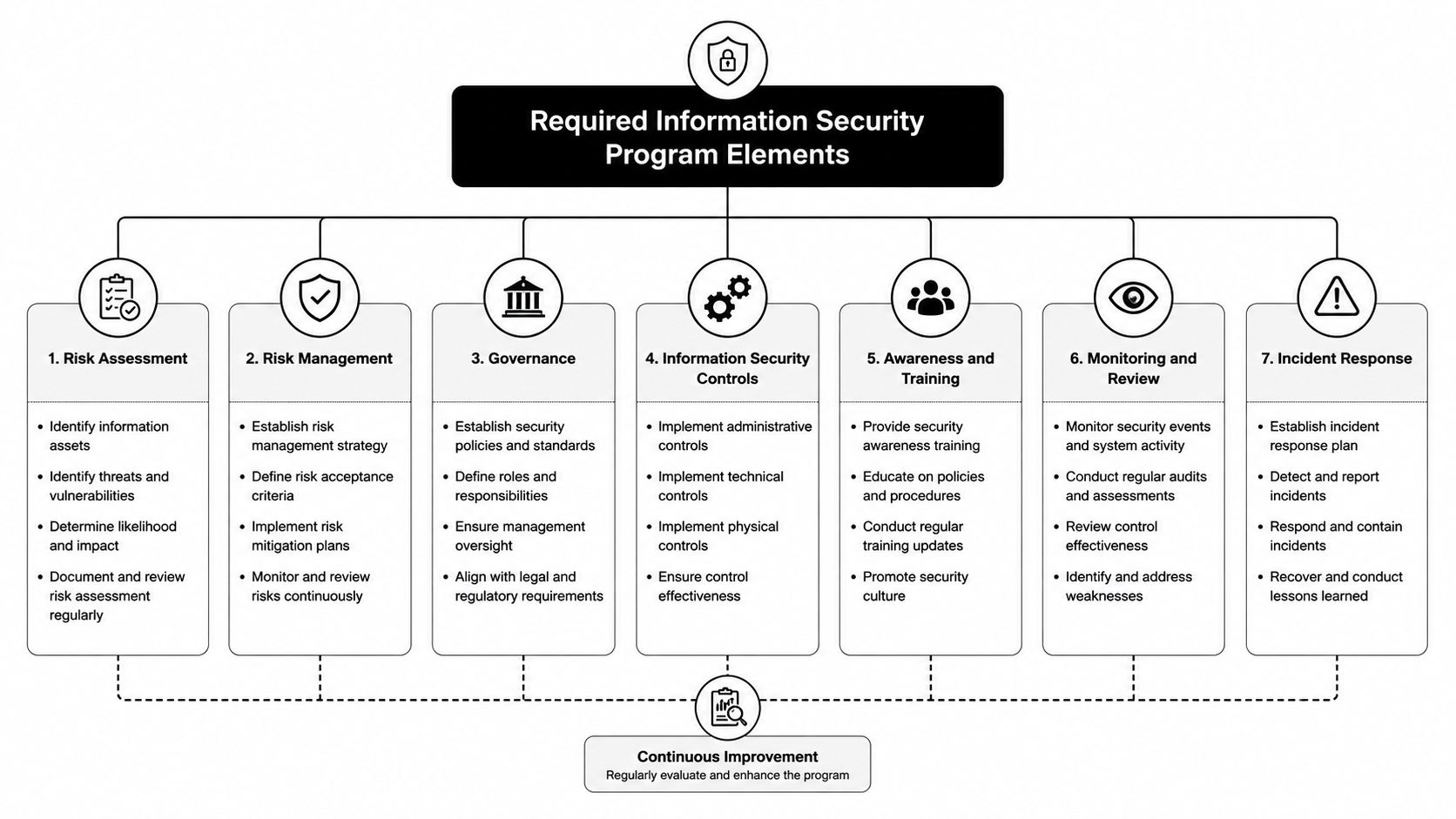
In a defensible program, every required component is linked to an accountable owner, a designated system of record, and supporting evidence. For most organizations covered by the revised FTC Safeguards Rule, the elements below constitute the operational control set.
Risk assessment and program design
Begin with a documented assessment that identifies reasonably foreseeable internal and external risks to customer information and evaluates whether current safeguards respond to those risks. Inventory data stores, applications, endpoints, identities, cloud services, service providers, and transmission paths. The most compelling evidence consists of an approved assessment, data-flow documentation, risk ratings, treatment decisions, and review records connected to material changes.
Access controls and MFA
Only authorized users may gain access, and that access must be tied to business necessity. Apply least privilege using identity governance, role-based permissions, privileged-access controls, and prompt deprovisioning. MFA ought to apply to all individuals who access systems containing customer information, not merely remote administrators.
Evidence ought to cover policy settings, enrollment and exception records, access reviews, privileged-session logs, and samples demonstrating that terminated or transferred users were addressed promptly. A control deployed only for the VPN does not necessarily protect email, cloud consoles, databases, or support tools that contain customer information.
Encryption
Protect customer information with encryption while stored and while moving. Record where encryption is applied, how keys are managed, which systems are excluded, and what compensating safeguards are in place when encryption cannot be implemented. Configuration exports, certificate inventories, cloud storage settings, database controls, and backup reports carry more weight than a policy statement.
Monitoring, testing, and training
The rule mandates ongoing monitoring or recurring testing, including penetration testing and vulnerability assessments. The FTC update specifically requires continuous monitoring or annual penetration testing plus biannual vulnerability assessments, as well as oversight of critical controls. Retain scoping notes, test reports, findings, remediation tickets, retest results, and management acceptance decisions.
Training for employees ought to be tailored to their roles. Training records show participation, yet security teams should also keep evidence that high-risk roles understand escalation, data handling, access, and incident-reporting procedures.
Incident response and service providers
Keep a written incident response plan that addresses detection, triage, containment, recovery, communication, documentation, and post-incident improvement. Place exercise results, case timelines, decision logs, notification assessments, and corrective actions in a controlled repository.
For service providers, preserve due-diligence records, contracts, security reviews, issue tracking, attestations, and termination or transition evidence. The centralized log management approach is valuable in this context because it provides security teams with a shared location to retain events from internal systems and outsourced services.
Board reporting
The qualified individual's annual written report should cover program status, material risks, testing outcomes, significant incidents, unresolved deficiencies, and recommended changes. Board reporting is most effective when it draws on current control telemetry and tracked remediation, instead of being reconstructed from memory before a meeting.
Mapping Technical Controls to Audit Evidence
Auditors do not assess a dashboard because it appears polished. They assess whether the underlying records are complete, attributable, time-stamped, protected from tampering, and linked to a documented response. A SIEM or XDR platform can assist, but only if the organization builds collection and correlation around its GLBA scope.
An effective design begins with the customer-information inventory. Determine which systems store, process, or transmit customer information, then gather authentication, access, privilege, configuration, endpoint, network, database, and file-activity events from those systems. Correlation rules should convert isolated events into explainable detections, such as a successful login followed by unusual privilege activity and access to sensitive files.
| GLBA Requirement | Technical Control | Evidence Artifact |
|---|---|---|
| Written risk assessment | Asset, data-flow, identity, and threat inventory | Approved assessment, risk register, treatment decisions |
| Access controls and MFA | Identity-provider policies, privileged-access management, access reviews | Configuration exports, review approvals, exception records |
| Encryption | Storage, database, endpoint, backup, and transport encryption checks | Configuration evidence, key-management records, remediation tickets |
| Monitoring and testing | SIEM correlation, endpoint detection, vulnerability scanning, penetration testing | Rule history, alerts, test reports, findings, retest results |
| Incident response | Case management, escalation workflows, response playbooks | Timeline, analyst actions, containment records, post-incident review |
| Service-provider oversight | Vendor inventory, contract controls, security reviews | Due-diligence file, contract clauses, issue tracking |
| Board reporting | Governance workflow linked to current metrics and findings | Signed report, meeting materials, action decisions |
What strong telemetry looks like
A list of log sources does not prove effective monitoring. The evidence must demonstrate that sources are connected, events arrive with usable timestamps and identities, parsing stays accurate, alerts are reviewed, and retention supports investigation. Keep rule changes and tuning decisions as well. An auditor may reasonably ask why a detection was modified, who approved the change, and whether the revised logic was tested.
Automated playbooks can generate consistent case records for account disablement, host isolation, ticket creation, evidence preservation, or escalation. Automation must still be governed. Retain the trigger, actions, approvals, exceptions, and final outcome so the response can be reproduced.
For Microsoft 365 environments, security leaders may also benefit from guidance on defensible M365 for IT directors, particularly when identity, collaboration, and cloud audit records are part of the customer-information control boundary. Teams considering a unified approach can examine GLBA compliance and SIEM as an example of linking detection data with compliance reporting.
Common Compliance Gaps and How to Remediate Them
Audit failures generally stem from disconnected operations, not from a complete lack of security tools. The institution has a SIEM, an identity platform, endpoint protection, and a vulnerability scanner, but nobody can show that the controls cover the entire customer-information environment or that findings result in verified remediation.
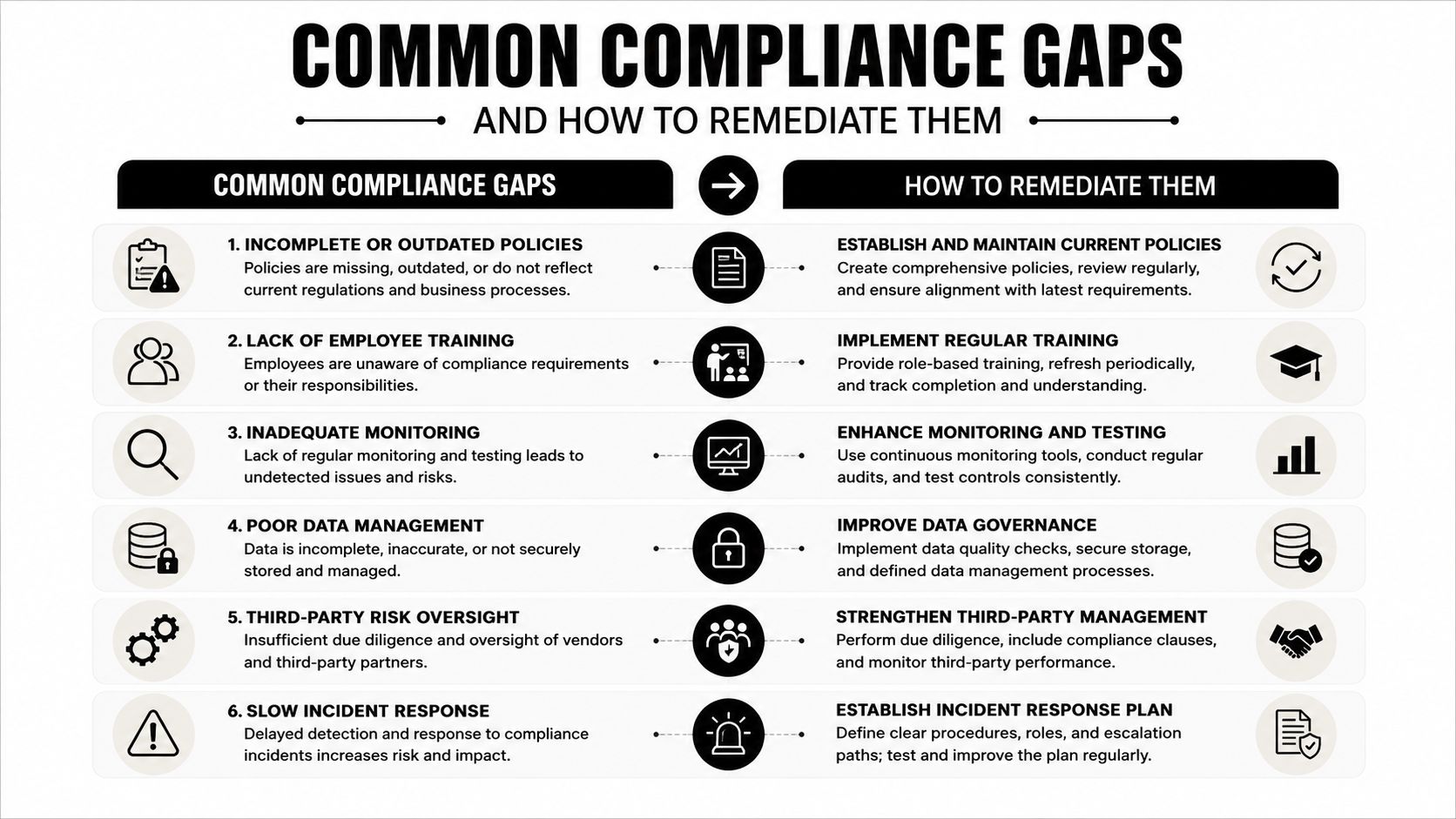
Gap and remediation comparison
| Common gap | Why it persists | Remediation that produces evidence |
|---|---|---|
| Incomplete asset inventory | Procurement, cloud, and business teams create systems outside security workflows | Reconcile CMDB, cloud accounts, endpoint agents, data stores, and vendor inventories, then assign owners |
| MFA exceptions on privileged access | Legacy systems or operational convenience weaken enforcement | Document each exception, approve equivalent safeguards, set an expiry review, and monitor use |
| Unreviewed vendor access | Contracting focuses on availability and cost rather than data exposure | Classify providers by access, review safeguards, enforce contractual duties, and track remediation |
| Fragmented logging | Teams collect logs locally without common retention or analysis | Define required sources, validate ingestion, protect records, and test detection coverage |
| Untested response plans | The plan was written by compliance without operational ownership | Run exercises, record decisions and timing, assign corrective actions, and retest |
| Findings without closure proof | Vulnerability tickets close after a change, not after validation | Require retesting, evidence of the fix, residual-risk approval, and management visibility |
The most serious gap is frequently telemetry blindness. If an institution cannot observe access to customer information, privilege changes, suspicious authentication, or file activity, it cannot reliably investigate an event or determine when discovery occurred.
The defensibility of any control rests on the evidence trail it generates.
Order of remediation is important. Define scope and assign ownership before addressing identity and encryption gaps, confirming logging works, testing response, and linking findings to governance. Purchasing an additional security tool before ownership and data coverage are resolved typically yields another dashboard while assurance remains unchanged.
Building Your GLBA Implementation Checklist
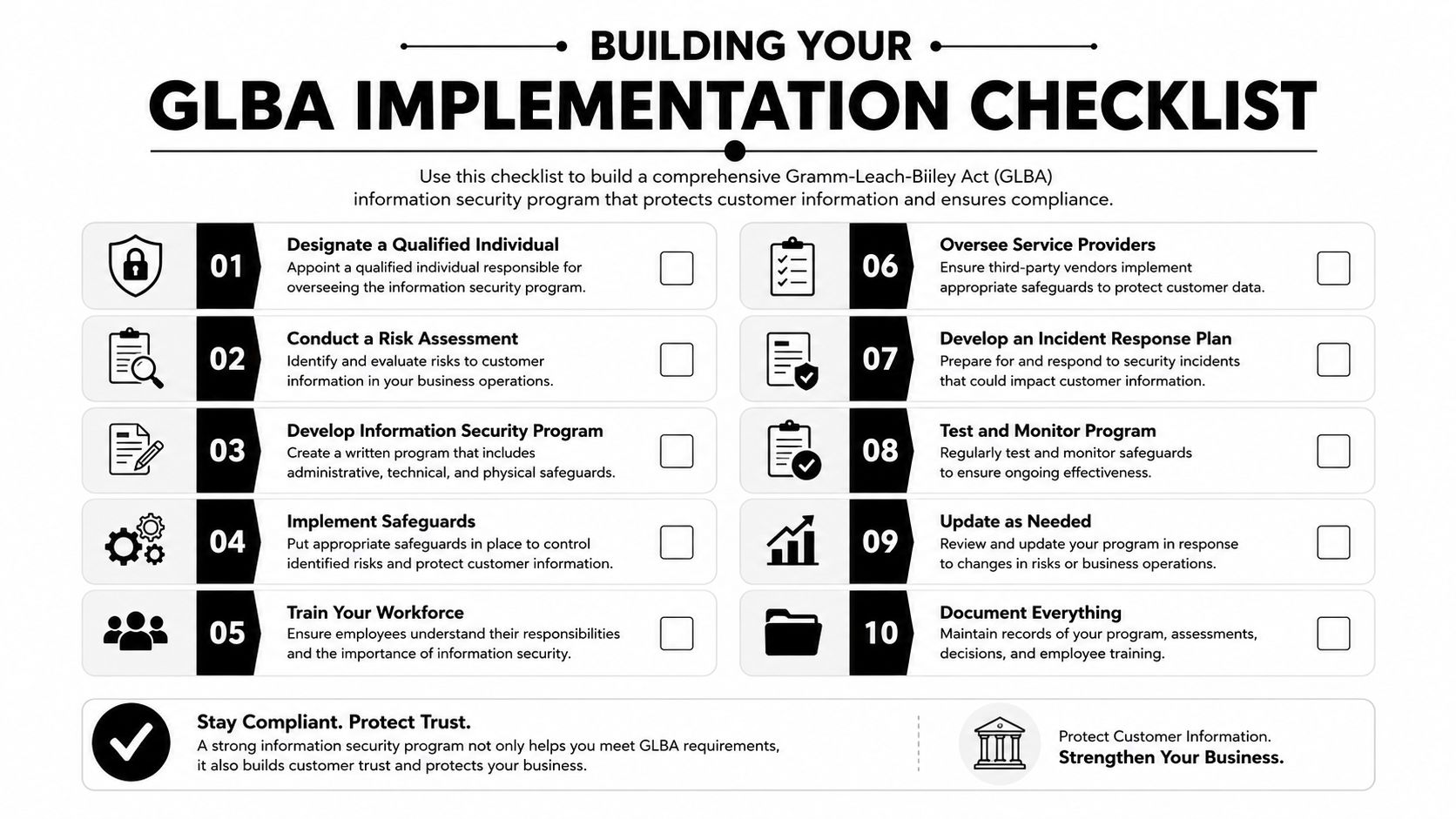
An effective checklist needs to distinguish foundational prerequisites from ongoing operations. If not, teams may record controls as finished even though the underlying dependencies are still unstable.
Establish the foundation
- Define scope: Determine the locations of customer-information repositories, applications, endpoints, identities, facilities, cloud services, and providers.
- Assign accountability: Designate the qualified person and record their authority, responsibilities, escalation paths, and reporting obligations.
- Approve the risk assessment: Capture threats, safeguard adequacy, treatment decisions, accepted risks, and review triggers.
- Document the control boundary: Keep a controlled inventory covering system owners, data flows, provider relationships, and dependencies.
Operationalize the safeguards
- Enforce identity controls: Enforce MFA and least privilege, and retain policy configurations, access reviews, and exception approvals.
- Verify encryption: Inspect storage, transport, endpoints, databases, and backups, and retain evidence for key management and remediation.
- Collect security telemetry: Collect authentication, access, privilege, configuration, endpoint, network, and file events from systems within scope.
- Test effectiveness: Keep vulnerability assessments, penetration-testing reports, monitoring results, findings, remediation records, and retests.
- Exercise response: Conduct realistic exercises that cover unauthorized access, data acquisition, provider activity, and evidence preservation.
Keep governance current
- Report to the board: Report program status, material risks, testing outcomes, incidents, unresolved gaps, and recommended changes in writing.
- Review providers: Monitor due diligence, contracts, security findings, access, and exit controls.
- Preserve evidence: Safeguard logs, cases, approvals, reports, and change history from modification or accidental loss.
Arrange these tasks according to dependency. If scope is missing, the risk assessment remains incomplete. If telemetry is absent, monitoring assertions lack strength. If response procedures are untested, notification analysis turns into an improvised exercise.
Achieving Continuous Compliance Through Automated Monitoring
A point-in-time assessment has value, yet it cannot be the main discovery method for a program that requires continuous monitoring and meets a deadline-driven breach obligation. An overlooked event might stay hidden until a scheduled review, and the organization then lacks the ability to establish facts for prompt triage.
The operational answer is a connected monitoring loop:
- Collect events involving identity, endpoint, network, cloud, application, and file activity.
- Correlate connected activity into detections that mirror attack paths and policy violations.
- Investigate notifications that retain context, user identity, asset ownership, and event history.
- Respond via authorized playbooks, and with human sign-off for actions that present business risk.
- Report and improve by connecting incidents, test results, rule modifications, and remediation results.
SIEM, XDR, and SOAR functions prove useful when they produce such evidence during routine security operations. A solution like Unified Security Stack can collect logs from cloud services, network devices, and endpoints, link events, enable automated response playbooks, and align compliance evidence with GLBA workflows. Such functionality does not substitute for governance or experienced judgment. It narrows the distance between what the SOC sees and what the compliance team has to prove.
Teams building a broader program can use this step-by-step compliance implementation resource for arranging ownership, evidence, and control validation. The core idea stays simple: continuous monitoring is not an extra reporting layer. It is what enables the institution to identify change, investigate quickly, and show that safeguards keep working. A dedicated compliance management solution can help tie those activities to consistent reporting rather than a last-minute audit rush.
Visit Unified Security Stack to assess how its open-source SIEM, SOAR, and XDR functions can consolidate GLBA telemetry, link suspicious activity, automate response processes, and keep audit-ready evidence. Use the platform to shift your GLBA program from policy attestation to continuously proven control effectiveness.