Mastering Baseline Configuration Management in Hybrid IT
Last quarter your audit passed because the screenshots aligned with the baseline. Then an emergency firewall adjustment was deployed, a legacy admin account returned, and the exception was never documented. By the time operations detected the drift, the environment had diverged from the documentation, and the control meant to demonstrate stability was now contributing to the issue.
This is a key challenge with baseline configuration management within hybrid IT. A baseline is meaningful only when it mirrors production, is modified through formal control, and supports the rest of your security stack. NIST regards that baseline as a documented set of specifications that can change only through change control procedures NIST baseline configuration definition, and ISO frames configuration management as a governed lifecycle built around planning, identification, control, status accounting, and audit ISO configuration management guidance.
Table of Contents
- Why Unmanaged Configurations Expose Your Organization
- Establishing Your Authoritative Configuration Baseline
- Automating Configuration Drift Detection
- Building Automated Remediation and Response Workflows
- Integrating Baseline Alerts with SIEM and XDR Platforms
- Streamlining Audit Evidence and Compliance Reporting
Why Unmanaged Configurations Expose Your Organization
An audit failure seldom begins at the audit itself. It begins with an undocumented change that makes it into production, remains there, and gradually turns into the accepted norm. A server reboot fails, a control is turned off so a business app can continue operating, or a cloud security group is opened more broadly than planned, and the environment moves away from the approved state.
Drift turns small exceptions into security gaps
That drift is significant because the system stops behaving as your security team anticipates. A firewall rule, local policy, firmware setting, or identity control can each introduce blind spots once it departs from the approved baseline. In regulated settings, this is how an ordinary exception turns into an audit finding, a compliance gap, or the opening an attacker required.
A baseline configuration is a documented collection of specifications for a system that has undergone formal review and agreement, and it may change only via formal change control procedures. That definition is important because it transforms configuration management from estimation into an auditable reference state.
Practical rule: When the live system and the documented baseline no longer align, the baseline has already gone stale.
Compliance, operations, and security all depend on the same reference state
Unmanaged configuration is not merely a documentation issue. PCI, CMMC, HIPAA, and ISO-aligned programs all rely on demonstrating that systems remain inside approved guardrails, not simply that a policy sits in a folder. When the approved state departs from reality, all downstream work becomes more difficult, from incident triage to root-cause analysis to evidence collection.
NIST SP 800-53 CM-2 codified that reality in federal settings by requiring organizations to create, document, and keep a current baseline configuration for every system under configuration control. Such a baseline is not a one-time deliverable. It is the reference point that enables security teams to identify drift, compare systems, and determine whether a change was deliberate or risky.
When you send those baseline drift events into a SIEM or SOAR platform such as Unified Security Stack, you go beyond basic compliance verification. The same alert that identifies an unauthorized registry change or an altered cloud security group can also initiate investigation, ticketing, or automated containment. This moves baseline management from a paper exercise to an operational control that supports detection and response.
Establishing Your Authoritative Configuration Baseline
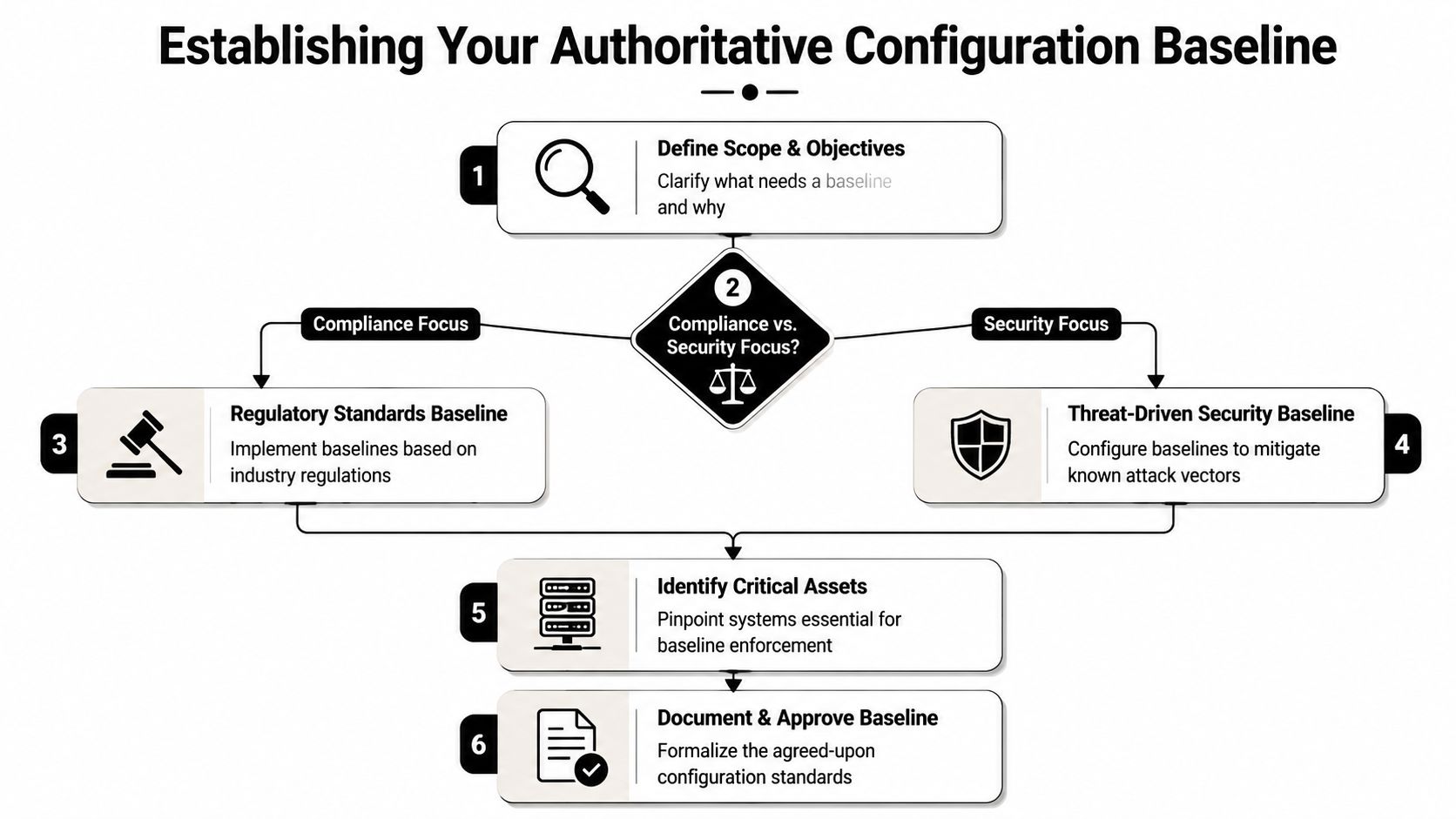
The quickest route to failure here is to create a baseline from nothing without an underlying standard. Choose an authoritative benchmark first, then adapt it to your environment. This usually means beginning with CIS Benchmarks, DISA STIGs, or Microsoft Security Baselines, followed by determining which controls are required, which are conditional, and which require exceptions for business reasons.
Start with the standard, not with the exception
For NIST SP 800-171 / CMMC 2.0 alignment, practical guidance recommends selecting a baseline like CIS Benchmarks or DISA STIGs and enforcing it with tools like Group Policy for Windows or Ansible for Linux, while keeping evidence such as GPO backups and Ansible playbooks NIST SP 800-171 / CMMC 2.0 implementation checklist. That is the correct order because it provides auditors with a recognizable reference and operations with a repeatable build.
A sound baseline also accounts for risk, not only compliance. NIST-based tailoring can be performed using a risk matrix that maps data classification to allowed actions like read, add, modify, delete, and read-only, then drives the monitoring and alerting depth for each combination NIST-based baseline tailoring with risk matrix. That method prevents you from applying one rigid profile to every system in a mixed fleet.
Turn policy into deployable configuration
A baseline is useful only when teams can deploy it consistently. On Windows, that typically requires GPO, MDM, or SCCMOn Linux systems, this is frequently Ansible, Chef, or Puppet. The key point is not the brand name; it is that the baseline becomes an enforceable artifact instead of a policy PDF.
A baseline that cannot be deployed the same way twice is not a baseline. It is a suggestion.
Use your documentation to make the intent clear. Document the approved settings, the reason for every deviation, the owner, and the approval path. If a setting is deliberately different on a high-risk database server, that exception must appear in the same governance model as the standard build.
Document the baseline like code
Infrastructure-as-code keeps the baseline durable by maintaining configuration in version control and making change review practical. A GPO backup or Ansible playbook is much more valuable than a static checklist, because it demonstrates how the approved state is enforced and how it can be reconstructed after a failure.
When you set up the process for a hybrid environment, begin with a limited scope. Choose a single operating system family, server class, or endpoint profile, and expand only after the change-control path is reliable and the baseline withstands real drift events without disrupting legitimate work.
Automating Configuration Drift Detection
Manual review remains effective only while the environment changes at a pace people can inspect. At that point, drift detection must operate continuously, or at minimum on a daily cadence. Best-practice guidance calls for checking baselines at least once per day, and manual checks are slower and more error-prone baseline configuration best practices.
Detect drift before it becomes a blind spot
Describing this workflow is simple; running it well is not. Gather the live configuration, compare it with the approved baseline, and mark every delta that lacks prior approval. A PCI-oriented baseline workflow begins by defining the secure state, automatically collecting current configuration data, comparing it against the baseline, and routing deltas through formal change control before the baseline is updated PCI-oriented baseline workflow.
That comparison must include both volatile and persistent settings. A temporary change that remains after a reboot can matter as much as a permanent one, particularly on firewalls, endpoints, and system services. If your tooling examines only one layer, you will overlook the drift attackers prefer to conceal themselves behind.
For teams standardizing visibility, one option is the file integrity monitoring workflow from Unified Security Stack's file integrity monitoring, which can bring detection together around files and configuration changes rather than handling them as separate events. The value lies not in the label but in the consistent comparison with an approved state.
Filter noise without ignoring real change
Not every difference indicates a breach. Some are valid change tickets, maintenance windows, or platform updates. Detection logic must distinguish approved change from unauthorized change, otherwise the team will begin disregarding alerts.
Reporting discipline is important in this area. PCI-oriented guidance advises producing reports for all changes and reviewing them for patterns that enhance the process, not merely for audit evidence PCI-oriented baseline workflow. Those reports should be used to adjust the policy and identify repeated drift on the same assets, because that usually signals weak controls, hurried maintenance, or a configuration path that is too simple to bypass.
Daily drift detection matters because the longer a system goes without review, the longer unauthorized change can remain concealed within normal operations.
If you are choosing where to begin, focus first on internet-facing systems, privileged hosts, and assets nearest to regulated data. In those areas, a minor configuration error escalates into an incident most quickly.
Building Automated Remediation and Response Workflows
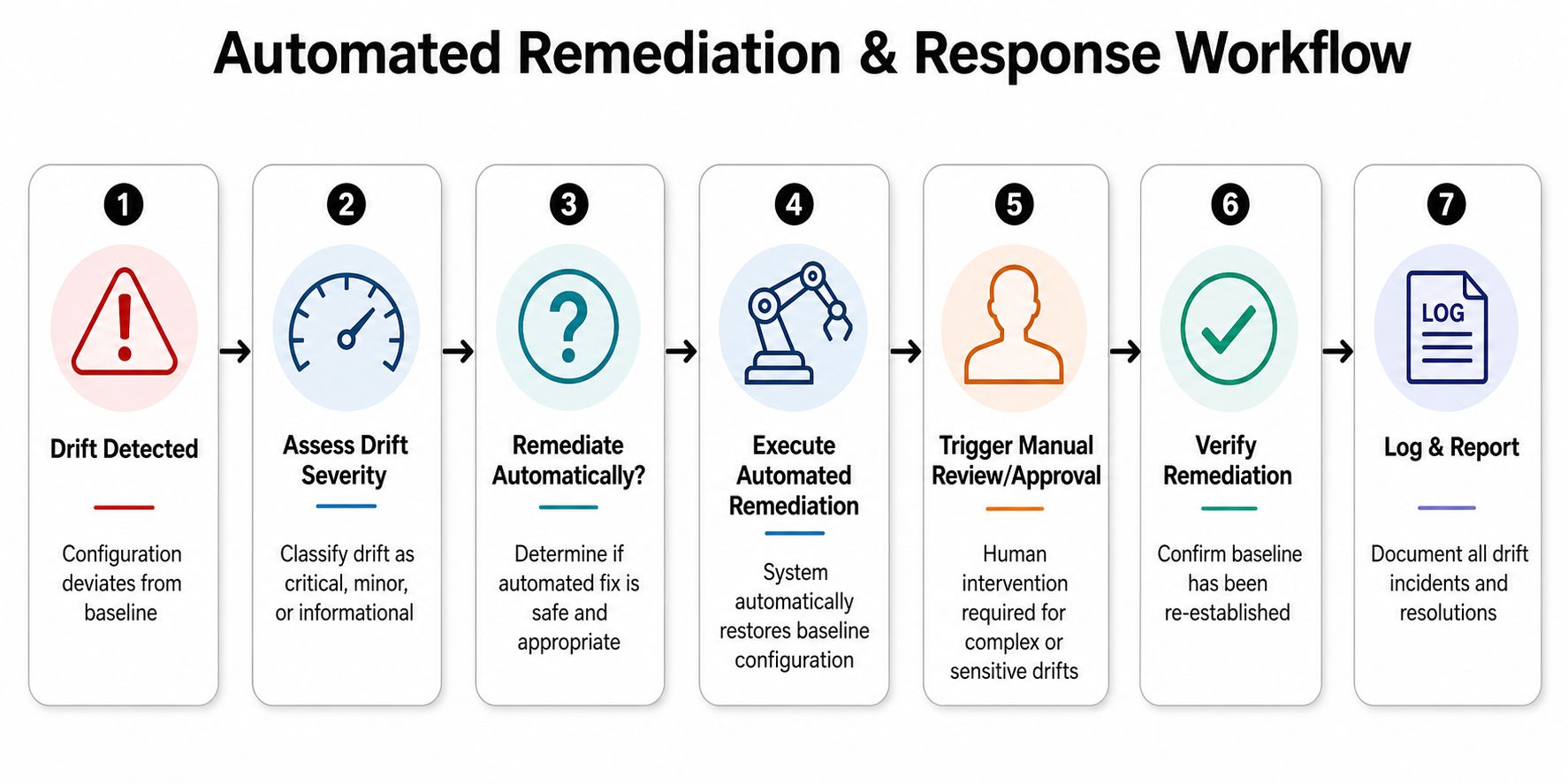
Detection without response merely creates a more detailed backlog. The most effective remediation model begins with severity. Certain drift should cause an immediate rollback, whereas other changes should create a ticket and await human approval. The key is to make that decision deterministic rather than emotional.
Automate the obvious cases
If a firewall rule is disabled, a security setting is turned off, or a hardened service is re-enabled, the response should be rapid and automated whenever that is safe. In such cases, a configuration management tool can return the prior approved state and record the action as a controlled remediation, not an unexpected fix.
The goal is not to remove humans. It is to save human involvement for decisions that genuinely require judgment. Routine reversions should be in a playbook, since a playbook is easier to audit than someone's recollection of what they intended to do during an incident.
Route ambiguous drift into change control
Not every deviation should be rolled back automatically. Some are legitimate, some are incomplete change requests, and some require a security review before any action occurs. In those situations, the workflow should open a ticket, include the drift details, and assign the case to the proper owner for approval or rejection.
A well-formed ticket records the affected baseline, the suspected cause, the comparison output, and the closeout action. This aligns with the broader configuration-control model, in which every change is documented, validated, and either accepted into the baseline or rolled back.
If you're standardizing the workflow across environments, keep the response taxonomy short:
- Critical drift: Revert automatically when the change can be safely reversed.
- Authorized change: Associate it with the approved ticket and suppress noise.
- Unknown drift: Create a ticket and require review before the baseline changes.
- Repeated drift: View it as a process failure, not an isolated event.
When a deviation continues to occur, the problem is generally the process rather than the scanner.
That is also where auditability gets better. A remediation loop that tracks what changed, who approved it, and whether the baseline was restored provides a genuine control history rather than a scattering of incident notes.
Integrating Baseline Alerts with SIEM and XDR Platforms
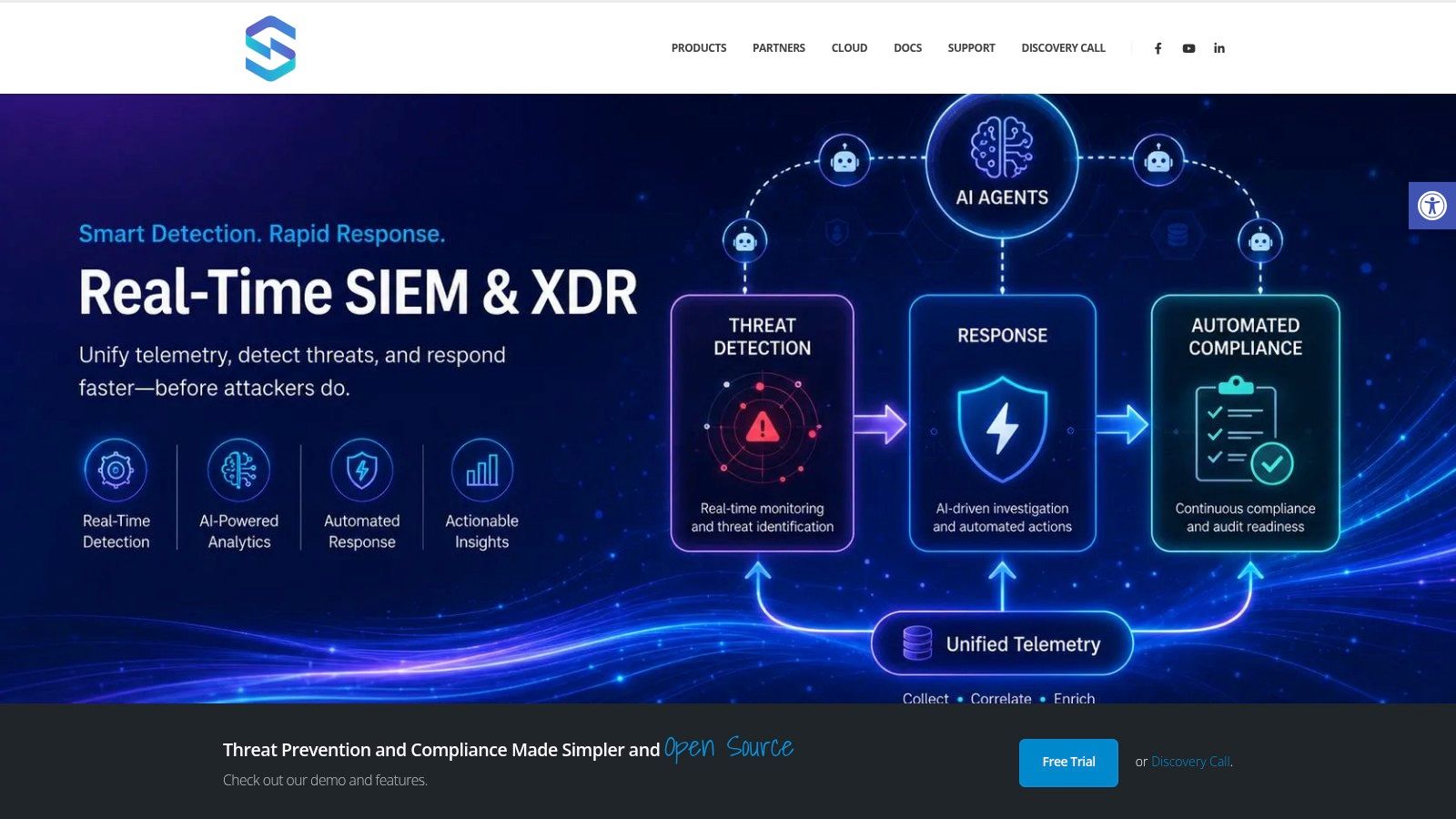
A drift alert alone indicates that a configuration changed. Feed that alert into a SIEM or XDR workflow, and it begins to indicate whether the change matches the pattern of an intrusion. That is the practical move from compliance monitoring to threat detection.
Use drift as a signal, not a report
Security teams require the baseline to function like live telemetry. NIST SP 800-53 CM-2 requires organizations to maintain a current baseline configuration, and that baseline has to be reviewed at least annually, which aligns with continuous monitoring and SOC integration NIST SP 800-53 CM-2. In practice, drift events ought to enter incident workflows instead of remaining in a monthly spreadsheet.
A simple correlation pattern is worth understanding. If a new local administrator account emerges alongside unusual sign-ins, suspicious network traffic, or endpoint alerts, you are not seeing three distinct events. More likely, a single incident is appearing through multiple sensors. That is why baseline alerts should sit in the same stream as your other SOC data.
For teams centralizing that data, Unified Security Stack's centralized log management can serve as one location to collect those events together with other telemetry. The value lies in the correlation path, not in collection by itself. It is also where a SOC can determine whether a drift event corresponds to a maintenance window or fits within a broader attack chain.
Write rules around meaningful deviations
Correlation rules ought to target the baseline shifts that matter most to attackers. Fresh privileged accounts, security services that get turned off, modified startup items, and unanticipated policy changes on critical systems are the deviations worth watching. Because the baseline gives the SIEM context, the team can tell ordinary maintenance apart from activity that needs review right away.
A risk-based baseline keeps alerting aligned with the system being monitored. A lab host and a domain controller should not follow the same response path, because false positives carry different operational costs. This matters in hybrid environments where CMMC and PCI controls may apply to different systems with different change tolerance. The alerting level should reflect that distinction so the SOC sees what matters without being buried in low-value noise.
The response should also take intent into account. If a drift event arrives alongside an endpoint alert, a burst of failed logins, or suspicious outbound activity, the case belongs in the analyst queue with context attached. If it reflects only an approved maintenance task, the platform should suppress it without obscuring the audit trail. That gives the team a practical balance among speed, control, and evidence, and it helps prevent internal threats with compliance.
Streamlining Audit Evidence and Compliance Reporting
Auditors do not want a narrative about your intentions. They want proof that the control operates, remains current, and detects drift when it occurs. That is where a mature baseline program proves its value, because the same data that supports detection also supports reporting.
Prove control effectiveness with operational metrics
To prove that baseline management is reducing risk, track configuration drift rates, patch latency, and the number of unauthorized changes detected Netwrix baseline configuration guidance. Those metrics demonstrate whether the baseline is limiting variance, which is the entire purpose of the control.
Use the reporting layer to generate current-state views, historical drift logs, and remediation records. That gives auditors a clear chain from approved baseline to observed deviation to corrective action. It also makes it easier to demonstrate that your enforcement is not merely policy on paper.
If your team needs help mapping those records into a broader control framework, Unified Security Stack's compliance management solutions can act as one option for centralizing evidence and linking detections to compliance workflows. The key point is that the evidence stays connected to actual system behavior, not slideware.
Make the report useful to security, not just audit
A baseline report should serve a purpose beyond satisfying an auditor. It should help the security team see where the environment continues to drift, which assets are most difficult to stabilize, and which changes repeat often enough to point to a process problem. That is also where a resource such as preventing internal threats with compliance becomes relevant, since baseline evidence can reveal patterns that are not simply accidental misconfigurations.
The strongest reports usually answer four questions quickly:
- What changed? Display the difference from the approved state.
- Was it approved? Associate the change with a ticket or exception.
- Was it remediated? Document the restore action or acceptance path.
- Did it recur? Highlight recurring deviations for escalation.
That reporting structure supports CMMC, PCI, HIPAA, and ISO-style audits because it demonstrates governance, not merely activity.
If you are creating or improving a hybrid baseline program, start with a single critical platform, link its drift alerts to your SIEM, and make sure each deviation either auto-remediates or generates a formal ticket. Then apply the same pattern across your Windows, Linux, cloud, and network layers with one control owner, one review cadence, and evidence your auditors can readily follow. A practical approach to doing so is to evaluate Unified Security Stack for consolidated drift detection, correlation, response, and compliance reporting in a single workflow.