Security Incident Response: A Guide for SOCs & CISOs
A breach is not costly only when systems crash. It becomes costly when an organization spends months learning what happened, who must make the call, which evidence was lost, and which business services cannot wait. According to IBM's 2024 Cost of a Data Breach Report, the global average cost of a data breach reached $4.88 million in 2024, while the average time to identify a breach was 194 days.
That shifts how security incident response is viewed at once. It is not merely an IT cleanup task. It is a business continuity practice positioned where SOC operations, executive decisions, legal risk, customer confidence, and recovery planning meet. Teams that handle it like a ticket queue tend to find the gap too late, as counsel requests facts, leadership demands timelines, and analysts are still working to confirm scope.
The practical difficulty is that most incident response material ends at the SOC boundary. Actual incidents do not. They reach into compliance, communications, HR, eDiscovery, insurance, external responders, and at times law enforcement. A mature response program must manage two tracks simultaneously: the technical process that contains the attacker and the business process that keeps the organization running under strain.
Table of Contents
- The True Goal of Modern Incident Response
- The 6 Phases of the Incident Response Lifecycle
- Building Your Response Team and RACI Matrix
- Actionable Playbooks for Common Threats
- The Technology Powering IR SIEM SOAR and XDR
- Measuring Success and Mapping to Compliance
- Your Implementation Roadmap and Common Pitfalls
The True Goal of Modern Incident Response
Security incident response is frequently defined as detecting, containing, and remediating threats. That definition is accurate but incomplete. In practice, the main job is to reduce business harm while preserving decision quality.
Why response is different from troubleshooting
Troubleshooting repairs a system that has failed. Incident response handles an event driven by an adversary. That distinction is important.
If an email gateway goes down, the team brings service back. If an attacker gets into a mailbox, the team must address tougher questions. Was any data accessed? What accounts were involved? Must legal preserve evidence? Are regulators or customers impacted? Is the user's device still trustworthy? The SOC cannot make those calls by itself.
A useful way to frame it is this: troubleshooting restores functionality, but security incident response brings functionality back, curbs spread, preserves facts, and supports later decisions. If you omit the evidence and coordination work, you might bring systems back sooner and still fail the incident.
Practical rule: If the event may lead to legal review, executive reporting, customer notification, or an insurance claim, you are no longer dealing with a purely technical issue.
Leaders who need a concise executive framing can use resources like this CTO's guide to incident response, which lays out the decision-making side clearly enough for stakeholders outside the SOC while not oversimplifying the technical realities.
What good incident response protects
The first objective is to minimize impact. That typically means restricting lateral movement, halting ongoing abuse, and safeguarding business-critical systems before the team has complete certainty.
The second is to restore services safely. Safely matters. Restoring a compromised identity, a poisoned host, or an unverified backup merely resets the clock for the next outage.
The third is to preserve evidence. Teams under pressure often view this as paperwork. It is not. Without preserving evidence, root-cause analysis becomes weaker, legal review becomes riskier, and remediation becomes repetitive because no one can prove what occurred.
A mature program also safeguards trust. Customers, boards, regulators, and business owners do not assess incident response solely by whether the malware was removed. They assess it by whether the organization acted with coherence under pressure.
The 6 Phases of the Incident Response Lifecycle
The lifecycle provides teams with a repeatable operating model. A mature incident response program is structured around preparation, identification, containment, eradication, recovery, and lessons learned, with containment serving as the highest-value control point for limiting blast radius, as described in Atlassian's incident response guidance.
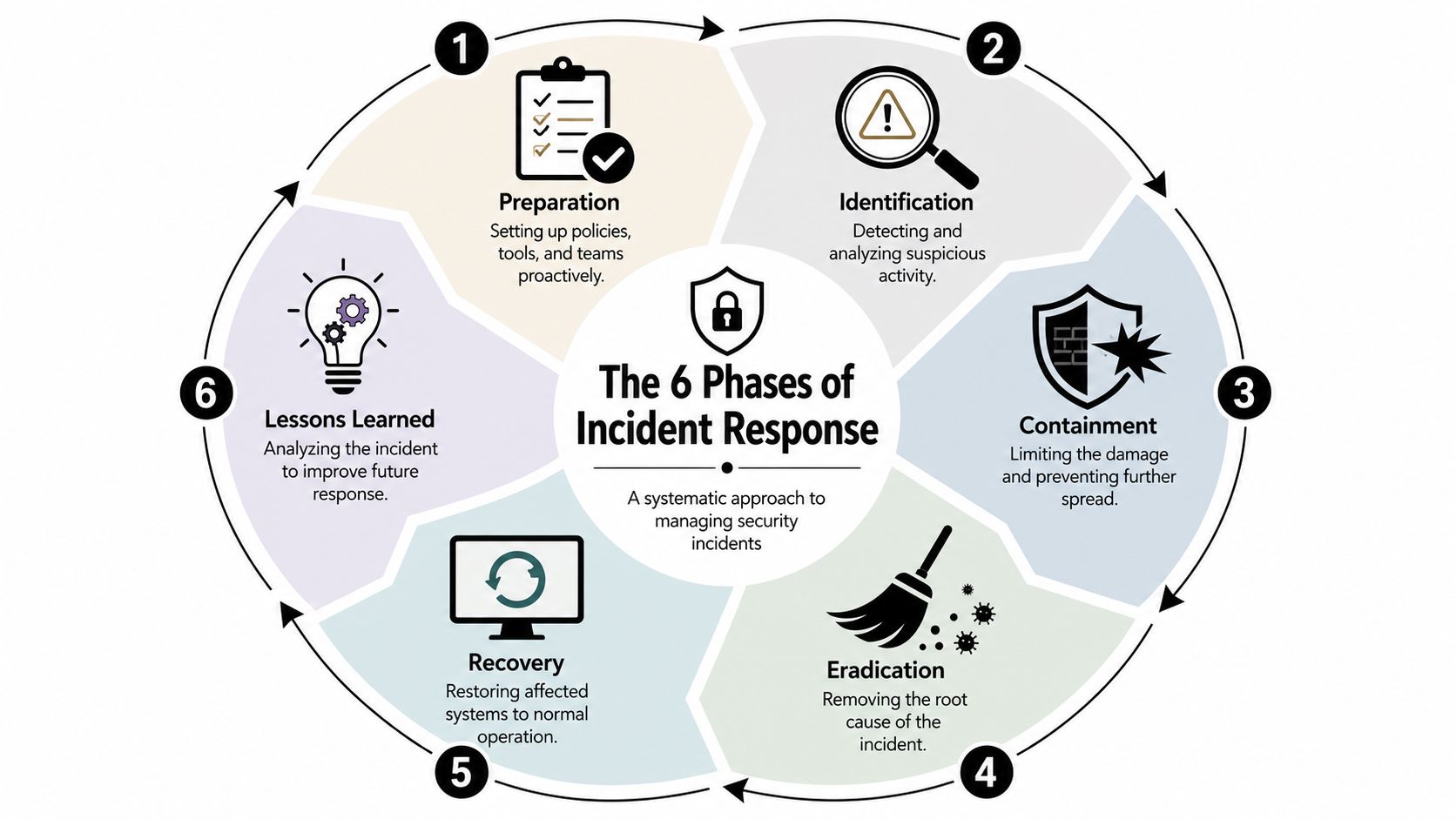
Preparation
Preparation is where most response quality is determined. Not because it stops every incident, but because it decides whether people know what to do when time is compressed.
This phase covers response policies, escalation thresholds, contact trees, logging coverage, forensic readiness, backup validation, access to emergency tooling, and pre-approved playbooks. It also covers business decisions, such as who may authorize isolation of a production server, who retains outside counsel, and who communicates with customers or regulators.
Teams often invest too little here because it does not seem urgent. Then the first live incident turns into a workshop on missing prerequisites.
Identification
Identification begins when a signal becomes credible enough to warrant investigation. That signal may originate from SIEM correlation, EDR telemetry, a user report, cloud alerts, suspicious authentication activity, or third-party notification.
The objective is not to prove every detail right away. The objective is to establish whether the activity is benign, suspicious, or an active incident that needs coordination. Skilled analysts ask a focused set of early questions: what happened, what is affected, what is still ongoing, and how confident are we?
A frequent error is waiting for certainty before escalating. In actual operations, early escalation with clear confidence levels works better than late escalation with perfect wording.
Containment
During containment, the response takes control. While identification may indicate what could be taking place, containment keeps the incident from worsening as the rest of the investigation follows.
Immediate containment can involve quarantining endpoints, locking accounts, ending sessions, denying malicious indicators, or separating systems. Longer-term containment might include traffic limitations, temporary configuration adjustments, or closer monitoring of critical assets while eradication is planned.
Containment choices must be linked to business criticality rather than analyst preference. Taking the wrong system offline can produce a self-inflicted outage.
That is why experienced teams prepare tiered containment options ahead of time. Full isolation and monitoring only are not the sole alternatives. Intermediate states should exist to balance evidence preservation, service availability, and attacker disruption.
Eradication
Eradication removes the root cause of the compromise. It may entail deleting malware, stripping out persistence, changing credentials, patching vulnerable software, retiring unsafe assets, or restoring systems from trusted baselines.
Weak scoping causes damage during this phase. If the team eradicates on the originally affected host but overlooks adjacent compromised accounts or hidden persistence, the incident comes back under a different alert name. Sound eradication is evidence-driven and scope-aware.
A strong practice here is to set exit criteria before making system changes. For instance: reset every known compromised account, complete persistence checks, tune detections to catch re-entry, and have operations and security validate the affected assets.
Recovery
Recovery puts systems back into production under heightened review. It differs from eradication. Eradication takes away the problem. Recovery shows the business can operate again without bringing risk back.
Teams should order recovery according to business criticality. Identity services, communication platforms, transaction systems, and regulated data environments may each demand different validation steps. Monitoring should tighten during this period, because attempted re-entry often surfaces when the attacker realizes access has been disrupted.
A rushed recovery usually yields two issues: operations that are unstable and confidence that is incomplete.
Lessons learned
In the last phase, organizations either grow more mature or repeat the same patterns.
A valuable review does not end with a user clicked a phishing email or a server was unpatched. It considers detection gaps, escalation delays, unclear approvals, communication friction, evidence gaps, and where business and technical sides lost alignment.
Apply the review to refresh playbooks, enhance detections, revise ownership, and sharpen decision thresholds. When the same category of incident occurs again, the organization should respond differently the next time. Otherwise, the meeting was merely therapy.
Building Your Response Team and RACI Matrix
Tools cannot resolve ownership. During a live incident, ambiguous responsibility consumes more time than missing dashboard components. The strongest teams determine beforehand who investigates, who authorizes, who advises, and who needs updates.
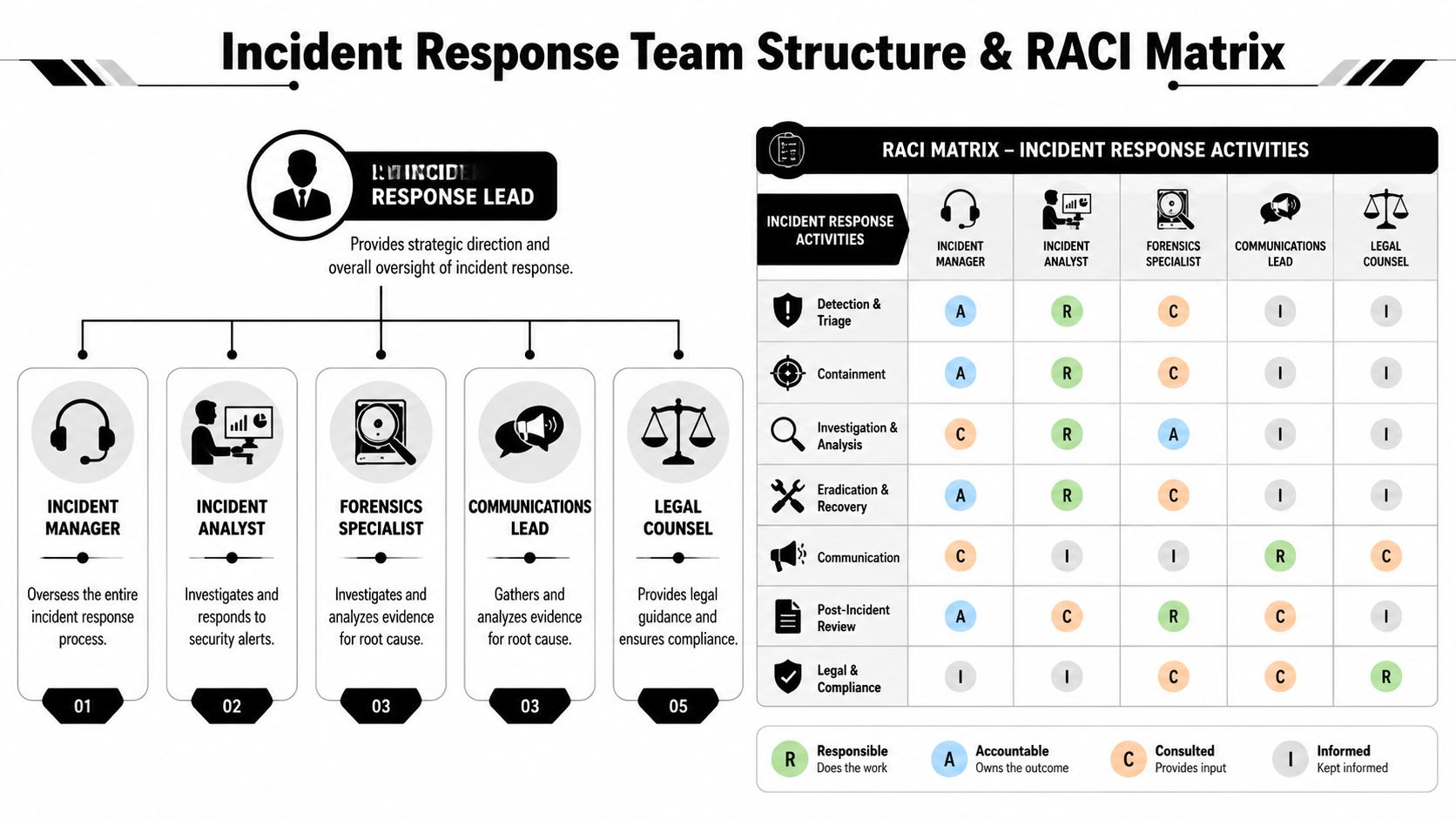
Who needs to be in the room before an incident starts
Most organizations can identify their SOC analyst and security lead. Fewer can identify who owns evidence retention, employee matters, customer messaging, or law-enforcement coordination. This gap is widespread. Wiz's incident response framework overview As noted, many teams still treat response as a SOC-only workflow and fail to pre-plan for legal, regulatory, and operational escalation.
A practical core team usually includes:
- Incident commander: Holds responsibility for coordination, priorities, and decision flow. This role sustains the response and stops technical workstreams from breaking into pieces.
- Technical lead: Leads investigation, containment, and remediation for affected systems.
- SOC analyst or analysts: Confirm alerts, develop timeline detail, pivot through telemetry, and monitor scope.
- Forensics specialist: Maintains and examines evidence when root cause, legal exposure, or insurer requirements are at stake.
- Communications lead: Oversees internal updates and external communications in coordination with legal review.
- Legal counsel: Provides guidance on preservation, disclosure, privilege, contracts, and regulatory duties.
- IT operations or platform owners: Implement changes across infrastructure, cloud, identity, and endpoint systems.
- HR or people operations: Required when employee accounts, insider activity, or disciplinary matters are involved.
For teams formalizing those responsibilities, role descriptions like Threat detection and response roles can assist in turning broad incident response expectations into job functions with clear accountability. It also helps tie the team design to the broader SOC operating model, since handoffs break down when detection and response are designed in isolation.
How a RACI prevents wasted time
A RACI matrix gives each major task four lenses: who is Responsible, who is Accountable, who must be Consulted, and who should be Informed. The value is not in the spreadsheet itself. The value lies in resolving ambiguity before the crisis.
Here's a simple example:
| Activity | Responsible | Accountable | Consulted | Informed |
|---|---|---|---|---|
| Triage suspicious alert | SOC analyst | Technical lead | System owner | Incident commander |
| Isolate endpoint | IT operations | Incident commander | Technical lead, business owner | Legal, leadership |
| Approve customer communication | Communications lead | Executive sponsor | Legal, incident commander | Support teams |
| Preserve forensic evidence | Forensics specialist | Legal counsel | Technical lead | Executive sponsor |
Without this clarity, teams dispute authority during containment. With it, people can move quickly without making up governance as they go.
During the first hour of an incident, the focus should be on executing decisions, not determining who is permitted to make them.
Actionable Playbooks for Common Threats
Playbooks are how strategy becomes actionable. A solid playbook does not attempt to forecast every branch. It provides the team with an operational sequence, clear triggers, and enough structure to keep the response unified as pressure mounts.
Ransomware playbook example
A ransomware incident typically does not start with the ransom note. It often begins with endpoint alerts, suspicious privilege activity, widespread file modification behavior, disabled security controls, or authentication patterns that do not match the user or host.
A practical ransomware playbook usually starts like this:
- Validate the trigger. Verify whether the activity is encryption, staging before encryption, destructive behavior, or a false positive from legitimate software.
- Classify impacted scope. Determine which hosts, users, shares, administrative accounts, and connected systems are affected.
- Contain quickly. Contain compromised endpoints, limit privileged accounts, and segment systems showing signs of lateral movement.
- Preserve evidence. Collect volatile data when possible, preserve relevant logs, and avoid wiping hosts before forensic and legal review.
- Assess business impact. Establish which critical services are affected and whether recovery choices hinge on application dependencies or backup integrity.
- Eradicate and rebuild. Eliminate persistence, change credentials, patch exploited paths, and rebuild high-risk systems from trusted baselines.
- Recover in waves. Bring back the most critical services first, then monitor intensively for recurrence.
What works is decisive containment combined with disciplined scoping. What does not work is restoring systems while the team still has active privileged compromise or unknown lateral movement.
Business email compromise playbook example
Business email compromise is a distinct type of incident. It often appears less dramatic than ransomware, yet it can generate payment fraud, data exposure, and executive escalation very quickly.
A practical mailbox compromise playbook should include:
- Confirm the compromise path: Examine login patterns, mailbox rules, delegated access, and atypical message activity.
- Protect the identity first: Change credentials, terminate live sessions, rotate MFA factors as necessary, and inspect connected accounts.
- Search for spread: Search the environment for comparable phishing messages, impacted recipients, misuse of inbox rules, and message forwarding activity.
- Contain business damage: Warn finance, procurement, and executive assistants if payment requests, invoice changes, or sensitive conversations might be implicated.
- Preserve communication evidence: Preserve relevant email artifacts, timestamps, and administrative actions for legal review and root-cause analysis.
- Communicate with precision: Inform internal stakeholders who might act on fraudulent requests. Wider communication can happen later. Initial messaging should be focused and operational.
Phishing response breaks down if the team resets a single account yet overlooks the business process the attacker sought to exploit.
The most effective playbooks consistently incorporate non-technical checks. When an attacker leveraged an executive mailbox to influence a wire request, finance controls are as important as mailbox remediation.
The Technology Powering IR SIEM SOAR and XDR
Tools cannot replace incident response discipline, yet a mature response is difficult to sustain without suitable telemetry and orchestration. A practical stack generally combines SIEM for log correlation, EDR for endpoint visibility and isolation, SOAR for automated playbooks, and XDR to bring endpoint, network, and cloud signals together in a single investigation workflow, as noted earlier in the lifecycle discussion.
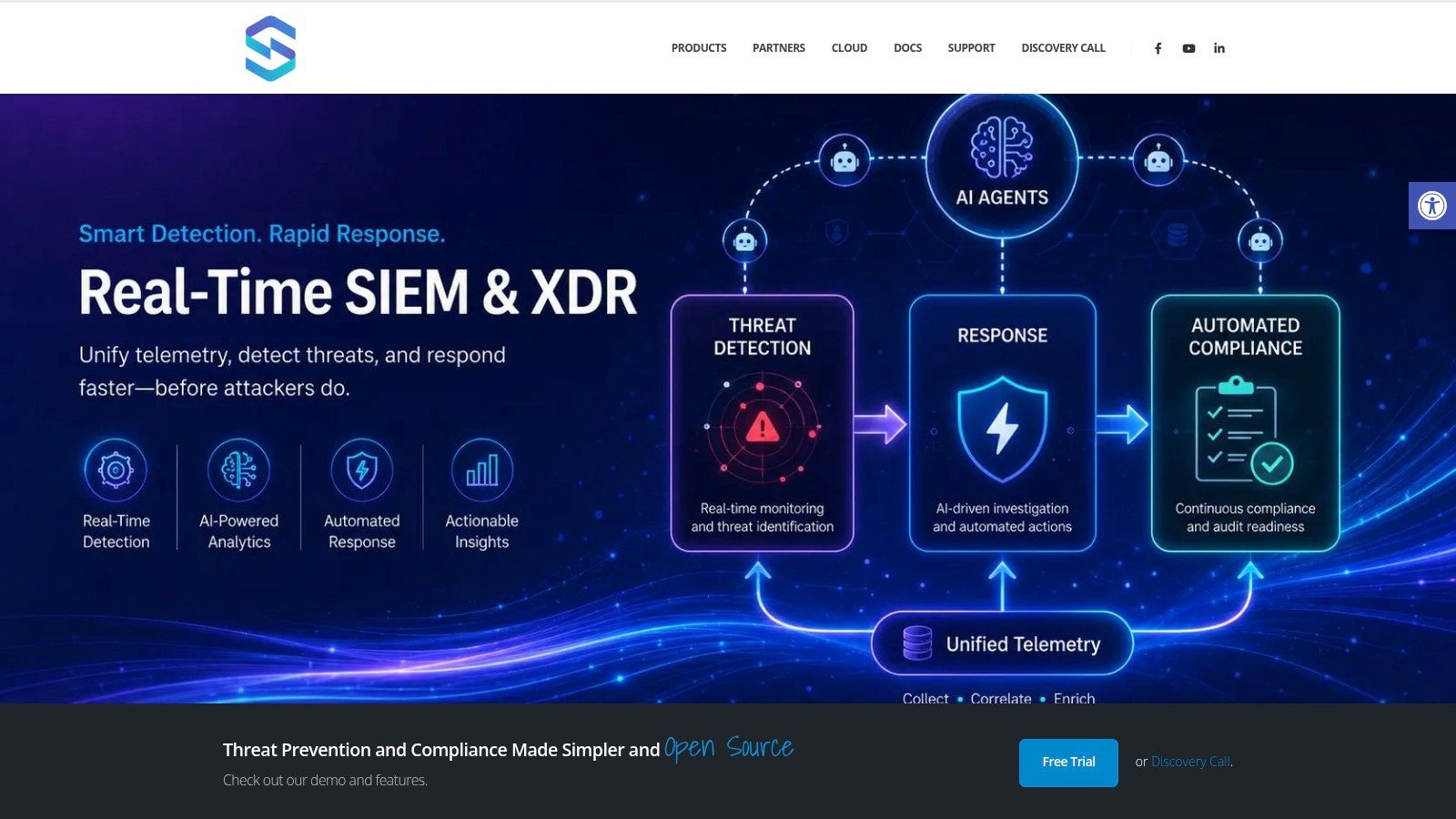
What each platform layer actually does
A SIEM provides the record of what occurred across systems. It collects authentication events, cloud logs, firewall activity, application telemetry, and infrastructure signals so analysts can correlate patterns that one tool would not detect by itself.
An EDR platform offers direct insight into host behavior. This is important when you require process lineage, suspicious execution chains, registry or persistence indicators, and the capacity to isolate an endpoint without depending on another team.
A SOAR platform converts routine response actions into governed workflows. It can open cases, enrich alerts, notify stakeholders, disable accounts, create tickets, and initiate containment steps with approval gates when necessary.
XDR is valuable when an incident spans boundaries. A mailbox alert, a cloud login anomaly, and suspicious endpoint activity frequently form part of the same narrative. XDR enables analysts to investigate that narrative in one workflow rather than piecing it together manually.
A short comparison helps:
| Capability | Primary use in response | Common failure mode |
|---|---|---|
| SIEM | Correlation, timeline, visibility across systems | Too much noise and weak normalization |
| EDR | Host investigation and containment | Incomplete endpoint coverage |
| SOAR | Repeatable actions and case workflow | Automating bad process design |
| XDR | Unified cross-domain investigation | Overreliance on vendor-defined logic |
How the stack supports the lifecycle
During preparation, teams require dependable log ingestion, case workflows, access controls, and validated automation. During identification, correlation rules and endpoint telemetry minimize blind spots. During containment, automation is important because repeated manual steps are slow and prone to error. During eradication and recovery, integrated tooling provides evidence to the team that actions altered risk.
A practical option is to use a platform that unifies these functions rather than making analysts switch among isolated consoles. Unified Security Stack's incident response automation and SOAR capabilities are one example of that model. It ingests logs, correlates events across sources, and enables automated response playbooks so teams can move from alert to action without recreating the workflow in separate products.
The balance is simple. More tightly integrated tooling generally enhances speed and consistency, but only when the organization has already established approvals, escalation logic, and playbook quality. Automating an unclear process only makes poor decisions occur faster.
Measuring Success and Mapping to Compliance
An incident response program must be evaluated as an operational capability, not portrayed as a policy document. If teams cannot demonstrate where time is lost, they cannot improve it.
Operational metrics that matter
The metrics that matter most are those connected to handoffs and delays. Teams often measure the time required to detect, validate, contain, eradicate, and recover. The value does not lie in giving leadership a vanity metric. It lies in revealing where the workflow stalls.
For instance, a team might find that technical triage is quick while containment approval is slow. Or that mailbox compromises are detected rapidly, but root-cause validation falls behind because logs are fragmented. Those are process issues, not problems with analyst effort.
A workable operating review should include:
- Detection quality: Which alerts turned into actual incidents, and which sources produced high-noise triage.
- Containment delay: Where approvals, absent access, or business dependencies delayed action.
- Recovery confidence: Whether restored systems were verified with proper monitoring and ownership.
- Repeat incident patterns: Whether the same control gap continues to reappear across different incident types.
Reporting and evidence for auditors and counsel
Incident reporting is frequently handled as the last administrative task. That is the wrong order. Effective reporting is a forensic control. Guidance from Virginia Tech's incident response management process stresses recording the incident timeline, affected systems and accounts, attack vector, remediation steps, and communication logs so teams can assist root-cause analysis and confirm recovery.
This same reporting rigor also aids compliance. Auditors and legal counsel typically seek a defensible sequence of events, proof that controls were executed, and evidence that recovery actions were verified. When the incident record is incomplete, teams must rebuild decisions from chat messages and recollection.
Consolidating evidence in one location is useful. A platform for centralized log management offers responders one place to keep relevant telemetry, maintain timelines, and align technical facts with audit requirements in regulated environments.
Effective reporting answers two questions simultaneously: what occurred, and how can we show that our response was appropriate?
When teams do this well, compliance turns into an outcome of disciplined operations instead of a separate cleanup effort once the incident is closed.
Your Implementation Roadmap and Common Pitfalls
Most organizations do not require a flawless program from the start. They need a practical one that can withstand a real incident and then get better. The greater risk is waiting until every policy, tool, and org chart appears complete.
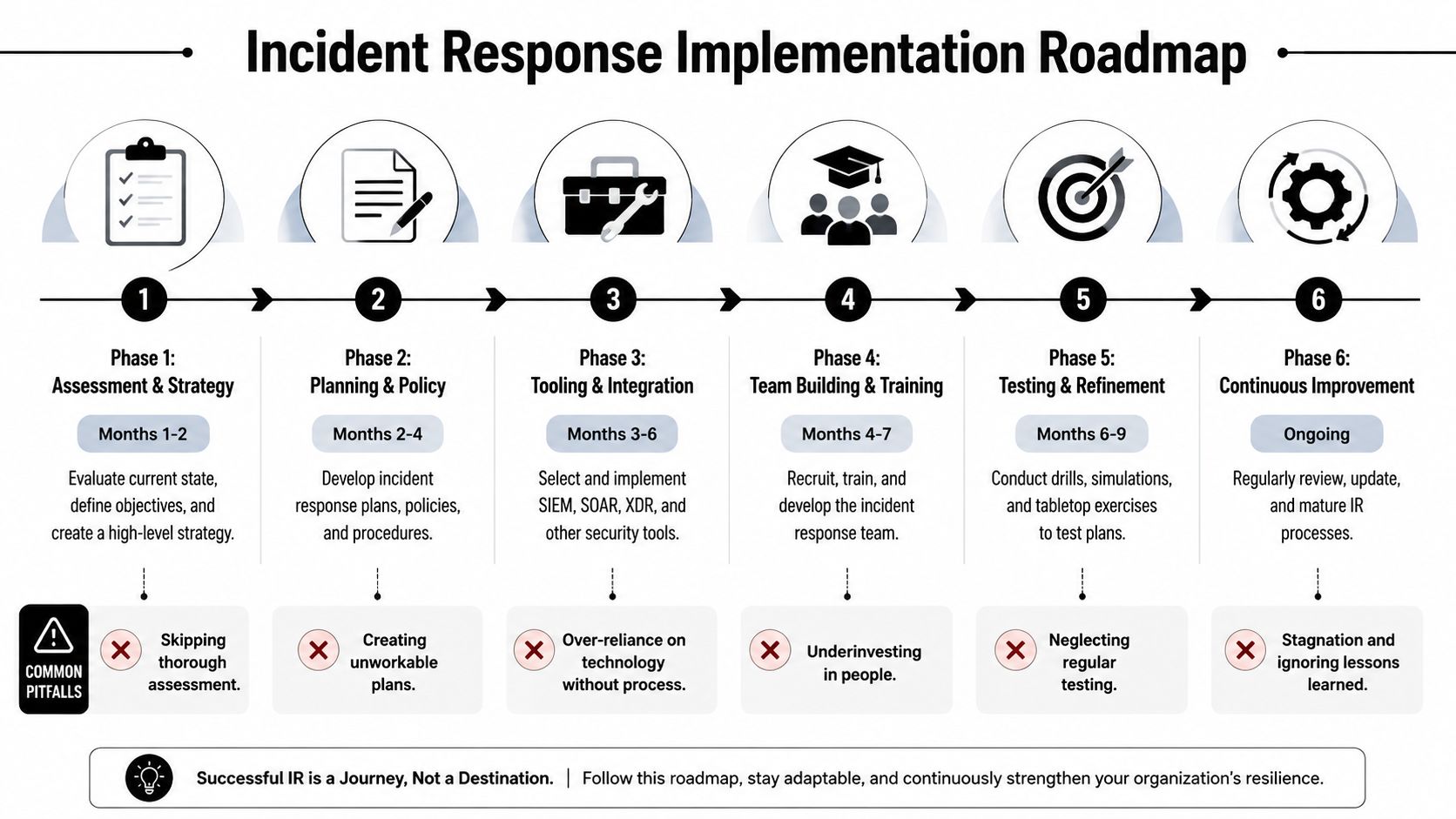
A practical maturity path
Begin by assessing existing telemetry, escalation routes, business dependencies, and lines of authority. Then draft a minimum viable response plan: severity criteria, incident roles, communication channels, evidence handling, and a brief list of priority playbooks.
Next, connect your tools to the process you plan to operate. Then train the personnel who will carry it out. This covers security, IT, legal, communications, and business owners. A plan understood only by the SOC is not a response program. It is a local procedure.
The last step is recurring testing. CISA's guidance on cybersecurity plans and assessments notes that only 30% of organizations regularly test their incident response plans, which means 70% are depending on unverified strategies during a real crisis. That should be sufficient to end the debate over whether tabletop exercises and simulations are optional. They are not.
Where teams usually fail
The most common failures are predictable:
- Untested plans: The document is in place, but no one has rehearsed decisions under time pressure.
- Unclear roles: Security, legal, IT, and leadership each presume another group is accountable for critical decisions.
- Tool-first thinking: Deployment of the stack is complete, yet the playbooks, approvals, and handoffs remain weak.
- Poor business integration: Teams can resolve alerts, but they do not know how to handle disclosure, continuity, or executive updates.
For teams building the plan itself, this incident response plan overview A useful external reference, it reinforces the need for a structured, testable operating model rather than a policy binder.
Ordinarily, the organizations that improve most rapidly are those willing to conduct imperfect drills, uncover weak points, and correct them before an attacker can.
If you're building or maturing a security incident response program, Unified Security Stack One option to assess for unifying SIEM, SOAR, XDR, and compliance workflows into one operating model. It is especially applicable if your team needs centralized visibility, automated playbooks, and evidence gathering without connecting multiple disparate tools.