AI Powered Threat Detection: CISO’s Guide
The market is sending CISOs an unmistakable message. AI-powered threat detection and response was valued at USD 5.59 billion in 2024 and is projected to reach USD 23.52 billion by 2032, at a 20.00% CAGR according to Kings Research on the AI-powered threat detection and response market. This type of expansion does not occur because security teams enjoy new tools. It occurs because current environments produce more telemetry than analysts can truly examine, and attackers evolve faster than detection rules are updated.
Traditional detection remains relevant. Signatures, blocklists, correlation rules, and analyst intuition are still components of a healthy SOC. Yet they cannot cover sufficient territory by themselves anymore. The difficult task now is not just recognizing known malicious activity. It is detecting suspicious behavior concealed within everyday log noise across cloud services, endpoints, network flows, identity systems, and third-party APIs.
This is where AI powered threat detection proves its value. Not through magic, and not by substituting for engineering discipline. It succeeds when teams supply it with usable data, limit it through context, and link it to SIEM, XDR, response automation, and compliance evidence. It fails when buyers look to a black box to repair poor telemetry, fragmented visibility, or weak detection engineering.
Table of Contents
- The Inevitable Rise of AI in Cybersecurity
- Understanding Core AI and Machine Learning Techniques
- Beyond Signatures The Power of Behavioral Analytics
- Architecting for AI Integrating with SIEM and XDR
- How LLMs Assist Alert Triage and Incident Response
- Deployment Best Practices and Reducing False Positives
- Measuring Success and Automating Compliance
The Inevitable Rise of AI in Cybersecurity
Security teams today gather more telemetry than analysts can carefully assess. That shortfall explains why AI has shifted from optional trial to routine detection work.
The cause is not novelty. It is the combination of identity logs, SaaS activity, endpoint events, cloud control plane data, firewall telemetry, vulnerability findings, and east-west traffic now arriving in one queue. Static rules remain important, but they were designed for narrower environments and more predictable data. In hybrid estates, logging quality differs by source, baselines move constantly, and attackers understand how to remain close to ordinary administrative behavior.
That final point is often overlooked in AI security writing. Noise accounts for only half the challenge. The more difficult problem is adversary camouflage. An attacker who distributes actions among legitimate tools, trusted accounts, and low-and-slow sequences can evade simple threshold logic while harmful activity merges with normal operations.
Security is now a data and context problem
Seasoned teams understand how to craft rules. Operational pressure appears when those rules must address shifting baselines, incomplete visibility, and event streams that were never properly normalized to begin with. Analysts then devote time to recurring edge cases while higher-risk activity remains hidden within routine system behavior.
AI powered threat detection assists by finding patterns that do not conform to clean signature logic. It can link weak signals across time, users, hosts, and services, then direct attention where a human reviewer would otherwise have to navigate multiple tools. That does not turn AI into magic. It makes AI useful when the data pipeline is robust enough to sustain it.
For teams evaluating practical tooling around suspicious files and indicators, a resource like Flaex's MCP server analysis tool is valuable because it demonstrates how automated enrichment can enable quicker analyst decisions without claiming to replace investigation.
Practical rule: If your detection stack can absorb additional data only by increasing analyst fatigue, the constraint is scale, not effort.
Why this became operationally necessary
The strongest AI deployments rest on disciplined event processing, normalization, and correlation. Without that base, models learn the incorrect baseline, magnify poor telemetry, and produce a new class of false positives that look complex but consume analyst time. Teams preparing for this transition should examine how event correlation and artificial intelligence in security operations fit together, because correlation provides AI with the surrounding context it requires to score behavior accurately.
Platform design also matters here. In products like Unified Security Stack, the value is not merely that AI can identify anomalies. The value is that correlated security data, enrichment, and detection logic reside along the same operational path, enabling analysts to test whether a model is uncovering attacker behavior or simply reacting to messy logs.
The operational question is where AI should sit in the stack, what data it should observe, and how much authority it should hold. In practice, this typically means using AI first to prioritize, correlate, and surface patterns, then broadening automation only after teams have tuned for noisy data and tested for AI-driven adversary camouflage.
Understanding Core AI and Machine Learning Techniques
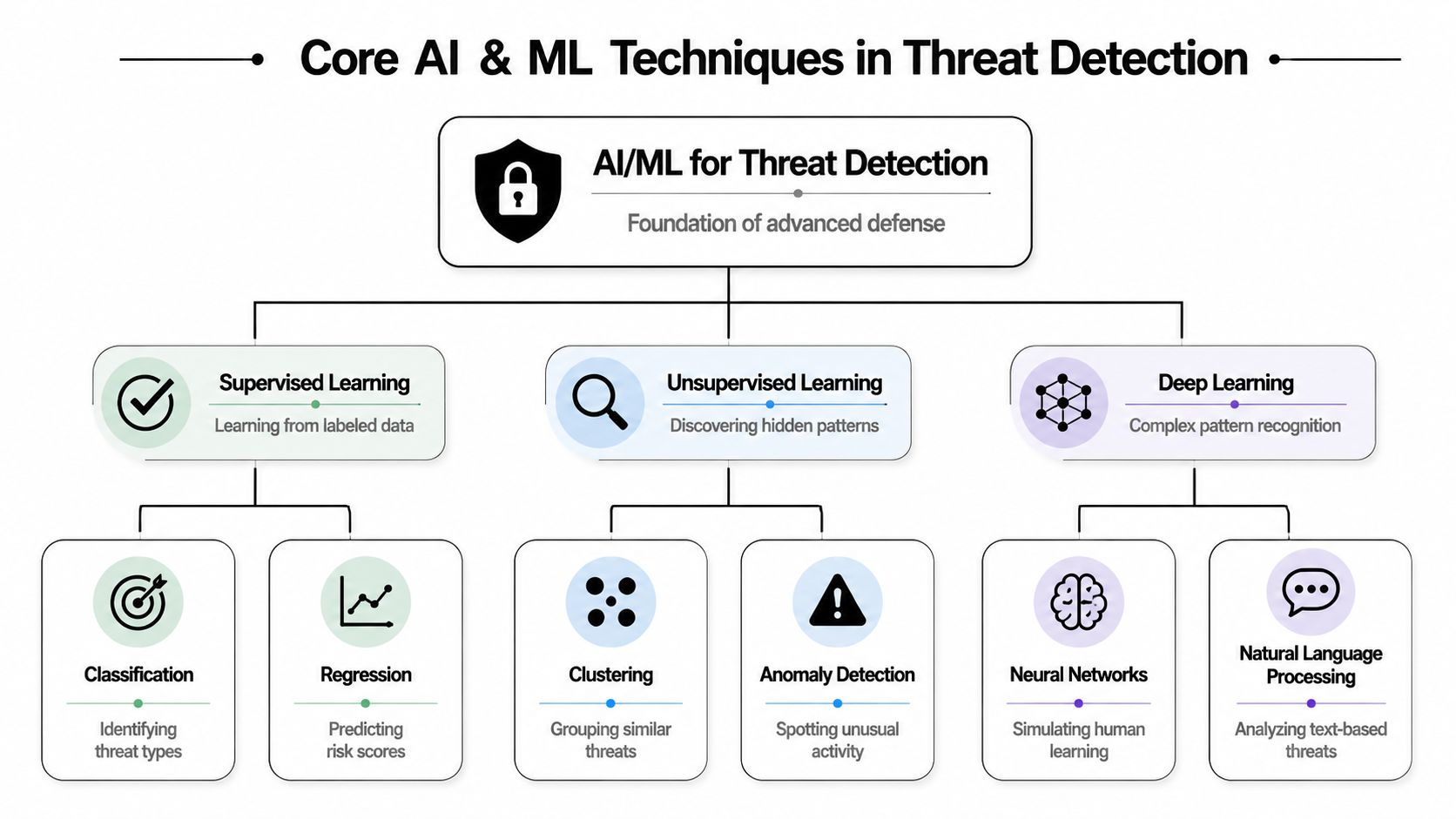
When many security buyers hear the term AI, they encounter a fog of overlapping terminology. In practice, security models are built to address different problems. Certain models classify recognizable patterns. Others hunt for anomalies. Still others manage more complex relationships involving text, process behavior, or large event sequences.
An everyday comparison can make this clear. Picture a building security team. One system is trained on labeled examples of bad behavior and learns to identify them. Another learns the building's usual rhythm and flags anything unusual. A third can process complex signals, like language or multi-step activity, that simpler models find difficult to interpret.
What supervised learning is good at
Supervised learning trains using labeled examples. In security, this frequently means known malicious files, known phishing characteristics, or known benign and suspicious activity classes. If you have ever trained a model to tell malware from not malware, that is supervised learning.
It's good at:
- Classification tasks: Placing an event, email, file, or process into a category that is already known.
- Risk scoring: Giving a comparative probability that an activity merits review.
- High-volume repetitive decisions: Managing routine decisions that analysts would otherwise make by hand repeatedly.
The limitation is clear. It learns only from what the training process specifies well. When labels are weak, outdated, or skewed toward a single environment, the model mirrors that.
Where unsupervised models earn their keep
Unsupervised learning doesn't depend on pre-labeled examples to the same degree. It searches for clusters, patterns, and outliers within the data itself. In SOC operations, this helps identify unusual behavior without requiring a known signature.
AI-driven threat detection frequently proves more valuable than legacy logic. Unsupervised models can identify a service account behaving outside its established pattern, or a host communicating in a manner that doesn't match its peer group, even when no existing rule covers that exact sequence.
Security teams need to be cautious here. Anomalous does not automatically mean malicious. Effective anomaly detection focuses analyst attention. It does not take the place of investigation.
Why deep learning matters in selective use cases
Deep learning is most effective when the input is too complex for simpler feature engineering. This can involve language-heavy signals, rich behavioral sequences, or highly variable content where context is important.
In security operations, deep learning often shows up in areas like:
- Natural language processing: Examining email content, analyst notes, or threat intelligence text.
- Sequence analysis: Interpreting chains of events instead of standalone alerts.
- Complex pattern recognition: Managing signals that do not condense neatly into a few handcrafted rules.
This is not to say every SOC problem calls for a neural network. Frequently it does not. Simpler models are easier to clarify, calibrate, and control. The real question is not which AI is the most advanced. It is which model suits the detection problem and our data quality.
If your team is sorting through that distinction, this short guide on how to choose the right AI/ML approach is a helpful framing reference because it distinguishes general AI language from concrete machine learning implementation choices.
Beyond Signatures The Power of Behavioral Analytics
Signature-based detection continues to play a part. It is fast, understandable, and reliable for known bad indicators. When a file hash, exploit pattern, or command sequence matches something already identified, signatures stay efficient.
The issue is coverage. Signatures are backward-looking by design. Attackers need only alter enough of their tooling or delivery path to evade them. That is why behavioral analytics has become essential to modern detection.
Why signatures still matter but stop short
Picture signatures as a bouncer holding a list of known troublemakers. If someone is on the list, entry is refused. If not, the system offers little judgment.
Behavioral analytics operates differently. It learns how users, hosts, identities, applications, and services typically behave. It detects when a developer account suddenly reaches systems it never accessed before, or when a backup service starts moving data at an unusual time along an unfamiliar path.
Much of what teams expect from AI powered threat detection stems from this shift. You are no longer confined to asking whether we have seen this exact thing before. You can ask whether this activity makes sense in this environment.
What behavioral analytics actually changes
The practical gains usually show up in three places:
- Compromised credentials: Behavioral models can identify login and access patterns that do not align with the user's history.
- Insider risk: Not because intent can be known from logs alone, but because abnormal access and transfer behavior often leaves a trace that can be detected.
- Low-and-slow intrusion activity: Attackers who remain quiet for extended periods are more easily missed during alert-by-alert review.
The most basic comparison is this.
| Criterion | Signature-Based Detection | AI Behavioral Analytics |
|---|---|---|
| Detection basis | Known indicators and predefined rules | Baselines, patterns, and deviations over time |
| Strength | Fast confirmation of known threats | Better at surfacing novel or subtle behavior |
| Zero-day visibility | Limited | Better suited to unknown or evolving activity |
| Alert context | Often event-level | Usually enriched with user, host, and time context |
| Tuning model | Rule updates and IOC refreshes | Baseline refinement, feedback, and environmental context |
| Common failure mode | Misses new techniques | Flags benign change as suspicious if context is weak |
Behavioral detection also relies on clean telemetry and reasonable baselines. If the team does not understand what normal means for privileged accounts, service identities, admin tools, and maintenance windows, the model will struggle.
For a concrete view of how this works in practice, behavior anomaly detection in modern security operations is a valuable reference because it treats behavior as an operational signal, not merely a marketing term.
Architecting for AI Integrating with SIEM and XDR
AI does not exist in a vacuum. It must be part of an operating model. In actual deployments, this means SIEM, XDR, enrichment, response automation, and reporting all need to operate from the same underlying event stream.
The biggest design error is investing in an AI layer before repairing data ingestion. Teams expect the model to clean up the chaos. It will not. It will learn from the chaos.
Start with the data pipeline not the model
Hybrid environments create challenges. Cloud services generate one kind of telemetry. Network devices generate another. Endpoints, SaaS platforms, IAM tools, and legacy systems each send distinct fields, distinct formats, and varying levels of reliability.
2025 industry reports reveal that 60% of hybrid cloud breaches involve AI models failing due to data drift from unstructured logs in legacy systems, and organizations using AI in mixed environments report 30% higher false negative rates when logs lack standardization, according to Oligo's analysis of AI threat detection in real-world applications. This matches what many architects observe directly. When log quality changes while model assumptions do not, detection quality weakens subtly.
Sound ingestion is better than sophisticated modeling. When fields vary, timestamps wander, identities fail to resolve, and asset context is absent, the AI layer will generate polished nonsense.
What a workable architecture looks like
A strong architecture usually follows this path:
- Ingest broadly via APIs, Syslog, NetFlow, cloud audit sources, endpoint agents, and identity systems.
- Normalize aggressively so shared entities such as user, host, process, source, destination, and action are represented consistently.
- Correlate before scoring so the AI layer receives sequences and relationships rather than isolated pieces.
- Enrich with context including asset criticality, user role, known maintenance windows, and earlier related alerts.
- Route output carefully into queues for analysts, automated playbooks, case management, and reporting.
This is why AI-powered detection generally performs best within a wider platform, not as a standalone point product.
Where Unified Security Stack fits
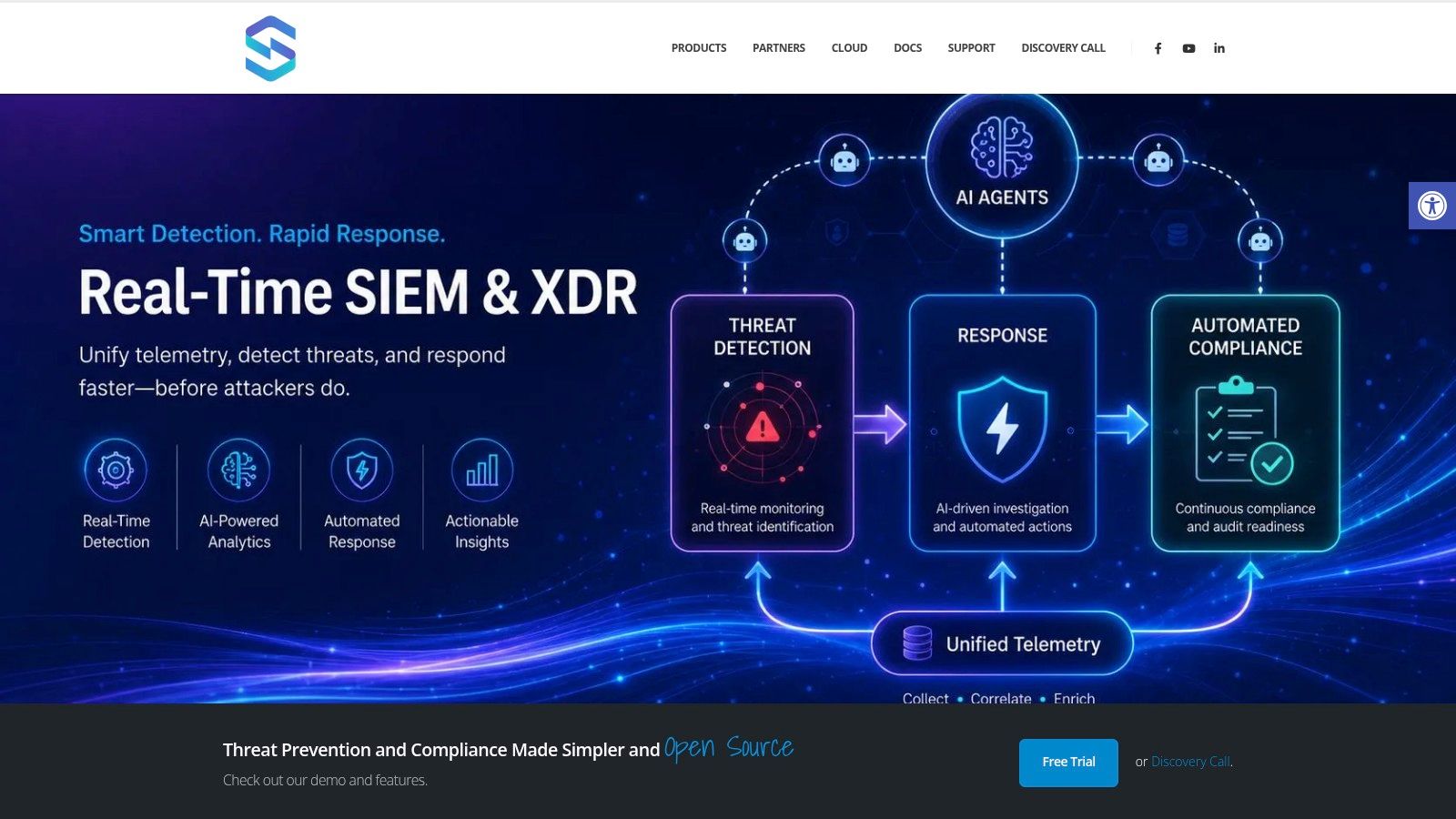
One practical example is Unified Security Stack, which unites SIEM, SOAR, and XDR functions in one workflow. Its architecture matters here because it takes in cloud, endpoint, and network telemetry via APIs, Syslog, NetFlow, and agents, then correlates events before indexing. That order is important. It cuts noise before analysts or downstream AI models must interpret the data.
From an architecture standpoint, that is the correct path for AI-powered threat detection. Place AI after normalization and correlation, not ahead of them. If you are assessing cloud-delivered security analytics patterns, SIEM on cloud architectures for hybrid environments is worth examining because deployment model and data path decisions directly shape detection quality.
How LLMs Assist Alert Triage and Incident Response
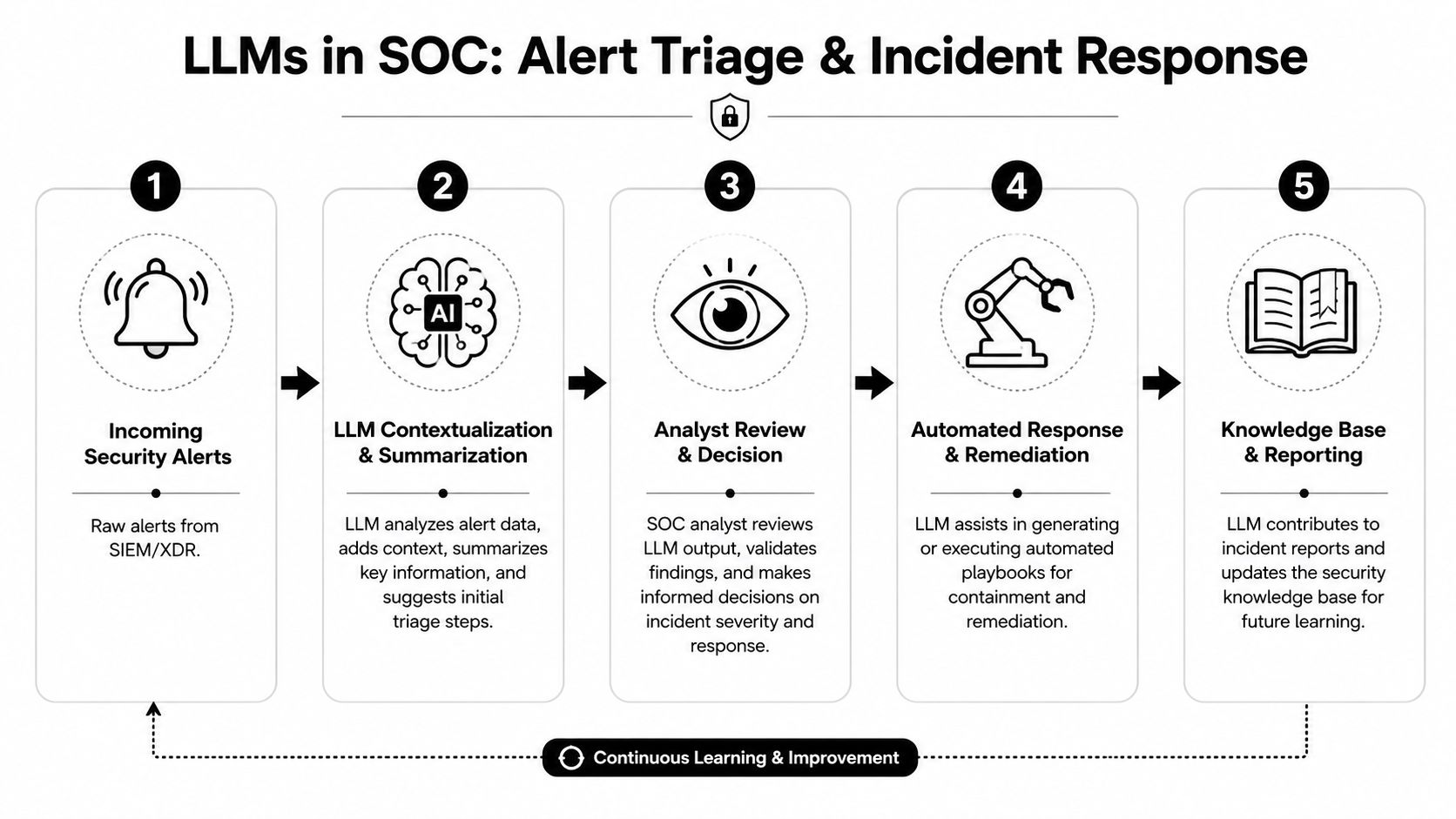
Large language models have value in the SOC, though not as many vendors suggest. They typically are not the primary detection engine. They operate after detection, helping people understand, prioritize, and respond to what the system has already identified.
That difference is important. If you think an LLM will take the place of a behavioral model, it will not. If you use it to convert noisy machine output into clear analyst context, it can save time.
A straightforward sequence clarifies the role.
Detection models and LLMs do different jobs
A detection model may flag suspicious lateral movement, unusual token use, or an endpoint behavior sequence worth examining. The LLM then helps turn that into something an analyst can use promptly.
Rather than displaying ten related events and an unfiltered correlation chain, the system can generate a brief summary: what occurred, why it matters, which assets were involved, and what follow-up checks make sense.
Three places LLMs help immediately
- Alert summarization: Analysts do not need another stack of JSON. They need a concise, accurate incident narrative.
- Guided triage: An LLM can propose useful questions, such as whether the identity has privileged access, whether the host faces the internet, or whether similar activity has occurred recently.
- Rule and playbook drafting: Analysts can state a desired response in everyday language and then refine the resulting rule or workflow.
That final scenario carries more weight than most people realize. Plenty of teams have no shortage of ideas. What they lack is the time to convert those ideas into detections and playbooks ready for production.
A short demo can make that more tangible:
In incident response, LLMs deliver the most value as support tools rather than final authorities. Allow them to summarize, draft, and offer recommendations. Trained analysts should retain the final say on investigations and containment decisions.
An important control concern also exists. LLM output must be viewed as analyst support, never as fact. It may summarize context effectively, yet it can also exaggerate certainty or overlook details unique to the environment. Organizations require auditability, prompt safeguards, and explicit limits on which actions may run automatically.
Deployment Best Practices and Reducing False Positives
Many AI detection initiatives fail because of flawed implementation, not inadequate models. I have watched teams direct a new model at disorganized hybrid telemetry, leave default thresholds in place, and then ask why analysts are overwhelmed by alerts within days.
A phased rollout resolves much of that.
Begin in observation mode. Allow the platform to study behavior patterns across identities, endpoints, service accounts, cloud workloads, and business applications. During this phase, examine the output carefully. The objective is not to celebrate anomaly scores. It is to uncover absent logs, malfunctioning parsers, inconsistent asset names, and identity gaps that will corrupt the model down the line.
Assisted operations come next. Have the system prioritize alerts, group related signals, and present context, while analysts remain responsible for containment. Once the team recognizes recurring alert patterns and has confidence in the telemetry pipeline, automate a limited set of actions with well-defined rollback criteria.
In practice, four deployment habits make a measurable difference:
- Set baselines before turning on aggressive response. Tasks such as administrative work, automation jobs, patch cycles, and finance or HR processes frequently appear suspicious until the system has observed them often enough.
- Restrict the scope of the initial rollout. Tuning a clearly understood business unit or a compact collection of high-value data sources is simpler than tuning the whole environment.
- Incorporate analyst feedback into training input. Model refinement and enrichment logic should incorporate dispositions, suppressions, and investigation results.
- Maintain separation between severity and confidence. Even a low-confidence signal tied to a domain controller may warrant review. A high-confidence alert on a low-value test asset might not.
Cutting false positives is just part of the effort. Mature teams also adjust for adversaries who learn the baseline and remain near it.
Proofpoint's discussion of AI threat detection and adversarial camouflage underscores an issue many vendor articles overlook. Adversaries shape traffic and behavior to merge with routine cloud and user activity. In hybrid environments, detecting this becomes more difficult because the baseline is already noisy. Remote administration, SaaS integrations, ephemeral workloads, and service-to-service traffic all provide cover.
This alters the way detections must be designed. Static thresholds and standalone anomaly scores do not suffice. More effective deployments seek combinations of weaker signals: privilege context, deviation from peer groups, irregular sequencing, access to sensitive assets, session timing, and behavioral shifts following a role change or infrastructure change.
Field note: When a model only considers whether an action is unusual, it will overlook operators who understand how to remain just within the boundary of normal behavior.
Solid entity resolution is more important here than many teams anticipate. If the platform cannot reliably associate events with the same user, host, container, or workload across sources, the model loses continuity. Service accounts require separate handling for the same reason. Their behavioral patterns differ from those of human users, and merging them into a single baseline reliably generates noise.
Managing exceptions also demands discipline. Migrations, new SaaS deployments, and maintenance windows often produce legitimate anomalies. Record those exceptions, set time limits for them, and revisit them once the change is complete. Permanent suppressions tend to deteriorate over time.
This is one area where Unified Security Stack aligns closely with the newer operating model. The value is not limited to AI scoring. It emerges from bringing behavioral analytics together with correlation, asset context, analyst feedback, and controlled automation within a single workflow. That method matches the real conditions security teams face: imperfect data, shifting infrastructure, and adversaries learning to conceal themselves within both.
Measuring Success and Automating Compliance
Security teams adopting AI for detection still fall short when they cannot demonstrate two results. The time required to detect and contain genuine threats must decrease, and the program must generate audit evidence without adding yet another reporting load.
Use operational metrics leadership can understand
An effective scorecard begins with mean time to detect, mean time to respond, analyst effort per incident, and the percentage of alerts that turn into validated investigations. These measures show leadership whether the system is lowering risk or merely producing activity.
They also reveal a frequent failure pattern in AI deployments. A model may appear accurate during testing yet still consume analyst time in production because the environment is noisy, the asset inventory is incomplete, or the data supplied to the model is inconsistent across cloud, endpoint, identity, and network sources. In hybrid environments, I would prefer a modest gain in response time that persists week after week over an impressive detection rate that falls apart under ordinary operational noise.
Also monitor suppression rates and reopened cases.
Those metrics help tell sound tuning apart from indiscriminate filtering. When alert counts fall while reopened investigations climb, the team may be training the system to disregard meaningful weak signals, among them the low-and-slow patterns that AI-driven adversary camouflage relies on.
Compliance gets easier when detection creates evidence
Compliance work becomes less burdensome when detections, analyst actions, case notes, and response steps reside in one system. That platform then forms part of the evidence trail for HIPAA, CMMC, SOC 2, PCI DSS, ISO 27001, and comparable frameworks.
The payoff in practice is straightforward. Rather than rebuilding incident timelines, ownership records, escalation history, and remediation actions for every audit cycle, teams can draw them from routine security operations. That lowers manual reporting effort and offers leadership better visibility into how controls perform over time.
A trade-off exists here. Automated control mapping delivers time savings, yet only when the detections beneath it are properly tuned and the evidence is kept in a form auditors can verify. Poor data hygiene, brief retention periods, and uneven case handling will weaken the AI initiative and the compliance narrative alike.
Reaching this degree of integration across detection, response, and compliance typically calls for a platform built with that objective in mind.
If you're evaluating such a unified approach, Unified Security Stack is worth evaluating for hybrid environments. It brings SIEM, SOAR, XDR, log management, and compliance workflows together in a single operating layer, which lets security teams link detection outcomes to audit-ready evidence rather than running those efforts as separate initiatives.