What exactly is a Cloud SIEM? The downsides, the upsides, and the difficulties.
Security Information and Event Management (SIEM) is a software solution that gathers security data from various sources, examines log information, and detects patterns that could point to a threat or breach. With SIEM, IT teams can detect and respond in real time to many types of threats throughout networks. Yet traditional on-premises SIEMs are falling behind and are being displaced by newer security approaches that offer stronger benefits.
What is a Cloud SIEM?
The growth of cloud SIEM has delivered major advantages for organizations that must oversee and control all their data, users, servers, devices, applications, and other endpoints efficiently and effectively from any location, at any time. All through a single central cloud-based dashboard where administrators can find and resolve any potential cyber security threats.
A cloud-based SIEM lets IT teams manage threats with added flexibility, convenience, and power across several environments.
This SIEM, known as Cloud SIEM-as-a-Service (SaaS), gives organizations an enterprise-grade security solution without requiring expensive on-premise hardware and software. Organizations can set up a cloud SIEM within minutes with no upfront infrastructure or staff training investment. So,
What advantages does cloud-based SIEM offer compared with on-premises SIEM?
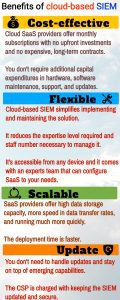
Cloud-based SIEM solutions offer several advantages over traditional SIEM on-premise solutions:
- Cost-effective - Cloud SaaS providers provide monthly subscriptions without upfront investments and without costly long-term contracts. A cloud-based SIEM gives access to many plans that are far more profitable than an on-premise SIEM. Also, since you do not require extra capital expenditures for hardware, software maintenance, support, and updates, this model allows you to lower costs.
- Flexible - Cloud-based SIEM solutions are built to make implementation and maintenance easier. Because SaaS requires no installation, it lowers the expertise level and the number of staff needed to manage it. In addition, you can reach the SIEM from any device and get faster custom implementations since SaaS includes a team of experts who can configure it for your needs.
- Scalable - As an organization expands, cloud SIEM solutions should deliver the agility and scalability needed to manage enormous volumes of data. These SIEM providers offer large data storage capacity, faster data transfer rates, and much quicker operation. Installing an on-premise SIEM solution can involve a lengthy onboarding process before the system is fully operational. With the Cloud SaaS solution, deployment is faster.
- Update - The Cloud SIEM eliminates the need to manage updates and keep pace with new capabilities. As a result, the Cloud Service Provider (CSP) is responsible for keeping the SIEM updated and secure.
Downsides of cloud-based SIEM
As is well known, no SIEM solution is perfect. Cloud SIEM likewise has its own possible limitations, including:
- Sensitive data is moved off-site: Data management always carries risk. An organization continually faces risk when moving sensitive data off-site, and the risks tied to data in transit are always higher than those for data at rest. When choosing Cloud SIEM, you should understand how frequently providers update their systems and integrations and what encryption practices they apply to your logs. Thus, if data is managed correctly, they can reduce the risks that come from transferring and storing data with a third party.
- Focus on Monitoring and Reporting: Certain Cloud-based SIEM providers concentrate on monitoring and reporting features, overlooking the risks tied to insufficient threat management and threat remediation. You must make sure that your provider is as committed to threat mitigation and remediation as you are.
- Limited data access: Often, some Cloud SIEM vendors do not provide access to your data, even though it is your data originating from your endpoints and systems. Your provider should be dependable, allowing you access to your data at any time; even so, you receive reports based on data collected from your endpoints. If your provider does not do this, ideally through a customized dashboard, it is likely time to rethink your service.
Today, small and midsize businesses (SMBs) can adopt SIEM tools for both compliance and for tracing and diagnosing security issues. Unified Security Stack is a strong on-premise and cloud-based SIEM provider. In either case, Unified Security Stack provides affordable, cost-effective solutions for SMBs, helping companies lower TCO.
So, which particular features does cloud-based SIEM Unified Security Stack provide that make it appealing?
Features of Unified Security Stack in the cloud
Unified Security Stack currently integrates with Azure, AWS, Google Cloud, SaaS, and PaaS including Office365 and AWS Lamda.
With Unified Security Stack, you don’t have to worry about deploying your Managed SIEM, watching over the infrastructure, or handling compliance. You will not have to actively safeguard your organization, yet you will retain full access to your dashboard. The expert team at Unified Security Stack is thoroughly trained to manage SIEM, identifying and addressing any suspicious activity that might put your environment at risk.
Features of Unified Security Stack’s Cloud-based SIEM:
- Log Management
- Dashboard Builder
- Vulnerability Scanners (Vulnerability Management)
- Identity Management
- Incident Response
- HIDS and NIDS
- Cloud Monitoring (AWS, Azure)
- Endpoint Protection compatibility
- Compliance Management (HIPAA, GPDR, ISO, SOC, and GLBA)
- Custom reports
- File Tracking and Classification
- Threat Intelligence
Choosing the proper cloud SIEM provider becomes a critical asset for your organization in combating cyber threats. One of the key reasons organizations ought to adopt this SIEM technology is because it allows them to meet security compliance standards at an affordable price.