Mastering Threat Detection and Prevention in 2026
Cybersecurity leaders do not require one more notice that threats are expanding. They require a framework aligned with how attacks unfold today. The pressure is difficult to dismiss given that the threat detection system market is expected to increase from $13.4 billion in 2024 to over $54 billion by 2034, while global cyberattacks average 1,968 incidents per week and cybercrime is projected to cost the world $23 trillion in 2027, according to Statista's threat detection market analysis.
What alters the discussion in 2026 is not simply additional tools. It is the demand to bring security operations, response automation, and compliance evidence together under a single operating model. CISOs are working to protect hybrid environments, govern identity-centric attack paths, meet HIPAA, GLBA, PCI, CMMC, and ISO 27001 requirements, and still provide analysts with a workflow they can run effectively each day.
The real question is no longer if you possess SIEM, EDR, XDR, malware research feeds, CVE context, or compliance mappings. It is whether those elements interoperate well enough to enable dependable threat detection and prevention.
Table of Contents
- The Escalating Need for Unified Threat Management
- Detection Versus Prevention A Fundamental Distinction
- Core Architectures SIEM XDR and SOAR Explained
- Detection Engineering and Threat Intelligence
- Automated Response and Security Playbooks
- Measuring Success with MTTD MTTR and False Positives
- Unifying Security Operations and Compliance Management
The Escalating Need for Unified Threat Management
Security teams seldom fail due to a shortage of tools. They fail because every tool resolves only one portion of the incident.
One console displays endpoint activity. Another contains cloud alerts. Identity data remains with the IAM team. Compliance evidence resides in tickets, screenshots, and spreadsheets that surface just before an audit. In a hybrid environment, that division introduces delay precisely where speed and context are most critical.
The market has answered that pressure, and the growth numbers mentioned earlier show it. Organizations are increasing detection spending because attackers traverse identity, endpoints, SaaS, and cloud workloads faster than isolated teams can investigate. The business effect extends beyond incident response alone. A missed sequence can turn into a data exposure, an outage, a reporting issue, or all three.
Unified threat management is important because attacks do not respect org charts or product boundaries. A suspicious sign-in can result in token abuse in a SaaS app, unusual mailbox access, data movement, and then a compliance issue because the team cannot demonstrate a clear timeline of who accessed what. Security leaders seeking a sound operating model typically begin by setting risk tolerance and priorities, often using broader frameworks such as TekRecruiter's cyber risk expertise, then translate those choices into detection, response, and evidence gathering.
A unified, open-source platform alters the economics of this effort. It places telemetry, correlation, response workflows, and audit artifacts into a single operating layer rather than dispersing them across disconnected products. That does not eliminate the need for specialized controls. It does lower the cost of context switching, duplicate integrations, and parallel reporting processes owned by separate teams.
The practical gains are specific:
- Shared visibility: Endpoint, identity, network, cloud, and application events arrive in one location for investigation.
- Cross-domain correlation: Analysts can link low-signal events that appear harmless on their own but point to account misuse or lateral movement when seen together.
- Repeatable response: Frequent cases such as impossible travel, malware on a managed host, or privileged account misuse can follow established playbooks.
- Built-in evidence collection: The same workflow that enables triage can retain logs, decisions, and timestamps for internal review and external audits.
There is a trade-off. Centralization can generate noise when teams ingest everything without a data model, detection standards, and ownership. Open-source platforms help manage cost and lessen vendor lock-in, but they still demand engineering discipline. Normalization, rule tuning, retention design, and access control determine whether the platform becomes an operational security layer or merely another data sink.
One rule proves reliable in practice. If a control helps an analyst investigate but cannot support an audit, or meets an audit requirement but gives defenders no usable signal, the program is carrying avoidable overhead.
Teams that need a common vocabulary before changing architecture should align on key unified threat management terms. Clear terminology prevents vendor packaging from steering design decisions that ought to rest on risk, operations, and compliance needs.
Detection Versus Prevention A Fundamental Distinction
Security programs decline when teams treat detection and prevention as interchangeable. They are connected, but they address different problems.
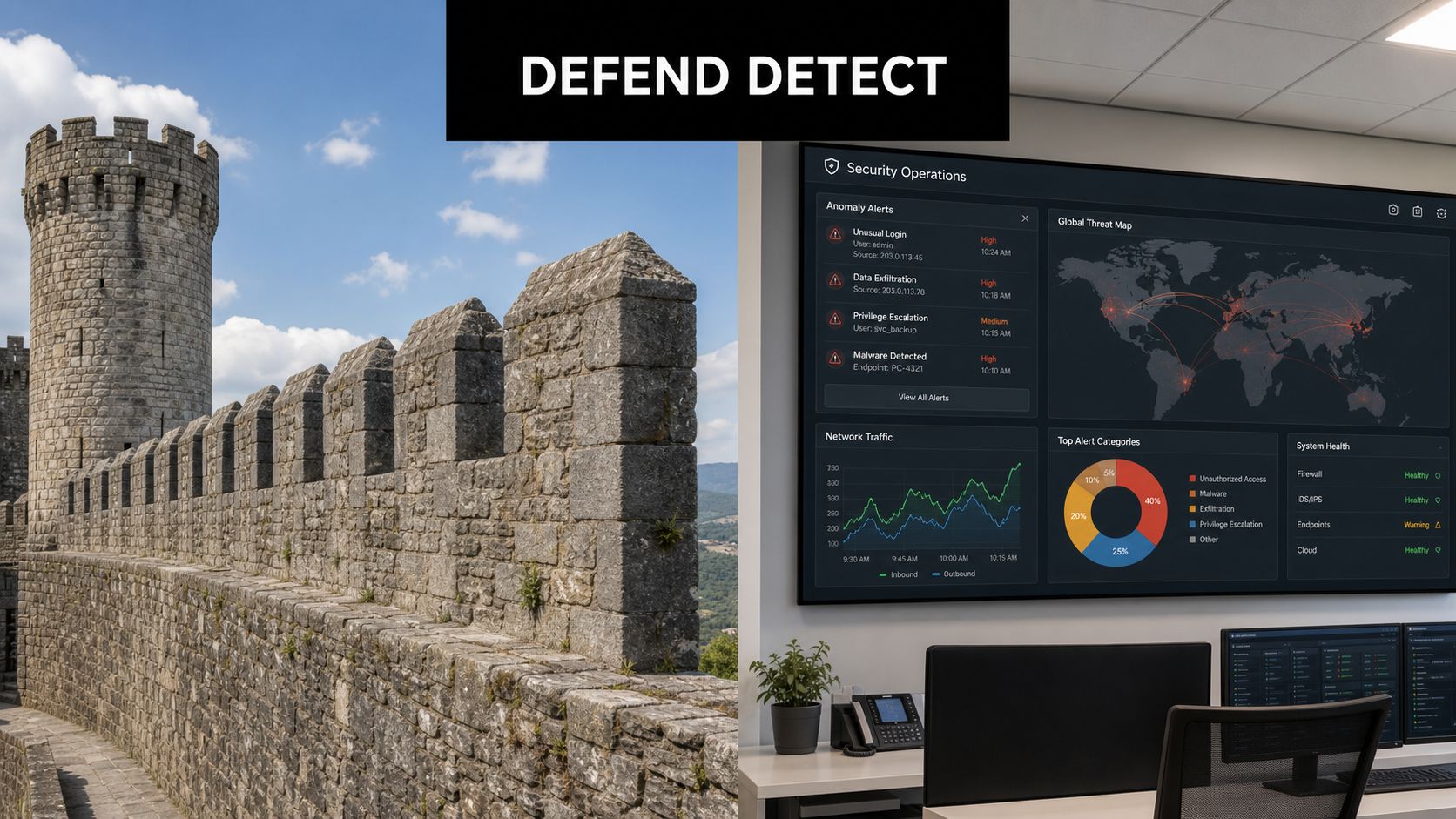
Prevention acts as the wall, gate, and lock. It aims to halt malicious activity before it succeeds. This includes firewall policy, MFA, allowlisting, email filtering, endpoint hardening, and access controls. Detection is the patrol within the fortress. It searches for signs that someone entered anyway, or that a trusted user is doing something they should not.
Why prevention alone fails
Prevention controls remain necessary. No serious architect claims otherwise. But prevention has blind spots that grow wider in cloud-first environments.
An access policy can be correct and still permit abuse of a valid account. An endpoint control can be healthy and still miss a sequence that relies on native administration tools. An email gateway can block obvious phishing and still allow a message that leads to token abuse through a trusted workflow.
This is why experienced teams no longer debate which side matters more and instead ask where each one fails. Prevention shrinks the attack surface and filters out commodity noise. Detection finds the routes that remain once controls are deployed.
Why detection now has to be behavioral
Earlier methods depended primarily on known malicious files, static IOCs, and signature matching. This approach no longer suffices against contemporary adversary tactics. CrowdStrike’s 2026 report revealed that 82% of detections were malware-free, with attackers increasingly using valid credentials and trusted SaaS integrations, which pushes defenders toward behavioral anomaly detection rather than static IOC matching, as summarized in this SentinelOne review of malware statistics.
That single shift changes program design in a few important ways:
| Security objective | Prevention-heavy approach | Detection-heavy approach |
|---|---|---|
| Stop known malicious files | Signature scans and filtering | Process behavior and execution analytics |
| Protect identities | Password policy and MFA | Impossible travel, token misuse, odd privilege use |
| Secure SaaS | App approval and settings | Baseline deviations, impossible workflows, unusual API activity |
| Contain abuse | Manual analyst action | Automated isolation, revocation, or quarantine |
The most effective programs presume that certain sanctioned tools, identities, and integrations will be exploited. They build detections for misuse, rather than only for malware.
What works in practice
The practical design pattern is layered defense with explicit handoff points:
- Apply prevention to lower noise. Block what you can with low cost and high reliability.
- Rely on detection to uncover what appears legitimate on the surface. Concentrate on behavior, sequence, and context.
- Apply response to contain quickly. Effective detection absent containment still leaves room for lateral movement.
What fails is heavy investment in prevention while treating detection as a reporting function. By the time a CISO sees the consequences of that error, the problem typically is not a tool failure. It is that the security model equated blocked with safe.
Core Architectures SIEM XDR and SOAR Explained
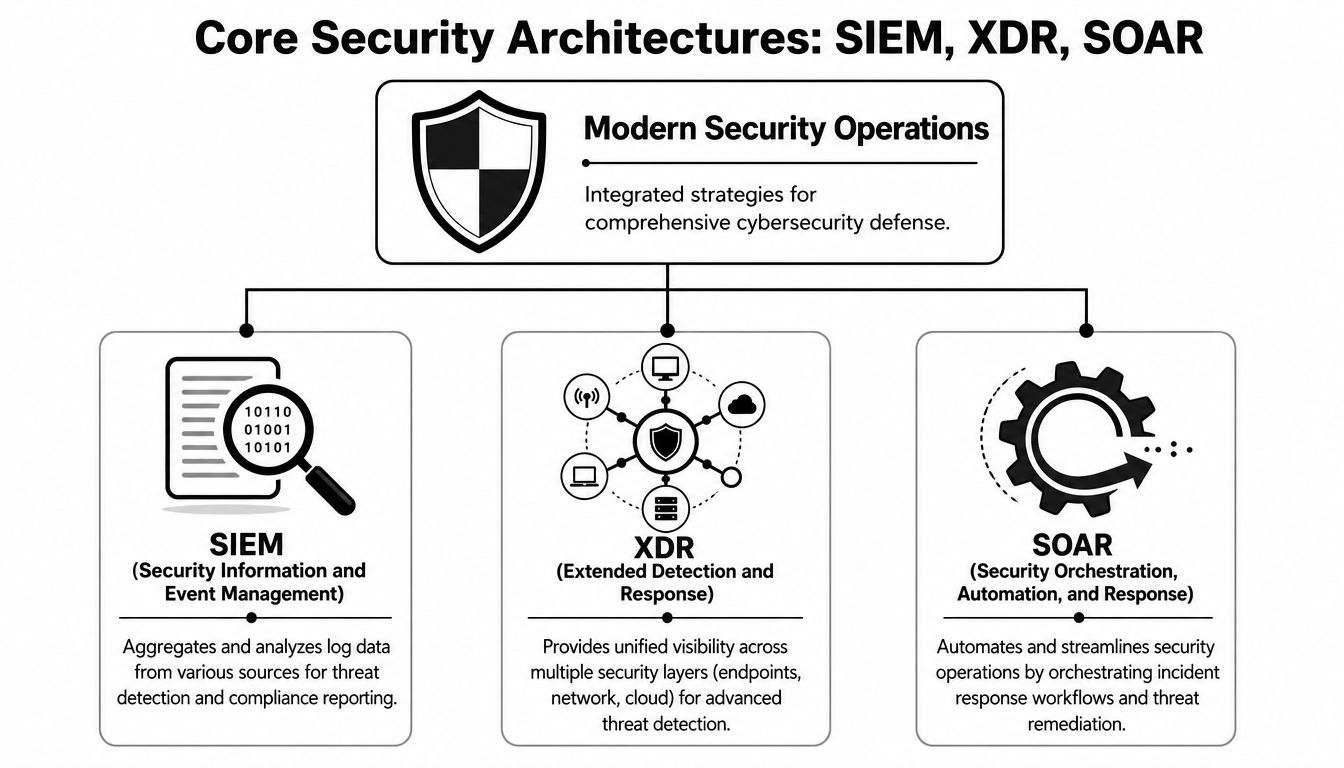
Much of the confusion in security purchasing stems from viewing SIEM, XDR, and SOAR as rival categories. In actual operations, they are separate layers within one system.
What SIEM does well
SIEM remains the foundation for centralized log management, event normalization, correlation, and auditability. It is where security teams aggregate authentication logs, firewall records, cloud events, vulnerability findings, and application activity. It is also where compliance teams turn when they need traceability.
SIEM is most effective when the organization requires breadth. If the question is whether we can search across all critical systems and reconstruct what happened, SIEM is typically the answer. The trade-off is that SIEM can grow costly and noisy when ingestion discipline is weak and detections are poorly tuned.
Where XDR adds depth
XDR extends detection and response across several domains with stronger operational context. In practice, this frequently means improved linkage among endpoint activity, identity events, cloud telemetry, and at times network observations.
XDR generally lowers analyst friction by presenting a threat narrative rather than requiring manual stitching. It is valuable when the team must understand a campaign across control planes, not merely inspect isolated logs. The trade-off is breadth of coverage. Some XDR products are wide-ranging, while others remain endpoint-centric with additional connectors at the edges.
A useful way to think about the split is simple:
- SIEM answers: What occurred across the estate?
- XDR answers: What attack story is developing across related controls?
- SOAR answers: What action should the system take next?
For teams comparing operating models, this overview of security incident and event management systems serves as a useful companion to architecture reviews because it clarifies where collection, analysis, and response duties reside.
Why SOAR matters after detection
SOAR becomes valuable as soon as a team can describe the same incident steps repeatedly. If analysts consistently enrich an alert with identity context, consult threat intelligence, retrieve host details, notify the owner, and quarantine a mailbox, that should be turned into a workflow.
SOAR is not only about speed. It is about consistency. A well-designed playbook lowers analyst variance, maintains evidence, and prevents basic containment from hinging on whoever is working that shift.
Architect's view: Automation delivers the quickest returns on repetitive, high-confidence actions. It breaks down when teams automate decisions before standardizing them.
How the stack fits together
The healthiest operating model combines the three:
| Layer | Primary purpose | Typical output |
|---|---|---|
| SIEM | Collect and correlate telemetry | Alerts, searches, evidence, dashboards |
| XDR | Link activity across controls | Incident context, attack chain visibility |
| SOAR | Orchestrate response steps | Tickets, enrichments, containment actions |
An open-source platform can ease friction among those layers when it manages ingestion, correlation, response, and compliance evidence in a single place. Unified Security Stack is one instance in that category. It brings together SIEM, SOAR, and XDR capabilities for hybrid environments and is frequently considered by teams seeking a single operating surface rather than several separate consoles. For readers assessing the overlap among these categories, this SIEM vs XDR comparison is helpful because it shows where these technologies complement one another instead of competing.
Detection Engineering and Threat Intelligence
Detection quality does not result from purchasing a platform. It results from engineering. That means selecting the right telemetry, authoring rules that withstand imperfect data, aligning logic with attacker behavior, and tuning continuously.
Start with telemetry you can trust
Most detection programs that fail do not do so because analysts lack skill. They fail because telemetry is incomplete, late, duplicated, or inconsistent. A solid engineering workflow begins by establishing what needs to be visible across endpoints, identities, cloud services, SaaS applications, firewalls, and vulnerability data.
The difficulty is not gathering everything. It is gathering what supports a detection hypothesis. To detect suspicious privilege escalation, you need identity changes, successful and failed authentication context, host process events, and sufficient asset metadata to determine whether the behavior is expected.
Another operational gap that many teams undervalue is demonstrating that the telemetry source is sound. Public guidance frequently overlooks the question of verified EDR deployment health, although security leaders routinely must show that agents are deployed, meet policy, and work across the environment. This gap is important because quiet coverage failures build false confidence well before they produce alerts.
Write rules that survive real-world data
Correlation rules frequently break for mundane reasons. Absent fields. Surprising data types. Regex that is too broad. Fixed values where dynamic correlation is required. Sound rule design presumes event pipelines are disorderly.
Unified Security Stack's rule guidance is useful in this context. Effective SIEM correlation rules should rely on CEL expressions that handle missing fields with safe() and has(), while limiting dataTypes to what the rule requires for stronger performance and accuracy in hybrid environments, as documented in Unified Security Stack's correlation rule implementation documentation.
A few design habits consistently help:
- Handle nulls first: Create conditions that will not fail when a field you expect is missing.
- Limit scope: Limit data sources and event types so the rule processes only the smallest required volume.
- Correlate on dynamic values: Link related events to user, host, process, or token context rather than fixed strings.
- Set time windows deliberately: Brief enough to reduce noise, long enough to detect multi-step activity.
Tune detections like a product
Detection engineering is ongoing, iterative work. A rule should progress through hypothesis, draft, testing, deployment, review, and refinement. When a team writes rules once and never revisits them, false positives pile up and analysts lose trust in the queue.
The recommended approach is to unit test conditions against events that should trigger, events that should not, and edge cases before broader deployment. Deduplication also counts. Rules that keep triggering on the same condition teach analysts to disregard useful signals.
Strong detections are not those that fire most frequently. They are the ones analysts continue to trust after months in production.
Threat intelligence strengthens this process when it shapes logic instead of merely decorating it. The useful question is not what new IOC was ingested. It is what attacker behavior should change in our rules based on what we learned.
Behavioral analytics is also increasingly important today because teams must detect deviations from normal workflows, not only match known-bad artifacts. This is especially critical for insider risk, where security teams often need not just anomaly scoring but a clear, human-readable rationale for why a pattern is suspicious. For practitioners who are building that capability, this detection engineering resource is a sensible starting point because it keeps attention on implementation rather than theory.
Automated Response and Security Playbooks
Even the best detection leaves you exposed if each response begins with a person opening five tabs and moving details into a ticket. Security playbooks are meant to eliminate that delay.

A ransomware alert that doesn't wait for a meeting
A useful playbook begins with a focused scenario. For example, an endpoint alert shows suspicious encryption behavior, a user account has unusual access activity, and the host recently contacted an unfamiliar external service. The system should not simply create a case and wait.
A mature workflow can enrich the alert, retrieve host context, verify whether the device is managed, gather recent user activity, and isolate the endpoint when confidence is high. It can also inform the owner, open an incident, and retain artifacts for later review.
That order matters because containing ransomware is a race against lateral movement and business disruption, not a paperwork exercise.
Where automation helps and where it hurts
The strongest automation targets repetitive steps with clear decision thresholds:
- Email threats: Look for similar messages, quarantine mail confirmed as malicious, and alert affected users.
- Identity abuse: Terminate active sessions, enforce reauthentication, or mark privileged accounts for prompt review.
- Endpoint containment: Contain affected hosts, pause processes that pose risk, and initiate collection of evidence.
- Cloud misuse: Invalidate tokens, turn off integrations that appear suspicious, and open a case for follow-up investigation.
Automation turns dangerous when confidence is low and potential impact is broad. Revoking the wrong executive account at quarter close, or quarantining a vital production host without safeguards, can become an incident in itself.
Tiered response is a practical model. Low-risk actions execute on their own. Medium-risk actions need approval from an analyst. High-risk actions need change control or a designated approver.
This walkthrough helps show how orchestration fits into real response workflows:
What a playbook should always include
A strong playbook requires more than just steps to take. It should specify:
- Trigger conditions so the workflow does not operate on weak signals.
- Enrichment steps to incorporate user, asset, and threat context.
- Containment logic using clear confidence thresholds.
- Evidence capture for subsequent forensics and compliance review.
- Escalation paths when the workflow cannot complete safely by itself.
The objective is not to eliminate analysts. It is to preserve their time for choices that call for judgment.
Measuring Success with MTTD MTTR and False Positives
Security leaders frequently ask if the program is getting better, yet many teams continue to reply with volume-based metrics. A greater number of alerts, logs, and tickets does not demonstrate stronger threat detection and prevention. In fact, it often demonstrates the reverse.
What the metrics really mean
MTTD Tracks the time until suspicious or malicious activity is discovered. MTTR Tracks the time required to contain, remediate, or otherwise respond after the issue is identified. Together, these metrics convey a business narrative. The longer both stay elevated, the more opportunity attackers have to remain, broaden access, and cause operational disruption.
False positives must be discussed alongside these metrics because they skew both. When weak detections fill the queue, analysts take longer to triage, genuine incidents wait longer, and leaders receive a distorted picture of control effectiveness.
The tuning loop that mature teams use
Strong teams do more than monitor dashboard trends. They examine detections by family and determine whether a rule still merits analyst attention. Unified Security Stack offers especially specific guidance here: mature security teams review 20 to 30 recent alerts from one detection family on a fixed cadence and classify the rule as Keep as-is, Refine, or Retire or replace, as outlined in Unified Security Stack's real-time threat detection guidance.
That process works because it forces the right questions:
| Review question | Why it matters |
|---|---|
| Did the alert detect attacker behavior soon enough? | Measures operational usefulness, not just correctness |
| What was the duration of the triage process? | Exposes enrichment and workflow gaps |
| Why was the case closed? | Reveals false positives and logic drift |
| Was the context sufficient to take action? | Tests whether telemetry is supporting response |
Operational advice: Avoid tuning individual alerts separately. Tune alert families instead. Patterns emerge there far more quickly.
What CISOs should ask for
An effective executive review does not require dozens of charts. It requires proof that the team is cutting investigation delay and enhancing signal quality.
Ask for:
- Trend direction for MTTD and MTTR
- Top noisy detection families and what changed
- Rules retired because they no longer mapped to meaningful attacker behavior
- Cases where automation shortened containment
- Gaps where telemetry or ownership still slows response
Those questions move the discussion from raw volume toward control quality that can be measured.
Unifying Security Operations and Compliance Management
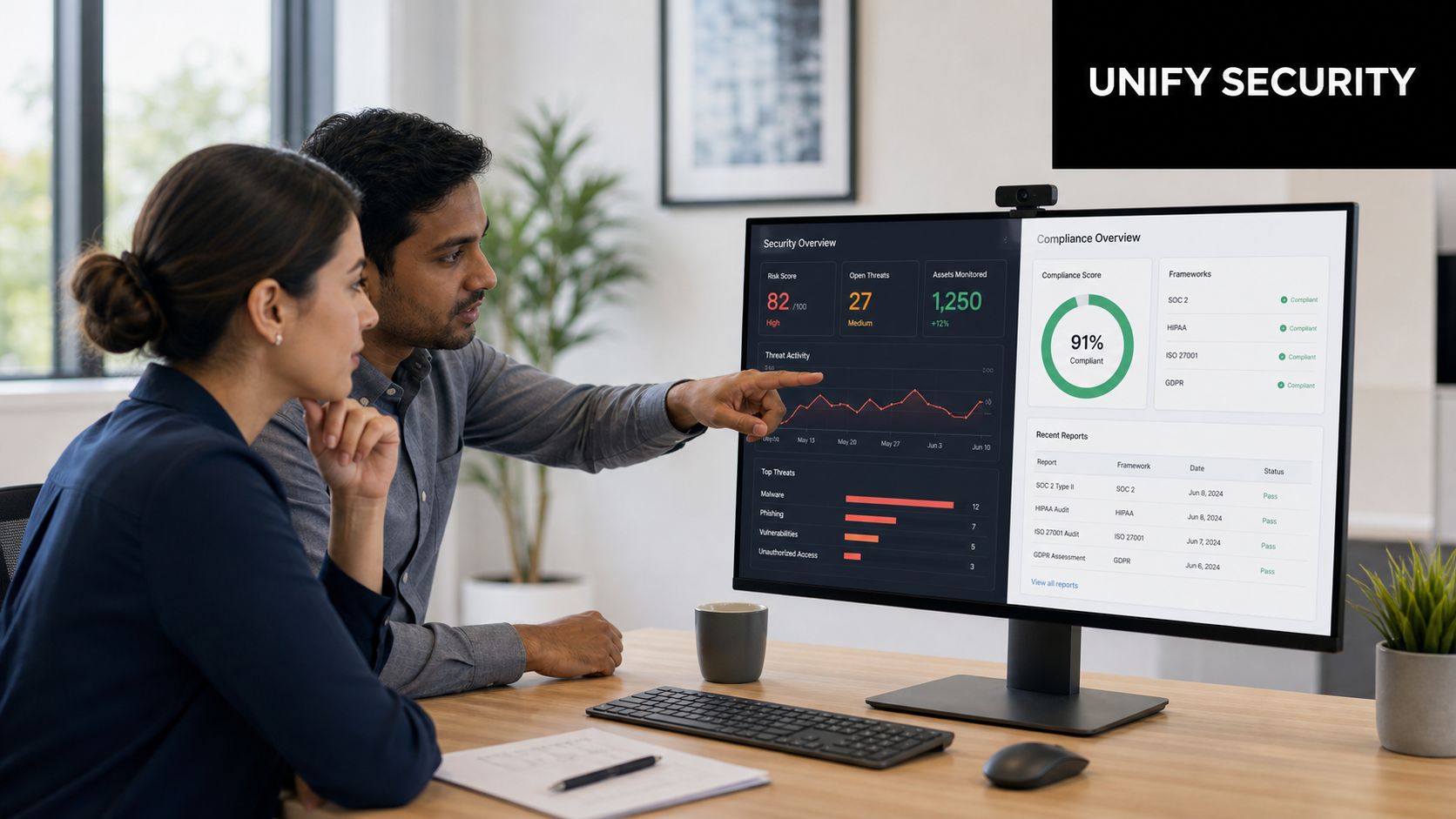
Security operations and compliance teams frequently use the same data yet behave as if their programs are separate. The SOC seeks precise detection and fast containment. Compliance seeks evidence, traceability, control mapping, and repeatable proof. A unified platform eliminates that division because one event stream can serve both outcomes.
Why technical detections matter to auditors
Auditors do not simply request dashboard screenshots. They ask which control detected what, why it matters, what evidence was retained, and how the organization aligns technical logic with the framework language it says it follows.
That mapping must be explicit. For frameworks including HIPAA, CMMC, and ISO 27001, SIEM correlation rules should reference MITRE ATT&CK technique IDs and CVE numbers so auditors can trace detections to adversary behaviors and compliance requirements, as explained in Unified Security Stack's SIEM correlation rule guidance.
That may sound administrative, yet it produces meaningful operational gains as well. When a rule documents the behavior detected, the ATT&CK technique involved, relevant CVEs, known limitations, and related rules, analysts gain better context and compliance teams receive clearer evidence.
The practical bridge between SOC and compliance
In mature environments, every part of the response lifecycle can support both teams:
- Log ingestion supplies evidence of control coverage and user activity.
- Correlation rules Illustrate how the organization detects risky behavior.
- Playbooks Demonstrate that response procedures are defined and repeatable.
- Case records Present timestamps, ownership, disposition, and remediation.
- Rule metadata Connects technical detections with framework controls and threat models.
Fragmented tooling causes the greatest harm. When detections reside in one system, response notes in another, and audit evidence in a separate repository, the organization ultimately translates the same incident three times.
A workable implementation model
For a CISO or architect trying to operationalize this, the sequence should be straightforward:
Ingest the systems that matter first
Begin with identity providers, endpoints, critical SaaS platforms, firewalls, cloud audit logs, and vulnerability sources. Avoid chasing total coverage until you have reliable coverage.Normalize around detection use cases
Develop collection and parsing around specific use cases, including suspicious authentication, privilege misuse, lateral movement, sensitive data access, and high-risk configuration change.Attach compliance context to the rules
Include ATT&CK references, CVEs when applicable, rule descriptions, known false-positive conditions, and related controls so the logic serves analysts and auditors alike.Automate evidence capture
Keep alert history, response actions, approvals, and case notes retained by default. If evidence depends on manual screenshots, it will not hold up under pressure.Review detections and controls together
Include security operations and compliance owners in the same review cycle. Noise in the SOC and ambiguity in audit evidence often stem from the same poorly defined rule.
Security teams should not keep one language for defenders and a separate one for auditors. The control needs to explain itself.
Why open-source unification is attractive
An open-source platform is particularly valuable in this context because it gives teams greater control over data handling, rule logic, integrations, and reporting workflows. This matters for MSPs, MSSPs, healthcare organizations, finance teams, and government contractors that need flexibility without accepting a black-box operating model.
It also shifts procurement logic. Rather than buying one product for SIEM, another for SOAR, another for endpoint visibility, and an additional layer for compliance reporting, teams can assess whether a unified stack can reduce data movement, cut duplicated engineering, and clarify ownership across the program.
The final state is easy to describe even if building it requires effort: a single detection pipeline, a single response workflow, and a single evidence trail that supports both security operations and regulated audits.
Teams that want a unified approach can evaluate Unified Security Stack as an open-source platform for SIEM, SOAR, XDR, and compliance management across hybrid environments. Its practical value lies in consolidating telemetry, correlation, response playbooks, and audit evidence so security and compliance teams are not rebuilding the same narrative in separate systems.