What constitutes a cyber-attack? Ten prevalent categories of cyber-attacks
Regardless of how small your business may be, organizations face a growing risk each year of losing millions of dollars to cyber-attacks. They vary types of cyber-attacks, and frequently workers within organizations cannot recognize them. The National Cyber Security Alliance reports that roughly 95% of all business security breaches result from human error.
In response, our Unified Security Stack team has compiled the ten most frequent kinds of cyber-attacks so employees can identify and stop them.
What is a cyber-attack?
A cyber-attack is harmful software deployed by cybercriminals with the intent to disrupt, damage, and exploit computer systems, networks, or electronic devices. Through an attack, hackers can steal, alter, or delete data, commit extortion, or harm the victims' reputations.
How Cyber-attacks Are Classified
- Cyber warfare. Cyberwarfare occurs when one country attacks another country's information systems and infrastructure. Its primary objective is to cripple or otherwise disrupt communications or services. Groups such as NATO, CIA, and NSA have classified certain cyber-attacks as acts of war that may prompt a military response from the governments targeted.
- Cyber-crime. Cybercrime refers to a harmful act that uses computers and Internet connections to distribute viruses, illegal information, or unlawful content.
- Cyber terrorism. Cyber terrorism refers to unlawful attacks and threats directed at computers, networks, and information. Cyberterrorists often target military, government, and corporate networks. It is carried out to spread fear among civilians and pressure the government.
Top 10 common types of cyber-attacks
- Denial-of-Service (DOS) attack
- Malware (Ransomware, Spyware, Virus, Worms, Trojan horse, Rootkit, Keylogger, Adware, Logic bombs)
- Phishing attack
- Structured Query Language (SQL) Injection attack
- Password cracking attack
- Man-in-the-middle (MITM) attack
- DNS Spoofing attack
- Eavesdropping attack
- XSS attack
- Birthday attack
Denial-of-Service (DOS) attack
A DoS attack overwhelms systems, servers, and/or networks with relentless requests that exhaust resources, blocking legitimate requests from intended users. DoS attacks fill a system's resources to hinder responses to service requests.
Conversely, distributed denial-of-service (DDoS) attacks are also initiated from multiple infected host machines. They aim to deny service, bring the system offline, and enable additional network attacks.
Among the most prevalent DoS and DDoS attacks are botnets, ping-of-death, TCP SYN flood attacks, smurf attacks, and teardrop attacks.
Expand your knowledge with our guide to Preventing DDoS attacks to protect organizations.
Malware
Malware exploits a vulnerability to enter a network when a user clicks a harmful link or suspicious email attachment. This kind of cyber-attack installs malicious software within the system to block access to critical network components. In addition, the software can retrieve data from the hard drive, disrupt systems, or render them useless.
There are different types of Malware attacks and they are:
- Ransomware– This kind of malware encrypts data belonging to the user or organization to block file access. Meanwhile, the attacker requests a ransom payment to decrypt the data and prevent it from being published or deleted. Frequently, paying the ransom is the simplest way to restore data access; however, it can ruin an organization's finances.
- Spyware– The program gathers information about users, their systems, and the websites they visit and sends that data to a remote user. It can also install additional malicious programs from the web.
- Virus- A virus is malicious code attached to a file, applications, or master boot records in order to infect computers, disks, and apps. Various virus types exist, including File infectors, Macro viruses, Boot-record infectors, and others. Anti-virus software can detect these kinds of cyber-attack viruses based on the following behaviors:
- Shows deceptive messages or launches pop-up windows.
- It alters the device's settings so that more viruses can be downloaded onto the computer.
- It attaches itself to an application's initialization sequence, and once the user opens it, the virus runs instructions before handing control to the app.
- By associating itself with a file, it creates a virus file that has the same name but a .exe extension. As a result, the virus code runs when the user opens the wrong file.
- When the user starts the system, it loads the virus stored in the boot sector into memory and spreads it to other disks and computers.
- Worms- Worm attacks are standalone programs that replicate across networks and computers. Unlike viruses, they do not attach themselves to a host file. They spread through email attachments. When the user opens the attachment, it activates the worm program. A worm attack sends a copy of itself to every email contact stored on the infected computer. Its purpose is to carry out malicious activities, overload an email server, and achieve DOS attacks.
- Trojan horse– A Trojan Horse is a type of malware that is downloaded onto a computer while disguised as a legitimate program. The hacker conceals malicious code inside legitimate software to gain access to users' systems. Unlike viruses, a trojan does not copy itself; it is designed to create a backdoor that attackers use for malicious activities.
- Rootkit– Usually, they propagate via email attachments and downloads from unsafe websites, remaining concealed inside legitimate software. This malware category grants hackers remote administrative access so they can control the targeted device. A Rootkit may impact software, the operating system, computer hardware, and firmware.
- Keylogger– A Keylogger is a program that captures keyboard keystrokes, saving them to a file or transmitting them across the internet. Cybercriminals employ it to uncover users’ credentials and details about their browsing habits. Yet some Keyloggers are hardware devices built into the internal components of a PC. Ultimately, neither type of Keylogger damages the host.
- Adware– Adware is software often bundled with freeware programs to show advertisements. When a user downloads the program from the Internet, Adware installs itself quietly on the device without the user’s knowledge. The hacker earns money whenever the user clicks on an advertisement. A sound recommendation for avoiding this irritating malware is to exercise caution and download programs only from trusted, reputable sources.
- Logic bombs– A logic bomb is malicious code attached to an application that runs by itself once a logical condition is met. Typically, that logical condition relies on a particular date and time.
Phishing attack
A Phishing attack involves sending emails that seem to come from a trusted source. However, such an email carries an attachment or a link to an illegitimate website that contains the malicious program. Phishing seeks to make users reveal personal information or to prompt them into doing something that benefits the attacker.
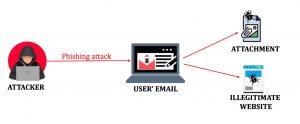 Diagram of Phishing attack
You can spot a harmful link by hovering the mouse over it without clicking. If the URL directs you to a suspicious website, do not open it.
Structured Query Language (SQL) Injection attack
SQL Injection is a cyber-attack in which a string of SQL code is inserted into a web application’s input data. Its aim is to exploit a security flaw in the web application’s SQL query. The injection succeeds when the cybercriminal gains access to all data in the database, particularly usernames and password hashes. In some cases, attackers can use SQL injection to expose sensitive data, destroy data, or ruin entire databases.
Web programmers must understand how their programming language works with databases so they can block malicious code injections. By keeping their programming secure, they will thereby help prevent security breaches.
Password cracking attack
Password cracking attempts to recover a password from one or more hashes. Hackers rely on brute force via an automated program that guesses the user’s password. Most users create easy-to-remember passwords, which poses a major problem for them.
Certain systems restrict the number of password entry attempts before access is denied, which prevents password cracking attacks. Other systems add extra bits to every password before hashing it. Consequently, even if two users chose the same password, they would not be the same.
Man-in-the-middle (MITM) attack
MITM attacks let attackers eavesdrop on communication between two network users or between a user and a service. Once the hacker is positioned in the middle of the two parties, they can:
- Spoofing the user IP to convince the system that it is communicating with a known and trusted entity, which provides the attacker access to the system.
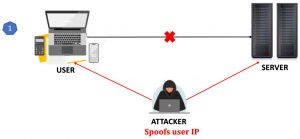 Diagram of Man-in-the-middle (MitM) attack “IP Spoofing”
- Intercepting and storing messages exchanged between two users in order to alter them and then send them while impersonating one of those users.
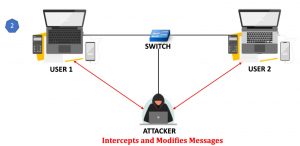 Diagram of Man-in-the-middle (MitM) attack “Replay”
Companies can defend themselves against MITM attacks by applying strong encryption on access points or by using a virtual private network (VPN).
DNS Spoofing attack
In Domain Name System (DNS) spoofing, a hacker changes DNS records so traffic goes to a fake or spoofed website. After arriving at the fraudulent site, the victim may enter sensitive information that the hacker can use or sell. The hacker might also build a low-quality site with derogatory content to damage a competitor company’s reputation. During a DNS spoofing attack, the attacker gains an advantage because the user believes the site visit is legitimate. The hacker is then free to commit crimes under the name of an innocent company.
Attackers seek to exploit weaknesses in DNS servers. To stop DNS spoofing cyber-attacks, companies should make sure those servers remain up to date.
Eavesdropping attack
Hackers use an Eavesdropping attack to capture sensitive data from the network. To accomplish this, the attacker assumes a position where they can listen in on communication between two parties. An Eavesdropping attack is difficult to detect without specialized equipment that monitors network activity. Naturally, this creates a complex problem for many organizations to address. However, data encryption remains the strongest protection against eavesdropping.
XSS attack
A Cross-site scripting or XSS attack enables the attacker to inject malicious scripts into a website’s database that has script injection vulnerabilities. When the user loads the website in the browser, the script executes, and the user’s cookies are sent to the attacker. This allows the hacker to use the cookies for session hijacking. Sometimes, hackers use XSS attacks to exploit additional vulnerabilities for:
- Capturing screenshots.
- Detecting and gathering network information.
- Log keystrokes.
- Accessing the user’s machine remotely and controlling it.
Companies can prevent XSS attacks by using a whitelist of allowable entities. In this manner, the web application will accept nothing except approved entries. Organizations can also apply a sanitizing technique. This technique inspects data as it is entered, checking whether it contains anything harmful.
Birthday attack
During a birthday attack, a malicious actor takes advantage of hash algorithms. They serve as a security mechanism for confirming message authenticity. If an attacker can produce the same hash that the sender appended, the attacker can swap the message for one of their own. The receiving device will accept it because the hash is correct.
The birthday paradox stems from the fact that in a room containing 23 people, the chance is greater than 50% that two share a birthday. Therefore, the paradox shows that hashes, like birthdays, are less unique than many believe.
Longer hashes should be used for verification to prevent birthday attacks. Every additional digit included in the hash causes the odds of generating a matching one to fall sharply.
How can organizations prevent every kind of cyber-attack?
No universal solution exists for cyber-attack issues. Still, businesses can adopt proactive steps to prevent these kinds of cyber-attacks and safeguard their data and networks.
- Apply security updates and ensure your operating system stays current.
- Deploy a firewall to block traffic on ports that are unused.
- Deploy antivirus software on every workstation linked to your network.
- Deploy dedicated protection systems such as HIDS (IDS/IPS).
- Transfer sensitive data by using secure protocols (TLS/SSL).
- Create password policies that require long passwords with complex patterns.
- Do not click links in emails or social media posts that appear suspicious.
- A Virtual Private Network (VPN) should be used to establish a safer connection.
- Adopt cloud-managed endpoint protection to help with advanced monitoring and remote remediation.
- Employ anti-spyware software that includes active scanning and routine updates.
- Regularly back up data to prevent loss in the event of cyber-attacks.
Attackers are growing smarter and more sophisticated in their attacks, and traditional antivirus software cannot detect them sufficiently. Nevertheless, businesses can deploy SIEM tools such as Unified Security Stack, with technologies that monitor, detect, prevent, and respond to all kinds of cyber-attacks in real-time. A SIEM can simplify a company's protection by integrating IDS, IPS, cloud service, incident response, penetration testing, vulnerability assessment, and more. Additionally, most SIEM tools provide SOC as a service to monitor networks and respond immediately to an attack.