MITRE ATT&CK Framework: A Practical Guide for SOC Teams
You are sitting in the meeting already, and the question before everyone seems straightforward: can the SOC spot a technique connected to a noisy intrusion path? Three analysts give three separate answers because each is looking at a different dashboard, a different log source, and a different way of thinking. The MITRE ATT&CK framework provides those individuals a single common language for describing adversary behavior, so the conversation begins with evidence rather than speculation.
This is critical as ATT&CK helps shift teams away from ambiguous debates about adversaries and toward precise operational inquiries. What data are we collecting? Which tactics can this data support? Where do we have the most significant blind spots in detection and response? MITRE defines ATT&CK as globally-accessible knowledge base built from real-world observations of adversary behavior spanning attack phases, going past a mere list of malware names or CVEs.
In SIEM, EDR, and XDR efforts, that common vocabulary allows detection teams to link techniques to real data sources before they create any rule. It also shifts the compliance discussion. Leaders and auditors typically worry less about whether a dashboard appears active and more about whether the team can demonstrate traceable proof of monitoring, response, and control coverage.
Table of Contents
- Why SOC Teams Keep Coming Back to ATT&CK
- Understanding the Core Building Blocks
- How Big the Enterprise Matrix Really Is
- Working with Navigator, Layers, and STIX Mappings
- Operationalizing ATT&CK in Detection Engineering
- How Realistic Is Your ATT&CK Coverage
- Wiring ATT&CK into SIEM, XDR, SOAR, and Compliance
- A Practical 90 Day Plan for Your SOC
Why SOC Teams Keep Coming Back to ATT&CK
A Monday review meeting can quickly become chaotic. One analyst claims the team can detect credential theft because a rule exists for suspicious logins, another says the environment captures only part of the behavior chain, and a third cites a threat intel report that uses completely different wording. ATT&CK provides those three people a common reference point, so they can shift from opinion to evidence.
Shared language beats improvised labels
SOC work becomes noisy because attacker behavior is messy. One team might call a sequence lateral movement, another might label the same activity remote execution, and a vendor product may give it a proprietary alert name. ATT&CK reduces that confusion by standardizing how defenders describe behavior, which makes coordination across teams much easier.
MITRE describes ATT&CK as a framework for modeling how adversaries interact with systems during an operation, which is precisely why it suits detection engineering and threat hunting so well. A hunter can tie a lead to a technique, a detection engineer can determine whether telemetry is present, and a manager can ask whether coverage is getting better. Everyone remains aligned on the behavior of the adversary and avoids becoming lost in tool-specific jargon.
Practical rule: if two analysts cannot point to the same ATT&CK technique, they likely are not discussing the same detection problem.
That is one reason ATT&CK continues to appear in enterprise security programs. In a CLTC/McAfee study, more than 80% of enterprises said they use MITRE ATT&CK, 63% said they use both the Enterprise and Cloud matrices, and 57% said they use it to identify gaps in deployed security controls (CLTC/McAfee report). Those figures do not mean every deployment is mature, but they do demonstrate that the framework has become a practical language for real teams.
Why leadership cares too
ATT&CK also helps when a SOC must justify its work to leadership. Executives do not need the entire taxonomy, but they do need a defensible response to questions about visibility, control gaps, and detection priorities. ATT&CK enables the SOC to state, in clear terms, which behaviors are covered, which are not, and why certain gaps were postponed.
It also provides auditors a clearer narrative. Rather than describing detection controls in a fragmented manner, teams can connect evidence to specific adversary behaviors and demonstrate how that evidence maps to monitoring, response, and prioritization.
Understanding the Core Building Blocks
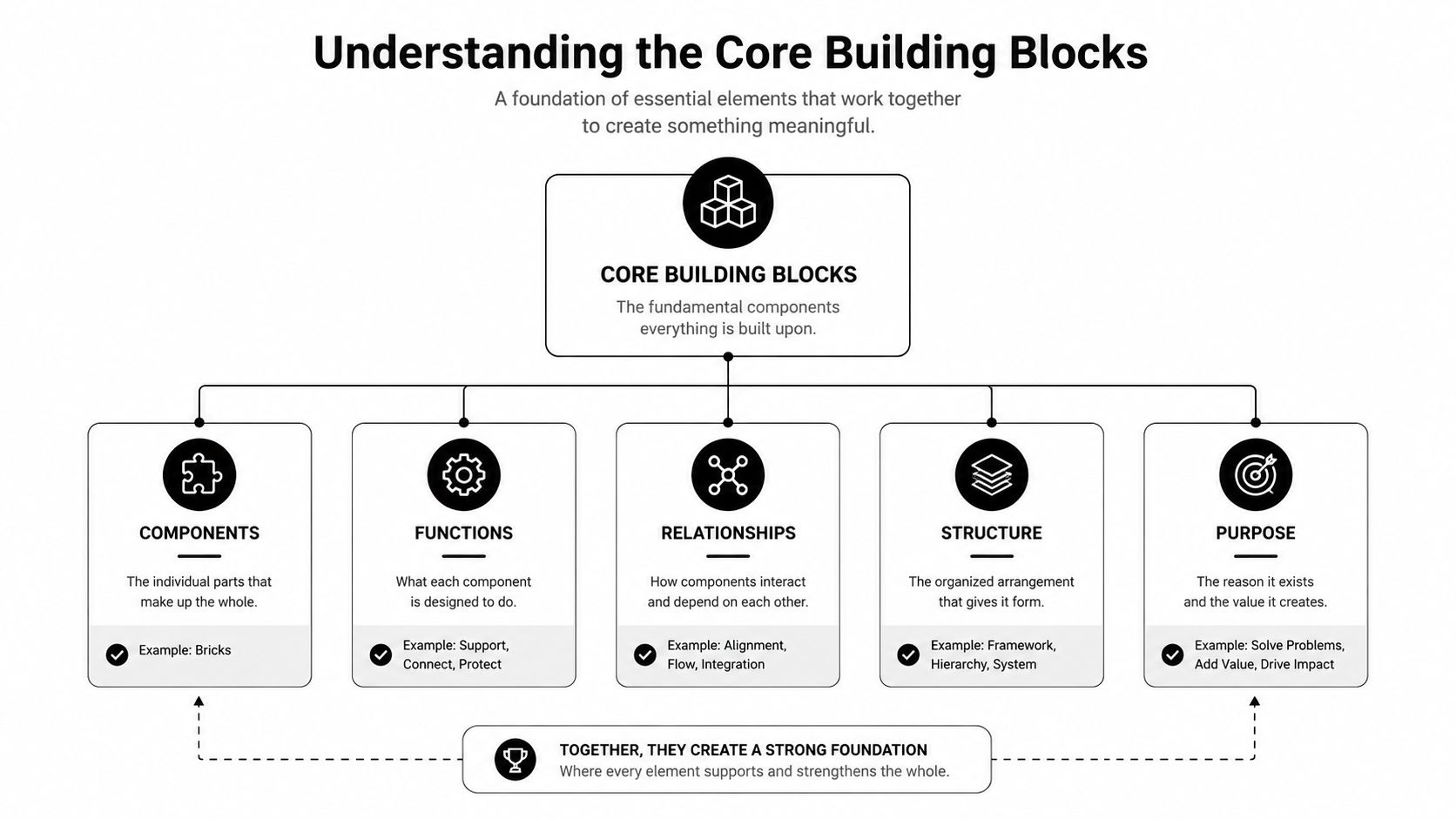
Picture ATT&CK as a heist novel. Tactics represent the chapters, the reasons the crew acts at each stage. Techniques represent the methods used in those chapters. Sub-techniques represent the more detailed variations on those methods. Procedures are the real cases, the documented examples drawn from incident reporting and threat research.
Read the hierarchy from the top down
Start with tactics, because they answer why the adversary is acting this way now. The ATT&CK enterprise model organizes behavior across tactics that describe stages and objectives, such as discovery, credential access, and lateral movement. Then move to techniques, which tell you how that objective is carried out. A single tactic can contain many techniques, and a single technique can contain several sub-techniques.
Sub-techniques matter because the same behavior often appears in different forms. The basic technique might be broad, but the sub-technique focuses the evidence you need, which is what a SOC analyst cares about when creating detections. Procedures sit at the bottom of the stack, and they are the closest thing ATT&CK has to field evidence from real incidents.
The diagram below helps establish the idea that ATT&CK is more than a list. It is a structured system with connected building blocks.
Match the matrix to your environment
ATT&CK has separate matrices for Enterprise, Mobile, and ICS, and the right choice depends on what you protect. If your team defends laptops, identity systems, cloud workloads, and servers, Enterprise is the correct fit. If mobile devices are important, the Mobile matrix supplies the applicable behavior model. If industrial systems are important, the ICS matrix is the one to choose.
The bridge between ATT&CK theory and SIEM reality is the data source and data component. A technique page tells you what type of evidence can support detection, and that is the part analysts often skip too soon. If you do not know whether the behavior leaves process creation data, command-line data, registry data, or authentication logs, you do not know whether a rule is feasible.
ATT&CK gains real value once technique pages are handled as telemetry requirements rather than as something to read.
That is what assists a new SOC analyst the most. The page does not simply declare that something is bad. It tells you which field, which event type, and which evidence stream can demonstrate that the behavior occurred.
How Big the Enterprise Matrix Really Is
The Enterprise matrix is so extensive that no team should view complete coverage as an easy undertaking. It contains 14 tactics and breaks them into 211 techniques and 468 sub-techniques, while also cataloging 166 groups, 755 software tools, and 47 campaigns (MITRE ATT&CK). That is not a simple checklist. It is a dense operational knowledge base that detection teams must work through carefully.
The shape of the matrix matters
The spread across tactics is not even. Discovery contains 34 techniques and Command and Control carries 30 techniques, while Resource Development and Exfiltration each have 9 techniques (MITRE ATT&CK). That imbalance matters because it reveals to defenders where attacker behavior spreads widely and where it remains more concentrated.
When planning detection efforts, the practical place to begin is straightforward. You do not start by creating a rule for each technique. You begin by reviewing the telemetry you already gather and asking which techniques it can back. The matrix's scale pushes teams to prioritize coverage planning instead of pursuing a completeness exercise.
Coverage has to be telemetry-first
The Enterprise techniques page demonstrates how wide the matrix is, and ATT&CK's overview resources describe the framework as a method for organizing tactics, techniques, sub-techniques, and procedures across enterprise, mobile, and ICS domains. That breadth means one detection often must cover more than one sub-technique, and a single data stream can support several techniques simultaneously.
The issue is not how many technique names a team can remember. The issue is whether the logs can distinguish one behavior from another. Process creation, command-line execution, registry changes, and authentication logs often carry most of the weight because they let analysts distinguish comparable activity from distinct activity.
The image below illustrates why the matrix should be viewed as a planning surface rather than a poster.
A mature SOC does not try to cover every box. It determines which techniques are relevant to its environment and then aligns them with the telemetry it can rely on.
Working with Navigator, Layers, and STIX Mappings
ATT&CK Navigator proves useful as soon as a SOC stops treating ATT&CK as a reading list and begins using it to guide coverage decisions. A layer allows you to color-code techniques by coverage, priority, or assessment result, so gaps become visible without making everyone revisit every technique page. Teams can layer red-team findings, threat intel priorities, current detection coverage, and target coverage, then compare those layers side by side.
Use layers to make the conversation concrete
A strong Navigator layer transforms vague disagreement into something the entire room can examine. If the red-team layer reveals one pattern, the current detection layer reveals another, and the target layer reveals where leadership wants coverage to end up, the gap is difficult to overlook. That helps when a SOC engineer, a manager, and an analyst view the same matrix but interpret it through different levels of experience.
The value here lies in planning, not decoration. Teams can use layers to determine where to invest engineering time, where telemetry needs improvement, and where a technique is understood in theory but remains insufficiently instrumented in practice. For a SOC manager, that is more useful than yet another spreadsheet of green checks.
For context on how ATT&CK content can feed broader threat intelligence workflows, see this example of a threat intelligence feed integrated into operational tooling.
The schema behind the UI
Behind Navigator sits a formal model built on STIX 2.1. Within that model, techniques appear as attack-pattern objects, tactics as x-mitre-tactic, and data components as x-mitre-data-component objects, as defined in the ATT&CK data model schemas. That is important because it allows tools to parse ATT&CK content in a machine-readable manner rather than treating it as free text.
The cited schema version is 3.3.0, which demonstrates that the model is maintained as an evolving interoperability layer rather than a frozen glossary. For SIEM and XDR teams, this means ATT&CK-aligned detections can be validated before deployment, and telemetry can be normalized against adversary behavior consistently.
This moves the practice from tagging alerts with ATT&CK terms to creating a data model your tools can consume. Once a platform can map events to structured ATT&CK content, teams can monitor coverage, structure reporting, and keep rule metadata aligned with the same technique definitions their analysts rely on.
Operationalizing ATT&CK in Detection Engineering
MITRE's guidance for analytics is simple, and it is the part many teams hurry past. First, identify the behaviors you want to detect. Then obtain the data that can provide evidence of those behaviors. Only after that should you develop the analytics. If you reverse that sequence, you end up writing clever rules for telemetry you lack.
Start from the evidence, not the alert
ATT&CK technique pages point you toward the evidence that counts, such as process creation, command-line execution, registry modification, file creation, and authentication logs. These are not abstract labels. They are the essential inputs your SIEM or XDR platform needs to distinguish one technique from another.
A simple framing helps here. Detection of a technique depends on whether it can be observed. Without the right logs, correlation logic alone cannot solve the problem. Telemetry triage therefore needs to come before rule creation.
| ATT&CK Data Component | What It Captures | Typical Telemetry Source |
|---|---|---|
| Process Creation | New processes and their parent-child relationships | Endpoint agent, Sysmon, EDR |
| Command-Line Execution | Arguments and flags used to launch commands | Endpoint telemetry, process auditing |
| Registry Modification | Changes to registry keys and values | Windows event data, EDR telemetry |
| File Creation | New or altered files on disk | Endpoint agent, file monitoring |
| Authentication Logs | Login attempts and access events | Identity provider, server logs, VPN logs |
| File Access | Reads and writes to sensitive files | Endpoint telemetry, audit logs |
Build the pipeline in the right order
When the data is present, the pipeline becomes simpler to understand. Agents and collectors capture events, centralized logging normalizes them, correlation rules link several signals, and response playbooks take action based on the result. That order creates a clear route from an ATT&CK technique to operational response.
A practical example is useful. If you are monitoring for OS Credential Dumping (T1003)You do not create a single rule and consider the job complete. Combine process monitoring with file access and authentication telemetry, then seek behavior consistent with credential collection instead of standalone noise. This is how ATT&CK moves from a labeling task to a detection chain.
For a deeper look at the operational side of rule-building, this internal guide on detection engineering It serves as a helpful companion. It is particularly suitable when your team is advancing from ad hoc alerts toward a genuine detection lifecycle.
Operational advice: When a technique page does not reference a telemetry source you trust, view that as a visibility gap rather than a rule-writing issue.
How Realistic Is Your ATT&CK Coverage
Many teams align detections with ATT&CK and believe the difficult work is complete. Usually it is not. Coverage figures may appear neat in a presentation even as the supporting telemetry still fails to capture the behavior you need. For that reason, ATT&CK should be used first as a detection engineering tool, not as a reporting checklist.
Begin by asking what data we truly have. If the answer is unclear, the coverage score will be unclear as well. A technique may appear covered on paper because a rule exists, even when the SIEM receives only partial evidence and the analyst still cannot verify the behavior. Effective coverage work starts by connecting techniques to actual data sources, then confirming those sources can support reliable detection before a rule is written.
Coverage scores can hide missing evidence
A high-level coverage map may seem reassuring while still overlooking the behaviors that matter most. When telemetry is limited, the map can exaggerate true visibility. That is why MITRE cautions teams not to chase 100% coverage and instead prioritize techniques that fit the environment (MITRE ATT&CK resources).
Begin the assessment with an inventory. Enumerate the data sources you collect, then determine which techniques those sources can support with evidence. Next, label the remainder as gaps. Only after that should you choose which gaps merit closure according to your threat model, regulatory obligations, and business risk. A coverage chart without that inventory resembles a building map lacking floor labels, helpful for orientation, poor for response.
Honest coverage beats decorative coverage
CISA advises analysts to note gaps explicitly when ATT&CK mapping is incomplete, because many reports do not contain enough forensic detail for a full mapping (CISA ATT&CK mapping best practicesThat guidance matters because it prevents ATT&CK mapping from becoming paperwork theater.
A better question is not whether we mapped this alert to ATT&CK. It is whether we can prove the behavior using the data we have. If the answer is no, the next step is either to enhance telemetry or to accept the gap and record it plainly. That honesty makes coverage defensible to a CISO and clear to the analysts who must work the alerts.
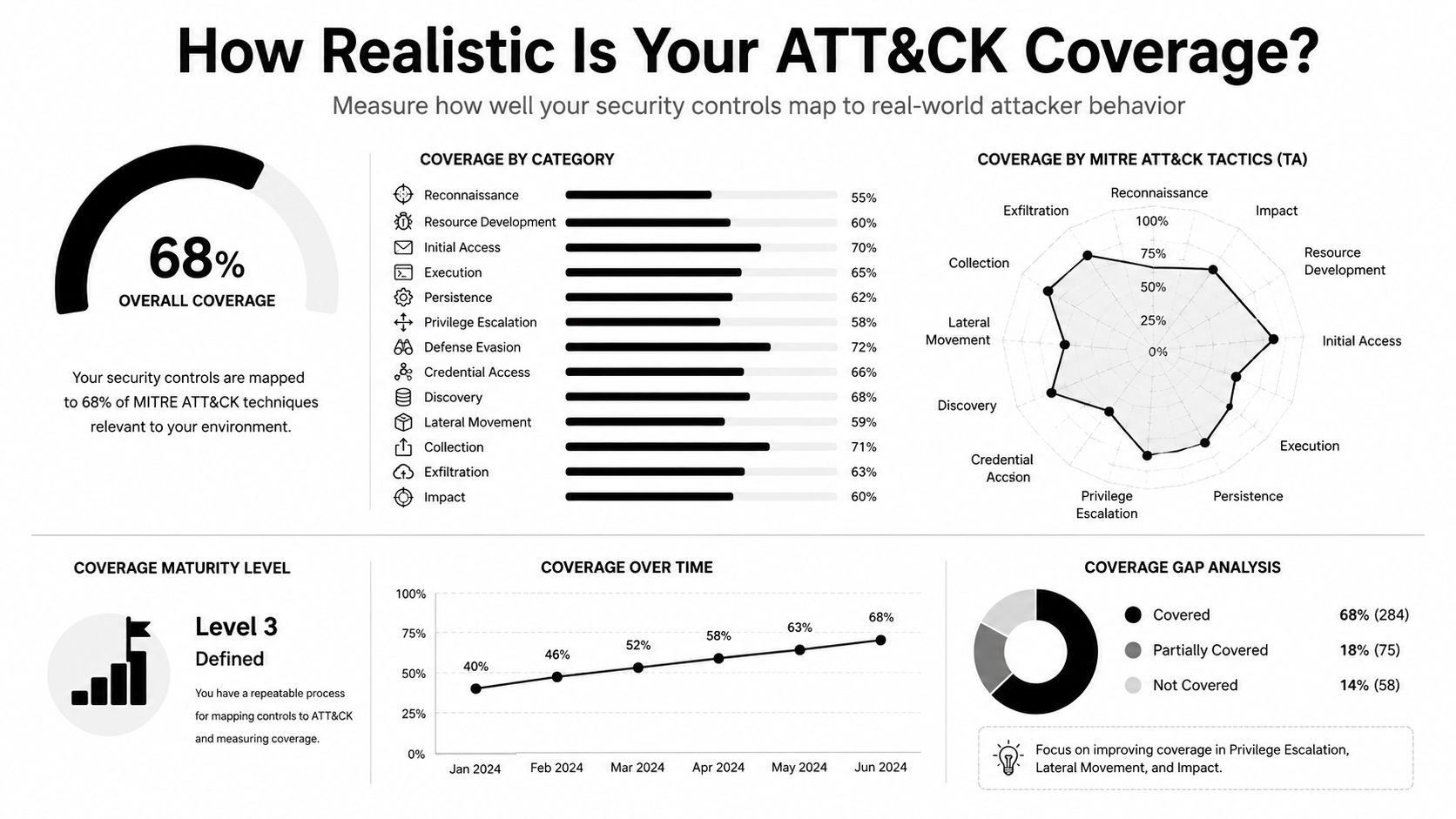
Genuine coverage work withstands review because it begins with evidence quality rather than a dashboard color. That standard gives leadership something defensible and gives the SOC a map that mirrors what the environment can observe.
Wiring ATT&CK into SIEM, XDR, SOAR, and Compliance
ATT&CK delivers the most value when connected to the tools the SOC already operates. A current SIEM or XDR platform can take in ATT&CK-aligned content, normalize events to technique IDs, and feed that information back into coverage views for leadership. Unified Security Stack is one platform that maps gathered events to MITRE ATT&CK within its normalization and enrichment pipeline, while also applying correlation rules to enable detection workflows.
Technique IDs make response more precise
SOAR playbooks gain from ATT&CK since a hit on one technique requires a different response than a hit on another. A credential-access alert and a lateral-movement alert should activate distinct containment logic, distinct escalation paths, and distinct investigation questions. ATT&CK supplies the label that makes that branching more orderly.
The goal is not merely automation. It is consistency. When a playbook relies on a technique ID, the team can move away from fragile rule names and toward behavior-based response. That is simpler to sustain as alert volumes grow and several analysts work the same queue.
For AWS-heavy environments, this practical guide on build SIEM with CloudTrail and GuardDuty It serves as a helpful reference for connecting cloud telemetry to a detection pipeline.
Compliance gets cleaner when detections are structured
Compliance frameworks such as HIPAA, GLBA, PCI, CMMC, ISO 27001, and SOC 2 All rely on proof that monitoring and response function in practice. ATT&CK-mapped detections assist because they link control language to particular behaviors and observable logs, which is far easier to trace during audits.
The warning is straightforward. If the mapping is skewed or partial, it can turn into documentation theater rather than operational progress. That is why CISA's guidance on identifying gaps matters, and why the SOC should view ATT&CK as an evidence model, not only a reporting format.
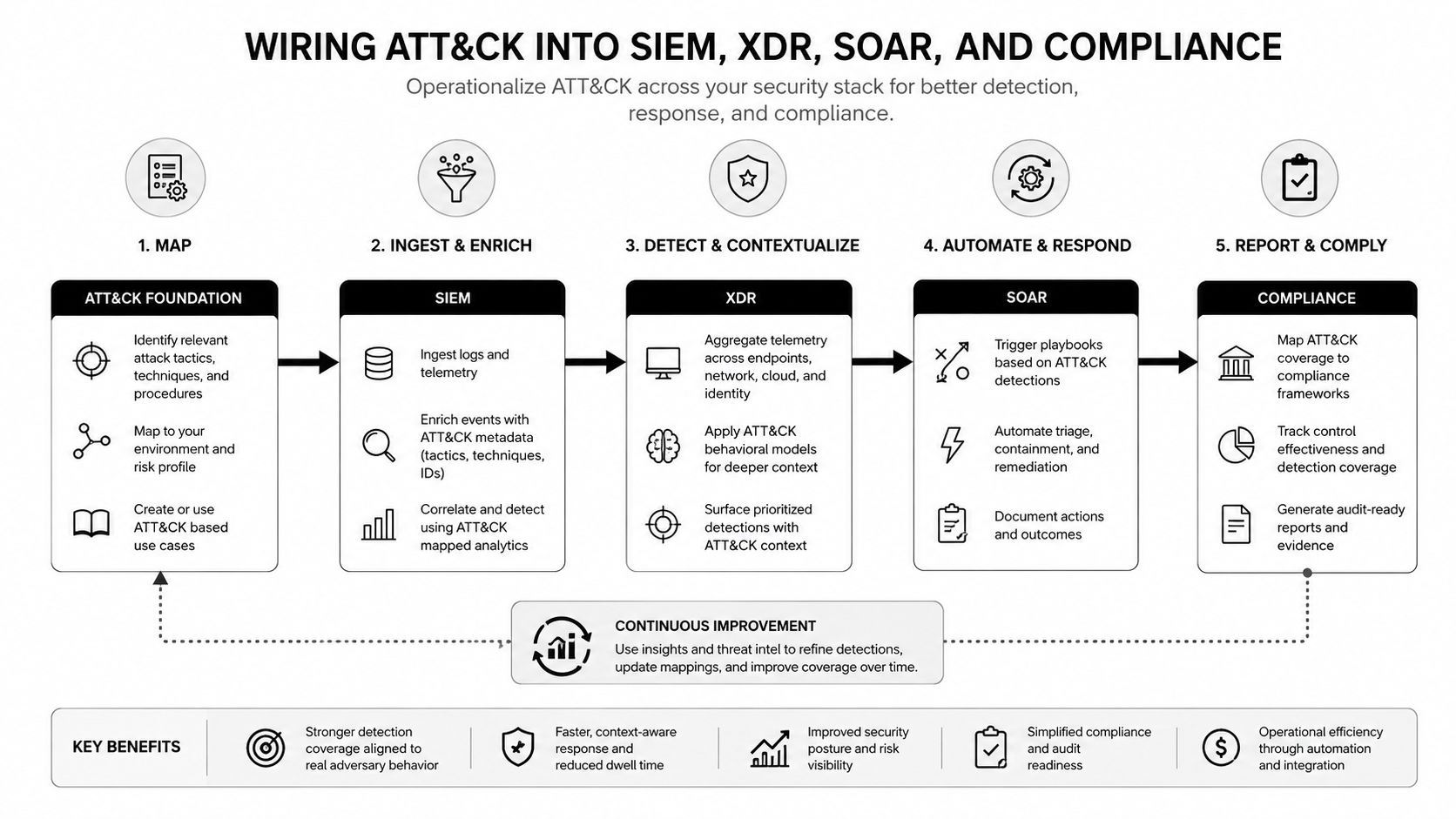
If your team is standardizing detections across SIEM, XDR, and compliance workflows, this internal overview of threat detection and response solutions belongs naturally in that same discussion.
A Practical 90 Day Plan for Your SOC
Begin with a telemetry inventory during days 1 to 30. Connect the data components you collect to the techniques they can support as evidence, and record what is absent without softening it. This creates a realistic baseline before anyone argues about rule quality.
In days 31 to 60, focus on the high-value tactics that usually matter most to defenders, especially Credential Access, Lateral Movement, Defense Evasion, and DiscoveryWrite or adjust detections based on the telemetry you trust, not the technique names you wish you covered.
Between days 61 and 90, create Navigator layers, connect SOAR playbooks to technique IDs, and deliver the first ATT&CK-aligned report for leadership and auditors. The output is straightforward: a coverage map linked to actual logs, a list of accepted gaps, and a response workflow aligned to the behaviors that matter to you.
Unified Security Stack gives SOC teams a single location to normalize logs, correlate behavior, and map detections to MITRE ATT&CK, with no need for a separate reporting stack. If your goal is to make ATT&CK a live detection engineering workflow, go to Unified Security Stack and see how its SIEM, SOAR, and XDR capabilities align with that approach.