Top guide for building an incident response plan.
What does incident response entail?
Incident response (IR) refers to the process through which Computer Security Incident Response Teams (CSIRT) assist organizations in identifying, halting, and recovering from any data breach as rapidly as possible.
What does an incident response plan entail?
An incident response plan is a document that guideline organizations about responding effectively to disasters, cyber-attack, or security breaches, helping to reduce incident-related costs and lower the likelihood that they will happen again in the future.
Components of incident response plan
An incident response plan typically includes:
- Introduction
- Incident Identification and First Response
- Resources
- Roles and Responsibilities
- Detection and Analysis
- Containment, Eradication, and Recovery
- Incident Communications
- Appendices
Introduction
The present section needs to set out the objectives, scope, and guiding principles, while emphasizing the plan's purpose. The introduction should also explain what your plan aims to accomplish and where its limitations lie.
Incident Identification and First Response
This part explains how the CSIRT identifies an incident and decides whether the plan needs to be activated. Moreover, especially during the COVID-19 stage, it is wise to establish beforehand who may invoke the plan, how communication will take place, and where to meet.
Resources
Incident responders will describe the resources that can support the team's work, such as personnel and equipment. They frequently keep an incident kit prepared with contact cards, chargers, extra cables, notepads, and similar items.
Roles and Responsibilities
Defining the roles and responsibilities of incident response team members is essential, along with support or backup contacts if a member cannot be reached.
Detection and Analysis
At this point, the team records how an incident is characterized and detected, which depends heavily on the attack's type and scope. In some cases, the CSIRT turns to templates, online examples, or professional guidance to gain practical insights. These inputs help produce the playbooks that constitute the core of this part of your plan.
Containment, Eradication, and Recovery
Frequently, this section of the plan is the document's most technical portion. It sets out strategies for limiting the incident scope and procedures for eradicating and recovering all affected systems. –In the next part of the article How to create an incident response plan, you will find detailed information on Containment, Eradication, and Recovery.
Incident Communications
Communication protocols are effective during the incident notification procedure for stakeholders, customers, and other organizations. In this part, the team specifies all notifications and addresses involvement from internal personnel, cybersecurity consultants, and every provider, including managed service providers, law enforcement, privacy regulators, and analytics forensics specialists. Remember that everyone involved must be identified beforehand to prevent improvisation.
Appendices
Based on your plan's scope and size, you might decide to add reference materials as appendices to the incident response plan. These can include physical and logical network infrastructure diagrams, web and cloud service connections, backup schedules, and similar items. They may also cover documentation of security solutions at sensitive points, such as firewalls and IDS/IPS that provide resistance to attack, plus incident logs. Information such as phone numbers and emails for all contacts, providers, and partners that must be notified is also included. So, in this section, you will append all supplementary documentation that complements the plan. Many organizations still choose to keep a paper copy of the plan and resources in case systems are unavailable.
How can you create an incident response plan?
The first item an incident response plan must establish is the company's approach for handling incidents. It should identify every cybersecurity resource required, the responsible people, and their contacts.
The incident response phases are:
- Preparation
- Identification
- Containment
- Eradication
- Recovery
- Lessons Learned
Continue reading for a deeper look at each phase.
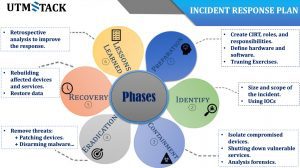 Stages of the Incident Response Life Cycle.
Preparation:
The incident response preparation phase is essential for a successful response. In this situation, organizations must define the computer incident response team (CIRT), its roles, responsibilities, and whom it needs to notify. This is also the moment to select any advanced hardware and software resources that may be needed. The preparation phase is used by organizations to ensure the team is trained for its duties in a data breach. Thus, when CIRT triages an incident, team members need to know how to prioritize it and when to escalate it.
One great method to assess the team's knowledge is to conduct incident response drills. Remember that the more preparation there is, the lower the probability of making critical mistakes.
Identify
When an incident occurs, the CSIRT must determine its size and scope to eliminate it successfully. Indicators of compromise (IOCs) are a crucial cybersecurity element that helps gauge the likelihood of a specific event or incident. They allow the computer security incident response team to rapidly identify incidents within organizations and respond to possible threats. In addition, many organizations adopt an IOC-based approach to cyber threat hunting. However, the IOC process is not always simple, and doing it effectively requires appropriate knowledge and tools.
Containment
The containment phase of an incident is the process of controlling the scope and severity of cyber-attacks. A containment strategy may involve shutting down vulnerable services, locking system access, and separating affected devices from the network. It also includes protecting sensitive data by moving it offline or encrypting it. The team may even need a deep-dive analysis and long-term containment to perform hard disk forensics. This analysis can produce additional IOCs, and the identification phase may need to be revisited.
Eradication
After the incident is successfully contained, the threat eradication phase can begin. At this stage, experts determine what caused the security breach and how to eliminate it. Common actions to eradicate threats include patching devices, disarming malware, disabling compromised accounts, and applying updates.
Recovery
The Recovery phase covers all actions needed to restore an organization's computing services after a disruption. This is the point where the team begins rebuilding affected devices and recovering data from previously saved clean backups. In addition, it is essential to create new configurations and confirm that no further threats remain by monitoring compromised devices.
Lessons Learned
Once the threat is resolved, it’s time to analyze all incident response planning and enhance them in a methodical way. The team should conduct a Post Incident Review (PIR) meeting, recording and revising the playbooks to bolster the response. Note what succeeded and where gaps were present to help stop similar incidents or common cyber-attacks from happening later.
Importance of incident response plan
Incident response plans are essential because they collect a set of procedures that help organizations overcome data breaches. Typically, the planning is designed to address any incidents that result in data loss, theft, disclosure, modification, denial of service, physical destruction, or misuse. It also helps organizations protect their customers and other stakeholders by reducing the impact or severity of breaches. It is advised that organizations apply information security incident response policies and proven practices for protecting state systems and data.