CMMC Compliance Requirements a Practical Guide for 2026
Many defense contractors are in the same position right now. A solicitation arrives, DFARS wording becomes stricter, someone asks whether the company is CMMC ready, and the room goes quiet because no one is fully certain what that means operationally.
Typically, the first response is to collect policies, retrieve the old SSP, and begin reviewing controls in a spreadsheet. That is not sufficient anymore. CMMC does not reward paper maturity. It rewards organizations that can show assessors how controls operate in practice, on real systems, with real evidence.
Table of Contents
- Introduction Navigating the New CMMC Mandate
- Decoding the CMMC 2.0 Levels and Practices
- The Central Role of NIST SP 800-171 in CMMC
- Mastering Evidence and Documentation Requirements
- Preparing for Your CMMC Assessment
- Bridging Common Gaps with a Unified Security Platform
- Conclusion Building a Culture of Continuous Compliance
Introduction Navigating the New CMMC Mandate
The practical issue usually begins before the audit. It begins when a bid team needs a quick answer on eligibility, an IT manager tries to determine which enclave handles CUI, and leadership realizes the company may need to prove compliance before the next contract milestone.
That pressure is no longer theoretical. The Department of Defense formally introduced the first phase of CMMC 2.0 on November 10, 2025, and Phase 3 is scheduled for November 10, 2027, when Level 2 certification becomes mandatory for most applicable contracts, according to the DoD CMMC program overviewFor many contractors, this turns CMMC compliance requirements from something we are monitoring into an operational deadline.
Teams must also tie compliance planning to the real contract pipeline. If you are attempting to see where future opportunities might trigger CMMC clauses, using Software for Government contracting can help teams evaluate opportunities sooner and prevent security requirements from surfacing after capture work is already in progress.
Practical rule: When CUI is part of the environment, do not approach CMMC as a policy initiative. Approach it as an evidence initiative.
That change is important because assessors will not settle for written intent. They will want to confirm that access controls are enforced, logs exist and are reviewed, encryption is active, and the organization can explain how security operations support the documented control set.
The organizations that struggle most typically are not disregarding cybersecurity. They operate with fragmented tools, uneven ownership, and outdated documentation. They hold pieces of compliance, yet they cannot present a coherent account.
That is why CMMC's operational reality matters. You need controls, but you also need evidence. You need documentation, but you also need current system data supporting it. And you need to shift from paper compliance to continuous compliance, where evidence is produced through normal security operations instead of being assembled in a rush before assessment week.
Decoding the CMMC 2.0 Levels and Practices
CMMC 2.0 becomes easier to manage once you stop viewing it as a single monolithic standard. It is a tiered model linked to the sensitivity of the information you manage and the rigor of the assessment you will face.
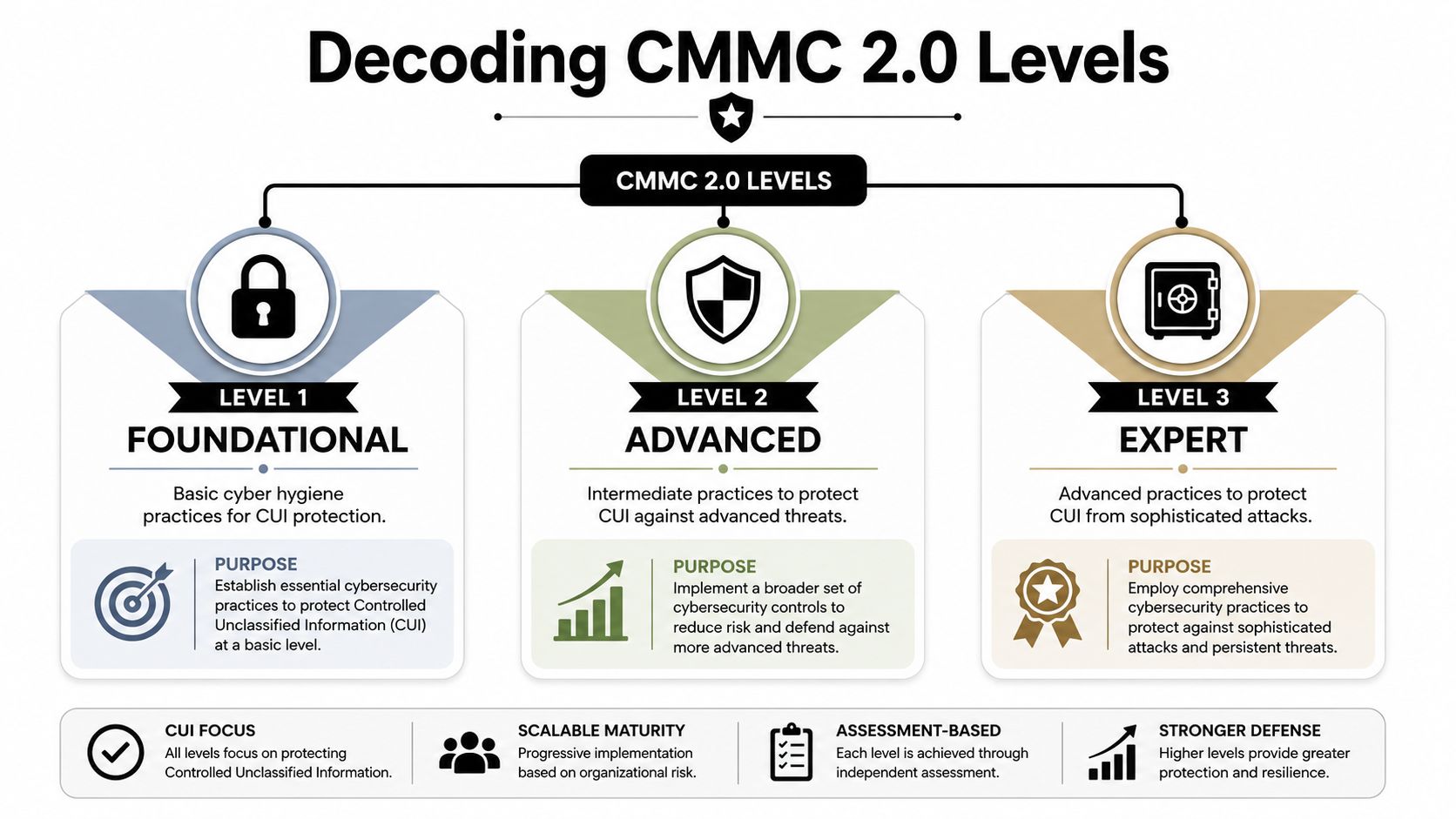
Which level applies to you
At an operational level, the decision begins with data type.
- Level 1 applies to FCI and emphasizes core cybersecurity hygiene.
- Level 2 applies to CUI and it is the point at which most defense contractors face the major requirements of CMMC compliance.
- Level 3 applies to a narrower group operating in higher-risk environments that demand stronger defenses against advanced threats.
The largest error here is assuming the level is merely a label. It is not. The level shapes system scope, documentation depth, assessment method, and the volume of evidence your team must produce upon request.
For Level 2, the mandate is quite precise. CMMC 2.0 Level 2 mandates exactly 110 security controls aligned with NIST SP 800-171 Revision 2, and it requires a triennial independent assessment by an authorized C3PAO, with interim self-assessments registered in SPRS, as outlined in this CMMC compliance reference.
CMMC 2.0 levels at a glance
| Attribute | Level 1 (Foundational) | Level 2 (Advanced) | Level 3 (Expert) |
|---|---|---|---|
| Primary information type | FCI | CUI | Higher sensitivity CUI environments |
| Core purpose | Basic cyber hygiene | Protection aligned to NIST SP 800-171 | Added protection against advanced threats |
| Required practices | 17 foundational controls | 110 controls | Level 2 plus advanced controls from NIST SP 800-172 |
| Assessment model | Self-assessment | C3PAO assessment every three years, with interim self-assessments in SPRS | Government-led assessment |
| Operational burden | Lower | High evidence burden and ongoing maintenance | Highest evidentiary and technical rigor |
That table is helpful, but operations leaders need the plain-language explanation. Level 1 is generally manageable through disciplined administration. Level 2 demands a genuine compliance program. Level 3 calls for mature defensive operations and ongoing proof that controls work under pressure.
Contractors often fail in planning because they ask, “What level do we need?” before asking, “Where does FCI or CUI actually flow?”
Another trade-off is important here. A narrow, well-designed CUI enclave can make Level 2 attainable. A loosely defined enterprise-wide scope can turn the same requirement into an extensive remediation effort. The level gives you the rule set. Your architecture determines how burdensome compliance becomes.
For most organizations, the practical focal point is Level 2. That is where security architecture, documentation discipline, and evidence handling all converge. If you grasp how Level 2 operates in practice, the rest of the framework becomes much easier to grasp.
The Central Role of NIST SP 800-171 in CMMC
When contractors ask what Level 2 actually is, the briefest useful answer is this: it is the required implementation and proof of the NIST SP 800-171 control set for systems within scope for CUI.
What Level 2 actually means operationally
That is important because many organizations already recognize the control families in theory. The difficulty begins when theory must survive assessment.
Take a few examples:
- Access control means far more than user accounts and password policies. Teams must demonstrate that access is limited, justified, and enforced in the systems that count.
- Audit and accountability means logs are not simply collected. They must be retained, reviewable, and connected to meaningful user and system activity.
- Incident response means the organization can show how it identifies, escalates, records, and manages security incidents impacting assets within scope.
- Configuration and change management means authorized baselines, monitored changes, and proof that control configurations align with policy requirements.
Compliance initiatives often expose their weak points. Policy states one thing. The endpoint agent is not installed everywhere. Log sources are uneven. Shared admin accounts remain in place. The SSP describes a neat boundary, while the real data flow is chaotic.
A capable assessor can quickly determine whether a team actually operates its controls or simply documents them.
The strongest defense is to regard each control family as policy, technical enforcement, and evidence production combined. If any element is absent, weakness exists even when the remaining two appear polished.
What changes when organizations move toward Level 3
Level 3 sets the bar even higher. Contractors must reach Level 2 and implement advanced controls from NIST SP 800-172 intended to protect against advanced persistent threats. As noted earlier in DoD program materials, only DIBCAC conducts those assessments.
From an operational view, that shifts the discussion. Level 2 often centers on proving disciplined implementation. Level 3 centers on proving greater resilience, deeper detection, and a more active defensive stance.
That is the reason teams should not view CMMC as disconnected from security operations. As your monitoring, alerting, endpoint visibility, and response workflow grow more mature, proving to assessors that the control environment is active becomes simpler. When the environment relies on manual screenshots, ad hoc exports, and staff memory, the audit becomes harder quickly.
Mastering Evidence and Documentation Requirements
Organizations devote too many hours to asking if a control is present and too few to asking if they can prove it under scrutiny. In CMMC, proof prevails.

Your SSP defines the audit boundary
Every assessment depends on the System Security Plan, a process through which many programs either secure scope control or surrender it. According to this CMMC Q&A reference on SSP scoping, every CMMC 2.0 assessment requires a precise SSP that records the exact flow of CUI, sets the assessment boundary, and serves as the main evidence artifact during the Examine, Interview, and Test phases.
Should the SSP be vague, the audit turns expensive and confusing. If it is inaccurate, the assessor will quickly find the gap. A robust SSP identifies where CUI enters, where it resides, who can access it, what systems support it, and which controls protect it.
That document also needs to stay current. Cloud services change. Shared responsibility models develop. New integrations arise. If your SSP continues to match last year's environment, it is not a compliance asset. It is a liability.
What assessors expect to examine
Assessors do not depend on a single evidence type. They seek consistency across multiple forms of proof, including:
- Policies and procedures that correspond with how the organization states controls should function.
- Configuration evidence including screenshots, exports, and system configurations that prove technical enforcement.
- Operational records encompassing logs, alert histories, tickets, and access reviews.
- People evidence gathered from interviews with administrators, compliance owners, and system users.
- Artifact control including approval histories, authorizations, and preserved versions. Organizations handling documentation workflows often find value in examining e-signature options for modern teams so approvals are simpler to verify and retain.
At this point, centralized telemetry is essential. When logs reside in disconnected tools, teams spend time manually gathering evidence and resolving mismatched timestamps. A centralized log management approach simplifies retaining evidence, correlating events, and generating more organized audit support.
Here's a useful reality check before assessment prep starts:
When a control owner must involve three separate admins and two exported spreadsheets to demonstrate a single requirement, the evidence process is not mature enough.
The video below serves as a useful companion for teams that must look past documentation and toward readiness in practice.
The strongest evidence programs avoid last-minute scrambling. They create current, organized, repeatable artifacts because compliance is integrated into operations, not attached after the fact.
Preparing for Your CMMC Assessment
A CMMC assessment seems less like a single audit and more like a stress test of whether your organization runs the security model it has documented.
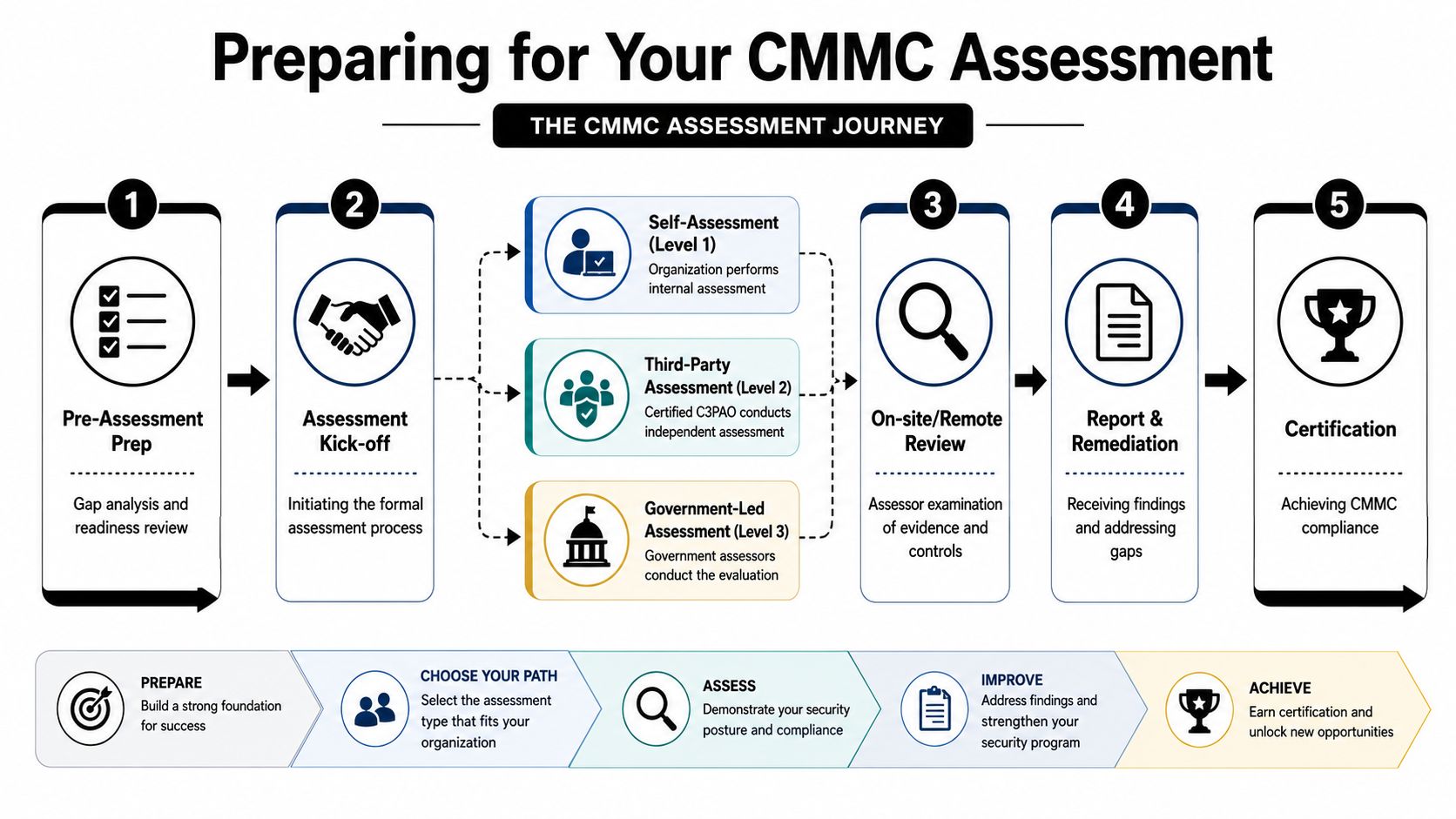
What the assessment experience feels like
The details vary by level. Level 1 depends on self-assessment. Level 2 requires the triennial third-party assessment mentioned earlier. Level 3 includes a government-led review. Yet for contractors, the experience shares common pressure points.
Assessors typically work through an Examine, Interview, and Test rhythm:
- Examine involves examining your SSP, policies, procedures, architecture records, and technical artifacts.
- Interview involves talking with the individuals who are expected to operate the controls. Poor ownership becomes evident quickly here.
- Test involves confirming that documented controls work within the operational environment.
That is why mock interviews have value. I have seen technically strong teams falter because the system owner, security lead, and compliance manager explained the same process in three different ways. Assessors spot inconsistency even when the control exists.
A readiness review centered on evidence walkthroughs often proves more valuable than another spreadsheet gap list. If your team needs structure for that preparation, a CMMC compliance checklist can help coordinate owners, artifacts, and validation tasks ahead of the formal assessment.
Why preparation has become a business issue
The resource commitment is tangible. Recent data reveals that only 8% of organizations have achieved certified CMMC Level 2 compliance, while 42% are “in progress,” and the DoD estimates the average cost for a Level 2 assessment and annual affirmation at approximately $104,670. Those numbers highlight how much remediation, coordination, and audit support the process requires.
That same data reveals something more significant than the figures alone. Many contractors already know they are not finished, and they are acting now. The real risk is not only failing an assessment. It is waiting too long to establish the operating model that supports one.
A practical prep sequence usually works better than a giant compliance launch:
- Start with scoping. Determine precisely which systems store, process, or transmit CUI.
- Validate owners. Each major control area requires a designated operator, not merely a policy approver.
- Run evidence drills. Request that teams provide evidence for specific controls with little notice.
- I have not received any text to edit. Please provide the content you wish to have rewritten. When policy, tooling, and actual practice do not align, the most painful findings result.
The contractors who remain composed during assessment week seldom have the best-looking documentation. They are the ones who have practiced the evidence process in advance.
Bridging Common Gaps with a Unified Security Platform
Most readiness efforts that fail do not fail because the organization is missing security tools. They fail because the tools do not create a consistent evidence trail.

Where teams usually break down
The recurring gaps are familiar:
- Fragmented logging leaves Audit and Accountability proof scattered among firewalls, cloud platforms, endpoints, and identity tools.
- Weak incident handling records make it difficult to prove that alerts resulted in documented action.
- Inconsistent endpoint visibility introduces doubt about malware protection, patch validation, and system state.
- Manual evidence collection turns every audit request into an isolated project.
- Stale access reviews weaken assertions regarding least privilege and user accountability.
These are not hypothetical problems. They emerge when assessors ask straightforward questions that ought to have straightforward answers. Who accessed the system? Where is the evidence? How long are logs kept? Show the alert, the ticket, and the remediation record.
The more closely your evidence aligns with routine security operations, the simpler CMMC becomes.
What a unified platform changes
An integrated SIEM, SOAR, and XDR strategy is beneficial because it places detection, response, and evidence creation within one operational workflow. Rather than assembling proof after an event, teams can gather, correlate, retain, and report through a shared system.
That's where a platform like Unified Security Stack for mastering CMMC compliance with a comprehensive and technical approach works as a practical choice. It unites log management, response orchestration, endpoint visibility, vulnerability scanning, and compliance mapping in one stack, which helps when CMMC compliance requirements require demonstrating both control enforcement and supporting evidence.
In practice, unified platforms help in a few concrete ways:
- For Audit and Accountability, centralized ingestion simplifies retention and retrieval of logs from endpoints, network devices, and cloud services.
- For Incident Response, automated playbooks produce a clearer record of who responded, what actions were taken, and when escalation happened.
- For Access Control, correlated identity and system events strengthen the defensibility of privilege reviews and anomaly investigations.
- For SSP support, compliance mapping and artifact collection lessen the manual effort required to assemble evidence from separate systems.
What does not work is purchasing a platform and believing the problem is solved. Tools help only when teams clearly define scope, ingest the right telemetry, assign control owners, and review evidence regularly. The tool should reinforce the program. It cannot replace the program.
Conclusion Building a Culture of Continuous Compliance
CMMC compliance requirements are operational needs. They shape architecture, access design, logging, incident response, documentation, and how teams demonstrate control performance over time.
Organizations that manage CMMC effectively do not view it as a paperwork exercise. They create an environment where routine security operations generate evidence, where the SSP remains aligned with the real boundary, and where control owners can explain and show what they do.
That represents a major shift. Passing an assessment is important, but maintaining a defensible security posture is more important. Contractors that make this transition are better positioned for audits, contract eligibility, and daily protection of sensitive government information.
If your team is trying to move from scattered logs and spreadsheet-driven audits to a more defensible continuous-compliance model, Unified Security Stack deserves evaluation. It unites SIEM, SOAR, XDR, and compliance workflows so security teams can produce evidence during daily operations rather than recreating it ahead of each assessment.