Flawless Network Security Audit: 2026 Unified Security Stack Guide
Right now, you likely fall into one of two categories. An external auditor is already booked, and your team is scrambling to demonstrate that controls exist; or you have inherited a security program that appears mature in a slide deck yet breaks down when evidence is requested.
That's where a network security audit Often, it goes wrong. Teams run it as a project with a beginning and an end, yet it functions better as a validation cycle. Its real purpose is not to generate a lengthy report. It is to demonstrate that the network, identities, logs, configurations, and response controls can withstand examination.
A strong audit ought to give you three outcomes. A scope you can defend. Evidence you can rely on. A remediation plan your operators can carry out without making the effort a quarterly emergency.
Table of Contents
- Defining Your Audit Scope and Objectives
- Automating Asset Discovery and Network Mapping
- Establishing an Audit-Ready Data Collection Strategy
- Executing Vulnerability Scans and Configuration Reviews
- Auditing Access Controls and Detection Effectiveness
- Generating Compliance-Mapped Reports for Auditors
- From Periodic Audits to Continuous Assurance
Defining Your Audit Scope and Objectives
Bad scoping is the starting point for most audits that fail. Some teams pull in every network, every cloud account, every subsidiary, and every legacy application because they believe a broad scope appears mature. Others narrow scope so much that the audit is technically clean but strategically pointless.
A stronger place to begin is financial and operational exposure. SentinelOne points out that the average cost of a data breach has reached $4.88 million in 2024 in its summary of industry data, which is why organizations use audits to verify access controls, firewall rules, vulnerability management, and compliance readiness before incidents escalate (SentinelOne network security audit overview). That figure matters because scope is not an IT exercise. It is a business choice about what failure would cost.
Start with business exposure, not device count
Set the scope around systems whose compromise or unavailability would cause the greatest harm. That typically includes a combination of:
- Revenue-critical paths such as customer portals, payment flows, partner connectivity, and remote access infrastructure
- Regulated data zones where HIPAA, GDPR, PCI, or contractual controls require evidence
- Privilege concentration points such as identity providers, VPN concentrators, jump hosts, directory services, and firewall management planes
- Operational choke points including core switches, internet edges, cloud security groups, DNS services, and logging infrastructure
That moves you beyond a lazy all-production-assets claim and toward a scope an auditor can actually test.
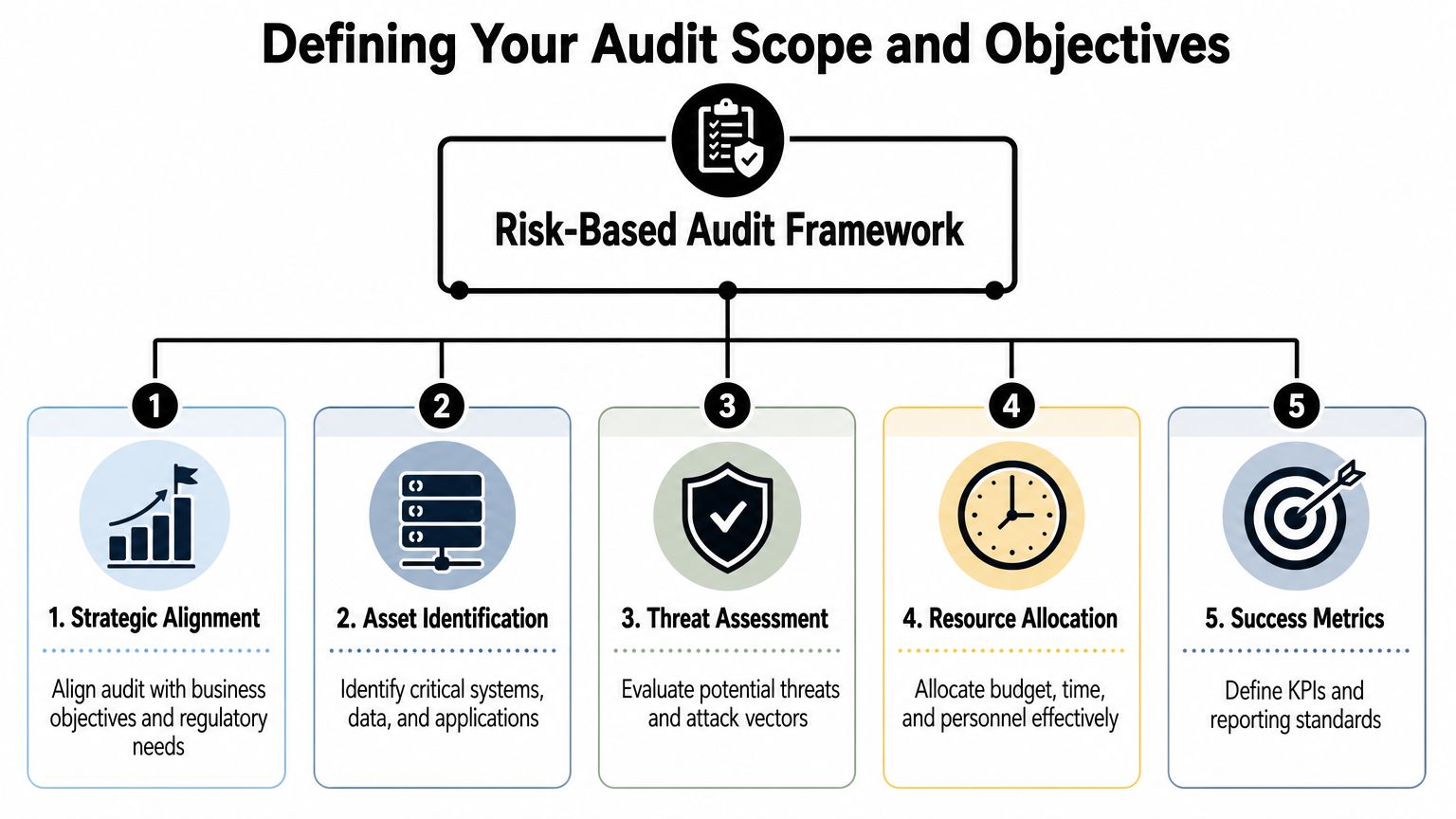
A simple scope statement should answer five questions:
- What environments are in scope. On-prem, cloud, branch locations, remote workforce, third-party connections.
- What data types are in scope. Customer records, employee information, payment data, clinical data, intellectual property.
- Which controls are being validated. Segmentation, access control, monitoring, logging, patching, backup and recovery.
- What's excluded. Be explicit. Documented exclusions can be managed. Concealed exclusions turn into audit findings.
- What evidence will prove success. Configuration exports, log samples, rule reviews, scan results, access reviews, remediation tickets.
Practical rule: If the scope cannot be captured in a one-page control narrative, it is likely too broad to audit effectively.
Build a scope that an auditor can defend
New CISOs frequently wonder whether scope should follow a framework or the network diagram. It should follow both, in that sequence. Begin with the compliance or risk driver, then map it to the environments and controls that support it. If you are getting ready for a regulated assessment, define the control families first and then identify the network components that deliver those controls.
This is also where comparing your thinking against a field guide written for actual operators, not only compliance teams, helps. The Splash Access guide on network security is useful because it anchors audit planning in practical review areas instead of abstract policy language.
A strong objective statement sounds like this:
| Objective type | Weak version | Strong version |
|---|---|---|
| Compliance | Review network security | Validate that network segmentation, logging, and access control evidence supports the applicable framework |
| Risk reduction | Check vulnerabilities | Confirm that exploitable weaknesses on critical network paths are identified, prioritized, fixed, and retested |
| Operations | Assess monitoring | Verify that security events from key network and identity systems are collected, correlated, retained, and reviewable |
That is the difference between conducting an audit and building one that withstands questions.
Automating Asset Discovery and Network Mapping
If your inventory sits in a spreadsheet, your audit already contains blind spots. The spreadsheet may still serve ownership and finance, but it is not a reliable source for security validation. Devices are rebuilt. Cloud workloads appear and vanish. Contractors introduce unmanaged endpoints. Teams create temporary tunnels and neglect to close them.
Hamilton Barnes reports that only 52% of organizations conduct regular network security audits, while 19% never conduct them, and notes that Canadian guidance treats regular device inventory as a core audit discipline (Hamilton Barnes on network security audits). Inventory quality is where the maturity gap appears first.
Why static inventories fail
A static inventory answers “what did we know existed when someone last updated the file?” An audit needs to answer different questions:
- What is connected now
- What moved recently
- Which assets communicate with sensitive systems
- Which systems generate security evidence
- Which assets have no clear owner
That is why discovery must be continuous. Gather asset data from network devices, virtualization platforms, cloud APIs, endpoint agents, directory services, DHCP, and existing CMDB records. Then reconcile duplicates and tag each asset with enough context to support audit decisions.
The inventory isn't complete until each asset has, at minimum:
- Business context tied to function or service
- Technical context such as operating environment, platform type, and network role
- Security context including logging status, vulnerability status, and control coverage
- Ownership context showing who approves changes and who remediates findings
For teams trying to get that under control, an asset management view built for security operations provides more benefit than a static database by tying inventory to live evidence.
What a usable network map includes
An audit-oriented network map must do more than sketch boxes and lines. It needs to expose trust boundaries and evidence paths. The aim is to pinpoint where an audit may break down because a control sits in one location while its proof resides in another.
Use this checklist when mapping:
- North-south paths for internet-facing access, partner links, VPNs, and remote administration
- East-west paths between application tiers, management networks, and shared services
- Security control points such as firewalls, IDS, proxies, NAC, identity providers, and DNS
- Data-producing nodes that should emit logs, flow data, and endpoint telemetry
- Third-party dependencies where a provider hosts systems or processes traffic that affects your evidence chain
In an audit, the most valuable network map instantly exposes what you cannot see today.
A single practical test is always effective. Choose a sensitive application and follow the path from user authentication through application access to administrative management. If your team cannot chart that route, name the devices in it, and list the logging sources that confirm each control functioned, the audit still rests on assumptions.
Establishing an Audit-Ready Data Collection Strategy
Many organizations believe their issue is logging when it is actually evidence. The logs are there. The problem is that they are partial, poorly parsed, misaligned, or cannot be retrieved in a manner an auditor would accept.
Deepstrike identifies scope failure, inventory failure, identity failure, testing failure, evidence failure, and third-party failure as the most common audit-failure buckets, with weak logging and incomplete evidence repeatedly called out as leading causes (Deepstrike compliance statistics and audit failure patterns). When evidence fails, many technically capable teams lose credibility.
What makes evidence usable
Evidence ready for audit carries four qualities. It must be complete, aligned in time, attributable, and retained so that it can be reviewed.
That requires more than sending Syslog onward. You must check whether firewall logs keep action fields, whether endpoint events preserve user context, whether cloud audit records arrive reliably, and whether parsing converts raw events into searchable fields. If your platform holds events yet your analysts still read raw text to answer simple questions, the data pipeline is not mature enough for audit work.
A strong collection strategy should cover:
- Event source validation so you know which systems are expected to send data and which aren't
- Timestamp integrity across network devices, servers, endpoints, cloud services, and security tools
- Field normalization for usernames, hostnames, rule actions, severity, and asset identifiers
- Retention discipline that matches your internal requirements and any applicable framework obligations
- Searchability so an auditor can ask for a control and get evidence, not a promise to circle back later
How to validate collection before the audit
Do not wait until the audit meeting to learn that a parser failed three months ago. First, run a collection validation exercise. Select a representative set of core sources, including edge firewalls, identity systems, VPN, critical servers, EDR, and cloud control planes. Verify that they send logs, that parsing functions, and that the data can support an investigation timeline.
A good validation pass usually includes:
| Check | What to verify | Failure signal |
|---|---|---|
| Source presence | Expected systems are reporting | A critical source is missing entirely |
| Time accuracy | Event order is reliable across sources | Timestamps don't align during a known activity |
| Parsing quality | Key fields are extracted consistently | Analysts must search raw message text |
| Retention access | Older evidence is retrievable | Historical events exist but can't be queried quickly |
If your team needs a centralized place to bring these sources together, a centralized log management workflow for hybrid environments is useful because it narrows the gap between collection and proof. But the tool is only part of the answer. Operating discipline matters more.
Poor evidence consumes more audit time than absent evidence, since it leads everyone down the wrong path first.
The audit standard ought to be straightforward. If an operator cannot rebuild who accessed what, by which path, at what time, and whether the control produced a record, that source is not yet audit-ready.
Executing Vulnerability Scans and Configuration Reviews
Scanning uncovers what is known. Configuration review uncovers what is risky. You need both, and they must run on separate tracks because each answers a different question.
Scanners excel at finding exposed flaws, absent patches, aging software, and familiar misconfigurations. They cannot tell you whether a permissive firewall object, an inherited cloud security group, or an outdated admin rule opens a realistic attack path. That second judgment still requires human review.
Run scanning and review as separate tracks
Begin with wide vulnerability coverage across servers, endpoints, appliances, network devices, and cloud workloads. Label assets by business criticality before scanning, not afterward. Otherwise the findings become a technical backlog rather than a remediation plan ranked by risk.
Then run a separate configuration review on the systems that shape trust and traffic:
- Firewalls and security groups for broad allow rules, stale objects, risky administrative exposure, and rule conflicts
- Routers and switches for management plane exposure, unused services, and segmentation drift
- IDS and network security controls for disabled inspection, bypass conditions, and alert gaps
- Remote access systems for weak policy enforcement, overbroad access, and poor session visibility
A platform that supports automated vulnerability scanning with operational context can help reduce noise, but do not let scan results take the place of review discipline. In mature environments, the largest problems often stem from logic errors, not missing signatures.
Prioritize findings by operational risk
Do not rank every finding solely by scanner severity. A medium-rated issue on a domain-adjacent admin host may be more urgent than a high-rated issue on an isolated test box. The most important factors are exploit path, asset role, privilege adjacency, and exposure.
Use a triage model like this:
- Fix first. Internet-facing assets, identity infrastructure, remote access, management interfaces, and any item on a sensitive data path.
- Fix next. Internal systems that connect segments or provide shared services.
- Schedule with compensating controls. Lower-exposure assets where existing controls already lower the chance of exploitation.
At a later stage of the cycle, include a remediation retest. If fixes go unverified, they turn into repeat findings, and those repeat findings persuade auditors that the process is merely ceremonial.
This brief demonstration serves as a helpful reminder: scanners ought to support an operational workflow rather than only producing reports.
A practical network security audit does not reward teams for uncovering the largest number of problems. It rewards teams able to demonstrate they identified the correct issues, remediated the most important ones first, and confirmed those fixes under production conditions.
Auditing Access Controls and Detection Effectiveness
Even a fully patched network can remain easy to exploit when privilege management is careless and detection is inadequate. That is why access review and detection review should be part of the same audit movement. One shows who can cause harm. The other shows whether you would detect it.
A peer-reviewed study on cybersecurity audit effectiveness reported that 70% of organizations with audit programs did not have any successful cyber-security attacks, while 45 organizations continued to report successful attacks, indicating that audits lower but do not remove compromise risk (ScienceDirect study on cybersecurity audit effectiveness). That is the proper mindset for this section of the audit. Controls may exist and still break down under actual abuse.
Review privilege where misuse would hurt most
Begin with privileged access rather than general user access. Examine the accounts and roles capable of modifying firewalls, identity policy, segmentation, logging, endpoint configuration, and cloud networking. Those permissions can both make an incident possible and conceal it.
Look for these patterns:
- Inherited admin access that no one revalidated after role changes
- Shared privileged accounts that break attribution
- Service accounts with broad permissions and weak oversight
- Emergency access paths that exist permanently instead of only when needed
- Third-party admin access with unclear boundaries and poor review cadence
One helpful test is to choose a critical system and quickly answer three questions. Who can administer it, who authorized that access, and what evidence would reveal misuse? If those answers reside in different tools and no one has reconciled them, the control is not yet strong enough.
Test whether detection can see abuse
Identity review alone, without detection testing, provides only half the picture. The audit should also verify whether misuse of valid access would produce reviewable signals.
That means evaluating whether your monitoring can detect:
| Abuse pattern | Evidence you should have |
|---|---|
| Privileged login outside normal process | Authentication records tied to user, device, and outcome |
| Admin rule changes on firewalls or security groups | Configuration change logs with actor and timestamp |
| Lateral movement from management zones | Network and endpoint telemetry that links source and destination |
| Disabled or altered logging | Events that show the action and the account behind it |
Access review demonstrates authorization on paper. Detection review demonstrates that you can catch misuse in practice.
In these audits, teams frequently find that their SIEM content is noisy yet shallow. They receive numerous alerts, but the rules are not tuned to actual control abuse. When your analysts repeatedly close the same benign events, the audit should classify that as a detection quality problem, not an analyst problem.
The target standard is straightforward. A privileged action on a critical network path should be traceable to a person, subject to review, and hard to conceal.
Generating Compliance-Mapped Reports for Auditors
People often underestimate how much the final report matters. Not because presentation outranks substance, but because substance without structure causes friction. An auditor does not want a heap of screenshots, exports, and scanner output. They want a coherent record linking scope, testing, findings, evidence, and remediation to specific controls.
Newer guidance stresses real-time monitoring, scalable reporting, automation, and compliance workflows, since organizations continue to struggle with separating meaningful risk from noise. It further contends that a successful audit reliably prioritizes what can be fixed and verified at scale (Sprinto guidance on network security audits). Strong reporting does precisely that.
Why raw findings don't satisfy auditors
A raw vulnerability report only shows an auditor that a tool executed. It does not show whether the finding is significant, whether it corresponds to a control obligation, whether remediation was validated, or whether management accepted the residual risk.
The report has to do four jobs at once:
- Explain the business impact so leadership understands why the finding exists in the report
- Prove the technical condition with evidence that another reviewer can inspect
- Map the condition to a control so compliance stakeholders can act on it
- Document remediation status so the issue can be tracked beyond the audit window
This is why spreadsheets break down under pressure. They split the finding from the evidence, the evidence from the owner, and the owner from the framework requirement.
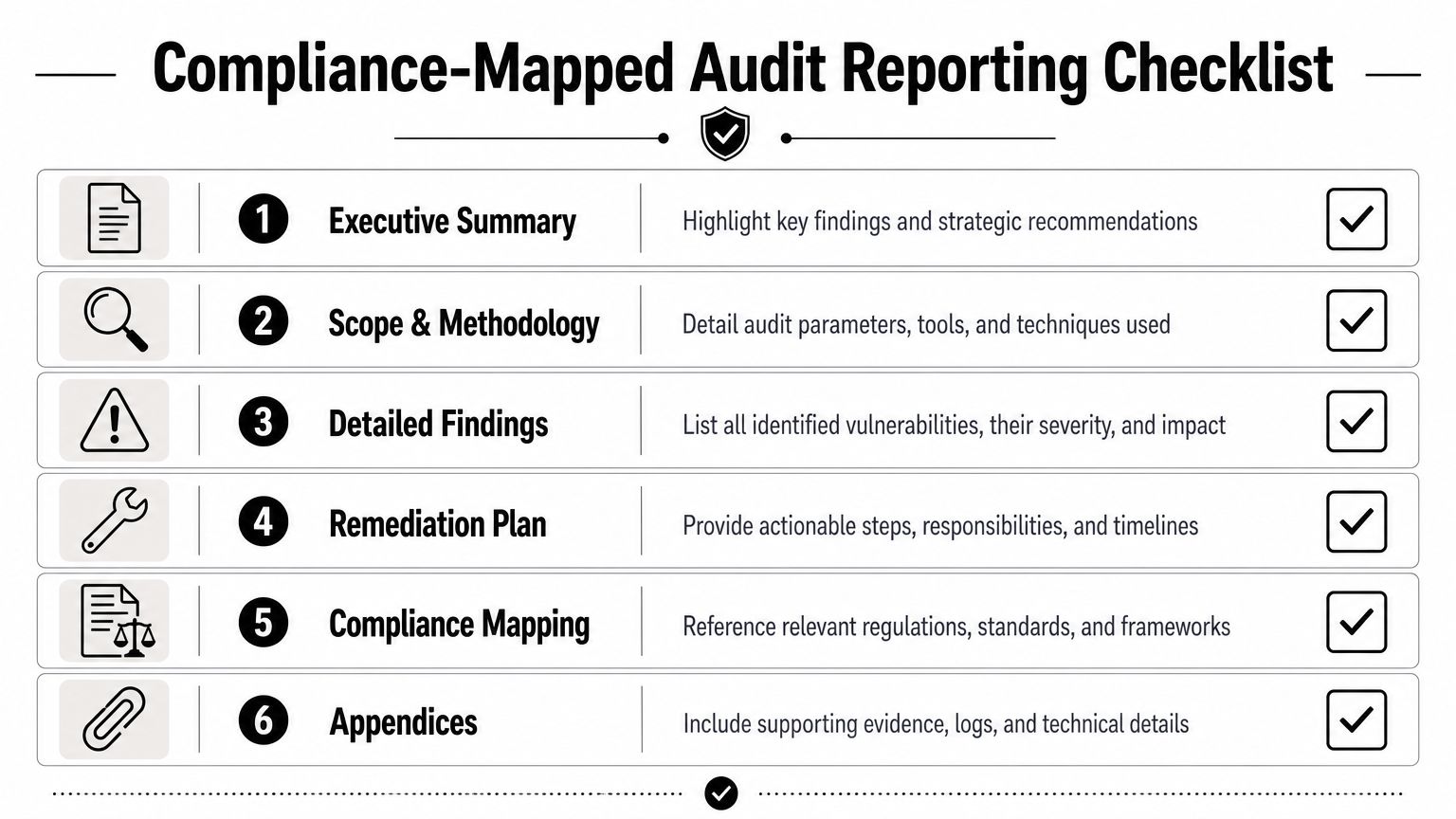
What a strong audit report contains
A report that works for both auditors and operators usually has these parts:
Executive summary
Keep it brief. State what was tested, what failed, what poses the greatest operational risk, and what leadership must fund or enforce.
Scope and methodology
Record environments, dates, evidence sources, testing methods, exclusions, and any assumptions. This kind of documentation helps settle many audit disputes before they arise.
Detailed findings
Each finding should include:
- Condition with clear technical description
- Risk statement tied to an attack path or control weakness
- Evidence references such as config output, log excerpts, screenshots, or test records
- Control mapping to the relevant requirement set
- Owner and remediation status so it's actionable
Remediation record
Do not stop at recommended action. Include target state, owner, dependency, and retest expectation. If a finding cannot be fixed right away, document the compensating control or risk acceptance decision.
“If the finding can't be traced to evidence and a named owner, it isn't ready for the final report.”
One format that works well is a compact mapping table:
| Finding | Evidence | Control mapping | Owner | Status |
|---|---|---|---|---|
| Overbroad firewall access | Rule export and change history | Relevant network access control requirement | Network security team | In remediation |
| Missing log coverage on critical segment | Collector validation records | Relevant logging and monitoring requirement | Security operations | Validation pending |
| Excess privilege on admin group | Access review output | Relevant least-privilege requirement | Identity team | Awaiting approval |
The best reports also maintain chain of custody for evidence. Store exports in an organized repository, name them consistently, and note when they were collected. Auditors trust process. Poor evidence handling makes even strong technical work appear weak.
From Periodic Audits to Continuous Assurance
The most polished audit programs stop treating the audit as a recurring emergency. They use it as a forcing function to embed recurring control validation into operations. That transforms the entire experience. Rather than assembling evidence from scratch every cycle, the team continuously maintains proof that controls are present, monitored, and reviewed.
This shift begins with a single premise. Whatever you validate by hand this quarter ought to be a candidate for automation or scheduled verification the following quarter. If a firewall rule review uncovered stale access, make it a recurring review job. If a logging check found missing telemetry, build alerts for source dropout. If a privileged account review surfaced old entitlements, put attestation and exception handling on a schedule.
Turn findings into recurring control checks
The strongest continuous assurance programs convert audit themes into operational checks:
- Scope drift checks so new network segments, cloud projects, or remote access paths don't appear without governance
- Inventory drift checks that flag unmanaged or unowned assets
- Evidence health checks for missing logs, parser failures, or retention gaps
- Configuration drift checks for sensitive network and identity controls
- Remediation verification checks that confirm a fix stayed fixed after deployment changes
SOAR also justifies its place here. When the audit identifies recurring failure patterns, containment and response ought to become partly automated. Suspicious admin activity can set off enrichment. Absent telemetry can create an operational task. High-risk findings can move workflow forward rather than wait for the next meeting.
Build the next audit before this one ends
A mature network security audit program evaluates closure quality, not merely finding volume. The questions that matter are operational. Did the owner resolve the issue. Did anyone retest it. Did the control become simpler to prove afterward. Did the evidence path get better.
This is why the audit should finish with a control register, not merely a report archive. Each major finding should enter a queue with an owner, due state, validation method, and proof requirement. The next audit then becomes easier since the evidence standard was set during remediation, not created afterward.
The pattern that works looks like this:
- Audit the current state with clear boundaries and proof criteria.
- Translate findings into repeatable checks managed by operational teams.
- Automate collection and validation wherever identical evidence is repeatedly requested.
- Retest closed findings and route those results back into reporting.
- Preserve compliance mapping so control owners do not need to reconstruct context every cycle.
Once that loop is in place, the annual audit no longer feels like a special event. It becomes a review of a system that has already been proving itself.
If you want to turn your network security audit process into continuous validation, Unified Security Stack deserves a close review. It brings SIEM, SOAR, XDR, vulnerability management, log collection, access auditing, and compliance workflows onto one platform, which makes it easier to keep evidence, detection, and remediation connected rather than scattered across disconnected tools.